2027 Online BA in Psychology - General Psychology After an AAS in Rehabilitation Services: Compare Transfer Credit and Remaining Coursework
Audited and Verified:
Our Editorial and Data Verification Process
Research.com uses government datasets, official education statistics and primary institutional information to support its career and degree guides. Our review process checks factual accuracy, occupational definitions, source dates and the requirements associated with the credentials discussed.
How This Article Was Fact-Checked
Our editorial team verifies salary estimates, employment projections, education requirements and program information against original data providers and official organizations. Salary figures are checked against the relevant occupational definitions and reporting periods. Information about licensure, accreditation and required in-person training is reviewed separately.
Fact-checked and verified on:

Co-Founder and Chief Data Scientist
An AAS in rehabilitation services can give you a useful foundation for a general psychology BA, but a school may accept your courses without applying all of them to graduation requirements. That distinction can change your remaining coursework, cost, and completion date. This guide is for AAS graduates comparing online psychology programs. It shows how to read a transfer evaluation, identify likely curriculum gaps, and request the degree audit you need before committing to a school.
Key Things You Should Know
- Compare three figures for each school: credits accepted, requirements satisfied, and credits still needed for graduation. They are not interchangeable.
- Rehabilitation-services courses may fit electives or applied requirements, while statistics, research methods, upper-division psychology, and general education may remain.
- A completion estimate is dependable only after a school reviews your transcript, course equivalencies, residency rules, and the availability of remaining courses.
How many AAS credits transfer into an online BA in general psychology?
There is no reliable AAS-to-BA credit total that applies across schools. An associate of applied science is often designed around occupational coursework, while a BA also requires general education and a psychology major. A university may accept a rehabilitation course as elective credit but still require you to take a different course to satisfy a specific psychology requirement.
A transfer evaluation has three distinct outcomes. Accepted credits enter your university record; applied credits satisfy identified degree requirements; and remaining credits account for everything you must still complete, including any upper-division or university-residency requirements. An AAS awarded as a credential does not necessarily waive the BA's general education requirements.
For a meaningful comparison, send each prospective school your official transcript and, where equivalencies are unclear, syllabi for rehabilitation, statistics, and psychology courses. Ask the registrar or transfer-credit office for equivalencies and the psychology department for decisions about major substitutions. Then request a degree audit showing where every accepted course lands.
If an evaluation lists a relevant course only as a general elective, ask about the school's documented appeal process before enrolling.
Be particularly cautious with programs advertising speed. A guide to accelerated undergraduate forensic psychology study can provide a comparison point, but an advertised timeline cannot establish how your AAS will apply to a general psychology BA.
What courses remain after transferring an AAS in rehabilitation services?
Your remaining courses depend less on the number of credits printed on the AAS transcript than on the requirements they satisfy. Rehabilitation coursework may support disability-services or human-services electives, while courses in counseling techniques or assessment may not replace a psychology department's research-based core.
The following comparison shows where an AAS graduate commonly needs a closer review; it is not a substitute for a school-issued degree audit.
| BA requirement area | Possible AAS contribution | What to verify |
| General education | Writing, mathematics, social science, or natural science | Whether each course meets the receiving school's specific category |
| Psychology foundations | Introductory psychology or lifespan development | Course equivalency and any minimum-grade rule |
| Statistics and research methods | Statistics, if taken; applied documentation coursework is usually different | Required mathematical content, psychology-specific methods, and prerequisite order |
| Upper-division major courses | Usually limited if AAS courses are lower division | Minimum upper-division psychology credits and residency rules |
| Open or applied electives | Rehabilitation practice, disability services, and related support courses | Elective limits and whether credits would duplicate other coursework |
If you want to retain a rehabilitation or recovery-services emphasis, compare available electives rather than assuming "general psychology" includes that focus. Online undergraduate addiction psychology program comparisons may help you weigh a specialized alternative, but addiction-related coursework does not itself confer a counseling credential.
What are the admission requirements for an online psychology bachelor's degree?
Most transfer applications call for prior college transcripts and evidence that you meet the university's academic standards. Schools differ on minimum grades, transferable-credit thresholds, deadlines, and whether applicants must apply separately to the psychology major. An AAS in rehabilitation services does not inherently prevent admission, but admission alone does not confirm how its credits will satisfy the BA.
Before applying, distinguish the decisions made by admissions, the transfer-credit office, and the psychology department. Ask whether a preliminary transcript review is available before a deposit is due, when the official audit becomes binding under school policy, and whether you may appeal a course equivalency. Keep course descriptions and syllabi from your AAS, particularly for statistics, development, and any research-related coursework.
Some comparison resources cover several distinct questions at once, including online forensic psychology tuition, admissions, and outcomes. Use another major's admissions information only as a prompt for questions; obtain the requirements for the specific general psychology BA and entry term you intend to pursue.
Delivery format does not change the central transfer question: either program can leave you with unmet major, general education, or residency requirements. Online study can reduce commuting, but it may include scheduled class meetings, timed assessments, group work, campus visits, or locally arranged experiences. Campus study may offer easier access to laboratories, faculty, and student organizations, although those opportunities still require time in your schedule.
For an AAS graduate who is already working in rehabilitation services, the most useful comparison is practical: can you take the courses that remain, in the required order, without leaving work or repeating credits? Ask how often upper-division psychology and methods courses run online, whether research participation can be completed remotely, and whether any internship is required rather than optional.
When choosing an online psychology program, compare the actual course schedule and degree audit alongside the format. "Online" describes delivery, not a promise of asynchronous study or faster graduation.
A general psychology BA usually develops breadth in psychological science rather than training for one clinical job. Depending on the school, its major may include introductory psychology, statistics, research methods, developmental and social psychology, biological or cognitive psychology, and a senior seminar or capstone. General education and electives sit alongside the major; the exact mix is institution-specific.
For rehabilitation-services graduates, statistics and research methods deserve early attention. Experience recording service outcomes or working with clients is valuable, but it may not cover research design, data analysis, or evaluating evidence at the depth the psychology major requires. Check whether methods has a statistics prerequisite and whether a transferred course is approved as an equivalent - not merely listed as elective credit.
If you may pursue graduate study, use electives and projects to fill the prerequisites of the programs you are considering. For example, forensic psychology master's completion time comparisons concern a later degree, not a reason to skip undergraduate methods preparation or assume that every master's program has identical entry requirements.
Completion time depends on the approved degree audit, how many remaining courses you can take each term, prerequisite sequencing, and how often required courses are offered. Count requirements rather than subtracting the AAS's total credits from the BA's published total: an accepted elective cannot replace an unmet statistics course or upper-division psychology requirement.
Ask an advisor for a term-by-term plan using your evaluated transcript. The plan should identify prerequisite bottlenecks, any courses offered only in certain terms, the school's residency requirement, and a pace you can sustain alongside work. If your employer offers education assistance, check whether its reimbursement rules affect your enrollment pace.
An accelerated graduate program is a separate decision after the BA. Resources on accelerated psychology master's study for working adults should not be used to estimate undergraduate completion time.
The relevant cost is the price of your remaining degree plan, not the school's advertised tuition rate alone. Compare tuition for the credits you must take with mandatory online or technology fees, books and software, and any travel or placement expenses. A school with a lower per-credit rate may cost more overall if fewer AAS courses satisfy its BA requirements.
Request an itemized estimate based on your degree audit, including any difference between part-time and full-time enrollment. Ask the financial-aid office how your planned course load, previously attempted credits, and satisfactory academic progress affect aid eligibility; ask your employer separately about reimbursement. The online psychology tuition comparison guide can help identify schools to investigate, but only a school-specific estimate can reflect your transfer outcome.
Check that the university holds recognized institutional accreditation and that it applies to the institution awarding the degree. Verify the status and any relevant dates through the accreditor and the U.S. Department of Education's accreditation records. Institutional accreditation matters for such decisions as credit recognition and eligibility for federal student aid, though another university still decides which credits it will accept.
Do not reject a general psychology BA because it lacks American Psychological Association program accreditation: APA accreditation does not cover general undergraduate psychology majors.
Professional-program recognition becomes a different question if you later consider a degree designed for counseling or another regulated profession. For instance, comparisons of accredited mental health counseling education by program pace address a distinct graduate pathway, not an accreditation requirement for this BA.
Your AAS experience may already support rehabilitation or human-services work. A BA can add research literacy, writing, and broader behavioral-science preparation for roles such as service coordinator, program assistant, or research-support employee, subject to each employer's requirements.
For an internal promotion, compare the job posting and your employer's degree policy before assuming a psychology BA is necessary; a different bachelor's major or targeted training may meet the goal more directly.
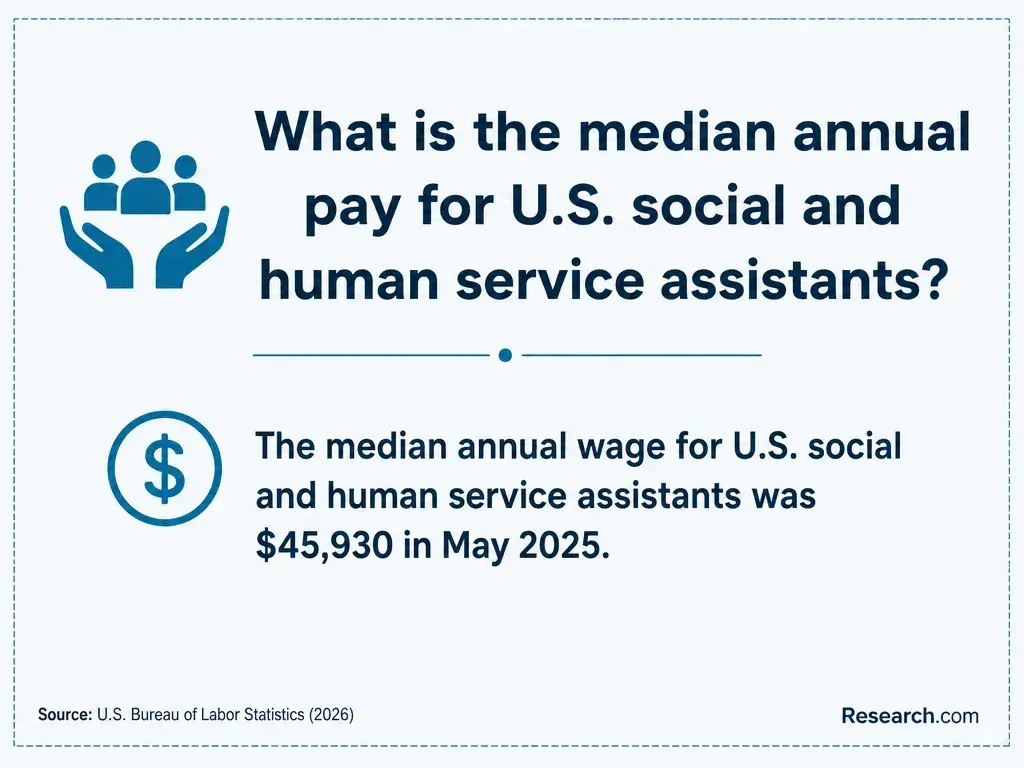
Salary comparisons require a specific occupation and location. The U.S. Bureau of Labor Statistics reports wages for occupations - not for everyone holding a psychology BA - and broad categories can mix workers with different credentials and experience. Compare the published wage information for your target occupation with local job postings and your current compensation rather than treating a degree as a salary increase.
The distinction becomes especially important when looking at earning potential after a master's in forensic psychology: pay associated with a different degree level or a licensed role is not a forecast for an AAS graduate finishing a general psychology BA.
Is a graduate degree or license required for psychology careers?
Many support, coordination, and research-assistant roles do not require a psychology license, although employers may require a bachelor's degree, experience, or a separate credential. A general psychology BA does not authorize psychotherapy, diagnosis, independent psychological assessment, or use of a protected professional title. Rehabilitation-services experience does not change those boundaries.
If your goal is licensed counseling, social work, or psychology practice, identify the exact occupation and state before choosing further education. Those paths have different qualifying degrees, supervised-experience rules, and licensing requirements; a general psychology master's is not automatically a substitute. Consider the total education and supervision commitment, not just the next program's advertised length.
A guide to financial planning for accredited counseling degrees may be relevant if counseling - not nonclinical rehabilitation support - is your intended destination.
Other Things You Should Know About Psychology
Usually, you can describe the skills and methods you used. Obtain permission before sharing agency materials, and remove client-identifying or restricted information. Do not present an agency project as independently approved psychological research.
Only if the BA program permits it and approves the role, learning objectives, and supervision. Employment and academic internship credit are separate decisions.
Compare the two schools' actual audits. A BA and BS can differ in science, mathematics, language, and elective requirements; the label alone does not show which uses more of your AAS coursework.
First confirm your employer's requirement and any applicable state credential rules. Targeted training or an approved certification may be more direct if a bachelor's degree is not required for your goal.
- School-Determined Requirements | 2024-2025 Federal Student Aid Handbook https://fsapartners.ed.gov/knowledge-center/fsa-handbook/2024-2025/vol1/ch1-school-determined-requirements
- Articulation - Office of the Registrar - The University of Utah https://registrar.utah.edu/transferarticulation/
- Transfer Evaluation Processes - Office of the Registrar | Coles College of Business https://campus.kennesaw.edu/current-students/registrar/transfer/transfer-evaluation-processes.php
- Transfer Credit Evaluation - TXST Admissions https://www.admissions.txst.edu/future-students/transfer-credit-evaluation.html
- Does an AAS Degree Transfer to a Bachelor's? | Marshall University https://www.marshall.edu/blog/aas-to-bachelors-transfer/
- Bachelor of Arts in Psychology - Online Program | CSULB CPaCE https://www.cpace.csulb.edu/courses/bachelor-of-arts-in-psychology
- General Education | harford.edu https://catalog.harford.edu/general-education/
- Policies and Forms | Department of Psychological Sciences | UC Template 2014 https://psychology.uconn.edu/undergraduate/policies-and-forms/
- Degree Audit and Transfer Credit - Registration and Records https://registrar.ncsu.edu/operations/degree-audit-and-transfer-credit/
- Online Psychology Bachelor's Degree | University of West Florida https://uwf.edu/programs/online/psychology-ba/