
2027 Easiest Online College Degrees and Majors

Co-Founder and Chief Data Scientist
Choosing an “easy” online degree is not about finding a program with no work. It is about finding a degree that fits your strengths, schedule, budget, and career goals without creating unnecessary academic or financial strain. That decision matters more now because many students are questioning the value of college: according to NCES data published in 2023, total undergraduate enrollment in degree-granting institutions has declined by 15 percent in the past decade.
This guide is for students who want a manageable online degree, working adults who need flexibility, and career changers who want a practical credential without putting life on hold. You will learn which online majors are often considered more accessible, how long they usually take, what they may cost, how employers view online degrees, and how to avoid choosing a program that looks convenient but fails to deliver career value.
Quick answer: What are the easiest online degrees?
English, Psychology, Liberal Arts, General Studies, Communications, Business Administration, and Management are commonly considered easier online degrees because they usually rely less on advanced math, lab science, or intensive clinical requirements. However, the easiest degree for you depends on your reading, writing, technical, analytical, and interpersonal strengths.
Most online bachelor’s degrees take three to four years of full-time study, although accelerated formats, transfer credits, and part-time enrollment can change the timeline. Easy online degrees typically range from $300 to $600 per credit hour at public universities and $500 to $900 at private institutions. According to NACE's Job Outlook 2024 survey, 87.4% of employers hired new college graduates with online degrees, with no difference in starting salary compared to traditional degrees.
- Best fit for writing-oriented students: English, Communications, Journalism, History, Liberal Arts
- Best fit for people-focused students: Psychology, Sociology, Education, Social Work, Counseling
- Best fit for career flexibility: Business Administration, Management, Marketing, General Studies
- Best fit for stronger earning potential: Computer Science, Nursing, Accounting, Healthcare Administration
- Best way to protect your investment: choose an accredited program, compare total cost, confirm career outcomes, and ask whether the degree meets licensure or certification requirements if your field requires them
How to think about “easy” online degrees before you choose one
An easy online degree is usually easier because the subject matches a student’s natural abilities, the program offers flexible scheduling, or the curriculum has fewer lab, clinical, or advanced quantitative requirements. It does not mean the degree is low quality. A writing-heavy major may feel simple to a strong reader but exhausting to someone who dislikes essays. A business degree may feel practical and manageable to one student but difficult for another who struggles with accounting or statistics.
The best choice is a degree that is manageable enough to finish and useful enough to support your next career step. Before enrolling, compare academic difficulty, transfer-credit policies, accreditation, cost, employer recognition, and whether the program connects to jobs you would actually want.
| Decision factor | Why it matters | What to check before enrolling |
| Academic fit | A degree feels easier when it uses skills you already have or enjoy building. | Review sample courses, assignments, writing expectations, math requirements, labs, and group projects. |
| Career fit | A manageable degree still needs to support your employment goals. | Look at job titles, entry-level requirements, internships, certifications, and graduate school pathways. |
| Accreditation | Accreditation affects credit transfer, employer recognition, financial aid, and licensure preparation. | Verify the institution and, when relevant, programmatic accreditation through official accreditor databases. |
| Total cost | Low tuition can be offset by fees, textbooks, proctoring, technology, and longer completion time. | Ask for a full cost estimate, including tuition, fees, books, equipment, and graduation charges. |
| Flexibility | Online programs vary widely in structure and weekly deadlines. | Confirm whether courses are asynchronous, synchronous, self-paced, accelerated, or cohort-based. |
| Support services | Online students often need advising, tutoring, tech help, and career guidance to stay on track. | Ask about online tutoring, advisor response time, career coaching, library access, and disability services. |
Affordable Quick Online Degree Programs with High Acceptance Rates for 2027
If your priorities are affordability, speed, and accessibility, start with programs that combine flexible admissions, clear career pathways, and practical coursework. The options below can work well for students who want a faster route into a degree field, but you should still check accreditation, transfer-credit rules, and whether the curriculum meets your long-term goals.
1. Business Administration
Business administration is a strong option if you want a broad degree that can apply to many industries. Look for accredited programs with courses in accounting, finance, management, marketing, and operations. If you already know your career direction, compare concentrations such as marketing, finance, entrepreneurship, or project management so your degree has a clearer professional focus.
2. Computer Science
Computer science can be more demanding than many “easy” majors, but online programs may be accessible for students who enjoy problem-solving, coding, and technology. Prioritize programs with hands-on programming assignments, portfolio projects, and specialization options in areas such as artificial intelligence or cybersecurity. If you are new to coding, ask whether the program offers beginner-friendly prerequisites or tutoring support.
3. Psychology
Psychology is a good fit for students who are curious about behavior, motivation, mental health, development, and research. Online coursework often includes developmental psychology, abnormal psychology, social psychology, statistics, and research methods. A bachelor’s degree in psychology can support roles in human resources, social services, healthcare support, and research assistance, while clinical counseling or psychologist roles usually require graduate education and, in many cases, licensure.
4. Counseling
Counseling-related degrees introduce students to communication skills, human development, ethics, helping relationships, and mental health concepts. At the undergraduate level, this degree may lead to support roles in social services, community organizations, or human resources. If your goal is to become a licensed counselor, verify graduate degree and state licensure requirements before choosing a program.
5. Social Work
Social work is best for students who want to serve families, children, older adults, people with disabilities, or communities facing complex challenges. Because field education is central to professional preparation, look for programs from accredited schools for social work that clearly explain internship or field placement expectations. If you may pursue licensure later, confirm that the degree pathway aligns with your state’s requirements.
6. Speech Language Pathology
Speech-language pathology programs introduce students to communication disorders, language development, anatomy, linguistics, and intervention strategies. A bachelor’s degree can prepare you for assistant-level or related support roles in schools, healthcare environments, or rehabilitation settings, depending on local requirements. Students who want to become speech-language pathologists should expect graduate study and should verify certification and licensure expectations early.
7. Accounting
Accounting can be a practical online degree for detail-oriented students who are comfortable with numbers, rules, and documentation. Strong programs cover taxation, auditing, financial reporting, managerial accounting, and business law. If becoming a CPA is part of your plan, ask whether the curriculum helps satisfy educational requirements for the CPA exam in your state.
8. Healthcare Administration
Healthcare administration focuses on the business side of healthcare, including operations, finance, policy, compliance, and leadership. It can be a good option for students who want to work in healthcare without pursuing a clinical role. Compare programs based on internship access, healthcare-specific coursework, and whether faculty or career services have connections to hospitals, clinics, insurance organizations, or long-term care facilities.
9. Nursing
Nursing is not usually an easy degree academically because it includes science coursework, clinical training, and licensure preparation. However, online nursing pathways can be attractive for students with prior healthcare experience or licensed nurses completing a bridge program. Before enrolling, confirm clinical placement availability, state authorization, accreditation, and whether the program prepares graduates for the required licensing process.
10. Special Education
Special education degrees prepare future educators to support students with disabilities and diverse learning needs. Online programs may be flexible, but teacher preparation often requires supervised fieldwork or student teaching. Choose programs that teach evidence-based instructional practices, behavior supports, assessment, collaboration, and legal responsibilities while clearly explaining in-person placement requirements.
- Benefits of earning an online college degree
- Skills students develop in accessible online degree programs
- Typical completion time for online college degrees
- Average tuition for online college degree programs
- Extra online learning fees to plan for
- Financial aid options for online students
- Common admissions requirements for online degrees
- How to select the easiest online degree for your situation
- How to verify online college accreditation
- How to tailor your online degree to your career goals
- Support services available to online learners
- Online degrees and job prospects compared with campus degrees
- Common challenges in online degree programs
- Time-management strategies for online students
- How to find an affordable, high-quality online program
- Whether easy online degrees have the same value as standard online degrees
- Ways to finish an online degree faster without weakening quality
- Whether accelerated online master’s programs can speed up career growth
- Online master’s degrees with strong earning potential
- Long-term return on investment for easy online degrees
- How to spot online degrees with stronger salary potential
21 Easiest Online Degrees and Majors for 2027
The list below focuses on majors that are often manageable online because they emphasize reading, writing, discussion, applied projects, or broad interdisciplinary learning. Some programs on the list, such as nursing, accounting, biology, and computer science, can be more demanding but may still be accessible online for students with the right preparation and support.
1. English
An online English degree suits students who enjoy reading closely, writing clearly, and analyzing language. Courses often include literature, composition, rhetoric, creative writing, linguistics, and editing. Graduates may pursue roles in writing, publishing, communications, teaching support, content strategy, public relations, or graduate study.
2. General Studies
General studies is designed for students who want a flexible curriculum or who have transfer credits from multiple subjects. Programs usually combine humanities, social sciences, natural sciences, mathematics, and electives. This degree can help students qualify for broad entry-level roles or prepare for later specialization through a certificate, graduate program, or career-specific training.
3. Marketing
Marketing programs teach students how organizations understand audiences, position products, build campaigns, and measure results. Online coursework may cover consumer behavior, market research, advertising, brand strategy, analytics, and digital marketing. Graduates may work as marketing coordinators, advertising assistants, public relations staff, market research assistants, or social media specialists.
4. Psychology
Psychology is a popular online major for students interested in behavior, emotion, cognition, relationships, and development. Courses usually include research methods, statistics, developmental psychology, abnormal psychology, and social psychology. Graduates may move into human resources, social services, case management support, research assistance, or graduate study in psychology, counseling, or social work.
5. Childcare & Education
Childcare and education programs focus on how children learn, develop, communicate, and respond to classroom environments. Common courses include early childhood education, child psychology, curriculum planning, family engagement, and classroom management. Career paths may include preschool teaching, childcare administration, educational support roles, or further teacher preparation, depending on state requirements.
6. Liberal Arts
Liberal arts degrees provide broad training in communication, reasoning, research, culture, history, philosophy, literature, and the arts. This major can work well for students who want intellectual variety and transferable skills rather than a narrowly technical path. Graduates often use the degree in writing, research, advocacy, nonprofit work, public service, or as a foundation for graduate education.
7. Management
A management degree helps students understand teams, organizations, operations, leadership, and decision-making. Online programs often include human resource management, organizational behavior, strategic planning, project management, and business communication. Graduates may qualify for supervisory, administrative, operations, or entrepreneurial roles across different industries.
8. Computer Science
Computer science is a strong online option for students who like logic, coding, systems, and technical problem-solving. Programs typically include programming, algorithms, databases, cybersecurity, networks, data structures, software development, and web technologies. Graduates may pursue work as software developers, IT specialists, systems analysts, database administrators, or related technology professionals.
9. Communications
Communications degrees teach students how messages are created, delivered, interpreted, and managed across media and organizations. Students may study public relations, digital media, journalism, interpersonal communication, mass communication, and persuasion. Career options include corporate communications, marketing support, media relations, public relations, advertising, and journalism-related roles.
10. Education
An online education degree can prepare students for teaching, instructional support, curriculum work, or education administration pathways. Coursework may include curriculum design, assessment, learning theory, instructional methods, classroom management, and educational psychology. If your goal is a licensed teaching role, confirm student-teaching requirements and state approval before enrolling.
11. Biology
Biology degrees study living systems, organisms, genetics, ecology, evolution, and the relationship between life and the environment. Online programs may include virtual labs, in-person lab components, or hybrid requirements, depending on the school. Graduates may pursue entry-level roles or additional education in healthcare, environmental science, research, education, or laboratory-related fields.
12. Business Administration
Business administration gives students a wide view of how organizations operate. Courses often include finance, accounting, marketing, management, business law, economics, and organizational behavior. Graduates may seek roles as business analysts, project coordinators, marketing managers, operations staff, entrepreneurs, or administrative leaders.
13. Anthropology
Anthropology examines people, cultures, language, archaeology, human evolution, and social systems. Students may take courses in cultural anthropology, archaeology, linguistic anthropology, biological anthropology, and research methods. Graduates may work in museums, cultural resource management, social research, community organizations, education, or international development support.
14. History
An online history degree develops research, interpretation, writing, and evidence-based analysis skills. Courses may cover world history, American history, historiography, historical methods, and specialized periods or regions. Graduates may pursue work in education, archives, museums, public history, research, writing, or graduate study.
15. Journalism
Journalism programs prepare students to report, write, edit, research, verify information, and produce stories across formats. Online coursework may include media law, ethics, news writing, investigative reporting, multimedia production, and digital storytelling. Graduates may work as reporters, editors, content producers, multimedia journalists, or communications specialists.
16. Hospitality
Hospitality degrees focus on the management of hotels, restaurants, events, tourism services, and guest experiences. Courses may include hospitality operations, event planning, food service management, customer service, tourism, and hospitality law. Graduates may pursue roles in hotel management, event coordination, tourism operations, restaurant management, or guest services leadership.
17. Criminal Justice
Criminal justice programs examine law enforcement, courts, corrections, crime, ethics, and public safety systems. Coursework may include criminology, criminal law, forensic science, policing, corrections, and criminal justice ethics. Graduates may work as police officers, probation officers, legal assistants, security managers, or pursue additional training for specialized public safety roles.
18. Earth Science
Earth science explores geology, meteorology, oceanography, climate, environmental processes, and the physical systems of the planet. Online programs may include environmental science, geospatial analysis, fieldwork, and earth systems courses. Graduates may pursue environmental science, geology, meteorology support, park service, education, or sustainability-related roles.
19. Sociology
Sociology studies social life, institutions, inequality, culture, groups, and systems. Students often take courses in social theory, research methods, statistics, social problems, culture, family, race, gender, and organizations. Graduates may move into social services, community development, human resources, nonprofit work, market research, or policy support.
20. Nursing
Nursing degrees prepare students for patient care roles and, depending on the pathway, registered nurse preparation or advanced nursing study. Required coursework typically includes anatomy, pharmacology, nursing fundamentals, health assessment, and clinical rotations. Graduates may work in hospitals, clinics, nursing homes, community health organizations, or other healthcare settings after meeting required licensing steps.
21. Accounting
Accounting degrees train students to record, analyze, audit, and report financial information. Programs often include financial accounting, managerial accounting, taxation, auditing, business law, and financial analysis. Graduates may pursue work as accountants, auditors, tax specialists, financial analysts, or continue toward professional certification.
What graduates often report about easy online degrees
Students who complete flexible online degrees commonly point to three advantages: they can study around work and family responsibilities, they build confidence with digital learning tools, and they interact with classmates from different locations and professional backgrounds. Psychology students often value the chance to connect coursework to everyday behavior. English students frequently emphasize stronger writing and analysis skills. Liberal arts students often appreciate the ability to explore several disciplines before choosing a more specific career direction.
These benefits are real, but they depend heavily on program design. A strong online program should offer meaningful instructor interaction, timely feedback, reliable technology, clear deadlines, and access to academic support.
What are the benefits of pursuing an online college degree?
Online degrees can make college more practical for students who cannot relocate, leave work, or attend classes at fixed times. The biggest advantages are flexibility, broader access, potential cost savings, and the chance to build career-relevant skills while managing other responsibilities.
- Flexible scheduling: Many online courses let students complete weekly assignments around work, caregiving, military service, or other commitments.
- Location independence: Students can access lectures, readings, discussions, and assignments from anywhere with a reliable internet connection.
- Potential affordability: Online students may avoid commuting and housing costs, and some programs are priced competitively. For graduate business students, options such as MBA programs under 10k may help reduce total cost.
- Program variety: Online colleges often offer concentrations, electives, and degree pathways that let students match coursework to career goals.
- Career mobility: A degree can help qualify students for promotion, career change, graduate study, or roles that require a bachelor’s credential.
- Networking access: Discussion boards, virtual teams, alumni groups, and online career events can connect students with peers and professionals outside their local area.
- Instructor and advisor access: Email, video meetings, virtual office hours, and online tutoring can provide support without requiring campus visits.
- Digital workplace skills: Online learning strengthens time management, written communication, self-direction, and comfort with collaboration platforms.
- Exposure to diverse perspectives: Programs such as BSW online can bring together students with different professional, cultural, and regional experiences.
- Continuing education access: Online learning can make it easier to return to school later for certificates, graduate programs, or professional development.
The chart below shows how educational attainment is associated with higher weekly earnings.
What are the key skills gained from easy online college degree programs?
Accessible online degrees can still build valuable workplace skills. In many cases, the strongest outcomes are transferable abilities that employers use across industries, including communication, organization, problem-solving, and digital collaboration.
- Time management: Students learn to plan weekly readings, assignments, exams, and projects without the structure of daily campus attendance.
- Self-discipline: Online coursework requires students to stay engaged even when no one is physically present to remind them.
- Problem-solving: Applied assignments and case studies help students practice evaluating information and making decisions.
- Communication: Discussion boards, presentations, papers, emails, and group projects strengthen written and verbal expression.
- Technical confidence: Students gain experience with learning management systems, video tools, online libraries, collaboration software, and digital research.
If speed is a priority, compare short-format options carefully. Programs such as the best associate degree in 6 months online may help some students move faster, but you should verify accreditation, credit requirements, and whether the credential supports your next academic or career step.
How long does it typically take to complete an online college degree?
Students often ask how long does it take to get a bachelor's degree. In general, an online college degree can take two to four years, depending on the credential level, enrollment status, transfer credits, course availability, and program structure. Some accelerated online bachelor’s programs may shorten completion time to 18 months for students with significant prior credits, while part-time study or breaks can extend the timeline.
Programs in healthcare, education, engineering, and other fields with clinical work, labs, student teaching, or supervised practice may take longer than fully online programs based mainly on coursework.
| Student situation | Likely effect on completion time | What to ask the school |
| Full-time student with few transfer credits | Often closer to the standard three to four years for a bachelor’s degree | How many credits are required, and are courses available every term? |
| Student with prior college credits | May finish faster if credits transfer into the degree plan | How many credits will apply to major, general education, and elective requirements? |
| Working adult studying part time | May need longer because of a lighter course load | Is there a part-time plan that keeps financial aid and graduation goals on track? |
| Accelerated program student | May complete faster but with heavier short-term workload | How many hours per week should students expect per course? |
| Student in a clinical or licensure field | May need extra time for placements, labs, or supervised practice | Who arranges placements, and can they be completed near home? |
What is the average cost of tuition for online college degree programs?
Cost is one of the most important factors in choosing an online program. If you are comparing schools, start with how much does online college cost and then calculate your own total based on credits, fees, transfer credits, and financial aid.
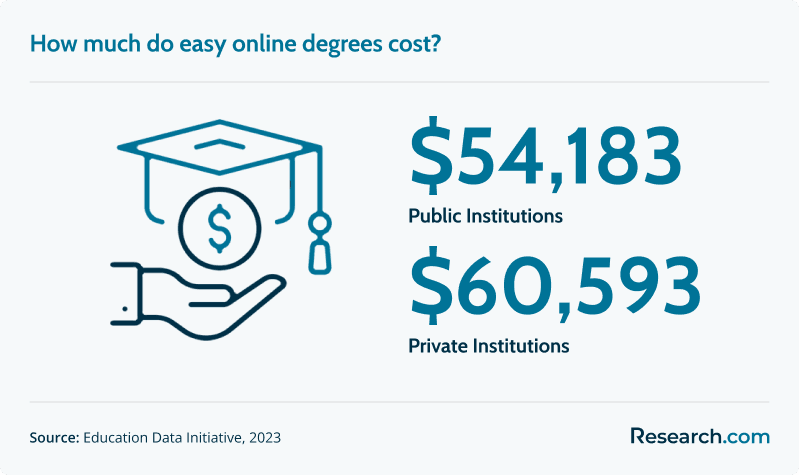
According to data published by the Education Data Initiative in 2023, private institutions typically charge around $60,593 for easy online degrees, while public universities offer affordable online degrees at about $54,183. In-person degrees are listed at around $185,252 for private institutions and about $85,348 for public universities. On a per-credit basis, easy online degrees may range from $300 to $600 at public universities and $500 to $900 at private institutions. These figures refer to tuition and do not include costs such as books, technology, proctoring, or graduation fees.
Students planning to continue beyond the bachelor’s level should also understand the average cost of master's degree before committing to a long-term education plan.
Are there any additional fees or expenses associated with online learning?
Yes. Online programs can include charges beyond tuition, even when the advertised price looks low. This applies to undergraduate programs and to graduate options, including some of the cheapest online masters. Always ask for a full cost breakdown before enrolling.
- Technology fees: Schools may charge for learning platforms, software access, online support, or digital infrastructure.
- Course materials: Students may need textbooks, e-books, access codes, lab kits, subscriptions, or specialized software.
- Virtual proctoring fees: Some courses require paid remote proctoring for exams.
- Online library or database access: Certain programs may charge for expanded digital resources or subscriptions.
- Graduation fees: Diploma processing, commencement participation, and related administrative expenses may be separate.
- Hardware and internet costs: Students may need a reliable computer, webcam, microphone, printer, or upgraded internet service.
- Distance learning fees: Some institutions add a per-course or per-credit online delivery fee.
What are the financial aid options for students enrolling in online degrees?
Online students may qualify for many of the same financial aid options as campus-based students, as long as the school and program meet eligibility requirements. Aid can include grants, scholarships, loans, work-study, veteran benefits, and employer tuition assistance.
- Grants: Grants generally do not need to be repaid and are often based on financial need. Examples include the Pell Grant and the Federal Supplemental Educational Opportunity Grant (FSEOG).
- Scholarships: Scholarships may be awarded for academic achievement, athletic ability, community service, career goals, demographics, or other criteria.
- Loans: Students may use federal loans, including Direct Subsidized Loans and Direct Unsubsidized Loans, or private loans from banks and other lenders.
- Work-study programs: Eligible students may earn money through part-time employment connected to their financial aid package, including some virtual or campus-based roles.
- Veterans benefits: Veterans, active-duty service members, and eligible dependents may be able to use benefits such as the GI Bill or Yellow Ribbon Program.
- Employer tuition assistance: Some employers help pay for job-related education through tuition reimbursement or tuition assistance policies.
What are the prerequisites for enrolling in online degree programs?
Admissions requirements vary by school, degree level, and major. Many online bachelor’s programs are designed for broad access, but selective or specialized programs may require specific coursework, grades, licenses, or experience.
- High school diploma or equivalent: Most affordable online bachelor degree programs require a high school diploma or GED.
- English proficiency: Students applying to programs taught in English may need to show language proficiency through exams such as TOEFL or IELTS.
- Academic transcripts: Applicants usually submit transcripts from high school, previous colleges, or both.
- GPA requirements: Some schools set minimum GPA standards for admission or for transfer students.
- Prerequisite courses: STEM, healthcare, education, and other specialized programs may require prior courses or demonstrated subject readiness.
- Letters of recommendation: Some programs request references from teachers, professors, supervisors, or professional contacts.
- Personal statement or essay: Applicants may need to explain their academic goals, career interests, and reasons for choosing the program.
- Application fee: Many schools charge an application fee, although students can also search for an online university no application fee option.
The chart below shows the percentage of undergraduate students exclusively enrolled in distance courses, based on NCES data published in 2023.
How to choose the easiest online degree?
To choose the easiest online degree for your situation, match the program to your strengths, confirm the workload, check accreditation, compare costs, review student support, and make sure the degree connects to realistic career options.
- Start with your strengths. If you are a strong writer, English, communications, history, or liberal arts may feel manageable. If you are comfortable with numbers and structure, accounting or business may be a better fit.
- Read the curriculum before applying. Course titles alone are not enough. Review descriptions, prerequisites, math requirements, labs, fieldwork, and capstone expectations. For example, the cheapest online RN to BSN programs may require an active license, while another healthcare pathway may require only a high school diploma or equivalent.
- Choose the right format. Asynchronous courses are better for students who need schedule flexibility. Synchronous courses may help students who need live structure and accountability.
- Confirm support services. Look for advising, tutoring, writing centers, math help, library support, technical support, and career services available fully online.
- Use transfer credits strategically. Prior credits can reduce cost and time, but only if they apply to your degree requirements.
- Compare career outcomes. A degree that is easy to finish but weakly connected to employment may not be the best investment. Working adults can also compare accelerated degree programs for working adults if speed is a major priority.
| If you want... | Consider these online majors | Be careful about... |
| The lightest math load | English, History, Liberal Arts, Communications | Heavy reading and writing requirements |
| Broad career flexibility | Business Administration, Management, General Studies | Choosing a degree with no specialization or career plan |
| People-focused work | Psychology, Sociology, Social Work, Counseling, Education | Licensure or graduate school requirements for many roles |
| Better technical career options | Computer Science, Accounting, Healthcare Administration | Math, coding, compliance, or certification expectations |
| A healthcare pathway | Nursing, Healthcare Administration, Speech Language Pathology | Clinical placements, licensure, accreditation, and state authorization |
How can I ensure that an online college degree program is accredited?
To verify accreditation, check the school’s institutional accreditation and any programmatic accreditation required for your field. Do not rely only on a school’s marketing page. Confirm the accreditor through official databases or the accrediting organization’s website.
Examples of field-specific accreditors include the Accreditation Board for Engineering and Technology (ABET) for engineering programs, the Commission on Collegiate Nursing Education (CCNE) for nursing programs, the Association to Advance Collegiate Schools of Business (AACSB) for business programs, and the Council for the Accreditation of Educator Preparation (CAEP) for education programs. Students considering distance-focused institutions may also review DEAC accreditation.
How can I customize my online degree program to align with my career goals and interests?
The easiest online degree becomes more valuable when you shape it around a clear outcome. Use electives, concentrations, internships, certificates, projects, and portfolios to connect the degree to specific jobs or graduate programs.
- Select a concentration: Choose a track that matches your target field, such as digital marketing, human resources, finance, cybersecurity, or nonprofit management.
- Use electives intentionally: Do not fill electives randomly. Pick courses that build skills employers request in job postings.
- Talk to advisors early: Ask which courses support internships, licensure, certification, graduate admission, or portfolio development.
- Add experience: Internships, practicums, service learning, and applied projects make an online degree more credible.
- Attend career events: Virtual employer sessions and workshops can help you understand hiring expectations.
- Track industry changes: Follow trends in your field, including AI tools, automation, regulation, remote work, and credential requirements.
- Build a portfolio: Save writing samples, business plans, coding projects, research papers, campaign work, presentations, or case studies that show what you can do.
What support services are available to online degree students?
Quality online programs usually provide more than recorded lectures. Look for academic advising, tutoring, writing support, technical assistance, online library access, career counseling, mental health resources, disability services, and networking opportunities. Students balancing work and school may benefit from programs with structured calendars, proactive advising, and flexible formats, including accelerated online degree programs for working adults.
How do online degrees compare to traditional degrees in terms of job prospects?
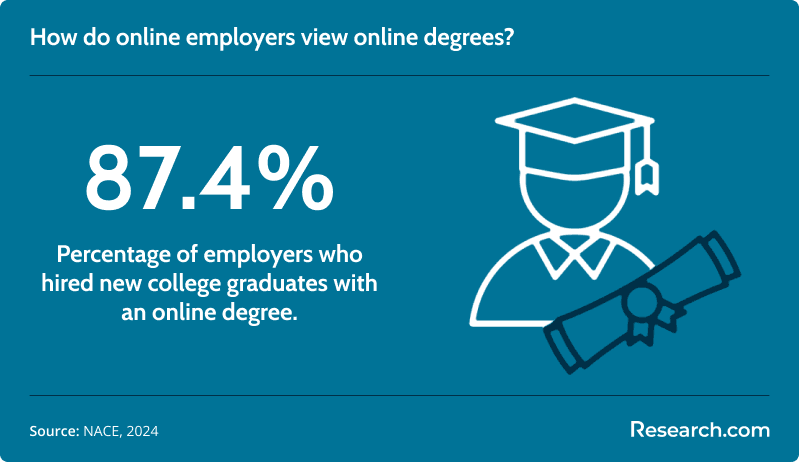
Online degrees can compete with campus-based degrees when they come from accredited institutions and produce relevant skills. According to NACE's Job Outlook 2024 survey, 87.4% of employers hired new college graduates with online degrees, with no difference in starting salary compared to traditional degrees.
That does not mean every online degree has the same value. Employers may still consider the school’s reputation, accreditation status, major, experience, internships, portfolio, certifications, and interview performance. In fields where job skills are easy to demonstrate, such as business, technology, healthcare administration, or project work, practical evidence can matter as much as the delivery format. Students comparing business-related pathways may also review options such as the cheapest online project management degree.
What challenges might I face when pursuing an online degree?
Online learning is flexible, but it can also feel isolating and self-directed. Students may struggle with motivation, procrastination, unclear expectations, limited face-to-face interaction, unreliable technology, or difficulty separating school from home responsibilities. These challenges are manageable, but they should be planned for before classes begin.
- Isolation: Join discussion groups, attend virtual office hours, and participate in student communities.
- Procrastination: Create weekly deadlines that are earlier than the official due dates.
- Technology problems: Test your internet, webcam, software, and learning platform before the term starts.
- Unclear workload: Ask advisors how many hours students typically spend per week in each course.
- Too little structure: Consider structured options such as accelerated online bachelor degrees if regular deadlines help you stay accountable.
What are some tips for managing time effectively while pursuing an online degree?
Time management is often the difference between finishing an online degree and falling behind. The most successful students treat online school like a scheduled responsibility, not a task to complete only when time is left over.
- Build a weekly study calendar. Block time for lectures, readings, assignments, discussion posts, exams, and review sessions.
- Break large assignments into smaller steps. Divide papers, projects, and exams into research, outlining, drafting, revision, and submission stages.
- Prioritize by deadline and difficulty. Complete urgent or demanding work first, then move to smaller tasks.
- Use digital organization tools. Calendars, reminders, task boards, and apps such as Trello or Asana can help you track due dates and progress.
- Create a focused study space. Reduce interruptions, silence unnecessary notifications, and use website blockers if social media becomes a distraction.
How can I choose an online degree program that's both affordable and high quality?
Do not choose an online program based on tuition alone. A lower-cost program may become expensive if few credits transfer, required courses are unavailable, support is weak, or the degree does not help you qualify for your target role. Compare accreditation, curriculum quality, faculty access, student support, career services, graduation requirements, and total estimated cost.
Working adults can start with curated resources such as the best affordable online schools for working adults, then verify each program’s fees, transfer policies, course schedule, and career services directly with the school.
| Common mistake | Why it can hurt you | Better approach |
| Choosing the cheapest tuition without checking fees | Technology, proctoring, books, and graduation charges can raise total cost. | Request a complete cost estimate before applying. |
| Ignoring accreditation | Credits may not transfer, employers may question the degree, and financial aid can be affected. | Verify institutional and programmatic accreditation through official sources. |
| Assuming online means self-paced | Many online courses still have weekly deadlines or live sessions. | Ask whether courses are asynchronous, synchronous, accelerated, or competency-based. |
| Overlooking licensure rules | Education, nursing, counseling, social work, and similar fields may have state-specific requirements. | Confirm state authorization and licensure preparation before enrolling. |
| Relying only on rankings | A highly ranked school may not be the best fit for your budget, schedule, or career path. | Use rankings as one input, then compare curriculum, support, outcomes, and cost. |
Are the easiest online degrees just as good as standard online degrees?
An easier online degree can be just as legitimate as a more demanding program if it is accredited, academically sound, and aligned with your goals. The real issue is not whether a degree is “easy.” The issue is whether it prepares you for the work, graduate study, certification, or advancement you want.
Degrees in communications, business administration, liberal arts, human resources, and related fields often emphasize transferable skills such as writing, organization, leadership, analysis, and collaboration. These skills can be useful in many workplaces. However, fields such as engineering, healthcare, technology, education, counseling, and accounting may require deeper technical training, supervised practice, certification, or licensure.
If you choose a less demanding bachelor’s degree, you can strengthen it with internships, certificates, portfolio projects, professional experience, or later graduate study. Students planning to build more specialized credentials can compare affordable online masters programs as a next step.
How can I expedite my online degree completion while maintaining academic quality?
You can finish faster without lowering academic quality by using legitimate acceleration strategies: transfer credits, prior learning assessment, competency-based coursework, summer enrollment, heavier course loads, and accelerated terms. The key is to avoid taking on more than you can handle.
Before choosing a fast track, ask an advisor how acceleration affects financial aid, course sequencing, graduation requirements, licensure preparation, and weekly workload. Students seeking shorter associate pathways can review options such as the fastest associates degree online.
Can accelerated online master's programs boost my career in less time?
Accelerated online master’s programs can help experienced professionals gain advanced credentials faster, especially when the program is well aligned with their current field or target leadership role. These programs usually compress coursework into intensive terms, so they require strong time management and a clear professional purpose.
Before enrolling, compare curriculum depth, faculty expertise, accreditation, employer recognition, capstone or practicum expectations, and how the program fits your work schedule. Professionals considering a short graduate route can research one year masters degrees to understand available formats and trade-offs.
Which online master's degree leads to the highest earning potential?
Online master’s degrees in specialized areas such as healthcare, engineering, technology, and business may offer stronger earning potential, but outcomes depend on field, experience, location, employer demand, and the specific credential. Do not choose a graduate program based only on salary headlines. Compare the curriculum, accreditation, industry demand, career services, and salary data tied to your target role.
For a focused review of higher-paying graduate fields, see What masters degree pays the most? and use it alongside labor market research and program-specific outcome data.
What is the long-term ROI of easy online degrees?
The long-term return on investment of an easy online degree depends on how much you pay, how quickly you finish, how much debt you take on, and whether the degree helps you increase earnings or qualify for better roles. The financial case is stronger when the program is affordable, accredited, career-aligned, and completed without excessive borrowing.
Education level is associated with earnings differences: associate degree holders earn a median weekly income of $1,005, while bachelor's degree holders earn $1,432. Still, salaries are not guaranteed. Your major, job market, experience, location, internships, certifications, and professional network all affect outcomes. For comparison, students interested in high-earning bachelor’s pathways can review 4 year degrees that make 100k.
How can you identify online degrees with strong earning potential?
To find an online degree with stronger earning potential, connect the major to real jobs before you apply. A degree that is flexible and manageable should also lead toward roles with employer demand, advancement opportunities, and clear skill requirements.
- Research industry demand. Healthcare, technology, and business administration often offer practical career pathways. Students looking for accessible options can explore easiest online degrees that pay well.
- Check graduate employment information. Some universities publish placement rates, employer partners, internship outcomes, or alumni career paths.
- Review salary data. Use sources such as the Bureau of Labor Statistics or reputable salary databases to compare target occupations.
- Verify accreditation and reputation. Accredited degrees are more likely to be recognized by employers and graduate schools.
- Look for certification alignment. Accounting programs that support CPA preparation or IT programs that align with recognized certifications may improve marketability.
- Compare job postings. Search current job ads for your target role and note required degrees, software skills, certifications, experience, and preferred qualifications.
Questions to ask before enrolling in an easy online degree
- Is the institution accredited, and does my field require programmatic accreditation?
- How many of my transfer credits will apply directly to graduation requirements?
- What is the full cost, including fees, books, technology, proctoring, and graduation charges?
- Are courses asynchronous, synchronous, self-paced, accelerated, or cohort-based?
- How many hours per week do students usually spend on each course?
- Does the program require labs, clinicals, student teaching, internships, or campus visits?
- Will this degree meet licensure, certification, or graduate school requirements in my state?
- What online support services are available, and when can students access them?
- What jobs do graduates pursue, and does the school publish outcome information?
- Can I speak with an advisor before applying and receive a written degree plan?
Current trends affecting online degrees
Online education is becoming more integrated into mainstream higher education, but students should evaluate programs carefully. Employers are increasingly focused on demonstrable skills, portfolios, internships, certifications, and work experience. AI and automation are also changing expectations in fields such as writing, marketing, business, technology, healthcare administration, and data-related roles. Students should look for programs that teach responsible technology use, critical thinking, communication, and practical problem-solving rather than relying only on textbook knowledge.
Cost pressure is another major trend. As students compare online and campus options, affordability, transfer credits, employer tuition assistance, and faster completion pathways are becoming more important. The best online degree is not simply the easiest one; it is the one you can complete, afford, and use.
Key Insights
- “Easy” is personal. The easiest online degree is the one that fits your strengths, not necessarily the one with the fewest requirements.
- Accreditation is nonnegotiable. It affects financial aid, credit transfer, employer recognition, graduate study, and licensure pathways.
- Online degrees can be employer-accepted. NACE's Job Outlook 2024 survey reported that 87.4% of employers hired new college graduates with online degrees, with no difference in starting salary compared to traditional degrees.
- Total cost matters more than advertised tuition. Include fees, materials, technology, proctoring, transfer credits, and time to completion in your comparison.
- Career alignment protects ROI. A manageable degree should still connect to real jobs, advancement, certifications, graduate programs, or portfolio-building opportunities.
- Licensure fields require extra caution. Nursing, education, counseling, social work, and speech-language pathology may require clinical hours, fieldwork, exams, or state approval.
- Support services can determine success. Strong advising, tutoring, technical support, and career services are especially important for online students balancing school with work or family.
References:
- Bureau of Labor Statistics (BLS). (2023). Education Pays. BLS.
- Hanson, M. (2023). Cost of Online Education vs. Traditional Education. Education Data Initiative.
- National Association of Colleges and Employers (NACE). (2024). Employers See Online Degrees as Comparable to In-Person Degrees. NACE.
- National Center for Education Statistics (NCES). (2023). Undergraduate Enrollment. Postsecondary Education. NCES.
Other Things You Should Know About Easy Online Degrees
Students need a reliable computer, high-speed internet, and updated software like Microsoft Office. Some programs might also require specific tools or platforms, such as Zoom for video conferencing, or specialized software for particular majors like graphic design or programming.
Job prospects for 2026 easiest online college degree majors vary based on the field of study. Generally, fields like healthcare administration, marketing, and education have favorable outlooks. While demand can fluctuate, pursuing skills in widely applicable areas can enhance employability.


