
2027 Best Self-Paced Online Colleges and Courses

Co-Founder and Chief Data Scientist
Self-paced online colleges are designed for students who need a degree or career credential without fixed class meeting times. They can be a strong option if you work full time, care for family, live far from campus, or already know some course material and want to move faster where possible. The trade-off is that flexibility shifts more responsibility to you: you must manage deadlines, verify accreditation, compare real costs, and choose a program that employers or licensing boards will recognize.
This guide explains how self-paced online colleges work, how they differ from other online programs, which schools and course formats to consider in 2027, and how to evaluate cost, quality, career outcomes, support services, and accreditation before enrolling.
Quick Answer: Are Self-Paced Online Colleges a Good Choice?
Self-paced online colleges can be worth it for independent learners who need maximum scheduling flexibility and are comfortable organizing their own study time. The best programs are accredited, transparent about tuition and fees, clear about transfer credit and prior learning policies, and supported by academic advising, tutoring, technical help, and career services. They are not ideal for students who need frequent live instruction, in-person labs, daily accountability, or a highly structured classroom schedule.
Key Takeaways for Attending Self-Paced Online Colleges
- The number of institutions with five or more fully online programs increased from 48% in 2013, to 76% in 2022.
- Online courses may be synchronous, asynchronous, or hybrid. Self-paced programs usually fall under asynchronous learning, although some still set course or term deadlines.
- Around 85% of universities and colleges believe that one major strategic outcome of online learning is that it increases student access to their programs.
- 28% of undergraduate students enroll in online degree programs to start a new career, and 27% do so to earn more money with a new career.
- 84% of adults believe that employers are more accepting of online degrees now than before.
Affordable Quick Online Degree Programs With High Acceptance Rates in 2027
If your goal is to finish a bachelor’s degree as efficiently and affordably as possible, the best program is usually one that accepts transfer credits, offers multiple start dates, provides online coursework, and leads to jobs or graduate pathways that match your goals. Below are common online degree areas students often consider when looking for accessible, flexible programs.
1. Business Administration
A business administration bachelor’s degree covers the core functions of organizations, including accounting, finance, marketing, human resources, operations, and management. It is a practical choice for students who want a broad business credential that can apply to management, entrepreneurship, consulting support, sales operations, and organizational leadership roles.
2. Psychology
A psychology degree introduces students to human behavior, cognition, emotion, research methods, development, mental health, and social behavior. It can support entry-level work in human services, healthcare support, human resources, case management support, or research assistance, and it can also prepare students for graduate study in psychology, counseling, or related fields.
3. Counseling
A counseling-related degree teaches foundational concepts in mental health, helping relationships, communication, ethics, and human development. Students considering this field should check licensure rules carefully, because many counseling careers require graduate education, supervised experience, and state licensure beyond the bachelor’s level.
4. Computer Science
A computer science degree focuses on programming, algorithms, data structures, software development, computing theory, systems, and problem-solving. It can prepare graduates for technology roles connected to software, data, cybersecurity, artificial intelligence, application development, and technical analysis, depending on the curriculum and projects completed.
5. Healthcare Administration
A bachelor’s degree in healthcare administration is built for students who want to work on the business and operations side of healthcare. Coursework often addresses healthcare policy, finance, compliance, human resources, leadership, and facility operations, which can lead to roles in hospitals, clinics, medical offices, public health organizations, and healthcare service companies.
6. Nursing
A bachelor’s degree in nursing prepares students for professional nursing practice by combining nursing theory, clinical decision-making, patient care, evidence-based practice, and supervised clinical experience. Because nursing is a licensed profession, students must confirm that any online or hybrid program meets the clinical and licensure requirements in the state where they plan to practice.
7. Social Work
Social work degrees such as the Bachelor of Social Work (BSW) and Master of Social Work (MSW) combine classroom learning with supervised field education. Students study social welfare policy, human behavior, ethics, trauma-informed practice, advocacy, and direct service methods. Graduates may pursue roles in schools, healthcare, community agencies, and clinical settings, though advanced clinical roles generally require additional education and licensure.
8. Accounting
An accounting bachelor’s degree develops skills in financial reporting, taxation, auditing, cost accounting, accounting systems, and business analysis. It can prepare students for work in public accounting, corporate accounting, government finance, nonprofit finance, or forensic accounting. Students who plan to become CPAs should verify state education requirements before choosing a program.
9. Logistics
A logistics or supply chain management degree focuses on transportation, warehousing, distribution, procurement, inventory control, supply chain analytics, and global trade. It is a useful option for students interested in operations-heavy industries where efficient movement of goods, materials, and information is central to business performance.
10. Marketing
Marketing degrees at the undergraduate or MBA level often include consumer behavior, market research, digital marketing, brand strategy, analytics, social media, and campaign planning. Graduates may pursue roles in digital marketing, product marketing, market research, advertising, communications, or brand management, depending on experience and specialization.
Which Fast Online Degree Path Fits Your Goal?
| Program Area | Best Fit For | Important Check Before Enrolling |
| Business administration | Students who want a broad credential for management, operations, sales, or entrepreneurship | Look for concentrations, internship options, and transfer credit policies. |
| Psychology or counseling | Students interested in helping professions, human behavior, or graduate study | Confirm whether your target career requires a master’s degree or state licensure. |
| Computer science | Students who want technical roles and are prepared for programming-heavy coursework | Review projects, languages taught, career services, and portfolio-building opportunities. |
| Healthcare administration or nursing | Students interested in healthcare operations or patient care | For nursing, verify clinical placements, state authorization, and licensure alignment. |
| Accounting | Students who enjoy financial detail, compliance, reporting, and business analysis | Check CPA education rules if certification is part of your plan. |
| Logistics or marketing | Students interested in business functions with measurable outcomes and industry applications | Ask about software tools, analytics coursework, and employer connections. |
- Best self-paced online colleges and courses for 2027
- Online courses vs. self-paced online courses
- The state of online higher education in the United States
- How to choose a self-paced online college
- Advantages of self-paced online colleges
- Admission and technology requirements
- Challenges of self-paced online learning
- Employer recognition of self-paced online degrees
- Long-term benefits of self-paced online degrees
- Scholarships and grants for self-paced online programs
- Practical training and career readiness
- Pathways to advanced credentials
- Is a self-paced online college worth it?
- Career advancement support
- Networking and job placement
- Technology and personalized learning
- Accreditation and quality standards
- Academic integrity and assessments
- Student support services
- Accelerated degree options
- Cost-effectiveness and ROI
- Key insights
10 Best Self-Paced Online Colleges and Courses for 2027
How We Rank Schools
Choosing a self-paced online college involves real costs, time, and opportunity trade-offs. To make this list more useful, we focus on factors that matter to online learners: accreditation, program availability, delivery format, flexibility, student support, cost information, and available outcome data. Research.com’s ranking process uses its methodology along with data sources such as IPEDS from the National Center for Education Statistics, Peterson's database, including its Distance Learning Licensed Data Set, and College Scorecard.
1. Capella University
Capella University offers FlexPath, a competency-based format that lets students move through coursework as they demonstrate mastery. Students set their own deadlines within the structure of the billing session, submit assessments through the online platform, and spend less time on material they already understand. FlexPath students also receive support from an academic coach and course instructor.
The pricing model uses one tuition fee for each 12-week billing session. Students may take up to 2 courses at a time and begin another after completing a course, which can help motivated learners control both pace and cost. FlexPath includes undergraduate and graduate options in fields such as business, education, psychology, health care, and related areas.
2. The University of Illinois Online at Urbana-Champaign
The University of Illinois, Urbana-Champaign offers online courses and programs for degree-seeking and non-degree-seeking learners. Its virtual course options serve students who need year-round enrollment, schedule flexibility, or access to individual courses outside a traditional campus timetable.
The online catalog serves several groups: high school students exploring advanced coursework, residential students adding online classes to their schedules, working professionals pursuing certifications, career changers considering fully online degrees, and learners who want to explore a subject before committing to a full program.
UI at Urbana-Champaign also offers continuous, self-paced NetMath and Math Teacher Link courses. These may interest teachers with a degree in mathematics or educators teaching math at the 9-14th-grade levels.
3. Penn Foster College
Penn Foster College provides self-paced online certificate, diploma, and degree programs. Students can access courses through a computer, tablet, or mobile device at any time. Learners have up to two years to complete diploma programs and up to six years to complete college degree programs, with extensions requiring approval. Penn Foster holds accreditation from the Distance Learning and Training Council (DETC).
4. Thomas Edison State University
Thomas Edison State University offers flexible online degree pathways for adult and transfer students. TESU provides more than 40 self-directed majors across fields such as education, business, English, psychology, economics, and other disciplines, with online options at both undergraduate and graduate levels.
5. Waubonsee Community College
Waubonsee Community College offers flexible learning through MyChoice. In its online format, instruction takes place through Canvas and does not require in-person attendance. Courses are asynchronous, using materials such as recorded lessons, study guides, and assigned activities. Students can take up to two courses at a time and pay an $8 per college credit hour student fee for open-entry classes.
6. Western Governors University
Western Governors University offers career-focused bachelor’s and master’s degrees in information technology, business, education, healthcare, and fields connected to the most in demand teaching subjects. WGU’s competency-based model is designed for working adults who want to advance when they prove subject mastery rather than when a traditional semester ends. Courses are accredited by the DETC and four other regional accrediting agencies, and students do not follow fixed program lengths.
7. University of North Dakota – Online and Distance Education
The University of North Dakota offers “Self-Paced Enroll Anytime” courses that use an independent study format through online or mail-in delivery. These courses typically take about three to nine months to complete. UND Online offers over 180 self-paced courses in subjects such as economics, math, chemistry, geology, physics, and courses under social science.
8. Columbia College
Columbia College offers over 70 fully online programs. Its 100% online courses provide 24/7 access to course materials, allowing students to study when their schedules permit. Courses run in eight-week sessions across six academic sessions, which gives learners multiple opportunities to begin or continue progress during the year.
9. Fort Hays State University
Fort Hays State University offers over 200 online degree and certificate programs. Students can choose courses in eight-week or 16-week formats, access coursework through Blackboard, and may receive credit for qualifying prior learning experiences.
10. Purdue University Global
Purdue Global offers 175 academic programs for working adults in a 100% online format and builds on Purdue University's 150 years of educational experience. Most undergraduate students meet half their requirements through prior learning credits, and new courses start every month. Students who want to test the fit can try a course for free for three weeks, with no financial obligation during the introductory 3-week period.
What Graduates Say About Self-Paced Online Degrees
-
: "
“A full-time job and family responsibilities made returning to school feel out of reach. The online format changed that because I could study in short blocks of time, even late at night. Finishing my marketing degree without pausing my life gave me more confidence and helped me prepare for new career opportunities.” Charmaine
"
-
: "
“Learning online gave me the ability to slow down when I needed to. If a lesson was difficult, I could replay the material and review the readings again. Discussion boards also connected me with classmates from different places, which added perspectives I would not have encountered otherwise.” Daniel
"
-
: "
“I did not think a computer science degree would fit into my schedule. Studying from home removed the commute and gave me access to interactive resources that kept me engaged. The format helped me build skills while preparing for a career change.” Martin
"
What Is the Difference Between Online Courses and Self-Paced Online Courses?
Online learning is not one single format. Some courses require live attendance, some let you complete work on your own schedule, and others combine both models. A standard online course may still have scheduled lectures, live discussions, weekly due dates, and group activities. A self-paced course usually gives students more control over when they study and how quickly they move through lessons, although many schools still set maximum completion windows.
This distinction matters when you are comparing programs such as an online degree in healthcare management, education, accounting, technology, or business. The format can affect how quickly you finish, how much instructor interaction you receive, and how long does it take to get a bachelor's degree online.
Online Course Formats Compared
| Format | How It Works | Best For | Possible Drawback |
| Synchronous online | Students attend live virtual classes at scheduled times. | Learners who want structure, real-time discussion, and instructor access. | Less flexible for students with unpredictable schedules. |
| Asynchronous online | Students access recorded lectures, readings, assignments, and discussions without live class meetings. | Learners who need flexibility but can still meet course deadlines. | Requires strong self-management and regular study habits. |
| Self-paced online | Students progress through modules at their own speed, often within a course or term limit. | Independent learners who want to accelerate or slow down as needed. | Less daily accountability; procrastination can delay completion. |
| Hybrid online | Online coursework is combined with live sessions, campus visits, labs, or clinical experiences. | Students in fields that need hands-on practice or supervised training. | May require travel, scheduled attendance, or local placement approval. |
When Self-Paced Learning Makes Sense
- You already know some material. Competency-based or self-paced models may let you move faster through familiar topics.
- Your schedule changes often. Students with rotating shifts, caregiving duties, or travel-heavy jobs may benefit from fewer required meeting times.
- You study well independently. Self-paced programs reward students who can plan, review, and complete work without daily reminders.
- You are comparing flexible education pathways. For example, students researching the best online teaching degrees should check whether programs include required fieldwork, licensure alignment, and any live components.
What Is the State of Online Higher Education in the United States?
Online higher education is now a mainstream part of the U.S. college market. According to McKinsey, demand for online education is continuously growing. Even before the pandemic, 94% of member institutions of the American Association of State Colleges and Universities (AACSU) already offered fully online programs. These institutions offered 20 fully online programs and 16 hybrid programs on average. The number of institutions with five or more fully online programs increased from 48% in 2013, to 76% in 2022.
Institutions continue to expand online learning because it can increase access for students who cannot attend campus regularly. Around 85% of institutions believe that one major strategic outcome of online learning is that it increases student access to their programs. Online learning has also been associated with increased success among minority students, although outcomes depend on program quality, student support, technology access, and instructional design.
The chart below summarizes strategic outcomes institutions report from online learning, with increased student access as the leading outcome, followed by stronger academic continuity during disruption.
How Do You Choose a Self-Paced Online College?
The best self-paced online college is not simply the fastest or cheapest option. It is the one that fits your goal, learning style, budget, timeline, and career requirements. Use the steps below before submitting an application.
1. Define Your Goal Before Comparing Schools
Start with the outcome you want. Are you trying to finish a bachelor’s degree, change careers, qualify for a promotion, complete prerequisites, or enter a licensed profession? A student looking for an engineering degree online should evaluate labs, math requirements, ABET relevance where applicable, and hands-on components differently than a student pursuing business or general studies.
2. Verify Accreditation and State Authorization
Accreditation affects transfer credits, graduate school eligibility, employer recognition, and access to federal financial aid. Check the college’s accreditor through official sources, not only the school’s marketing pages. If your program leads to licensure, confirm state authorization and licensing board approval before enrolling.
3. Review the Actual Course Format
“Self-paced” can mean different things. Some courses allow open progress with broad completion windows; others have weekly deadlines but no live meetings. Ask whether assignments, exams, discussions, or proctored assessments must be completed by specific dates.
4. Compare Support Services
Online students should have access to advising, tutoring, library resources, technical support, accessibility services, and career counseling. Flexible coursework is helpful, but weak support can make self-paced learning harder than expected.
5. Calculate the Full Cost
Do not compare tuition alone. Include technology fees, textbooks, exam proctoring, transfer credit evaluation, graduation fees, clinical or lab costs, and subscription-style billing rules. Also ask whether financial aid applies to the self-paced format.
6. Test the Platform When Possible
Introductory courses, demos, and trial periods can reveal whether you like the learning management system, course layout, assessment style, and instructor communication process before you commit fully.
Questions to Ask Before Enrolling
| Question | Why It Matters |
| Is the institution accredited by a recognized accreditor? | Accreditation affects degree recognition, credit transfer, and financial aid eligibility. |
| Does the program meet licensure or certification requirements in my state? | Online programs do not automatically satisfy every state’s professional rules. |
| How many credits can I transfer? | Transfer credits can reduce time and cost, but policies vary widely. |
| Are courses fully self-paced or just asynchronous? | Some online courses still have weekly deadlines and required term schedules. |
| What student support is available after business hours? | Working adults often study at night or on weekends. |
| What happens if I do not finish during the billing period? | Subscription or term-based pricing can become expensive if progress slows. |
What Are the Advantages of Attending Self-Paced Online Colleges?
Self-paced online colleges are most valuable when flexibility directly solves a scheduling, location, or pacing problem. They can be especially useful for working adults, military-connected students, caregivers, transfer students, and parents comparing the online degrees for moms.
- Flexible scheduling: Students can study around work, family, travel, or health obligations without commuting to campus for every class.
- Potentially faster progress: Learners who already understand a topic may move through material more quickly in competency-based or self-paced formats.
- Broader program access: Students can enroll in programs outside their immediate geographic area when relocation is not realistic.
- Lower indirect costs: Online learning can reduce commuting, housing, parking, and some campus-based expenses.
- Stronger digital habits: Online coursework builds experience with learning platforms, collaboration tools, file management, digital research, and remote communication.
- Personalized study rhythm: Students can spend more time on difficult material and move faster through familiar concepts.
The chart below draws from the EducationDynamics 12th Annual Report and shows preferences and expectations among today’s online college students.
What Are the Requirements for Attending Self-Paced Online Colleges?
Admissions and participation requirements vary by school, degree level, and field. In general, students need academic eligibility, reliable technology, basic digital skills, and the ability to work independently.
- Academic credentials: Undergraduate programs usually require a high school diploma or GED. Graduate programs typically require a relevant bachelor’s degree.
- Application materials: Schools may request an application, transcripts, a personal statement, recommendations, test scores, or a fee. Students seeking lower upfront costs may compare online colleges with open enrollment and no application fee.
- Technology access: Students need a reliable computer, stable internet, webcam or microphone when required, and software compatible with the school’s learning platform.
- Digital literacy: You should be comfortable using email, learning management systems, cloud storage, video platforms, discussion boards, and online library tools.
- Time management: Self-paced students must create study routines, track assignments, prepare for exams, and avoid falling behind without frequent in-person reminders.
What Are the Challenges of Attending Self-Paced Online Colleges?
Self-paced learning solves some problems but creates others. A study by Mphekeleli Besele, “Challenges of Online Learning to University Students,” identifies several difficulties students can face in online education.
- Technology problems: Poor internet connections, platform outages, outdated devices, and software compatibility issues can interrupt coursework.
- Less immediate interaction: Students may feel isolated when they cannot easily ask questions in person or collaborate face to face.
- High need for self-discipline: Without classroom routines, students must plan their own study schedule and maintain momentum.
- Hands-on training limits: Fields that require labs, clinical practice, studios, or fieldwork may be harder to deliver fully online. This is important in areas such as sciences, healthcare, and engineering, including programs like masters industrial engineering online.
- Digital skill gaps: Students unfamiliar with online tools may need extra time to learn platforms before they can focus fully on course content.
Common Mistakes to Avoid
| Mistake | Better Approach |
| Choosing the cheapest program without checking accreditation | Verify accreditation first, then compare total cost. |
| Assuming “online” means “self-paced” | Ask whether courses have live meetings, weekly due dates, or fixed terms. |
| Ignoring licensure requirements | Contact the relevant state board before enrolling in nursing, teaching, counseling, social work, or similar fields. |
| Overestimating how fast you can finish | Build a realistic weekly study plan based on work and family obligations. |
| Looking only at rankings | Use rankings as a starting point, then evaluate curriculum, support, outcomes, and cost. |
| Forgetting transfer policies | Request an official transfer credit evaluation before committing. |
Will Employers Recognize My Self-Paced Online Degree?
Employers are generally more likely to respect an online degree when it comes from an accredited institution, the program is relevant to the role, and the applicant can demonstrate skills and experience. The delivery format matters less when the credential is credible and the graduate can explain what they learned.
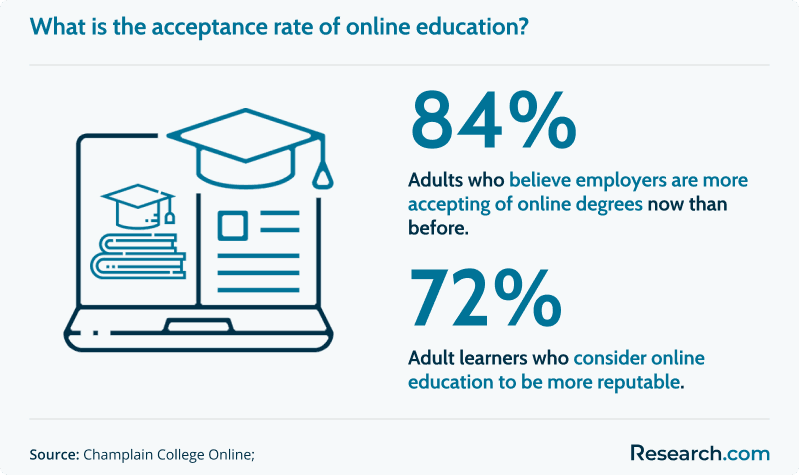
Perception of online education has changed considerably. According to post-pandemic survey data, 84% of adults believe employers are more accepting of online degrees now than before, and 72% consider online education to be more reputable. Still, students should avoid assuming every online credential carries equal value. Accreditation, institutional reputation, career relevance, and demonstrated competence all matter.
What Are the Long-Term Benefits of Earning a Degree From Self-Paced Online Colleges?
The benefits of a self-paced online degree can extend beyond schedule flexibility. Students who succeed in this format often strengthen planning, accountability, written communication, digital collaboration, and independent problem-solving skills. Those habits can be useful in remote, hybrid, and project-based workplaces.
Self-paced education can also make it easier to align learning with a specific career direction. Students may choose programs, concentrations, certificates, or electives that support their target industry. Comparing accredited options such as non profit online universities can help students focus on institutional quality as well as flexibility.
Another long-term advantage is adaptability. Graduates who have learned how to teach themselves, navigate digital systems, and manage independent projects may be better prepared to reskill as industries change. However, outcomes are not guaranteed. Career growth depends on the field, local labor market, experience, networking, credentials, and the quality of the program.
How Do I Find Scholarships and Grants for Self-Paced Online Colleges and Courses?
Self-paced online students may qualify for financial aid, but eligibility depends on the school, program structure, enrollment status, accreditation, and aid rules. Use these steps to search for funding:
- Complete the Free Application for Federal Student Aid (FAFSA) to check eligibility for federal grants, loans, and work-study options where applicable.
- Ask the school’s financial aid office whether students in self-paced or competency-based formats qualify for the same aid as students in standard online programs.
- Search for institutional scholarships, employer tuition assistance, military benefits, state grants, professional association awards, and private scholarships.
- Review deadlines, renewal rules, GPA requirements, enrollment minimums, and whether awards apply to online programs.
- Ask whether transfer credits, prior learning credit, or credit by exam can reduce the number of courses you need to pay for.
How Do Self-Paced Online Colleges Integrate Practical Training to Ensure Career Readiness?
Strong self-paced online programs connect academic content to workplace tasks. Depending on the field, this may include case studies, simulations, virtual labs, capstone projects, portfolio assignments, supervised fieldwork, internships, or employer-informed projects. Career-focused programs may also incorporate industry software and scenario-based assessments so students can practice applying concepts rather than only reading about them.
Hands-on requirements are especially important in technical and vocational areas. Students comparing career training options, including online trade school programs, should ask how practical skills are assessed, whether equipment or local placements are required, and how the program verifies competency.
Can Self-Paced Online Colleges Pave the Way to Advanced Academic Credentials?
Self-paced online programs can support further education when they are accredited and academically rigorous. Students who plan to pursue graduate school should confirm that credits will be recognized, prerequisites are included, grades or competency records meet admissions expectations, and faculty recommendations are available when needed.
For learners with long-term academic goals, an online bachelor’s or master’s program may become a stepping stone toward doctorate degrees or specialized post-graduate credentials. The key is to choose a program that aligns with admissions requirements for the next credential, not just the current one.
Is Attending a Self-Paced Online College Worth It?
A self-paced online college is worth considering if it helps you complete a recognized credential in a format you can realistically sustain. It is most likely to be a good fit when the school is accredited, the program matches your career goal, the total cost is manageable, and you have enough discipline to study without a fixed weekly classroom schedule.
It may not be the right choice if you need frequent live instruction, learn best through in-person discussion, struggle with procrastination, or are entering a field that requires intensive hands-on training unavailable through the program. Licensure fields require extra caution. For example, students pursuing social work should look for properly recognized options such as CSWE accredited social work programs when that accreditation is relevant to their goals.
Who Should Choose a Self-Paced Online College?
- Working adults who need control over study hours
- Students with transfer credits or prior knowledge
- Independent learners who can plan and meet goals
- Career changers who need flexible retraining
- Students who live far from campus-based programs
Who Should Consider a Different Format?
- Students who need daily structure and live accountability
- Learners who prefer in-person discussion and immediate feedback
- Students entering programs with extensive lab, clinical, or fieldwork requirements that are not clearly supported
- Anyone pursuing licensure without confirmation that the program meets state requirements
How Can Self-Paced Online Colleges Support Career Advancement for Students?
Self-paced online colleges can support career growth when coursework is tied to employer needs and the school provides practical career resources. Look for programs that offer:
- Industry-aligned courses: Curriculum connected to current expectations in fields such as technology, healthcare, education, and business.
- Applied skill development: Assignments that build measurable abilities in areas such as project management, data analysis, leadership, communication, and technical tools.
- Career services: Resume reviews, interview preparation, job search coaching, career assessments, and guidance for career changers.
- Employer-aware credentials: Certificates, concentrations, portfolios, or capstone projects that help students show what they can do.
How Do Self-Paced Online Colleges Enhance Career Networking and Job Placement Opportunities?
Networking can be harder in a self-paced format, so students should look for colleges that intentionally create connection points. Useful services may include virtual career fairs, alumni communities, employer webinars, mentoring programs, internship support, online student organizations, and career coaching.
Affordability should also be evaluated alongside career support. A low-cost program may be attractive, but students comparing the cheapest online bachelor's degree options should still ask whether the school offers job search help, employer connections, and career-relevant projects.
How Do Self-Paced Online Colleges Use Technology to Personalize Learning?
Many online colleges use learning platforms that track progress, organize modules, deliver automated feedback, host discussions, and help students identify weak areas. Some programs use adaptive learning tools, dashboards, predictive assessments, or modular course sequencing to help students move through content more efficiently.
Technology alone does not guarantee quality. The best use of digital tools is tied to clear learning outcomes, meaningful instructor feedback, accessible course design, and fair assessment. Students interested in speed should compare self-paced options with fast track school programs and ask how the school maintains academic rigor while allowing faster completion.
What Are the Accreditation and Quality Standards in Self-Paced Online Colleges?
Accreditation should be one of the first filters when choosing a self-paced online college. Accredited online universities have been reviewed by recognized accrediting agencies for standards related to curriculum, faculty, student resources, governance, and institutional quality.
Students should understand the difference between institutional accreditation and programmatic accreditation. Institutional accreditation applies to the college or university as a whole. Programmatic accreditation applies to specific fields, especially in licensed or professionally regulated areas such as nursing, counseling, social work, teaching, engineering, and business.
Accreditation Checklist
- Confirm the school’s accreditor through an official accreditation database or recognized agency source.
- Check whether your specific program has any required programmatic accreditation.
- Ask whether credits transfer to other colleges or graduate programs.
- Verify state authorization if you live outside the state where the school is based.
- For licensure programs, contact the licensing board in the state where you plan to work.
How Do Self-Paced Online Colleges Ensure Academic Integrity and Quality Assessments?
Quality self-paced programs use multiple tools to protect academic standards. These may include secure testing software, remote proctoring, plagiarism detection, identity verification, timed assessments, project-based evaluations, and honor codes. Instructors may also use written assignments, oral defenses, portfolios, or applied projects to confirm that students can use what they have learned.
This matters for students considering flexible or accelerated credentials, including quick degree programs that pay well. A faster path should still require credible assessments, meaningful feedback, and evidence that students have met the same learning outcomes expected in a traditional format.
What Additional Student Support Services Do Self-Paced Online Colleges Offer?
Support services can make the difference between finishing and stopping out. Before enrolling, ask whether online students receive the same level of help as campus students and whether support is available during evenings or weekends.
- Academic advising: Degree planning, course sequencing, transfer credit guidance, and progress checks.
- Tutoring and writing help: Support for difficult subjects, research papers, math, writing, and study skills.
- Technical support: Help with login problems, software, exams, video tools, and learning platforms.
- Career counseling: Resume feedback, interview preparation, job search planning, and career transition guidance.
- Financial aid guidance: Help understanding aid eligibility, billing models, and FAFSA-related questions, including options such as online colleges that accept fafsa.
- Community and accessibility resources: Online student groups, disability services, mental health resources, and library access.
Do Self-Paced Online Colleges Offer Accelerated Degree Options Without Compromising Quality?
Some self-paced online colleges offer accelerated pathways through competency-based learning, prior learning credit, transfer credit, shorter terms, or modular course design. These options can help motivated students finish sooner, but speed should not come at the expense of accreditation, learning outcomes, faculty feedback, or required hands-on experience.
Students researching faster bachelor’s pathways can compare options such as 2-year accelerated bachelor degrees. Before enrolling, ask how many credits are required, how transfer credits are evaluated, whether courses are available year-round, and what happens if you need more time than expected.
How Can Students Evaluate the Cost-Effectiveness of Self-Paced Online Colleges?
Cost-effectiveness is not the same as low tuition. A program is cost-effective when it offers a credible credential, reasonable total cost, strong completion support, and a realistic connection to your career or academic goal.
Key Factors to Evaluate Cost-Effectiveness
- Tuition structure: Some schools charge per credit, while others use term or subscription pricing. Subscription models can save money if you complete courses quickly, but they may cost more if your pace slows.
- Additional fees: Ask about technology fees, textbooks, digital materials, proctoring, labs, graduation fees, transfer evaluations, and clinical or placement costs.
- Financial aid: Confirm whether the program is eligible for federal aid, scholarships, employer tuition assistance, state grants, or institutional awards.
- Transfer and prior learning credit: Credit for previous coursework, exams, military training, professional certifications, or work-based learning can reduce both time and cost.
- Accreditation and recognition: Programs from cheap accredited online colleges may be appealing, but accreditation and relevance should remain non-negotiable.
- Career alignment: Compare program outcomes with your target field, but avoid assuming any degree guarantees a specific salary or job.
Simple ROI Questions Before You Enroll
| ROI Question | What to Look For |
| How much will I pay from start to finish? | Total cost after transfer credits, aid, fees, and materials. |
| How long will completion realistically take? | A timeline based on your weekly availability, not only the fastest advertised path. |
| Will this credential qualify me for my next step? | Employer expectations, graduate admissions requirements, or licensure rules. |
| What support exists if I fall behind? | Academic coaching, tutoring, alerts, and flexible completion options. |
| What evidence can I show employers? | Portfolio work, projects, internships, certifications, capstones, or applied assessments. |
Key Insights
- Self-paced online colleges are best for students who need flexibility and can manage their own study schedule without frequent live class meetings.
- “Online,” “asynchronous,” and “self-paced” do not always mean the same thing. Always ask about deadlines, live sessions, billing periods, and maximum completion windows.
- Accreditation is essential. For licensed careers, programmatic accreditation and state approval may matter as much as institutional accreditation.
- The cheapest program is not always the most cost-effective. Compare total cost, transfer credit, financial aid, support services, completion time, and career relevance.
- Employer acceptance of online degrees has improved, but credibility still depends on the school, program quality, field, experience, and the skills you can demonstrate.
- Accelerated and competency-based formats can reduce time to completion for motivated students, but they require discipline and should still include rigorous assessments.
- Before enrolling, ask direct questions about student support, practical training, technology requirements, licensure alignment, transfer policies, and what happens if you need more time.
References:
- Aslanian, C. B., and Fischer, S. (2022). Online College Students Report 2022.
- Aslanian, C.B., Fischer, S., Kitchell R., & Lenexa, KS (2023). Online College Students. Report 2023. EducationDynamics. https://insights.educationdynamics.com/rs/183-YME-928/images/EDDY-online-college-students-2023.pdf
- Hanson, M. (August 2023). Cost of Online Education vs. Traditional Education. Education Data Initiative. https://educationdata.org/cost-of-online-education-vs-traditional-education
- Capranos, D., and Magda, A. J. (2022). Online learning at public universities 2022: Views of AASCU member institutions as COVID-19 transforms higher education.
- Diaz-Infante, N., Lazar, M., Ram, S., & Ray, A. (2022, July 20). Demand for online education is growing. Are providers ready? McKinsey & Company.
- Doak, M. (2022, March 7). Online learning can lead to increased success for minority students in higher education. Technology Solutions That Drive Education.
- Education pays, 2022: Career Outlook: U.S. Bureau of Labor Statistics. (2023, May 5). Bls.gov.
- Hanson, M. (2021, December 9). Is College Worth it? | Return on Investment Analysis of College Degree. Education Data Initiative.
- Hanson, M. (2023, August 23). Cost of Online Education vs. Traditional Education [2023]: Comparison. Education Data Initiative.
- Hanson, M. (2024, March 3). Student Loan Debt Statistics [2024]: Average + total debt. Education Data Initiative.
- National Center for Education Statistics (2022). Fast Facts: Distance Education.
- Finley, A. (2023). THE CAREER-READY GRADUATE, WHAT EMPLOYERS SAY ABOUT THE DIFFERENCE COLLEGE MAKES. American Association of Colleges and Universities. https://dgmg81phhvh63.cloudfront.net/content/user-photos/Research/PDFs/AACU-2023-Employer-Report.pdf
Other Things You Should Know About the Best Self-Paced Online Colleges
Key criteria for selecting the best self-paced online college programs in 2027 include accreditation, course variety, faculty expertise, technological resources, support services, and student reviews. Ensuring the institution offers accredited programs and has a reliable support system can help guarantee a quality education experience that meets individual needs and goals.
In 2027, top-rated self-paced online colleges include Western Governors University, University of Florida Online, and Southern New Hampshire University. These institutions offer varied programs, strong student support, and innovative self-paced structures tailored to diverse learning needs.
Self-paced online college courses in 2027 often require completion of general education credits in subjects like mathematics, humanities, and sciences, consistent with traditional degree programs. These courses can vary by institution but typically account for about 30-40% of total credit requirements.


