
2027 How to Become a Counselor: A Step-by-Step Guide

Co-Founder and Chief Data Scientist
Becoming a counselor is a serious career decision because the path usually requires graduate education, supervised clinical training, state licensure, and ongoing professional development. It can also be a deeply meaningful profession for people who want to help others manage mental health concerns, addiction, grief, family conflict, school challenges, career decisions, and life transitions.
The need for qualified counselors remains significant. Each year, one in five Americans battles mental illness, and in 2024, 52.1% of American adults with mental illnesses sought and received treatment. At the same time, licensing rules, telehealth expectations, employer requirements, and online degree options can make the route confusing for prospective students.
This guide explains how to become a counselor, what education and licensing steps are typically required, how salaries and job prospects vary by specialty, how to compare degree programs, and what questions to ask before investing in this career path.
Quick answer: How do you become a counselor?
To become a licensed counselor in most U.S. states, you generally need to earn a bachelor’s degree, complete a master’s degree in counseling or a closely related field, finish supervised clinical experience, pass a counseling exam such as the National Counselor Exam, apply for state licensure, and complete continuing education to keep your license active. Requirements vary by state and counseling specialty, so students should verify rules with the state licensing board before enrolling in a program.
| Step | What it usually involves | Why it matters |
| Bachelor’s degree | Study psychology, human services, social work, or a related field | Builds the academic foundation for graduate counseling study |
| Master’s degree | Complete a counseling-focused graduate program, preferably one aligned with licensure requirements | Usually required for independent clinical practice |
| Supervised experience | Complete 2,000 to 3,000 hours of supervised clinical experience, depending on state rules | Develops real client-facing counseling competence |
| Licensing exam | Pass a recognized exam such as the National Counselor Exam | Demonstrates readiness for professional practice |
| State licensure | Apply through your state counseling board and meet all documentation requirements | Allows you to practice legally within your approved scope |
| Continuing education | Complete approved professional learning after licensure | Maintains license status and keeps skills current |
Key things you should know about becoming a counselor
- About three out of five younger adults (59%) who reported seeking professional mental health care show why counselors remain important to mental health support in 2025.
- The 2026 job market for counselors is strong, with a 17% growth outlook connected to rising demand for mental health services and broader public acceptance of treatment.
- Substance abuse, behavioral disorder, and mental health counselors have a median annual wage of $53,710, while experienced professionals at the top of the field may exceed $86,030 annually.
- Public institutions offer most CACREP-accredited counseling programs (60.24%), which can make accredited education more accessible for some students.
- A counseling degree can be worth the investment for students who understand the licensure process, compare program costs carefully, and are committed to emotionally demanding client-centered work.
- What is a counselor?
- What does a counselor do?
- How to become a counselor
- What are the licensing requirements for counselors?
- What are the career prospects of a counselor?
- How much does a counselor make?
- What skills should counselors have?
- What qualifications are employers looking for in counselors?
- How can aspiring counselors accelerate their education and training?
- What are alternative careers for graduates of counseling degrees?
- What is the earning potential for addiction recovery counselors?
- What advanced career opportunities can elevate a counselor’s professional trajectory?
- How can counselors integrate telehealth and digital tools to expand their practice?
- Is a counseling degree worth it?
- How can counselors prevent burnout and maintain well-being in their profession?
- Should I pursue an LCSW or LPC for my counseling career?
- What strategies can boost a counselor’s private practice success?
- How does location impact grief counselor salary?
- What specializations are available for counselors in terms of faith-based counseling?
- What are the financial considerations for online counseling programs?
- How can I choose an affordable substance abuse counseling degree program?
- Benefits of online school counseling programs
What is a counselor?
A counselor is a trained helping professional who works with individuals, couples, families, students, or groups to address emotional, behavioral, educational, career, or mental health concerns. Counselors use structured assessment, ethical decision-making, evidence-informed techniques, and supportive communication to help clients clarify problems and work toward realistic goals.
Counseling is different from casual advice. Professional counselors are trained to listen carefully, assess risk, document care, protect confidentiality, and use appropriate interventions. Depending on their role, they may help clients manage anxiety, depression, substance use, grief, relationship conflict, academic planning, or career goals.
Counselors work in schools, hospitals, private practices, community agencies, addiction treatment centers, colleges, correctional settings, employee assistance programs, and telehealth platforms. Students who need a flexible route into the field often compare campus-based options with the best online colleges to find programs that fit their schedule, budget, and licensure goals.
What graduates say about counseling careers
- My counseling degree helped me develop the clinical skills and personal self-awareness I needed to support clients responsibly. The work is challenging, but helping people move through difficult seasons has made the career deeply meaningful. -Charita
- Studying counseling online gave me the flexibility to keep up with work and family obligations while preparing for a client-centered profession. The combination of coursework, practice-based learning, and field experience helped me understand what counseling really requires. -Jasper
- The process of becoming a counselor changed how I understand people, resilience, and mental health. I now use those lessons every day when helping clients identify patterns, build coping skills, and make healthier decisions. -Cherry
What does a counselor do?
A counselor helps clients understand problems, build coping strategies, improve relationships, make decisions, and work toward emotional or behavioral change. The day-to-day work depends on the setting. A school counselor may help students with academic planning and social-emotional concerns, while a mental health counselor may provide therapy for anxiety, trauma, or depression. A substance abuse counselor may focus on recovery planning, relapse prevention, and support systems.
Some students enter the field through counseling programs, while others compare related fields such as social work, psychology, marriage and family therapy, or human services before choosing the credential that best fits their career goals.
Common counselor responsibilities
- Assess client needs using interviews, clinical judgment, and appropriate tests and assessments.
- Create treatment, academic, career, or support plans based on the client’s situation and goals.
- Lead individual, family, group, school, or career counseling sessions.
- Identify risk factors, respond to crises, and make referrals when clients need higher levels of care.
- Coordinate with physicians, social workers, teachers, case managers, or other professionals when appropriate.
- Keep accurate records while following confidentiality laws, ethical codes, and workplace policies.
| Counseling setting | Typical clients | Common focus areas |
| School or college | Students | Academic planning, career exploration, social-emotional support, referrals |
| Community mental health | Individuals and families | Anxiety, depression, trauma, crisis support, access to services |
| Addiction treatment | People with substance use or behavioral disorders | Recovery planning, relapse prevention, group counseling, family support |
| Private practice | Individuals, couples, or families | Therapy, relationship issues, life transitions, specialized treatment areas |
| Career services | Students, workers, or career changers | Career assessment, job search planning, education choices, workplace transitions |
How to become a counselor
The route to becoming a counselor usually starts with undergraduate study and continues through a graduate counseling program, supervised fieldwork, licensure exams, and state approval. Students often begin with a psychology degree, human services major, or a related program such as a substance abuse counseling degree.
- Earn a bachelor’s degree: Choose a major that builds your understanding of human behavior, research, communication, ethics, and social systems. Psychology, counseling-related human services, sociology, and social work are common options.
- Research your state’s counseling license: Before choosing a graduate program, review your state licensing board’s education, practicum, internship, exam, and supervision requirements.
- Complete a master’s degree in counseling: Most professional counseling licenses require a graduate degree. Many students look for programs connected to recognized standards from the National Board for Certified Counselors (NBCC), the Council for Accreditation of Counseling and Related Educational Programs (CACREP), or a regional graduate education accrediting body.
- Finish practicum and internship requirements: Graduate counseling programs typically include supervised field experiences where students practice counseling skills in approved settings.
- Complete post-graduate supervised experience: Many states require 2,000 to 3,000 hours of supervised clinical experience before full independent licensure.
- Pass the required exam: Licensing boards commonly require a recognized counseling exam, along with background checks, fees, transcripts, and supervisor documentation.
- Maintain your license: Licensed counselors must complete continuing education and follow state renewal rules throughout their careers.
The chart below shows that among institutions offering CACREP-accredited programs, public colleges make up the majority. This matters because public options may expand access for students comparing accredited counseling education.
How long does it take to become a counselor?
The full timeline depends on prior education, enrollment status, state rules, and specialty. A common route includes a bachelor’s degree, a master’s degree, supervised clinical hours, and exam preparation. Students who already have a bachelor’s degree may move more quickly into graduate study, while part-time students or career changers may need more time.
| Career stage | What to complete | Decision point |
| Undergraduate preparation | Bachelor’s degree and relevant experience | Choose a major and volunteer or work setting that confirms your interest in helping professions |
| Graduate education | Master’s program with counseling coursework and field training | Verify that the program supports the license you want in your state |
| Supervised practice | Post-degree clinical hours under an approved supervisor | Choose settings that match your intended specialty |
| Licensure | Exam, application, fees, and board approval | Track deadlines and documentation carefully |
| Professional growth | Continuing education, supervision, specialization, or private practice preparation | Build a sustainable career path and avoid burnout |
What are the licensing requirements for counselors?
Counselor licensing protects clients by setting minimum standards for education, supervised practice, ethics, and competence. Exact requirements differ by state and credential, but most states expect candidates to complete several core steps.
- Earn a master’s degree in counseling or a closely related field.
- Complete the required supervised clinical experience hours, which vary by state.
- Pass a recognized exam, such as the National Counselor Exam (NCE).
- Submit transcripts, supervision records, an application, and licensing fees to the state board.
- Complete continuing education after licensure to remain eligible for renewal.
Because licensing rules are state-specific, do not rely only on a school’s marketing page. Confirm whether the program meets the requirements in the state where you plan to practice. A good starting point is your state licensing board or a professional organization such as the National Board for Certified Counselors (NBCC).
| Question to verify | Why it matters |
| Does this degree meet my state’s counseling license requirements? | Some programs may be academically strong but not aligned with every state’s licensure rules. |
| Is the program accredited or regionally accredited? | Accreditation can affect licensure eligibility, transferability, financial aid, and employer confidence. |
| How are practicum and internship placements handled? | Field placement support is critical, especially for online students. |
| What exam does my state require? | Exam requirements differ, and students should prepare early. |
| Can I complete supervised hours in my current location? | Students planning to move or study online need to understand cross-state limitations. |
What are the career prospects of a counselor?
Counseling career prospects are strong in several areas because demand for mental health, behavioral health, addiction recovery, and student support services continues to grow. Opportunities differ by specialty, credential, state, and work setting.
Current outlook figures cited for major counseling categories include:
- Substance abuse, behavioral disorder, and mental health counselors: projected employment growth of 22% from 2024 to 2034.
- School and career counselors and advisors: anticipated job growth of 5%.
These numbers suggest especially strong demand for behavioral health and mental health counseling, while school and career counseling may be more closely tied to education budgets, student enrollment, and regional hiring patterns. Students interested in addiction treatment can compare requirements for becoming a substance abuse counselor.
| Career path | Best fit for | Important consideration |
| Mental health counseling | Students who want to provide therapy in clinical or community settings | Usually requires graduate education, supervised experience, and licensure |
| Substance abuse counseling | Students interested in addiction recovery and behavioral health | Credential requirements vary widely by state and job level |
| School counseling | Students who want to support children, adolescents, or college students | May require school-specific certification or state education department approval |
| Career counseling | Students interested in education, workforce development, or employee transitions | Some roles may emphasize advising and assessment more than clinical counseling |
| Private practice | Licensed professionals who want autonomy and a defined specialty | Requires business planning, referral networks, compliance knowledge, and financial discipline |
How much does a counselor make?
Counselor pay depends on specialty, license level, employer, location, years of experience, and whether the counselor works in a school, healthcare system, nonprofit agency, government program, or private practice. According to May 2024 data from the U.S. Bureau of Labor Statistics:
- The median annual wage for substance abuse, behavioral disorder, and mental health counselors was $59,190.
- School and career counselors earn a median annual wage of $65,140.
Pay also varies by industry:
- Hospitals often pay substance abuse counselors a higher median wage of $59,190.
- For school counselors, elementary and secondary schools can offer a median wage of $76,960.
The salary comparison below should be treated as a planning tool, not a guarantee. Individual earnings can change based on state licensure, local demand, employer type, caseload, specialization, and whether the counselor works full time.
Factors that can affect counselor salary
| Factor | How it can influence earnings |
| License level | Independent clinical licensure may qualify counselors for higher-responsibility roles and private practice. |
| Specialization | Addiction, trauma, school counseling, marriage and family work, and grief counseling can lead to different pay ranges. |
| Work setting | Hospitals, schools, agencies, and private practices often use different pay structures. |
| Location | Demand, cost of living, state funding, and provider shortages can affect compensation. |
| Experience | Supervisory, program management, consulting, and advanced clinical roles may increase earning potential. |
What skills should counselors have?
Effective counselors need more than compassion. They must combine interpersonal skill, ethical judgment, cultural humility, documentation accuracy, crisis awareness, and the ability to apply counseling methods appropriately. The work requires emotional presence without losing professional boundaries.
- Communication: Explain ideas clearly, ask useful questions, and document sessions accurately.
- Active listening: Pay close attention to what clients say, what they avoid, and how they express emotions nonverbally.
- Clinical judgment: Assess client needs, recognize risk, and select appropriate interventions or referrals.
- Crisis intervention: Respond calmly to urgent safety concerns and follow established protocols.
- Empathy: Understand the client’s experience without making assumptions or taking control of the client’s decisions.
- Cultural responsiveness: Adapt counseling approaches to the client’s identity, background, values, and lived experience.
- Boundaries: Maintain professional limits that protect both the client and the counselor.
- Flexibility: Adjust methods when a client’s needs, goals, or circumstances change.
What qualifications are employers looking for in counselors?
Employers typically look for a combination of education, supervised experience, license eligibility, ethical reliability, and practical counseling skill. Entry-level support roles may accept a bachelor’s degree, but many clinical and school counseling positions prefer or require a master’s degree and progress toward licensure.
- Relevant degree: A bachelor’s degree may support entry-level work, while a master’s degree is often expected for clinical counseling roles.
- License or license eligibility: Many employers want candidates who are licensed, provisionally licensed, or clearly on track for state licensure.
- Supervised experience: Internships, practicum placements, agency work, or school-based experience can make candidates more competitive.
- Documentation skills: Counselors must write clear notes, treatment plans, progress updates, and referral records.
- Crisis readiness: Employers value candidates who can follow safety procedures and respond appropriately to high-risk situations.
- Professional ethics: Confidentiality, informed consent, mandated reporting, and scope of practice are central to counseling work.
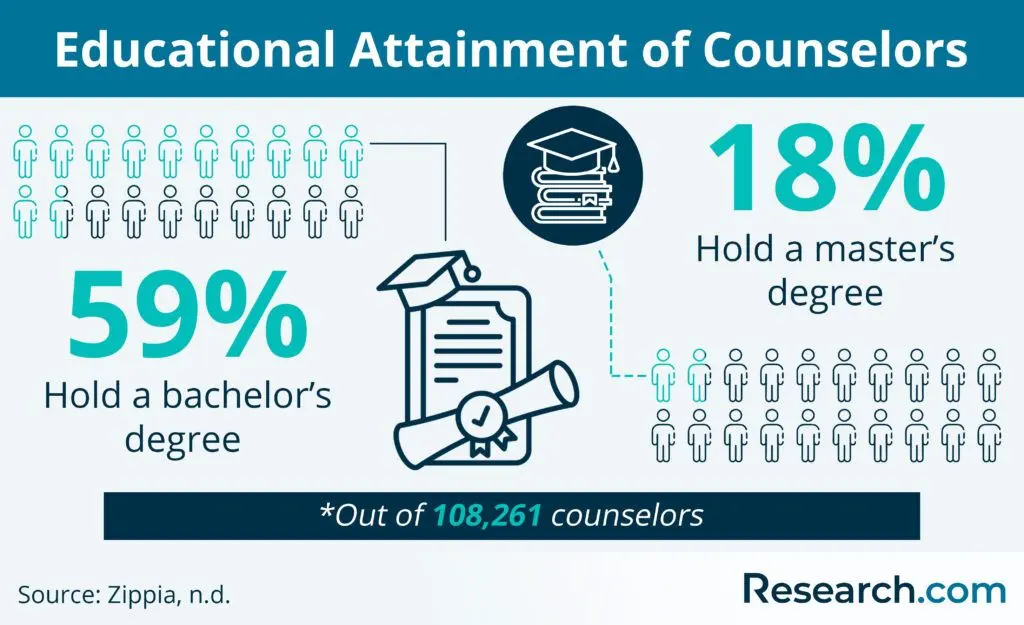
The image below indicates that among counselors, 59% hold a bachelor's degree. It also shows that 18% hold a master's degree, which is often important for clinical practice and more advanced counseling positions. The chart includes 108,261 counselors and reflects how education level can shape access to different roles.
Choosing a counseling program: what to compare before enrolling
| Selection factor | What to check | Common mistake to avoid |
| Accreditation | Confirm institutional accreditation and whether the counseling program aligns with CACREP or state requirements. | Assuming every online counseling degree leads to licensure. |
| Licensure alignment | Ask whether graduates meet education requirements in your state. | Enrolling before checking your state board’s rules. |
| Field placement support | Find out who arranges practicum and internship sites. | Discovering too late that you must find placements alone. |
| Total cost | Compare tuition, fees, residency requirements, travel, books, and lost work time. | Looking only at per-credit tuition. |
| Format | Decide whether online, hybrid, evening, or campus study fits your responsibilities. | Choosing speed over fit, support, and licensure quality. |
| Outcomes | Ask about licensure exam preparation, completion rates, employment support, and alumni roles. | Relying only on rankings or advertising claims. |
How can aspiring counselors accelerate their education and training?
Students who want to enter counseling as quickly as possible should look for legitimate time-saving options, not shortcuts that weaken licensure eligibility. Accelerated, online, and competency-based formats may help some students move faster, but only if the program still meets state education and clinical training standards.
One possible route is a fast-track program with compressed terms or flexible pacing. Students comparing these options can review fastest online counseling degree pathways to understand how accelerated study may affect workload, field placement timing, and licensure planning.
Students can also reduce delays by transferring eligible credits, choosing a program with strong internship coordination, preparing early for licensing exams, and selecting supervised placements that match their intended specialty. Speed matters, but licensure fit matters more.
What are alternative careers for graduates of counseling degrees?
A counseling background can prepare graduates for several helping, education, healthcare, and social service roles. Some require additional credentials, while others may be available with related experience.
- Health Education Specialist: Creates wellness and prevention programs for communities or organizations ($62,860).
- Marriage and Family Therapist: Supports couples and families through emotional, relational, and behavioral concerns ($58,510).
- Probation Officer: Supervises and supports people on probation or parole while promoting rehabilitation ($61,800).
- Psychologist: Studies behavior, emotion, cognition, and mental processes, often requiring advanced graduate training ($92,740).
- Registered Nurse: Provides patient care and teaches individuals or communities about health conditions ($86,070).
- Rehabilitation Counselor: Helps people with disabilities pursue independence, employment, and daily living goals ($44,040).
- School and Career Counselor: Helps students plan academic pathways, careers, and transitions ($61,710).
- Social and Community Service Manager: Leads programs that serve families, communities, or specific populations ($77,030).
- Social and Human Service Assistant: Provides support in psychology, rehabilitation, social work, and community service settings ($41,410).
- Social Worker: Helps people manage life challenges and connect with resources ($58,380).
Graduates who want research, teaching, assessment, or advanced clinical specialization may eventually consider a doctorate degree in psychology, depending on career goals and licensing requirements.
What is the earning potential for addiction recovery counselors?
Addiction recovery counseling can be a strong fit for professionals who want to work with clients facing substance use disorders, relapse risk, family disruption, and long-term recovery needs. Pay varies by state credential, employer, treatment setting, and experience. Counselors who add specialized training in substance dependency, group counseling, motivational interviewing, and evidence-based recovery models may become more competitive for higher-responsibility roles.
Students comparing this specialty can review careers in addiction recovery salary information to understand how job title, credential level, and local demand can affect earnings.
What advanced career opportunities can elevate a counselor’s professional trajectory?
After licensure, counselors can move beyond direct service roles into supervision, program leadership, clinical training, consulting, teaching, specialization, or private practice. These paths usually require experience, strong ethical judgment, and sometimes additional credentials.
Advanced opportunities may include becoming a clinical supervisor, opening a group practice, leading a behavioral health program, consulting for schools or agencies, teaching adjunct courses, or specializing in trauma, addiction, couples work, grief, or career development. Counselors comparing timelines for therapy-related professions can review how long does it take to become a therapist.
How can counselors integrate telehealth and digital tools to expand their practice?
Telehealth is now part of mainstream counseling practice, especially for clients who face transportation barriers, rural access gaps, scheduling challenges, or limited local provider options. Counselors who offer virtual care must understand privacy requirements, emergency protocols, informed consent, secure platforms, and state practice rules.
Digital tools can support scheduling, documentation, outcome tracking, psychoeducation, and between-session exercises. However, counselors should avoid using technology in ways that compromise confidentiality or exceed their competence. Students interested in online therapy training and family-focused virtual care can compare programs such as the best online MFT programs to see how digital delivery is addressed in related fields.
| Digital practice area | What counselors should consider |
| Telehealth sessions | Use secure platforms, confirm client location, and plan for emergencies. |
| Online documentation | Protect records and follow employer, legal, and ethical requirements. |
| Client communication | Set clear policies for email, messaging, cancellations, and response times. |
| Outcome tools | Use assessments responsibly and explain how results support treatment planning. |
| Cross-state practice | Verify whether you are legally allowed to serve a client located in another state. |
Is a counseling degree worth it?
A counseling degree can be worth it for students who are committed to mental health work, understand the licensing timeline, and choose a program that supports their target credential. The field offers meaningful work and strong demand in several specialties, but it also requires emotional stamina, graduate-level study, supervised experience, and careful financial planning.
In 2024, over 52 million adults in the United States sought mental health counseling. Employment is also expected to increase by 16% from 2024 to 2034, which is much faster than the average for all other professions. The median annual wage for substance abuse, behavioral disorder, and mental health counselors was $59,190 in 2024, with the potential to earn over $95,400 for top earners.
Who should consider a counseling degree?
- Students who want a client-facing career focused on mental health, behavior, education, or recovery.
- People who are prepared for graduate school, supervised practice, and state licensing requirements.
- Professionals who can manage emotionally complex conversations while maintaining boundaries.
- Students who have confirmed that their chosen program aligns with their state’s licensing rules.
Who may want a different path?
- Students who want a quick credential without graduate study or supervised hours.
- People who prefer administrative, research, or policy work over direct client interaction.
- Students who cannot complete required field placements due to schedule, location, or state limitations.
- People who are uncomfortable with crisis situations, documentation, or strict ethical requirements.
How can counselors prevent burnout and maintain well-being in their profession?
Counseling can be rewarding, but constant exposure to trauma, grief, conflict, crisis, and emotional pain can increase burnout risk. Sustainable counselors treat self-care as a professional responsibility, not a luxury.
- Maintain boundaries: Set realistic availability, avoid taking responsibility for every client outcome, and protect personal time.
- Use supervision and consultation: Discuss difficult cases with qualified supervisors or peers instead of carrying the emotional load alone.
- Monitor caseload intensity: Balance high-acuity cases when possible and recognize when your workload is becoming unsafe.
- Keep learning: Continuing education can refresh clinical skills and reduce the stress that comes from feeling unprepared.
- Build restorative habits: Exercise, rest, hobbies, relationships, reflection, and time away from work help sustain long-term practice.
- Seek support early: Counselors can also benefit from therapy, peer groups, mentoring, or employee assistance resources.
Should I pursue an LCSW or LPC for my counseling career?
The better choice depends on the kind of work you want to do. A Licensed Professional Counselor path typically focuses on counseling theory, therapy techniques, assessment, and mental health treatment. A Licensed Clinical Social Worker path often includes therapy but may also emphasize case management, social systems, advocacy, and community resources.
Students who want a therapy-centered counseling identity may prefer the LPC route, while students who want broader clinical social work opportunities may prefer the LCSW route. Scope of practice, insurance rules, state licensing requirements, and employer preferences vary, so compare both carefully. For a focused credential comparison, read Is LCSW or LPC better?
| Credential path | Often emphasizes | May be a good fit if you want to |
| LPC | Mental health counseling, therapy methods, diagnosis-related treatment planning, client change processes | Provide counseling services in clinical, agency, school, or private practice settings |
| LCSW | Clinical social work, systems, case management, advocacy, therapy, community resources | Combine therapy with social services, healthcare systems, policy, or community-based support |
What strategies can boost a counselor’s private practice success?
Private practice requires both clinical skill and business discipline. Licensed counselors who want to work independently must understand legal structure, insurance, billing, referrals, documentation, marketing ethics, client retention, and risk management.
- Define a clear specialty, such as anxiety, couples work, grief, trauma, addiction recovery, or career transitions.
- Build referral relationships with physicians, schools, attorneys, community agencies, and other clinicians.
- Create ethical online visibility through a professional website, accurate directory profiles, and clear service descriptions.
- Set policies for fees, cancellations, telehealth, documentation, emergencies, and client communication.
- Track revenue, expenses, taxes, insurance, and caseload capacity before expanding.
- Continue improving clinical methods so business growth does not outpace quality of care.
Counselors considering independent practice can review how much do therapists make private practice to understand how compensation can vary when earnings depend on caseload, fees, expenses, payer mix, and business model.
How does location impact grief counselor salary?
Grief counselor salary can vary by geography because client demand, cost of living, employer type, funding, and provider availability differ by region. Students planning a grief counseling career should compare local job postings, licensing rules, and compensation expectations before choosing a work setting.
- Urban areas: Pay may be higher where demand, employer concentration, and living costs are greater.
- Rural areas: Salaries may be lower in some regions, although provider shortages can create opportunities.
- High-cost regions: Employers may offer higher pay to reflect local living expenses.
- Regional demand: Areas with more hospitals, hospices, behavioral health clinics, or large populations may offer more grief counseling roles.
Students interested in this specialty can learn more about grief counselor salary and the steps connected to grief counseling careers.
What specializations are available for counselors in terms of faith-based counseling?
Faith-based counseling integrates spiritual values, religious identity, and mental health support when that approach fits the client’s needs and consent. Christian counseling is one example, but faith-informed counseling may also be practiced in other religious or spiritual contexts.
Counselors interested in this path should understand both clinical ethics and the limits of spiritual integration. The client’s beliefs should guide the process; counselors should not impose their own views. Students who want to explore this area can review how to become a Christian counselor.
What are the financial considerations for online counseling programs?
Online counseling programs can be convenient, but students should compare the full cost and licensure value before enrolling. Tuition is only one part of the price. Fees, residencies, technology requirements, travel, books, supervision costs, exam fees, and lost work hours can change the real investment.
Students should also ask whether online learners receive the same field placement support, advising, licensure guidance, and career services as campus students. A low tuition price is not a good deal if the program does not support your intended license. To compare cost-conscious options, review the most affordable online masters in mental health counseling.
How can I choose an affordable substance abuse counseling degree program?
An affordable substance abuse counseling program should still meet academic, licensing, and workforce expectations. Start by confirming accreditation and state credential alignment. Then compare the curriculum, internship requirements, faculty experience, student support, and total cost.
Look for courses in addiction theory, counseling techniques, group work, ethics, co-occurring disorders, relapse prevention, family systems, and case documentation. Ask whether the program helps students find field placements in addiction treatment or behavioral health settings. Students comparing cost-focused options can review an affordable substance abuse counseling degree online.
Benefits of online school counseling programs
Online school counseling programs can help working adults, parents, and career changers pursue graduate study without relocating. They can be especially useful for students who need schedule flexibility, but they still require careful licensure and field placement planning.
- Flexible scheduling: Many online programs include asynchronous coursework, which can help students balance school with work and family responsibilities.
- Access beyond your local area: Online learning can make it possible to compare programs in other states, as long as the program supports your licensure goals.
- Potential cost savings: Students may reduce commuting, relocation, and campus-related expenses, though fees and residency costs should still be reviewed.
- Technology-supported learning: Virtual simulations, recorded lectures, video meetings, and digital resources can help students practice and review counseling concepts.
- Field placement planning: Online students should confirm how internships are arranged in local schools or approved settings.
Common mistakes to avoid when becoming a counselor
| Mistake | Why it can be costly | Better approach |
| Choosing a program before checking state licensure rules | You may graduate without meeting the requirements for the license you want. | Contact the state licensing board and ask the school for written licensure alignment information. |
| Focusing only on tuition | Fees, residencies, exam costs, supervision expenses, and lost work time can change the real cost. | Calculate total program cost and compare financial aid options. |
| Assuming online automatically means easier | Online counseling programs still require fieldwork, deadlines, clinical skill practice, and intensive reading. | Review weekly workload, synchronous meeting requirements, and placement expectations. |
| Ignoring field placement support | Practicum and internship delays can postpone graduation or licensure. | Ask who secures placements and what happens if local sites are limited. |
| Relying only on rankings | A highly ranked program may not fit your state, budget, schedule, or specialty. | Use rankings as one input, not the deciding factor. |
| Assuming salary outcomes are guaranteed | Pay varies by role, location, employer, license, and experience. | Compare local job postings and talk with professionals in your target specialty. |
Questions to ask before enrolling in a counseling program
- Does this program meet the educational requirements for my intended license in my state?
- Is the institution accredited, and is the counseling program aligned with recognized professional standards?
- How many practicum and internship hours are required, and who helps secure placements?
- What percentage of students complete the program and pursue licensure?
- What licensing exam preparation is included?
- Are there in-person residency requirements, and what do they cost?
- Can I attend part time if I need to keep working?
- What support is available for online students?
- How does the program prepare students for telehealth, crisis work, ethics, and documentation?
- What is the total estimated cost, including fees and fieldwork-related expenses?
References:
- American Association for Marriage and Family Therapy. (n.d.). What is Marriage and Family Therapy?
- Council for Accreditation of Counseling and Related Educational Programs. (2026). Annual Reports and Vital Statistics Reports. CACREP
- Statista. (2024). Mental health treatment or therapy among U.S. Adults 2002 - 2024. Statista
- School and Career Counselors and Advisors: Occupational Outlook Handbook. (2024, April 17). U.S. Bureau of Labor Statistics.
- Substance Abuse, Behavioral Disorder, and Mental Health Counselors: Occupational Outlook Handbook. (2024, April 17). U.S. Bureau of Labor Statistics.
- National Alliance on Mental Illness. Mental health by the numbers. (2024). NAMI
- What Does a Career Facilitator Do? | CCE. (2024). Cce-Global.org.
- SAMHSA, C. for B. H. S. and Q. (2024). Key substance use and mental health indicators in the United States: Results from the 2024 National Survey on Drug Use and health. SAMHSA
- Marquette University. (2025, November 7). Why clinical mental health counseling is one of the fastest-growing careers in America. Marquette University Online.
- Public attitudes toward mental health in the United States. (2025). American Psychological Association.
- Zippia. (n.d.). 15 Essential Counselor Skills for your Resume and Career.
Key insights
- Becoming a counselor usually requires a bachelor’s degree, a counseling-related master’s degree, supervised clinical experience, a licensing exam, and state approval.
- Licensure rules are not identical across states. Always verify requirements before choosing an online or campus program.
- Demand is strongest in several mental health and behavioral health areas, with substance abuse, behavioral disorder, and mental health counselors projected to grow 22% from 2024 to 2034.
- Salary depends heavily on specialty, setting, location, license level, and experience. Median wages cited include $59,190 for substance abuse, behavioral disorder, and mental health counselors and $65,140 for school and career counselors.
- Accreditation, field placement support, licensure alignment, and total cost matter more than convenience alone when comparing counseling programs.
- Online counseling programs can be a practical option, but students must confirm internship arrangements, state eligibility, residency requirements, and technology expectations.
- Counseling can be personally rewarding, but burnout prevention, supervision, boundaries, and self-care are essential for a sustainable career.
Other Things You Should Know About How to Become a Counselor
In 2027, counselors can specialize in areas like school counseling, marriage and family therapy, substance abuse, mental health, and rehabilitation counseling. Each specialization may require additional certifications or coursework, often governed by state or professional associations.
In 2027, while a psychology degree can provide a strong foundation, it is not strictly necessary to become a counselor. A master’s degree in counseling or a related field, along with meeting specific state licensure requirements, is typically essential.
To become a licensed counselor in 2027, you typically need a master's degree in counseling or a related field. Accredited programs, in addition to coursework, require supervised clinical experience. Specific requirements may vary by state, so checking the guidelines for your location is essential.


