
2027 Licensed Professional Clinical Counselor (LPCC) Salary by State

Co-Founder and Chief Data Scientist
Licensed professional clinical counselors (LPCC) risk losing out on strong earning potential in 2027 if they overlook how pay differs by state. Missing this insight could mean accepting a lower LPCC salary than their skills deserve.
The Bureau of Labor Statistics reports a median annual wage of $53,710 for counselors in mental health–related fields, yet actual pay varies greatly across the U.S. This article examines LPCC salaries state by state, prepared with expert career planning insights to guide readers toward the locations that offer the best opportunities and help them avoid undervalued positions.
Key Benefits of Becoming a Licensed Professional Clinical Counselor
- Opens the door to specialized roles such as mental health counselor, clinical therapist, or behavioral health consultant across diverse settings.
- Offers a strong earning outlook, with the median annual wage for counselors in mental health–related fields reported at $53,710 by the Bureau of Labor Statistics.
- Provides the opportunity to make a meaningful impact by helping individuals manage challenges, improve well-being, and build healthier lives.
- What is the average LPCC salary in the United States? Average Salary
- How does LPCC salary vary by state? Salary by State
- What are the highest paying states for LPCCs? Highest-Paying States
- How do experience levels affect LPCC salaries? Experience
- Do LPCC specializations increase earning potential? Specializations
- What industries employ LPCCs and how do salaries differ? Industries
- How does education and licensing impact LPCC salary? How does education and licensing impact LPCC salary?
- What is the job outlook for LPCCs in 2027? Job Outlook
- How do benefits and perks compare across LPCC jobs? Benefits & Perks
- How can LPCCs increase their salary over time? How can LPCCs increase their salary over time?
- How Reliable Is LPCC Salary Data and What Should You Consider? How Reliable Is LPCC Salary Data and What Should You Consider?
What is the average LPCC salary in the United States?
Becoming a Licensed Professional Clinical Counselor is both a career and a financial decision. You may be weighing graduate school costs, supervised-hour requirements, state licensure rules, and the reality of working in mental health care. Salary matters because LPCCs often invest years in education and training before they can practice independently.
This guide explains what LPCCs earn, why pay varies so widely, which states and settings tend to pay more, and how experience, specialization, benefits, and licensure affect long-term income. It is designed for students considering counseling programs, associate-level counselors planning their next move, and licensed clinicians comparing job offers or private practice options.
Quick answer
The average Licensed Professional Clinical Counselor salary in the United States is about $53,710 per year, based on recent Bureau of Labor Statistics data for mental health and related counseling occupations. That number is a national reference point, not a guaranteed salary. New counselors, provisional license holders, and clinicians in lower-funded settings may earn less, while experienced LPCCs, supervisors, private practitioners, and specialists may earn more.
The biggest salary drivers are location, employer type, years of experience, full licensure, clinical niche, and whether the counselor works for an organization or operates a private practice. Hospitals, large healthcare systems, specialty outpatient programs, private practice, and telehealth can offer stronger earning potential than some nonprofit, school-based, community, or residential roles.
A smart salary comparison looks beyond the headline figure. Review local job postings, benefits, cost of living, supervision support, caseload expectations, loan repayment options, and state license rules before deciding whether the LPCC path fits your financial goals. The same careful approach applies when comparing very different careers, such as becoming a DEA agent, where salary must be weighed against training, risk, location, advancement, and long-term fit.
| Salary factor | How it affects LPCC earnings |
| State and metro area | Compensation can be higher in regions with strong demand, large health systems, workforce shortages, or higher reimbursement rates, though living costs may reduce the real value of the paycheck. |
| Experience | Early-career counselors commonly start lower on the pay scale, while seasoned clinicians may qualify for supervision, leadership, consulting, or independent practice income. |
| Employer setting | Hospitals, specialty clinics, private practice, and telehealth may provide higher income potential than some community agencies, residential programs, or nonprofit roles. |
| Specialized training | Focused expertise in trauma, substance use, crisis response, family therapy, or child and adolescent counseling can improve marketability and referral opportunities. |
| Licensure level | Fully licensed LPCCs may be able to practice independently, bill for services, supervise others, or qualify for roles that provisional counselors cannot access. |
How does LPCC salary vary by state?
LPCC salaries differ substantially from one state to another. Higher-paying states may have larger urban markets, more competitive healthcare employers, expanded behavioral health funding, or shortages of licensed mental health professionals. Lower-paying states may have smaller markets or different service funding models, but they may also have lower housing and everyday living costs.
For that reason, state salary comparisons should always include cost of living. A high salary in an expensive city can leave less disposable income than a lower salary in a more affordable area. Before relocating for an LPCC job, compare rent or mortgage costs, taxes, commuting, health insurance, caseload size, supervision availability, and whether your license will be recognized or require additional steps.
This kind of comparison is useful in many education and career decisions. For example, students researching the fastest online CCNA training bootcamps should not judge programs by speed alone; cost, credential value, employer demand, and career goals matter as well.
Highest paying states for LPCCs
States such as California, New Jersey, and New York are often linked with stronger counselor pay because they have dense populations and major healthcare markets. However, those states can also have high living expenses, so a larger salary does not automatically mean better financial outcomes.
Lowest paying states for LPCCs
Some Southern and Midwestern states, including Mississippi or Arkansas, tend to report lower average counselor wages. That may reflect smaller employer markets, fewer specialized clinical settings, or different public funding structures. Lower living costs can partly narrow the gap, but counselors should still review local job postings before making assumptions.
Regional trends to watch
Coastal states and large metropolitan regions often provide higher compensation than rural areas. Western and Northeastern states may exceed the national average, while some parts of the Midwest and South may fall below it. LPCCs who are open to relocation, underserved-area work, hospital employment, or telehealth may have more ways to improve income.
What are the highest paying states for LPCCs?
LPCC-related salaries are often strongest where demand for behavioral health care is high and employers compete for licensed clinicians. Based on recent 2025 data, the following states are among the higher-paying locations for LPCC-related roles.
| State | Reported average LPCC salary | Hourly equivalent | Possible reason for stronger pay |
| Washington | About $111,900 per year | $53.80 per hour | Robust healthcare systems and ongoing state mental health investments |
| Oregon | Roughly $110,900 annually | $53.33 per hour | Need for more accessible behavioral healthcare services |
| Maine | About $110,200 per year | $53.00 per hour | Clinician shortages within a smaller state labor market |
| Arizona | $109,400 annually | $52.61 per hour | Population growth and expanding healthcare services in markets such as Phoenix |
| Michigan | Around $105,900 per year | $50.92 per hour | Opportunities in Detroit, Grand Rapids, hospitals, clinics, and private practice settings |
These figures show that high LPCC pay is not limited to the most expensive coastal states. States with provider shortages, growing communities, and expanding behavioral health networks can also create competitive salary opportunities.
How do experience levels affect LPCC salaries?
Experience is one of the most predictable influences on LPCC pay. New counselors usually begin in lower-compensation roles while they complete supervised hours, improve clinical documentation, learn treatment planning, and build confidence with different client needs. As they gain experience, LPCCs may move into specialized clinical positions, supervision, program leadership, or private practice.
The credential creates access to the profession, but salary growth usually comes from proven competence, specialization, strong documentation, ethical practice, and the ability to manage complex cases. This is true in many skilled fields. Students comparing options such as affordable online welding trade school programs also need to evaluate long-term earnings, not only the initial training price.
| Career stage | Typical salary information | Common settings | Best next step |
| Entry level | Annual earnings around $43,000 | Community mental health agencies, schools, nonprofit programs, and support-focused clinical roles | Complete supervised hours, seek strong mentorship, improve assessment and documentation skills, and build a reliable counseling foundation. |
| Mid-career | Often within the 25th to 75th percentile range of about $58,500 to $88,000 per year | Outpatient clinics, group practices, healthcare organizations, and specialized counseling programs | Develop a marketable niche, document outcomes, pursue stronger clinical roles, and negotiate based on expertise. |
| Experienced or senior level | Top earners can make between $101,500 and $113,500 annually | Private practice, hospitals, supervisory roles, clinical leadership, and consulting | Move into supervision, program management, training, private practice, advanced specialty care, or multiple income streams. |
Entry-level salaries
Newly licensed or associate-level counselors usually begin near the lower end of the salary range. These roles can still be strategically valuable because they provide supervised practice, exposure to real client needs, and the clinical habits required for independent work.
Mid-career salaries
After several years in practice, many LPCCs move into the $58,500 to $88,000 range. Counselors with experience in trauma, addiction, children and families, crisis care, or co-occurring disorders may have more leverage when applying or negotiating.
Experienced and senior-level salaries
The highest salaries are more common among LPCCs who supervise other clinicians, manage programs, work in hospitals, build a strong private practice, or develop a specialty that attracts consistent referrals. These roles require clinical judgment, ethical decision-making, strong records, and business or leadership skills.
Do LPCC specializations increase earning potential?
Specialization can raise LPCC earning potential when the training matches real employer needs, client demand, or reimbursement opportunities. A broad counseling foundation is essential, but clinicians who can serve a defined population or condition often become more competitive for specialized roles and private-practice referrals.
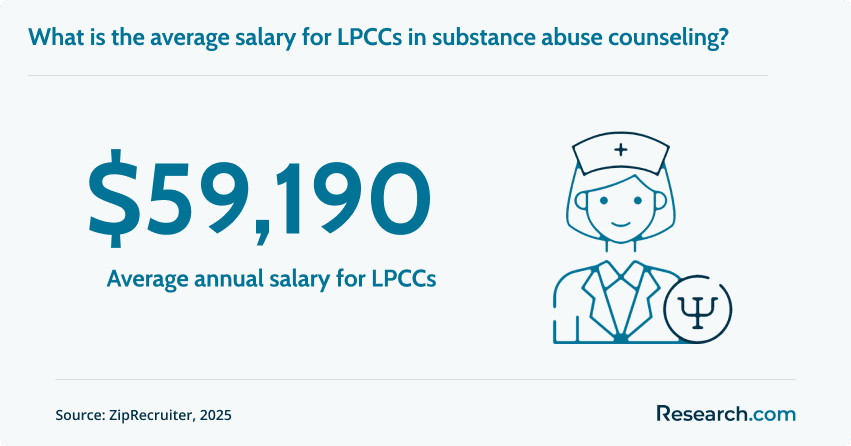
For example, LPCCs in substance abuse and behavioral disorder counseling earn about $59,190 per year, reflecting continued demand for addiction-related care. Trauma or crisis counseling can also support stronger compensation, with earnings commonly reaching $68,011/year. Child and adolescent therapy is another specialized area, with salaries frequently rising above the national median of $87,702 /year because the work requires knowledge of youth development, family systems, school concerns, and age-appropriate interventions.
Choose a specialization for strategic reasons, not just because a certificate is convenient. The best specialization helps you serve a specific client group, qualify for better positions, expand referral sources, or justify higher private-practice fees. That same logic applies to accelerated education options such as the fastest online homeland security degree programs: speed is useful only when the credential also supports credible career outcomes.
| Specialization | Reported salary information | Best fit for counselors who want to... |
| Substance abuse and behavioral disorder counseling | About $59,190 per year | Work in addiction treatment, recovery planning, relapse prevention, and co-occurring behavioral health care. |
| Trauma or crisis counseling | Earnings commonly reaching $68,011/year | Support clients experiencing acute distress, violence, grief, disaster exposure, or major life disruption. |
| Child and adolescent therapy | Salaries frequently rising above the national median of $87,702 /year | Serve children, teens, families, schools, developmental needs, and early-intervention cases. |
What industries employ LPCCs and how do salaries differ?
LPCCs work across healthcare, community, private, residential, and family-service settings. The work environment affects more than salary. It can shape schedule flexibility, documentation demands, benefits, caseload size, crisis exposure, supervision quality, and advancement options.
The largest employment categories include outpatient mental health and substance abuse centers (17%), offices of other health practitioners (17%), individual and family services (15%), residential facilities (9%), and hospitals (8%). Counselors should choose an employment setting based on both compensation and professional fit. For instance, hospitals may offer stronger benefits and clinical teams, while private practice may provide autonomy but less predictable revenue.
People with related operational or financial skills may also support behavioral health organizations outside direct counseling. A professional with a management accounting degree, for example, may work on budgeting, compliance, healthcare operations, or service planning.
| Employment setting | Share of counselors noted | Typical salary range or average | Good fit if you value... |
| Healthcare and hospital systems | About 8% | Typically between $70,000 and $80,000 per year | Team-based care, benefits, structured workflows, and complex clinical cases. |
| Outpatient mental health and substance abuse centers | 17% | Averaging $65,000 to $75,000 annually | Consistent counseling work, treatment-plan experience, and recurring client care. |
| Private practice or telehealth | Not listed as a separate percentage in the provided data | Often from $75,000 to over $90,000 depending on specialization and caseload | Autonomy, niche development, flexible scheduling, and business ownership. |
| Individual and family services | About 15% | Often $50,000 to $58,000 annually | Family systems work, child services, case coordination, and community-based support. |
| Residential treatment facilities | Roughly 9% | Usually $48,000 to $55,000 | Longer-term treatment, structured care, crisis support, and intensive client contact. |
| Offices of other health practitioners | 17% | Generally around $60,000 to $70,000 annually | Group practice, integrated wellness care, and collaboration with other providers. |
Healthcare and hospital systems
Hospitals can pay well because mental health support is needed across inpatient, outpatient, emergency, and integrated-care settings. These jobs may also include stronger benefits, retirement plans, and clearer promotion routes.
Outpatient centers and private practices
Outpatient centers provide a large share of counseling jobs and often give clinicians steady caseloads. Private practice and telehealth may increase income potential, but they require business planning, marketing, billing knowledge, insurance credentialing, and careful management of appointment volume.
Individual and family services
Individual and family service roles may pay less than hospital or private-practice positions, but they can be meaningful for LPCCs who want to work with families, children, vulnerable clients, and community-based programs.
Residential facilities
Residential treatment settings may offer more modest pay than some other environments, yet they can provide valuable experience in crisis response, long-term care planning, relapse prevention, and coordinated treatment.
Other health practitioners’ offices
Group practices and integrated wellness clinics can offer a balance between organizational employment and independent work. Compensation depends on the client population, payer mix, reimbursement model, specialty services, and clinician productivity expectations.
How does education and licensing impact LPCC salary?
Education and licensure are central to LPCC earning power. Most LPCCs need a master’s degree in counseling or a closely related field, and that graduate credential connects to the broader salary outlook for master’s degree holders. Entry-level positions for these graduates typically pay between $45,000 and $52,000 per year.
Advanced degrees such as a PhD or PsyD may open higher-paying paths in supervision, teaching, research, administration, or specialized clinical leadership. Salaries in those tracks can reach $70,000 to $85,000.
Licensure status can be just as important as the degree itself. Fully licensed LPCCs often have more income options than associate, intern, or provisional license holders because they may be eligible to practice independently, bill insurance, supervise clinicians, or start a private practice, depending on state regulations.
Continuing education can also strengthen salary potential when it builds skills employers and clients value. Training in trauma care, addiction counseling, telehealth, crisis response, child and adolescent therapy, or evidence-based treatment methods may help counselors qualify for specialized and better-compensated work.
| Credential or status | Why it matters for salary | What to check before investing |
| Master’s degree in counseling or related field | Often required for LPCC licensure pathways; entry-level roles typically pay between $45,000 and $52,000 per year | Confirm that the program is accredited and meets the coursework, practicum, and internship rules in your intended state. |
| Full state licensure | May expand access to independent practice, reimbursement, supervision, and higher-responsibility positions | Review supervised-hour requirements, exams, renewal rules, continuing education, and license portability. |
| PhD or PsyD | Can support salaries reaching $70,000 to $85,000 in supervisory or academic roles | Choose this route if you want teaching, research, administration, or advanced clinical leadership, not only one-on-one counseling. |
| Specialty certifications and continuing education | May improve competitiveness and support stronger offers or higher fees | Prioritize credentials recognized by employers, insurers, referral partners, or the client population you plan to serve. |
What is the job outlook for LPCCs in 2027?
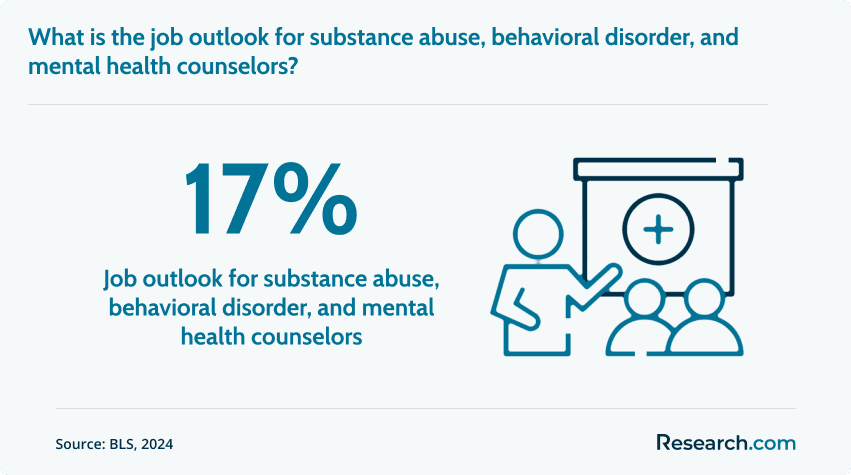
The outlook for Licensed Professional Clinical Counselors remains strong. The U.S. Bureau of Labor Statistics projects employment of substance abuse, behavioral disorder, and mental health counselors to grow about 17% from 2024 to 2034, which is much faster than the average for all occupations.
Several forces are supporting demand: greater public awareness of mental health needs, more willingness to seek counseling, insurance coverage for behavioral health services, and care models that rely on outpatient, community-based, and integrated behavioral health treatment. LPCCs may find opportunities in outpatient clinics, hospitals, schools, community programs, residential facilities, and telehealth services.
About 48,300 openings per year are projected on average in mental health and substance abuse counseling fields. These openings include both newly created positions and roles that become available when workers leave the occupation. For students weighing education routes, the decision process is similar to comparing the fastest online graphic design degree programs: a quick path can help, but credential quality, practical preparation, demand, and employability determine the real value.
Current trends affecting LPCC salaries
- Telehealth is changing access and competition: Remote counseling can help clinicians reach more clients, but income depends on state practice rules, reimbursement policies, platform fees, privacy requirements, and caseload consistency.
- Employers need specialized clinical skills: Trauma, addiction, youth mental health, crisis intervention, and co-occurring disorder expertise can make an LPCC more competitive.
- License portability remains a planning issue: Counselors who want to relocate or serve clients across state lines should verify each state’s rules instead of assuming their license will transfer automatically.
- Documentation and compliance are becoming more important: Strong clinical notes, treatment plans, ethical billing, and outcome tracking can influence employability and advancement.
- AI may reduce administrative burden but not replace clinical judgment: Technology may support scheduling, documentation drafts, and client communication, but licensed counselors remain responsible for ethics, assessment, treatment decisions, and therapeutic relationships.
How do benefits and perks compare across LPCC jobs?
Base salary is only one part of an LPCC job offer. Health insurance, retirement contributions, paid leave, supervision, continuing education reimbursement, loan forgiveness eligibility, flexible scheduling, and manageable caseloads can change the real value of a position. Professionals comparing other graduate-level options, such as an MBA in construction management, face a similar trade-off: the highest salary is not always the best overall offer.
| Benefit or perk | Where it may be stronger | Why it affects total compensation |
| Healthcare coverage | Hospitals, government agencies, and large nonprofits | Medical, dental, and vision benefits can add meaningful value beyond wages. |
| Retirement plans | Government, education, and large healthcare employers | Pensions or 401(k) matching can contribute to long-term financial security. |
| Paid time off | Schools, government roles, and some large organizations | Time away from client work helps reduce burnout and improves career sustainability. |
| Loan forgiveness eligibility | Government and nonprofit positions | Eligible roles may help counselors manage graduate debt if the borrower and job meet program requirements. |
| Flexible schedule | Telehealth, group practice, and private practice | Schedule control can improve work-life balance, though income may depend on consistent bookings. |
| Supervision and continuing education support | Hospitals, larger clinics, and training-focused agencies | Employer-paid development can reduce out-of-pocket costs and speed professional growth. |
A job with a slightly lower salary may be a stronger long-term choice if it includes quality supervision, strong benefits, reasonable caseloads, and burnout protection. A higher-paying role may be less attractive if it comes with unstable hours, poor support, or unrealistic productivity demands.
How can LPCCs increase their salary over time?
LPCCs usually raise income through a combination of licensure progress, clinical skill development, strategic specialization, careful job selection, and business knowledge. Salary growth is rarely the result of one single move. It usually comes from a sequence of decisions that increase credibility, referral opportunities, and responsibility.
Experience is the foundation. As counselors gain years in practice, they may qualify for senior clinical roles, supervision, program management, clinical director positions, consulting, or private practice. That pattern aligns with broader master’s in clinical mental health counseling salary trends, where income often improves as credentials, judgment, and leadership capacity grow.
Practical ways to improve LPCC earning potential
- Reach full licensure efficiently: Track supervised hours carefully, meet exam and renewal requirements, and understand when your state allows independent practice.
- Select a specialization with market demand: Trauma, addiction, child and adolescent therapy, crisis counseling, family therapy, and telehealth skills may improve job options.
- Evaluate total compensation, not salary alone: Compare base pay, health insurance, retirement, PTO, supervision, loan forgiveness, continuing education, and caseload expectations.
- Become strong in documentation and compliance: Accurate notes, ethical billing, treatment planning, and privacy compliance matter in healthcare settings and private practice.
- Approach private practice as a business decision: Private practice can exceed $90,000 per year, but it requires marketing, billing, taxes, scheduling, insurance credentialing, and cash-flow planning.
- Use telehealth thoughtfully: Remote counseling can expand access, but LPCCs must follow state licensure laws, privacy standards, platform rules, and payer requirements.
- Negotiate with evidence: Bring local salary data, certifications, productivity metrics, clinical niche expertise, and leadership contributions to pay conversations.
- Add secondary income streams when appropriate: Experienced LPCCs may earn additional income through supervision, workshops, adjunct teaching, training, consulting, or program development.
Common mistakes that can limit LPCC income
| Mistake | Why it creates problems | Better decision |
| Choosing a graduate program without checking licensure alignment | You could finish the degree and still lack required coursework, practicum, internship, or supervised-hour eligibility for your state. | Verify state counseling board requirements before enrolling. |
| Judging job offers by salary only | A higher salary may come with poor benefits, heavy caseloads, weak supervision, or burnout risk. | Compare total compensation and workload expectations. |
| Assuming every online counseling program meets state rules | Licensure requirements vary and may include in-person clinical components or state-specific coursework. | Ask the school and state licensing board to confirm eligibility, preferably in writing. |
| Starting private practice before you are ready | Limited clinical experience or weak business planning can make income unstable. | Build clinical competence, referral sources, billing knowledge, and financial reserves first. |
| Ignoring cost of living | A high salary in a costly city may not improve day-to-day financial well-being. | Compare take-home pay, housing, taxes, transportation, insurance, and benefits. |
| Relying on one salary database | Different sources use different job titles, samples, locations, and reporting methods. | Cross-check BLS data, state reports, job postings, salary databases, and actual employer offers. |
How reliable is LPCC salary data and what should you consider?
LPCC salary data is helpful, but it is not perfect. National figures may combine related counseling occupations, and salary websites often group job titles such as “licensed professional counselor,” “mental health counselor,” “trauma therapist,” and “child and adolescent therapist.” Those labels may not match the exact LPCC scope of practice in every state.
For the most realistic estimate, use several sources and then compare them with active job postings in your target city or region. Consider cost of living, benefits, caseload expectations, supervision requirements, state license portability, and graduate school debt. If education cost is a major concern, reviewing the most affordable online counseling degrees can help you connect salary expectations with the total investment required.
Questions to ask before choosing an LPCC path or accepting a job
- Does the graduate program meet licensure requirements in the state where I want to practice?
- How many supervised clinical hours are required before I can become fully licensed?
- What do current LPCC job postings in my city actually pay?
- Does the employer provide supervision, continuing education support, and realistic caseloads?
- Are the benefits strong enough to make up for a lower base salary?
- Would a specialization improve my earning potential in my target market?
- Do I understand the financial realities of private practice, including billing, taxes, insurance, marketing, and cancellations?
- Will my license transfer if I move, or will I need additional coursework, exams, or supervised hours?
Here’s what graduates have to say about becoming an LPCC
- Athena: "Becoming an LPCC gave me work that feels deeply human. The demand for licensed counselors is clear, and I can see how therapy changes the lives of people going through difficult seasons."
- Robert: "The education and licensing process took real commitment, but it gave me a professional path with stability and room to advance. As more people seek mental health support, I believe the career has lasting value."
- May: "Flexibility has been one of the strongest parts of this career. LPCCs can work in clinics, hospitals, private practice, or telehealth while still doing work that helps clients heal and move forward."
References:
- U.S. Bureau of Labor Statistics. (2025). Substance abuse, behavioral disorder, and mental health counselors. Occupational Outlook Handbook. U.S. Department of Labor.
- ZipRecruiter. (2025). Child and adolescent therapist salary. ZipRecruiter.
- ZipRecruiter. (2025). Entry-level licensed mental health counselor salary. ZipRecruiter.
- ZipRecruiter. (2025). What is the average trauma therapist salary by state. ZipRecruiter.
- Zippia. (2025). Licensed professional counselor salaries. Zippia.
- Additional BLS listing: Substance abuse, behavioral disorder, and mental health counselors.
Key Insights
- The average Licensed Professional Clinical Counselor salary in the United States is about $53,710 per year, but local pay can differ widely by state, city, employer, licensure level, and specialty.
- Reported 2025 top-paying states include Washington, Oregon, Maine, Arizona, and Michigan, with average salaries ranging from around $105,900 to about $111,900 per year.
- Experience has a major effect on income: entry-level counselors may earn around $43,000, while senior LPCCs, supervisors, and private practitioners can reach much higher salary ranges.
- Specialization can improve earning power when it matches real demand, especially in substance abuse, trauma or crisis counseling, and child and adolescent therapy.
- Hospitals, outpatient centers, private practice, and telehealth may provide stronger earning potential, while community and residential roles may offer valuable clinical experience and mission-driven work.
- Full licensure is one of the most important financial milestones because it can expand access to independent practice, reimbursement, supervision, and higher-responsibility roles.
- The job outlook is favorable, with BLS projecting about 17% employment growth from 2024 to 2034 and about 48,300 openings per year in related counseling fields.
- The best LPCC salary decision is not simply choosing the highest-paying job or state. Compare total compensation, living costs, graduate debt, benefits, supervision, caseload, license portability, specialization value, and long-term career fit.
Other Things You Should Know About Licensed Professional Clinical Counselor (LPCC) Salary by State
In 2027, the average salary for Licensed Professional Clinical Counselors (LPCCs) across the United States is approximately $60,000 per year. However, this figure may vary based on location, level of experience, and additional certifications.
In 2027, LPCC salary variations across states are influenced by cost of living, state-specific licensing requirements, demand for mental health services, and funding for healthcare programs. States with higher living costs and urban centers often offer higher salaries to accommodate expenses and attract qualified professionals.
Yes, different states have varying licensing requirements for LPCCs in 2027. For instance, California requires passing the California Law and Ethics Exam, while Texas mandates the Texas Jurisprudence Exam. It's crucial to check specific state requirements before applying for licensure.


