
2027 Master's in Clinical Mental Health Counseling Salary

Co-Founder and Chief Data Scientist
Employment for mental health counselors is projected to grow by 17% from 2024 to 2034, a rate significantly faster than the average for all occupations (Bureau of Labor Statistics, 2025). This robust outlook underscores the increasing demand for licensed professionals dedicated to helping individuals with behavioral, emotional, and substance use disorders. As public awareness of mental health issues grows, so does the need for skilled practitioners, making it an opportune time for those considering a career in this rewarding field.
In this article, I will explain what the average clinical mental health counseling salary is, and how it is influenced by factors like experience, location, and certifications. I will also point out which career paths and specializations provide the highest compensation. These details will help you understand how a master's degree in clinical mental health counseling can lead to a stable and lucrative career.
Key Things To Know About Clinical Mental Health Counselor Salaries
- Average salaries for a clinical mental health counselor range from a median of $59,190, reported by the BLS, to over $72,000 according to other market-based sources.
- A counselor's geographic location is a major factor in compensation, with median salaries in the highest-paying states like California and New Jersey reaching over $74,000 annually.
- Employment for mental health counselors is projected to grow by 17% over the next decade, significantly faster than the average for all occupations, resulting in 81,000 new jobs.
- What is the average clinical mental health counseling salary? Average Salary
- Which states offer the highest clinical mental health counseling salary? Salary by State
- What sectors offer the highest salary for graduates with a master’s degree in clinical mental health counseling? Salary by Industry
- Which professional licenses have the strongest impact on salary growth? Which professional licenses have the strongest impact on salary growth?
- Which specializations pay the most for graduates with a master’s degree in clinical mental health counseling? Specializations
- How do salaries change with years of counseling experience? How do salaries change with years of counseling experience?
- What leadership roles provide the highest earnings for counselors? What leadership roles provide the highest earnings for counselors?
- Are there gender differences in clinical mental health counseling salary? Are there gender differences in clinical mental health counseling salary?
- What is the projected growth of the clinical mental health counseling industry over the next decade? Job Outlook
- Is a master’s degree worth the cost based on clinical mental health counseling salary data? Is a master’s degree worth the cost based on clinical mental health counseling salary data?
- Can affordable online counseling degrees drive career advancement? Can affordable online counseling degrees drive career advancement?
Clinical mental health counseling salary in 2026: what counselors can realistically earn
If you are considering a master’s degree in clinical mental health counseling, salary is one of the most important questions to answer before enrolling. The degree can lead to stable, meaningful work, but the financial return depends heavily on licensure, state, work setting, specialization, years of experience, and whether you eventually move into private practice or leadership.
This guide explains how much clinical mental health counselors earn, why salary sources report different numbers, which states and sectors pay more, and how credentials and specializations can change long-term income. It is written for prospective graduate students, current counseling students, associate-level counselors completing supervised hours, and licensed professionals planning their next career move.
You will also see how counseling pay compares across settings, what salary growth can look like over time, and how to evaluate whether a master’s program is worth the cost. While unrelated fields such as an MBA in operations management follow different career paths, they share one important lesson: compensation is rarely determined by the degree alone. Industry, location, specialization, and employer type shape the final salary.
Quick answer: what is the average clinical mental health counseling salary?
The average clinical mental health counseling salary depends on the data source. The Bureau of Labor Statistics reports a median annual wage of $59,190 for substance abuse, behavioral disorder, and mental health counselors as of May 2024. Private salary platforms show higher averages: ZipRecruiter lists an average annual salary of $72,203 as of September 2025, while Glassdoor reports an average of $72,478 for clinical mental health counselors.
The practical takeaway is simple: $59,190 is a useful national baseline, but licensed counselors in higher-paying states, private practice, healthcare systems, government roles, or specialized niches may earn more. New graduates usually earn less while completing supervised clinical hours, and fully licensed counselors generally have stronger salary mobility.
| Salary source | Reported figure | What it means for readers |
| Bureau of Labor Statistics | $59,190 median annual wage as of May 2024 | A national midpoint for the broader category of substance abuse, behavioral disorder, and mental health counselors. |
| ZipRecruiter | $72,203 average annual salary as of September 2025 | A market-based estimate that may reflect active job postings and self-reported compensation trends. |
| Glassdoor | $72,478 average annual salary | An employer and worker-reported estimate that may capture higher-paying roles not fully reflected in occupational medians. |
These numbers should not be read as guaranteed earnings. They are better used as planning benchmarks. Your actual salary will depend on licensure status, caseload, payer mix, employer budget, geography, experience, and whether your role includes supervision, program management, or specialized services.
For students still comparing graduate options, salary potential is one reason many people review the top educational counseling master’s programs online alongside clinical counseling pathways, especially if they are deciding between school-based, educational, and mental health counseling careers.
What entry-level salary can you expect after earning a master’s in clinical mental health counseling?
Entry-level pay is usually lower because new graduates are often not yet independently licensed. Most states require a period of supervised post-graduate clinical experience before counselors can practice independently, qualify for more roles, or bill certain payers without supervision.
According to PayScale, the average starting clinical mental health counseling salary is approximately $48,642. Salary.com reports that the typical entry-level salary for a licensed professional counselor ranges from $44,800 to $55,100, with a median of $49,500.
| Career stage | Typical salary information from the article data | Why pay changes |
| New graduate or associate-level counselor | Approximately $48,642 starting average according to PayScale | Supervised status may limit independent practice, billing privileges, and access to higher-paying roles. |
| Entry-level licensed professional counselor | $44,800 to $55,100, with a median of $49,500 according to Salary.com | Licensure improves employability, but early-career counselors are still building experience and caseload depth. |
| Fully licensed, experienced counselor | Can move toward national averages and higher-paying settings | Independent practice rights, specialization, supervisory responsibilities, and employer type become more important. |
The supervised practice period is often the financial bottleneck in this career path. It can be temporary, but students should plan for it before borrowing for graduate school. Ask programs how graduates typically complete supervised hours, whether the school supports placement, and what local associate-level roles usually pay.
What is the top 10% earning potential for clinical mental health counselors?
The highest earners usually move beyond generalist employee roles. They may build a private-pay practice, specialize in a high-demand clinical area, supervise other clinicians, work in government or corporate settings, or step into director-level leadership.
The BLS reports top 10% earning potential of over $98,210 for the broader counselor category. Glassdoor reports that private practice therapists average $111,606 annually, with top earners reaching up to $179,661. ZipRecruiter reports that forensic mental health counselors earn an average of $87,877, with the top 10% reaching $129,000. Glassdoor also lists Military and Family Life Counselor roles at an average of $122,788 per year.
| Higher-earning path | Reported salary figure | Who this path may fit |
| Top 10% of counselor earners | Over $98,210 according to the BLS | Licensed counselors with experience, strong credentials, and access to higher-paying markets. |
| Private practice therapist | $111,606 average; top earners up to $179,661 according to Glassdoor | Counselors comfortable with business operations, client acquisition, payer decisions, and clinical independence. |
| Forensic mental health counselor | $87,877 average; top 10% reaching $129,000 according to ZipRecruiter | Clinicians interested in courts, correctional systems, evaluations, and legally involved populations. |
| Military and Family Life Counselor | $122,788 average according to Glassdoor | Counselors prepared to serve military-connected individuals and families, often in structured organizational settings. |
High earnings are possible, but they usually require deliberate positioning. Counselors who want the upper end of the salary range should think early about licensure, specialization, referral networks, supervision credentials, and whether they prefer clinical, administrative, or entrepreneurial advancement.
Which states offer the highest clinical mental health counseling salary?
Location is one of the clearest salary drivers in clinical mental health counseling. State demand, cost of living, Medicaid reimbursement patterns, employer competition, and the supply of licensed clinicians all affect compensation. A counselor earning a high nominal salary in an expensive state may not necessarily have more spending power than a counselor earning slightly less in a lower-cost region.
Location-based pay differences are not unique to counseling. Professionals with a master’s degree in compliance, for example, may see very different compensation depending on whether they work in finance, healthcare, government, or another regulated industry. Counseling salaries work the same way: where you practice can matter almost as much as what you do.
Based on the data provided, these states rank among the highest-paying markets for clinical mental health counselors:
| State | Median annual wage | Decision note |
| California | $78,200 (BLS, 2025) | High pay potential, but students and counselors should weigh housing, taxes, and commuting costs. |
| New Jersey | $74,500 (BLS, 2025) | Strong salary market, especially for counselors near dense healthcare and metropolitan employment hubs. |
| Alaska | $71,400 (BLS, 2025) | Higher pay may reflect demand, geographic access issues, and recruitment needs. |
| Oregon | $70,300 (BLS, 2025) | A strong market for counselors, though local cost of living varies by region. |
| Washington | $67,600 (BLS, 2025) | Compensation can be attractive, particularly around larger healthcare systems and urban markets. |
Before relocating for a higher salary, compare take-home pay, rent or mortgage costs, health insurance, student loan payments, state licensing transfer rules, supervision requirements, and local job availability. A higher wage is helpful only if it improves your overall financial position.
How do federal or state funding changes influence counselor earnings?
Public funding affects counseling salaries because many counselors work in schools, community mental health agencies, government programs, hospitals, and nonprofit clinics. When funding expands, organizations may be able to add programs, hire more clinicians, improve retention packages, or raise compensation in hard-to-staff areas.
Medicaid coverage and reimbursement are especially important for agencies serving low-income clients. The expansion of Medicaid under the Affordable Care Act increased the number of people with mental health coverage, which contributed to greater demand for counseling services and influenced reimbursement opportunities. When budgets shrink, agencies may face hiring freezes, heavier caseloads, reduced services, or pressure to keep wages flat.
For job seekers, the practical question is not just “What does this state pay?” It is also “Who funds the employer?” A hospital system, federal agency, private group practice, school district, community clinic, and nonprofit counseling center may operate under very different budget constraints.
The following graph shows the top-paying states for clinical mental health counselors and reinforces how strongly geography can shape salary outcomes.
What sectors offer the highest salary for graduates with a master’s degree in clinical mental health counseling?
A master’s degree in clinical mental health counseling can lead to many settings, but pay varies by employer. Hospitals, outpatient centers, government agencies, schools, hospice programs, and marriage and family therapy settings may all value counseling skills differently. The best sector for you depends on whether you want clinical depth, predictable benefits, schedule flexibility, leadership potential, or private-practice income.
Understanding employer economics matters. Just as learning what is management accounting helps professionals interpret how budgets and operating decisions affect business outcomes, counselors benefit from understanding how reimbursement, grants, contracts, caseload expectations, and payer mix influence salaries.
Counselors who want to move toward management may also build complementary leadership skills. A fast-track organizational leadership bachelor's degree online is not a substitute for counseling licensure, but leadership training can be useful for professionals who later supervise teams, coordinate programs, or manage behavioral health operations.
| Sector or specialization | Reported salary data | Best fit for counselors who want... |
| Hospitals and outpatient care centers | Hospitals: $61,930 median annual wage (BLS, 2025); Outpatient Clinicians: $67,286 average according to ZipRecruiter | Interdisciplinary care, clinical structure, steady referrals, and possible benefits through larger employers. |
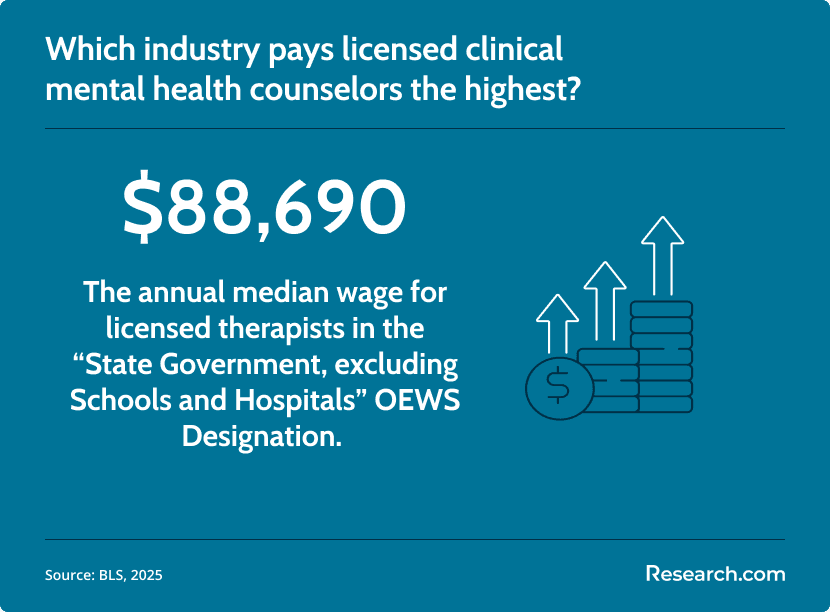
| Government | Some licensed counselor roles can reach over $80,000 annually; government-employed psychologists earned a median salary of $126,990 (BLS, 2025) | Stability, benefits, public service, and structured advancement ladders. |
| Educational services | School and career counselors earn a median salary of $65,140, with top earners making over $105,870 (BLS, 2025) | Work with students, academic systems, career planning, and school-based mental health needs. |
| Hospice and end-of-life care | Hospice Counselor average salary of $60,409; top 10% over $82,500 according to ZipRecruiter | Specialized work with grief, family systems, serious illness, and end-of-life support. |
| Marriage and family therapy | Marriage and family therapists earn a median annual salary of $63,780 (BLS, 2025) | Couples, families, relational dynamics, and systems-based therapy. |
The highest-paying setting is not always the best setting for every counselor. A hospital role may offer stability but less autonomy. Private practice may offer more upside but requires business risk. Government work may come with strong benefits but slower hiring. The right choice depends on your risk tolerance, preferred clients, schedule needs, and long-term career goals.
Which professional licenses have the strongest impact on salary growth?
Licensure is the main turning point in a counseling salary trajectory. A master’s degree provides the academic foundation, but state licensure determines whether you can practice independently, qualify for many roles, supervise others, or bill for services in certain settings. For many students, this is why counseling is considered a professional pathway rather than simply another graduate credential.
If you are comparing graduate programs based on income potential, it may help to review broader data on a master’s degree that pays well. For counseling specifically, however, the salary value of the degree depends on whether the program supports your state’s licensure requirements.
Licenses and certifications can affect compensation in different ways. Some establish legal practice authority, while others signal specialization. Students should distinguish between mandatory state licensure and optional professional certifications.
| Credential | Reported salary information | How it may support salary growth |
| National Certified Counselor | Offered by the National Board for Certified Counselors (NBCC); average salary of $60,034 annually (PayScale, 2025) | Demonstrates national professional recognition and may strengthen applications for some roles. |
| Certified Addiction Counselor | Offered by the Association for Addiction Professionals (NAADAC); average salary of $59,672, with top earners reaching over $78,000 annually (ZipRecruiter, 2025) | Useful for counselors working in substance use treatment, integrated care, recovery programs, and behavioral health agencies. |
| Certified Rehabilitation Counselor | Top 10% of earners in this field make over $77,200 (BLS, 2025) | Can support work with clients navigating disability, employment, rehabilitation, and independent living goals. |
| Certified Clinical Supervisor | Average annual salary for a clinical supervisor is $57,408, with top earners making over $78,000 (PayScale, 2025) | Can open doors to supervision, training, quality assurance, and management responsibilities. |
Before choosing a credential, ask whether it is required, preferred, or simply nice to have in your target job market. A certification that is valuable in addiction counseling may not matter as much in private couples therapy, school counseling, or hospital-based behavioral health.
Which specializations pay the most for graduates with a master’s degree in clinical mental health counseling?
Specialization can increase earning potential when it helps a counselor serve a population that has strong demand, limited provider supply, or higher reimbursement opportunities. The strongest specializations are not just interesting; they align with real client needs and clear referral sources.
Students interested in school-based work may also compare counseling pathways with the shortest school counseling master’s programs online. School counseling and clinical mental health counseling can overlap in purpose, but they often differ in licensure, work setting, and daily responsibilities.
| Specialization | Reported salary data | Important decision point |
| Trauma counseling | Average over $91,000 annually, with top earners making over $130,000 per year according to PsychologySchoolGuide.net | Requires strong clinical training, ethical scope of practice, and often advanced continuing education. |
| Sports psychology | National average salary of $92,813, with most salaries ranging from $66,500 to $117,000 according to ZipRecruiter | May require careful role alignment because sports psychology can overlap with psychology, counseling, performance coaching, and athletics consulting. |
| Industrial-organizational psychology | Median annual wage of $113,320 according to the BLS | This is often a psychology-oriented, workplace-focused path and may not map directly onto every counseling licensure route. |
| Grief counseling | Average clinical mental health counseling salary of approximately $64,500 for a grief counselor according to Salary.com | Can fit hospice, healthcare, private practice, bereavement centers, and family support roles. |
Specialization should be chosen strategically. A high salary estimate is not enough. Consider whether your state license permits the work, whether additional training is expected, whether employers are hiring for that niche, and whether you can build referral relationships in that area.
How do salaries change with years of counseling experience?
Counseling salaries tend to rise as professionals move from supervised practice to independent licensure, then into specialized, supervisory, or leadership roles. Experience improves clinical judgment, but it also improves employability. Senior counselors may be trusted with complex cases, program development, training responsibilities, and higher-value client populations.
Salary platform data show a steady progression. New graduates with less than one year of experience can expect a starting salary of approximately $45,000 to $49,000. Early-career counselors with 1–4 years of experience rise to around $50,000. Mid-career professionals with 5 to 9 years of experience reach average salaries of over $57,000.
More experienced counselors see the largest gains. Those with 10–19 years of experience can earn an average of over $67,000, while professionals with 20 or more years in the field can approach or exceed $90,000. The biggest jumps often occur when experience is paired with independent licensure, a strong specialty, supervisory credentials, private practice growth, or administrative responsibility.
| Experience level | Salary information from the article data | How to improve earning potential at this stage |
| Less than one year | Approximately $45,000 to $49,000 | Secure quality supervision, document clinical hours carefully, and choose roles that support licensure progress. |
| 1–4 years | Around $50,000 | Build competence with specific populations, pursue continuing education, and track measurable clinical outcomes. |
| 5–9 years | Over $57,000 | Consider specialization, supervision training, private practice options, or higher-paying healthcare and government settings. |
| 10–19 years | Over $67,000 | Move into program leadership, clinical supervision, consulting, or advanced specialty practice. |
| 20 or more years | Approaching or exceeding $90,000 | Leverage reputation, referral networks, leadership experience, and niche expertise. |
The graph below presents median annual pay for selected mental health care job titles and shows how compensation differs across the broader behavioral health field.
What leadership roles provide the highest earnings for counselors?
Leadership is one of the clearest ways for counselors to increase earnings without relying only on a larger caseload. Administrative and executive roles pay more because they involve clinical oversight, staffing, compliance, budgets, program quality, and organizational strategy.
For professionals who still need the graduate foundation for counseling roles, accelerated counselor education online programs may be worth comparing. Speed should not be the only factor, though. The program must still align with licensure requirements, fieldwork expectations, and accreditation considerations.
| Leadership role | Reported salary data | Common responsibilities |
| Chief Clinical Officer | $137,902 average annual salary, with top earners making over $207,500 according to ZipRecruiter | Oversees clinical strategy, service quality, compliance, staffing models, and organization-wide care standards. |
| Director of Behavioral Health | $124,587 average salary, with top earners making over $187,500 according to the Association of Professional Organizational Sociologists | Manages behavioral health departments, programs, budgets, teams, and care delivery systems. |
| Director of Counseling | $103,662 average salary, with top earners making up to $146,000 according to ZipRecruiter | Leads counseling departments, supervises staff, coordinates services, and manages operational goals. |
| Mental Health Administrator | $86,287 average salary, with top earners reaching over $124,500 according to ZipRecruiter | Handles practice operations, scheduling systems, policy implementation, reporting, and administrative performance. |
Leadership is best suited for counselors who enjoy systems work as much as direct care. These roles may involve fewer therapy hours and more meetings, personnel decisions, reporting, and accountability for outcomes. For the right professional, that trade-off can bring higher pay and broader impact.
Are there gender differences in clinical mental health counseling salary?
Yes. The counseling and mental health workforce includes a substantial number of women, but wage differences still appear in available salary research. The gap is often smaller than in some other professions, yet it remains important for workers, employers, and graduate students to understand.
Recent data cited in the article show that women earn 96 cents for every dollar earned by men as therapists and 94 cents for every dollar earned by men as psychologists. In a forensic psychology study, female forensic psychologists earned an average of $0.83 for every $1.00 earned by male counterparts.
Pay gaps can reflect many factors, including experience, hours worked, job setting, leadership representation, negotiation patterns, specialty area, and employer practices. However, research also suggests that disparities may persist even after accounting for some job-related differences, which points to broader structural and historical issues.
| Salary equity issue | Why it matters | Practical step for counselors |
| Unequal pay for similar roles | Small percentage differences compound over a career. | Use current salary data before accepting offers or annual raises. |
| Underrepresentation in higher-paying roles | Leadership and specialized roles often drive the highest salaries. | Seek supervision, management training, and transparent promotion criteria. |
| Limited salary transparency | Workers may not know whether their pay is competitive. | Compare offers by base pay, benefits, caseload, supervision, flexibility, and advancement path. |
The following chart visualizes the gender distribution of mental health counselors and shows the proportion of men and women in the profession.
What is the projected growth of the clinical mental health counseling industry over the next decade?
The employment outlook for mental health counselors is strong. Demand is being shaped by increased awareness of mental health needs, broader acceptance of counseling, integrated behavioral health models, and expanded access to care in many settings.
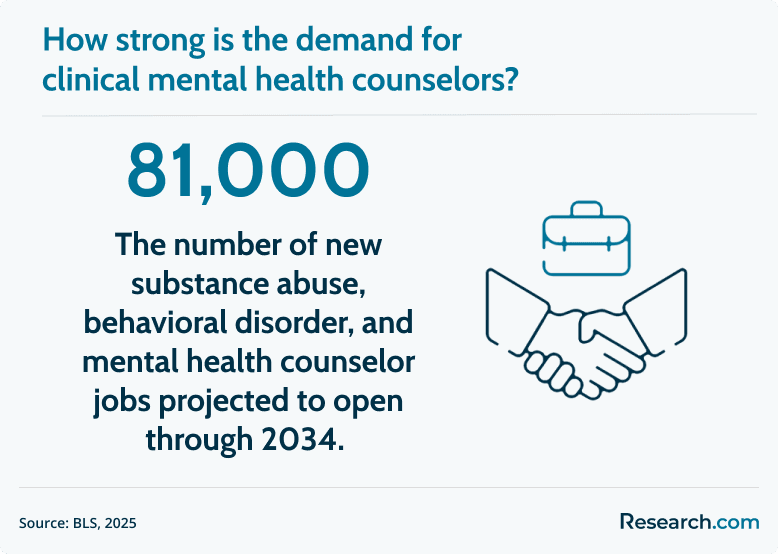
The BLS projects that employment of mental health counselors will grow by 17% from 2024 to 2034, creating 81,000 new jobs over the decade. This growth is expected to come from demand in hospitals, outpatient care, community agencies, employee assistance programs, schools, and other behavioral health settings.
Strong job growth does not mean every graduate will automatically earn a high salary. It means the labor market is expected to need more trained professionals. Counselors who complete licensure, build in-demand skills, and choose markets strategically will generally be better positioned than those who rely on the degree alone.
Current trends shaping counselor salaries and job options
- Greater use of telehealth: Virtual counseling has expanded access, but pay depends on employer model, state licensure rules, reimbursement, and whether the counselor works for a platform, agency, or private practice.
- Integrated behavioral health: More care settings are combining mental health services with primary care, hospitals, schools, and community programs, creating roles for counselors who can collaborate across disciplines.
- More attention to credential fit: Employers increasingly look for candidates whose degree, supervised hours, and license align with the population and setting served.
- Continued pressure on public systems: Community and school-based roles may have strong demand but can be affected by federal, state, and local funding decisions.
- Growing interest in specialization: Trauma, addiction, grief, family systems, and other focused areas can help counselors differentiate themselves in competitive markets.
Is a master’s degree worth the cost based on clinical mental health counseling salary data?
A master’s degree in clinical mental health counseling can be worth the cost for students who understand the licensure pathway, choose an appropriately aligned program, control debt, and plan for the lower-paid supervised period after graduation. It is not a degree to choose casually, because it usually requires graduate tuition, fieldwork, post-degree supervised hours, exam preparation, and state licensure fees before full earning potential is reached.
The total cost of a 60-credit master's program can vary widely. The article data places typical costs at $20,000–$40,000 for public universities and over $100,000 for private institutions. That difference can change the return on investment dramatically, even if two programs lead to the same license.
The salary case is strongest when the student graduates from a program that meets licensure requirements, avoids excessive debt, completes supervised hours efficiently, and moves into a stable or higher-paying setting. Licensed professionals earn a median of nearly $60,000, top earners make over $98,000 annually, and the field is projected to grow by 17% over the next decade.
Students who want to broaden their professional communication skills may also explore options such as a fastest professional writing degree online, but that type of credential serves a different purpose. It does not replace the graduate counseling coursework and supervised clinical requirements needed for mental health counseling licensure.
| ROI factor | Why it affects value | Question to ask before enrolling |
| Program cost | A lower-cost licensure-aligned program can improve long-term financial return. | What is the total tuition and fee cost for the full 60-credit master's program? |
| Licensure alignment | A degree that does not meet state requirements can delay or block your career plan. | Does this program meet the educational requirements for my intended state license? |
| Field placement support | Internships and practicum experiences are essential for graduation and career readiness. | Does the school help students secure approved clinical placements? |
| Supervised post-graduate hours | Early-career earnings may be limited until full licensure is complete. | How do graduates typically find supervised associate-level positions? |
| Local salary market | National averages may not reflect your state, city, or employer type. | What do entry-level and fully licensed counselors earn in my target area? |
| Debt load | Loan payments can reduce the practical value of a counseling salary. | How much will I need to borrow, and what monthly payment can I manage on an entry-level salary? |
Online vs. campus counseling programs: how the choice can affect cost and career progress
| Program format | Potential advantages | Potential drawbacks |
| Online counseling program | May offer scheduling flexibility, reduce relocation costs, and allow students to keep working while enrolled. | Students must confirm field placement support, state authorization, licensure alignment, and any in-person residency requirements. |
| Campus counseling program | May provide local clinical connections, in-person faculty access, and established practicum relationships. | May require commuting, relocation, or reduced work hours, which can increase total cost. |
| Hybrid counseling program | Can combine online coursework with periodic in-person training or local clinical experience. | Travel, residency schedules, and placement rules should be reviewed before enrollment. |
Common mistakes that can reduce your counseling salary return
- Choosing a program without checking licensure requirements: Always confirm that the curriculum fits the state where you plan to practice.
- Looking only at tuition: Fees, books, travel, residency requirements, lost wages, exam costs, and supervision-related costs can change the real price.
- Assuming online programs work in every state: State authorization and licensure rules vary, and online delivery does not automatically mean nationwide eligibility.
- Ignoring internship and practicum logistics: A program may be affordable but difficult to complete if you cannot secure approved clinical placements.
- Borrowing based on top-earner salaries: Plan around entry-level and associate-level pay first, then treat higher salaries as long-term potential.
- Choosing a specialization only because it sounds lucrative: High-paying niches require market demand, appropriate training, ethical competence, and often a strong referral base.
- Overlooking benefits: A slightly lower salary with strong health insurance, retirement contributions, paid supervision, or loan repayment support may be worth more than a higher base wage.
Can affordable online counseling degrees drive career advancement?
Affordable online counseling programs can support career advancement when they meet licensure requirements, provide credible clinical training, and help students avoid unnecessary debt. Lower borrowing can make a major difference in a field where many graduates begin in supervised roles before reaching full salary potential.
The key is quality and fit, not price alone. Students should compare accreditation, faculty experience, practicum support, state licensure alignment, graduation requirements, student support, and total program cost. Research.com’s guide to the most affordable online counseling degrees can be a useful starting point for identifying lower-cost options, but each program should still be checked against your state licensing board’s requirements.
How to choose a counseling program with salary and licensure in mind
- Start with your target state license. Identify the exact license you want and review education, practicum, internship, exam, and supervised-hour requirements.
- Confirm program alignment in writing. Ask the school whether its curriculum meets requirements in your state and whether there are restrictions for online students.
- Calculate total cost, not just tuition. Include fees, books, travel, residencies, technology, exam fees, and potential lost income.
- Ask about clinical placement support. Find out whether the school places students, provides leads, or expects students to find sites independently.
- Compare local salaries by career stage. Look separately at associate-level, fully licensed, specialized, private practice, and leadership roles.
- Evaluate debt against entry-level pay. Use conservative salary assumptions, especially for the supervised period after graduation.
- Look for specialization options that match your market. Trauma, addiction, grief, family systems, and other niches may improve opportunities when local demand exists.
- Ask about graduate outcomes. Request information on licensure exam preparation, employment settings, completion support, and alumni career paths.
References:
- Bureau of Labor Statistics. (2025). Marriage and Family Therapists. Occupational Outlook Handbook. https://www.bls.gov/ooh/community-and-social-service/marriage-and-family-therapists.htm
- Bureau of Labor Statistics. (2025). Psychologists. Occupational Outlook Handbook. https://www.bls.gov/ooh/life-physical-and-social-science/psychologists.htm
- Bureau of Labor Statistics. (2025). School and Career Counselors and Advisors. Occupational Outlook Handbook. https://www.bls.gov/ooh/community-and-social-service/school-and-career-counselors.htm
- Bureau of Labor Statistics. (2025). Substance abuse, behavioral disorder, and mental health counselors. Occupational Outlook Handbook. https://www.bls.gov/ooh/community-and-social-service/substance-abuse-behavioral-disorder-and-mental-health-counselors.htm
- Congress.gov. (2025). The Impact of Federal Support for School Mental Health Services. https://www.congress.gov/119/meeting/house/118317/documents/HHRG-119-ED00-20250604-SD003.pdf
- Counseling Psychology. (2025). Counselor Salary by State (Median Annual Counseling Pay). https://www.counselingpsychology.org/counselor-salary-by-state-median-annual-counseling-pay/
- Data USA. (2023). Mental health counselors. https://datausa.io/profile/soc/mental-health-counselors
- Glassdoor. (2025). Clinical Mental Health Counselor Salary. https://www.glassdoor.com/Salaries/clinical-mental-health-counselor-salary-SRCH_KO0,32.htm
- PayScale. (2025). Average Mental Health Counselor (MHC) Salary. https://www.payscale.com/research/US/Job=Mental_Health_Counselor/Salary
- PayScale. (2025). Salary for Certification: National Certified Counselor (NCC). https://www.payscale.com/research/US/Certification=National_Certified_Counselor_(NCC)/Salary
- Salary.com. (2025). Licensed Professional Counselor (LPC) Salary. https://www.salary.com/research/salary/benchmark/licensed-professional-counselor-lcpc-salary
- ZipRecruiter. (2025). Clinical Mental Health Counseling Salary. https://www.ziprecruiter.com/Salaries/Clinical-Mental-Health-Counseling-Salary
Key Insights
- The best salary benchmark is a range, not one number. The BLS median is $59,190, while ZipRecruiter and Glassdoor report averages above $72,000 for clinical mental health counselors.
- Licensure is the major salary divider. New graduates often start lower while completing supervised hours; fully licensed counselors have stronger access to independent practice, higher-paying roles, and advancement.
- Location can change the financial picture. California, New Jersey, Alaska, Oregon, and Washington show strong median wages, but cost of living and licensing rules should be considered before relocating.
- High earners usually specialize, lead, or practice independently. Private practice, forensic counseling, government roles, military family counseling, and executive behavioral health leadership can exceed general counseling salary levels.
- A master’s degree can be worth it, but only with cost control. A 60-credit program may cost $20,000–$40,000 at public universities or over $100,000 at private institutions, so debt should be compared against realistic entry-level and licensed salary expectations.
- Program fit matters as much as affordability. Before enrolling, confirm accreditation, licensure alignment, clinical placement support, state authorization, and total cost.
- Do not plan your finances around top-earner data. Use entry-level and median salaries for budgeting, then treat specialization, leadership, and private practice income as long-term upside.
Other Things You Should Know About Clinical Mental Health Counseling Salaries
The average salary for a first-year clinical mental health counselor with a master's degree in 2027 is approximately $50,000 to $55,000 annually, depending on geographical region and employer type. Urban areas tend to offer higher starting salaries compared to rural locations.
In 2027, salaries for clinical mental health counselors with a master's degree vary by location due to cost of living, demand for mental health services, and state funding for health initiatives. Urban areas and states with higher living costs typically offer higher salaries to match the expense of residing in those regions.


