
2027 Cost of Online MBA Programs

Co-Founder and Chief Data Scientist
The demand for professionals with advanced business knowledge and skills is increasing due to globalization, digital transformation, complex decision-making, and the need for specialized expertise. As a result, online MBA programs have become popular among those seeking to advance their careers.
However, the cost of online MBA degrees can be a barrier for many individuals. For this guide, my team and I looked into the current development and trends in the MBA industry to provide answers to questions like “How much does an MBA cost” and “How can I prepare for the financial challenges of an MBA degree”.
Key things you should know about the cost of online MBA programs
- According to a 2024 report on master’s degrees from the Education Data Initiative, the average cost of MBA programs was $60,410.
- Top-ranked programs in the U.S. charged an average of $253,179 in 2025.
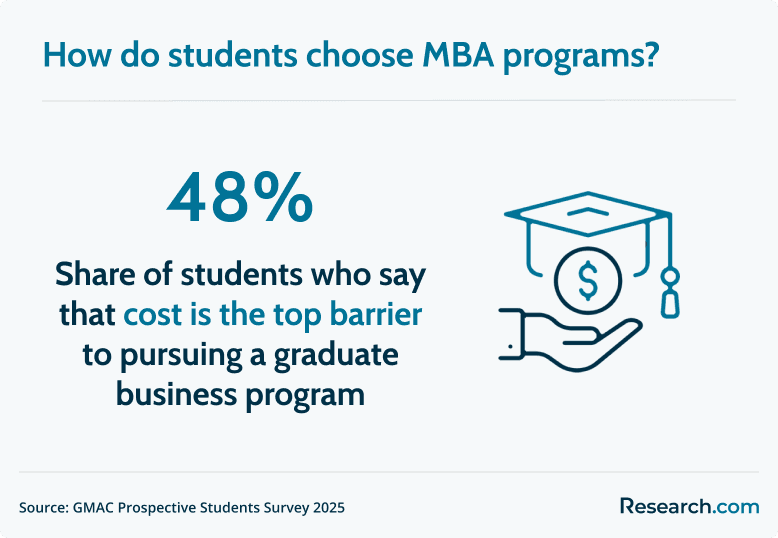
- 48% of candidates for GME degrees report cost as the top barrier that may prevent them from pursuing graduate business school.
- What is the average tuition cost of online MBA programs for 2025? Average Cost
- Are there additional fees associated with the cost of online MBA programs? Are there additional fees associated with the cost of online MBA programs?
- How do the costs of online MBA programs compare to traditional on-campus MBA programs? Online vs. On campus
- Do employers perceive online MBA degrees differently than on-campus degrees? Do employers perceive online MBA degrees differently than on-campus degrees?
- Are there any differences in cost between full-time and part-time enrollment for online MBA programs? Are there any differences in cost between full-time and part-time enrollment for online MBA programs?
- What are some common hidden costs and fees associated with online MBA programs? What are some common hidden costs and fees associated with online MBA programs?
- Are there any tips for students on managing their finances during their MBA studies? Are there any tips for students on managing their finances during their MBA studies?
- Do online MBA programs offer any flexible payment plans or installment options? Payment Plans
- What are some future trends that could impact the cost of online MBA programs? What are some future trends that could impact the cost of online MBA programs?
- What are the career outcomes and salary prospects for online MBA graduates? What are the career outcomes and salary prospects for online MBA graduates?
- What types of financial aid are available for students enrolled in online MBA programs? Financial Aid
- What are the financial considerations for international students pursuing an online MBA? What are the financial considerations for international students pursuing an online MBA?
- What are the factors influencing the cost of online MBA programs? What are the factors influencing the cost of online MBA programs?
- Can accelerated online MBA programs offer a cost-effective path to career advancement? Can accelerated online MBA programs offer a cost-effective path to career advancement?
- What is the role of specializations in reducing costs and maximizing ROI in online MBA programs? What is the role of specializations in reducing costs and maximizing ROI in online MBA programs?
- Which MBA specializations yield the highest salary growth? Which MBA specializations yield the highest salary growth?
- What are the cost-effective alternatives to traditional online MBA programs? What are the cost-effective alternatives to traditional online MBA programs?
- Can you excel in an online MBA program without taking the GMAT? Can you excel in an online MBA program without taking the GMAT?
- How can you verify the credibility and long-term value of an online MBA program? How can you verify the credibility and long-term value of an online MBA program?
- How can you effectively compare the overall cost efficiency of online MBA programs? How can you effectively compare the overall cost efficiency of online MBA programs?
What does an online MBA cost in 2026?
Choosing an online MBA is usually a financial decision before it becomes an academic one. Tuition can range from relatively affordable public university options to premium programs priced closer to elite campus-based MBAs, and the advertised tuition rarely tells the whole story. This guide explains what online MBA students should expect to pay, which fees often get missed, how online and campus costs compare, and how to judge whether a program is likely to be worth the investment.
According to a 2024 Education Data Initiative report on master’s degrees, the average cost of MBA programs is $60,410. That figure is a useful starting point, but it does not capture the full spread of online MBA pricing. BusinessBecause reported that top-ranked U.S. MBA programs charged an average of $253,179 in 2025. At the lower-cost end, the average cost for the most affordable online MBA programs in the country is around $310 per credit hour for out-of-state students.
Quick answer: how much should you budget for an online MBA?
For 2026 planning, students should treat tuition as only one part of the total cost of attendance. A realistic budget should include tuition, mandatory university fees, technology charges, books and software, residency or travel costs, health insurance if required, and the opportunity cost of reduced work hours. The best-value program is not always the lowest tuition option; it is the accredited program that fits your career goals, minimizes unnecessary debt, and provides credible employer value.
| Cost item | Why it matters | What to check before enrolling |
| Published tuition | This is the largest visible cost, but schools calculate it differently. | Ask whether tuition is charged per credit, per course, per semester, or as a flat program rate. |
| Mandatory fees | These can change the real cost even when tuition looks affordable. | Request the full cost of attendance, not just the tuition page. |
| Residency or immersion costs | Some online MBAs require campus visits, travel, lodging, and meals. | Confirm whether in-person components are required or optional. |
| Financing costs | Loans, payment plans, and late fees can raise the final amount paid. | Compare interest rates, repayment terms, and employer reimbursement rules. |
| Career value | A cheaper program may not be a better investment if it lacks recognition or career support. | Review accreditation, alumni outcomes, employer connections, and career services. |
Are there extra fees beyond online MBA tuition?
Yes. Online MBA students often pay several costs that are separate from base tuition. These fees vary by school, but they can materially change the total cost of attendance.
- Technology fees. Online programs may charge for learning platforms, remote student support, technical infrastructure, or software access.
- Books, cases, and course materials. MBA courses frequently use textbooks, business cases, simulations, databases, and digital resources that may not be included in tuition.
- Application fees. Many business schools charge a fee when you submit an application, even if you are not admitted.
- Exam or proctoring fees. Some courses require monitored exams, third-party testing services, or certification-related assessments.
- Graduation charges. Diploma processing, regalia, ceremony participation, and related graduation expenses may be billed separately.
- Administrative and student service fees. These can include library access, student activity fees, registration fees, or online student service charges.
The key is to compare the full cost of attendance, not just the advertised price per credit. This same approach applies whether you are comparing MBA programs or trying to evaluate affordable online MFA programs: tuition alone does not show what you will actually pay.
| Question to ask the school | Why it protects you |
| Can you provide a full itemized cost of attendance for the entire MBA? | It helps reveal fees that are not shown in headline tuition. |
| Are online students charged different fees than campus students? | Some online programs remove campus costs, while others add technology or distance-learning fees. |
| Are books, software, simulations, and business cases included? | MBA materials can be costly if billed separately. |
| Are there required in-person residencies? | Travel, lodging, meals, and time away from work can increase the real price. |
| Does tuition change during the program? | Part-time students may be exposed to future tuition increases if they take longer to finish. |
How do online MBA costs compare with on-campus MBA costs?
Online MBAs can cost less than campus MBAs, but the answer depends on the school, residency status, program format, and fee structure. The biggest savings often come from avoiding relocation, commuting, parking, and full-time income loss rather than from tuition alone.
Tuition
Some online MBA programs charge lower tuition because they do not rely as heavily on physical campus facilities. Others charge the same tuition for online and campus students, especially when the degree is delivered by the same faculty and carries the same institutional brand. Reputation, accreditation, residency status, and program length can all affect the final tuition bill.
A useful comparison comes from one of the top one-year online master’s program options. At the University of Florida Warrington College of Business, a non-business graduate living out of state pays $63,738 in tuition and fees for the one-year on-campus MBA. The online option is priced at $49,205, which creates savings of about $14,500.
The gap can be larger at some private institutions, but it is not universal. Students should not assume that online automatically means cheaper.
Non-tuition expenses
Campus MBA students may need to budget for relocation, rent, meals, transportation, parking, campus fees, and reduced work hours. Online students typically avoid many of these costs, although they may still pay technology fees, course material charges, residency travel costs, and exam fees.
Opportunity cost
For working professionals, the largest financial difference may be income continuity. A full-time campus MBA can require leaving the workforce or reducing employment. An online MBA may allow students to keep earning while studying, which can reduce the opportunity cost of graduate school.
| Cost factor | Online MBA | On-campus MBA |
| Tuition | May be lower, equal, or occasionally similar to campus tuition depending on the school. | Often includes access to campus-based services and facilities. |
| Housing and relocation | Usually not required unless the program has residencies. | May be a major expense for students who move near campus. |
| Work continuity | Often easier to combine with full-time employment. | Full-time formats may reduce or pause earnings. |
| Networking format | Usually virtual, with some programs adding residencies or live sessions. | More frequent in-person interaction with classmates, faculty, recruiters, and alumni. |
| Best fit | Working professionals who need flexibility and want to limit relocation and income disruption. | Students who prioritize campus recruiting, immersive networking, and in-person learning. |
Do employers value online MBA degrees the same way they value campus MBAs?
Employer acceptance of online MBAs has improved, especially when the degree comes from a recognized, accredited business school. The format matters less when the program has rigorous admissions standards, respected faculty, strong student support, and evidence that graduates can apply business skills in real work settings.
That said, employer views are not identical across industries, regions, or companies. Candidates applying for MBA graduate entry-level roles may find that some employers focus more on school reputation, internships, prior work experience, and interview performance than on whether the program was online.
- Institution reputation. A degree from a well-known and respected university may carry employer value regardless of delivery format.
- Accreditation and academic quality. Employers are more likely to trust online MBA programs that meet recognized quality standards.
- Learning design. Live classes, team projects, simulations, consulting projects, and capstones can make an online MBA feel more rigorous and practical.
- Career-relevant skills. Employers care about leadership, analytics, communication, decision-making, and problem-solving. The degree format does not replace the need to demonstrate these abilities.
- Industry norms. Organizations with remote teams and distributed workforces may be more comfortable with online graduate education.
Specialized online MBA pathways can also be credible when they match the student’s career direction. For example, an online MBA in human resources, technology, finance, marketing, or healthcare management may help a student build targeted expertise when the program is academically sound and professionally relevant.
The GMAC Corporate Recruiters Survey shows that 55% of corporate recruiters globally value graduates of online and in-person graduate management education programs equally. In the United States, only 28% of corporate recruiters do so. That difference means U.S. students should pay especially close attention to school reputation, accreditation, employer relationships, and alumni outcomes. The chart below presents the data by region.
Why accreditation matters for online MBA value
Accreditation is one of the first credibility checks students should make. Employers generally place more trust in degrees from accredited institutions and business schools because accreditation indicates that the program has been reviewed against recognized academic and quality standards.
Business school accreditors such as the Association to Advance Collegiate Schools of Business and the Accreditation Council for Business Schools and Programs evaluate areas such as curriculum quality, faculty qualifications, institutional resources, and continuous improvement. If you are comparing accredited online MBA programs, verify both institutional accreditation and business school accreditation where applicable.
An accredited online MBA can also improve access to alumni networks, career services, employer events, and professional development resources. These services matter because MBA value often comes from the combination of curriculum, credentials, relationships, and career mobility.
Students seeking a lower-cost option without giving up recognized quality standards may want to compare AACSB-accredited online MBA programs that balance price, reputation, and academic rigor.
Does full-time or part-time enrollment change the cost of an online MBA?
It can. Full-time and part-time online MBA students may pay the same total tuition if the school charges a fixed program price, but costs can differ when tuition is charged per credit, when fees repeat each term, or when part-time students take longer and face tuition increases.
- Tuition model. Per-credit programs may make it easier to spread payments over time, while flat-rate full-time pricing can sometimes reduce the total cost for students who finish quickly.
- Time to completion. Full-time online MBA students may finish in one to two years. Part-time students may take two to four years or longer depending on their course load.
- Financial aid access. Some scholarships, assistantships, and aid options may require a minimum enrollment level. Full-time students may qualify for aid that part-time students cannot access.
- Work and income. Part-time study can help students keep working, while full-time study may increase the risk of lost income if the workload becomes too demanding.
| Enrollment choice | Potential cost advantage | Potential drawback | Best for |
| Full-time online MBA | Faster completion may reduce repeated fees and accelerate career movement. | Heavier workload may reduce work hours or income. | Students who can manage an intensive schedule and want to finish quickly. |
| Part-time online MBA | Costs can be spread over more terms while the student continues working. | Longer timelines may expose students to fee repetition or tuition increases. | Working professionals who need flexibility and income stability. |
| Accelerated online MBA | Shorter duration can reduce opportunity cost. | Fast pacing can be difficult for students with major work or family obligations. | Prepared students with strong time-management skills and clear career goals. |
Before choosing a pace, calculate both direct costs and opportunity costs. A lower monthly payment is helpful, but a longer program is not always cheaper if fees repeat or tuition increases.
What hidden costs do online MBA students often overlook?
Hidden costs are expenses that do not appear prominently in tuition comparisons but still affect affordability. They are especially important for students trying to avoid unnecessary debt.
- Health insurance. Some online MBA programs require students to carry health insurance. The top MSN/MBA programs, including the one at Johns Hopkins Carey Business School, charge up to $2,000 for health insurance per semester.
- MBA association and club dues. Student organizations may charge membership fees, though they can also provide valuable networking opportunities.
- Local transportation. Students may need to travel for residencies, networking events, interviews, campus visits, or required meetings.
- Personal and professional expenses. Career coaching, conferences, business attire, certifications, and extracurricular activities can add to the total cost.
- Room and board for residencies. Some online MBAs include in-person components that require hotel stays and meals.
- Lost income. Students in demanding full-time formats may need to reduce work hours or leave employment temporarily.
- Enrollment deposits. Some schools require a deposit to reserve a seat, and refund policies vary.
- Financial aid processing or loan-related costs. Borrowing can involve fees, interest, and repayment obligations that extend beyond graduation.
The 2025 GMAC Prospective Students Survey found that 48% of candidates for master’s in management programs and other graduate management education degrees cite cost as the top barrier that could keep them from business school. For online MBA applicants, that makes a detailed cost worksheet essential before committing.
| Common mistake | Better approach |
| Comparing programs only by tuition per credit. | Compare total program cost, required credits, mandatory fees, and expected out-of-pocket expenses. |
| Ignoring residency requirements. | Ask whether travel, lodging, meals, or time away from work will be required. |
| Assuming online students pay no campus-related fees. | Review the fee schedule for online graduate business students specifically. |
| Borrowing the full amount without a repayment plan. | Estimate monthly payments and compare them with realistic post-MBA earnings scenarios. |
| Choosing a low-cost program without checking accreditation. | Verify institutional accreditation and business school accreditation before applying. |
How can students manage MBA costs while enrolled?
Managing online MBA costs requires planning before admission and discipline throughout the program. Students who start with a clear financing strategy are less likely to overborrow or be surprised by fees.
- Build a pre-enrollment budget. Include tuition, fees, books, software, exam costs, travel, emergency savings, and expected loan payments.
- Improve your financial position before starting. Reducing credit card balances, maintaining a strong credit score, and limiting new debt can improve financing flexibility.
- Create a separate buffer for MBA extras. Networking events, club dues, conferences, and optional travel can be worthwhile, but they should be planned rather than charged impulsively.
- Use non-repayable aid first. Prioritize scholarships, grants, employer tuition assistance, fellowships, assistantships, and tuition discounts before turning to loans.
- Control material costs. Buy used books when appropriate, use library resources, and confirm whether required software is included in tuition.
- Take advantage of online student services. Virtual advising, digital libraries, career coaching, and faculty office hours can add value without extra travel.
- Keep an emergency fund. Unexpected medical bills, job changes, family needs, or technology replacement can disrupt a tight MBA budget.
- Consider flexible income sources. Freelancing, consulting, tutoring, or part-time project work can help offset costs if it does not interfere with academic performance.
- Review your borrowing each term. Do not automatically accept the maximum loan amount if your actual expenses are lower.
- Plan for post-MBA repayment early. Connect your borrowing decisions to realistic career goals, expected salary movement, and repayment timelines.
The risk of future debt is a major concern for prospective MBA students. According to a 2025 GMAC survey of prospective graduate management education candidates, the major barriers to pursuing business school were:
- Cost of the program: 48%
- Not getting into preferred school: 27%
- Lack of financial aid: 26%
- Level of work experience: 21%
- Admission test scores: 19%
Do online MBA programs offer payment plans or installments?
Some online MBA programs allow students to pay tuition in installments rather than all at once. This can make the program easier to manage from a cash-flow perspective, especially for working professionals who receive tuition reimbursement from an employer after completing each course or term.
Payment plans are not always free. Some schools charge enrollment fees, late fees, or penalties for missed payments. Students should also compare installment plans with upfront payment discounts when available, because paying in full may reduce administrative costs for those who can afford it.
| Payment option | Possible benefit | Risk to review |
| Installment plan | Spreads tuition into smaller payments. | May include plan fees or penalties for missed deadlines. |
| Employer reimbursement | Can reduce out-of-pocket cost if the employer pays part of tuition. | Students may need to pay first and wait for reimbursement. |
| Upfront payment | May qualify for discounts at some schools. | Requires substantial cash on hand. |
| Student loans | Can cover tuition and eligible education expenses. | Interest and repayment obligations increase long-term cost. |
Before committing to any payment arrangement, ask the school for all fees, deadlines, refund rules, and consequences for late payment.
What trends could affect online MBA costs in the next few years?
Online MBA pricing will likely be shaped by technology, competition, credential alternatives, employer funding, and regulation. These forces may lower costs in some programs while increasing costs in others that invest heavily in premium digital learning, live instruction, analytics tools, and career services.
- Technology investment. Artificial intelligence, virtual learning tools, machine learning, and advanced learning platforms may improve online delivery, but schools may also pass some technology costs to students.
- More competition among online programs. As more universities compete for working professionals, some schools may offer more flexible pricing, scholarships, or shorter formats.
- Alternative credentials. The growth of alternative credentials, including certificates, badges, and microcredentials, may give students lower-cost ways to build targeted business skills before or instead of completing a full MBA.
- Open educational resources. Free or low-cost textbooks, videos, and course materials may reduce student expenses when schools adopt them thoughtfully.
- Employer-sponsored education. Companies may continue using tuition assistance to attract, retain, and upskill employees. Deloitte, Apple, Wells Fargo, Google, and Intel are among well-known companies that help pay for employees’ MBA education.
- Regulatory and accreditation changes. Financial aid rules, state authorization requirements, and accreditation standards can affect program costs, eligibility, and student protections.
Student demand is also shifting. In 2025, global online MBA applications rose 36% year over year, despite a 56% decline overall. While some students are returning to in-person formats, online and flexible MBA options continue to appeal to working professionals who need schedule flexibility.
What career outcomes and salary prospects can online MBA graduates expect?
An online MBA can support career advancement when it helps students build leadership, finance, strategy, analytics, operations, and communication skills that employers need. The strongest outcomes usually come from programs that combine academic rigor with career coaching, alumni access, applied projects, and credible employer recognition.
However, salary growth is not guaranteed. Outcomes depend on prior work experience, industry, location, school reputation, specialization, networking, and job market conditions. Students comparing ROI should review realistic career paths, not just promotional salary claims. For role ideas and compensation-focused paths, Research.com’s guide to the highest-paying MBA careers can help frame the possibilities.
| Career goal | What to look for in an online MBA |
| Move into management | Leadership courses, team projects, organizational behavior, and practical management assignments. |
| Change industries | Career coaching, alumni mentoring, internships or consulting projects, and a relevant specialization. |
| Advance in a current company | Employer tuition support, flexible scheduling, and coursework tied to current business problems. |
| Enter a technical leadership role | Analytics, information systems, operations, or technology management coursework. |
| Strengthen executive readiness | Strategy, finance, negotiation, change management, and executive communication training. |
What financial aid is available for online MBA students?
Online MBA students may qualify for several types of financial support. Availability depends on the institution, enrollment level, citizenship or residency status, employer policies, military status, and academic profile.
- Federal student aid. The Free Application for Federal Student Aid is a common starting point for students researching how to pay for an MBA. It can help eligible students access federal loans and other aid options.
- Private student loans. Banks, credit unions, and other lenders may offer loans to cover gaps after scholarships, grants, employer aid, and federal options. These loans often require a credit check and may have less favorable terms than federal loans.
- Scholarships and grants. Business schools, foundations, professional associations, and external organizations may offer awards based on merit, financial need, field of study, identity, leadership, or career goals. Students can start with Research.com’s guide to MBA scholarships and financial aid, including examples such as the Society for Human Resource Management Foundation Graduate Scholarships and the QS ImpACT MBA Leadership Scholarship.
- Institutional aid. Universities may provide grants, scholarships, tuition discounts, or fellowships directly to admitted MBA students. Examples include MBA scholarships from Indiana University Kelley School of Business, University of Florida Warrington College of Business, and Columbia Business School.
- Military benefits. Service members, veterans, and eligible dependents may be able to use the GI Bill, Yellow Ribbon Program, or Military Tuition Assistance for eligible graduate study.
- State-based assistance. Some states offer need-based or other financial aid for residents. California, Texas, New York, Illinois, Virginia, Washington, New Jersey, and Pennsylvania were the top states that offered the most need-based grants, according to a 2024 Inside Higher Ed report.
- Work-study opportunities. Some schools may offer part-time work options connected to federal, state, institutional, or campus employment programs.
- Graduate assistantships. Certain MBA students may receive stipends, tuition support, or other benefits through teaching, research, administrative, or program support roles.
Borrowing should be approached carefully. Based on a 2025 Education Data Initiative report, the average debt for an MBA graduate was $76,996. More than half of MBA graduates in 2025 had student loan debt, with balances 133% higher than the average balance back in 2000.
What financial issues should international students consider before choosing an online MBA?
International students should review both program cost and payment logistics before enrolling. Online delivery may reduce relocation expenses, but it does not remove every financial complication.
- Tuition rates. Some schools charge different rates based on residency, citizenship, or location. Confirm whether international online students pay the same tuition as domestic students.
- Mandatory fees. Application fees, technology fees, student service fees, and course materials may apply in addition to tuition.
- Currency exchange. Exchange-rate changes can affect the actual cost paid in the student’s home currency.
- Payment method and timing. International wire transfers, bank fees, installment deadlines, and currency conversion timing can affect affordability.
- Living expenses. Students studying from outside the United States still need to budget for housing, food, transportation, technology, and internet access in their location.
- Scholarship eligibility. Some institutional scholarships are open to international students, while others are limited by citizenship or residency status.
- Loan access. International students may not qualify for federal student aid and may need to evaluate private loan options carefully.
- Residency requirements. If the program requires U.S. campus visits, students should budget for travel, lodging, meals, and any visa-related expenses that may apply.
What factors most influence the cost of an online MBA?
The total cost of an online MBA is shaped by far more than the school’s tuition page. Students should evaluate how program design, reputation, accreditation, pacing, and support services affect both the price and the value received.
- School reputation and market recognition. Well-known business schools may charge more, but brand value can matter in certain industries and hiring markets.
- Accreditation. Accredited programs may offer stronger credibility, student protections, and employer acceptance.
- Credit requirements. A lower per-credit rate may not be cheaper if the program requires more credits.
- Program format. Full-time, part-time, executive, and accelerated formats can produce different tuition schedules and opportunity costs.
- Specialization costs. Some concentrations require specialized software, labs, certifications, or tools.
- Residencies and travel. Hybrid or low-residency online MBAs may require in-person attendance.
- Financial aid and employer support. Scholarships, tuition reimbursement, grants, and assistantships can significantly change net cost.
- Career services. A program with stronger coaching, alumni access, and employer connections may offer better long-term value than a cheaper program with limited support.
Whether comparing the best one-year online MBA programs or a slower part-time path, students should calculate net cost, not sticker price.
Can an accelerated online MBA be more cost-effective?
An accelerated online MBA can be cost-effective when a student is prepared for the pace and can finish quickly without sacrificing work performance or learning quality. Shorter programs may reduce repeated fees and help graduates apply new skills sooner. They may also lower opportunity costs if the student can move into higher-level responsibilities earlier.
The trade-off is intensity. Compressed formats require disciplined time management, strong academic preparation, and realistic work-life planning. Students considering accelerated online MBA programs should ask how many hours per week are expected, whether live attendance is required, and how quickly courses move.
How do MBA specializations affect cost and ROI?
Specializations can increase or improve the value of an online MBA depending on how closely they match a student’s target role. A focused concentration may help students build employer-relevant skills, but some tracks can also involve added costs.
- Cost differences by specialization. Technology management, data analytics, and similar tracks may require specialized software, simulations, or certification preparation. General management tracks may have fewer tool-related costs.
- Career alignment. A specialization can improve ROI when it supports a clear career direction in a field where employers value that expertise.
- Industry networking. Specialized tracks may connect students with faculty, alumni, guest speakers, and employers in a specific sector.
- Flexibility. Some programs allow students to combine focus areas, such as marketing and analytics, which may broaden career options.
Students interested in technology leadership can review Research.com’s guide to what you can do with an MBA in information technology to understand how a specialization can shape career direction.
Which MBA concentrations are most closely tied to salary growth?
MBA salary growth depends on the graduate’s prior experience, industry, employer, location, and role. Still, concentrations connected to high-demand business functions can strengthen a graduate’s positioning for leadership roles. Students often evaluate finance, healthcare management, technology management, analytics, and related areas when comparing earning potential.
Because salary outcomes vary, students should avoid choosing a concentration based only on pay claims. Instead, compare job postings, required skills, employer demand, and alumni outcomes. Research.com’s guide to the highest-paying MBA concentrations can help identify options that may align with compensation-focused goals.
What lower-cost alternatives exist beyond a traditional online MBA?
A traditional online MBA is not the only path to advanced business education. Experienced professionals may find that an executive MBA, graduate certificate, microcredential, or specialized master’s degree better fits their goals and budget.
Executive MBA programs can be useful for mid- to senior-level professionals who want strategic leadership training without stepping away from work. Students comparing alternatives can review the most affordable online executive MBA programs to see whether an EMBA format better matches their experience level and schedule.
| Alternative | When it may make sense | What to watch |
| Online executive MBA | You already have substantial leadership experience and want executive-level development. | Admissions may require significant professional experience. |
| Graduate business certificate | You need targeted skills faster and at a lower cost than a full degree. | It may not carry the same weight as an MBA for some roles. |
| Microcredential or badge | You want to build a specific skill such as analytics, project management, or digital strategy. | Employer recognition varies widely. |
| Specialized master’s degree | You want depth in one field, such as finance, accounting, analytics, or management. | It may offer less broad leadership preparation than an MBA. |
Can you earn a strong online MBA without taking the GMAT?
Yes, some online MBA programs waive the GMAT or do not require it. These programs may evaluate applicants through professional experience, undergraduate performance, leadership history, recommendations, essays, or interviews instead of standardized test scores.
A no-GMAT option can reduce application stress and may lower pre-enrollment costs by eliminating test preparation and exam fees. However, students should still evaluate academic quality, accreditation, career services, and employer reputation. Applicants seeking lower-cost options can compare affordable online MBA programs with no GMAT requirement.
How can you verify the credibility and long-term value of an online MBA?
To judge long-term value, look for evidence rather than marketing language. A credible online MBA should provide transparent tuition and fee information, recognized accreditation, qualified faculty, strong student support, career services, and clear information about graduate outcomes.
- Verify accreditation. Check institutional accreditation and business school accreditation directly through official accreditor or school sources.
- Review curriculum depth. Make sure the program covers core MBA areas such as accounting, finance, strategy, marketing, operations, leadership, and analytics.
- Assess online delivery quality. Look for live sessions, faculty interaction, group work, advising, tech support, and accessible learning materials.
- Check career support. Strong online programs should offer coaching, résumé help, interview preparation, alumni access, and employer engagement.
- Look for transparent outcomes. Employment rates, salary data, alumni roles, and student satisfaction data are more useful than vague claims.
- Compare alternatives. If cost is the main concern, review affordable business pathways such as affordable online business management degree programs.
How can you compare the overall cost efficiency of online MBA programs?
Cost efficiency means getting the strongest realistic value for the money you spend. It is not the same as choosing the cheapest school. A low-cost program may be a poor investment if it lacks accreditation, career support, employer recognition, or curriculum relevance.
- Calculate total program cost. Add tuition, fees, materials, travel, residency costs, and financing costs.
- Subtract grants, scholarships, and employer aid. Compare the net price after non-repayable support.
- Estimate opportunity cost. Consider lost income, reduced work hours, or delayed promotions.
- Check accreditation and reputation. A credible credential matters for employer trust.
- Review career services and alumni access. These can influence job mobility and long-term value.
- Compare likely outcomes with debt. Use conservative salary assumptions and realistic repayment planning.
- Use external benchmarks. Research.com’s guide to how much an MBA costs can help frame cost comparisons.
How does an online MBA affect long-term earnings and career growth?
An online MBA can contribute to long-term earnings growth when it helps a student move into higher-responsibility roles, change industries, or strengthen leadership and analytical capabilities. The degree is most valuable when paired with relevant experience, strong networking, and a clear career strategy.
Students should compare expected outcomes with market data and program-specific evidence. Employment rates, average salary changes, promotion patterns, alumni job titles, and employer partnerships are more useful than broad promises. Research.com’s comparison of business management and administration salary considerations can provide additional context when evaluating career direction.
Key Insights
- The average cost of MBA programs is $60,410, but online MBA prices vary widely by institution, format, accreditation, and fee structure.
- Top-ranked U.S. MBA programs charged an average of $253,179 in 2025, while the most affordable online options average around $310 per credit hour for out-of-state students.
- Tuition is not the full cost. Students should also budget for technology fees, books, software, exam fees, residencies, health insurance, travel, and possible income reduction.
- Online MBAs may be cheaper than campus programs, but the biggest savings often come from avoiding relocation and maintaining employment.
- Employer acceptance is strongest when the online MBA comes from a reputable, accredited school and the graduate can demonstrate career-relevant skills.
- Full-time, part-time, and accelerated formats create different trade-offs between speed, workload, cash flow, and opportunity cost.
- Financial aid, employer tuition assistance, scholarships, military benefits, and institutional grants can substantially reduce net cost, but borrowing should be tied to a realistic repayment plan.
- The best-value online MBA is the one that fits your career goals, has credible accreditation, provides strong support, and leaves you with manageable debt.
References
- BusinessBecause. (2025). Cost Of MBA Report 2025 | How To Manage Your Expenses. BusinessBecause
- Carnegie Mellon University. (n.d.). 2023-2024 Estimated Cost of Attendance. CMU
- Graduate Management Admission Council. (2025, April). GMAC Prospective Students Survey – 2025 Summary Report. GMAC
- Graduate Management Admission Council. (2025, July). Corporate Recruiters Survey – 2025 Report. GMAC
- Graduate Management Admission Council. (2025, October). Application Trends Survey - 2025 Summary Report. GMAC
- Hanson, M. (2025, November 13). Average Graduate Student Loan Debt. Education Data Initiative
- Hanson, M. (2024, November 23). Average Cost of a Master’s Degree. Education Data Initiative
- Education Data Initiative. Student Loan Debt by Major. Education Data Initiative
- Johns Hopkins University. (2025, May). Tuition and Fees 2025-2026. JHU
- Knox, L. (2024, December 17). State Financial Aid on the Rise. Inside Higher Ed
- Johns Hopkins University. Carey Business School tuition and fees. JHU Carey Business School
- Oklahoma State University Spears School of Business. (n.d.). 2023-2024 Graduate Tuition. OSU
- University of Florida Warrington College of Business. (n.d.). Graduate Tuition and Aid. UF Warrington College of Business
Other Things You Need to Know About the Cost of Online MBA Degrees
In 2027, the cost of an online MBA program varies significantly depending on the institution. On average, students can expect to pay between $30,000 and $75,000. Some programs at prestigious universities may charge upwards of $100,000. It's essential to consider additional fees for course materials and technology.
Yes, many institutions offer financial aid options for online MBA programs in 2027, including scholarships, grants, and loans. Students should check specific program websites for eligibility criteria and application deadlines to secure potential funding and reduce education expenses.
In 2027, the cost of online MBA programs is influenced by factors such as the institution's reputation, program length, residency requirements, and available financial aid packages. Additionally, specialized programs or concentrations can affect tuition, along with any supplemental fees for technology or resources.


