
2027 Should You Get an MBA Right After College

Co-Founder and Chief Data Scientist
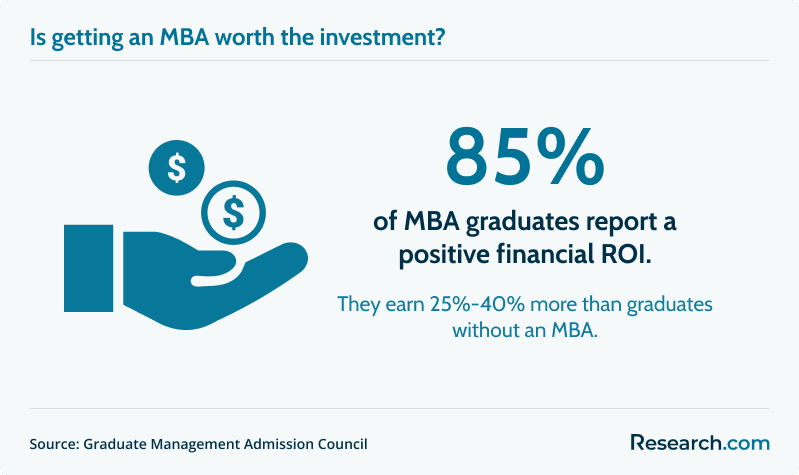
As they complete their bachelor’s degree, many students wonder whether to begin working or pursue an MBA right away. Pursuing an MBA after college can feel like a bold move, but it can also open doors to faster career growth. The long-term payoff is clear: 85% of MBA graduates reported a net positive financial return from their degree. This demonstrates that the investment often pays off, regardless of when it begins.
If you are deciding on taking an MBA right after college, it helps to understand both the advantages and the trade-offs. This article explores everything you need to know about the potential career benefits, salary outcomes, industry trends, and employer expectations.
Key Things to Know About Getting an MBA Right After College
- The biggest advantage of getting an MBA right after college is building career momentum early. Graduates enter leadership tracks and competitive industries sooner than peers who wait to pursue an MBA.
- MBA graduates typically earn a median salary of $125,000.
- Consulting, finance, and technology consistently hire the largest share of MBA graduates.
- What are the benefits of pursuing an MBA right after college? Benefits
- What are the potential drawbacks of pursuing an MBA right after college? Drawbacks
- Who is best suited to pursue an MBA immediately after graduating? Who is best suited to pursue an MBA immediately after graduating?
- Which top MBA programs accept applicants immediately after college? Which top MBA programs accept applicants immediately after college?
- How can undergraduates fund an MBA without prior income? Financial Aid
- What are the admission requirements for recent graduates? Requirments
- What core skills are developed in an MBA program? Core Skills
- Are there industries that favor candidates with an MBA obtained immediately after undergrad? Industries
- How do I select the right MBA program immediately after college? How do I select the right MBA program immediately after college?
- What is the average salary of someone who completes an MBA immediately after college? Average Salary
- How do career outcomes differ between early MBA graduates and those who work first? Career Outcomes
Should you pursue an MBA right after college?
Getting an MBA immediately after earning a bachelor’s degree is a high-stakes timing decision. It can help ambitious graduates build business knowledge, access recruiters, and move toward management sooner, but it can also be expensive and less effective if the student has no clear career target or practical experience to bring into the classroom.
This guide is for undergraduates, recent graduates, parents, and career changers evaluating whether an early MBA is a smart next step. It explains the benefits, risks, admissions expectations, funding options, program types, career outcomes, and mistakes to avoid before committing to graduate business school.
Quick answer: Is an MBA right after college worth it?
An MBA right after college can be worth it for students with strong academics, clear goals, leadership experience, and access to scholarships or strong recruiting pipelines. It is less ideal for students who are uncertain about their career direction, need work experience to strengthen their profile, or would take on heavy debt without a realistic plan for post-MBA employment.
| Choose an MBA right after college if... | Consider working first if... |
| You have a specific target such as consulting, finance, technology, entrepreneurship, or a specialized business track. | You are unsure which industry or function you want to enter. |
| You have strong grades, internships, leadership roles, or startup experience that show readiness. | Your resume is mostly academic and lacks evidence of practical business exposure. |
| You can access scholarships, fellowships, assistantships, or manageable loan options. | You would need to borrow heavily without a clear salary or hiring strategy. |
| You are applying to a program designed for early-career or deferred MBA candidates. | Your target schools strongly prefer applicants with several years of full-time experience. |
What are the main benefits of starting an MBA early?
The strongest advantage of an early MBA is momentum. Students move directly from undergraduate study into advanced business training, often before family obligations, career lock-in, or relocation constraints make graduate school harder. The value depends heavily on program quality, recruiting access, and how clearly the student can connect the degree to a career goal.
Faster access to management-oriented roles
An MBA can help recent graduates compete for roles that involve planning, analysis, team coordination, client strategy, or operational decision-making. Instead of spending several years proving business readiness from a purely entry-level position, graduates may be able to signal that they have studied finance, marketing, operations, organizational behavior, and strategy in a structured graduate environment.
This does not guarantee a leadership title immediately. Employers still assess maturity, judgment, communication skills, and work history. However, the credential may help a graduate enter leadership-development programs, rotational programs, analyst-to-manager pipelines, or specialized business roles earlier than peers with only an undergraduate degree.
Potential salary advantage at career entry
MBA graduates often pursue higher-paying roles than bachelor’s-level graduates, especially in consulting, finance, technology, and corporate strategy. For students who choose the right program and land strong post-MBA roles, higher early earnings may influence long-term compensation growth.
The salary benefit is not automatic. It depends on the school’s employer relationships, the student’s prior experience, location, industry, and ability to convert recruiting opportunities into offers. A high-cost MBA with weak placement support can be a poor financial decision even if the degree has a strong reputation in general.
Access to a graduate-level business network
Business school networks are often more targeted than undergraduate networks. Students may interact with alumni, recruiters, founders, executives, visiting speakers, and classmates from different industries. Specialized programs, such as an online MBA in engineering management, can be especially useful for students who want to combine technical training with business leadership.
For a recent graduate, this network can lead to internships, informational interviews, mentorship, and job leads. The student must still be proactive. Networking value comes from building relationships, contributing to projects, attending recruiting events, and following up professionally, not simply being enrolled in an MBA program.
Broader business flexibility
An MBA exposes students to multiple business functions, including accounting, finance, marketing, operations, analytics, leadership, and strategy. That range can help early-career professionals avoid being locked into one narrow path before they understand the broader job market.
This flexibility is useful in industries affected by automation, AI-enabled analytics, digital transformation, and changing employer expectations. Graduates who can connect data, people, process, and strategy may be better positioned to move between functions as business needs change.
Early signal of ambition and readiness
For students who already have internships, campus leadership, entrepreneurial projects, or research experience, an MBA can reinforce a strong early-career narrative. Admissions committees and employers may see the decision as credible when the applicant can explain why the degree fits a specific professional plan.
What are the risks of pursuing an MBA immediately after college?
An early MBA can accelerate some careers, but it can also reduce the degree’s value if the student enters without practical context. Many MBA classrooms rely on case discussion, team projects, leadership reflection, and peer learning. Students with no full-time work history may find it harder to contribute examples, evaluate workplace trade-offs, or understand how business decisions play out inside organizations.
| Potential drawback | Why it matters | How to reduce the risk |
| Limited work experience | Many MBA programs are designed for applicants with 3-5 years of professional experience, so classroom concepts may feel abstract without workplace exposure. | Prioritize programs built for early-career students, deferred admission, internships, consulting projects, or required experiential learning. |
| Weaker employer positioning | GMAC’s 2023 Corporate Recruiters Survey found that employers strongly prefer MBA hires with prior work experience. | Build a resume through internships, part-time roles, student consulting, entrepreneurship, or industry projects before and during the MBA. |
| High cost | The average MBA in the U.S. costs $70,000-$80,000 per year, which can be difficult for graduates without savings or employer sponsorship. | Compare total cost, fellowships, assistantships, loan terms, placement outcomes, and lower-cost formats before enrolling. |
| Smaller professional network at entry | Recent graduates often enter business school with fewer professional contacts than classmates who have already worked for several years. | Use career services early, attend employer events, join industry clubs, and pursue internships aggressively. |
- Limited experience applying business concepts: MBA courses often ask students to analyze real organizational challenges. Without job experience, recent graduates may need extra effort to connect theory with practice.
- Possible disadvantage against experienced MBA candidates: Recruiters may view a candidate with several years of work history as more prepared for client-facing, managerial, or specialized roles.
- Debt pressure: Borrowing for graduate school before earning full-time income can create financial stress, particularly for students already carrying undergraduate debt.
- Lower networking leverage at the start: MBA networks are valuable, but students with prior industry exposure often know how to use them more strategically. This is especially true in relationship-driven fields such as entertainment business careers, where contacts and prior projects can matter as much as credentials.
Who is a strong fit for an MBA right after undergrad?
The best candidates for an immediate MBA are not simply students who want to stay in school. They are students who can show academic strength, leadership potential, professional focus, and enough exposure to business problems to benefit from graduate-level training.
This path may make sense for students targeting consulting, finance, technology, entrepreneurship, analytics, operations, or specialized management roles. It can also be appropriate for students with strong internships, family business experience, military or service leadership, startup work, or significant campus leadership responsibilities.
Career planning should be evidence-based. Just as students in other fields compare labor demand and location-specific opportunities, such as reviewing which states may need nurses the most, MBA applicants should evaluate employer demand, program placement data, and industry fit before choosing a school.
Deferred MBA programs may be a better middle path
Many high-achieving undergraduates apply through deferred MBA programs rather than enrolling immediately. Schools such as Harvard, Stanford, and Wharton offer pathways that allow students to secure admission while still in college and then gain professional experience before starting the MBA.
These programs are highly selective. Admission rates typically hovering around 9% to 12% mean applicants must show more than strong grades. Competitive candidates often combine excellent academics with internships, leadership roles, community impact, entrepreneurial initiative, or unusual achievement in a technical, creative, or public-service field.
Signs you may be ready
- You can explain exactly why you need an MBA now rather than after several years of work.
- You have completed internships, consulting projects, research, startup work, or leadership roles that show business maturity.
- You understand your target industry and the types of roles MBA graduates typically enter.
- You have compared cost, scholarships, debt, and realistic salary outcomes.
- You are comfortable learning with classmates who may have more professional experience than you.
Signs you should probably work first
- You are using an MBA mainly to postpone a job search.
- You cannot name the roles, industries, or employers you want to pursue after graduation.
- You would rely almost entirely on loans and have not calculated repayment scenarios.
- Your target schools report better outcomes for candidates with several years of full-time experience.
- You need time to build confidence, communication skills, or workplace judgment before graduate study.
Which MBA programs consider applicants with little or no full-time experience?
Some business schools offer deferred admission, early-career pathways, or special structures for outstanding students who are still in college or recently graduated. These options are not interchangeable. Some allow immediate enrollment, while others require admitted students to work before matriculating.
Applicants should read each school’s current admissions policy carefully. Program names, eligibility rules, deadlines, and work-experience expectations can change, and a school that considers early-career candidates may still prefer evidence of maturity and leadership.
| Program or school | How it supports early-career applicants | Best fit |
| Yale School of Management Silver Scholars Program | College seniors can begin MBA study after completing their undergraduate degree, complete core coursework, pursue a full-time internship, and then return to finish the degree. | Students who want a structure that combines immediate graduate study with built-in professional experience. |
| University of Washington’s Foster School of Business | Applicants may be evaluated on academic record, internships, and leadership activities, allowing some recent graduates to be considered. | Students with strong undergraduate performance and meaningful applied experience. |
| UCLA Anderson School of Management | Candidates with limited work experience may be considered when they demonstrate academic excellence, leadership promise, and extracurricular achievement. | Applicants who can show readiness through achievements outside full-time employment. |
| Harvard Business School 2+2 Program | Students apply in their final year of college and work for two years before beginning the MBA. | High-achieving undergraduates from varied academic backgrounds, including STEM and humanities. |
Early-career MBA routes are one example of how professional pathways are becoming more flexible. Students exploring multiple long-term directions may also find it useful to compare how professionals move across fields, such as the common career changes nurses pursue, because it shows why transferable skills and timing matter in graduate education decisions.
How can recent graduates pay for an MBA without prior full-time income?
Funding is one of the biggest barriers for students who go straight from college to business school. Without savings, employer sponsorship, or several years of income, applicants need to compare funding options before they apply, not after they are admitted.
At Harvard Business School, about 50% of MBA students receive need-based fellowships. Need-based and merit-based aid can be especially important for younger applicants because they may have limited assets and no established salary history.
Common MBA funding sources
| Funding source | How it works | What to check |
| School fellowships and scholarships | Business schools may provide need-based or merit-based awards that reduce tuition. | Application deadlines, renewal rules, whether aid covers fees or living costs, and whether awards are guaranteed for the full program. |
| Federal loans | Federal options such as the Direct Unsubsidized Loan and Grad PLUS Loan are available through the U.S. Department of Education. | Borrowing limits, interest, repayment timing, deferment options, and total debt at graduation. |
| Private loans | Banks and credit unions may offer graduate student loans. | Interest rates, cosigner requirements, repayment flexibility, and borrower protections. |
| Assistantships | Some programs offer teaching or research assistantships that may offset part of the cost. | Availability for MBA students, workload, tuition benefits, and whether assistantships are competitive. |
| Lower-cost or online programs | Some students reduce cost by choosing flexible or lower-tuition MBA formats. | Accreditation, recruiting access, graduation outcomes, and whether the program fits the student’s career target. |
Students comparing price should look beyond tuition. Fees, housing, relocation, lost income, travel for residencies, technology costs, and interest on loans can change the real cost substantially. Researching options such as affordable online MBA programs can help applicants understand how program format affects total cost.
What do MBA admissions committees expect from recent graduates?
Early-career MBA applicants are evaluated differently from candidates with several years of full-time employment. Because they may not have a traditional professional record, admissions teams look for evidence that the student can handle rigorous coursework, contribute to class discussion, work well in teams, and explain a credible career plan.
- Strong academic record: Applicants typically need a high undergraduate GPA. Programs often require a 3.5 or above to demonstrate readiness for graduate-level business coursework.
- GMAT or GRE performance: Many programs require standardized testing, though some may grant waivers for exceptional academic records or other evidence of quantitative and analytical ability. The average GMAT scores for MBA programs at top schools typically fall between 650 and 730.
- Leadership evidence: Admissions committees look for initiative through internships, student organizations, community work, research, athletics, service, entrepreneurship, or part-time employment.
- Clear essays: Applicants need to explain why they want an MBA now, how the program fits their goals, and what they will contribute despite limited full-time experience.
- Recommendation letters: Two or three letters are typically required from professors, mentors, internship supervisors, or others who can describe the applicant’s judgment, character, work ethic, and leadership potential.
- Interview readiness: Many programs use interviews to assess communication, professionalism, self-awareness, and the applicant’s understanding of the MBA experience.
How to strengthen an application before graduation
- Complete at least one internship or applied project connected to your target field.
- Take quantitative courses if your transcript lacks business, economics, statistics, finance, or analytics preparation.
- Document leadership outcomes, not just titles. Admissions committees want evidence of impact.
- Build relationships with recommenders early so they can write detailed letters.
- Research each school’s career outcomes and explain why that specific program fits your plan.
- Prepare for interviews by practicing concise explanations of your goals, strengths, weaknesses, and timing decision.
What skills can an MBA develop for early-career students?
MBA programs are designed to build both technical business competence and leadership judgment. For students entering directly after college, the most valuable skills are often the ones that help translate academic ability into workplace performance.
| Skill area | What students learn | Why it matters for early-career graduates |
| Financial analysis | Students learn to read financial statements, evaluate investments, model trade-offs, and connect numbers to business decisions. | It helps new graduates contribute beyond entry-level administrative tasks. |
| Marketing and customer strategy | Courses cover market segmentation, positioning, competitive analysis, and campaign planning. | It prepares students to understand how organizations create demand and measure business impact. |
| Operations and project management | Students study process improvement, resource allocation, supply chains, and cross-functional execution. | It helps graduates manage complexity and coordinate work across teams. |
| Leadership and team management | Programs use group projects, simulations, and cases to develop communication, conflict resolution, and decision-making. | It gives younger students structured practice before they supervise people in formal roles. |
| Critical thinking | Case-based learning trains students to diagnose problems, compare alternatives, and defend recommendations. | It supports consulting, strategy, operations, and management-track roles. |
| Negotiation and communication | Students practice presenting to stakeholders, persuading decision-makers, and negotiating across competing interests. | It helps graduates operate with confidence in client, executive, and team settings. |
| Innovation and entrepreneurship | Many programs teach opportunity evaluation, business models, risk assessment, and new venture planning. | It is useful for students pursuing startups, family businesses, or product-focused roles. |
Some programs use specialized formats to connect business skills with a particular sector. For example, students interested in athletics, events, and commercial strategy may compare options such as the fastest online MBA programs in sports management.
According to GMAC, 95% of employers value analytical and problem-solving abilities in MBA hires. Another 88% highlight leadership and team management skills. Those findings show why applicants should evaluate whether a program teaches skills through applied projects, internships, simulations, and employer-facing experiences rather than coursework alone.
Accreditation and program recognition also matter. Although business degrees and counseling degrees follow different professional rules, the due diligence principle is similar: students should verify that a program’s quality standards are credible, just as counseling students review recognized accrediting bodies for counseling degrees.
Which industries are most receptive to early-career MBA graduates?
Some industries value structured problem-solving, analytical ability, and leadership potential enough to consider MBA graduates with limited full-time experience. Even in these fields, however, internships, projects, networking, and interview performance can determine whether an early MBA pays off.
Consulting
Consulting remains the largest employer of MBA graduates, hiring nearly 31% of MBA talent globally. Firms such as McKinsey, BCG, and Bain evaluate structured thinking, communication, quantitative reasoning, and client readiness. Early-career MBA graduates can be competitive when they show strong case interview skills and evidence of leadership.
Technology
Tech accounted for 19% of global MBA hiring in 2023, making it the second-largest recruiter after consulting. Companies such as Amazon, Google, and Microsoft hire MBA graduates into product management, strategy, operations, and business analytics roles. Younger MBA graduates may need to show technical fluency, project experience, or domain knowledge to stand out.
Finance and investment banking
Investment banks and financial institutions often value MBA training for analyst and associate pathways. These roles require quantitative ability, stamina, attention to detail, and comfort with financial modeling. Recent graduates with strong academics and relevant internships may be able to compete, though prior finance experience can still help.
Entrepreneurship and startups
Entrepreneurial students may use an MBA to build skills in finance, marketing, operations, fundraising, and strategy. GMAC data shows that about 10% of MBA graduates launch a startup within three years of graduation. For younger founders, the degree can provide structure and mentorship, but it does not replace customer discovery, product testing, or market validation.
Specialized and mission-driven business roles
Some students use an MBA to enter fields tied to sustainability, healthcare administration, sports, media, engineering management, or social impact. Specialized programs can be useful when they match a student’s goals and include relevant employer connections. For instance, students interested in environmental strategy may compare fast online MBA programs in sustainability as part of a broader search.
How should you choose the right MBA program after college?
The right MBA is not always the highest-ranked or most expensive program. For a recent graduate, fit matters more because the program must compensate for limited work experience through advising, internships, practical learning, employer access, and a strong peer environment.
| Factor to evaluate | Questions to ask | Why it matters |
| Program format | Is it full-time, part-time, online, hybrid, accelerated, or deferred? | Format affects cost, networking, recruiting access, and ability to gain work experience. |
| Early-career support | Does the school regularly admit students without full-time experience? | A program built for experienced professionals may not provide the right support for recent graduates. |
| Career outcomes | Where do graduates work, and what roles do they obtain? | Placement data is more useful than general prestige when judging career fit. |
| Internships and applied learning | Are internships, consulting projects, practicums, or company-sponsored projects built into the curriculum? | Recent graduates need practical experience to strengthen their post-MBA profile. |
| Employer relationships | Which companies recruit on campus or through virtual career services? | Recruiting access can make the difference between a useful MBA and an expensive credential. |
| Total cost | What will tuition, fees, living costs, travel, and interest add up to? | Debt should be evaluated against realistic salary outcomes, not best-case scenarios. |
| Accreditation and reputation | Is the institution credible, and is the business school recognized by employers in your target market? | Program credibility affects transferability, employer trust, and long-term value. |
Online vs. campus MBA after college
| Option | Advantages | Trade-offs |
| Campus MBA | Stronger in-person networking, recruiting events, clubs, and peer learning. | Usually requires relocation or full-time attendance and may increase living costs. |
| Online MBA | More flexibility, potential cost savings, and ability to work while studying. | Students may need to be more intentional about networking and recruiting. |
| Deferred MBA | Allows students to secure admission early and gain work experience before enrolling. | Admission is highly competitive, and students must still make good use of the work period. |
| Specialized MBA | Can align closely with a target field such as engineering management, sustainability, sports, or healthcare business. | May be less flexible if the student later changes industries. |
Current trends recent graduates should consider
- Skills-based hiring: Employers increasingly evaluate what candidates can do, not only which degree they hold. MBA applicants should look for programs that build measurable skills through projects, analytics work, internships, and presentations.
- AI and analytics: Business roles increasingly require comfort with data, automation, and AI-supported decision-making. Students should review whether the MBA curriculum includes analytics, digital strategy, technology management, or AI-related business applications.
- Higher scrutiny of ROI: Because MBA tuition can be substantial, students should compare total cost with realistic career outcomes. A lower-cost program with strong placement in a target market may be a better fit than a more expensive option with weak support.
- Greater competition for top programs: Deferred and early-career MBA pathways can be very selective. Applicants need a strong story, not just strong grades.
What salary can early MBA graduates expect?
The average starting salary for professionals who pursued an MBA after college is about $125,000. Seattle University reports a comparable figure, noting a $126,000 median salary for MBA graduates, even those with limited prior experience.
The University of Iowa similarly points out that MBA graduates often begin their careers with salaries near $120,000. These figures suggest strong earning potential, but students should treat them as reference points rather than guarantees. Salary depends on school, industry, location, prior experience, internships, interview performance, and economic conditions at the time of graduation.
Long-term outcomes are also important. According to GMAC’s Alumni Perspectives on the Value of Graduate Management Education, about 85% of graduates believe their MBA brought a positive financial return. MBA graduates often see a 56% average salary increase between their pre- and post-MBA wages.
Students comparing graduate options should also remember that salary logic differs across fields. For example, the career planning and licensure considerations for a master’s degree in mental health counseling are different from the ROI model for an MBA, so comparisons should account for profession-specific requirements.
How do outcomes differ for students who get an MBA early versus those who work first?
The main difference is starting position. Early MBA graduates may complete the degree sooner and enter management-oriented tracks earlier, but experienced MBA graduates often have stronger resumes, clearer goals, and better access to senior or specialized roles immediately after graduation.
According to GMAC’s 2023 Corporate Recruiters Survey, employers prefer MBA hires with 3-5 years of work experience, particularly for consulting and finance roles. That preference can make some early MBA graduates less competitive for roles that expect client leadership, prior industry exposure, or direct management experience.
The median starting salaries for early MBA graduates in the U.S. are around $125,000, compared to $150,000-$160,000 for mid-career MBA hires, reflecting the effect of professional experience on immediate earning power.
| Path | Likely advantages | Likely limitations | Best suited for |
| MBA immediately after college | Maintains academic momentum, may accelerate access to business roles, and builds a graduate network early. | Less work experience, possible recruiter skepticism, and higher risk if goals are unclear. | Students with strong academics, internships, leadership, and a defined career plan. |
| Work first, then MBA | Stronger classroom contribution, clearer goals, more competitive recruiting profile, and possible employer sponsorship. | Graduate school may be harder to pause for later due to career and personal obligations. | Students who want to test industries, build savings, or strengthen their admissions profile. |
| Deferred MBA | Secures admission early while preserving the benefits of work experience before enrollment. | Highly competitive and requires disciplined career planning during the deferral period. | High-achieving undergraduates who want both early admission and professional experience. |
Common mistakes to avoid
- Choosing based only on rankings: Rankings can be useful, but they do not prove that a program fits your industry, budget, or experience level.
- Ignoring accreditation and employer recognition: A program should be credible to the employers and regions you care about.
- Looking only at tuition: Total cost includes fees, housing, travel, interest, and the income you may give up while studying full time.
- Assuming salary outcomes are guaranteed: Published salaries reflect specific graduate groups and labor market conditions. Your outcome may differ.
- Applying without a career story: Recent graduates need to explain why an MBA now makes sense and how they will use it.
- Underusing career services: Students should begin networking, resume work, interview preparation, and internship searches early.
- Assuming online and campus programs offer the same recruiting access: Some online MBAs provide strong support, but students should verify employer access and networking opportunities before enrolling.
Questions to ask before applying
- Does this program regularly admit and support students with little full-time experience?
- What internships, consulting projects, or applied experiences are available?
- Which employers recruit from the program for my target role?
- What are the realistic salary outcomes for graduates with backgrounds similar to mine?
- How much will I borrow, and what monthly repayment could look like after graduation?
- Would I be a stronger candidate if I worked for two or three years first?
- Is a deferred MBA, specialized master’s degree, certificate, or entry-level job a better next step?
- Can I clearly explain why this school, this format, and this timing fit my goals?
What do graduates say about getting an MBA early?
- : "Starting business school right after my bachelor’s degree helped me compete for consulting internships I would not have known how to access on my own. The case-based training improved the way I structured problems, and by graduation I had several offers that were stronger than the entry-level roles I had considered. — Ramon"
- : "I was concerned that I had not worked long enough before enrolling, but my program connected me with mentors who had deep industry experience. Their guidance helped me close that gap and gave me enough confidence to help launch a startup that is now in its second year. — Elise"
- : "Going straight into an MBA let me keep my academic rhythm while building a professional network across engineering, law, technology, and business. The team projects, especially the pitches, taught me how leadership works when people bring very different expertise to the table. — Arjun"
Key Insights
- An MBA right after college is most useful for students with strong academics, leadership evidence, applied experience, and a clear career direction.
- The biggest risk is entering too soon. Many employers prefer MBA hires with 3-5 years of work experience, and inexperienced graduates may face tougher recruiting competition.
- Cost should be evaluated carefully. The average MBA in the U.S. costs $70,000-$80,000 per year, so scholarships, fellowships, assistantships, and lower-cost formats can materially affect ROI.
- Deferred MBA programs can offer a balanced route by allowing students to gain admission early and build professional experience before enrolling.
- Early MBA graduates may see starting salaries around $125,000, while mid-career MBA hires may start closer to $150,000-$160,000, showing how work experience affects immediate outcomes.
- Program fit matters more than prestige alone. Recent graduates should prioritize career services, internships, employer access, alumni support, accreditation, and practical learning.
- The best next step is to compare three options side by side: enroll now, apply for deferred admission, or work first and apply later.
References:
- BusinessBecause. (2024, December). Employer confidence in MBA talent remains strong amid AI and evolving work models. Retrieved from https://www.businessbecause.com/news/in-the-news/9823/employer-confidence-in-mba-talent-remains-strong BusinessBecause
- Business Standard / CFA Institute. (2025, July 8). 85 percent of Indian graduates prefer industry certifications for better jobs and higher income – CFA Institute Graduate Outlook Survey 2025. Retrieved from https://www.business-standard.com/content/press-releases-ani/85-percent-indian-graduates-prefer-industry-certifications-for-better-jobs-and-higher-income-cfa-institute-graduate-outlook-survey-2025-125070801037_1.html Business Standard
- e-GMAT. (2023, March 7). MBA Salary 2023 – What factors affect your Post-MBA salary? Retrieved from https://e-gmat.com/blogs/post-mba-salary-factors-affecting-average-mba-salary/ e-GMAT
- FT (Financial Times). (n.d.). Start-up costs for MBA graduates pay off. Retrieved from https://www.ft.com/content/3d3f48f8-95cb-11e4-be7d-00144feabdc0 Financial Times
- GMAC. (2023). MBA Degree Profile: Corporate Recruiters Survey 2023. Retrieved from https://www.gmac.com/market-intelligence-and-research/research-library/employment-outlook/mba-degree-profile-corporate-recruiters-survey-2023 gmac.com
- Forbes (Jones, C.). (2024, December 3). When does it make financial sense to pursue an MBA? Retrieved from https://www.forbes.com/sites/cicelyjones/2024/12/03/when-does-it-make-financial-sense-to-pursue-an-mba/
- Forbes (Pong, C.). (2024, December 26). 90% of companies make better hires based on skills over degrees. Retrieved from https://www.forbes.com/sites/cynthiapong/2024/12/26/90-of-companies-make-better-hires-based-on-skills-over-degrees/
Other Things You Should Know About Pursuing an MBA Right After College
Pursuing an MBA right after college in 2027 can expedite career entry and potentially yield a faster ROI, especially if you aim for fields like consulting. However, you might lack practical insights that peers with work experience bring. Weigh industry expectations and personal readiness before deciding.


