
2027 Top 10 Common Career Changes for Nurses

Co-Founder and Chief Data Scientist
Nearly half of U.S. healthcare workers say they plan to leave their jobs within the next year, and nurses are leading this shift. Burnout, long hours, and limited growth opportunities push many to seek new directions—both inside and outside healthcare.
This article breaks down the top 10 career changes nurses commonly pursue in 2027, from education and case management to corporate and creative roles. By the end, you’ll see which paths align with your skills, lifestyle goals, and long-term career security.
Key Things You Should Know About Nursing Career Change
- Career change doesn’t always mean leaving healthcare entirely. Many nurses shift into adjacent roles—like case management, education, or therapy—that allow them to stay in the field without the demands of bedside care.
- Pay and job outlook vary widely depending on the new role. While some career paths may offer higher salaries, others prioritize work-life balance, autonomy, or reduced stress over financial rewards.
- Transferable skills are your strongest asset. Clinical expertise, communication, critical thinking, and adaptability help nurses transition smoothly into roles in healthcare administration, corporate settings, or even creative industries.
- Top 10 Common Career Changes for Nurses Career Changes
- What higher-paying roles can a nurse transition into besides bedside care? Higher-Paying Roles
- Which non-clinical healthcare jobs do nurses commonly move into? Non-Clinical Jobs
- What skills do nurses need to successfully switch to a new healthcare career? Skills for Transition
- How much does it cost and how long does it take to train for common nurse career pivots? Cost & Training Time
- What are the pros and cons of moving from clinical nursing to administrative or leadership roles? Pros & Cons
- What jobs outside of healthcare are good for nurses looking for less stress? What jobs outside of healthcare are good for nurses looking for less stress?
- How do nurses evaluate if a career change is worth the sacrifice (time, money, lifestyle)? How do nurses evaluate if a career change is worth the sacrifice (time, money, lifestyle)?
- What financial and personal challenges do nurses face when changing careers? What financial and personal challenges do nurses face when changing careers?
- What steps should a nurse take to prepare for a career change in 2027? What steps should a nurse take to prepare for a career change in 2027?
Top 10 Common Career Changes for Nurses
Nurses who want new challenges often move into roles that build on their clinical skills without staying at the bedside. Many shift to healthcare-adjacent fields, while others move into entirely different industries. Below are ten common roles nurses transition into, including salary insights and growth projections. This gives a realistic picture of where nursing experience can lead and what the long-term opportunities look like.
Nurse Educator / Health Educator
Nurses often become educators, training future nurses or promoting public health. According to BLS, health educators earn a median salary of $63,000 with a 4% growth rate (2024–2034), faster than average. Academic nurse educators may earn higher, especially in universities or teaching hospitals. This role appeals to nurses who enjoy teaching and mentoring, offering stability and the chance to influence the next generation of healthcare professionals.
Medical and Health Services Manager
Many nurses move into administration, overseeing operations in hospitals or clinics. BLS reports a median salary of $117,960 and an impressive 23% job growth (2024–34), much faster than average. This career leverages organizational and leadership skills nurses already use daily. The role offers advancement and significant earning potential, especially in large healthcare systems needing strong management for quality and compliance.
Medical Writer
Nurses with strong communication skills transition into medical writing, producing content for research, education, or industry. According to Indeed, U.S. medical writers earn about $114,138 annually. While BLS groups them under technical writers (median $79,960, job growth 7%), those specializing in medicine often earn higher. This role is attractive because it allows nurses to use their expertise without clinical stress, offering flexibility and remote opportunities.
Case Manager
Nurses often move into case management, coordinating patient care across providers. Salary.com reports average earnings of about $96,155 annually in the U.S. Demand is steady, with an outlook of 6% for social and community service managers. That’s driven by aging populations and the need for efficient care. This role suits nurses who excel at organization and communication. It offers regular hours compared to shift work and allows nurses to advocate for patients while stepping away from direct bedside demands.
Public Health Professional
Public health careers attract nurses wanting to impact communities rather than individuals. Zippia lists public health officer at $59,172 with a job outlook of 6% until 2028. Salary.com, meanwhile, reports an average of $97,746 for public health practioners. This field focuses on prevention, outreach, and health equity, aligning with many nurses’ values. It also offers opportunities in government, NGOs, and nonprofits, providing stability while broadening a nurse’s professional reach.
Clinical Research Coordinator
Nurses transition into clinical research, supporting trials and new treatments. According to ZipRecruiter, clinical research coordinators earn about $59,666 annually on average, which a job outlook, according to Zippia, of 6% until 2028. The role has stable demand as healthcare innovation grows, especially in pharmaceuticals and biotech. Nurses are strong candidates due to their knowledge of patient safety, protocols, and documentation. This role provides meaningful work advancing medicine while offering more predictable schedules.
Pharmaceutical or Medical Sales Representative
Nurses often move into sales, where clinical knowledge is valued for credibility with clients. According to Zippia, the average salary for pharmaceutical sales reps is about $68,571 annually, with high performers exceeding that through commissions. The job outlook of 4% until 2028, a steady growth. This path offers flexibility, strong financial potential, and the chance to step into corporate healthcare.
Health Informatics Specialist
With technology reshaping healthcare, nurses enter informatics to manage electronic records and data systems. BLS classifies them under medical records specialists, earning a median salary of $50,250 with 7% growth (2024–34). Advanced informatics professionals may earn higher, often above $90,000 according to Glassdoor. This career suits nurses comfortable with IT and data, offering a balance of healthcare knowledge and tech skills.
Physical Therapist
Some nurses pursue physical therapy, focusing on rehabilitation and mobility. BLS reports a median salary of $101,020 and 11% growth (2024–34), much faster than average. This career requires a Doctor of Physical Therapy degree, but nurses often have a strong foundation in patient care that eases the transition. It offers autonomy, hands-on work, and excellent job stability in diverse settings.
Occupational Therapist
Nurses sometimes retrain as occupational therapists, helping patients regain independence in daily activities. BLS reports a median salary of $98,340 with 11% growth (2024–34), much faster than average. This role requires a master’s degree in occupational therapy, but nurses’ background in patient care provides a solid transition base. It’s appealing for those who want one-on-one impact in rehabilitation settings while avoiding bedside nursing stress.
What higher-paying roles can a nurse transition into besides bedside care?
Nurses looking for higher-paying alternatives to bedside roles often transition into administrative, educational, or specialized healthcare positions.
- Medical and health services managers, for example, command a median salary of $117,960 and benefit from strong growth prospects.
- Other lucrative shifts include becoming a medical writer, where salaries can reach six figures depending on specialization, or moving into physical or occupational therapy, both offering salaries above $95,000 with double-digit growth rates.
These options demonstrate that nursing expertise translates into roles with strong earning power.
Beyond healthcare delivery, pharmaceutical or medical sales provide opportunities for nurses who thrive in business and communication. Case management, health education, and public health roles also offer competitive salaries, especially as demand for prevention and community-based care expands. Choosing the right path depends on whether nurses prioritize income, stability, or flexibility, but several routes lead to higher-than-average compensation compared to bedside care.
Salary isn’t the only consideration, however. Just as patients ask who makes more medical assistant or pharmacy technician, nurses evaluating career changes weigh financial outlook alongside work-life balance and professional growth. Understanding pay trends helps set realistic expectations when leaving bedside nursing.
The chart below highlights how common nurse career changes compare in salary potential. It provides a snapshot of where nurses can expect the best earnings and shows the breadth of opportunities beyond direct patient care.
Which non-clinical healthcare jobs do nurses commonly move into?
Nurses often move into non-clinical healthcare jobs to continue using their expertise while avoiding the physical and emotional strain of bedside roles. These positions allow them to focus on coordination, leadership, education, or data-driven care improvements. Common examples include:
- Case Manager: coordinating care plans across multiple providers and services.
- Nurse or Health Educator: training nursing students or promoting public health.
- Clinical Research Coordinator: managing trials and research compliance.
- Health Informatics Specialist: working with electronic health records and data systems.
- Medical and Health Services Manager: overseeing operations in hospitals, clinics, or long-term care facilities.
Many nurses pursue additional education, such as a healthcare administration degree, to qualify for management or informatics roles. These careers provide higher earning potential, more predictable hours, and a path to leadership while remaining connected to healthcare.
The chart below shows the biggest barriers nurses face when transitioning into non-clinical jobs through further education or training. Financial costs and time pressures are the most significant challenges.
What skills do nurses need to successfully switch to a new healthcare career?
Nurses need a strong mix of clinical expertise and transferable soft skills to succeed in new healthcare careers. These skills allow them to adapt quickly, work across disciplines, and add value outside of direct patient care, much like transferable skills from fields such as liberal arts can lead to diverse opportunities, making one wonder what can you do with a masters in history.
Essential skills include:
- Communication: explaining complex information to patients, families, or healthcare teams.
- Leadership and management: guiding teams, managing cases, or running departments.
- Data and technology literacy: working with electronic health records or health informatics systems.
- Critical thinking and problem-solving: analyzing patient or system needs and making sound decisions.
- Education and mentoring: training new nurses, patients, or community members effectively.
Building on these skills helps nurses move into specialized paths, whether through formal education or retraining. For example, those interested in therapy roles can follow structured steps to become a behavior therapist, applying their patient care experience in new contexts.
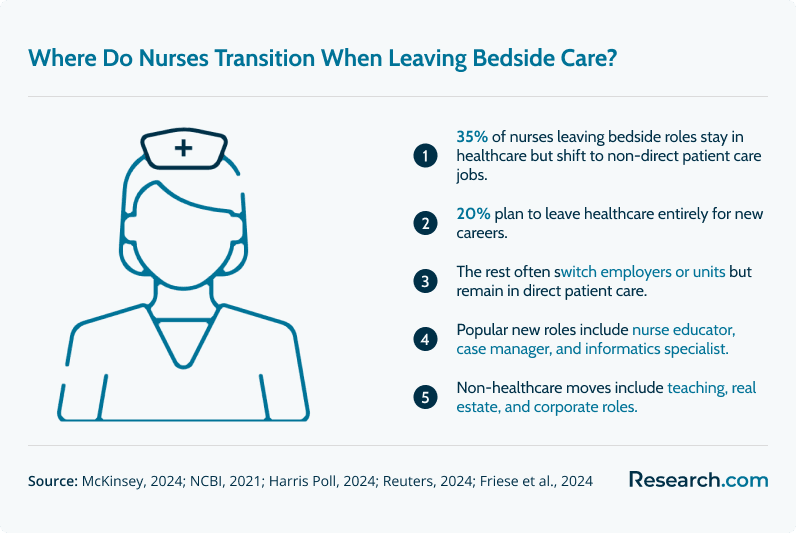
The infographic below shows where nurses transition when leaving bedside care. Many shift into non-direct patient care roles that draw heavily on these transferable skills.
How much does it cost and how long does it take to train for common nurse career pivots?
It depends on the target role, but plan for anywhere from a few hundred dollars over a few months to six figures over multiple years. Typical ranges in the U.S. (2025):
- Medical & Health Services Manager (MHA or similar): 1–2 years full time; ~$20k–$60k at public universities, ~$60k–$120k at private schools.
- Health Informatics (certificate/bootcamp): 4–12 months; ~$3k–$15k; bachelor’s or experience often required.
- Clinical Research Coordinator (certificate + exam): 3–9 months; ~$1k–$4k for prep/courses/exam fees.
- Medical Writer (certificate programs): 3–6 months; ~$1k–$3k; portfolio building is crucial.
- Case Management (ACM/RN-BC prep + exam): 2–4 months; ~$500–$1,200 for courses + exam.
- Public Health (MPH): 1–2 years; ~$25k–$70k public; ~$60k–$120k private.
- Physical Therapist (DPT): 3-year DPT after prerequisites; program tuition commonly ~$60k–$120k+ total.
- Occupational Therapist (MS/OTD): 2–3 years; ~$50k–$110k total tuition.
Costs swing based on in-state vs out-of-state rates, online vs campus delivery, and how much credit you can transfer. Look for employer tuition help and stackable, lower-cost certificates to test a path before committing to a full degree. If you’re price-shopping entry-level clinical credentials as add-ons, browsing a cheap pharmacy tech program can show what low-cost, short-cycle options look like—even if you don’t plan to be a tech.
What are the pros and cons of moving from clinical nursing to administrative or leadership roles?
The main advantage of moving from clinical nursing to administrative or leadership roles is the opportunity to influence healthcare systems at a higher level while reducing direct patient-care strain. Many nurses choose these paths to gain better work-life balance, higher salaries, and the ability to shape policy and organizational outcomes. For some, this includes pursuing advanced degrees like an NP, leading to an exploration about NP programs for international students. However, the transition also comes with challenges that require trade-offs compared to bedside work.
Pros:
- Higher earning potential, with medical and health services managers earning a median salary of $117,960.
- Greater work-life balance since administrative roles often follow standard office hours.
- Ability to influence systems and policies, impacting care delivery on a broader scale.
- Career stability and strong job growth (23% through 2034).
Cons:
- Less direct patient interaction, which some nurses may miss.
- Increased responsibility for budgets, compliance, and staffing.
- Requires advanced education, often a master’s in healthcare administration.
- High-pressure environment with accountability for organizational performance.
This career path is rewarding for those who want leadership and broader impact, but it isn’t suited for everyone. Would you like me to draft a follow-up section that directly contrasts administrative vs. educator roles since both are major non-bedside pivots nurses consider?
What jobs outside of healthcare are good for nurses looking for less stress?
Nurses looking for less stress often find rewarding second careers outside of healthcare that still draw on their professional strengths. These roles typically offer more predictable schedules, reduced emotional demands, and the opportunity to apply transferable skills in new contexts. Some consider using organizational and problem-solving expertise in a different sector, such as considering what does a special education administrator do. Many options allow nurses to preserve their communication, organizational, and problem-solving expertise without the physical or emotional toll of direct patient care.
Common jobs outside healthcare for nurses include:
- Teacher or corporate trainer: applying knowledge to educate students or employees.
- Medical writer: producing technical or consumer health content, often with remote flexibility.
- Insurance claims analyst: reviewing cases with structured hours and less emotional strain.
- Human resources specialist: managing workplace policies and employee well-being.
- Real estate agent: leveraging interpersonal skills with independence and flexibility.
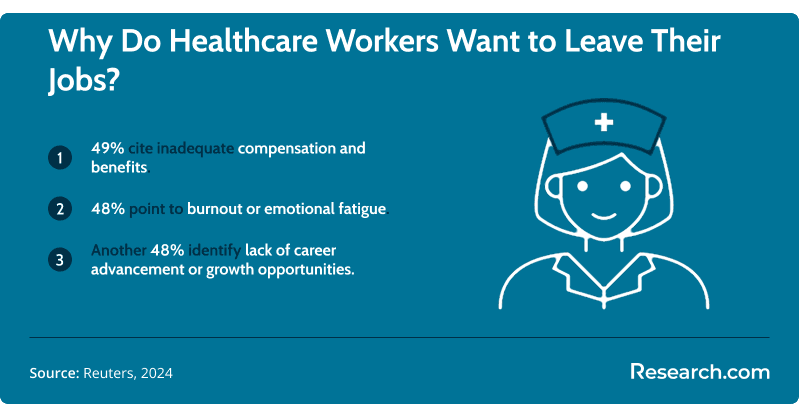
The infographic below highlights why nurses often seek these lower-stress paths, with burnout, limited growth, and pay concerns pushing many to pursue alternative careers.
How do nurses evaluate if a career change is worth the sacrifice (time, money, lifestyle)?
Nurses evaluate whether a career change is worth the sacrifice by weighing the financial, personal, and professional trade-offs against expected gains. The central question is whether the transition will improve their long-term stability, income, and well-being enough to justify the upfront costs and effort, much like considering why get an MBA in engineering management.
Ways nurses evaluate a career change include:
- Financial return: Estimating the potential salary increase compared to tuition, certification fees, and temporary income loss.
- Time commitment: Considering how long new training or degrees will take and whether that fits with family or work responsibilities.
- Lifestyle balance: Looking at scheduling demands, stress levels, and whether the role allows for more predictable hours.
- Job market stability: Reviewing labor statistics, job postings, and employer demand to confirm realistic opportunities.
- Personal fulfillment: Measuring alignment with long-term goals, values, and interests.
The chart below compares job outlook percentages for common nurse career changes. These figures help nurses see whether the time and financial sacrifices are supported by long-term growth potential in their chosen field.
What financial and personal challenges do nurses face when changing careers?
Nurses face several financial and personal challenges when changing careers, often making the transition harder than expected. These barriers can impact their ability to pursue further education, maintain stability, and adapt to new professional identities.
Key challenges include:
- Upfront education costs: Tuition, certification programs, and exam fees can be expensive, especially without employer support.
- Lost income during training: Many nurses must reduce hours or leave jobs temporarily to retrain, creating financial strain.
- Work–life balance pressures: Balancing study, work, and family responsibilities often leads to exhaustion and stress.
- Uncertainty in job security: New roles may not always provide the same stability or benefits as nursing.
- Identity shift: Leaving direct patient care can feel like abandoning a core part of one’s professional identity.
For instance, those exploring care case manager requirements often find that while the career offers stability and meaningful work, the transition requires upfront financial sacrifice and a willingness to shift into a different pace of healthcare.
What steps should a nurse take to prepare for a career change in 2027?
The first step nurses should take to prepare for a career change in 2025 is to clearly define their career goals and identify why they want to transition. Clarity helps guide the training, networking, and job search process. Once goals are set, nurses can begin to take practical steps to make their transition smoother.
Steps to prepare for a career change include:
- Assess transferable skills: Identify clinical, leadership, and communication skills that apply to new roles.
- Research target careers: Compare salaries, job outlooks, and required credentials for roles of interest. For instance, understanding the
- Pursue education or certification: Enroll in degree programs, certificate courses, or online modules relevant to the new career path.
- Network strategically: Connect with professionals in the desired field through LinkedIn, conferences, or alumni groups.
- Gain experience gradually: Take part-time, freelance, or volunteer opportunities to test the new role before committing fully.
By following these steps, nurses can minimize risks, make informed decisions, and create a realistic timeline for their transition into a fulfilling second career.
Here's What Graduates Have To Say About Their Nursing Career Change
- Mireille: "Switching from bedside care to public health felt daunting, but studying online gave me flexibility to balance work and family. The transition opened doors to leadership roles and better hours. I never thought I’d enjoy research and community planning as much as I do now."
- Tomas: "I moved from nursing into health informatics after completing an online certification. The flexibility let me train while working full-time, and I now earn more while working fewer weekends. I feel less burned out and more in control of my career path."
- Elin: "Online study made it possible for me to shift into medical writing without leaving my night shifts behind. I gradually built skills, gained confidence, and found a career with more creative freedom and less physical strain. The independence this career gives me is priceless."
Key Findings
- Nurses earn $93,600 annually on average, but many transition for better pay or balance.
- Medical and health services managers see $117,960 salaries with 23% growth by 2034.
- 35% of nurses leaving bedside care stay in healthcare but shift to non-direct roles.
- Burnout and stress drive 48% of healthcare workers to consider career exits.
- Education barriers include 66% citing cost and 49% citing lack of time.
- Non-healthcare paths include teaching, writing, and corporate roles offering lower stress.
References:
- AACN Journals. The Nursing Shortage and Work Expectations Are in.
- AANP. Nurse Practitioners Secure No. 1 Spot Across Three U.S. News & World Report Best Jobs Rankings.
- Advisory Board. Healthcare Workers.
- BLS. Health Educators.
- BLS. Health Information Technologists and Medical Registrars.
- BLS. Medical and Health Services Managers.
- BLS. Medical Records and Health Information Technicians.
- BLS. Nurse Anesthetists, Nurse Midwives, and Nurse Practitioners.
- BLS. Occupational Therapists.
- BLS. Pharmacists.
- BLS. Physical Therapists.
- BLS. Registered Nurses.
- BLS. Social and Community Service Managers.
- BLS. Technical Writers.
- Business Wire. Harris Poll Survey: Burnt-Out Healthcare Workers Plan Exit as Workforce Shortages Loom, Opportunities for Education and Growth May Convince Some to Stay.
- HRSA. State of the Health Workforce Report 2024.
- Indeed. Medical Writer Salaries.
- JAMA Network. Friese et al. 2024.
- Journal of Nursing Regulation. 2025 Report.
- McKinsey. Surveyed Nurses Consider Leaving Direct Patient Care at Elevated Rates.
- NCBI Bookshelf. The Nursing Workforce – The Future of Nursing 2020–2030.
- Nurse.org. 2024 State of Nursing.
- Public Health JHU. Master of Health Administration (MHA).
- Reddit. Those Who Left Nursing – What Careers Have You Chosen Beyond Healthcare?
- Reuters. Over Half of U.S. Healthcare Workers Plan to Switch Jobs by Next Year, Survey Finds.
- Salary.com. Case Manager I Salary.
- Salary.com. Public Health Practitioner Salary.
- Zippia. Clinical Research Coordinator Jobs.
- Zippia. Clinical Research Coordinator Job Trends.
- Zippia. Pharmaceutical Sales Representative Jobs.
- Zippia. Public Health Officer Jobs.
- Zippia. Registered Nurse Jobs Demographics.
- Zippia. Registered Nurse Jobs Education.
- ZipRecruiter. Clinical Research Coordinator Salaries.
Other Things You Should Know About Nursing Career Change
Yes, many nurses leverage their clinical experience to transition into healthcare administration roles, benefiting from their firsthand understanding of patient care and healthcare operations. Additional coursework or certifications in healthcare management may be beneficial to smoothing this career transition in 2027.
Yes, many nurses pursue part-time or online programs that allow them to continue working while studying. Flexibility in online education has expanded, enabling nurses to balance shifts with coursework. However, time management becomes critical since responsibilities at work and home can make the journey demanding. Planning ahead helps avoid burnout during the transition.
In 2027, common career changes for nurses include roles such as healthcare administrator, nurse educator, medical sales representative, nurse consultant, informatics nurse specialist, telemedicine nurse, nurse researcher, case manager, legal nurse consultant, and wellness coach. These roles offer diverse opportunities and leverage nursing skills in new ways.
Nurses transitioning to a telehealth specialist role in 2027 typically need a valid nursing license, experience in patient care, and training in telehealth technologies. Some employers may require certification from recognized bodies like the American Telemedicine Association.


