
2027 Most Affordable Bachelor’s in Substance Abuse Counseling Online

Co-Founder and Chief Data Scientist
Finding an affordable way to earn your degree can be challenging, especially with rising tuition costs. This article addresses these concerns by listing the most affordable online bachelor's in substance abuse counseling programs for 2027. With an 17% job growth projected until 2034 and an average annual salary of $59,190, pursuing this degree can be a wise investment. We will provide you with options to study from anywhere, offering flexibility and affordability to help you start your career in substance abuse counseling.
What are the benefits of getting a substance abuse counseling degree?
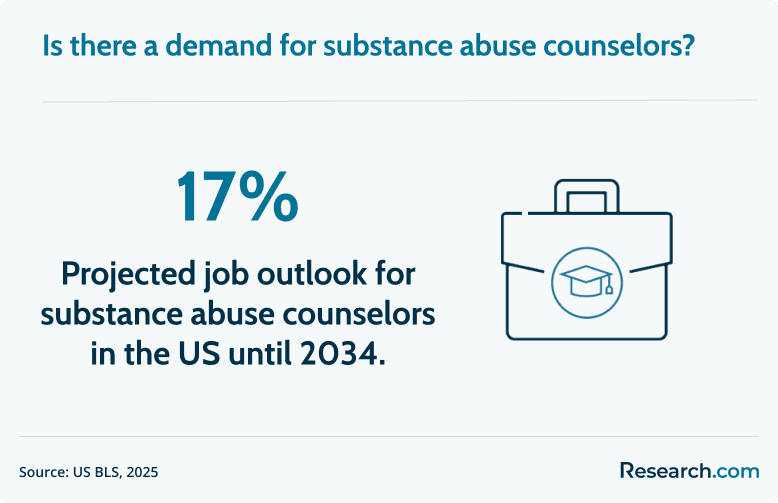
- Employment of substance abuse counselors is projected to grow 17% from 2024 to 2034, much faster than the average for all occupations.
- Graduates can work in diverse environments, including outpatient care centers, hospitals, and individual and family services, providing flexibility in choosing a workplace.
- A substance abuse counseling career allows you to make a significant difference in individuals' lives by helping them overcome addiction and improve their mental health.
What can I expect from a substance abuse counseling career?
A career in substance abuse counseling involves helping people overcome addiction and improve their mental health. With an online bachelor's in substance abuse counseling, you will learn how to evaluate clients' health, create treatment plans, and provide support during recovery. You’ll work one-on-one or in groups, guiding clients to cope with stress, rebuild relationships, and find healthier ways to handle life's challenges. This career also involves documenting progress, educating families, and sometimes collaborating with other health professionals. It’s a rewarding path where you significantly impact individuals' lives.
Where can I work with an online bachelor's in substance abuse counseling?
With an online bachelor's in substance abuse counseling, you can work in various settings such as outpatient care centers, individual and family services, and hospitals. Most of these counselors, according to the Bureau of Labor Statistics (BLS), work in outpatient mental health and substance abuse centers, employing about 18% of all professionals in this field. Individual and family services employ 15%, while offices of other health practitioners hire 12%.
Here are some places where you might find work:
- Outpatient mental health and substance abuse centers: 85,380 jobs
- Individual and family services: 68,510 jobs
- Offices of other health practitioners: 63,370 jobs
- Residential treatment facilities: 42,230 jobs
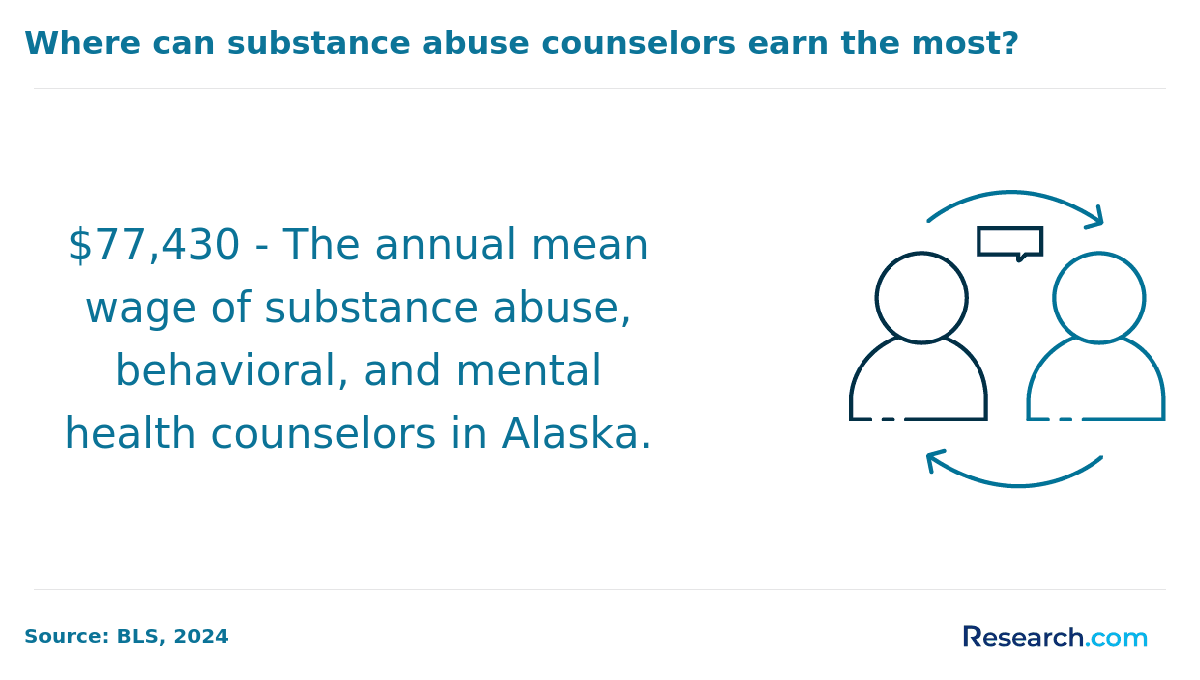
Regarding geography, California has the highest employment level, with 54,660 counselors, followed by New York and Pennsylvania. If you want the best pay, Alaska, Utah, and the District of Columbia are the top-paying states.
How much can I make with substance abuse counseling?
With an online bachelor's in substance abuse counseling, you can expect to make around $59,190 per year, which is the median annual wage for this field as of 2024. Earnings can vary based on the industry and location.
Here are the median annual wages for different settings:
- Hospitals (state, local, and private): $61,930
- Offices of other health practitioners: $59,570
- Outpatient mental health and substance abuse centers: $58,200
- Individual and family services: $57,080
- Residential mental health and substance abuse facilities: $49,610
Top-paying states include:
- Alaska: $77,430
- Utah: $70,310
- District of Columbia: $67,750
- New Jersey: $67,250
- New York: $67,240
These figures give you a good idea of potential earnings with this degree.
- 2027 Best Online Bachelor's in Substance Abuse Counseling List of Programs
- How long does it take to complete an online bachelor's in substance abuse counseling? How long does it take to complete an online bachelor's in substance abuse counseling?
- How does an online bachelor's in substance abuse counseling program compare to an on-campus program? How does an online bachelor's in substance abuse counseling program compare to an on-campus program?
- What is the average cost of an online bachelor's in substance abuse counseling? Program Cost
- What are the financial aid options for students enrolling in online bachelor's in substance abuse counseling? Financial Aid Options
- What are the prerequisites for enrolling in online bachelor's in substance abuse counseling? What are the prerequisites for enrolling in online bachelor's in substance abuse counseling?
- What courses are typically in an online bachelor's in substance abuse counseling program? What courses are typically in an online bachelor's in substance abuse counseling program?
- What types of specializations are available in online bachelor's in substance abuse counseling? What types of specializations are available in online bachelor's in substance abuse counseling?
- How to Choose the Best Online Bachelor's in Substance Abuse Counseling Program How to Choose the Best Online Bachelor's in Substance Abuse Counseling Program
- Understanding the Importance of Accreditation in Online Substance Abuse Counseling Programs Understanding the Importance of Accreditation in Online Substance Abuse Counseling Programs
- How do substance abuse counselors address co-occurring grief issues? How do substance abuse counselors address co-occurring grief issues?
- Can an advanced degree accelerate your career advancement? Can an advanced degree accelerate your career advancement?
- How to Complete an Online Bachelor's in Substance Abuse Counseling Program How to Complete an Online Bachelor's in Substance Abuse Counseling Program
- What student support services are offered in online substance abuse counseling programs? What student support services are offered in online substance abuse counseling programs?
- What challenges might arise during an online bachelor's in substance abuse counseling program? What challenges might arise during an online bachelor's in substance abuse counseling program?
- What licenses or certifications are required after earning a substance abuse counseling degree? What licenses or certifications are required after earning a substance abuse counseling degree?
- What career paths are available for graduates of online bachelor's in substance abuse counseling programs? Career Paths
- What is the job market for graduates with an online bachelor's in substance abuse counseling? Job Market
- How can you advance your professional development through mentorship and networking? How can you advance your professional development through mentorship and networking?
- How can you enhance a substance abuse counseling degree with Christian counseling certification? How can you enhance a substance abuse counseling degree with Christian counseling certification?
- What emerging trends are shaping substance abuse counseling practice? What emerging trends are shaping substance abuse counseling practice?
- Which counseling license is the right fit for you? Which counseling license is the right fit for you?
- How can substance abuse counselors maximize their earning potential? How can substance abuse counselors maximize their earning potential?
2027 Best Online Bachelor’s in Substance Abuse Counseling Programs
An online bachelor’s in substance abuse counseling is designed for students who want to work with individuals, families, and communities affected by addiction, behavioral health challenges, and recovery-related issues. The right program can help you build counseling skills, complete field experience, prepare for state credentialing steps, and decide whether to enter the workforce after graduation or continue into graduate study.
This guide compares strong online bachelor’s programs, explains how long they take, what they cost, what courses and internships usually involve, and how licensure works after graduation. It also covers online versus campus learning, financial aid, accreditation, career paths, job outlook, and practical questions to ask before enrolling. If you are specifically looking for faith-integrated counseling education, you may also want to compare online Christian counseling degree programs.
Quick Answer: Is an Online Bachelor’s in Substance Abuse Counseling Worth Considering?
An online bachelor’s in substance abuse counseling can be a practical choice if you want a flexible pathway into addiction counseling, prevention services, behavioral health support, or community programs. Most bachelor’s programs require 120 credits and often take about four years, although transfer credits, part-time enrollment, and prior college coursework can change the timeline.
The most important decision is not simply whether the program is online. You should verify accreditation, confirm whether the curriculum supports the credential you want in your state, compare total costs beyond tuition, and ask how practicum or internship placements are handled for online students.
How We Selected the Programs
Research.com rankings are developed through structured research and data review. Our team evaluates program availability, institutional data, affordability indicators, distance education information, and other school-level factors. For a broader explanation of the process, review our ranking methodology.
Data sources used for this guide include:
- IPEDS database
- Peterson’s database
- Distance Learning Licensed Data Set, College Scorecard database
- National Center for Education Statistics
Best Online Bachelor’s in Substance Abuse Counseling Programs
The programs below are suited for students who want undergraduate training in addiction counseling, addiction studies, prevention, recovery ministry, or related behavioral health fields. Because counseling credentials vary by state, students should always confirm licensure alignment before enrolling.
| School | Program Focus | Credits | Published Cost | Accreditation |
| Fort Hays State University | Sociology Addictions Counseling | 120 credits | $242.76 per credit hour | Higher Learning Commission (HLC) |
| City Vision University | Addiction Counseling with Christian perspective | 120 credits | $800 per course | Distance Education Accreditation Commission (DEAC) |
| Union College, KY | Substance Abuse Counseling | 120 credits | $225 per credit hour | Southern Association of Colleges and Schools Commission on Colleges (SACS COC) |
| University of Central Arkansas | Addiction Studies with prevention and treatment tracks | 120 credits | $238.00/hr | Higher Learning Commission (HLC) |
| SUNY Empire State University | Addiction Studies | 120 credits | $353 per credit for online out-of-state residents | Middle States Commission on Higher Education |
1. Fort Hays State University
Fort Hays State University offers Bachelor of Arts and Bachelor of Science options in Sociology Addictions Counseling. The program is built for students who want addiction counseling preparation within a sociology-based curriculum and is designed to support licensure preparation as an addiction counselor in Kansas. Coursework includes addiction-focused study in family counseling, pharmacology, ethics, psychopathology, and related practice areas. Students also complete two practicum courses for applied experience.
- Program length: Typically 4 years for a bachelor’s degree
- Track or concentration: Sociology Addictions Counseling
- Cost per credit: $242.76 per credit hour
- Credits required: 120 credits
- Accreditation: Higher Learning Commission (HLC)
2. City Vision University
City Vision University provides an online Bachelor’s in Addiction Counseling that integrates Christian counseling principles with addiction counseling preparation. The curriculum is aligned with NAADAC standards and covers clinical evaluation, treatment planning, multicultural counseling, and other skills relevant to addiction services. Students may choose from clinical counseling and Christian recovery ministry concentrations.
- Program length: 4 years
- Tracks or concentrations: Clinical Counseling Concentration, Christian Recovery Ministry Concentration
- Tuition or cost per credit: $800 per course
- Credits required: 120 credits
- Accreditation: Distance Education Accreditation Commission (DEAC)
3. Union College, KY
Union College offers an online Bachelor of Science in Substance Abuse Counseling with a curriculum that combines general education, electives, specialized counseling coursework, and an internship. Students study screening, assessment, treatment planning, case management, crisis intervention, client education, and professional consultation. The program may appeal to students who want a liberal arts foundation paired with substance abuse and psychology coursework.
- Program length: 4 years
- Track or concentration: Substance Abuse Counseling
- Cost per credit: $225 per credit hour
- Credits required: 120 credits
- Accreditation: Southern Association of Colleges and Schools Commission on Colleges (SACS COC)
4. University of Central Arkansas
The University of Central Arkansas offers a Bachelor of Science in Addiction Studies for students interested in addiction treatment, prevention, education, and behavioral health work. The program includes addiction theory, counseling practice, research, ethics, treatment approaches, mental health, drug education, and multicultural counseling. It includes prevention and treatment tracks and is designed for students with an associate degree.
- Program length: Typically 4 years.
- Tuition or cost per credit: $238.00/hr
- Credits required: 120 credits
- Accreditation: Higher Learning Commission (HLC).
5. SUNY Empire State University
SUNY Empire State College offers a Bachelor of Science in Addiction Studies that examines addiction, treatment models, prevention, advocacy, ethics, and culturally responsive practice. The program prepares students for roles in counseling-related support, prevention programs, advocacy organizations, administration, and other addiction services settings.
- Program length: Typically 4 years for full-time students.
- Tracks or concentrations: Not specified.
- Tuition or cost per credit: $353 per credit for online out-of-state residents.
- Credits required: 120 credits
- Accreditation: Middle States Commission on Higher Education.
What Students Say About Online Substance Abuse Counseling Degrees
- : "The online format helped me continue working and caring for my family while completing a degree connected to the work I care about. Flexible courses and responsive instructors made the program manageable, and I left with skills I can use in my community. — Janice"
- : "My program connected addiction theory with practical treatment tools, which made the coursework feel relevant. The online structure also helped me build confidence through applied assignments and supervised learning experiences. — David"
- : "Studying online gave me access to classmates with different life experiences and professional goals. Those discussions helped me understand addiction and recovery from a wider perspective. — Jessica"
Key Findings
- Most online bachelor’s in substance abuse counseling or addiction studies programs require 120 credits and commonly take about four years for full-time students.
- Published costs vary widely. The listed programs include per-credit rates such as $225 per credit hour, $238.00/hr, $242.76 per credit hour, and $353 per credit for online out-of-state residents, plus a course-based model at $800 per course.
- Online programs can be convenient, but students must confirm whether field experience, practicum, or internship requirements can be completed near where they live.
- Accreditation matters for financial aid, credit transfer, employer recognition, and possible licensure or certification eligibility.
- State licensing requirements differ. A bachelor’s degree may support entry-level or credentialing pathways, but some clinical counseling roles require graduate education and supervised hours.
How Long Does an Online Bachelor’s in Substance Abuse Counseling Take?
An online bachelor’s in substance abuse counseling usually takes about four years of full-time study. Programs such as Fort Hays State University and the University of Central Arkansas require 120 credits, which is a common structure for bachelor’s degrees. Students typically complete general education, major courses, electives, and supervised or practical learning requirements.
Completion time depends on enrollment pace and transfer credit. Full-time students may finish faster than part-time students, while students who already hold an associate degree may be able to shorten the remaining timeline. If you are comparing broader online counseling degrees, pay attention to whether each program is designed for first-time college students, transfer students, or degree-completion students.
| Student Situation | Likely Timeline Impact | What to Ask the School |
| First-time bachelor’s student | May need the full 120-credit sequence | Are general education and major courses available fully online? |
| Transfer student | Previously earned credits may reduce time to graduation | How many credits can transfer into the major and electives? |
| Working adult student | Part-time enrollment may extend the program | Can I take fewer courses without losing financial aid eligibility? |
| Student seeking licensure preparation | Fieldwork scheduling may affect pacing | Can practicum or internship hours be completed in my state? |
Online Versus Campus Substance Abuse Counseling Programs: Which Format Fits You?
An online bachelor’s in substance abuse counseling is usually best for students who need flexibility because of work, family responsibilities, military service, location, or transportation constraints. Campus programs may be better for students who want frequent face-to-face interaction, local networking, and structured weekly schedules.
Online education is now a mainstream option for many undergraduate students. According to the National Center for Education Statistics, in 2024, 53.8% of students were enrolled in distance education courses. Employers are generally more likely to respect an online degree when it comes from an accredited institution, especially when the online program follows the same academic standards as campus-based offerings.
| Factor | Online Program | Campus Program |
| Schedule | Often more flexible, especially with asynchronous courses | Usually follows set class times and campus schedules |
| Field experience | May be arranged near the student’s location | Often connected to local agency partnerships |
| Interaction | Uses discussion boards, video meetings, email, and virtual advising | Provides in-person discussion, labs, meetings, and campus events |
| Costs beyond tuition | May reduce commuting, housing, and relocation expenses | May involve transportation, parking, meal plan, or housing costs |
| Best for | Self-directed students who need location flexibility | Students who prefer regular in-person structure |
How Much Does an Online Bachelor’s in Substance Abuse Counseling Cost?
Cost depends on the institution, residency status, transfer credits, fees, and whether the program charges by credit or by course. One cited estimate places the cost of an online degree at about $54,183 for a public university, compared with $85,348 for the same degree pursued in person. For students comparing a substance abuse counselor degree, the most useful number is total program cost after transfer credit and aid, not tuition alone.
Among the programs listed here, Fort Hays State University charges $242.76 per credit, which totals $29,131.20 for 120 credits, while Union College charges $225 per credit, totaling $27,000 for 120 credits. These figures do not necessarily include every possible fee, book, technology cost, or field placement expense, so students should request a written cost breakdown before enrolling.
For undergraduate substance abuse counselor degree programs, in-state tuition averages $9,279, while out-of-state tuition averages $22,492. Over four years, that equals about $37,116 for in-state students and $89,968 for out-of-state students. Campus students may also face additional expenses, including $1,360 per year for transportation, $600 more annually for a campus meal plan than home-cooked meals, parking permits, and housing.
| Cost Category | Why It Matters | Question to Ask |
| Tuition | Usually the largest direct academic cost | Is tuition charged per credit, per course, or per term? |
| Technology fees | Online students may pay platform or distance learning fees | Are online fees included in the published tuition rate? |
| Books and course materials | Counseling courses may require textbooks, assessment resources, or subscriptions | Are digital materials included, rented, or purchased separately? |
| Practicum or internship expenses | Field placements can require travel, background checks, or documentation | Who helps secure placements, and what extra costs are typical? |
| Residency or campus visits | Some online programs may require limited in-person participation | Are any campus visits, intensives, or in-person exams required? |
Financial Aid Options for Online Substance Abuse Counseling Students
Online students may qualify for many of the same financial aid options as campus students if they attend an eligible accredited institution. Before choosing a program, confirm that the school participates in federal aid programs and ask how enrollment intensity affects aid eligibility.
- Federal aid: Complete the Free Application for Federal Student Aid (FAFSA) to determine eligibility for federal grants, student loans, and work-study options.
- Scholarships: Search for awards from the school, counseling organizations, community foundations, recovery-focused nonprofits, and behavioral health associations.
- Grants: Need-based grants can reduce out-of-pocket costs and generally do not require repayment.
- Private loans: Private education loans can fill funding gaps, but they must be repaid with interest and should be compared carefully.
- Institutional aid: Ask each school about merit scholarships, need-based grants, transfer scholarships, adult learner awards, and employer partnership discounts.
Students seeking low-cost counseling pathways may also want to compare the cheapest online LPC programs, especially if they are considering graduate-level counseling licensure later.
Admission Requirements for an Online Bachelor’s in Substance Abuse Counseling
Most online bachelor’s programs require a high school diploma or GED for first-year admission. Transfer-friendly programs may also require official college transcripts from every institution previously attended. Requirements vary, but common materials include:
- Official transcripts: Schools usually request high school transcripts, GED documentation, and any prior college records.
- Minimum GPA: Many programs use a minimum GPA, often between 2.0 and 3.0.
- Test scores: Some institutions may ask for SAT or ACT scores, although many waive this requirement.
- Personal statement: Applicants may be asked to explain their interest in addiction counseling, behavioral health, recovery work, or community service.
- Recommendations: Letters from teachers, supervisors, counselors, or professionals can support an application.
- Technology readiness: Because the program is online, schools may expect students to use learning platforms, video tools, email, and digital research resources confidently.
Students should also be realistic about the personal qualities required for this field. Strong communication, empathy, boundaries, resilience, ethical judgment, and self-discipline are important both in online coursework and in future client-facing settings.
Common Courses in an Online Bachelor’s in Substance Abuse Counseling
Coursework usually blends psychology, counseling theory, addiction science, ethics, case management, prevention, and field-based learning. These classes build a foundation for counseling careers that involve addiction, recovery, behavioral health, and community support.
| Course Area | What Students Learn | Why It Matters in Practice |
| Introduction to Substance Abuse Counseling | Basic addiction concepts, counseling roles, and substance use patterns | Builds the foundation for later clinical and prevention coursework |
| Psychology of Addiction | Behavioral, cognitive, and psychological factors connected to addiction | Helps students understand why recovery requires more than willpower |
| Pharmacology in Substance Abuse | How substances affect the brain, body, behavior, and treatment planning | Supports safer, more informed counseling and referral decisions |
| Counseling Techniques and Theories | Major counseling approaches used with individuals and groups | Prepares students for structured helping conversations and interventions |
| Ethics in Counseling | Confidentiality, boundaries, legal responsibilities, and professional conduct | Reduces risk and supports client-centered care |
| Case Management in Substance Abuse | Assessment, service coordination, treatment planning, and progress monitoring | Useful in agencies, treatment centers, recovery programs, and community services |
| Multicultural Counseling | Cultural, social, and identity-related factors in addiction and treatment | Improves responsiveness to diverse clients and communities |
| Crisis Intervention | Immediate response strategies for behavioral health and substance-related crises | Prepares students for high-pressure situations that require calm judgment |
Specializations in Online Substance Abuse Counseling Bachelor’s Programs
Specializations allow students to focus their degree on a particular population, service setting, or counseling function. Not every program offers formal concentrations, so review the curriculum carefully before applying.
- Clinical counseling: Emphasizes direct client work, treatment planning, therapeutic techniques, and group or individual counseling support.
- Prevention counseling: Focuses on outreach, education, school-based programming, and community strategies that reduce substance misuse risk.
- Youth counseling: Prepares students to understand adolescent and young adult substance use issues, family systems, and early intervention.
- Family counseling: Explores how substance use affects family relationships, communication, relapse prevention, and recovery support.
- Crisis intervention: Builds skills for responding to emergencies involving substance use, mental health symptoms, safety concerns, or acute distress.
Students who want to understand how addiction counseling overlaps with psychology, therapy, and behavioral science may also find it useful to review different types of psychology and related career paths.
How to Choose the Best Online Bachelor’s in Substance Abuse Counseling Program
To become a counselor or counseling-related professional, choose a program based on fit, licensure alignment, cost, and support services rather than ranking alone. Use the checklist below before applying.
- Confirm state eligibility: Ask whether the program meets educational requirements for the counseling credential you want in the state where you plan to work.
- Check institutional accreditation: Accreditation affects financial aid, credit transfer, employer recognition, and future graduate school options.
- Review fieldwork logistics: Ask who finds practicum or internship sites, whether your location is approved, and how supervision is documented.
- Compare course delivery: Decide whether asynchronous, synchronous, hybrid, or cohort-based learning best fits your schedule and learning style.
- Look beyond tuition: Include fees, textbooks, technology, travel, field placement costs, and lost work time.
- Evaluate student support: Strong online programs provide academic advising, tutoring, technical help, library access, career services, and faculty availability.
- Assess reputation carefully: Consider faculty expertise, graduate outcomes when available, employer connections, and whether the school has a respected counseling or behavioral health department.
- Ask about transfer credits: A generous transfer policy can lower cost and shorten completion time, but major requirements may limit how many credits apply.
Why Accreditation Matters in Online Substance Abuse Counseling Programs
Accreditation is one of the first things to verify when evaluating an online bachelor’s program. It shows that an institution or program has been reviewed against recognized academic standards. For counseling-related fields, accreditation can also influence financial aid, transfer credit, graduate admission, employment, and credentialing options.
What Accreditation Can Affect
- Academic quality: Accredited institutions undergo review of curriculum, faculty qualifications, learning resources, governance, and student services.
- Licensure and certification: Some states or credentialing bodies require coursework from accredited schools or programs. Requirements differ, so students must verify rules directly with their state board.
- Credit transfer: Credits from accredited institutions are more likely to be considered by other accredited colleges, although transfer is never guaranteed.
- Financial aid: Federal student aid and many scholarship programs are generally tied to enrollment at eligible accredited institutions.
- Graduate school options: Students who plan to pursue a master’s degree should confirm that the bachelor’s program will be accepted by the graduate schools they are considering.
How to Verify Accreditation
Start with the school’s accreditation page, then verify the claim directly through the accreditor or federal accreditation resources. For counseling and addiction-related education, students may see references to regional or national institutional accreditation as well as specialized organizations. The Council for Accreditation of Counseling and Related Educational Programs (CACREP) and the National Addiction Studies Accreditation Commission (NASAC) are recognized names in counseling and addiction studies accreditation discussions.
If you are comparing counseling-related degree options beyond addiction counseling, you may also want to review the most affordable online MFT programs and compare accreditation, clinical training, and licensure outcomes.
How Substance Abuse Counselors Address Co-Occurring Grief Issues
Substance use and grief can overlap. Clients may use substances after a death, traumatic loss, family disruption, job loss, or other major life change. Counselors need to recognize when grief, trauma symptoms, depression, or anxiety may be influencing substance use patterns and recovery progress.
Common approaches include trauma-informed care, grief-sensitive assessment, coordinated treatment planning, and referrals to specialized providers when a client’s needs exceed the counselor’s scope. For readers interested in grief-focused work, Research.com also provides information on grief counselor salary and career considerations.
Can a Master’s Degree Help You Advance After a Bachelor’s?
A bachelor’s degree can prepare students for entry-level roles, prevention work, case management support, recovery services, and credentialing pathways in some states. However, many advanced clinical counseling roles require graduate education, supervised clinical experience, and state licensure.
A focused graduate program, such as a master's in addiction counseling, can help professionals deepen assessment skills, manage more complex cases, supervise services, and qualify for broader counseling credentials where allowed by state law. Students should compare the cost of graduate education against licensing goals, employer requirements, and expected career mobility.
How to Succeed in an Online Bachelor’s in Substance Abuse Counseling Program
Online learning is flexible, but it is not effortless. Students must manage deadlines, communicate proactively, participate in virtual discussions, and prepare for fieldwork requirements. The habits below can improve both academic performance and professional readiness.
- Build a weekly study routine: Block time for readings, assignments, discussion posts, exams, and practicum preparation before the week begins.
- Keep course materials organized: Use folders, calendars, naming conventions, and saved copies of syllabi so deadlines and resources do not get lost.
- Participate consistently: Discussion boards and group projects are often where counseling concepts become practical. Engage early instead of posting at the last minute.
- Ask for help quickly: Contact instructors, advisors, tutors, or technical support as soon as problems appear. Waiting can turn a small issue into a failed course or missed fieldwork deadline.
- Develop professional connections: Attend webinars, join student groups, connect with faculty, and look for addiction counseling associations or recovery-focused events.
- Use fieldwork strategically: Treat practicum and internship experiences as career-building opportunities. Practice assessment, documentation, treatment planning, boundaries, and crisis response under supervision.
- Protect your motivation: Counseling education can be emotionally demanding. Revisit your goals, maintain healthy routines, and seek support when coursework or field experiences feel heavy.
Students who later decide to move into family systems or relationship-focused clinical work can compare affordable online MFT programs as a possible next step.
Student Support Services to Look For in Online Counseling Programs
Strong support services can make a major difference in an online counseling program, especially for students who are balancing school with work or caregiving. Look for services that help you complete courses, prepare for internships, and transition into employment or graduate study.
- Academic advising: Helps students plan courses, understand degree requirements, and avoid unnecessary credits.
- Technical support: Reduces disruption when learning platforms, video tools, or online exams create problems.
- Online library access: Supports research assignments, evidence-based practice coursework, and capstone projects.
- Tutoring and writing help: Useful for students returning to school after time away or completing research-heavy assignments.
- Career services: Can provide resume reviews, interview preparation, job search guidance, and employer connections.
- Mental health and peer support: Important in a field where students may study difficult topics such as trauma, relapse, crisis, and family disruption.
If you are comparing related online therapy pathways, affordable online MFT programs may also be worth reviewing for program format, clinical preparation, and timeline differences.
Challenges of Online Substance Abuse Counseling Programs
Online substance abuse counseling programs can be effective, but students should plan for predictable challenges. The biggest issues usually involve time management, isolation, fieldwork logistics, and limited face-to-face practice.
| Common Challenge | Why It Happens | Better Strategy |
| Falling behind | Flexible schedules can make deadlines feel less urgent | Create fixed weekly study blocks and track all due dates in one calendar |
| Feeling disconnected | Online students may have fewer informal conversations with peers and faculty | Attend virtual office hours, join student groups, and participate early in discussions |
| Difficulty practicing counseling skills | Some communication skills are easier to develop in live interaction | Choose programs with simulations, synchronous practice, role play, or strong field supervision |
| Field placement uncertainty | Online students may live far from the school’s usual placement partners | Ask before enrollment how local placements are approved and supervised |
| Technology barriers | Video platforms, proctored exams, and learning systems can create friction | Test tools early and confirm support hours for evenings or weekends |
Students seeking broader faith-integrated training at the graduate level may also compare an online masters in Christian counseling after reviewing clinical requirements and state rules.
Licensure and Certification After a Substance Abuse Counseling Bachelor’s Degree
Most states require licensure or certification for substance abuse counseling practice, but the exact title, education level, supervised hours, exam, and scope of practice vary. Students should research requirements early because a degree that works for one state may not fully satisfy another state’s rules.
Common post-degree steps include:
- Complete supervised clinical hours. These hours typically range from 2,000 to 4,000, depending on state regulations.
- Pass a certification exam, such as the National Certified Addiction Counselor (NCAC) exam or a state-specific examination.
- Apply through the state licensing or certification board, which may require background checks, documentation of education and supervision, ethics training, or client confidentiality training.
Some states use multiple credential levels, allowing professionals to advance as they complete additional education, supervised experience, or exams. Continuing education may also be required to keep a license or certification active.
Career Paths With an Online Bachelor’s in Substance Abuse Counseling
Graduates may work in addiction treatment centers, outpatient programs, hospitals, recovery organizations, social service agencies, correctional settings, community nonprofits, or prevention programs. Some roles may require additional certification, licensure, or graduate education depending on the state and employer.
| Role | Typical Work | Average Salary Reported by BLS |
| Substance Abuse Counselor | Supports clients dealing with addiction, recovery planning, relapse prevention, and treatment participation | $53,710 per year |
| Mental Health Counselor | Helps clients manage behavioral health concerns that may overlap with substance use | $53,710 per year |
| Rehabilitation Counselor | Assists people with physical, emotional, or mental disabilities in pursuing personal and work-related goals | $44,040 per year |
| Social Worker | Connects individuals and families with support for addiction, housing, health, family needs, or crisis situations | $58,380 per year |
| Social and Community Service Manager | Coordinates programs, staff, budgets, and services for community well-being | $77,030 per year |
Students who want to increase clinical scope or pursue advanced counseling credentials may consider the most affordable online masters in mental health counseling as a future step.
Job Outlook for Substance Abuse Counseling Graduates
The substance abuse counselor job outlook is strong. Employment for substance abuse, behavioral disorder, and mental health counselors is projected to grow 17% from 2024 to 2034, which is much faster than the average for all occupations. About 48,300 job openings are expected each year, on average, because of growth and the need to replace workers who move into other occupations or retire.
Demand is connected to the continuing need for mental health and addiction treatment services, including support for people with opioid use disorders and young people with behavioral health concerns. Even with favorable projections, job outcomes are not guaranteed. Location, licensure level, employer type, experience, and graduate education can all affect opportunities.
Mentorship and Networking for Substance Abuse Counseling Students
Professional relationships can help students understand licensing pathways, find internship sites, learn about job openings, and develop ethical practice habits. Online students should be intentional because they may not have the same casual networking opportunities that occur on campus.
- Join addiction counseling, behavioral health, or human services associations when student memberships are available.
- Attend webinars, virtual conferences, and continuing education events related to addiction treatment and prevention.
- Ask faculty and field supervisors for feedback on career goals, credential options, and professional strengths.
- Connect with alumni who work in treatment centers, prevention programs, recovery organizations, and community agencies.
- Learn how advanced credentials differ by reviewing pathways such as the fastest way to become a licensed therapist.
Adding Christian Counseling Training to a Substance Abuse Counseling Degree
Some students want to serve clients in faith-based recovery programs, churches, pastoral counseling settings, or Christian nonprofits. Christian counseling certification can complement a substance abuse counseling background by adding training in theology, pastoral care, spiritual formation, faith-based ethics, and spiritually integrated helping approaches.
This path is not a substitute for state counseling licensure when licensure is required. Instead, it may strengthen fit for faith-oriented roles or clients seeking spiritually informed support. Students should confirm whether a certification is recognized by employers, churches, ministries, or professional organizations relevant to their goals.
For a deeper look at this pathway, review Research.com’s guide to Christian counseling certification.
Trends Shaping Substance Abuse Counseling Education and Practice
Substance abuse counseling continues to evolve as treatment systems respond to telehealth, integrated behavioral health, data-informed care, and growing attention to co-occurring mental health needs. Online degree programs may prepare students for these changes by using virtual discussions, simulated counseling practice, digital case studies, and coursework that connects addiction treatment with mental health, ethics, and community resources.
Telehealth has expanded access to care in many settings, although rules and reimbursement can vary. Counselors are also expected to understand culturally responsive practice, trauma-informed care, harm reduction discussions, and collaboration with medical, social service, and recovery support professionals. Students looking for flexible and lower-cost options can compare the cheapest online bachelor's degree in substance abuse counseling while checking whether the curriculum reflects current practice expectations.
Which Counseling License Should You Plan For?
The right credential depends on the work you want to do. Addiction counseling credentials may support substance use treatment roles, while broader licenses such as LPC or LCSW can lead to different scopes of practice, clinical responsibilities, and employment settings. These paths often require graduate education, supervised experience, and state exams.
Before choosing a bachelor’s program, ask whether your long-term goal is addiction counseling, mental health counseling, social work, marriage and family therapy, prevention, case management, or program administration. If you are weighing broader clinical routes, Research.com’s comparison of therapist LPC vs LCSW pathways can help clarify major differences.
How Substance Abuse Counselors Can Improve Earning Potential
Earning potential in substance abuse counseling depends on location, employer, credentials, experience, education level, and role responsibility. Counselors who want to improve income over time often pursue advanced degrees, additional certifications, supervisory responsibilities, specialized populations, program management roles, or private practice where allowed by law and licensure.
Students should be cautious about assuming that any degree guarantees a specific salary. A stronger strategy is to compare state licensure requirements, employer job postings, supervision rules, and graduate degree options before investing in additional education. For broader income strategies in therapy-related careers, review Research.com’s discussion of therapist highest earning potential.
Common Mistakes to Avoid Before Enrolling
| Mistake | Why It Can Hurt You | Better Approach |
| Choosing only by tuition price | The lowest tuition may not include fees, books, or fieldwork costs | Ask for the full estimated cost of attendance and compare net cost after aid |
| Ignoring accreditation | Non-accredited study may limit financial aid, transfer, employment, or licensure options | Verify accreditation through the school and accrediting body before applying |
| Assuming online means self-paced | Many online programs still have weekly deadlines, live sessions, or cohort schedules | Request a sample course schedule and confirm synchronous requirements |
| Overlooking licensure rules | State requirements vary, and some roles require graduate education | Contact the state board before enrollment and keep documentation of coursework |
| Waiting to plan fieldwork | Internship placement can delay graduation if approval takes time | Ask early how placements are found, approved, supervised, and evaluated |
| Relying only on rankings | A highly ranked school may not match your state, schedule, budget, or career goal | Use rankings as a starting point, then compare fit factors directly |
Questions to Ask Schools Before You Apply
- Does this program meet educational requirements for addiction counseling credentials in my state?
- What percentage of the degree can be completed online?
- Are there required campus visits, weekend intensives, or in-person exams?
- Who arranges practicum or internship placements for online students?
- Can I complete supervised hours near my home?
- How many transfer credits will you accept, and how many apply to the major?
- What is the total estimated cost, including tuition, fees, books, technology, and field placement expenses?
- What student support services are available in the evenings or on weekends?
- What credentials do faculty members hold, and do they have experience in addiction counseling?
- What are typical graduate outcomes for students in this program?
Key Insights
- An online bachelor’s in substance abuse counseling can be a strong fit for students who need flexibility and want to enter addiction services, behavioral health support, prevention, or recovery-related work.
- The safest program choice is accredited, affordable after aid, realistic for your schedule, and aligned with the credentialing rules in the state where you plan to work.
- Most programs require 120 credits and often take about four years, but transfer credits and part-time study can significantly change the timeline.
- Cost comparisons should include more than tuition. Fees, books, technology, transportation, field placement costs, and lost work hours can affect the true price.
- Licensure is not automatic after graduation. Many states require supervised hours, exams, applications, background checks, and continuing education.
- Career options include substance abuse counselor, mental health counselor, rehabilitation counselor, social worker, and social and community service manager, but job duties and legal scope depend on credentials and state rules.
- Students who want advanced clinical practice, supervision, or broader counseling authority should plan early for graduate education and licensure requirements.
References:
- BLS (2025). Rehabilitation Counselors: Occupational Outlook Handbook: U.S. Bureau of Labor Statistics.
- BLS (2025). Social and Community Service Managers: Occupational Outlook Handbook: U.S. Bureau of Labor Statistics.
- BLS (2025). Social Workers: Occupational Outlook Handbook: U.S. Bureau of Labor Statistics.
- BLS (2025). Substance Abuse, Behavioral Disorder, and Mental Health Counselors: Occupational Outlook Handbook: U.S. Bureau of Labor Statistics.
- BLS (2025). Substance Abuse, Behavioral Disorder, and Mental Health Counselors. Bureau of Labor Statistics.
- Zippia (2026). Substance Abuse Counselor Demographics and Statistics: Number of substance abuse counselors in the US.
Other Things You Should Know About Online Bachelor's in Substance Abuse Counseling Program
Financial aid options for these programs include federal grants like the Pell Grant, scholarships specific to counseling studies, and state-funded aid. Students should also explore work-study opportunities and low-interest federal student loans for additional support in 2027.
To select a cost-effective yet quality program in 2027, compare tuition rates, check accreditation status, review faculty credentials, and look for student support services. Consider financial aid and scholarships to reduce costs further.
Admission requirements typically include a high school diploma or GED, official transcripts, a minimum GPA, and sometimes standardized test scores. Some programs may also ask for a personal statement or letters of recommendation. Requirements vary, so checking with individual programs is essential.


