
2027 Best Online DNP Programs Without Clinicals

Co-Founder and Chief Data Scientist
In 2022, only 2.7% of registered nurses in the U.S. held a doctorate. For many experienced nurse leaders, that number points to a clear challenge: an MSN, once the gold standard, no longer guarantees a peer-level voice in the executive suite. The Doctor of Nursing Practice (DNP) is the credential designed to bridge that gap, translating your deep clinical wisdom into strategic authority.
This is more than just a list of programs. Our career planning experts, with over 10 years of experience, have built this guide to give you a clear, confident path forward. Here you'll find a strategic roadmap to the best online DNP programs without clinicals.
What are the benefits of getting a DNP program without clinicals?
- Gain C-suite credibility and the authority to lead strategic initiatives alongside other doctoral-prepared executives.
- Achieve a significant increase in earning potential, with median salaries for DNP graduates reaching around $100,000 compared to $90,000 for those with an MSN.
- Develop mastery in high-demand areas like healthcare finance, data analytics, and organizational leadership to drive system-wide change. s
What can I expect from an online DNP program without clinicals?
You can expect a demanding, high-level curriculum focused on the skills needed for executive leadership and academic administration. Coursework centers on topics like healthcare policy, finance, data analytics, and organizational strategy. This is a significant shift from the clinical focus of an MSN.
The centerpiece of these programs is the DNP scholarly project. This is not a theoretical dissertation. It’s an applied, hands-on initiative where you identify a real problem within a healthcare or academic organization and implement a data-driven solution.
This project is what replaces traditional patient-facing clinical hours, proving your mastery of system-level practice. Many students complete their projects at their current workplace, delivering direct value to their employers even before graduating from online DNP programs without clinicals.
Where can I work with an online DNP program without clinicals?
With this degree, you are prepared to work at the system level across the entire healthcare ecosystem. Your expertise is not confined to a single hospital or university building; it's transferable to any setting that requires strategic nursing leadership.
Graduates find top-tier roles in the corporate offices of large hospital systems, academic institutions, and public health organizations. Beyond these more traditional paths, your skills are in high demand in the private sector. Many DNP-prepared leaders work for insurance companies, health technology firms, and government agencies, shaping policy and designing the future of healthcare delivery from the top down.
How much can I make with an online DNP program without clinicals?
DNP-prepared nurses are among the highest earners in the profession. As a baseline, nurse practitioners earn a median salary of $132,050 as of 2024. However, the true financial power of the DNP is not just an immediate salary bump, but its ability to unlock a career ladder with a significantly higher long-term ceiling.
While you may not earn a Chief Nursing Officer's salary the day after graduation, the degree makes you a candidate for those executive roles. It provides access to the positions where six-figure salaries are the starting point, not the goal.
- List of the Best Online DNP Programs Without Clinicals for 2027 List of Programs
- How long does it take to complete an online DNP program without clinicals? Completion Time
- How does an online DNP program without clinicals compare to an on-campus program? How does an online DNP program without clinicals compare to an on-campus program?
- What is the average cost of an online DNP program without clinicals? Program Cost
- What are the financial aid options for students enrolling in an online DNP program without clinicals? Financial Aid
- What are the prerequisites for enrolling in an online DNP program without clinicals? What are the prerequisites for enrolling in an online DNP program without clinicals?
- What courses are typically in an online DNP program without clinicals? What courses are typically in an online DNP program without clinicals?
- What types of specializations are available in an online DNP program without clinicals? Sepecializations
- How to Choose the Best Online DNP without Clinicals How to Choose the Best Online DNP without Clinicals
- What career paths are available for graduates of an online DNP program without clinicals? Career Paths
- What is the job market for graduates of an online DNP program without clinicals? Job Market
- What challenges might I face with a non-clinical online DNP program? What challenges might I face with a non-clinical online DNP program?
Best Online DNP Programs Without Clinicals for 2027
An online Doctor of Nursing Practice without traditional clinical rotations can be a strong option for experienced nurses who want to move into executive leadership, systems improvement, informatics, policy, or nursing education rather than direct advanced clinical practice. The key is understanding what “without clinicals” actually means: most programs still require practice-based learning, a DNP scholarly project, leadership experiences, intensives, or workplace-based application. They simply do not follow the same patient-care clinical rotation model used in nurse practitioner, nurse midwifery, or nurse anesthesia tracks.
This guide is for MSN-prepared nurses comparing post-master’s DNP programs that emphasize leadership instead of new clinical licensure. You will learn how the programs compare, how long they take, what they cost, what admissions committees look for, how to evaluate accreditation and fit, and which career paths may make the degree worth the investment.
Quick answer: What is the best online DNP without clinicals?
The best online DNP without clinicals is the program that matches your career target, schedule, budget, and required practice expectations. Executive leadership, systems leadership, informatics, and nursing education tracks are common choices for nurses who already have graduate-level preparation and want a terminal practice doctorate without becoming a new type of clinical provider. Before enrolling, confirm the program’s nursing accreditation, project requirements, on-campus intensives, tuition structure, and whether your current workplace can support your DNP project.
How these online DNP programs were evaluated
Because a DNP is a major financial and professional commitment, rankings should be transparent and based on credible education data. Research.com uses information from the Integrated Postsecondary Education Data System, Peterson's database, the College Scorecard database, and The National Center for Education Statistics to compare institutions and program characteristics.
These sources help provide a consistent basis for reviewing online DNP programs without traditional clinical rotations. To learn more about how Research.com evaluates schools and programs, see the Research.com methodology page.
| Rank | Program | Program length | Credits | Cost per credit | Best fit |
| 1 | Duke University - Executive Leadership DNP | 2 years | 35 credits | $2,250 | Nurses seeking executive leadership preparation with online coursework and campus intensives |
| 2 | Vanderbilt University - DNP Executive Leadership | 2 years | 36 credits | $2,057 | Nurses interested in systems thinking, economics, and quality improvement leadership |
| 3 | Johns Hopkins University - Doctor of Nursing Practice Post-Master’s Track | 2 years | 40 credits | $2,057 | Nurses who want specialization options and policy-focused practice leadership |
| 4 | University of Alabama at Birmingham - DNP Nurse Executive | 2 years | 43 | $723 | Nurses pursuing practice-focused executive preparation through a distance-accessible format |
| 5 | Wichita State University - Doctor of Nursing Practice (MSN to DNP) | 2 years | 31 credits | $259.75 | Nurses looking for a fully online, evidence-based advanced nursing practice pathway |
| 6 | Marymount University - Doctor of Nursing Practice (MSN to DNP) | 28 months | 30-39 credits | $1,301 | Working professionals who want small cohorts and no on-campus residency requirements |
| 7 | Old Dominion University - Doctor of Nursing Practice - Nurse Executive | 2 years | 36 | $486 (in-state); $649 (out-of-state) | Nurses who can attend semesterly weekend intensives in Virginia Beach |
| 8 | Arkansas State University - Doctor of Nursing Practice – Leadership | Approximately 1 year | 36 | $560 | Nurses seeking an accelerated, 100% online leadership-focused DNP |
1. Duke University - Executive Leadership DNP
Duke University offers an Executive Leadership DNP for nurses preparing to guide large, complex healthcare organizations. The program is built around leadership transformation, innovation, and executive decision-making, with online coursework supported by in-person intensives that help students connect with faculty and peers.
- Program Length: 2 years
- Required Credits to Graduate: 35 credits
- Cost per Credit: $2,250
- Accreditation: Commission on Colleges of the Southern Association of Colleges and Schools
2. Vanderbilt University - DNP Executive Leadership
Vanderbilt University provides an executive-focused DNP for nurses who want to lead system-level change. The program offers flexible entry options for nurses with different types of master’s preparation and emphasizes healthcare economics, organizational strategy, systems thinking, and quality improvement.
- Program Length: 2 years
- Required Credits to Graduate: 36 credits
- Cost per Credit: $2,057
- Accreditation: Southern Association of Colleges and Schools Commission on Colleges
3. Johns Hopkins University - Doctor of Nursing Practice Post-Master’s Track
Johns Hopkins University structures its post-master’s DNP around solving substantial healthcare problems through analytics, policy awareness, and practice improvement. Students can choose from six specializations and may also explore dual degree options depending on their professional direction.
- Program Length: 2 years
- Required Credits to Graduate: 40 credits
- Cost per Credit: $2,057
- Accreditation: Middle States Commission on Higher Education
4. University of Alabama at Birmingham - DNP Nurse Executive
The University of Alabama at Birmingham offers a Nurse Executive DNP for nurses preparing for high-level leadership in healthcare systems. Its distance-accessible model combines online study with required on-campus intensives, making it suitable for students who want flexibility but can still travel for key program experiences.
- Program Length: 2 years
- Required Credit Hours to Graduate: 43
- Cost per Credit Hour: $723
- Accreditation: Southern Association of Colleges and Schools Commission on Colleges
5. Wichita State University - Doctor of Nursing Practice (MSN to DNP)
Wichita State University offers an MSN-to-DNP pathway that focuses on advanced evidence-based practice, leadership, health policy, organizational systems, and population health. The program ends with an evidence-based project that students defend after completing the required curriculum.
- Program Length: 2 years
- Required Credits to Graduate: 31 credits
- Cost per Credit Hour: $259.75
- Accreditation: Higher Learning Commission
6. Marymount University - Doctor of Nursing Practice (MSN to DNP)
Marymount University designs its online MSN-to-DNP program for working nurses who need a flexible structure. The program uses small cohorts, does not require on-campus residency, and focuses on evidence-informed practice, ethical decision-making, healthcare policy, and quality improvement leadership.
- Program Length: 28 months
- Required Credits to Graduate: 30-39 credits
- Cost per Credit: $1,301
- Accreditation: Southern Association of Colleges and Schools Commission on Colleges
7. Old Dominion University - Doctor of Nursing Practice - Nurse Executive
Old Dominion University offers a Nurse Executive DNP that combines online coursework with semesterly weekend intensives in Virginia Beach. Students also complete executive internships in their local areas, which can help connect doctoral learning to real leadership responsibilities.
- Program Length: 2 years
- Required Credit Hours to Graduate: 36
- Cost per Credit Hour: $486 (in-state); $649 (out-of-state)
- Accreditation: Southern Association of Colleges and Schools Commission on Colleges
8. Arkansas State University - Doctor of Nursing Practice – Leadership
Arkansas State University provides an accelerated, 100% online DNP focused on leadership across healthcare environments. Students can align practice experiences and the quality improvement project with their own professional setting, which may be useful for nurses who want their doctoral work to address an immediate workplace need.
- Program Length: Approximately 1 year
- Required Credit Hours to Graduate: 36
- Cost per Credit Hour: $560
- Accreditation: Higher Learning Commission
How Long Does It Take to Complete an Online DNP Program Without Clinicals?
Most post-MSN DNP programs without traditional clinical rotations take about one to two years for full-time students. Many working nurses choose a part-time format instead, which usually extends the timeline to two to four years.
The right pace depends on your workload, family responsibilities, project site access, and whether the program requires intensives or synchronous sessions. A shorter program can be attractive, but it may not be the best option if you are already in a demanding leadership role and need time to build a strong DNP project.
How your starting point affects the timeline
Post-MSN DNP students usually have the shortest route because they already hold graduate nursing preparation. Nurses starting from a Bachelor of Science in Nursing have a longer path; students comparing earlier doctoral routes often ask how many years a BSN to DNP takes, with many full-time options falling in the three- to four-year range depending on the program structure and acceleration options.
Why flexible DNP formats are expanding
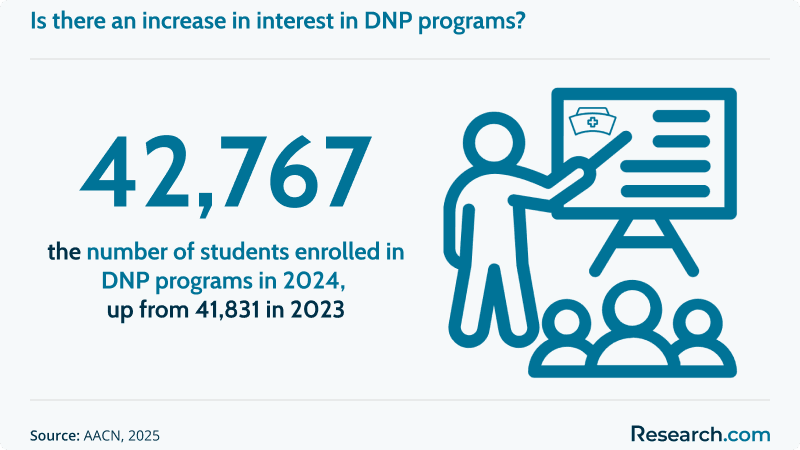
Universities have built these programs for experienced nurses who cannot pause their careers to relocate. Today, there are 439 schools enrolling students, with a total of 42,767 students in DNP programs nationwide. For many nurses, the appeal is practical: they can keep working, apply course concepts immediately, and use their own organizations as learning environments for practice improvement.
Online DNP Without Clinicals vs. On-Campus DNP: What Is the Difference?
An accredited online DNP can carry the same academic value as an on-campus DNP, but only if the program meets recognized quality standards. Delivery format is not the main issue. Accreditation, faculty expertise, curriculum quality, project support, and graduate outcomes matter more.
Students should also distinguish institutional accreditation from nursing program accreditation. Institutional accreditation confirms the university meets broad academic standards, while nursing accreditation from organizations such as the Commission on Collegiate Nursing Education or the Accreditation Commission for Education in Nursing is especially important when evaluating the nursing program itself.
| Factor | Online DNP without traditional clinicals | On-campus DNP |
| Best for | Working nurses who need flexibility and may want to complete projects in their current workplace | Students who prefer face-to-face learning, campus resources, and in-person networking |
| Learning format | Mostly online, sometimes with intensives, synchronous sessions, or local practice experiences | Campus-based courses, in-person meetings, and local institutional resources |
| Employer perception | Strong when the program is accredited and connected to relevant leadership outcomes | Strong when the program is accredited and has a respected nursing faculty and curriculum |
| Main risk | Assuming “online” means no travel, no practice hours, or limited faculty interaction | Underestimating commute, relocation, schedule conflicts, or reduced work flexibility |
| What to verify | Residency requirements, project expectations, nursing accreditation, and student support | Campus schedule, project mentoring, cost of attendance, and faculty availability |
Online graduate education is now mainstream
Online graduate study is no longer unusual. In 2021, 40% of all postbaccalaureate students were enrolled in fully online programs. For nurses considering doctoral education, this broader online environment also makes it easier to compare national program models and ask strategic career questions, such as whether nurse practitioners need a DNP.
What Is the Average Cost of an Online DNP Program Without Clinicals?
DNP tuition varies significantly by school type, residency status, credit load, and fees. For the 2021-2022 academic year, graduate tuition at public schools averaged around $10,949 per year, while private schools averaged $19,979.
For DNP students, the better question is not just “What is the tuition?” but “What will the full degree cost after fees, travel, technology, books, lost work time, and available employer support?” The cost structure is very different from the average tuition for LPN programs, so students should evaluate the degree in relation to senior-level career goals rather than entry-level nursing preparation.
How to estimate return on investment
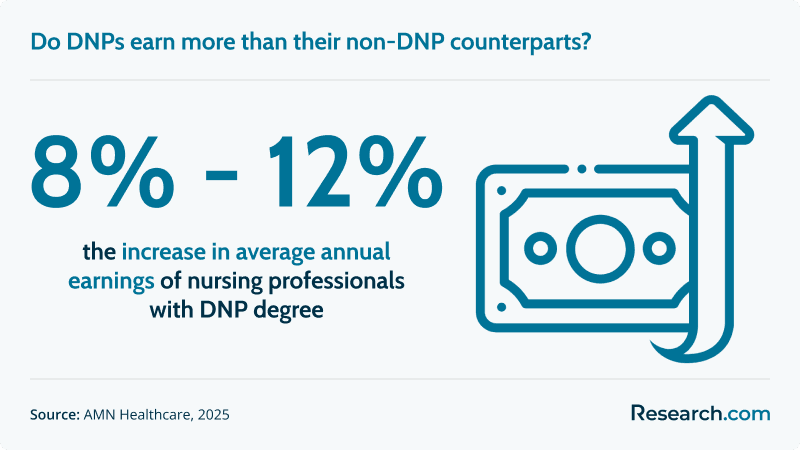
On average, DNP-prepared nurses earn between 8% and 12% more than colleagues who hold an MSN. For many, this translates to a median salary of around $100,000, compared with the $90,000 median for MSN graduates. Those figures can help frame the investment, but they should not be treated as a guarantee. Your return depends on your current salary, local market, specialty, leadership experience, employer, and whether the DNP helps you qualify for a higher-level role.
| Cost factor | Why it matters | Question to ask before enrolling |
| Tuition per credit | Small differences can add up across 30-39 credits, 35 credits, 36 credits, 40 credits, or 43 credits | Is the published rate the same for online students, in-state students, and out-of-state students? |
| Fees | Technology, graduation, clinical placement, or program fees can raise the total cost | What mandatory fees are charged each term? |
| Travel | Some online programs include intensives or weekend residencies | How many campus visits are required, and what expenses should I expect? |
| Project expenses | DNP projects may require data access, site approval, or workplace support | Will my employer support the project, and are there any site-related costs? |
| Time away from work | Accelerated formats can increase weekly workload | Can I complete the program without reducing work hours? |
Financial Aid Options for Online DNP Students Without Traditional Clinicals
Many DNP students combine several funding sources rather than relying on one option. Start early, because employer reimbursement deadlines, scholarship cycles, and federal aid processing can affect your enrollment plan.
- Employer tuition reimbursement: Hospitals, health systems, and universities may help fund doctoral study when the degree supports leadership development, retention, or organizational priorities.
- Federal loans: The Free Application for Federal Student Aid, or FAFSA, is the standard starting point for federal graduate student loan eligibility.
- Scholarships and grants: Nursing associations, foundations, schools, and professional organizations may offer awards for doctoral students, especially those focused on leadership, education, or workforce needs.
- Private loans: Private financing may help cover remaining gaps, but it should usually be considered after comparing federal aid, employer funding, and scholarships.
How to reduce your out-of-pocket cost
- Ask your employer whether tuition reimbursement applies to doctoral nursing programs and whether repayment obligations are attached.
- Request a full cost-of-attendance estimate from each school, not just the tuition rate.
- Compare part-time and full-time enrollment because aid eligibility and employer reimbursement may differ.
- Look for scholarships tied to your specialty, state, employer, or professional association.
- Avoid borrowing based only on expected salary growth; use conservative assumptions.
Prerequisites for Online DNP Programs Without Clinicals
Most post-MSN DNP programs expect applicants to hold an active, unencumbered RN license, a Master of Science in Nursing from an accredited institution, and a competitive graduate GPA. Admissions committees also review professional experience, writing ability, leadership potential, recommendation letters, and the applicant’s ability to complete a practice-focused doctoral project.
This pathway builds on earlier nursing education and licensure. If you are still comparing foundational nursing degrees, it may help to understand the differences among ADN, AAD, and AAS nursing degree options before planning a long-term doctoral route.
Leadership experience matters more than bedside specialty
For non-clinical DNP tracks, admissions committees often look for evidence that you can influence teams, improve systems, manage programs, teach, or lead change. A strong application usually shows progressive responsibility rather than only years of service.
If your long-term goal is research rather than practice leadership, compare doctoral paths carefully. Nurses considering a shift from practice-focused doctoral work to research-intensive study should review typical DNP to PhD program requirements, which often involve prior coursework, research preparation, and evidence of scholarly direction.
| Admissions element | What schools usually want to see | How to strengthen your application |
| RN license | An active, unencumbered license | Resolve licensing issues before applying and confirm state authorization rules for online study |
| MSN degree | Graduate nursing preparation from an accredited institution | Prepare transcripts early and confirm whether your MSN track meets entry requirements |
| Graduate GPA | A competitive record of graduate-level academic work | Use your statement of purpose to explain any weak spots and show readiness for doctoral study |
| Leadership background | Management, education, quality, policy, informatics, or systems-level experience | Quantify projects, committees, outcomes, budget responsibilities, or team leadership where possible |
| DNP project fit | A feasible practice problem aligned with the program’s focus | Identify a workplace issue and potential site support before applying |
Specializations Available in DNP Programs Without Traditional Clinical Rotations
Specialization matters because it signals the type of leadership role you are preparing for. A non-clinical DNP is different from advanced clinical programs such as an online MSN to FNP program, which prepares students for direct patient care as family nurse practitioners.
- Executive Nurse Leadership: Designed for nurses aiming at senior administration, C-suite roles, governance, finance, and organization-wide strategy.
- Systems Leadership: Focuses on quality improvement, care delivery redesign, workflow efficiency, and leading change across complex settings.
- Healthcare Informatics: Prepares data-oriented nurse leaders to work with clinical information systems, technology implementation, and data-supported decision-making.
- Nursing Education: Supports nurses who want to move into academic leadership, curriculum development, teaching strategy, program evaluation, or nursing school administration.
| Specialization | Choose it if you want to | Think twice if |
| Executive Nurse Leadership | Lead departments, service lines, or health system strategy | You prefer teaching or research over operations, budgets, and organizational politics |
| Systems Leadership | Improve quality, safety, efficiency, and patient outcomes at scale | You want a narrow specialty role with limited cross-functional responsibility |
| Healthcare Informatics | Use technology and data to improve clinical operations | You dislike analytics, systems implementation, or technology-driven change management |
| Nursing Education | Teach, design curricula, or lead academic programs | You want a role focused mainly on hospital administration or finance |
Typical Courses in an Online DNP Program Without Clinicals
Coursework in a non-clinical DNP moves beyond individual patient care and focuses on systems, evidence, policy, leadership, and organizational outcomes. The goal is to help experienced nurses solve complex problems across units, institutions, populations, or academic programs.
- Evidence-Based Practice: Teaches students how to evaluate research and turn findings into practical organizational change.
- Healthcare Policy and Advocacy: Examines how nurses influence policy decisions at local, state, and national levels.
- Healthcare Finance: Develops the financial literacy needed to understand budgets, resource allocation, and business cases.
- Quality Improvement: Focuses on structured methods for improving safety, performance, and care delivery.
- Organizational Leadership: Builds skills for leading teams, managing conflict, guiding change, and navigating complex institutions.
The DNP project is usually the central capstone experience. Students apply doctoral-level skills to a real practice problem, often in a workplace or approved partner site. With around 383 CCNE-accredited DNP programs in the U.S., this practice-focused model is a widely established route for preparing advanced nursing leaders.
Current trends shaping non-clinical DNP programs
- More attention to data and technology: Nurse leaders are increasingly expected to use dashboards, informatics tools, and outcome measures to guide decisions.
- Greater focus on systems improvement: Employers value leaders who can improve quality, safety, staffing models, patient flow, and organizational performance.
- Flexible doctoral formats: Online and hybrid models continue to serve experienced nurses who cannot relocate or leave full-time work.
- Stronger expectations for measurable impact: DNP projects are often judged by whether they address a real operational, educational, or quality problem.
How to Choose the Best Online DNP Without Clinicals
The best program is not always the most recognizable name. It is the one that helps you reach your target role without creating unnecessary cost, scheduling strain, or project barriers. Use the following criteria before applying.
- Accreditation: Confirm both institutional accreditation and nursing program accreditation. For nursing, look for recognized programmatic accreditation such as CCNE or ACEN when applicable.
- Project support: Ask how students are matched with faculty mentors, how project sites are approved, and what happens if a workplace project stalls.
- Faculty expertise: Review whether faculty have experience as nurse executives, deans, informatics leaders, policy experts, or quality improvement professionals.
- Format flexibility: Check whether courses are asynchronous, synchronous, hybrid, or intensive-based, and compare the schedule with your work reality.
- Total cost: Compare tuition, fees, travel, books, technology, and any required time away from work.
- Career alignment: Choose a track that clearly connects to your intended role, not just a general DNP title.
Questions to ask before choosing a program
- Is the nursing program accredited, and by which accreditor?
- Does the program require campus visits, weekend intensives, internships, or synchronous class meetings?
- Can I complete the DNP project at my current workplace?
- How many students does each faculty mentor supervise?
- What support is available for project design, data approval, writing, and dissemination?
- Are tuition rates different for online, in-state, and out-of-state students?
- What leadership roles have recent graduates moved into?
- Does the specialization match my target role in executive leadership, systems improvement, informatics, or education?
If your goal is academic teaching or nursing school leadership, compare this broader list with the best online DNP nursing education programs, since those options may place more emphasis on pedagogy, curriculum design, and academic administration.
Common mistakes to avoid
| Mistake | Why it can hurt you | Better approach |
| Assuming “no clinicals” means no practice requirements | Most DNP programs still require applied practice work, a project, or site-based learning | Ask for a detailed explanation of all practice, project, internship, and residency expectations |
| Choosing only by tuition | The cheapest program may not offer the specialization, mentorship, or flexibility you need | Compare total cost against career fit, support, completion structure, and project feasibility |
| Ignoring nursing accreditation | Institutional accreditation alone may not answer nursing-specific quality questions | Confirm programmatic nursing accreditation before applying |
| Underestimating workload | Doctoral writing, leadership projects, and data analysis can be demanding even online | Ask current students about weekly time commitments and peak workload periods |
| Relying only on rankings | A high-ranked school may not match your schedule, budget, location, or career path | Use rankings as a starting point, then evaluate personal fit and program requirements |
Career Paths for Graduates of Online DNP Programs Without Clinicals
A non-clinical DNP is designed for nurses who want to influence healthcare at the organizational, academic, or systems level. This is different from a specialized bedside or procedural route such as a cardiac nurse career path.
Graduates may pursue roles such as Chief Nursing Officer, Vice President of Patient Care Services, Chief Nursing Informatics Officer, Director of Nursing Education, or Dean of a College of Nursing. The degree can also support advancement in quality improvement, population health leadership, healthcare operations, and policy-oriented roles.
| Career direction | Possible roles | Why a non-clinical DNP may help |
| Executive leadership | Chief Nursing Officer, Vice President of Patient Care Services | Builds preparation in strategy, finance, systems leadership, and organizational change |
| Informatics leadership | Chief Nursing Informatics Officer, clinical systems leader | Supports technology-enabled decision-making and improvement across care environments |
| Quality and safety | Quality improvement leader, patient safety director | Emphasizes evidence-based change, outcomes measurement, and system redesign |
| Nursing education | Director of Nursing Education, Dean of a College of Nursing | Supports curriculum leadership, academic administration, and faculty development |
| Policy and systems improvement | Healthcare policy leader, population health strategist | Develops skills in advocacy, systems thinking, and practice-based implementation |
Is an online DNP without clinicals worth it?
It may be worth it if you already have graduate nursing preparation, want senior leadership responsibility, and can connect the degree to a realistic advancement path. It may not be the right choice if your goal is to become a nurse practitioner, nurse midwife, or nurse anesthetist, because those pathways require clinical preparation tied to role-specific licensure and certification.
Job Market for Graduates of Online DNP Programs Without Clinicals
The job market for DNP-prepared leaders is shaped by healthcare complexity, leadership turnover, faculty needs, quality demands, and employer expectations for advanced preparation. A non-clinical DNP can help position experienced nurses for senior roles, but the degree works best when paired with a strong record of leadership, measurable accomplishments, and a clear professional niche.
Employers do not hire the credential alone. They hire the nurse leader who can manage budgets, build teams, improve outcomes, translate evidence into practice, and communicate with executives, faculty, clinicians, and stakeholders.
Where demand may be strongest
- Hospitals and health systems: Especially for nursing administration, quality improvement, patient care services, and operational leadership.
- Academic institutions: For nursing education, program leadership, curriculum development, and faculty roles.
- Healthcare technology and informatics teams: For nurses who can connect clinical workflows with data systems and technology adoption.
- Population health and policy organizations: For nurses interested in system-level improvement, advocacy, and community outcomes.
Students who are much earlier in their nursing journey and want a direct doctoral route should compare these post-MSN programs with online direct entry DNP programs, which are built for individuals with a non-nursing bachelor’s degree who want an efficient route into nursing at the doctoral level.
Challenges You May Face in a Non-Clinical Online DNP Program
A non-clinical DNP can be flexible, but it is not easy. Students often underestimate the level of doctoral writing, project management, data interpretation, and leadership reflection required. The lack of traditional clinical rotations does not remove the need to prove advanced practice impact.
- Credibility concerns: Some stakeholders may be more familiar with clinical doctorates tied to direct patient care, so you may need to explain the systems-level value of your DNP work.
- Time management pressure: Balancing a doctoral program with a director, educator, or executive role requires disciplined planning.
- Project-site barriers: Workplace approvals, data access, leadership changes, or implementation delays can slow progress.
- Online isolation: Students who thrive on in-person interaction should choose programs with strong cohort engagement and faculty access.
- Career mismatch: A leadership DNP may not help if your real goal is clinical role expansion or new patient-care licensure.
If you are still building your nursing education foundation, compare doctoral plans with earlier pathways such as easy RN-to-BSN programs so that each step supports your long-term goal.
What Graduates Say About Online DNP Programs Without Clinicals
- : "I had years of clinical credibility, but executive meetings required a different language. The DNP helped me connect nursing priorities to finance, strategy, and measurable outcomes. That changed how I contributed at the leadership table. — Audrey"
- : "I worried that a non-clinical doctorate would feel removed from real nursing work. Instead, it helped me apply decades of experience at a broader level. The program was demanding, but it gave structure to the leadership work I already cared about. — Brian"
- : "An on-campus doctorate would not have worked with my job and family schedule. The online format made it possible to keep working while completing lectures, writing, and project tasks around my responsibilities. — Allana"
Other Things You Need to Know About Online DNP Programs Without Clinicals
What is the difference between a DNP and a PhD in nursing?
A Doctor of Nursing Practice is a terminal practice degree. It focuses on applying evidence, improving systems, leading teams, and translating research into better healthcare delivery. A PhD in nursing is a research doctorate focused on producing original scholarship and expanding nursing science.
Do I need to take the GRE to apply?
Many online DNP programs no longer require the Graduate Record Examinations for admission. Instead, schools may place more weight on graduate academic performance, professional achievements, leadership experience, writing quality, and fit with the program. Requirements vary, so check each school’s admissions page before applying.
Can my DNP project be based on my current job?
Often, yes. Many programs encourage students to complete a scholarly project tied to a real problem in their workplace, provided the site approves the work and the project meets academic standards. This can make the degree more valuable to both the student and employer.
Is a non-clinical DNP respected outside of nursing?
It can be respected in broader healthcare leadership when the graduate can demonstrate business, policy, quality, informatics, or education expertise. Outside nursing, stakeholders may not automatically understand the DNP, so graduates should be ready to explain the degree in terms of measurable leadership capabilities: improving outcomes, managing change, using evidence, leading teams, and solving system-level problems.
Who should avoid an online DNP without clinicals?
This type of program is not ideal for nurses who want to qualify for a new direct-care advanced practice role, such as family nurse practitioner preparation, unless the program specifically includes that clinical pathway. It may also be a poor fit for students who need extensive in-person support, dislike writing-intensive coursework, or cannot secure a feasible project environment.
References
- AACN Journals. Specialty certification: A path to improving outcomes. Retrieved September 11, 2025, from AACN Journals specialty certification article
- American Association of Colleges of Nursing. DNP fact sheet. Retrieved September 11, 2025, from AACN DNP fact sheet AACN Journals related source
- Herzing University. MSN vs. DNP – what’s the difference? Retrieved September 11, 2025, from Herzing University MSN vs. DNP comparison AACN Journals related source
- National Center for Education Statistics. Graduate degree fields. Retrieved September 11, 2025, from NCES graduate degree fields AACN Journals related source
- National Center for Education Statistics. Graduate tuition and required fees (2021–22). Integrated Postsecondary Education Data System. Retrieved September 11, 2025, from NCES graduate tuition and required fees table AACN Journals related source
- National Center for Education Statistics. Postbaccalaureate enrollment. Retrieved September 11, 2025, from NCES postbaccalaureate enrollment AACN Journals related source
- U.S. Bureau of Labor Statistics. Nurse anesthetists, nurse midwives, and nurse practitioners. Occupational Outlook Handbook. Retrieved September 11, 2025, from BLS Occupational Outlook Handbook AACN Journals related source
Key Insights
- An online DNP without traditional clinical rotations is best for MSN-prepared nurses pursuing leadership, education, informatics, quality, policy, or systems-level roles.
- “Without clinicals” does not usually mean “without practice requirements.” Expect a DNP project, applied leadership work, possible intensives, internships, or workplace-based experiences.
- Program fit matters more than brand name alone. Accreditation, project mentoring, specialization, format, total cost, and employer support should drive your decision.
- Most post-MSN options take one to two years full time, while many working nurses choose a two- to four-year part-time pace.
- Cost varies widely. Compare the full degree cost, not just tuition per credit, and factor in fees, travel, project needs, and reimbursement options.
- A non-clinical DNP can support senior roles such as Chief Nursing Officer, Vice President of Patient Care Services, Chief Nursing Informatics Officer, Director of Nursing Education, or Dean of a College of Nursing.
- The degree is not the right path if your goal is new direct-care advanced practice licensure unless the program specifically includes that clinical preparation.
Other Things You Need To Know About Online DNP Programs Without Clinicals
Online DNP programs without clinicals in 2027 may offer financial aid options, like federal student loans and institutional scholarships. Additionally, students might pursue grants or work-study opportunities, depending on the program's eligibility criteria and funding availability. Always check specific program offerings.
The best online DNP programs in 2027 without clinical requirements focus on comprehensive theoretical knowledge, leadership, policy, and evidence-based practice. They emphasize flexibility, accreditation, experienced faculty, and offer robust student support to ensure graduates are well-prepared for leadership roles in healthcare.


