
2027 Substance Abuse Counseling Degree Guide: Costs, Requirements & Job Opportunities

Co-Founder and Chief Data Scientist
The substance abuse crisis in the United States has intensified significantly over the last decade, driven largely by the rapid proliferation of high-potency synthetic opioids. Recent data shows that annual drug overdose deaths surpassed 91,000, representing a nearly fivefold increase since the early 2000s. Data from the Centers for Disease Control and Prevention (CDC) indicates that the rise of illicitly manufactured fentanyl has been a primary catalyst for this surge, affecting communities across every demographic.
As a career-planning expert with over 10 years of work experience, I have delved into the field of counseling and psychology and have found that many mental health professionals have built purposeful and rewarding careers. To help individuals who aim to venture into the field, I created this in-depth guide to accredited substance abuse counseling degree programs, the diverse career paths you can take, and the job market for degree holders.
What are the benefits of getting a degree in substance abuse counseling?
- With a substance abuse counseling degree, you can become a substance abuse counselor, a substance abuse social worker, or a child, family, and school social worker, among other potential roles.
- In 2022, substance abuse, behavioral disorder, and mental health counselors had a median annual wage of $49,710 [US Bureau of Labor Statistics (BLS), 2023].
- Online degrees in substance abuse counseling offer flexibility, accessibility, and affordability, enabling students to balance education with existing commitments, access a diverse range of programs, and potentially reduce overall educational costs.
What can I expect from a Substance Abuse Counseling degree?
Substance abuse counseling degree programs highlight major concepts in the field including addiction theory, counseling techniques, as well as ethical and legal considerations:
- Addiction Theory. A substance abuse counseling degree tackles addiction theories, exploring psychological and biological factors that influence addictive behaviors. Students study models like the biopsychosocial model to understand the multifaceted nature of addiction.
- Counseling Techniques. The program curriculum emphasizes therapeutic approaches, teaching students evidence-based counseling techniques. Motivational interviewing and cognitive-behavioral therapy are commonly covered and provide skills to facilitate behavior change and address underlying issues contributing to substance abuse.
- Ethical and Legal Considerations. Substance abuse counselors are required to know and understand the ethical standards and legal obligations in the field. This includes confidentiality, informed consent, and legal frameworks to ensure responsible and lawful counseling practices that safeguard both clients and practitioners.
Where can I work with a Substance Abuse Counseling degree?
Since the job of substance abuse counselors mainly involves assisting individuals in overcoming addiction and maintaining recovery, they usually find work in rehabilitation centers, mental health clinics, hospitals, correctional facilities, and private practice. Looking deeper into the work environment of substance abuse counselors, I found that 17% of substance abuse, behavioral disorder, and mental health counselors in the US were employed in outpatient mental health and substance abuse centers. Meanwhile, 8% were employed in state, local, and private hospitals. Moreover, 15% worked in individual and family services, while 17% worked in companies of other health practitioners (US BLS, 2025).
Mental health practitioners who attain a higher level of education, such as a master’s degree or a doctorate in counseling or psychology, may have expanded their scope of practice and acquired specialized knowledge and skills. Because of their expertise, they may find more competitive career opportunities in diverse companies and industries.
How much can I make with a Substance Abuse Counseling degree?
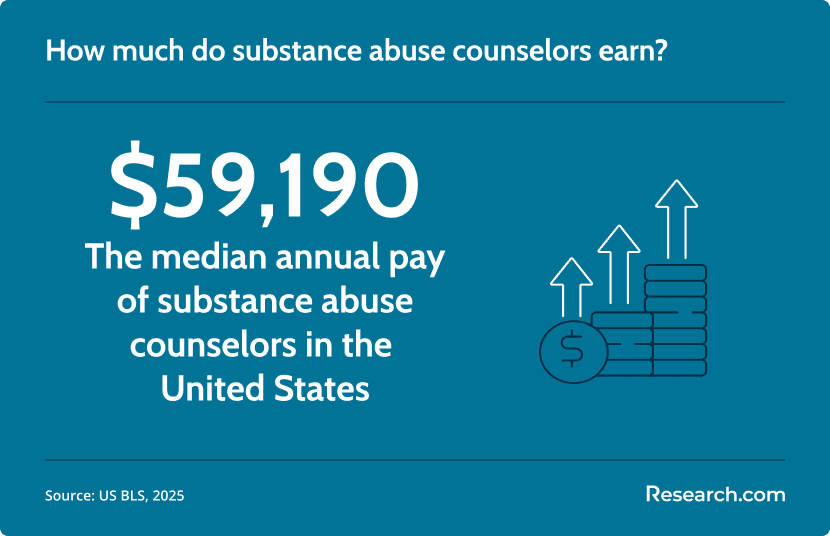
Substance abuse, behavioral disorder, and mental health counselors had a median annual wage of $59,190. To compare, I searched for the estimated median annual wage of all occupations in the US during the same year and found that the median annual wage of substance abuse, behavioral disorder, and mental health counselors is higher than that of all recorded US jobs (US BLS, 2025). I reckon this may mean that many substance abuse counselors have done financially better than many individuals in other professions in the coming years.
Moreover, the $49,710 median annual wage of counselors can be enough to afford the typical expenses of a single, childless resident of Florida, who needs a net annual income of $32,267 (Glasmeier & Massachusetts Institute of Technology, 2024) to get by in the state that was ranked 1st out of all US states in terms of economic performance in 2023 (Rich States, Poor States, 2024).
- 2027 List of Substance Abuse Counseling Degree Programs List of Programs
- What are the different types of substance abuse counseling degrees? What are the different types of substance abuse counseling degrees?
- How long does it take to complete Substance Abuse Counseling Degree Programs? How long does it take to complete Substance Abuse Counseling Degree Programs?
- How do Substance Abuse Counseling Degree Programs compare to an on-campus program? How do Substance Abuse Counseling Degree Programs compare to an on-campus program?
- What is the average cost of Substance Abuse Counseling Degree Programs? Program Costs
- What are the financial aid options for students enrolling in Substance Abuse Counseling Degree Programs? Financial Aid
- What are the prerequisites for enrolling in Substance Abuse Counseling Degree Programs? Program Requirements
- What courses are typically in Substance Abuse Counseling Degree Programs? What courses are typically in Substance Abuse Counseling Degree Programs?
- What types of specializations are available in Substance Abuse Counseling Degree Programs? What types of specializations are available in Substance Abuse Counseling Degree Programs?
- How do online programs differ in affordability and flexibility for counseling degrees? How do online programs differ in affordability and flexibility for counseling degrees?
- How to choose the best Substance Abuse Counseling Degree Program? How to choose the best Substance Abuse Counseling Degree Program?
- How can substance abuse counseling graduates maximize their earning potential? How can substance abuse counseling graduates maximize their earning potential?
- What is the path to becoming a licensed therapist? What is the path to becoming a licensed therapist?
- Are there accelerated pathways to fast-track my counseling career? Are there accelerated pathways to fast-track my counseling career?
- Can integrating faith-based approaches enhance substance abuse counseling effectiveness? Can integrating faith-based approaches enhance substance abuse counseling effectiveness?
- What career paths are available for graduates of Substance Abuse Counseling Degree Programs? What career paths are available for graduates of Substance Abuse Counseling Degree Programs?
- What is the job market for graduates with Substance Abuse Counseling Degrees? Job Outlook
- What are the licensing and accreditation requirements for substance abuse counseling programs? What are the licensing and accreditation requirements for substance abuse counseling programs?
- How do substance abuse counseling programs incorporate cultural competence? How do substance abuse counseling programs incorporate cultural competence?
- What challenges might you face when pursuing a substance abuse counseling degree? What challenges might you face when pursuing a substance abuse counseling degree?
- What emerging trends are reshaping substance abuse counseling education? What emerging trends are reshaping substance abuse counseling education?
- What should I consider when choosing between an LPC and LCSW license? What should I consider when choosing between an LPC and LCSW license?
- What is the long-term return on investment for a substance abuse counseling degree? What is the long-term return on investment for a substance abuse counseling degree?
2026 List of Substance Abuse Counseling Degree Programs
Choosing a substance abuse counseling degree is less about finding the “best” school in the abstract and more about finding the program that fits your career goal, licensure path, budget, and schedule. If you want to work with people affected by substance use disorders, the right degree can determine whether you qualify for entry-level support roles, state licensure, supervised clinical work, or advanced counseling positions.
This guide breaks down the degree options, compares online and campus formats, explains admissions and licensing considerations, and highlights current programs students often review first. It is designed to help you compare schools with more clarity and avoid common mistakes that can slow your progress.
Quick answer: what should you know before you choose a program?
Start with the credential you need for your state and career goal. An associate or bachelor’s degree may prepare you for support or pre-licensure roles, while a master’s degree is often the practical path for licensure and independent counseling work. Before enrolling, confirm accreditation, clinical placement support, course content, and whether the program meets your state’s licensing rules. Cost, flexibility, and supervised experience should also be part of the decision.
How do we rank schools?
To build this list, we reviewed institutions known for substance abuse counseling or closely related addiction studies programs and checked recent data from the research methodology used by our team. We relied on current information from the IPEDS database, Peterson’s database (including the Distance Learning Licensed Data Set), the College Scorecard database, and the National Center for Education Statistics. We also considered program structure, accessibility, and the relevance of each curriculum to substance use counseling careers.
Featured substance abuse counseling degree programs
1. Springfield College
Springfield College offers a bachelor of science (BS) in human services with a concentration in addiction studies or substance use disorder counseling. The curriculum takes an interdisciplinary approach, connecting addiction studies with mental health, counseling, and human services. Students can complete the program online through synchronous or asynchronous formats, which makes it a practical option for learners balancing school with work or family responsibilities.
- Program Length: 4 years
- Tracks/Concentrations: Addiction Studies
- Cost per Credit: $547
- Required Credits to Graduate: 120 credits
- Accreditation: New England Commission of Higher Education (NECHE)
2. University of Cincinnati
The University of Cincinnati delivers a research-focused online BS in substance abuse counseling. Students study pharmacology, alcoholism, drugs and behavior, clinical assessment and diagnostic procedures, and cultural competence. Because the program can support part-time enrollment, it may appeal to working adults who need a more flexible schedule without stepping away from their current job.
- Program Length: 3 to 4 years
- Tracks/Concentrations: Substance Abuse Counseling
- Cost per Credit: $566 (Resident); $581 (Non-resident)
- Required Credits to Graduate: 60 to 120 credits
- Accreditation: Higher Learning Commission (HLC)
3. Alvernia University
Alvernia University offers a Bachelor of Arts (BA) in Addictions and Mental Health Treatment. The program draws from psychology, social work, and criminal justice, which gives students a broad view of addiction treatment and recovery services. Alvernia says it has offered the program for more than 40 years, and the curriculum includes addictions, mental illness, counseling theories and techniques, psychotherapy, and legal and ethical issues.
- Program Length: 4 years
- Tracks/Concentrations:
- Addictions
- Mental Health Treatment
- Cost per Credit: $1,130
- Required Credits to Graduate: 123 credits
- Accreditation: Middle States Commission on Higher Education (MSCHE) Approved by the Pennsylvania Certification Board (PCB)
4. University of South Dakota
The University of South Dakota offers addiction counseling and prevention programs at both undergraduate and graduate levels. Students can complete the BS online or at the Vermillion Main Campus. Undergraduates can also add the field as a minor, and the university offers an online certificate for professionals who want credential-focused training. At the graduate level, USD provides an online MA with an option in co-occurring disorders, plus an online graduate certificate that meets South Dakota credentialing standards.
- Program Length: 4 years (BS degree); 2 to 3 years (MA degree)
- Tracks/Concentrations:
- Undergraduate: Treatment, Prevention
- Graduate: Advanced Track, Standard Track, Co-occurring Disorders Concentration
- Cost per Credit:
- Undergraduate: $259.10 (Resident); $376.10 (Non-resident)
- Graduate: $340.15 (Resident); $654.05 (Non-resident); $470.45 (Online)
- Required Credits to Graduate:
- 120 credits (BS degree)
- 33 credits (Advanced MA degree)
- 45 credits (Standard MA degree)
- Accreditation: HLC; National Addiction Studies Accreditation Commission (NASAC)
5. Crown College
Located in Minnesota, Crown College offers alcohol and drug counseling at both the associate of science (AS) and BS levels. The curriculum includes general psychology, case management for alcohol and drug counseling, and assessment and treatment planning. Students also complete internship experiences that are designed to support preparation for licensure as alcohol and drug counselors (LADC).
- Program Length: 2 to 4 years
- Tracks/Concentrations:
- Alcohol Counseling
- Drug Counseling
- Cost per Credit: $1,250
- Required Credits to Graduate: Contact the college for information on program curriculum and credit requirements.
- Accreditation: HLC
What graduates say about substance abuse counseling education
- Joseph: "My substance abuse counseling studies changed how I see addiction. The science, the human side, and the hands-on training all came together in a way that helped me understand how to support recovery. It feels meaningful to see that work make a difference."
- Alvin: "Online learning made it possible for me to keep working and take care of my family while earning my degree. The counseling courses gave me stronger tools for understanding addiction and helped me connect with people in a more thoughtful way."
- Jackie: "This degree helped me see how closely addiction and mental health are connected. My internship experiences made the classroom material more real and gave me confidence that I could apply what I learned in practice."
Key points at a glance
- Program fit matters more than prestige alone when you are preparing for counseling work.
- Licensure requirements vary by state, so always verify whether a program supports your target credential.
- Online programs can be a strong option if they include supervised fieldwork and reliable advising.
- Graduate study usually matters most for independent clinical practice and higher-level counseling roles.
- Accreditation, internship placement, and cost per credit should be checked before you apply.
What are the different types of substance abuse counseling degrees?
The degree level you choose shapes the work you can do, how long training takes, and whether you can move toward licensure. Some students want a quick entry into support roles. Others want a direct route to supervised clinical practice. The best option depends on your long-term career plan.
| Degree level | What it prepares you for | Typical best fit | Main limitation |
| Associate degree | Foundational knowledge and entry-level support roles | Students who want to start quickly or continue later | Usually not enough for full counselor licensure |
| Bachelor’s degree | Work in counseling-related settings and a path toward graduate study | Students who want flexibility and broader job options | Often still not enough for independent licensure |
| Master’s degree | Many licensure pathways, clinical practice, and supervisory roles | Students aiming for professional counseling practice | Higher cost and a longer time commitment |
| Doctoral degree | Research, teaching, leadership, and advanced supervision | Professionals seeking academic or executive roles | Not required for most counseling jobs or licenses |
- Associate Degree: A good starting point for students who want entry-level exposure to addiction services. Graduates may find support roles in clinics or community agencies, but most states require more education for full licensure.
- Bachelor’s Degree: Useful for students who want to work in counseling-adjacent settings or build toward graduate school. This level usually covers addiction theory, ethics, and therapeutic foundations.
- Master’s Degree: Often the most relevant degree for those who want licensure, direct client work, and greater autonomy. Master’s programs usually include advanced counseling coursework and supervised practice.
- Doctoral Degree: Best for students interested in academia, leadership, research, or high-level supervision rather than standard clinical entry.
If you are comparing counseling fields, students who plan to work with school-age populations may also want to review the most affordable online school counseling degrees to see how the licensure and coursework differ.
How long does it take to finish a substance abuse counseling degree?
Completion time depends on degree level, enrollment status, transfer credits, and whether the program includes supervised fieldwork. Students who study full-time usually finish faster, but part-time enrollment can be a better fit for working adults.
- Undergraduate programs: A bachelor’s degree usually takes about 4 years of full-time study. Part-time attendance, summer breaks, and transfer policies can change that timeline.
- Graduate programs: A master’s degree usually adds 2 to 3 years after the bachelor’s degree. Clinical placement, internship requirements, and capstone or thesis work can extend completion time.
Online vs. on-campus substance abuse counseling programs
Both formats can lead to strong training, but they serve different student needs. Online programs often work better for adults who need flexibility. Campus-based programs may be better for students who want more in-person interaction and a more structured schedule.
| Factor | Online program | On-campus program |
| Schedule | Usually more flexible, especially with asynchronous classes | Usually fixed class times and in-person attendance |
| Interaction | Virtual meetings, discussion boards, and email communication | Face-to-face contact with classmates and faculty |
| Field experience | May use local placements or supervised internships | Often easier to connect with campus-based clinics and partnerships |
| Best for | Working adults, caregivers, and distance learners | Students who want a traditional academic environment |
- Flexibility: Online programs usually make it easier to keep working or manage family responsibilities.
- Networking: Campus programs usually offer more in-person networking, though strong online programs can still create meaningful professional connections.
- Practical training: Both formats can include fieldwork. The key question is not whether the program is online, but whether it supports appropriate supervised experience.
What does a substance abuse counseling degree cost?
Tuition can vary widely depending on the degree level, school type, residency status, and whether the program is delivered online or in person. You should also budget for books, lab fees, technology fees, travel for field placements, and possible living costs if you study on campus.
Based on the current tuition data in the programs listed above, undergraduate tuition may range from $259.10 to $1,250 per credit, while graduate programs may range from $340.15 to $654.05 per credit.
What financial aid options can help reduce the cost?
Cost is one of the biggest barriers for students entering counseling fields, so it is worth planning financial aid early. The best strategy is usually to combine more than one funding source rather than rely on a single option.
- Federal Student Aid: Submitting the FAFSA can open access to grants, loans, and work-study opportunities based on financial need.
- Scholarships and grants: Schools, foundations, and professional organizations may offer awards that do not need to be repaid.
- Work-study: Eligible students may be able to earn money through part-time campus or community jobs related to their studies.
- Institutional aid: Many colleges offer their own scholarships, tuition discounts, or need-based grants.
- Loan forgiveness: Some service-based forgiveness programs may apply to graduates working in qualifying public service or behavioral health settings.
What are the usual admission requirements?
Admission standards differ by school and degree level, but most programs look for evidence that you can handle academic work and that you are serious about the field. Graduate programs usually ask for more preparation than undergraduate programs.
- Official transcripts: Schools review your prior academic record to confirm eligibility and readiness.
- Personal statement: Applicants often need to explain their interest in addiction counseling and career goals.
- Prior degree: Master’s programs usually require a completed bachelor’s degree in a related or broadly applicable field.
- Prerequisite coursework: Some programs expect background courses that support counseling study; depending on the program, this may include STEM coursework.
- Work or volunteer experience: Experience in behavioral health, social services, or community support can strengthen an application.
What courses are common in these programs?
Coursework should give you both theory and practical counseling skills. A strong curriculum usually covers addiction science, human behavior, ethics, and treatment planning.
- Introduction to substance abuse counseling: Covers the history, core concepts, and scope of the profession.
- Counseling techniques: Focuses on evidence-based methods such as motivational interviewing and cognitive-behavioral strategies.
- Psychopharmacology: Explains how substances affect the brain, behavior, and recovery process.
- Co-occurring disorders: Examines the overlap between addiction and mental health conditions.
- Ethics and legal issues: Reviews confidentiality, consent, boundaries, and professional responsibility.
What specializations can you pursue?
Specializations help you narrow your focus and prepare for the populations or settings you want to serve. Some concentrations are more clinically focused, while others emphasize prevention, family systems, or justice-related work.
- Adolescent substance abuse counseling: Focuses on prevention and treatment for teens, who may face different social, developmental, and school-related pressures. This path connects well to concerns reflected in college drug abuse statistics as well.
- Dual diagnosis counseling: Trains students to work with clients who have both substance use disorders and mental health conditions.
- Family and couples counseling: Helps counselors understand how addiction affects relationships, communication, and household stability, including stress-related dynamics that may be addressed through coping with stress strategies.
- Criminal justice and forensic counseling: Prepares graduates to work in court-linked, correctional, or diversion settings.
- Prevention and education: Centers on community outreach, awareness campaigns, and early intervention. This area remains relevant as global drug-use concerns continue to draw attention, including the 2025 report that 6% of the global population between the ages of 15 and 64 used drugs in the previous 12 months (United Nations Office on Drugs and Crime, 2025).
How do online programs affect affordability and flexibility?
Online programs can reduce some of the hidden costs of higher education, especially for students who would otherwise pay for commuting, campus housing, or relocation. They can also make it easier to keep working while earning a degree.
Many online counseling programs use asynchronous classes, which let students complete coursework on a schedule that fits work and family obligations. That convenience can be especially valuable for adult learners, career changers, and caregivers.
For students who are comparing lower-cost options, the cheapest online master's in mental health counseling can be a useful starting point for understanding how affordability and flexibility sometimes overlap. Still, cost should not be the only factor. A lower tuition rate is less helpful if the program does not support licensure, field placement, or career goals.
How do you choose the right substance abuse counseling program?
The strongest program for you is the one that matches your licensure plan, learning style, and budget. Before applying, compare each school on the points below rather than relying only on rankings or tuition.
- Accreditation: Verify regional, national, and discipline-specific accreditation. Common accreditors include HLC, NECHE, MSCHE, NASAC, and CACREP. Accreditation can affect transferability, licensure eligibility, and employer recognition.
- Curriculum: Review whether the coursework actually covers addiction counseling, ethics, mental health, assessment, and treatment planning.
- Clinical training: Confirm that the school offers supervised placements or internship support that aligns with your state requirements.
- Flexibility and student support: Look for part-time options, online delivery, advising, and career services that fit your life circumstances.
| What to compare | Why it matters | What to ask |
| Accreditation | Affects licensure, transfer, and employer trust | Is the program and institution properly accredited? |
| Field placement | Hands-on experience is essential in counseling | Will the school help arrange supervised clinical hours? |
| Tuition and fees | The full cost affects your debt and ROI | What is the total estimated cost, including fees? |
| Licensure alignment | Not every program meets every state rule | Does this curriculum meet the requirements where I plan to work? |
How can graduates improve their earning potential?
Earning potential usually grows with experience, licensure, specialization, and the type of setting you work in. Graduates who continue their education, build supervised hours, and pursue recognized credentials often have more opportunities for advancement than those who stop at the minimum requirement.
For more context on pay and career planning, see our guide on How much do counselors make?. Career growth can also improve if you move into supervisory work, private practice, program administration, or specialized treatment roles.
What is the path to becoming a licensed therapist?
Licensure usually requires more than earning a degree. In most states, you must complete supervised clinical hours, meet course content standards, and pass one or more exams. The exact requirements vary by state and credential type, so you should check the licensing board in the state where you plan to practice before enrolling.
If you want a faster overview of the steps, review the path to becoming a licensed therapist. The important thing is to make sure your degree supports the license you want, not just the title on the diploma.
Are there accelerated counseling pathways?
Some schools offer accelerated options that compress coursework into a shorter calendar period. These programs can help motivated students move forward more quickly, but speed should not come at the expense of supervised practice, accreditation, or state approval.
If you are comparing faster mental health pathways, you may also want to look at accelerated marriage and family therapy programs to see how different counseling disciplines structure clinical training. The key question is whether an accelerated path still gives you the requirements you need for licensure and job readiness.
Can faith-based approaches be useful in counseling education?
Some students want a program that integrates clinical counseling with spiritual or faith-informed perspectives. These programs can be a good fit for learners who want to serve clients in religious settings or who want training that reflects their personal values. The main concern is whether the curriculum still includes evidence-based clinical preparation and meets professional standards.
If that approach matters to you, compare those programs with options in our guide to the best Christian counseling programs. A faith-based emphasis should complement, not replace, strong counseling training.
What careers can you pursue after graduation?
Graduates can work in counseling, social services, treatment programs, community agencies, and some behavioral health settings. The job title you qualify for depends on your degree level, state rules, supervised experience, and licensing status.
| Career path | Typical responsibilities | Salary reference from the article |
| Substance abuse counselor | Assess clients, build treatment plans, document progress, and support recovery | 2024 median annual wage of $59,190 for substance abuse, behavioral disorder, and mental health counselors (US BLS, 2025) |
| Substance abuse social worker | Coordinate care with other providers and connect clients with support services | 2024 median annual wage of $61,330 for social workers in the US (US BLS, 2025) |
| Child, family, and school social worker | Support children and families dealing with abuse, poverty, and behavioral concerns | Not stated in the source data |
| Psychologist | Provide therapy, assessment, coping strategies, and relapse-support planning | 2024 median annual wage of $94,310 for psychologists in the US (US BLS, 2025) |
The chart below shows the median annual wages of counselors, social workers, and psychologists in the US in 2025, based on US BLS data.
What does the job market look like?
The outlook for addiction and substance use counseling remains strong. Demand is being shaped by ongoing mental health needs, greater attention to substance use treatment, and the wider use of telehealth and virtual counseling. These changes have expanded access in many settings, including remote and hybrid service models.
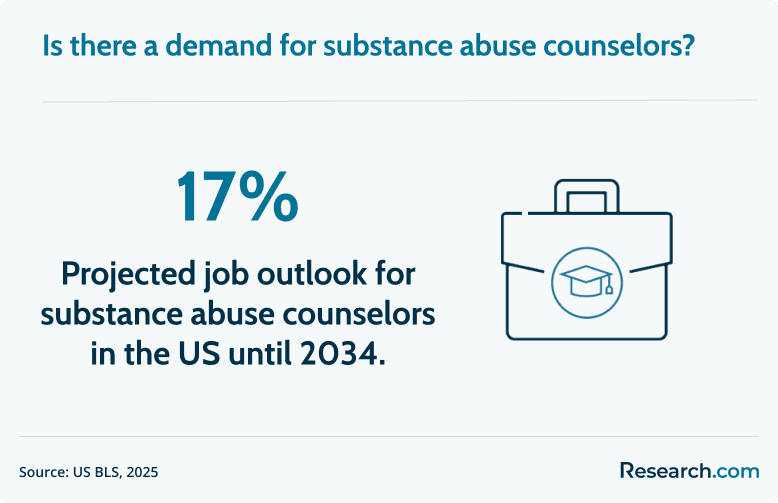
According to the US Bureau of Labor Statistics, employment of substance abuse, behavioral disorder, and mental health counselors is projected to grow 17% between 2024 and 2034, which is much faster than the average for all occupations. Even so, competition, funding pressures, and state licensing differences can affect hiring in specific regions and settings.
Graduates who are flexible about location, willing to gain supervised hours, and open to continuing education may be better positioned to adapt to the market.
What are the licensing and accreditation requirements?
Accreditation and licensure are closely connected. A strong program should be from a properly recognized institution and should help you meet the academic requirements for the license or certification you want. For many students, the most important question is not simply “Is the school accredited?” but “Will this program satisfy the requirements in my state?”
Some disciplines also look at programmatic accreditation, such as CACREP, and certain programs may align with state or board-specific standards. If you are exploring flexible formats, review substance abuse counseling online courses carefully to confirm that online delivery still includes the clinical and accreditation elements you need.
How do these programs build cultural competence?
Cultural competence is essential in counseling because clients come from different backgrounds, beliefs, family systems, and community contexts. Programs that teach this well prepare students to avoid one-size-fits-all treatment and to respond respectfully and effectively to diverse clients.
- Coursework: Many programs include multicultural counseling content and discussions of identity, bias, and cultural context.
- Training: Students practice adapting communication and treatment planning to client needs.
- Case studies: Realistic scenarios help learners understand how cultural factors can affect recovery and engagement.
- Community engagement: Fieldwork in diverse settings can strengthen empathy and real-world awareness.
What challenges should you expect?
This field can be deeply rewarding, but it is not easy. Students should expect emotional demands, intensive coursework, and the pressure of learning to support clients who may relapse, resist treatment, or struggle with complex mental health and social issues. Those realities make resilience and self-care important professional skills, not optional extras.
Program costs can also be a challenge. Even when financial aid is available, tuition and related expenses can add up quickly. If affordability is a top concern, compare schools carefully and consider whether a related field such as marriage and family therapy may offer a more suitable return on investment. You may also want to review the cheapest MFT programs if you are comparing counseling disciplines.
What trends are shaping substance abuse counseling education?
The field is changing as schools add more training in telehealth, virtual simulation, and technology-based client support. These changes reflect how services are delivered in real practice and how students are expected to work with clients across different settings.
At the same time, many programs are expanding asynchronous learning and flexible delivery models so adult learners can stay enrolled while working. That flexibility can be a major advantage, but it does not replace the need for strong supervision, field placement, and licensing alignment. For students seeking lower-cost options, a cheap online bachelor's degree in substance abuse counseling may be worth comparing if it still meets your professional goals.
What should you consider when choosing between LPC and LCSW?
The choice between licensure paths should be based on your long-term work setting, the type of clients you want to serve, and your state’s requirements. Both LPC and LCSW pathways can lead to meaningful counseling careers, but they do not always involve the same coursework, supervision model, or professional scope.
If you are deciding between them, review What is an LPC vs LCSW? to compare training expectations and common career settings. The best decision is the one that matches both your educational background and the license you can realistically pursue in your state.
What is the long-term return on investment?
The return on investment for a substance abuse counseling degree depends on how far you plan to take your training. Entry-level roles may provide a modest start, while licensure, specialization, and supervisory responsibilities can improve long-term earning potential. In many cases, the biggest gains come from continued education, supervised hours, and experience in settings with stronger advancement opportunities.
For students who want to understand what higher-income growth can look like in related therapy fields, see therapists that make the most money. The central idea is simple: a degree is only the beginning. Your ROI improves when the program leads to licensure, skill development, and roles that match market demand.
Common mistakes to avoid
- Choosing a school without checking whether the program meets state licensing rules.
- Comparing tuition only, without accounting for fees, fieldwork costs, and travel.
- Assuming every online program includes the supervised placement you need.
- Relying on rankings instead of curriculum fit and accreditation status.
- Assuming salary outcomes are guaranteed after graduation.
- Ignoring transfer policies if you may continue to a higher degree later.
Questions to ask before you enroll
- Does this program support the license or credential I want in my state?
- What type of accreditation does the school hold?
- How are internships or practicum placements arranged?
- Can I study part-time if needed?
- What is the total cost after fees, books, and field placement expenses?
- What kinds of jobs have recent graduates obtained?
References:
- Glasmeier, A. K. & Massachusetts Institute of Technology. (2024). Living Wage Calculation for Florida. https://livingwage.mit.edu/states/12
- Rich States, Poor States. (2024). Florida. https://www.richstatespoorstates.org/states/FL
- United Nations Office on Drugs and Crime. (2025). World Drug Report 2025. https://www.unodc.org/documents/data-and-analysis/WDR_2025/WDR25_B1_Key_findings.pdf
- US Bureau of Labor Statistics. (2025). National Occupational Employment and Wage Estimates, United States. Occupational Employment and Wage Statistics. https://www.bls.gov/oes/current/oes_nat.htm
- US Bureau of Labor Statistics. (2025). Substance Abuse, Behavioral Disorder, and Mental Health Counselors. Occupational Outlook Handbook. https://www.bls.gov/ooh/community-and-social-service/substance-abuse-behavioral-disorder-and-mental-health-counselors.htm
Key insights
- The right degree depends on whether you want entry-level support work, licensure, or advanced clinical practice.
- Accreditation and state licensure alignment matter more than marketing language or school prestige.
- Online programs can work well if they provide supervised field experience and clear advising.
- Graduate education is usually the most direct route for independent counseling and supervisory roles.
- Cost, placement support, and curriculum depth should all be weighed before enrolling.
Other Things You Should Know about Substance Abuse Counseling Degree Programs
To enroll in a substance abuse counseling degree program in 2027, students typically need a high school diploma or equivalent. Some programs might require previous coursework in psychology or social sciences. It's crucial to check specific prerequisites of each program as they can vary.
After earning a substance abuse counseling degree in 2027, you may need to pass the National Counselor Examination (NCE) or the Master Addiction Counselor (MAC) exam, depending on state requirements. These certifications validate your qualifications to practice professionally.


