
2027 How to Become a Christian Counselor

Co-Founder and Chief Data Scientist
The World Health Organization reports a 13% increase in mental health conditions and substance use disorders in the last decade. Notably, depression has become one of the leading causes of disability while suicide has become the fourth leading cause of death among young people aged 15 to 29. This dire development underscores the growing need for counselors. If you are among the faithful, you can become part of the solution as a Christian counselor, helping people process their life experiences from a faith-based perspective and facilitating their spiritual growth. With help from various academic and governmental studies, I present you this guide on how to become a Christian counselor while building a Christian counseling practice.
What are the benefits of becoming a Christian counselor?
- As a Christian counselor, you can earn an average of $40,000 a year.
- Christian counseling is distinct from mental health, behavioral, marital, or addiction counseling, but you can help address many of the same issues, supplemented with a spiritual perspective.
- You get to help people while practicing your Christian faith.
What can I expect from a Christian counseling degree?
Before knowing how to become a Christian counselor, it is only apt that you first know what exactly one can do with a Christian counseling degree and whether one is even necessary.
A Christian counseling degree qualifies you to become a professional Christian counselor, who provides counseling services while focusing on using a Christ-centered perspective and an understanding of scriptural knowledge to help individuals, families, and groups address different mental, behavioral, and emotional difficulties at any stage of life. A Christian counselor helps clients who are suffering from mental health issues, addictions, trauma, or disabilities.
With a Christian counseling degree and a license, you can also work as a mental health counselor, a substance abuse counselor, a teen counselor, a marriage and family therapist, an education director at church, a clinical mental health counselor, or a researcher.
Christian counseling may be complex in that different Christian counselors have different approaches. Moreover, the licensed professional counselors (LPCs) that specialize in Christian counseling may be lumped together or confused with pastoral counselors who are not licensed and therefore operate only in non-clinical settings, such as in the ministry, church, or clergy. So, to avoid confusion, we will focus on Christian counselors who pursue the licensure track.
Where can I work with a Christian counseling degree?
Once you have completed the requirements of how to become a Christian counselor, you become eligible for a selection of career paths. With a Christian counseling degree, you can work in a wide variety of settings, including churches, offices, government agencies, prisons and detention centers, and non-profit organizations to bring emotional and mental healing to individuals and their communities. You can also work in schools to provide faith-based therapy career guidance. You can also opt for private practice.
For licensed professional counselors (LPCs), a Christian counseling degree means a master’s degree. And if you plan to pursue a doctorate, you can decide to work in research or academic settings.
How much I can make with a Christian counseling degree?
According to ZipRecruiter, as of December 14, 2023, a Christian counselor in the United States earns an average hourly wage of $14.98. However, the salary range can vary widely, depending on factors such as education, certifications, additional skills, location, and length of experience.
Meanwhile, data from Salary.com says that as of November 27, 2023, the average Christian counselor salary is $39,667. The salary range typically falls between $36,621 and $43,283.
- 2027 List of Christian Counseling Programs List of Programs
- How do I become a Christian counselor? Steps
- How long does it take to become a licensed Christian counselor? Timeline
- What is the job outlook for Christian counselors? Job Outlook
- What is the average cost of a counseling program? Cost
- What does a doctorate in counseling mean for Christian counselors? What does a doctorate in counseling mean for Christian counselors?
- What are the prerequisites for enrolling in a counseling program? Prerequisites
- What skills and character traits do I need as a Christian counselor? What skills and character traits do I need as a Christian counselor?
- What courses are typically included in a counseling program? What courses are typically included in a counseling program?
- How do I find the best counseling program for me? How do I find the best counseling program for me?
- What makes Christian counseling a relevant profession? What makes Christian counseling a relevant profession?
- How can I finance my Christian counseling education? How can I finance my Christian counseling education?
- How can I build a successful private Christian counseling practice? How can I build a successful private Christian counseling practice?
- How can I incorporate Christian counseling into my existing career? How can I incorporate Christian counseling into my existing career?
- What career paths are available for Christian counselors? Career Paths
- What are alternative ways to accelerate your counseling career? What are alternative ways to accelerate your counseling career?
- Are there online education options for aspiring Christian counselors? Are there online education options for aspiring Christian counselors?
- What is the employment outlook for forensic psychologist? What is the employment outlook for forensic psychologist?
- What are the key challenges in becoming a Christian counselor? What are the key challenges in becoming a Christian counselor?
- How can behavior analysis skills complement my Christian counseling practice? How can behavior analysis skills complement my Christian counseling practice?
Christian Counseling Programs and Career Guide
Choosing a Christian counseling program is not just a degree decision. It affects whether you can qualify for state licensure, where you can practice, what clients you can ethically serve, and how you will integrate faith with evidence-based counseling. Some programs prepare students for licensed professional counseling, marriage and family therapy, addictions counseling, or pastoral care, while others are designed mainly for ministry-based counseling roles.
This guide is for students, ministry leaders, career changers, and working professionals who want to understand how to become a Christian counselor, compare program options, estimate the time and cost involved, and avoid common mistakes around accreditation and licensure. You will also find a list of Christian counseling programs, career paths, job outlook data, financing tips, and practical questions to ask before enrolling.
Quick Answer: How Do You Become a Christian Counselor?
To become a licensed Christian counselor, you typically need a bachelor’s degree, a counseling-related master’s degree with appropriate coursework, supervised clinical experience, and a passing score on the licensure exam required by your state. If your goal is pastoral or ministry counseling rather than clinical mental health counseling, the requirements may be different, but you should still verify your state rules and the scope of practice allowed for nonlicensed counselors.
| Goal | Typical Education Path | Licensure Consideration |
| Licensed mental health counselor with Christian integration | Bachelor’s degree plus master’s in counseling, clinical mental health counseling, or a related licensure-track program | Must meet state requirements for supervised hours and exams |
| Marriage and family counselor with Christian framework | Master’s program aligned with marriage and family therapy requirements | Licensure rules vary by state and may require specific coursework |
| Addiction counselor in a faith-based setting | Counseling or addictions-focused degree, depending on state and employer | May require addictions counseling certification or licensure |
| Pastoral or church-based counselor | Seminary, pastoral counseling, biblical counseling, or ministry-focused training | May not qualify for clinical licensure unless the program meets state standards |
How This Christian Counseling Program List Was Developed
Research.com understands that a counseling degree can involve years of study, supervised training, and substantial tuition costs. Program choice matters because accreditation, curriculum design, field placement support, and licensure alignment can affect your options after graduation.
The schools below were selected using research and data analysis based on the criteria described in our methodology. Program and institutional information was reviewed using sources such as the IPEDS database, Peterson’s database and its Distance Learning Licensed Data Set, the College Scorecard database, and the National Center for Education Statistics. Before applying, confirm current tuition, format, field placement policies, and whether the program satisfies the licensing rules in the state where you plan to practice.
Christian Counseling Programs to Consider
1. Fordham University
Fordham University offers a Master of Arts in Mental Health Counseling & Spiritual Integration for students who want clinical counseling preparation combined with theology and spirituality. The curriculum includes psychosocial assessment, ethics, diagnosis, clinical intervention, pastoral counseling, and spiritual care. Graduates are prepared to apply for mental health counselor licensure in New York, New Jersey, Connecticut, and several other states.
The program requires 20 courses or 60 semester credits, including nine credits of internship or field placement. Students complete 600 total clinical placement hours with weekly individual onsite supervision, giving them structured experience in real counseling settings.
Location: Bronx, NY
Credit Hours: 60
Estimated Tuition: $979/credit hour
Accreditation: Masters in Psychology and Counseling Accreditation Council (MPCAC)
2. Garrett-Evangelical Theological Seminary
Garrett-Evangelical Theological Seminary offers a Master of Arts in Pastoral Care and Counseling with a clinical track. The program is built for students who want to connect theological reflection with psychological theory while serving individuals and communities experiencing distress. The MAPCC Clinical Track is designed to qualify graduates for LPC licensure through the Illinois Department of Financial and Professional Regulation.
Students primarily study onsite, with some hybrid course options. Coursework covers areas such as addiction and substance abuse, human relations skills, psychopathology, and professional ethics. The program is usually completed in three years.
Location: Evanston, IL
Credit Hours: 60
Estimated Tuition: $875/credit hour
Accreditation: Higher Learning Commission (HLC)
3. Charlotte Christian College and Theological Seminary
Charlotte Christian College and Theological Seminary offers a Master of Divinity with three concentration options, including pastoral counseling. Students study biblical counseling foundations, premarital and marital counseling, addiction counseling, and topics related to becoming a grief counselor. The program includes an internship in a counseling environment and can generally be completed in two to three years.
Location: Charlotte, NC
Credit Hours: 96
Estimated Tuition: $1,437/course
Accreditation: Transnational Association of Christian Colleges and Schools (TRACS) Accreditation Commission
4. Calvary University
Calvary University offers seminary graduate programs, including a Master of Arts in Biblical Counseling. This program is designed for students planning to counsel in churches, parachurch organizations, and community settings. The curriculum is organized around three connected areas: counseling, Bible and worldview, and theology.
Location: Kansas City, MO
Credit Hours: 60
Estimated Tuition: $435$466/credit hour
Accreditation: HLC, Association for Biblical Higher Education Commission on Accreditation (ABHE)
5. Oral Roberts University
Oral Roberts University offers a Master of Arts in Professional Counseling through its Graduate School of Theology and Ministry. The program prepares students for counseling licensure while training them to serve in churches, faith-based agencies, and clinical environments. Students learn to connect counseling theories and models with theological understanding.
Depending on the track and concentration, graduates may pursue Licensed Professional Counselor (LPC), Licensed Marriage and Family Therapist (LMFT), or Licensed Alcohol and Drug Counselor (LADC) pathways in Oklahoma and potentially in other states.
- MA in Professional Counseling, Professional Counseling Track, with preparation for LPC and optional concentrations in Marital and Family Therapy or Addictions Counseling
- MA in Professional Counseling, Marital and Family Therapy Track, with preparation for LMFT and an optional concentration in Addictions Counseling
- MA in Professional Counseling, Addictions Counseling Track, with preparation for LADC-MH
The university also offers an online counseling degree option, specifically a Master of Pastoral Counseling, for students who need a format that better fits work or family responsibilities.
Location: Tulsa, OK
Credit Hours: 6681
Estimated Tuition: $695/credit hour (onsite), $535/credit hour (online)
Accreditation: Commission on Accrediting of the Association of Theological Schools (ATS)
6. Indiana Wesleyan University
Indiana Wesleyan University offers Master of Arts counseling programs through its Division of Graduate Counseling. Available specializations include:
- Clinical Mental Health Counseling
- Clinical Addictions Counseling
- Marriage and Family Counseling/Therapy
- Community Care
- School Counseling
As a Christian comprehensive university affiliated with The Wesleyan Church, Indiana Wesleyan integrates Christian faith with professional counseling preparation. Full-time students can typically finish in two to three years, while part-time students may take up to five years.
Location: Marion, IN
Credit Hours: 3660
Estimated Tuition: $602$632/credit hour
Accreditation: CACREP, National Addiction Studies Accreditation Commission (NASAC)
7. Liberty University
Liberty University offers faith-based graduate counseling options, including MA programs in Addiction Counseling and Marriage and Family Counseling for students pursuing licensure-related pathways. Liberty also offers residential pastoral counseling programs through degrees such as the MA in Pastoral Counseling, MA in Religion, and Master of Divinity. These programs approach counseling education from a Christian perspective.
Location: Lynchburg, VA
Credit Hours: 3675
Estimated Tuition: $410$545/credit hour
Accreditation: ATS, Council for Accreditation of Counseling and Related Educational Programs (CACREP)
8. Grace Theological Seminary
Grace Theological Seminary offers a Master of Divinity in Pastoral Counseling for students preparing for counseling ministry and seeking a strong biblical and theological foundation. Coursework includes counseling theories, biblical psychology, biblical languages, spiritual formation, and local church leadership. The pastoral counseling concentration is part of the M.Div. and can be completed in three years.
Location: Winona Lake, IN
Credit Hours: 75
Estimated Tuition: $466/credit hour
Accreditation: ATS, HLC
9. Grand Canyon University
Grand Canyon University offers a Master of Science in Christian Counseling for Substance Use and Addictive Disorders. The program presents psychological theory and counseling practice through a biblical framework, with attention to cultural, family, and sociological influences affecting people with substance use and addictive disorders. Students also study character formation, spiritual growth, and personal spiritual health.
The university also offers a Master of Science in Clinical Mental Health Counseling with an emphasis in Christian Counseling. This option focuses on counseling principles and best practices while helping students apply a Christ-centered approach to clinical work.
Location: Phoenix, AZ
Credit Hours: 48/74
Estimated Tuition: $575/credit
Accreditation: NASAC
10. Houston Christian University
Houston Christian University offers a Master of Arts in Christian Counseling that combines Christian tradition with contemporary psychotherapy and counseling practice. The program prepares students for spiritually informed therapeutic care in settings such as faith-based organizations, ministries, churches, hospitals, healthcare facilities, treatment centers, and private practices.
Location: Houston, TX
Credit Hours: 66
Estimated Tuition: $1,800/three-credit-hour course
Accreditation: Southern Association of Colleges and Schools Commission on Colleges (SACSCOC)
Program Comparison: What to Check Before You Apply
| Selection Factor | Why It Matters | Question to Ask |
| Licensure alignment | A faith-based counseling degree does not automatically qualify you for LPC, LMFT, or addiction counseling licensure. | Does this program meet the education requirements in the state where I plan to practice? |
| Accreditation | Institutional and programmatic accreditation can affect transfer credits, financial aid, employer recognition, and licensure eligibility. | Is the institution accredited, and is the counseling program accredited by a relevant body such as CACREP, MPCAC, NASAC, ATS, or another recognized accreditor? |
| Clinical placements | Practicum and internship support can determine whether you graduate with appropriate supervised experience. | Will the school help me secure approved placements near my location? |
| Faith integration model | Programs differ in how they blend theology, biblical counseling, pastoral care, and clinical methods. | How are Christian principles integrated with evidence-based counseling practice? |
| Format | Online, hybrid, and campus programs differ in flexibility, supervision logistics, residency requirements, and peer interaction. | Can I complete all coursework and clinical requirements while living in my state? |
| Total cost | Tuition is only part of the expense; fees, travel, books, internships, and exam costs also matter. | What is the estimated total program cost through graduation? |
What Students Value in Christian Counseling Programs
- Emily: "Studying Christian counseling online made it possible for me to keep caring for my toddler while preparing for the ministry work I felt called to do. The flexible schedule helped me stay present at home while still studying theology, psychology, and client care. Now that I have opened my practice, I see how counseling can reach people even when distance would otherwise be a barrier."
- David: "My rural community had few Christian counseling resources, so online study gave me access to training I could not find locally. Video lectures, case-based assignments, and interaction with other faith-centered students helped me grow without leaving my town. Today, I use that preparation to support families who might otherwise have limited counseling options."
- Rachel: "I did not think I could balance a corporate job with seminary-level counseling studies until I found an online format. Short modules fit into my commute, and live sessions created meaningful conversations with peers and faculty. As I move toward private practice, I still draw on the relationships and formation I experienced in that program."
Key Findings
- Christian counseling is not one single credential. It can refer to licensed clinical counseling with Christian integration, pastoral counseling, biblical counseling, marriage and family counseling, or addiction counseling in faith-based settings.
- Licensure-track students should prioritize programs that match the requirements of the state where they intend to practice.
- Programs vary widely in credit requirements, tuition, accreditation, and clinical training expectations.
- The strongest choice is not always the cheapest or fastest program. The best fit is the program that aligns with your desired counseling role, state rules, faith commitments, schedule, and budget.
How Do I Become a Christian Counselor?
Becoming a Christian counselor requires clarity about your intended role. If you want to diagnose mental health conditions, provide psychotherapy, bill insurance, or work as a licensed clinician, you generally need to follow the same licensure process as other professional counselors in your state. If you want to serve in a church, ministry, or pastoral care role, your education and credential requirements may be different, but ethical limits still matter.
- Complete a bachelor’s degree. A counseling bachelor’s degree is a common starting point, but psychology and related fields may also be acceptable. Full-time undergraduate study usually takes four years. Some students shorten this timeline through transfer credits, advanced placement credits, or summer courses. Students at Christian institutions may be able to study counseling areas such as mental health, addiction, school counseling, rehabilitation counseling, marriage and family counseling, or adolescent counseling while also encountering biblical and spiritual integration. A substance abuse counseling degree can also be relevant for students interested in addiction counseling.
- Earn a graduate counseling degree. Most licensed counseling paths require a master’s degree. For Christian counseling, this may mean a clinical mental health counseling program with spiritual integration, a pastoral counseling program, a marriage and family therapy program, or a specialized degree such as Christian counseling for substance use and addictive disorders.
- Complete supervised clinical experience. Master’s programs often include practicum and internship experiences, but state licensure usually requires additional supervised hours. Requirements differ by state. For example, the New York State Education Department requires mental health counselors to complete 3,000 hours of supervised experience after the master’s degree, including direct and indirect mental health counseling services.
- Pass the required licensure exam. States commonly require either the National Counselor Examination (NCE) or the National Clinical Mental Health Counseling Examination (NCMHCE), both administered by the National Board for Certified Counselors. New York requires the NCMHCE and does not accept the NCE.
- Maintain your license. After licensure, counselors must renew their license according to state rules and complete continuing education. Some Christian counselors also pursue credentials such as Board Certified Christian Counselor or Board Certified Professional Christian Counselor through the Board of Christian Professional and Pastoral Counselors.
How Long Does It Take to Become a Licensed Christian Counselor?
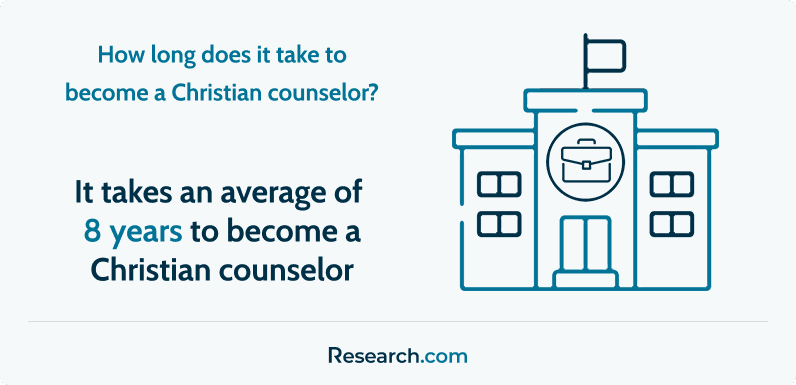
The typical path to licensed Christian counseling takes about eight years, though the exact timeline depends on your educational background, enrollment pace, state licensure rules, and how quickly you complete supervised clinical hours.
| Stage | Typical Time | What Happens During This Stage |
| Bachelor’s degree | 4 years | Students complete undergraduate coursework in counseling, psychology, or a related field. |
| Master’s degree | 2 years | Most states require graduate-level counseling preparation; many Christian counseling master’s programs take two to three years after the bachelor’s degree. |
| Supervised clinical experience | 2 years | Graduates complete 2,000-3,000 supervised clinical hours under an approved licensed counselor, often over one to two years. |
| Additional exam preparation or state steps | 3-6 months | Some states require extra exams or administrative steps beyond the National Counselor Exam. |
Students who want to move faster can look for accelerated master’s options, maximize transfer credits, attend full-time, and choose programs that build strong practicum and internship planning into the curriculum. Faster is only useful, however, if the program still meets licensure requirements.
What Is the Job Outlook for Christian Counselors?
There is no separate federal job outlook category for Christian counselors, so the most relevant data comes from broader counseling occupations. These figures are useful, but they do not guarantee demand or salary in a specific faith-based setting.
The U.S. Bureau of Labor Statistics reported that employment for substance abuse, behavioral disorder, and mental health counselors is projected to grow 18% from 2022 to 2032, with about 42,000 openings expected each year during that period. School and career counselors and advisors are projected to grow 5% from 2022 to 2032, with 26,000 openings each year. Marriage and family therapists are projected to grow 15% from 2022 to 2032, with 5,900 openings each year. For more context on broader counseling salary estimates, compare earnings by role, setting, credentials, and location.
Students should be cautious when comparing counseling to the highest paying bachelor degrees. Counseling careers can be meaningful and stable, but earnings vary by license type, specialization, employer, state, and whether you work in private practice, healthcare, schools, community agencies, or ministry settings.
| Projected Employment Growth (2022-2032) | Projected Annual Job Openings (2022-2032) | |
| Substance abuse, behavioral disorder, and mental health counselors | 18% | 42,000 |
| School and career counselors and advisors | 5% | 26,600 |
| Marriage and family therapists | 15% | 5,900 |
| Rehabilitation counselors | 2% | 6,700 |
What Is the Average Cost of a Counseling Program?
Counseling program costs vary based on degree level, school type, residency status, delivery format, fees, internship costs, and how many credits you need to complete. Tuition alone does not show the full cost, so students should compare total program cost through graduation.
- Average annual tuition for undergraduate students pursuing a bachelor’s degree is around $9,000.
- A four-year degree program at a public college or university can cost about $23,000 on average.
- A four-year degree program at a private college or university can cost about $31,000 on average.
- The average tuition for a master’s degree program in 2021 was $19,749.
- The average tuition for a master’s degree program in a public institution in 2021 was $12,394.
- The average tuition for a master’s degree program in a private institution in 2021 was $26,621.
Cost Factors Students Often Miss
| Cost Item | Why It Matters |
| Clinical placement expenses | Internship sites may require background checks, liability coverage, travel, or unpaid hours. |
| Technology and online learning fees | Online programs may charge separate platform or distance learning fees. |
| Residency or intensive requirements | Hybrid programs may require travel, lodging, and time away from work. |
| Licensure exam and application fees | These costs often occur after graduation and should be included in ROI planning. |
| Delayed income during clinical hours | Supervised experience can affect your earnings while you complete requirements. |
What Does a Doctorate in Counseling Mean for Christian Counselors?
A doctoral degree can make sense for licensed Christian counselors who want to teach, conduct research, supervise other clinicians, move into leadership, or build deeper expertise. The two common counseling doctorate options are the Doctor of Philosophy (Ph.D.) and Doctor of Education (Ed.D.).
Ph.D. in counseling programs are more common than Ed.D. programs and generally require four to six years of full-time study. They usually emphasize research, scholarship, and teaching rather than direct patient care. Ed.D. programs often appeal to education professionals who want counseling-related roles in administration, research, higher education, or clinical practice.
Another route is a doctorate in psychology, which can prepare graduates for scientific research, professional practice, or both, depending on the program type and licensure pathway.
What Are the Prerequisites for Enrolling in a Counseling Program?
Admission requirements differ by school and degree level. Undergraduate counseling programs usually review academic preparation and readiness for college-level study, while graduate counseling programs may evaluate your academic record, writing ability, references, professional goals, and fit for the counseling profession.
- Minimum GPA: Many programs look for a cumulative GPA of 3.0 or higher.
- Transcripts: Schools use transcripts to review prior coursework, grades, and degree completion.
- Standardized tests: Some programs may ask for GRE or other test scores.
- Letters of recommendation: Faculty members, supervisors, or professionals who know your work can help document your readiness.
- Personal statement: This essay explains why you want to enter counseling, how your background has prepared you, and why the program fits your goals.
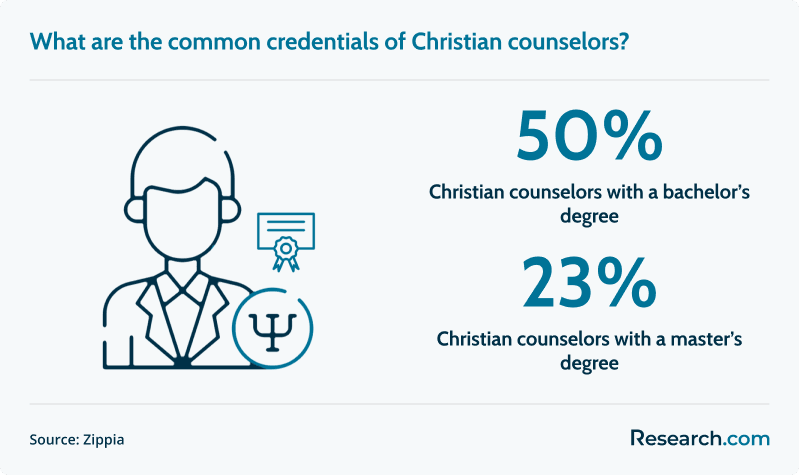
As a general reference point, around 50% and 23% of Christian counselors have bachelor’s and master’s degrees, respectively.
What Skills and Character Traits Do Christian Counselors Need?
Education and licensure are only part of the preparation. Christian counselors also need clinical judgment, ethical maturity, spiritual discernment, emotional steadiness, and the ability to serve clients without imposing beliefs inappropriately. Anyone learning how to become a counselor should develop both professional competence and personal character.
- Clinical knowledge and training: Your education determines what you are legally and ethically prepared to do, including whether you can assess, diagnose, and treat mental health conditions. Strong training also helps you respond to complex client needs with confidence.
- Insight: Christian counselors must understand client stories, family systems, trauma histories, beliefs, and motivations before offering guidance. Spiritual insight should support, not replace, careful assessment.
- Flexibility: Effective counselors adapt communication style, pacing, interventions, and spiritual integration to the client’s needs, readiness, background, and goals.
- Compassion: Clients often come to counseling during grief, addiction, conflict, anxiety, trauma, or spiritual struggle. Compassion helps counselors stay present without becoming judgmental or detached.
- Spiritual maturity: A Christian counselor should demonstrate humility, wisdom, forgiveness, and ethical use of Scripture. Spiritual authority must be handled carefully, especially when clients are vulnerable.
What Courses Are Typically Included in a Counseling Program?
Coursework depends on degree level, specialization, accreditation, and whether the program is clinical, pastoral, biblical, school-based, or addictions-focused. Most counseling programs include a mix of theory, skills training, ethics, assessment, research, and supervised practice.
- Psychology: General psychology, abnormal psychology, developmental psychology, social psychology, and personality theories.
- Counseling theories and techniques: Major counseling models, individual counseling, group counseling, and ethical application.
- Research methods: Statistics, research design, data analysis, and use of research in counseling decisions.
- Professional development: Career planning, counseling identity, ethics, writing, self-awareness, and personal growth.
- Psychopathology: Diagnostic frameworks, mental disorder treatment, and diagnostic interviewing.
- Assessment methods: Psychological testing, personality assessment, vocational assessment, and cultural considerations.
- Relationship building and counseling skills: Active listening, communication, rapport, crisis intervention, and client engagement.
- Addiction counseling: Substance use disorders, treatment models, relapse prevention, and referral resources.
How Do I Find the Best Christian Counseling Program for Me?
The best Christian counseling program is the one that fits your career target, licensure state, theology of counseling, learning format, budget, and timeline. Do not choose only by school reputation or tuition price. A less expensive program can become costly if it does not meet licensing rules where you live.
- Define the job you want. Decide whether you want clinical mental health counseling, marriage and family therapy, addiction counseling, school counseling, pastoral counseling, or ministry-based care.
- Verify licensure requirements first. Check your state counseling board before enrolling and ask the program to document how its curriculum maps to state requirements.
- Check accreditation. Look at both institutional accreditation and programmatic accreditation where relevant.
- Compare curriculum carefully. Review whether the coursework includes diagnosis, ethics, multicultural counseling, crisis intervention, assessment, human development, clinical skills, and supervised practice.
- Ask about field placements. Strong programs help students find approved practicum and internship sites. This is especially important for online students.
- Calculate total cost. Include tuition, fees, books, travel, technology, residency requirements, exam fees, and the cost of unpaid clinical hours.
- Evaluate fit. Consider faculty expertise, spiritual integration, student support, schedule flexibility, and whether the program’s counseling philosophy matches your goals.
Online vs. Campus Christian Counseling Programs
| Format | Best For | Trade-Offs |
| Online | Working adults, parents, ministry workers, and students far from Christian counseling programs | Requires strong self-discipline and careful planning for local clinical placements |
| Campus | Students who want face-to-face community, local internship networks, and structured schedules | Less flexible and may require relocation or commuting |
| Hybrid | Students who want flexibility but still value in-person intensives or occasional campus learning | Travel and residency requirements can add cost and scheduling pressure |
What Makes Christian Counseling Relevant?
Christian counseling remains relevant because many clients want mental health support that respects their faith commitments, spiritual struggles, moral questions, and religious community. At its best, Christian counseling does not ignore clinical standards. It integrates counseling skill with a client-centered and ethically appropriate use of Christian belief, prayer, Scripture, and spiritual formation.
- It recognizes spiritual meaning. Many clients interpret suffering, forgiveness, identity, purpose, and healing through faith. Christian counseling can create space for those beliefs when the client wants that integration.
- It offers a moral and theological framework. Christian counselors may help clients examine decisions, relationships, habits, and wounds through biblical values while still using careful counseling methods.
- It can support deeper healing for faith-centered clients. Some clients want counseling that addresses emotional pain and their relationship with God, church, family, and vocation.
- It can provide hope during crisis. Christian counseling can help clients connect present suffering with spiritual hope, community support, and long-term meaning.
- It can strengthen values-based change. For clients who choose faith integration, counseling can support recovery from addiction, relational harm, grief, anxiety, or destructive behavior through both clinical strategies and spiritual practices.
Students should also recognize the commitment involved. Becoming a Christian counselor may require around eight years of relevant preparation before independent licensed practice.
Related Helping Professions to Consider
Christian counseling is not the only career path for people called to serve others through crisis, healing, and long-term support. Some students eventually choose adjacent fields with more medical, social service, or institutional focus. For example, students drawn to direct patient care may compare counseling with nursing and review critical care nursing salary information before deciding.
Social work is another close alternative, especially for students who want to combine counseling skills with advocacy, case management, community support, and systems-level intervention. Comparing MSW vs MSSW pathways can help clarify graduate degree options, while those interested in justice settings may explore social work in corrections.
How Can I Finance My Christian Counseling Education?
Start financing research before you apply. Ask each school for the total estimated program cost, not just per-credit tuition. Then compare scholarships, grants, federal student aid eligibility, employer tuition reimbursement, ministry scholarships, payment plans, and part-time enrollment options.
Students who need a faster or more flexible path may also compare accelerated online programs, especially if they are considering marriage and family therapy. Reviewing options such as the fastest online MFT program can help you understand how program length, cost, and licensure preparation interact. The key is to reduce cost without choosing a program that weakens your licensing eligibility.
How Can I Build a Successful Private Christian Counseling Practice?
Private practice requires clinical competence and business discipline. Before opening a practice, clarify your licensure status, scope of practice, liability coverage, referral relationships, documentation policies, telehealth compliance, fee structure, and target client population.
- Write a business plan. Define your mission, services, ideal clients, fee model, and faith-based counseling approach.
- Handle legal and financial setup. Choose the appropriate business structure, maintain records properly, and secure professional liability insurance.
- Build referral networks. Connect with churches, physicians, schools, treatment centers, healthcare providers, and community organizations.
- Use secure technology. If offering telehealth, use platforms and documentation practices appropriate for counseling work.
- Continue advanced training. Specialized study can help differentiate your practice. Some counselors interested in deeper psychological assessment may review PsyD in neuropsychology programs, though this is a distinct advanced training path.
How Can I Incorporate Christian Counseling Into My Existing Career?
Not everyone needs to leave a current profession to use Christian counseling principles. Many professionals apply counseling-informed listening, empathy, ethical decision-making, and spiritual care within their existing role. The important boundary is this: do not represent yourself as a licensed counselor unless you meet the legal requirements in your state.
- Human resources and management: Leaders can use empathy, confidentiality, conflict resolution, and values-based communication when supporting employees.
- Healthcare and nursing: Healthcare workers may provide spiritual support alongside physical care, especially for patients facing grief, terminal illness, or mental health stress.
- Teaching and education: Educators can create compassionate environments and support students emotionally while staying within school policies and professional boundaries.
- Social work: Social workers may integrate faith-sensitive support when appropriate and client-directed, especially around trauma, family stress, addiction, or crisis.
- Pastoral and ministry work: Pastors and ministry leaders often use counseling skills for spiritual care, premarital counseling, grief support, and congregational guidance.
What Career Paths Are Available for Christian Counselors?
Christian counseling careers differ by license, training, employer, and setting. Some roles are clinical and require state licensure. Others are pastoral, ministry-based, or supportive and may not allow diagnosis or psychotherapy.
| Career Path | Main Focus | Typical Setting |
| Christian grief counseling | Helping clients process bereavement through counseling skills and faith-sensitive care | Private practice, churches, hospice-related settings, community organizations |
| Marriage and family counseling | Supporting couples and families through conflict, communication problems, and relational stress | Private practice, clinics, family service agencies, faith-based organizations |
| Pastoral counseling | Providing spiritual and emotional guidance in a ministry context | Churches, seminaries, ministries, chaplaincy-related settings |
| Addiction counseling | Helping clients address substance use and addictive disorders with clinical and spiritual support | Treatment centers, recovery ministries, outpatient programs, community agencies |
Students interested in grief work should review the education and credentialing process for that specialization. Learn more about how to become a grief counselor before choosing a program.
The chart below illustrates how location can affect salary outcomes. Among the major cities shown, Christian counselors in San Francisco, California earn the highest mean annual wage.
What Are Alternative Ways to Accelerate Your Counseling Career?
You can sometimes shorten the path to a counseling career, but you should not skip requirements that affect licensure or competence. The safest acceleration strategies are those that preserve accreditation, clinical quality, and state compliance.
- Use transfer credits strategically. Ask whether prior coursework can reduce required credits without removing licensure-required content.
- Choose full-time or accelerated formats. Intensive coursework and summer enrollment may reduce calendar time.
- Select programs with strong clinical coordination. Schools that help place students in approved sites can reduce delays during practicum and internship stages.
- Focus on your intended state. Knowing state rules early prevents wasted coursework or the need for additional classes later.
- Consider online options carefully. Online programs can be flexible, but you must confirm field placement support and state authorization.
For more guidance on efficient but compliant pathways, review the fastest way to get counseling degree resource.
Are There Online Education Options for Aspiring Christian Counselors?
Yes. Many students pursue Christian counseling or related counseling programs online because they need flexibility for work, family, ministry, or geographic reasons. Online learning can be a practical option, especially for students who live far from a Christian university or seminary.
However, online does not automatically mean easier, cheaper, or licensure-ready. Ask whether the program is authorized in your state, whether it meets your state’s licensing coursework rules, how practicum and internship placements are arranged, and whether any campus residencies are required. Students interested in family counseling may compare programs such as a masters degree in family counseling online while checking licensure alignment carefully.
What Is the Employment Outlook for Forensic Psychologist?
Forensic psychology is a different field from Christian counseling, but some counselors become interested in legal, correctional, assessment, or court-related work. Forensic psychology can broaden understanding of risk, behavior, trauma, and legal systems, but it usually requires specialized training beyond standard counseling preparation.
Students exploring this adjacent path can review what is the employment outlook for forensic psychologist to understand roles, trends, and career expectations in that field.
What Are the Key Challenges in Becoming a Christian Counselor?
Christian counseling can be deeply meaningful, but students should enter the field with realistic expectations. The work requires years of education, clinical supervision, emotional resilience, and clear professional boundaries.
| Challenge | Why It Matters | Better Approach |
| Balancing faith and clinical practice | Clients need ethical care that respects their beliefs and uses appropriate counseling methods. | Choose training that teaches both theology and evidence-based practice. |
| Meeting licensure rules | Requirements differ by state and can be confusing. | Confirm state board rules before enrolling and keep written documentation. |
| Managing emotional strain | Counselors regularly hear about trauma, grief, addiction, and relational pain. | Develop supervision, peer support, self-care, and spiritual accountability. |
| Handling financial pressure | Education, internships, licensure fees, and early-career income can create stress. | Build a realistic cost plan and compare total program value, not only tuition. |
| Navigating skepticism about faith-based counseling | Some clients or professionals may question the integration of religion and therapy. | Communicate your approach clearly, respect client autonomy, and practice within ethical limits. |
Students considering counseling roles in schools can also compare best online school counseling programs to see how school counseling preparation differs from Christian counseling or pastoral care.
Common Mistakes to Avoid When Choosing a Christian Counseling Program
- Assuming every Christian counseling degree leads to licensure. Some programs are ministry-focused and may not satisfy LPC, LMFT, or addiction counseling requirements.
- Looking only at tuition per credit. Total cost includes fees, books, travel, clinical placement expenses, and licensing costs.
- Ignoring state rules. A program that works in one state may not meet requirements in another.
- Choosing speed over eligibility. An accelerated program is only useful if it preserves required coursework and clinical training.
- Overlooking field placement support. Online students in particular should ask how the school helps secure approved practicum and internship sites.
- Relying only on rankings. Rankings can help narrow choices, but licensure fit, accreditation, supervision, cost, and theology of counseling are more important for your final decision.
How Can Behavior Analysis Skills Complement My Christian Counseling Practice?
Behavior analysis can help counselors think more systematically about observable behavior, reinforcement patterns, intervention planning, and measurable change. For Christian counselors, these skills may be useful when working with clients who need structured support for habits, routines, parenting issues, or behavior change goals.
Behavior analysis is its own specialized area, so counselors should pursue proper training before using advanced methods. Students interested in this additional expertise can compare the most affordable BCBA accredited programs online while considering how behavior analysis would fit their counseling scope and faith-based values.
Can Forensic Psychology Enhance My Christian Counseling Approach?
Forensic psychology may help counselors better understand risk assessment, crisis response, legal settings, and complex behavioral patterns. This can be useful for professionals who work near courts, corrections, child welfare, trauma services, or high-conflict family systems. It should be treated as an added specialization, not a substitute for counseling licensure.
Students who want to study this area can explore the most affordable masters in forensic psychology online options and compare them with their long-term counseling goals.
Questions to Ask Schools Before Enrolling
- Does this program meet licensure requirements in my state?
- What license or credential are graduates typically eligible to pursue?
- Is the program accredited by a relevant institutional or programmatic accreditor?
- How does the curriculum integrate Christian theology with clinical counseling practice?
- How are practicum and internship placements arranged?
- Can online students complete fieldwork in their home state?
- What is the total estimated cost through graduation?
- What percentage of students complete the program, pass licensure exams, and secure relevant employment?
- Are faculty members licensed counselors, theologians, researchers, or ministry practitioners?
- What student support is available for advising, supervision, writing, and career planning?
Key Insights
- Christian counseling can mean clinical counseling with faith integration, pastoral counseling, biblical counseling, marriage and family therapy, or addiction counseling. Define your target role before choosing a degree.
- If you want to become licensed, state requirements should drive your program search. Accreditation, coursework, supervised hours, and exam eligibility matter more than marketing language.
- The typical licensed path includes a four-year bachelor’s degree, a graduate counseling degree, supervised clinical experience, and a state-required exam. The full process often takes about eight years.
- Program costs vary widely, so compare total cost, financial aid, clinical placement expenses, and time away from paid work.
- Online Christian counseling programs can be practical for working adults, but students must verify state authorization, placement support, and licensure alignment.
- The strongest Christian counselors combine clinical competence, spiritual maturity, ethical boundaries, compassion, and a clear respect for client autonomy.
References:
- World Health Organization. (n.d.) Health Topics | Mental health. WHO.
- ZipRecruiter. (2023, December). Christian Counselor Salary. ZipRecruiter.
- Salary.com. (2023, November). Christian Counselor Salary. Salary.com.
- Colorado Christian University. (n.d.). 5 Traits of a Successful Christian Counselor. CCU.
- U.S. Bureau of Labor Statistics. (2023, September 6). Occupational Outlook Handbook | Substance Abuse, Behavioral Disorder, and Mental Health Counselors. BLS.
- U.S. Bureau of Labor Statistics. (2023, September 6). Occupational Outlook Handbook | School and Career Counselors and Advisors. BLS.
- U.S. Bureau of Labor Statistics. (2023, September 6). Occupational Outlook Handbook | Marriage and Family Therapists. BLS.
- Pacific College. (2022, July 31). The Difference Between Graduate and Undergraduate Degrees. Pacific College.
- National Center for Education Statistics. (2022). Digest of Education Statistics | Average and percentiles of graduate tuition and required fees in degree-granting postsecondary institutions, by control of institution: 1989-90 through 2020-21. NCES.
Other Things You Should Know About Christian Counselors
To become a Christian counselor in 2027, typically one needs at least a bachelor's degree in counseling, psychology, or a related field. Many also pursue a master's degree in Christian counseling and obtain licensure, which generally requires supervised clinical experience and passing a state-recognized exam.
In 2027, Christian counselors often need certification from bodies like the National Christian Counselors Association (NCCA). State requirements vary, but typically involve accredited education, supervised practice hours, and passing a certification exam specific to Christian counseling.
To become a Christian counselor in 2027, start by earning a bachelor's degree in counseling or a related field. Pursue a master's degree in Christian counseling, and obtain certification through a recognized body, such as the American Association of Christian Counselors. Gaining practical experience through supervised hours is also essential.


