
2027 Best LPN Programs in Delaware – Accredited Online LPN Programs

Co-Founder and Chief Data Scientist
Choosing an LPN program in Delaware is not just a school decision. It affects whether you qualify for state licensure, how quickly you can enter the nursing workforce, what clinical experience you receive, and whether your training can later support an LPN-to-RN pathway. This guide is for prospective practical nursing students, working adults considering a healthcare career change, and current healthcare workers who want a faster route into nursing in Delaware.
Delaware’s need for healthcare workers is especially important because the Delaware Journal of Public Health has reported significant strain across the state’s healthcare system. The Health Resources & Services Administration (HRSA) identifies 37 Health Professional Shortage Areas (HPSAs) in Delaware across primary care, dental, and mental health disciplines. While LPNs do not replace every shortage-area role, practical nurses can help expand access to basic patient care in hospitals, long-term care facilities, clinics, home health, and other care settings.
In this guide, you will learn what Delaware LPN programs require, how long they take, how much they cost, how online and campus-based formats differ, what licensure steps you must complete, and how to compare programs before enrolling.
Quick answer: Is an LPN program in Delaware worth considering?
An LPN program in Delaware can be a practical option if you want to enter nursing faster than a traditional RN pathway and are comfortable providing hands-on patient care under state scope-of-practice rules. Delaware practical nursing programs typically prepare graduates for the NCLEX-PN and state licensure, and LPNs in Delaware report a median salary of $54,292. The strongest candidates choose accredited programs with Delaware Board of Nursing approval, sufficient clinical placement, transparent costs, and clear graduate outcomes.
What are the benefits of getting an LPN degree in Delaware?
- Direct access to patient-care roles: Delaware LPN graduates may work in hospitals, long-term care facilities, clinics, physician offices, home health, and similar settings.
- Moderate training timeline: Many practical nursing programs can be completed faster than associate or bachelor’s nursing degrees, helping students enter the workforce sooner.
- Defined salary potential: The median salary for LPNs in Delaware is $54,292, though actual earnings vary by city, employer, shift, experience, and certifications.
- Licensure-focused education: Accredited nursing programs in the state are designed to meet practical nursing licensure requirements, including required clinical training.
- Flexible delivery in some programs: Students may find online or hybrid coursework options, but clinical and skills training still require in-person participation.
What can I expect from an LPN degree in Delaware?
In Delaware, practical nursing education is usually offered as a diploma or certificate-style program rather than a traditional academic “degree.” The goal is the same: complete a state-approved practical nursing curriculum, build clinical skills, and become eligible to sit for the National Council Licensure Examination for Practical Nurses (NCLEX-PN).
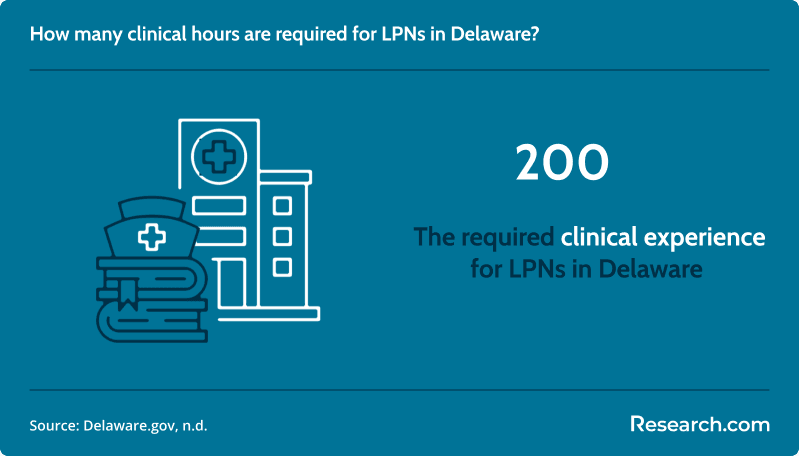
Delaware requires completion of an accredited practical nursing program that satisfies state standards within the past four years. Programs must include 200 hours of clinical experience, giving students supervised practice in real healthcare environments.
After finishing the program, graduates must apply through the Delaware Board of Nursing and Pearson Vue so they can schedule and take the NCLEX-PN. Passing the exam is required for practical nursing licensure.
Timing matters. If you graduated two or more years before taking the NCLEX-PN, you must show proof that you completed an NCLEX review course within the previous six months. If five or more years have passed since graduation, you are not eligible for licensure by examination and must contact the Board office for additional guidance.
LPN training can also be a stepping stone. Many Delaware LPNs later pursue RN education through LPN-to-RN or related bridge pathways that build on prior nursing experience.
Typical Delaware LPN pathway
| Step | What you do | Why it matters |
| 1. Confirm eligibility | Review age, education, testing, background check, health, and immunization requirements. | Missing documents can delay admission or clinical placement. |
| 2. Choose an approved program | Compare accreditation, Delaware Board of Nursing approval, clinical hours, cost, and schedule. | Only appropriate training supports licensure eligibility. |
| 3. Complete coursework and clinicals | Study nursing fundamentals, anatomy and physiology, pharmacology-related content, and supervised care. | Clinical preparation is essential for safe patient care and NCLEX-PN readiness. |
| 4. Apply for licensure and exam registration | Submit required materials to the Delaware Board of Nursing and Pearson Vue. | You cannot sit for the licensing exam until the required process is complete. |
| 5. Pass the NCLEX-PN | Take and pass the national practical nursing exam. | This is required before you can practice as an LPN. |
Where can I work with an LPN degree in Delaware?
Delaware LPNs work across many healthcare environments. According to the Delaware Nurses Association, LPNs collaborate with healthcare teams in settings such as:
- Hospitals
- Long-term care facilities
- Nursing homes
- Assisted living facilities
- Physician offices
- Clinics
- Schools
- Home health agencies
Day-to-day responsibilities often include taking vital signs, administering medications within scope, assisting with activities of daily living, observing changes in patient condition, documenting care, and communicating concerns to RNs, physicians, and other healthcare professionals.
How much can I make with an LPN degree in Delaware?
The average LPN salary in Delaware is $54,292. Pay can vary widely depending on the city, employer type, shift differentials, education, certifications, specialized skills, and years of experience.
ZipRecruiter reports that Dover leads Delaware cities for LPN pay above the state average, followed by Lewes and Wilmington. Wilmington exceeds the Delaware average by 14.9%, while Dover is $9,603, or 17.1%, above the $56,287 average.
| Salary factor | How it can affect earnings |
| Location | Urban and high-demand areas may offer higher pay, but commuting and cost of living should also be considered. |
| Care setting | Hospitals, long-term care, home health, clinics, and specialty offices may have different compensation structures. |
| Experience | New graduates usually start lower than experienced LPNs with proven clinical judgment and reliability. |
| Schedule | Evening, night, weekend, and overtime shifts may increase earnings depending on the employer. |
| Certifications and skills | Experience in wound care, geriatrics, dialysis, hospice, or similar areas may improve competitiveness. |
- Best LPN Programs in Delaware for 2027
- How long does it take to complete an LPN degree in Delaware?
- How does an online LPN program in Delaware compare to an on-campus program?
- What is the average cost of an LPN program in Delaware?
- What are the financial aid options for students enrolling in an LPN program in Delaware?
- What are the prerequisites for enrolling in an LPN program in Delaware?
- What courses are typically in an LPN program in Delaware?
- What types of specializations are available in LPN programs in Delaware?
- How to choose the best LPN program in Delaware
- What career paths are available for graduates of LPN programs in Delaware?
- How does Delaware address the demand for skilled LPNs in underserved areas?
- What is the return on investment for an LPN program in Delaware?
- What is the job market for graduates with an LPN degree in Delaware?
- Should I Consider Upgrading from LPN to RN in Delaware?
- What career support resources are available for LPNs in Delaware?
- How can I navigate the LPN licensure process in Delaware efficiently?
- How can LPNs transition to a nurse practitioner role in Delaware?
- What legal and ethical responsibilities do LPNs have in Delaware?
- Can LPNs Transition into Nurse Midwife Roles in Delaware?
- How are emerging technologies transforming LPN education in Delaware?
- What professional organizations are available for LPNs in Delaware?
- What Opportunities Exist for LPNs to Pursue Advanced Nursing Degrees in Delaware?
- How can allied healthcare training enhance LPN competencies in Delaware?
- What are the licensure renewal and continuing education requirements for LPNs in Delaware?
List of the Best LPN Programs in Delaware for 2027
How do we rank schools?
Because nursing education requires a major investment of time, money, and clinical effort, students need clear information before selecting a program. Research.com evaluates Delaware LPN programs using a ranking approach built around public data, program characteristics, and student-relevant outcomes.
Our ranking process uses current and comprehensive U.S. government and education data sources, including:
- The Integrated Postsecondary Education Data System (IPEDS)
- Peterson’s database, including the Distance Learning Licensed Data Set
- College Scorecard
- National Center for Education Statistics
Our experts also review factors such as graduation rate, student-faculty ratio, and program focus. Details about the ranking process are available on our methodology page.
1. Delaware Technical Community College
Delaware Technical Community College offers a practical nursing diploma designed to prepare students for entry-level LPN practice. The curriculum supports work in long-term care facilities, physician offices, clinics, public health centers, and similar healthcare environments. Graduates are prepared to pursue LPN licensure. The program is available at the Georgetown, Dover, and Stanton campuses, with evening and weekend scheduling options.
- Program Length: N/A
- Tracks/concentrations: N/A
- Cost per Credit: $2,287.50 per semester (for 15+ credit hours)
- Required Credits to Graduate: At least 39 credits
- Accreditation: Accreditation Commission for Education in Nursing (ACEN)
2. Delaware Skills Center
The Delaware Skills Center practical nursing program trains students to provide safe, lawful, and competent nursing care. Its mission emphasizes prevention, community health, and improving the well-being of Delaware residents. The program is approved by the Delaware Board of Nursing and the New Castle County Vocational Technical School District.
- Program Length: 10 months
- Tracks/concentrations: N/A
- Cost per Credit: $13,600 (tuition)
- Required Credits to Graduate: 1,635 (total hours)
- Accreditation: ACEN
3. Polytech Adult Education
Polytech Adult Education offers a practical nursing program totaling 1,496 hours. Its 68,000-square-foot training facility includes 16 classrooms, three computer labs, seven shops, a conference center, and a health services laboratory.
The program’s average class size ranges from ten to 25 students, which can support more direct instruction and hands-on learning. Students develop nursing knowledge, clinical judgment, critical thinking, caring behaviors, technical ability, and psychosocial skills. Clinical education begins in the first semester and continues throughout the full-time program.
- Program Length: 11 months
- Tracks/concentrations: N/A
- Cost per Credit: $14,999 (tuition)
- Required Credits to Graduate: 1,496 (total hours)
- Accreditation: ACEN
What graduates say about flexible LPN education
"Completing my LPN coursework online helped me keep my job and manage family responsibilities while moving toward nursing. The flexible schedule made the program possible for me." - Cynthia
"The online format gave me access to lectures and learning materials when I needed them. Virtual discussions with instructors and classmates helped me stay connected even when I was not on campus." - David
"Studying from home reduced commuting time and helped me build a schedule that worked. Online resources and virtual learning tools helped reinforce difficult nursing concepts." - Eden
Key Findings
- Delaware LPN graduates can work in hospitals, long-term care facilities, clinics, home health, schools, and other healthcare settings.
- LPNs in Delaware earn a median salary of $54,292, but wages differ by location, employer, experience, shift, and specialty skills.
- Practical nursing can be an entry point into nursing, and many LPNs later pursue RN education through bridge programs.
- O*NET projects Delaware will need an additional 2,610 LPNs by 2030, equal to about 220 openings every year and estimated job growth of 16% over the next decade.
- Wilmington is among the metropolitan areas with high LPN and LVN employment levels, with the Bureau of Labor Statistics reporting 13,020 LPN workers in 2024.
How long does it take to complete an LPN degree in Delaware?
Most Delaware LPN programs can be completed in about one to 1.5 years, depending on the school, schedule, and whether the student attends full time. Practical nursing programs are commonly offered through technical schools, community colleges, and workforce training institutions.
Students should expect a mix of classroom learning, laboratory practice, and supervised clinical experience. Courses commonly cover biology, pharmacology-related nursing content, patient care fundamentals, and clinical decision-making. The program should also prepare students for the NCLEX-PN, the licensing exam required for entry into LPN practice.
How does an online LPN program in Delaware compare to an on-campus program?
Online and hybrid LPN programs can make nursing education more manageable for students who work, care for family members, or live far from campus. However, LPN training cannot be completed entirely online because students must practice skills and complete clinical hours in person.
On-campus programs usually provide more structure, scheduled lab time, direct access to instructors, and face-to-face collaboration with classmates. They may be better for students who learn best through routine, immediate feedback, and hands-on practice.
The trade-off is flexibility. Campus-based schedules can conflict with work or family responsibilities, and students in rural areas may have fewer nearby options. Online or hybrid coursework may help with lecture-based content, but students still need reliable transportation and availability for labs, simulations, and clinical placements.
| Format | Best for | Limitations to check |
| Online or hybrid LPN coursework | Students who need schedule flexibility for lectures or assignments. | Clinical hours, skills labs, exams, and simulations may still require in-person attendance. |
| On-campus LPN program | Students who want structure, face-to-face instruction, and regular lab access. | Fixed schedules and commuting may be difficult for working adults. |
| Evening or weekend option | Students balancing employment with nursing school. | Clinical schedules may not always match evening or weekend class times. |
Students comparing practical nursing with graduate nursing routes should understand that LPN, MSN, and DNP programs serve very different career stages. Resources such as affordable online MSN programs can be useful later for nurses who have already progressed into RN-level education and want advanced practice or leadership roles.
What is the average cost of an LPN program in Delaware?
Practical nursing programs in Delaware typically cost between $3,500 and $14,699. That range may not include every expense, so students should ask each school for a complete cost breakdown before enrolling.
Although free LPN programs are not available in Delaware, families and students may use the Delaware 529 Plan, a tax-advantaged education savings account that can help pay qualified education costs at eligible institutions, including LPN schools.
When estimating total cost, include tuition, fees, books, uniforms, supplies, testing fees, background checks, drug screening, immunizations, transportation, and lost work hours during clinical rotations.
| Cost category | Questions to ask before enrolling |
| Tuition and required fees | Is the published price the full program cost or only tuition? |
| Books and supplies | Are textbooks, uniforms, lab kits, and equipment included? |
| Clinical requirements | Who pays for background checks, drug screening, immunizations, and health exams? |
| Licensure and testing | Are NCLEX-PN preparation, application fees, and exam costs included? |
| Transportation | How far are clinical sites from campus or home? |
Some LPNs eventually move toward healthcare leadership or management education. For those considering broader administrative roles later, Research.com also provides information on a low-cost online PhD in organizational leadership. Students considering a different field altogether can compare options such as the most affordable online engineering degree.
What are the financial aid options for students enrolling in an LPN program in Delaware?
Financial aid availability depends on the institution, program eligibility, and the student’s financial situation. Delaware Technical Community College, for example, connects students with options such as the SEED Scholarship program, Delaware Aid for Needy Students, and federal aid through the Free Application for Federal Student Aid (FAFSA).
Delaware nursing students may also qualify for federal grants, loans, or work-study opportunities. Common federal options include the Pell Grant, Federal Supplemental Educational Opportunity Grant (FSEOG), and federal student loans.
Students should also ask Delaware’s higher education agency about state-based aid and ask current employers about tuition reimbursement, especially if they already work in healthcare.
How to reduce the cost of an LPN program
- Complete the FAFSA early and respond quickly to any school requests for documents.
- Ask whether the program qualifies for federal financial aid before assuming loans or grants are available.
- Compare total program cost, not just tuition.
- Ask employers about tuition assistance, especially hospitals, long-term care facilities, and home health agencies.
- Look for scholarship deadlines before admission decisions are finalized.
- Choose a program with realistic commuting distance to reduce transportation costs.
What are the prerequisites for enrolling in an LPN program in Delaware?
Admission requirements vary by school, but Delaware LPN applicants commonly need to meet academic, health, safety, and documentation standards before entering clinical training. Requirements may include:
- Being at least 18 years old
- Earning satisfactory scores on the Test of Essential Academic Skills (ATI-TEAS)
- Submitting documentation for drug screening and a criminal background investigation
- Completing State of Delaware Adult & Child Abuse Registry checks
- Providing a physical examination report showing the ability to meet student nurse physical requirements
- Submitting required immunization documentation
- Completing the school’s application form
- Providing an official high school transcript or proof of General Educational Development (GED), plus college transcripts if applicable
- Submitting two professional reference letters
- Participating in an interview
Students should not wait until acceptance to gather these materials. Background checks, immunization records, transcripts, and testing appointments can take time, and delays may affect clinical eligibility.
What courses are typically in an LPN program in Delaware?
Delaware LPN programs combine nursing theory, foundational science, clinical practice, and NCLEX-PN preparation. Common courses include:
- Fundamentals of Nursing
- Anatomy and Physiology
- Nursing Clinicals
- Human Growth and Development
Students may also complete coursework in statistics, math, English, biology, and other general or supporting subjects depending on the program.
Skills students should expect to build
- Measuring and interpreting vital signs
- Assisting patients with mobility, hygiene, feeding, and daily living needs
- Administering medications within LPN scope and employer policy
- Performing basic wound care and observing healing progress
- Documenting patient care accurately
- Communicating changes in patient condition to supervising clinicians
- Using electronic health record systems and other clinical documentation tools
What types of specializations are available in LPN programs in Delaware?
Entry-level LPN programs generally focus on broad practical nursing preparation rather than deep specialization. However, students and graduates may pursue clinical exposure, electives, certificates, or employer-based training in areas such as:
- Wound care
- Geriatric
- Home care
- Hospice
- Dialysis
- Psychiatric
- Acute care
- Emergency room
- Dermatology
- Cardiology
- Family practice
- Gynecology
- Urology
- Pediatric
LPNs who enjoy working with children may later consider education-focused career paths. For example, students exploring non-nursing options can review affordable online early childhood education degree programs.
How to choose the best LPN program in Delaware
The best Delaware LPN program is not always the cheapest, fastest, or closest. It is the program that meets licensure requirements, fits your schedule, provides adequate clinical training, and gives you a realistic path to employment or further nursing education.
- Accreditation and state approval: Confirm that the program is accredited by a recognized nursing accreditor such as ACEN and approved by the Delaware Board of Nursing. Accreditation is also important when comparing later nursing pathways, including affordable online MSN programs.
- Curriculum and clinical hours: Verify that the program covers nursing fundamentals, anatomy and physiology, clinical practice, and NCLEX preparation. Delaware requires at least 200 clinical hours.
- NCLEX-PN performance: Ask for recent first-time NCLEX-PN pass rates. A strong pass rate can indicate effective instruction and exam preparation.
- Total cost and aid: Compare tuition, fees, books, supplies, clinical requirements, licensure costs, and available scholarships or grants.
- Schedule and location: Review program length, class times, campus location, lab requirements, and clinical site placement.
- Graduate outcomes: Ask about job placement support, employer partnerships, graduate employment rates, and bridge options for LPN-to-RN advancement.
Questions to ask every Delaware LPN program
| Question | Why it matters |
| Is the program approved by the Delaware Board of Nursing? | Approval is essential for licensure eligibility. |
| Is the program accredited by ACEN or another recognized body? | Accreditation can affect quality assurance, transfer options, and future education plans. |
| What is the total cost from admission through NCLEX-PN? | Published tuition may exclude major required expenses. |
| Where are clinical placements located? | Travel time and transportation can affect attendance and cost. |
| What are the first-time NCLEX-PN pass rates? | Exam performance helps you evaluate readiness support. |
| Does the school offer career services? | Resume help, interview preparation, and employer connections can support job entry. |
What career paths are available for graduates of LPN programs in Delaware?
Delaware LPN graduates may qualify for practical nursing roles in a range of patient-care environments. Common work areas include:
- Maternity wards
- Pediatric units
- Medical-surgical hospital units
- Long-term care facilities and nursing homes
- Physician offices, clinics, and outpatient facilities
- Home healthcare agencies
- Hospice settings
Depending on employer policies and scope-of-practice rules, LPN training may also support responsibilities such as:
- Conducting health screenings
- Providing basic first aid
- Administering medications in school settings
- Providing healthcare services in prisons, jails, or detention centers
- Serving underrepresented populations through community health centers, nonprofit organizations, and public health agencies
LPNs who want to move into administration, public service, or healthcare operations may later explore broader graduate programs. Research.com’s guide to the most affordable online MPA programs can help nurses compare public administration options that may support leadership goals.
The chart below shows the educational attainment of LPNs in the United States:
How does Delaware address the demand for skilled LPNs in underserved areas?
Delaware uses targeted workforce strategies to respond to healthcare access gaps in underserved communities, including areas designated as Health Professional Shortage Areas (HPSAs). These communities often face staffing pressure, making practical nurses valuable members of care teams that provide basic monitoring, patient support, chronic-care follow-up, and hands-on assistance.
State-funded loan repayment programs and financial incentives can help attract healthcare workers to high-need locations. Delaware employers also partner with local education providers to support clinical training, recruitment, and job placement connected to underserved communities.
For LPNs thinking about long-term career mobility, understanding Delaware’s broader nursing system is useful. Those considering RN licensure can review this guide on how to become a registered nurse in Delaware to compare requirements, education steps, and career progression.
What is the return on investment for an LPN program in Delaware?
The return on investment for an LPN program depends on total education cost, time out of the workforce, licensure success, starting pay, job stability, and whether the credential helps you advance later. A lower-cost program can still be a poor investment if it has weak NCLEX-PN outcomes or limited clinical support. A higher-cost program may be worthwhile if it has strong completion rates, reliable clinical placements, and good employer connections.
To evaluate ROI, compare program cost with Delaware’s reported LPN salary level, likely job availability in your region, and your plans for future education. Students who want a broader cost-planning framework can review how much nursing school costs.
| ROI factor | What to evaluate |
| Program price | Compare tuition, fees, supplies, exams, and commuting costs. |
| Completion time | Shorter programs may reduce time away from full-time earnings. |
| NCLEX-PN readiness | Licensure is required before the program can lead to LPN employment. |
| Local job market | Review openings near your home and ask schools about employer relationships. |
| Advancement potential | Consider whether credits or experience can support LPN-to-RN pathways. |
What is the job market for graduates with an LPN degree in Delaware?
Delaware’s healthcare workforce continues to shift as employers respond to changing care standards, staffing needs, and patient populations. Some institutions place stronger emphasis on RN hiring, particularly for roles that require broader assessment, planning, or supervisory responsibilities. For LPNs, this makes bridge education a valuable option for long-term career growth.
O*NET projects that Delaware will need an additional 2,610 LPNs by 2030. That equals about 220 openings each year and estimated job growth of 16% over the next decade.
Wilmington, Delaware, is among U.S. metropolitan areas with high employment levels for LPNs and LVNs. In 2024, the Bureau of Labor Statistics (BLS) reported a substantial LPN workforce of 13,020 individuals in the city.
Should I Consider Upgrading from LPN to RN in Delaware?
Moving from LPN to RN can expand your nursing scope, open more clinical responsibilities, and improve long-term advancement options. The trade-off is that RN preparation requires additional education, a licensing exam, and readiness for broader patient assessment, care planning, and leadership duties.
This path may make sense if you want more autonomy, stronger advancement potential, or access to roles that require RN licensure. It may not be the right immediate step if you need to work quickly, limit education costs, or build confidence in direct patient care first. For salary context, compare LPN vs RN salary before choosing a bridge program.
What career support resources are available for LPNs in Delaware?
Delaware LPN students and graduates can look for career support through schools, employers, workforce agencies, and professional networks. Community colleges and training centers may offer resume reviews, interview preparation, job boards, employer events, and clinical-site connections.
Healthcare employers may also provide mentoring, specialty onboarding, tuition support, and internal promotion pathways. LPNs should ask prospective employers whether they support bridge education or specialty training. For state credentialing guidance, review Delaware nursing license requirements.
How can I navigate the LPN licensure process in Delaware efficiently?
The most efficient way to handle Delaware LPN licensure is to start early, keep copies of every document, and follow Delaware Board of Nursing instructions carefully. Students should confirm transcript submission, clinical-hour documentation, NCLEX-PN registration, background checks, and application deadlines before graduation.
Do not assume the school completes every step for you. Ask your program which forms it submits and which items you must handle directly. For a more detailed process overview, see how to become a certified LPN in Delaware.
How can LPNs transition to a nurse practitioner role in Delaware?
An LPN cannot move directly into nurse practitioner practice without significant additional education. The usual progression involves becoming an RN, completing advanced nursing education, meeting clinical requirements, and earning the required credentials for advanced practice.
LPNs interested in this long-term path should first evaluate LPN-to-RN or LPN-to-BSN options, then review graduate nursing requirements. Accreditation, clinical placement quality, and state authorization are especially important. For details on the advanced practice pathway, review how to become a nurse practitioner in Delaware.
What legal and ethical responsibilities do LPNs have in Delaware?
Delaware LPNs must practice within state rules, employer policies, and accepted nursing standards. Their responsibilities include protecting patient privacy, documenting accurately, following medication and treatment protocols, reporting changes in condition, respecting patient rights, and maintaining professional boundaries.
LPNs must also understand HIPAA requirements, informed consent principles, delegation rules, mandatory reporting obligations, and ethical communication with patients and families. Programs that emphasize both clinical competence and professional accountability can help students prepare for these responsibilities. Students comparing broader nursing options can review the best nursing schools in Delaware.
Can LPNs Transition into Nurse Midwife Roles in Delaware?
LPNs can pursue nurse midwifery as a long-term goal, but the pathway requires multiple education and licensure steps beyond practical nursing. Nurse midwives are advanced nursing professionals, so LPNs typically need to progress to RN-level education and then complete graduate-level preparation in midwifery.
Prospective students should review state-specific rules, program accreditation, admission requirements, clinical placement expectations, and certification needs before planning this route. For a focused overview, see nurse midwife education requirements in Delaware.
How are emerging technologies transforming LPN education in Delaware?
Technology is changing how LPN students train and how practical nurses work. Delaware programs may use simulation labs, electronic health record practice, telehealth-related instruction, and digital learning platforms to strengthen clinical readiness.
These tools can help students practice documentation, communication, patient monitoring, and decision-making before working with patients. They do not replace clinical experience, but they can make skill development more realistic and measurable. Students who want technology-supported nursing education can compare the best online nursing programs in Delaware.
What professional organizations are available for LPNs in Delaware?
Professional organizations can help Delaware LPNs stay informed, build networks, access continuing education, and follow policy issues affecting nursing practice. Relevant organizations include:
- Delaware Nurses Association (DNA): DNA supports Delaware nurses through advocacy, professional development, networking, continuing education, mentorship opportunities, and updates on legislation affecting nursing practice.
- National Federation of Licensed Practical Nurses (NFLPN): NFLPN focuses on supporting LPNs nationally through professional resources, certification opportunities, continuing education, and advocacy for practical nursing.
- Delaware Board of Nursing: Although it is a regulatory board rather than a membership association, the Board is essential for licensure, practice rules, renewal information, and regulatory updates.
- American Nurses Association (ANA): ANA represents the broader nursing profession and provides resources on ethics, professional development, advocacy, and nursing trends.
- Local nursing and healthcare networking groups: Regional events, workshops, and healthcare groups can help LPNs meet employers, learn about openings, and connect with peers.
Pathways for LPNs to Advance Their Nursing Careers in Delaware
LPNs who want broader responsibilities can consider LPN-to-RN, LPN-to-BSN, and related bridge programs. These pathways allow practical nurses to build on prior clinical experience while preparing for RN-level practice.
Students comparing affordable bachelor’s completion options may find low-cost online RN to BSN programs useful once they meet the appropriate RN pathway requirements. Advanced education can support roles in clinical leadership, specialty care, public health, case management, and other areas that require or prefer RN preparation.
LPNs can also build expertise in geriatrics, pediatrics, critical care support, hospice, wound care, and other patient-care areas. The right choice depends on preferred patient population, work setting, schedule needs, and long-term career goals.
What Opportunities Exist for LPNs to Pursue Advanced Nursing Degrees in Delaware?
Delaware LPNs who plan to continue their education should map the full route before enrolling. If the goal is advanced practice, such as becoming a nurse practitioner, the student will typically need RN preparation before graduate nursing education.
Research.com’s guide to the best nurse practitioner programs in Delaware can help students compare advanced options after they meet prerequisite education and licensure requirements. LPN-to-RN and LPN-to-BSN pathways may also help practical nurses move toward higher responsibility and stronger long-term career flexibility.
How can allied healthcare training enhance LPN competencies in Delaware?
Allied healthcare training can strengthen an LPN’s practical skills, especially in communication, patient flow, basic clinical procedures, documentation, and teamwork. Cross-training can be useful for LPNs working in clinics, physician offices, community health settings, and outpatient care.
Additional training should complement—not replace—nursing licensure requirements. LPNs who want adjacent clinical skills can explore programs such as the best medical assistant programs in Delaware to understand how allied health roles overlap with practical nursing responsibilities.
What are the licensure renewal and continuing education requirements for LPNs in Delaware?
Delaware LPNs must keep their licenses active by meeting renewal rules and maintaining professional competence. Renewal typically includes continuing education requirements focused on patient care updates, regulatory changes, clinical skills, and professional practice expectations.
LPNs should choose continuing education from credible providers and keep records in case documentation is requested. Workshops, seminars, specialty certificates, and employer-based training can also support career development. Nurses considering adjacent health and wellness careers can review how to become a nutritionist in Delaware.
What are the emerging trends and challenges for LPNs in Delaware?
Delaware LPNs are entering a healthcare system shaped by technology, workforce shortages, aging populations, and changing employer expectations. The strongest candidates will be those who combine bedside skill with adaptability, communication, and readiness for continued learning.
- Telehealth and remote care: LPNs may support remote follow-ups, chronic condition monitoring, and patient communication through phone or video-based systems, especially where access to care is limited.
- Growth in home healthcare: Delaware’s aging population increases demand for home-based support, including medication assistance, wound care, monitoring, and help with activities of daily living.
- Workforce shortages and retention pressure: Healthcare employers need practical nurses, but burnout and turnover remain concerns. Flexible scheduling, competitive pay, and advancement options may influence where LPNs choose to work.
- Technology in daily practice: Electronic health records, digital medication systems, remote monitoring tools, and other technologies require LPNs to stay comfortable with new workflows.
- Patient-centered care expectations: Employers increasingly value communication, cultural awareness, family engagement, and respect for patient preferences.
- More education pathways: Flexible LPN to BSN online programs can help practical nurses plan for RN-level responsibilities, leadership, and specialization.
Common mistakes to avoid when choosing a Delaware LPN program
| Mistake | Better approach |
| Choosing only by lowest tuition | Compare total cost, NCLEX-PN outcomes, clinical support, and employer connections. |
| Assuming online means fully remote | Confirm lab, simulation, exam, and clinical attendance requirements before enrolling. |
| Ignoring accreditation and state approval | Verify approval with the Delaware Board of Nursing and review accreditation status. |
| Waiting to gather admission documents | Start transcripts, testing, health records, and background checks early. |
| Overlooking clinical site logistics | Ask where clinicals occur, how schedules are assigned, and whether transportation is required. |
| Assuming salary outcomes are guaranteed | Use salary data as a planning tool, not a promise; pay depends on employer, location, experience, and shift. |
| Relying only on rankings | Use rankings as a starting point, then verify fit, cost, licensure alignment, and outcomes. |
Key Insights
- An LPN program in Delaware is best for students who want a faster practical nursing route and are ready for hands-on patient care, clinical attendance, and state licensure requirements.
- Delaware practical nursing programs must prepare students for the NCLEX-PN and include 200 hours of clinical experience.
- Program costs in Delaware typically range from $3,500 to $14,699, but students should budget for fees, supplies, testing, transportation, and clinical requirements.
- The average LPN salary in Delaware is $54,292, with city-level differences reported by sources such as ZipRecruiter.
- O*NET projects demand for an additional 2,610 Delaware LPNs by 2030, or about 220 openings every year, with estimated job growth of 16% over the next decade.
- Online or hybrid coursework can improve flexibility, but LPN training still requires in-person labs and clinical practice.
- The safest program choice is one that is accredited, Delaware Board of Nursing-approved, transparent about costs, strong in NCLEX-PN preparation, and realistic for your schedule and commute.
- LPN can be a career destination or a stepping stone. Students who want broader scope, higher responsibility, or advanced nursing roles should plan early for LPN-to-RN or LPN-to-BSN options.
Related Articles for Nearby States
- 2027 Best LPN Programs in Maryland – Accredited Online LPN Programs
- 2027 Best LPN Programs in New Jersey – Accredited Online LPN Programs
- 2027 Best LPN Programs in Pennsylvania – Accredited Online LPN Programs
- 2027 Best LPN Programs in Virginia – Accredited Online LPN Programs
- 2027 Best LPN Programs in West Virginia – Accredited Online LPN Programs
- 2027 Best LPN Programs in New York – Accredited Online LPN Programs
- 2027 Best LPN Programs in Connecticut – Accredited Online LPN Programs
- 2027 Best LPN Programs in North Carolina – Accredited Online LPN Programs
- 2027 Best LPN Programs in Ohio – Accredited Online LPN Programs
- 2027 Best LPN Programs in Kentucky – Accredited Online LPN Programs
References:
- Salary.com. (2024). Licensed Practical Nurse Salary in Delaware. Retrieved from https://www.salary.com/research/salary/benchmark/licensed-practical-nurse-salary/de
- U.S. Bureau of Labor Statistics. (2025). Occupational Employment and Wage Statistics: Licensed Practical and Licensed Vocational Nurses. Retrieved from https://www.bls.gov/oes/current/oes292061.htm
- Zippia. (2024). Licensed practical nurse demographics and statistics in the US. Retrieved from
- ZipRecruiter. (2024). LPN Salary in Delaware. Retrieved from https://www.ziprecruiter.com/Salaries/Lpn-Salary--in-Delaware
Other Things You Should Know About the Best LPN Programs in Delaware
In 2027, LPN students in Delaware can access clinical training opportunities at local hospitals, community health centers, and nursing homes. This hands-on experience complements online coursework, providing essential skills for patient care and preparing students for successful careers in nursing.
In 2027, some top accredited online LPN programs in Delaware include the Delaware Technical Community College and the University of Delaware. These programs offer comprehensive coursework and clinical practice components essential for licensure and workforce readiness.


