
2027 Best Online Nursing Programs in Florida – Accredited RN to BSN Programs

Co-Founder and Chief Data Scientist
Florida nurses comparing online RN-to-BSN options are usually trying to answer three practical questions: Which programs are accredited, how much will they cost, and will the degree help them move into better roles without leaving work? This guide focuses on online nursing programs in Florida, especially RN-to-BSN pathways for licensed registered nurses who want a bachelor’s degree with flexible scheduling. Florida’s projected need for more than 59,000 nurses by 2035 makes program quality, licensure alignment, clinical expectations, and financial aid especially important. Below, you will find ranked program options, cost and timeline comparisons, licensure guidance, career outcomes, common mistakes to avoid, and questions to ask before enrolling.
Quick Answer: What Are the Best Online Nursing Programs in Florida Best For?
The best online nursing programs in Florida are strongest for licensed RNs who already hold an ADN or nursing diploma and want to earn a BSN while continuing to work. Most RN-to-BSN programs in this guide take one to two years, require about 24 to 39 credits, and are accredited by either the Commission on Collegiate Nursing Education or the Accreditation Commission for Education in Nursing. A BSN can support advancement into leadership, public health, education, case management, and graduate nursing pathways, but students should verify accreditation, clinical requirements, transfer policies, tuition, and Florida Board of Nursing expectations before committing.
Why earn a BSN in Florida?
- A BSN can make an RN more competitive for supervisory, care coordination, community health, and hospital leadership roles.
- Registered nurses in Florida earn a mean annual wage of $79,910, while advanced roles such as nurse practitioners and nurse anesthetists report higher mean wages.
- Online RN-to-BSN programs can reduce scheduling barriers for working nurses, although students still need to plan for deadlines, technology requirements, and any in-person clinical or practicum expectations.
What can I expect from the best online nursing programs in Florida?
Online RN-to-BSN programs in Florida typically build on existing RN training rather than preparing a beginner for initial RN licensure. Students can expect upper-division nursing courses in leadership, population health, research, evidence-based practice, health assessment, and quality improvement. Many programs use asynchronous coursework, discussion boards, virtual simulations, papers, projects, and community-focused assignments designed for nurses who are already working in clinical settings.
The strongest programs are accredited, clearly explain clinical or practice-based learning requirements, and provide academic support for online students. This matters because Florida is expected to face a shortage of 59,100 nurses by 2035, according to the Florida Hospital Association's 2024 Session: Health Care Workforce. A well-designed online program should help nurses strengthen patient care, understand healthcare systems, and prepare for expanded responsibilities without assuming that “online” means easier.
Where can I work with an online BSN from a Florida nursing program?
Graduates of online RN-to-BSN programs can work in many of the same settings as campus-based BSN graduates, provided they hold the required RN license and meet employer requirements. Florida employs 197,630 registered nurses, and the projected shortage of 59,000 nurses by 2035 points to continued demand across hospitals, outpatient centers, long-term care, home health, public health agencies, and specialty clinics.
Hospitals remain major employers, but nursing work in Florida is also expanding into ambulatory care, home-based services, care management, telehealth, and community health. This shift reflects patient preference for receiving care at home when appropriate, cost-control pressures, and broader efforts to manage chronic conditions outside inpatient settings. Job concentration also varies by region, with areas such as Miami-Fort Lauderdale-West Palm Beach and Gainesville offering different employment landscapes. Before choosing a program, consider where you want to work and whether the curriculum supports that setting.
| Work setting | Why BSN preparation can help | What to confirm before enrolling |
| Hospitals and health systems | Leadership, quality improvement, evidence-based practice, and interprofessional communication are often emphasized. | Ask whether the program has strong relationships with Florida healthcare employers. |
| Outpatient and ambulatory care | BSN coursework can strengthen care coordination, patient education, and chronic disease management skills. | Check whether population health and community nursing courses are included. |
| Home health and community care | Public health, gerontology, and health promotion courses can be directly useful. | Clarify whether practice projects can be completed in your local community. |
| Leadership or education roles | Courses in nursing management, research, and professional practice can support advancement. | Ask whether graduates move into charge nurse, educator, or supervisor roles. |
How much can I make after completing one of the best online nursing programs in Florida?
Registered nurses in Florida earn an annual mean wage of $79,910. More advanced nursing roles report higher mean wages, including $174,390 for nurse anesthetists and $110,310 for nurse practitioners. These figures do not guarantee individual earnings, because salary depends on experience, credentials, specialty, employer, region, shift differentials, and whether a nurse pursues graduate education.
For nurses who move outside Florida, the national median annual wage for registered nurses is $81,220. General medical and surgical hospitals employ the most RNs and report a mean annual wage of $90,600. Some less traditional industries report higher wages, including wholesale trade agents and brokers at $112,480 and pharmaceutical and medicine manufacturing at $110,270. A BSN can help position nurses for advancement, but the best salary outcomes usually come from combining education with experience, specialty skills, strong references, and licensure or certification alignment.
- 2027 Best Online RN-to-BSN Programs in Florida
- How long does it take to complete an online nursing program in Florida?
- How do the best online nursing programs in Florida compare to on-campus programs?
- What is the average cost of the best online nursing programs in Florida?
- What are the financial aid options for students enrolling in the best online nursing programs in Florida?
- What are the prerequisites for enrolling in the best online nursing programs in Florida?
- What courses are typically in the best online nursing programs in Florida?
- What types of specializations are available in the best online nursing programs in Florida?
- Florida’s Nursing Licensure and Certification Requirements for Online Programs
- How Accredited Online Nursing Programs Enhance Patient Care in Florida
- What challenges do students face in online nursing education in Florida?
- What are the current nursing license requirements in Florida?
- How are academic success and clinical outcomes measured in Florida’s online nursing programs?
- Can Supplementary Certifications Enhance Your Nursing Career?
- Are Fast-Track LPN Programs a Viable Path to Nursing Advancement in Florida?
- How to Choose the Best Online Nursing Programs in Florida
- How Can Online Nursing Programs Prepare You to Become a Nurse Practitioner?
- What Alternative Healthcare Roles Can You Pursue with an Online Nursing Degree?
- How Can Online Nursing Programs Pave the Way to Becoming a Nurse Midwife in Florida?
- How are career services and job placement programs enhancing career outcomes in Florida's online nursing education?
- What career paths are available for graduates of the best online nursing programs in Florida?
- What is the job market for graduates of the best online nursing programs in Florida with certificates?
- What are the top professional organizations for nurses in Florida and how can they benefit your career?
- How Do Online Nursing Programs Balance Digital Learning with Clinical Training?
- Pathways for Career Advancement with a DNP Degree in Florida
2027 Best Online RN-to-BSN Programs in Florida
Florida’s online RN-to-BSN programs are designed for licensed nurses who want bachelor’s-level preparation without stepping away from full-time work. The programs below are accredited options that vary in credit requirements, cost per credit, length, and curriculum emphasis. Use the list as a starting point, then verify the latest tuition, admission rules, transfer credit policies, and clinical expectations directly with each school.
How do we rank schools?
This list is informed by Research.com’s review of institutional and program data. You can learn more about our process in the methodology section. Ranking inputs include data from:
- IPEDS database
- Peterson’s database
- Distance Learning Licensed Data Set, College Scorecard database
- National Center for Education Statistics.
| School | Program length | Credits | Cost per credit | Accreditation |
| AdventHealth University | One year | 24 | $540 | Commission on Collegiate Nursing Education |
| Florida Atlantic University | One year | 31 | $105 | Commission on Collegiate Nursing Education |
| College of Central Florida | One to two years | 39 | $113 (Florida resident), $439 (Non-resident) | Accreditation Commission for Education in Nursing |
| Florida Gateway College | One to two years | 30 | $125 | Commission on Collegiate Nursing Education |
| Indian River State College | One year | 31 | $117 | Accreditation Commission for Education in Nursing |
1. AdventHealth University
The online Bachelor of Science in Nursing RN-BSN program at AdventHealth University is built for registered nurses who want a short completion timeline and a curriculum grounded in whole-person care. The program emphasizes leadership, professional nursing development, and clinical teaching skills for nurses who want to move beyond entry-level practice.
- Program Length: One year
- Tracks/concentrations: Health assessment and promotion, patho-pharmacology, introduction to research, and nursing leadership and management
- Cost per credit: $540
- Required Credits to Graduate: 24
- Accreditation: Commission on Collegiate Nursing Education
2. Florida Atlantic University
Florida Atlantic University approaches nursing as both an academic discipline and a caring profession. Its online Bachelor of Science in Nursing RN-MSN pathway prepares nurses to plan, coordinate, manage, and evaluate patient care while developing the academic foundation needed for roles such as clinical nurse, emergency room nurse, or community health nurse.
- Program Length: One year
- Tracks/concentrations: General pathophysiology, nursing research, population health, and pharmacotherapeutics
- Cost per credit: $105
- Required Credits to Graduate: 31
- Accreditation: Commission on Collegiate Nursing Education
3. College of Central Florida
The online RN-BSN at the College of Central Florida serves nurses who already completed an ADN or similar two-year nursing pathway in Florida. The program is intended to broaden clinical judgment, leadership ability, and readiness for more advanced practice environments or academic progression.
- Program Length: One to two years
- Tracks/concentrations: Nursing leadership and management, health assessment, and community nursing
- Cost per credit: $113 (Florida resident), $439 (Non-resident)
- Required Credits to Graduate: 39
- Accreditation: Accreditation Commission for Education in Nursing
4. Florida Gateway College
Florida Gateway College offers an online RN-BSN for nurses who hold an Associate of Science Degree in Nursing and an RN license. The curriculum is aimed at developing management, leadership, and broader professional nursing competencies while keeping the pathway accessible for working nurses.
- Program Length: One to two years
- Tracks/concentrations: Anatomy and physiology, human growth and development, human nutrition, and microbiology
- Cost per credit: $125
- Required Credits to Graduate: 30
- Accreditation: Commission on Collegiate Nursing Education
5. Indian River State College
The online RN-BSN program at Indian River State College gives registered nurses a structured way to deepen professional knowledge and prepare for leadership or administrative growth. The program’s one-year format may appeal to nurses who want a focused, accelerated bachelor’s completion option.
- Program Length: One year
- Tracks/concentrations: Nurse leadership, evidence-based practice, and research and theory
- Cost per credit: $117
- Required Credits to Graduate: 31
- Accreditation: Accreditation Commission for Education in Nursing
6. Florida Atlantic University
Florida Atlantic University is also listed with the same online Bachelor of Science in Nursing RN-MSN details. Students considering this option should confirm with the university how the pathway is structured, whether it awards the BSN along the way, and how graduate-level progression works.
- Program Length: One year
- Tracks/concentrations: General pathophysiology, nursing research, population health, and pharmacotherapeutics
- Cost per credit: $105
- Required Credits to Graduate: 31
- Accreditation: Commission on Collegiate Nursing Education
7. College of Central Florida
The College of Central Florida appears again with the same RN-BSN program information. For applicants comparing options, the main decision points are resident versus non-resident tuition, the 39-credit requirement, and how prior ADN credits transfer.
- Program Length: One to two years
- Tracks/concentrations: Nursing leadership and management, health assessment, and community nursing
- Cost per credit: $113 (Florida resident), $439 (Non-resident)
- Required Credits to Graduate: 39
- Accreditation: Accreditation Commission for Education in Nursing
8. Florida Gateway College
Florida Gateway College is repeated in the source list with the same online RN-BSN specifications. Prospective students should review the current catalog to confirm whether the science-related coursework is embedded in the program, transferred in, or required before admission.
- Program Length: One to two years
- Tracks/concentrations: Anatomy and physiology, human growth and development, human nutrition, and microbiology
- Cost per credit: $125
- Required Credits to Graduate: 30
- Accreditation: Commission on Collegiate Nursing Education
9. Indian River State College
Indian River State College is also included again with the same RN-BSN data. Nurses comparing one-year programs should look closely at course pacing, employer tuition support, and whether the workload is realistic alongside their current shift schedule.
- Program Length: One year
- Tracks/concentrations: Nurse leadership, evidence-based practice, and research and theory
- Cost per credit: $117
- Required Credits to Graduate: 31
- Accreditation: Accreditation Commission for Education in Nursing
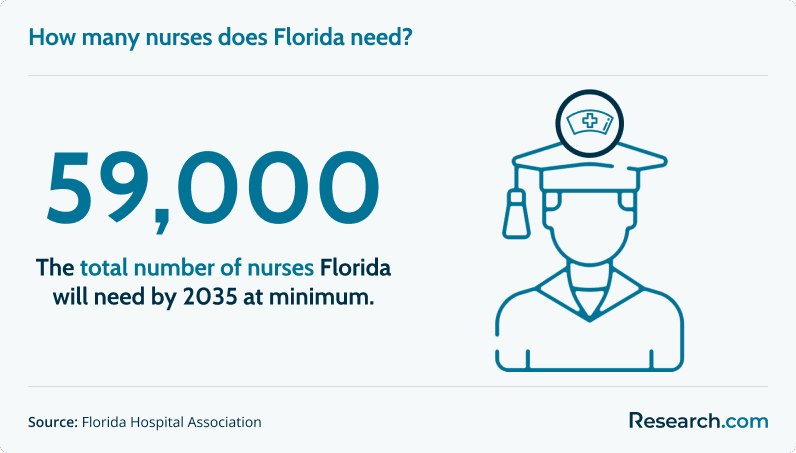
The infographic below, sourced from the Florida Hospital Association, illustrates Florida’s projected need for at least 59,000 additional nurses by 2035.
What Graduates Say About Online Nursing Programs in Florida
- "The online RN-to-BSN format made it possible for me to keep my full-time nursing schedule while completing my bachelor’s degree. The coursework helped me think more deeply about patient care, leadership, and communication, and the support services made the distance-learning format easier to manage." - Sarah
- "Completing the RN-to-BSN online gave me a practical way to strengthen my nursing knowledge without putting my career on hold. The virtual classroom was more interactive than I expected, and the flexibility helped me stay consistent from term to term." - James
- "The online BSN helped me build confidence for leadership responsibilities in my workplace. I could balance family, work, and school while learning how to apply evidence-based practice more effectively in patient care." - Emily
Key Findings
- Florida’s projected shortfall of over 59,000 nurses by 2035 makes workforce preparation a major priority for healthcare employers and nursing schools.
- The Nursing Student Loan Forgiveness Program (NSLFP), created in 1989, can provide up to $4,000 annually per nurse for a maximum of four years for eligible nurses who meet program rules.
- In 2024, 15,400 graduates from professional nursing programs received support through related initiatives like the NSLFP, with funding aligned to workforce needs and many awards connected to bachelor’s level RN program graduates.
- Modernization proposals have included removing the employer matching requirement and increasing funding to $1.3 million to broaden access to the NSLFP.
- Florida hospitals reported improvement in 2024, with the RN nurse vacancy rate falling to 7.8% and the turnover rate reaching 17.6%.
- Online nursing education is increasingly accepted: 76% of academic leaders view online degrees as equivalent to campus degrees, and that rises to 89% when the college also operates a traditional campus.
How long does it take to complete an online nursing program in Florida?
Most online RN-to-BSN programs in Florida take one to two years, depending on the school’s credit requirement, course sequence, transfer credits, and whether the student enrolls full time or part time. Programs from AdventHealth University, Florida Atlantic University, and Indian River State College list one-year completion options, while the College of Central Florida and Florida Gateway College list one- to two-year timelines.
Accelerated options are useful for nurses who can manage a heavier academic load, but speed should not be the only factor. Working nurses should compare weekly time expectations, assignment schedules, practicum requirements, and employer reimbursement deadlines. Students who want a broader comparison of online nursing pathways can review additional accredited online nursing programs.
| Timeline | Best for | Risk to consider |
| One year | RNs with strong time management, stable work schedules, and most prerequisites completed. | Course intensity may be difficult during overtime, night shifts, or family obligations. |
| One to two years | RNs who need more flexibility or want to spread costs across more terms. | Longer enrollment can delay graduation and may affect motivation. |
| Part-time pacing | Nurses balancing unpredictable clinical schedules or caregiving responsibilities. | Students should confirm maximum completion limits and course availability. |
How do the best online nursing programs in Florida compare to on-campus programs?
Accredited online nursing programs and campus-based programs are held to the same broad expectations for curriculum quality, student learning outcomes, and accreditation review. Online formats often use learning management systems, recorded or live lectures, virtual simulations, online discussions, faculty feedback, and practice-based projects. The difference is usually delivery format, not necessarily academic standard.
Online learning is especially practical for licensed nurses who cannot commute regularly or leave their jobs. According to Drexel University, 76% of academic leaders believe online degrees are equivalent to on-campus degrees, increasing to 89% when the college also has a traditional campus. Still, students should not assume all online programs are equally strong. The best choice is an accredited program with transparent faculty access, clinical guidance, student support, and graduate outcomes. For a broader look at why nurses choose the field, see Research.com’s guide to nursing career benefits.
What is the average cost of the best online nursing programs in Florida?
Costs vary sharply among the Florida online nursing programs listed here. AdventHealth University charges $540 per credit and requires 24 credits. Florida Atlantic University lists $105 per credit with 31 credits required. College of Central Florida charges $113 for Florida residents and $439 for non-residents, with 39 credits required. Florida Gateway College lists $125 per credit and 30 required credits. Indian River State College lists $117 per credit and 31 required credits.
Tuition per credit is only part of the total cost. Students should also ask about technology fees, textbooks, graduation fees, background checks, immunization documentation, proctoring, simulation fees, and whether tuition is locked by cohort. If you are still comparing educational levels, Research.com’s guide to the types of nursing degrees can help clarify how RN-to-BSN, MSN, DNP, and other pathways differ.
| Program | Cost factor to check | Why it matters |
| Low per-credit tuition | Required credits and mandatory fees | A low credit rate can still become expensive if many credits are required. |
| Higher per-credit tuition | Completion speed and included services | A shorter program may reduce time away from advancement opportunities. |
| Resident tuition | Florida residency rules | Non-resident rates can significantly change affordability. |
| Employer-supported tuition | Reimbursement caps and grade rules | Some employers pay only after course completion or require continued employment. |
What are the financial aid options for students enrolling in the best online nursing programs in Florida?
Florida provides several financial aid routes for nursing students. The state ranks 4th in total financial aid spending with $1.01 billion, and eligible online nursing students may be able to combine federal, state, institutional, employer, and loan repayment support. Always confirm whether your program participates in the aid source you plan to use.
- Federal and State Grants: Need-based grants can reduce out-of-pocket cost and generally do not require repayment if eligibility rules are met.
- Scholarships: Schools, nonprofit groups, employers, hospitals, and professional associations may offer awards based on need, merit, specialty interest, or service commitment.
- The Nursing Student Loan Forgiveness Program (NSLFP): This program supports eligible nurses working in critical shortage facilities and can provide up to $4,000 annually for up to four years. In 2024-25, the program made $6,228,000 in awards.
- Work-Study Programs: Some students qualify for part-time work opportunities that help cover education expenses while adding relevant experience.
- Loans: Federal and private loans may cover remaining costs, but students should compare interest rates, repayment terms, and total borrowing before enrolling.
Nurses considering graduate pathways should also review aid availability for online RN-to-MSN programs, because funding rules may differ by degree level.
What are the prerequisites for enrolling in the best online nursing programs in Florida?
RN-to-BSN programs are usually designed for students who already have nursing training and an active RN license. Requirements differ by school, but applicants commonly need to document prior nursing education, licensure, GPA, and prerequisite coursework.
- Active RN License: Most programs require a current, unencumbered Registered Nurse license before enrollment or before upper-division nursing courses begin.
- Associate Degree in Nursing or Nursing Diploma: Applicants typically need an ADN or diploma from an accredited nursing program.
- Minimum GPA: Many schools set a minimum GPA, often around 2.5 to 3.0, based on prior coursework.
- Prerequisite Courses: Anatomy, physiology, microbiology, statistics, nutrition, or other general education courses may be required before admission or graduation.
If affordability is the main barrier, compare admissions and transfer rules for the cheapest RN to BSN program online before choosing a higher-cost option. A low tuition rate is helpful only if your credits transfer cleanly and the program fits your licensure and career goals.
What courses are typically in the best online nursing programs in Florida?
Online RN-to-BSN programs in Florida usually focus less on basic bedside skills and more on professional practice, leadership, population health, research, and systems-level thinking. Common course areas include:
- Advanced Health Assessment: Builds stronger assessment skills across physical, psychosocial, and community health dimensions.
- Nursing Leadership and Management: Introduces staffing, communication, delegation, quality improvement, decision-making, and unit-level leadership concepts.
- Pathophysiology: Deepens understanding of disease processes and how they affect nursing care decisions.
- Community and Public Health Nursing: Examines prevention, health promotion, population health, and care for underserved groups.
- Evidence-Based Practice and Research: Teaches nurses how to evaluate research and apply evidence to improve patient outcomes.
These courses can also prepare nurses for future graduate study, including online masters programs for nursing, if they later decide to pursue advanced practice, education, or leadership roles.
What types of specializations are available in the best online nursing programs in Florida?
RN-to-BSN programs do not always offer formal concentrations, but many include electives or course sequences that help nurses focus on a practice area. Common areas of emphasis include:
- Pediatric Nursing: Focuses on nursing care for infants, children, and adolescents, including developmental needs and pediatric conditions.
- Gerontological Nursing: Addresses aging, chronic illness, palliative care, functional decline, and healthy aging strategies.
- Public Health Nursing: Prepares nurses for community-based prevention, health education, and population health work.
- Nurse Leadership and Administration: Develops management, policy, budgeting, staffing, and organizational leadership skills.
- Mental Health Nursing: Strengthens understanding of psychiatric conditions, therapeutic communication, and behavioral health support.
Florida’s Nursing Licensure and Certification Requirements for Online Programs
Florida nursing students should separate two issues: earning a degree and being licensed to practice. A BSN can strengthen credentials, but licensure depends on meeting Florida Board of Nursing requirements. Nurses pursuing the highest paid nurses pathways also need to verify advanced certification and practice authority rules.
To become an RN in Florida, candidates must complete an accredited nursing program and pass the NCLEX-RN exam. Students in online programs should confirm that the program is accredited by ACEN or CCNE and that it meets Florida requirements if initial RN licensure is involved.
After graduation, candidates apply through the Florida Board of Nursing, submit official transcripts, complete a criminal background check, and document required clinical hours when applicable. Out-of-state online students need to be especially careful, because a program that works for one state may not automatically satisfy another state’s rules.
Advanced practice nurses, including nurse practitioners and clinical nurse specialists, generally need graduate education plus specialty certification. After an online RN-to-MSN pathway, for example, graduates may need to pass a specialty exam such as Family FNP or ACNP through organizations such as the ANCC or the AANPCB before practicing in Florida.
Florida nurses must renew their licenses every two years and complete continuing education requirements. Strong online programs help students understand these obligations, but the final responsibility for licensure compliance belongs to the nurse.
How Accredited Online Nursing Programs Enhance Patient Care in Florida
Accredited online nursing programs can improve patient care by requiring students to master evidence-based practice, leadership, quality improvement, cultural responsiveness, and ethical decision-making. Accreditation by organizations such as the Commission on Collegiate Nursing Education and the Accreditation Commission for Education in Nursing provides an external review of whether a program meets recognized nursing education standards.
Florida’s patient population makes these competencies especially important. Programs may emphasize geriatric care, chronic disease management, end-of-life care, health literacy, and equitable communication because nurses frequently work with older adults, multilingual communities, and patients managing complex long-term conditions.
Technology is another major part of modern nursing education. Online programs often train nurses to work with electronic health records, telehealth workflows, virtual simulations, and data-informed care improvement. These skills are increasingly relevant in hospitals, outpatient practices, home health, and remote care coordination.
For nurses planning graduate-level advanced practice, an accredited BSN can also serve as a foundation for nurse practitioner programs in Florida. Accreditation does not guarantee a job or salary, but it helps protect students from programs that may not meet employer, licensure, or graduate school expectations.
What challenges do students face in online nursing education in Florida?
Online nursing students often underestimate the discipline required for self-paced or asynchronous coursework. Working nurses may face rotating shifts, overtime, family obligations, and limited study windows. Clinical or practice-based requirements can also be difficult if students must arrange local placements or complete projects in approved healthcare settings.
Technology can be another obstacle. Students need reliable internet, comfort with learning platforms, and the ability to complete virtual simulations, video meetings, online exams, and electronic submissions. Before enrolling, ask how the school supports online learners, how quickly faculty respond, and what happens if clinical placement becomes difficult. For a broader path from education to licensure, review how to become an RN in Florida.
What are the current nursing license requirements in Florida?
Florida RN licensure generally requires completion of an approved nursing education pathway, passing the NCLEX-RN, submitting required documentation, and clearing background checks. Nurses must also meet renewal and continuing education requirements to maintain active licensure.
Because licensure rules can change and may differ for endorsement, compact privileges, or advanced practice, students should rely on the Florida Board of Nursing and official program disclosures rather than assumptions. Research.com’s detailed guide to nursing license requirements in Florida explains the process in greater depth.
How are academic success and clinical outcomes measured in Florida’s online nursing programs?
Prospective students should evaluate outcomes, not just marketing claims. Useful indicators include NCLEX-RN pass rates where relevant, first-attempt licensure success, graduation rates, course completion rates, employer partnerships, student support quality, and job placement information. For RN-to-BSN programs, also ask how the school measures leadership, evidence-based practice, and population health competencies.
Clinical and practice readiness can be supported through simulation, faculty feedback, local preceptors, capstone projects, and partnerships with healthcare facilities. Students considering accelerated graduate options can compare how programs such as the shortest RN to MSN online program balance speed with clinical preparation.
Can Supplementary Certifications Enhance Your Nursing Career?
Additional certifications can help nurses show focused competence in a specialty area, but they should be chosen strategically. A certification is most useful when it aligns with a nurse’s current role, desired specialty, employer expectations, or graduate school plans. Nurses should avoid collecting credentials that do not support a clear career goal.
Some nurses also explore allied health training to better understand interdisciplinary care and administrative workflows. Programs such as medical assistant programs in Florida can provide context for clinical support roles, although they are not a substitute for RN or BSN preparation.
Are Fast-Track LPN Programs a Viable Path to Nursing Advancement in Florida?
Fast-track LPN programs can be a practical entry point for students who want to begin nursing work sooner before advancing to RN or BSN study. This path may appeal to career changers, students with limited time, or those who want direct patient care exposure before committing to a longer degree.
The trade-off is that LPNs have a different scope of practice and generally need additional education to become RNs or pursue BSN-level roles. Students considering this route should understand licensure steps, bridge program availability, transfer credit rules, and long-term costs. For more detail, review Research.com’s guide to LPN programs.
How to Choose the Best Online Nursing Programs in Florida
Florida has many accredited nursing options, including 72 CCNE-accredited programs. The best program is not always the cheapest, fastest, or highest ranked. It is the one that matches your license status, schedule, budget, transfer credits, career goal, and state requirements.
| Factor | What to ask | Why it matters |
| Accreditation | Is the program accredited by CCNE or ACEN? | Accreditation affects employer recognition, graduate school admission, and licensure confidence. |
| Admission fit | Do I need an active RN license, ADN, minimum GPA, or prerequisites? | Missing one requirement can delay enrollment or graduation. |
| Clinical or practicum rules | Are any in-person hours, projects, or preceptors required? | Online coursework may still involve local practice-based learning. |
| True cost | What is the total cost after fees, books, transfer credits, and aid? | Per-credit tuition alone can be misleading. |
| Student support | Are advising, tutoring, tech help, and career services available online? | Support quality can affect persistence and graduation. |
| Career alignment | Does the curriculum support leadership, public health, graduate study, or specialty care? | A program should connect to your next professional step. |
- Verify accreditation first. Do not enroll until you confirm recognized nursing accreditation and institutional legitimacy.
- Compare transfer credit policies. The best value often depends on how much prior ADN or general education credit is accepted.
- Match format to your work schedule. Ask whether classes are asynchronous, synchronous, accelerated, or cohort-based.
- Review outcomes. Graduation, employment, and licensure data help you evaluate program effectiveness.
- Talk to an advisor and a current student. Advisors explain policy; students reveal workload and support realities.
If you are still deciding whether a BSN is the right credential, Research.com’s guide on what is BSN explains the degree’s career uses and limitations.
Common Mistakes to Avoid When Choosing an Online Nursing Program in Florida
- Choosing based only on tuition. Low tuition can be offset by high fees, poor transfer credit, limited support, or a longer completion timeline.
- Ignoring accreditation. Unaccredited or poorly recognized programs can create problems for employment, licensure, and graduate school admission.
- Assuming online means no clinical work. Some programs require local practice projects, preceptors, or approved clinical experiences.
- Overloading your schedule. A one-year program can be efficient, but it may not be realistic during heavy work shifts or family responsibilities.
- Not checking state authorization. Out-of-state students should verify that the program can enroll them and meets their state’s requirements.
- Relying only on rankings. Rankings are useful, but program fit, cost, accreditation, and outcomes matter more for individual decisions.
How Can Online Nursing Programs Prepare You to Become a Nurse Practitioner?
An online BSN can be a stepping stone toward nurse practitioner education, but becoming an NP generally requires graduate-level preparation and specialty certification. BSN coursework in assessment, research, leadership, pharmacology foundations, and population health can help prepare nurses for the more advanced expectations of MSN or DNP study.
Nurses planning this route should choose a BSN program that supports graduate admissions, provides strong writing and research preparation, and helps students understand Florida’s advanced practice requirements. For a step-by-step explanation, see Research.com’s guide on how to become a nurse practitioner in Florida.
What Alternative Healthcare Roles Can You Pursue with an Online Nursing Degree?
A BSN does not limit nurses to bedside roles. Graduates may move into case management, utilization review, quality improvement, infection prevention, clinical documentation, telehealth coordination, informatics support, public health, education, or administrative roles. Some of these positions may require experience, certifications, or graduate education.
Nurses who enjoy documentation, compliance, and revenue-cycle work may also explore adjacent healthcare roles. Research.com’s guide to how to become a medical biller and coder in Florida explains one non-bedside pathway that uses healthcare knowledge in a different way.
How Can Online Nursing Programs Pave the Way to Becoming a Nurse Midwife in Florida?
RNs interested in nurse midwifery can use a BSN as preparation for graduate midwifery education. Online BSN programs can strengthen assessment, evidence-based practice, population health, and leadership skills, all of which are useful before entering a specialized advanced practice program.
Students should confirm that any future graduate program includes appropriate clinical training, certification preparation, and Florida licensure alignment. For a focused career roadmap, see Research.com’s guide on how to become a nurse midwife in Florida.
How are career services and job placement programs enhancing career outcomes in Florida's online nursing education?
Strong career services can make online nursing programs more valuable. Useful services include resume reviews, interview preparation, employer panels, alumni networking, clinical partnership referrals, graduate school advising, and help translating RN experience into leadership-ready language.
Career support is especially important for nurses changing specialties or moving from LPN to RN to BSN pathways. Students exploring earlier entry points can review Research.com’s guide on how to become an LPN in Florida to understand how different nursing credentials connect.
What career paths are available for graduates of the best online nursing programs in Florida?
Graduates of Florida online nursing programs can pursue clinical, leadership, education, and advanced-practice pathways. Nurses interested in the business side of healthcare may also benefit from management training or programs at the top business schools in Florida. The roles below show several common options and reported salary figures.
- Registered Nurse (RN): Florida employs 197,630 RNs, and they earn an annual mean wage of $79,910.
- Nurse Anesthetists: Florida employs 3,990 nurse anesthetists, who earn an annual mean wage of $174,390.
- Nurse Practitioners (NPs): Florida has 18,530 NPs, with an annual mean wage of $110,310.
- Licensed Practical Nurses (LPNs): Florida employs 36,970 LPNs, who earn an annual mean wage of $53,780.
- Nurse Educators: Florida has 4,540 nurse educators, with an annual mean wage of $80,160.
The comparison below highlights typical nursing roles and compensation patterns.
What is the job market for graduates of the best online nursing programs in Florida with certificates?
The job market for Florida nursing graduates is shaped by both national demand and the state’s own workforce pressures. Nationally, the BLS projects 5% growth in registered nursing positions from 2024 to 2034. In Florida, a projected shortage of 14,940 nurses by 2026 adds urgency to workforce planning.
Demand is influenced by population growth, an aging population, chronic disease management, hospital staffing needs, and the expansion of outpatient and home-based care. Certificates in specialty areas can help nurses demonstrate focused skills, but they work best when paired with relevant experience and a degree that employers recognize.
Florida has also used workforce initiatives such as the NSLFP to encourage nurses to work in critical shortage settings. Proposed changes, including removal of the employer matching requirement and expanded appropriations, reflect ongoing efforts to make support easier to access. For graduates, this means the job market is not just growing; it is also being shaped by policy efforts aimed at recruitment, retention, and education funding.
What are the top professional organizations for nurses in Florida and how can they benefit your career?
Professional organizations can help nurses stay current, meet peers, find continuing education, understand policy changes, and identify leadership opportunities. Membership is not required for every role, but it can be valuable for nurses who want to build a stronger professional network.
- Florida Nurses Association (FNA): Provides advocacy, continuing education, leadership opportunities, policy updates, events, and statewide networking.
- Florida Organization of Nurse Executives (FONE): Supports nurses pursuing leadership through workshops, mentoring, and executive-focused professional development.
- Nurse Practitioner Council of Florida: Offers support for nurse practitioners, including advocacy, job resources, workshops, and specialty-focused information.
- American Nurses Association - Florida Chapter (ANA-FL): Connects Florida nurses to broader professional development, research, advocacy, and certification-related resources.
- Florida Public Health Association (FPHA): Serves professionals focused on public health, community health, continuing education, and population-level practice.
How Do Online Nursing Programs Balance Digital Learning with Clinical Training?
Online nursing programs combine digital coursework with applied learning through simulations, local clinical partnerships, preceptor-guided experiences, community projects, and case-based assignments. For RN-to-BSN students, clinical learning may look different from pre-licensure nursing training because many students are already licensed and practicing.
Before enrolling, ask who arranges placements, whether students may use their workplace, how preceptors are approved, and what happens if a local site is unavailable. You can also compare expectations across accredited nursing schools in Florida to better understand how different programs handle theory and practice.
Pathways for Career Advancement with a DNP Degree in Florida
A Doctor of Nursing Practice can prepare experienced nurses for advanced clinical practice, executive leadership, health systems improvement, education, and policy-influencing roles. In Florida’s healthcare environment, DNP-prepared nurses may contribute to workforce development, care redesign, quality initiatives, and advanced patient care.
Advanced nursing roles often come with higher responsibility and may offer higher compensation, depending on specialty, employer, geography, and experience. If you are comparing long-term education ROI, Research.com’s state-by-state guide to how much do DNP professionals make can help frame salary expectations without assuming guaranteed outcomes.
Questions to Ask Before Enrolling
- Is the program accredited by CCNE or ACEN?
- Does the program meet Florida Board of Nursing requirements for my intended licensure or advancement path?
- How many of my ADN, diploma, or general education credits will transfer?
- What is the total cost after tuition, fees, books, technology, and clinical-related expenses?
- Are courses asynchronous, live, accelerated, or cohort-based?
- Will I need clinical hours, a capstone, a preceptor, or a community project?
- Can I complete practice requirements near where I live or work?
- What academic, technical, and career support is available to online students?
- What are the program’s graduation, employment, and licensure outcomes?
- How well does the program support my next step: leadership, graduate school, specialty practice, or non-bedside nursing?
Key Insights
- The best online nursing program in Florida is the one that is accredited, affordable for your situation, realistic with your work schedule, and aligned with your licensure and career goals.
- Most RN-to-BSN programs in this guide take one to two years and require 24 to 39 credits, but total cost depends on transfer credits, fees, residency status, and financial aid.
- Florida’s projected shortage of more than 59,000 nurses by 2035 makes BSN-prepared nurses important, but no program can guarantee a specific job or salary.
- Accreditation by CCNE or ACEN should be treated as a non-negotiable factor when comparing online nursing programs.
- Online does not mean effortless. Students need strong time management, reliable technology, and a plan for any required clinical or practice-based learning.
- Financial aid, employer reimbursement, scholarships, grants, and the NSLFP can reduce costs, but students should verify eligibility before enrolling.
- A BSN can support advancement into leadership, community health, education, care coordination, graduate nursing, and advanced practice pathways.
- Before choosing a school, ask direct questions about transfer credit, total cost, student support, clinical expectations, outcomes, and Florida licensure alignment.
Related Articles for Nearby States
- 2027 Best Online Nursing Programs in Georgia – Accredited RN to BSN Programs
- 2027 Best Online Nursing Programs in Alabama – Accredited RN to BSN Programs
- 2027 Best Online Nursing Programs in South Carolina – Accredited RN to BSN Programs
- 2027 Best Online Nursing Programs in Mississippi – Accredited RN to BSN Programs
- 2027 Best Online Nursing Programs in Tennessee – Accredited RN to BSN Programs
- 2027 Best Online Nursing Programs in North Carolina – Accredited RN to BSN Programs
- 2027 Best Online Nursing Programs in Louisiana – Accredited RN to BSN Programs
- 2027 Best Online Nursing Programs in Kentucky – Accredited RN to BSN Programs
- 2027 Best Online Nursing Programs in Arkansas – Accredited RN to BSN Programs
- 2027 Best Online Nursing Programs in West Virginia – Accredited RN to BSN Programs
References:
- 2024 Session: Health Care Workforce. (2024).
- Carson-Newman. (2025). By the Numbers: Nursing Statistics 2025. https://onlinenursing.cn.edu/news/nursing-by-the-numbers
- Hanson, M. (2022, February 15). Financial Aid Statistics [2023]: Average aid per student. Education Data Initiative.
- NCSBN. (2025). 2024 National Nursing Workforce Study. https://www.ncsbn.org/workforce
- Online Degree vs On-Campus Degrees. (n.d.). Drexel University Online.
- Registered Nurse. (2024). Indeed.com.
- U.S. Bureau of Labor Statistics. (2025). Occupational Outlook Handbook: Registered Nurses. https://www.bls.gov/ooh/healthcare/registered-nurses.htm
Other Things You Should Know About Online Nursing Programs in Florida
In 2027, Florida's accredited RN to BSN programs offer extensive support to online students. These include virtual academic advising, online tutoring, state-of-the-art learning platforms, and access to digital libraries. Additionally, students benefit from virtual networking opportunities with peers and faculty, enhancing their educational experience.
In 2027, online RN to BSN programs in Florida typically allow students to transfer up to 60 credits from prior nursing coursework. This policy helps students accelerate their degree completion. Official transcripts and course descriptions are usually required for transfer credit evaluation.
Top online RN to BSN programs in Florida typically require a current RN license, an Associate Degree in Nursing (ADN) or nursing diploma, a minimum GPA (often around 2.5-3.0), and completion of certain prerequisite courses. Some programs may also require professional nursing experience.


