
2027 Most Affordable Online BCBA Programs

Co-Founder and Chief Data Scientist
Are you currently working as a registered behavior technician (RBT) or special educator, watching your caseload grow while your career advancement stalls? The path to professional autonomy and a higher income ceiling requires a BCBA credential, but taking years off to attend a traditional on-campus program is rarely financially viable.
Fortunately, the industry is desperate for qualified leadership—the Behavior Analyst Certification Board (BACB) reports a staggering 58% increase in demand for BCBA from 2023 to 2024 alone. Prepared by career planning experts with more than 10 years of experience, this comprehensive guide breaks down how an affordable online program allows you to master your verified coursework asynchronously, letting you maintain your current income while accumulating your mandatory supervision hours.
What are the benefits of enrolling in an affordable online BCBA program?
- Attending an affordable online BCBA program makes everything significantly cheaper considering the high overall cost of a master's degree.
- Board-certified behavioral analysts in the United States earn an average base salary of $89,075 per year, with the potential of earning more depending on location, experience, and employer.
- Pursuing an online program gives you the flexibility to juggle your academic responsibilities with your work, family, and other personal commitments.
What can I expect from an online BCBA program?
While an online BCBA program offers the flexibility of asynchronous coursework, you must anticipate a stark operational divide between your theoretical academics and your clinical reality. The coursework itself is highly conceptual—focusing heavily on the principles of operant conditioning, data analysis, and BACB ethical guidelines. However, behavior analysis is an inherently applied science.
The primary challenge for online students is bridging this gap without the safety net of an on-campus university clinic. In a traditional program, students practice functional behavior assessments (FBAs) and intervention strategies in a controlled lab with direct professor oversight. Online, you must rely on video modules and a self-directed application. Because you are geographically isolated, you must be exceptionally proactive in your current workplace.
You will need to actively seek out complex behavioral cases and take the initiative to apply the theories you are learning on your screen to real-world clients, requiring a much higher degree of discipline than a traditional classroom setting.
Where can I work as a BCBA?
BCBA-certified behavior analysts have a diverse range of employment opportunities across various settings. The specific work environment you choose will depend on your interests, career goals, and the populations you'd like to work with. Here are some of the common workplaces for BCBAs:
- Clinical Practices. Many BCBAs work in clinics or private practices, providing one-on-one therapy or designing behavior intervention plans for individuals with Autism Spectrum Disorder (ASD), intellectual and developmental disabilities, or other behavioral challenges.
- Schools. With a growing emphasis on behavioral support in schools, BCBAs are increasingly sought-after to collaborate with teachers and develop behavior plans to improve student performance and address classroom behavior issues.
- Home-Based Services. BCBAs can provide in-home behavior intervention services for children and adults, working directly with families to implement behavior modification strategies in their everyday environments.
- Early Intervention Programs. Early intervention is crucial for children with developmental delays or behavioral challenges. BCBAs can play a vital role in designing and implementing programs to support these children's development and learning.
- Behavioral Health Facilities. Inpatient and outpatient behavioral health facilities may employ BCBAs to work with individuals with mental health conditions, substance abuse disorders, or eating disorders, using ABA principles to manage challenging behaviors and promote positive change.
- Non-Profit Organizations. Many non-profit organizations supporting individuals with disabilities or mental health challenges employ BCBAs to provide therapeutic services or train staff on behavior management techniques.
- Government Agencies. Government agencies involved in child welfare or disability services may hire BCBAs to consult on behavior intervention strategies or provide training to caregivers and professionals working with these populations.
- Research Institutions. BCBAs with a research background can contribute to the advancement of the field by designing and conducting research studies on behavior analysis principles and interventions.
- Private Consultancy. Experienced BCBAs can establish their own private consultancies, offering their expertise to schools, clinics, or families on a case-by-case basis.
How much can I make as a BCBA?
Based on our investigation of compensation data across clinical and educational sectors, a board-certified behavior analyst’s salary is dictated primarily by their billing model and work setting, not just their geographic location. While national averages show salaries hovering around $89,000, these figures mask the stark operational differences between educational and clinical settings.
School-based BCBAs generally operate on 9- or 10-month salaried contracts. While the base pay may appear lower on paper, these roles offer robust benefits, union protections, and predictable schedules without the pressure of commercial insurance billing.
Conversely, BCBAs working in private, often private-equity-backed autism clinics can command much higher annual salaries, frequently exceeding $95,000 to $105,000. However, this higher compensation is directly tied to strict "billable hour" expectations. In a clinical setting, your income and performance metrics are dependent on maintaining 25 to 30 direct billable hours per week, which requires managing a larger caseload of RBTs and constantly navigating insurance company authorizations.
- 2027 Most Affordable Online BCBA Programs Best Programs
- What are the requirements for enrolling in an online BCBA program? Requirements
- What are the requirements for getting certified as a behavior analyst? What are the requirements for getting certified as a behavior analyst?
- What courses are typically included in online BCBA programs? What courses are typically included in online BCBA programs?
- How long does it take to complete an online BCBA program? Completion Time
- How does an online BCBA program compare to an on-campus program? Online vs On-Campus
- What is the average cost of online BCBA programs? Average Cost
- How does one choose an online BCBA program? How does one choose an online BCBA program?
- What career paths are available for BCBA graduates? What career paths are available for BCBA graduates?
- What is the job market for BCBAs? Job Market
- Should I pursue an advanced doctoral degree in ABA? Should I pursue an advanced doctoral degree in ABA?
- Is an Online BCBA Program a Worthwhile Investment? Is an Online BCBA Program a Worthwhile Investment?
- What are the job placement rates for online BCBA graduates? What are the job placement rates for online BCBA graduates?
- How can an online BCBA program serve as a foundation for advanced studies? How can an online BCBA program serve as a foundation for advanced studies?
- How can you assess both the quality and affordability of an online BCBA program? How can you assess both the quality and affordability of an online BCBA program?
- What are the financial aid options for students enrolling in an online BCBA? Financial Aid
- How to Maximize Your Career Success After Completing an Online BCBA Program How to Maximize Your Career Success After Completing an Online BCBA Program
- How can combining BCBA certification with mental health counseling skills enhance your practice? How can combining BCBA certification with mental health counseling skills enhance your practice?
- How can online BCBA programs help you prepare for the BCBA exam? How can online BCBA programs help you prepare for the BCBA exam?
- Challenges of Pursuing an Online BCBA Program Challenges of Pursuing an Online BCBA Program
- How can you balance an online BCBA program with a full-time job? How can you balance an online BCBA program with a full-time job?
- Why is supervised fieldwork important in BCBA programs? Why is supervised fieldwork important in BCBA programs?
2026 Most Affordable Online BCBA Programs
Choosing an online BCBA program is not just a tuition decision. To become a Board Certified Behavior Analyst, you need the right academic pathway, coursework that aligns with Behavior Analyst Certification Board expectations, supervised fieldwork, exam preparation, and a realistic plan for paying for the program. A low-cost program can become expensive if you must pay separately for supervision, take extra prerequisite courses, or repeat the certification exam.
This guide is for students comparing affordable online applied behavior analysis programs, working RBTs planning the next credential step, educators moving into behavior analysis, and professionals deciding between a full master’s degree and a graduate certificate. You will learn how online BCBA programs work, what they cost, how to compare options, what certification requires, and which questions to ask before enrolling.
Quick Answer: What Is the Most Important Thing to Know About Online BCBA Programs?
The best online BCBA program is not always the cheapest one. A strong choice should combine affordable tuition, verified or properly attested coursework, support for supervised fieldwork, a realistic completion timeline, and solid preparation for the BCBA exam. Students should confirm current BACB eligibility rules before enrolling because coursework verification processes and certification pathways are changing.
If your goal is BCBA certification, pay close attention to three issues before choosing a school: whether the program’s coursework meets current BACB requirements, how you will complete 2,000 hours of Supervised Fieldwork or 1,500 hours of Concentrated Supervised Fieldwork, and whether supervision is included through your employer or must be paid for separately.
How We Ranked Affordable Online BCBA Programs
Affordability matters, but it should never be evaluated in isolation. This ranking was built to help students compare programs using transparent, verifiable information rather than marketing claims. Our research methodology draws from established education data sources, including the IPEDS database, Peterson’s database and its Distance Learning Licensed Data Set, the College Scorecard database, and the National Center for Education Statistics.
Because BCBA preparation is tied to certification eligibility, students should use this list as a starting point and then verify each program’s current status, fieldwork support, exam preparation resources, and tuition policies directly with the university.
How to Use This Ranking
Use the school list below to narrow your options, then compare the details that directly affect certification and return on investment. The most important questions are whether you need a master’s degree or only a certificate, whether the program fits your work schedule, and whether you already have access to a qualified supervisor.
| Decision Factor | Why It Matters | What to Ask Before Applying |
| Program type | A bachelor’s program, master’s program, and graduate certificate serve different student goals. | Does this program satisfy the academic step I need for BCBA or BCaBA eligibility? |
| Coursework alignment | Certification rules depend on approved or properly attested coursework. | Who confirms that my coursework meets current BACB requirements? |
| Fieldwork support | Online students often must arrange local supervision themselves. | Does the program help me find supervision, or am I responsible for securing it? |
| Total cost | Tuition is only part of the cost; supervision, fees, books, and exam preparation can add expenses. | What will I pay beyond tuition? |
| Exam outcomes | Passing the BCBA exam is necessary for the credential. | What is the program’s first-time BACB exam pass rate? |
Most Affordable Online BCBA Programs for 2026
1. Florida Tech
Florida Tech offers an online MA in Behavior Analysis Practice designed for graduate students who want formal preparation in behavior analysis. The curriculum includes courses within an Association for Behavior Analysis International-approved sequence, and students who attend during fall, spring, and summer terms can finish in two years.
The program emphasizes science-based practice, data-informed decision-making, and evidence-based ABA methods grounded in the experimental analysis of behavior.
- Location: Melbourne, FL
- Type of Institution: Private
- Program Offered: Master of Arts in Behavior Analysis Practice
- Total Credits: 33
- Estimated Cost Per Credit: $510 per credit hour for certificate courses within the master's program; $970 per credit hour for master's courses within the master's program.
- Program Length: 6 semesters
- Accreditation: Association for Behavior Analysis International (ABAI)
2. Central Methodist University
Central Methodist University provides an online Bachelor of Science in Applied Behavior Analysis for undergraduates interested in behavior analytic work with children who have autism, developmental delays, behavioral needs, and related conditions. The online curriculum follows the university’s campus-based program and is unusual because it offers ABA preparation at the bachelor’s level.
The coursework is part of a Verified Course Sequence overseen by ABAI. After completing the course sequence and required supervision hours, graduates may be eligible to sit for the BCaBA exam.
- Location: Fayette, MO
- Type of Institution: Private
- Program Offered: Bachelor of Science in Applied Behavior Analysis
- Estimated Cost Per Credit: $270
- Program Length: 4 years
- Accreditation: ABAI
3. University of Cincinnati
University of Cincinnati offers a Master of Education in Foundations in Behavior Analysis. The program focuses on human behavior, positive social skill development, and support for individuals with autism spectrum disorder, learning disabilities, and related needs. Its coursework draws from applied behavior analysis, education, and psychology for use in schools, agencies, and other service settings.
This 100% online program includes the ABAI-verified course sequence associated with Behavior Analyst Certification Board coursework expectations and is intended to prepare students for the Board Certified Behavior Analyst exam.
- Location: Cincinnati, OH
- Type of Institution: Public
- Program Offered: Master of Education in Foundations in Behavior Analysis
- Total Credits: 30
- Estimated Cost Per Credit: $761
- Program Length: 20 months
- Accreditation: ABAI
4. Western Connecticut State University
Western Connecticut State University offers an online Master of Science in Applied Behavior Analysis in a traditional academic schedule. The program is built for practitioners who want advanced behavior analytic training delivered through online technology in a research-oriented education environment.
The university also offers a Certificate in Applied Behavior Analysis for candidates who already hold an acceptable graduate degree from an accredited university. The 22-credit, six-course certificate is a Verified Course Sequence and is designed to meet coursework requirements for Behavior Analyst Certification Board eligibility.
- Location: Danbury, CT
- Type of Institution: Public
- Program Offered: Master of Science in Applied Behavior Analysis
- Total Credits: 30
- Annual Tuition: $7,674 per year
- Program Length: 2 years
- Accreditation: ABAI
5. University of Massachusetts Global
University of Massachusetts Global offers an online Applied Behavior Analysis Graduate Certificate made up of seven eight-week classes. The certificate was created to address educational requirements for students pursuing BCBA preparation and is described as nationally and internationally recognized.
- Location: Aliso Viejo, CA
- Type of Institution: Private
- Program Offered: Applied Behavior Analysis Graduate Certificate
- Total credits: 21
- Program Cost: $6,300 ($900 per course)
- Program Length: less than 1 year
- Accreditation: ABAI
6. Ball State University
Ball State University offers a 100% online Master’s Degree in Applied Behavior Analysis with an autism emphasis. The program costs more than several alternatives on this list, but it is widely enrolled and is described as the largest ABA program in the country. Its appeal is tied to course rigor and a BCBA first-time exam pass rate that is among the highest in the U.S. for high-enrolled programs.
- Location: Muncie, IN
- Type of Institution: Public
- Program Offered: Master of Arts in Applied Behavior Analysis
- Total Credits: 30
- Estimated Cost Per Credit: $1,528
- Program Length: 8 weeks or 16 weeks
- Accreditation: ABAI
7. Troy University
Troy University offers an online Bachelor’s in Psychology in Applied Behavior Analysis. The degree can help students build an undergraduate foundation for later BCBA preparation and covers psychological theory and practice through a student-centered curriculum. Students comparing this pathway may also want to review how a behavioral psychology degree connects to applied behavior analysis careers.
- Location: Troy, AL
- Type of Institution: Public
- Program Offered: Bachelor’s in Psychology in Applied Behavior Analysis
- Annual Tuition: $12,486
- Program Length: 4 years
- Accreditation: ABAI
8. University of Dayton
University of Dayton offers an M.S. in Applied Behavior Analysis that prepares students to work toward BCBA readiness through training with professional behavior analysts. Students learn to identify intervention needs, adapt behavioral strategies to individual clients, assess the causes of challenging behavior, and develop treatment plans.
- Location: Dayton, OH
- Type of Institution: Private
- Program Offered: Master of Science in Applied Behavior Analysis
- Total Credits: 33
- Estimated Cost Per Credit: $1,405
- Program Length: 24 months
- Accreditation: ABAI
9. Arizona State University
Arizona State University offers an online Graduate Certificate in Applied Behavior Analysis focused on the science of behavior and learning. The program introduces foundational ABA principles and is designed to prepare students for the BCBA exam.
After completing the online ABA certificate, graduates may apply behavior analysis skills in education, business, health care, therapy, and related service environments.
- Location: Tucson, AZ
- Type of Institution: Public
- Program Offered: Certificate in Applied Behavior Analysis
- Total Credits: 21
- Estimated Cost Per Credit: $643 per credit hour
- Program Length: 18 months
- Accreditation: ABAI
10. Simmons University
Simmons University offers an online Master of Science in Applied Behavior Analysis designed to satisfy coursework expectations for behavior analyst certification and prepare students to make measurable client-centered improvements.
The program carries a higher sticker price, but students who apply and complete a financial aid package may receive up to $20,000 in scholarships from Simmons University. The university reports a 75% BCBA exam pass rate among graduates who took the exam for the first time.
- Location: Boston, MA
- Type of Institution: Private
- Program Offered: M.S. in Applied Behavior Analysis
- Estimated Cost Per Credit: $1,125
- Program Length: 20 months
- Accreditation: ABAI
11. University of North Texas
University of North Texas offers an online Master of Arts in Applied Behavior Analysis as a professional practice degree. The program is structured to build a knowledge base for effective, compassionate behavior analytic practice and allows students to take from one to four classes per semester based on scheduling needs. It meets BACB coursework specifications.
- Location: Denton, TX
- Type of Institution: Public
- Program Offered: Applied Behavior Analysis Master of Arts Online
- Total Credits: 30 hours
- Program Cost: $13,900
- Program Length: ~ 1 year
- Accreditation: ABAI
12. University of Washington
University of Washington offers an online Master of Education in Applied Behavioral Analysis for working students. The program uses synchronous online classes and interactive learning technology so students can engage with faculty and collaborate with their cohort remotely.
Graduates earn a Master of Education in special education and complete coursework requirements associated with the BACB exam.
- Location: Seattle, WA
- Type of Institution: Public
- Program Offered: M.Ed. in Applied Behavior Analysis
- Total Credits: 64
- Estimated Cost Per Credit: $554
- Program Length: 2 years
- Accreditation: ABAI
13. University of South Florida
University of South Florida offers a Master of Science in Applied Behavior Analysis intended to prepare practitioners for work in developmental disabilities, education, autism, child protective services, rehabilitation, mental health, business, and technology. The program emphasizes practical strategies for designing, implementing, and evaluating behavior change in community settings.
- Location: Tampa, FL
- Type of Institution: Public
- Program Offered: M.S. in Applied Behavior Studies
- Estimated Cost Per Credit: $600
- Program Length: 2 years
- Accreditation: ABAI
14. Purdue University Global
Purdue University Global offers an online Postgraduate Certificate in Applied Behavior Analysis. The seven-course program focuses heavily on supporting autistic individuals, people with developmental disabilities, and individuals affected by traumatic brain injuries.
Courses run for 10 weeks and include topics such as Clinical Applications, Supervision, and Management; Principles of Applied Behavior Analysis; and Implementing Procedures for Behavior Change.
- Location: West Lafayette, IN
- Type of Institution: Public
- Program Offered: Postgraduate Certificate in Applied Behavior Analysis
- Estimated Cost Per Credit: $420
- Program Length: 11 months
- Accreditation: ABAI
15. Kent State University
Kent State University offers a Behavioral Intervention Specialist Certificate with seven courses that support board exam preparation. Course examples include Program Development in ABA and Advanced Interventions for Addressing Severe Behavior.
- Location: Kent, OH
- Type of Institution: Public
- Program Offered: Behavioral Intervention Specialist Certificate
- Estimated Cost Per Credit: $582
- Program Length: Less than a year
- Accreditation: ABAI
16. University of Massachusetts Lowell
University of Massachusetts Lowell offers an online Graduate Certificate in Applied Behavior Analysis. The seven-course certificate is designed to help students meet coursework requirements for the BCBA certification exam and prepare for exam success.
The certificate was developed with the Eunice Kennedy Shriver Center, which has a long-standing role in research, education, and service for people with developmental disabilities and their families. The program is aimed at professionals in psychology, education, childcare, and human services who want to understand behavioral methods and their applications.
- Location: Lowell, MA
- Type of Institution: Public
- Program Offered: Graduate Certificate in Applied Behavior Analysis
- Total Credits: 18
- Estimated Cost Per Credit: $600
- Program Length: 1 year
- Accreditation: ABAI
17. Bay Path University
Bay Path University offers a 100% online Applied Behavior Analysis master’s degree with synchronous class meetings and remote supervision meetings. Students can choose from several program formats and concentrations.
- MS in ABA - 48 credits; includes coursework and supervision required to qualify for the BACB Certification Exam
- Ed.S. in ABA - 51 credits; designed for candidates with an MS or MA in a related field; includes ABA coursework and supervision with applied research focus
- MS in ABA with Autism Spectrum Disorders Concentration - 57 credits
- MS in ABA with Supervision, Training and Organization Behavior Management (OBM) Concentration - 60 credits
- MS in ABA with Applied Verbal Behavior Concentration - 60 credits
- MS in ABA with Trauma-Informed Practice Concentration - 60 credits
- Location: Longmeadow, MA
- Type of Institution: Private
- Program Offered: Applied Behavior Analysis Master's Degree
- Estimated Cost Per Credit: $735
- Program Length: ~ 2 years
- Accreditation: ABAI
18. Portland State University
Portland State University offers two ABA options: a Master’s in Special Education with VCS coursework requiring 45 credits and a Graduate Certificate with VCS coursework requiring 33 credits.
The fully online ABA program includes a Verified Course Sequence aligned with the 5th Edition Task List, either as a graduate certificate or as part of a master’s degree under the BACB Pathway 2 eligibility framework. The curriculum also emphasizes Positive Behavior Interventions and Support and behavioral supports in early childhood settings.
- Location: Portland, OR
- Type of Institution: Public
- Programs Offered: Master's in Special Education in Applied Behavior Analysis and Graduate Certificate in Applied Behavior Analysis
- Total Credits: 45; 33
- Estimated Cost Per Credit: $383.50
- Accreditation: ABAI
19. Northern Arizona University
Northern Arizona University offers a Graduate Certificate in Positive Behavior Support. Positive Behavior Support is an approach that changes environments and teaches acceptable alternative behaviors so preferred behavior becomes easier and more effective than challenging behavior. ABA provides the scientific foundation for this approach.
The PBS Certificate courses are an ABAI Verified Course Sequence. Completing the certificate partially fulfills eligibility requirements to sit for the national BACB exam.
- Location: Flagstaff, AZ
- Type of Institution: Public
- Program Offered: Graduate Certificate in Positive Behavior Support
- Estimated Cost Per Credit: $575
- Accreditation: ABAI
20. University of West Florida
University of West Florida offers a Master in Applied Behavior Analysis through an online ABAI-verified course sequence aligned with 5th Edition Task List requirements for BCBA certification. The 7-course program includes Applied Behavior Analysis and System Support, Concepts of Applied Behavior Analysis, and Supervision and Management Fluency.
- Location: Pensacola, FL
- Type of Institution: Public
- Program Offered: Master in Applied Behavior Analysis
- Total Credits: 21
- Estimated Cost Per Credit: $384.60
- Accreditation: ABAI
21. Texas Tech University
Texas Tech University offers an online M.Ed. in Special Education with a concentration in Applied Behavior Analysis. The program is designed to give students multiple opportunities to build advanced applied behavior analysis skills.
- Location: Lubbock, TX
- Type of Institution: Public
- Program Offered: Master of Education in Special Education, Applied Behavior Analysis
- Total Credits: 36
- Estimated Cost Per Credit: $199.50
- Accreditation: ABAI
22. University of North Dakota
University of North Dakota offers an online Graduate Certificate in Applied Behavior Analysis for students who already have a master’s degree and want coursework that supports eligibility for the Behavior Analyst Certification Board exam. Courses may also be taken in sequence to strengthen education or behavioral health practice.
- Location: Grand Forks, ND
- Type of Institution: Public
- Program Offered: Graduate Certificate in Applied Behavior Analysis
- Total Credits: 22
- Estimated Cost Per Credit: $588.83
- Program Length: 1-1.5 years
- Accreditation: ABAI
23. Monmouth University
Monmouth University offers an online Master of Science in Special Education in Autism/Applied Behavior Analysis. The program combines the core M.S.Ed. Autism track with seven courses from the Applied Behavior Analysis certificate. Students learn to use scientifically based ABA techniques and principles to encourage positive behavior change in individuals with ASD. Graduates meet the university coursework requirements to sit for the BCBA exam.
- Location: West Long Branch, NJ
- Type of Institution: Private
- Program Offered: Master of Science in Special Education in Applied Behavior Analysis
- Estimated Cost Per Credit: $356
- Total Credits: 39
- Accreditation: ABAI
24. Lehigh University
Lehigh University offers an online Master of Education in Behavior Analysis and an online Graduate Certificate in Behavior Analysis. The programs prepare graduates to apply behavior analysis in ways that support positive change, with coursework covering research methods, ethics, workplace behavior, and related topics. The asynchronous format is designed for students balancing school, work, and personal obligations.
Lehigh University’s College of Education has submitted a course sequence for Behavior Analyst Certification Board course requirements for 2027.
- Location: Bethlehem, PA
- Type of Institution: Private
- Program Offered: Online Master’s and Certificate Programs in Behavior Analysis
- Total Credits: 21 (Graduate certificate); 30 credits (MEd)
- Estimated Cost Per Credit: $565
25. George Mason University
George Mason University offers an online Graduate Certificate in Applied Behavior Analysis. The curriculum is based on national BACB guidelines and includes simulations and applied activities to support experiential learning. Students may complete the certificate on its own or use it as a specialization within a master’s program.
- Location: Fairfax, VA
- Type of Institution: Public
- Program Offered: Graduate Certificate in Applied Behavior Analysis
- Total Credits: 21
- Estimated Cost Per Credit: $790
- Program Length: 1 year
- Accreditation: ABAI
Affordable Online BCBA Program Comparison
| School | Program Type | Credits or Length Listed | Cost Detail Listed |
| Florida Tech | Master of Arts | 33 credits; 6 semesters | $510 per credit hour for certificate courses within the master's program; $970 per credit hour for master's courses within the master's program. |
| Central Methodist University | Bachelor of Science | 4 years | $270 per credit |
| University of Cincinnati | Master of Education | 30 credits; 20 months | $761 per credit |
| Western Connecticut State University | Master of Science | 30 credits; 2 years | $7,674 per year |
| University of Massachusetts Global | Graduate Certificate | 21 credits; less than 1 year | $6,300 ($900 per course) |
| University of North Texas | Master of Arts | 30 hours; ~ 1 year | $13,900 |
| Texas Tech University | M.Ed. concentration | 36 credits | $199.50 per credit |
| University of West Florida | Master in Applied Behavior Analysis | 21 credits | $384.60 per credit |
What Board-Certified Behavior Analysts Say About Online Study
- Mary: "Managing work, family, and BCBA coursework was intimidating at the beginning. The online format made the difference because I could study during small openings in my schedule instead of relocating or commuting to campus. The class discussions were more useful than I expected, and faculty support helped me keep moving forward. I now work as a BCBA with autistic children, and the work feels meaningful."
- Rebecca: "An online BCBA pathway let me stay in my rural community, where a campus-based program was not available. The cohort still felt connected, and the recorded and live learning materials were clear. The program gave me the preparation I needed, and I passed the BCBA exam on my first attempt."
- Winston: "I was unsure whether online training would be rigorous enough. The program proved stronger than I expected because the coursework was detailed, the simulations helped me practice real decisions, and I learned from faculty in different parts of the country. That variety gave me a broader view of behavior analysis practice."
Key Findings
- Affordable online BCBA programs vary widely: some are master’s degrees, some are graduate certificates, and a few are undergraduate pathways that may lead toward BCaBA preparation or later graduate study.
- Tuition alone does not show the full cost. Students may also need to pay for supervision, fees, materials, exam preparation, and application-related costs.
- Fieldwork planning is often the hardest part for online students because the university may not provide clients, a practicum site, or an in-person supervisor.
- Certification rules are changing, so students should verify current BACB requirements and program eligibility before enrolling.
- First-time BCBA exam pass rates are one of the most useful outcome measures when comparing programs, especially when tuition is similar.
What Are the Admission Requirements for an Online BCBA Program?
Most online BCBA programs require applicants to hold a bachelor’s degree. Common backgrounds include psychology, education, special education, human services, and related fields. Students comparing undergraduate preparation can review an on-campus or online behavioral psychology degree to understand how behavioral science coursework may fit into a longer credential plan.
Some programs accept applicants from unrelated majors, but they may require prerequisite coursework in psychology, education, research methods, or related subjects. Graduate certificates typically expect students to already hold an acceptable graduate degree or to be enrolled in a qualifying graduate program.
Online learners also need the technical readiness to participate in digital coursework. That usually means reliable internet access, a computer that meets program specifications, comfort using a learning management system, and the ability to join discussions, submit assignments, and complete assessments online.
| Requirement | Typical Expectation | Why It Matters |
| Prior degree | Bachelor’s degree for most graduate programs; graduate degree for many certificates | BCBA eligibility generally requires graduate-level preparation. |
| Academic background | Psychology, education, ABA, special education, or related field | Relevant coursework can reduce the need for prerequisites. |
| Technology access | Reliable internet and a compatible computer | Online programs require consistent participation and assignment submission. |
| Fieldwork access | Local agency, clinic, school, or supervisor | Certification depends on supervised practice, not coursework alone. |
What Are the Requirements for Becoming a Board Certified Behavior Analyst?
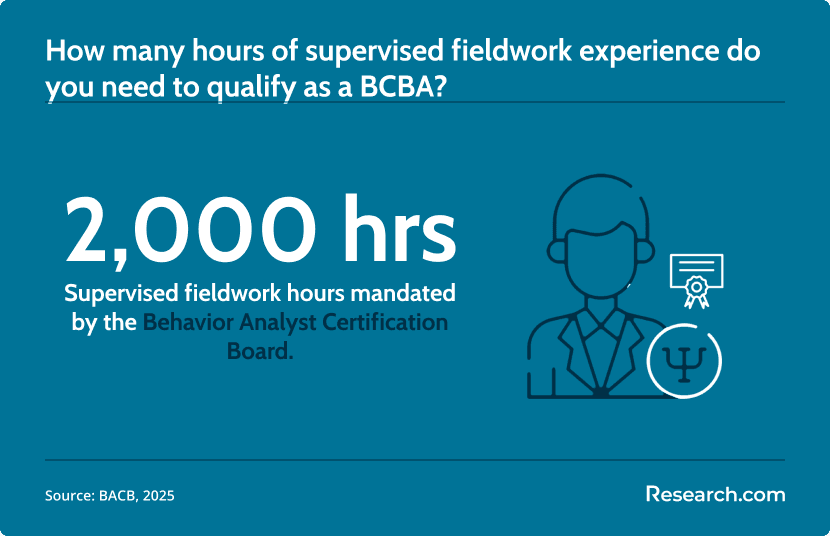
To become a Board Certified Behavior Analyst, candidates must complete a master’s degree, finish qualifying behavior analysis coursework, pass the BCBA exam, and complete supervised fieldwork. The academic portion is only one part of the process. For many students, the most difficult step is completing the BACB-required 2,000 hours of Supervised Fieldwork or 1,500 hours of Concentrated Supervised Fieldwork.
Students should understand the difference between restricted and unrestricted fieldwork activities before enrolling. At least 60% of fieldwork hours must be unrestricted, which includes higher-level tasks such as behavior assessment, behavior plan development, data interpretation, staff training, and supervision-related activities. No more than 40% can be restricted, which usually includes direct one-on-one service delivery.
This distinction is especially important for Registered Behavior Technicians and other direct-care workers. An employer may pay you primarily for billable direct therapy, but BCBA fieldwork requires substantial unrestricted work. Before choosing an online program, ask your employer whether you can complete assessment, programming, and supervision-related tasks during paid or approved work time.
What Courses Are Included in Online BCBA Programs?
Online BCBA programs are designed around behavior analytic content required for certification eligibility. Course titles differ by school, but most programs cover the same core knowledge areas: principles of behavior, assessment, intervention, ethics, research, data analysis, and supervision.
- Principles of Applied Behavior Analysis. Students study reinforcement, punishment, stimulus control, learning theory, and the conceptual foundations of ABA.
- Behavior Assessment. This course trains students to collect behavioral data, conduct assessments, and identify the functions of challenging behavior.
- Intervention Strategies in ABA. Students learn to design and evaluate behavior-change procedures, including reinforcement-based interventions, extinction procedures, prompting, fading, and other evidence-based methods.
- Ethics and Professional Conduct for BCBAs. Coursework covers professional responsibilities, informed consent, confidentiality, cultural responsiveness, conflicts of interest, and ethical decision-making.
- Research Methods in ABA. Students learn research design, single-case methods, data interpretation, and how evidence informs behavior analytic practice.
- Data Collection and Analysis in ABA. This course focuses on measurement systems, graphing, visual analysis, and evaluating whether interventions are working.
- Supervision in ABA. Students examine supervision models, performance feedback, staff training, professional development, and the responsibilities of supervising behavior analytic services.
How Long Does an Online BCBA Program Take?
Completion time depends on whether you choose a master’s degree or certificate, how many courses you take each term, whether the program is full time or part time, and how quickly you complete supervised fieldwork.
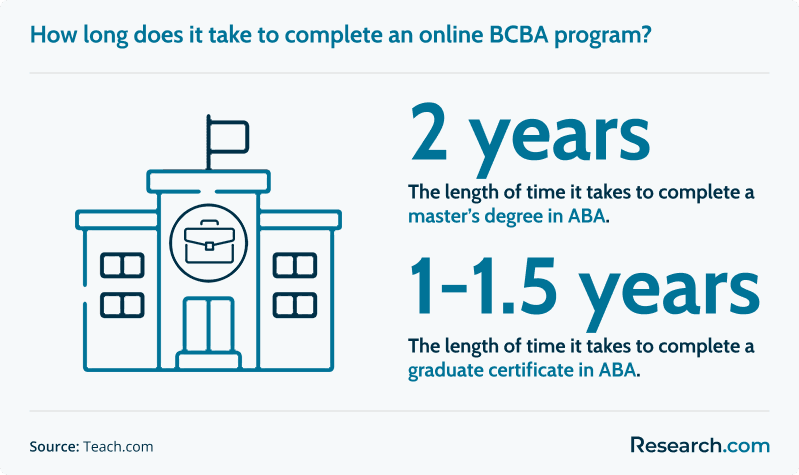
A master’s degree in ABA commonly takes two to three years of full-time study. A graduate certificate may take one to one-and-a-half years. Some programs use accelerated eight-week or 10-week courses, while others follow a traditional semester schedule.
Course load has a major effect on pace. Full-time students may take 2-3 courses per semester, while part-time students may take 1-2 courses per semester. Working adults should be careful with accelerated formats because shorter terms can compress reading, assignments, discussion posts, and exam preparation into a demanding weekly schedule.
Fieldwork can extend the overall timeline. The BACB requires at least 2,000 hours of supervised fieldwork experience or 1,500 hours of Concentrated Supervised Fieldwork before candidates qualify for the certification exam. Some students complete fieldwork while taking courses, while others need additional time after coursework ends.
| Pathway | Typical Academic Time | Best For | Watch Out For |
| Master’s degree in ABA or related field | Two to three years of full-time study | Students who still need the graduate degree required for BCBA eligibility | Higher total tuition and a longer academic commitment |
| Graduate certificate | One to one-and-a-half years | Students who already hold an acceptable graduate degree | Certificate programs may have limited financial aid options |
| Accelerated online format | Varies by school | Students with strong time management and stable work schedules | Compressed courses can be difficult while completing fieldwork |
Online BCBA Programs vs. On-Campus Programs
Online and campus-based BCBA programs may cover similar academic content, but the fieldwork experience can be very different. Campus programs may have university-affiliated clinics, local school partnerships, or faculty-connected practicum sites. Online students often need to build their own local fieldwork plan.
That flexibility can be valuable. Online programs allow students to remain employed, avoid relocation, and study from communities where no campus-based ABA program is available. However, the convenience comes with responsibility. You may need to locate a BACB-certified supervisor, secure a placement, confirm client access, and track fieldwork documentation largely on your own.
Online study may also reduce housing, commuting, and relocation costs. Students seeking federal aid should confirm whether their program participates in aid programs and may benefit from comparing colleges that accept FAFSA.
| Format | Advantages | Potential Drawbacks |
| Online BCBA program | Flexible location, easier to maintain employment, no relocation required | Fieldwork and supervision may be the student’s responsibility |
| On-campus BCBA program | More direct access to faculty, classmates, and university-affiliated practicum sites | May require commuting, relocation, or a less flexible schedule |
| Hybrid BCBA program | Combines online convenience with some in-person support | Travel requirements can add time and cost |
What Is the Average Cost of Online BCBA Programs?
Students asking what degree should I study should look beyond listed tuition when evaluating online BCBA affordability. Tuition is only the visible part of the investment. The hidden cost is often supervised fieldwork.
To sit for the BACB exam, students must complete fieldwork hours, and 5% of those hours, or 100 hours, must be directly supervised by a BCBA. If you work as an RBT at a clinic that provides free in-house supervision, tuition may be your main cost. If you work in a school or organization without an available BCBA, you may need to hire an independent supervisor.
Independent BCBA supervisors typically charge between $50 and $100 per hour. That can add $5,000 to $10,000 to a $22,000 program, changing the real cost of an otherwise affordable online degree. When comparing programs, request a full cost estimate that includes tuition, fees, books, supervision, exam preparation, and any residency or technology requirements.
How to Choose the Right Online BCBA Program
The strongest affordable program is the one that can get you from enrollment to exam readiness without unnecessary cost, delay, or confusion. Students comparing the best accredited online degrees should evaluate BCBA programs with certification-specific criteria, not general online-program rankings alone.
One of the most useful metrics is the school’s first-time BACB exam pass rate. The Behavior Analyst Certification Board publishes pass rates for Verified Course Sequences each year. A program with very low tuition but a 30% first-time pass rate may be a poor investment if graduates struggle to pass the board exam. Programs that consistently exceed the national average, which typically hovers around 55% to 60%, may offer stronger exam preparation value.
Also examine fieldwork infrastructure. Ask whether the university has a fieldwork coordinator, local placement guidance, supervisor directories, employer partnership support, or documentation training. A program that lowers tuition but leaves students without fieldwork support can create delays that cost both time and money.
Questions to Ask Before Enrolling
- Does this program meet current BACB coursework requirements for my intended certification pathway?
- Who is responsible for confirming coursework eligibility under the new attestation process?
- What is the program’s first-time BCBA exam pass rate?
- Does the school help students find supervised fieldwork placements?
- Can I complete unrestricted fieldwork hours through my current employer?
- Are supervision costs included, employer-provided, or paid separately?
- Is the program eligible for federal financial aid, employer reimbursement, scholarships, or payment plans?
- Can I attend part time without losing eligibility, financial aid, or access to key courses?
- What happens if BACB requirements change while I am enrolled?
Common Mistakes When Choosing an Online BCBA Program
| Mistake | Why It Can Hurt You | Better Approach |
| Choosing only by lowest tuition | Low tuition may not include supervision, fees, or strong exam preparation. | Compare total cost and student outcomes. |
| Ignoring fieldwork logistics | You may finish coursework but be delayed by missing supervision hours. | Secure a fieldwork plan before enrolling. |
| Assuming every online program meets certification rules | Certification requirements can change, and not every program fits every pathway. | Confirm requirements with the school and BACB-related guidance. |
| Overloading courses while working full time | Accelerated study can reduce learning quality and increase burnout. | Choose a pace that fits work, family, and fieldwork demands. |
| Relying only on rankings | Rankings may not reflect your state, employer, supervision access, or schedule. | Use rankings as a shortlist, then verify fit. |
What Career Paths Are Available for BCBA Graduates?
BCBA graduates can work in clinical, educational, community, organizational, and research settings. The right path depends on the population you want to serve, the type of work environment you prefer, and whether you want direct clinical work, supervision, management, consulting, or research.
Autism Spectrum Disorder Services
Many BCBAs work with children with autism spectrum disorder in settings such as early intervention programs, schools, ABA therapy centers, and family homes.
- Early intervention programs: Support young children as they build communication, social, adaptive, and behavioral skills.
- School settings: Work with teachers and support staff to design and implement behavior intervention plans.
- ABA therapy centers: Provide or supervise individual and group-based ABA services.
- Home-based services: Partner with families to implement consistent interventions in daily routines.
Developmental Disabilities Services
BCBAs also support people with intellectual disabilities, Down syndrome, cerebral palsy, and other developmental disabilities.
- Residential programs: Develop behavior plans that support communication, safety, independence, and daily living skills.
- Supported living settings: Help individuals participate more independently in home and community environments.
- Vocational rehabilitation programs: Teach workplace behaviors and support job-readiness skills.
Organizational Behavior Management
Some BCBAs apply behavior principles to workplace performance and organizational systems.
- Human resources: Help design training, reinforcement systems, performance feedback, and behavior-based management practices.
- Business consulting: Use behavior analytic strategies to improve productivity, engagement, and workplace systems.
- Nonprofit organizations: Develop interventions that support program goals and community outcomes.
Additional Practice Areas
- Gerontology: Apply ABA principles to behavioral concerns related to aging, memory loss, or dementia.
- Pediatrics: Address feeding, sleep, toileting, and behavioral concerns in young children beyond ASD-focused services.
- Research: Study interventions, evaluate practice models, and contribute to the evidence base in behavior analysis.
- Independent practice: Experienced BCBAs may pursue independent practice after meeting applicable professional, legal, and payer requirements.
Students comparing adjacent health and counseling careers may also explore how much a psychiatric nurse practitioner makes, review shortest post master's PMHNP online programs, or learn how to become a certified counselor.
What Is the Job Market for BCBAs?
The BCBA labor market has expanded quickly, largely because autism insurance coverage requirements increased access to ABA therapy. The BACB reported a 58% increase in demand for certified behavior analysts from 2023 to 2024.
In 2024, demand for BCBAs was highest in California, Massachusetts, Texas, New Jersey, and Florida. Together, these five states accounted for 40% of recent nationwide demand for behavior analysts.
All 50 states have passed mandates requiring commercial insurance providers to cover Applied Behavior Analysis therapy for individuals diagnosed with Autism Spectrum Disorder. This policy shift helped move ABA from a more limited educational and private-pay service into a large insurance-funded healthcare sector. Students comparing related earnings may also want to review information on behavioral psychologist salary and career options.
Strong demand does not mean every job will be the right fit. New BCBAs should evaluate caseload size, supervision expectations, billable-hour requirements, ethical support, documentation workload, and employer culture before accepting a position.
Should You Pursue a Doctoral Degree in ABA?
A doctoral degree in applied behavior analysis may make sense if your long-term goals involve university teaching, research leadership, advanced clinical specialization, program development, or high-level organizational leadership. It is not required for most BCBA roles, so students should weigh the time and cost carefully.
If you want to conduct research, teach future behavior analysts, or specialize in complex systems-level work, doctoral study may be worth exploring. Students considering that route can compare ABA PhD programs to understand available academic pathways.
Is an Online BCBA Program Worth It?
An online BCBA program can be worth the investment if it leads to certification eligibility, supports your fieldwork plan, prepares you for the exam, and fits your financial situation. It may be a poor fit if you cannot access qualified supervision, need more structure than online learning provides, or choose a certificate when you still need a qualifying graduate degree.
Before enrolling, compare program cost, exam outcomes, accreditation or coursework alignment, student support, and employer demand in your region. Reviewing broader lists such as the best ABA programs can also help you understand how affordable online options compare with other ABA pathways.
What Are Job Placement Rates for Online BCBA Graduates?
Job placement rates vary by school, region, employer network, and whether graduates have passed the BCBA exam. Prospective students should ask each program for recent placement data, alumni employment settings, employer partners, and career-services support.
Do not rely on general statements such as “high demand” or “strong placement” without asking for evidence. If you are comparing related graduate options before committing to ABA, you may also review affordable online masters in psychology programs.
Can an Online BCBA Program Support Advanced Study?
An online BCBA program can build a strong applied and analytical foundation for further graduate work. Some professionals use BCBA preparation as a platform for research, leadership, interdisciplinary clinical training, or doctoral study.
Students interested in broader clinical psychology training may compare behavior analysis with online PsyD programs accredited. The right choice depends on whether you want to focus on behavior analytic intervention, psychological assessment, counseling, research, or clinical leadership.
How Can You Evaluate Quality and Affordability Together?
A high-value online BCBA program should be both reasonably priced and capable of preparing students for certification. Look at academic rigor, coursework alignment, faculty qualifications, exam preparation, fieldwork support, advising, and documented outcomes.
Students comparing costs across psychology-related programs can also review cheap forensic psychology programs online to understand how ABA pricing compares with other specialized graduate fields.
How Does the Cost of an Online BCBA Program Compare With Other Online Psychology Degrees?
Online BCBA programs are often more certification-focused than general psychology degrees. That can make the investment more direct if your goal is behavior analyst certification, but it can also create extra costs for fieldwork supervision and exam preparation.
Other psychology-related programs may have different cost structures, timelines, and career outcomes. For example, students considering doctoral-level clinical training may compare ABA pathways with cheap online PsyD programs. The better option depends on your intended scope of practice, licensing goals, budget, and time horizon.
What Financial Aid Options Are Available for Online BCBA Students?
Financial aid options depend on whether the program is a degree or a certificate, the school’s eligibility, your enrollment status, and your personal aid profile. Certificate programs may have fewer federal aid options than degree programs, so students should confirm details before enrolling.
- Federal financial aid: Pell Grants and subsidized loans are often not available for standalone certificate programs.
- Master’s degree programs: BCBA coursework embedded in a master’s degree may qualify for federal aid depending on the institution and enrollment status.
- Scholarships and grants: Students can look for external awards connected to autism services, education, disability services, or behavior analysis.
- Employer tuition reimbursement: Clinics, schools, and human services agencies may help pay for job-related graduate study.
- Payment plans: Many universities let students spread tuition payments across a term or academic year.
How to Maximize Career Success After an Online BCBA Program
Completing coursework is only the beginning. To turn an online BCBA program into career progress, students should build practical experience, prepare deliberately for the exam, document fieldwork carefully, and develop a professional network.
Build a Strong Fieldwork Portfolio
Use supervised fieldwork to practice the work BCBAs actually do: assessment, intervention design, data review, caregiver training, staff consultation, and ethical decision-making. Keep organized records of case types, populations served, intervention goals, and measurable outcomes where appropriate.
Pursue Focused Training
Specialized training in autism services, early childhood intervention, severe behavior, organizational behavior management, trauma-informed practice, or supervision can help you target specific roles. Choose training based on your intended practice setting rather than collecting credentials without a plan.
Join Professional Communities
Professional organizations, conferences, webinars, and peer groups can help you stay current with research, ethical issues, supervision practices, and employer expectations. Networking can also help online students identify supervision opportunities and job openings.
Explore More Than One Career Setting
BCBAs work in clinics, schools, hospitals, homes, residential programs, community agencies, private practice, research, and business settings. Early-career professionals should compare roles carefully because caseloads, billing expectations, supervision quality, and work-life balance vary widely.
Can BCBA Certification Be Combined With Mental Health Counseling Skills?
BCBA training and mental health counseling are distinct professional pathways, but some professionals benefit from understanding both behavioral intervention and mental health concepts. Combining these perspectives may support more comprehensive care planning, especially when clients have behavioral needs alongside emotional, family, or mental health concerns.
Professionals interested in counseling-focused graduate study can compare ABA preparation with masters in clinical mental health counseling online programs. Students should remember that counseling practice may require separate licensure, supervised hours, and state-specific requirements.
How Do Online BCBA Programs Prepare Students for the BCBA Exam?
Strong online BCBA programs often include structured exam preparation through content review, practice questions, case-based assignments, simulated scenarios, and faculty feedback. Peer discussions and applied projects can also help students connect abstract concepts to real clinical decisions.
Students who are still at the undergraduate stage may consider a fast track online bachelor's degree in psychology before entering graduate-level ABA preparation. The stronger your behavioral science foundation, the easier it may be to understand advanced ABA coursework.
Seek Leadership Opportunities
After gaining experience, BCBAs may move into roles such as supervisor, clinical director, program manager, trainer, consultant, or administrator. Leadership roles often require more than clinical skill; they also require communication, staff development, ethical judgment, and systems thinking.
Some professionals broaden their human services expertise through related fields. For example, students interested in family systems may compare behavior analysis with the cheapest mft programs, while those focused on quicker ABA graduate completion may review the fastest master's in applied behavior analysis online.
Challenges of Pursuing an Online BCBA Program
Online BCBA programs offer flexibility, but they are not easier than campus programs. The biggest challenge is often arranging supervised fieldwork near where you live. If your school does not maintain partnerships in your area, you may need to contact clinics, schools, or independent BCBAs yourself.
Time management is another major issue. Online students often study while working, completing fieldwork, and managing family responsibilities. Without a fixed campus schedule, you need a weekly plan for lectures, readings, assignments, supervision meetings, and exam preparation.
Isolation can also affect motivation. Students should look for programs with active discussion forums, cohort models, faculty access, online office hours, and peer study groups. A flexible program is most effective when it still provides structure and accountability.
How Can You Balance an Online BCBA Program With a Full-Time Job?
Many online BCBA students continue working while enrolled, but success requires planning before the first course begins. The goal is to coordinate work, coursework, fieldwork, supervision, and personal responsibilities rather than treating each as a separate obligation.
- Create a weekly schedule: Block time for reading, assignments, class meetings, supervision documentation, and exam review.
- Set realistic course loads: One extra course can create problems if you are also trying to complete fieldwork hours.
- Talk with your employer early: Ask whether you can complete unrestricted activities and receive supervision at work.
- Use online flexibility carefully: Flexibility helps only if you create consistent study habits.
- Build a support system: Family, peers, mentors, supervisors, and classmates can help you stay accountable.
- Consider pace options: Accelerated programs may work for some students, but they require strong time management and stable work conditions.
Why Is Supervised Fieldwork Important in BCBA Programs?
Supervised fieldwork is the bridge between academic coursework and competent professional practice. Students learning how to become a board certified behavior analyst should understand that certification preparation requires hands-on experience with assessment, intervention planning, data-based decision-making, and ethical service delivery.
During fieldwork, students conduct assessments, design behavior intervention plans, monitor progress, train caregivers or staff, and receive feedback from a qualified supervisor. This experience helps students prepare for the BCBA exam and for the practical responsibilities of behavior analytic work after certification.
Fieldwork also helps students identify the populations and settings where they are most effective. A student may enter a program expecting to work in autism services, then discover an interest in schools, adult services, organizational behavior management, research, or supervision.
Key Insights
- The most affordable online BCBA program is the one that combines manageable tuition with strong exam preparation, valid coursework, and a realistic fieldwork plan.
- Students should verify current BACB requirements before enrolling because the VCS system ends on December 31, 2025, and the Coursework Attestation System begins January 1, 2026.
- Fieldwork can be the deciding factor in total cost and completion time. Confirm supervision access before committing to a program.
- First-time BCBA exam pass rates are a critical quality indicator. A very cheap program may not be a good investment if graduates struggle to pass the exam.
- Online programs are best for self-directed students who can manage time, coordinate local supervision, and stay engaged without a campus structure.
- Before applying, ask each school about total cost, fieldwork support, exam outcomes, financial aid eligibility, and what happens if certification rules change while you are enrolled.
References:
- BCBA Handbook / Certification Requirements https://www.bacb.com/wp-content/uploads/2025/08/BCBAHandbook_260529-2-a.pdf
- Current BCBA Requirements (2026) https://www.bacb.com/bcba/?topic=bcba-apply
- University BCBA Exam Pass Rates (2024) https://www.bacb.com/university-examination-pass-rates/
- BACB Certification Statistics (2025) https://www.bacb.com/about/bacb-certificant-annual-report-data/
- Indeed. (2024, May 13). Board certified behavior analyst salary in United States. Indeed.com.
- Behavior Analyst Certification Board. (2025). US employment demand for behavior analysts: 2010-2025. BACB.
- United States Bureau of Labor Statistics. (2024, April 17). Occupational Outlook Handbook: Psychologists. BLS.
Other Things You Should Know About Affordable Online BCBA Programs
In 2027, online BCBA programs can cost anywhere from $5,000 to $20,000, depending on the institution and the specifics of the program. It is important to compare tuition fees, financial aid options, and other associated costs when selecting a program.
Yes, you can become a BCBA through an online program if it meets the Behavior Analyst Certification Board (BACB) coursework requirements. Many accredited universities deliver the required classes fully online while allowing students to complete supervised fieldwork in their local communities under qualified supervisors. After earning a qualifying master's degree, completing the required coursework and supervised experience, and meeting all BACB eligibility requirements, graduates can take the BCBA certification exam. Online programs offer flexibility without changing the certification standards candidates must satisfy.
Yes. To qualify for BCBA certification, candidates generally must earn a qualifying master's degree from an accredited institution and complete the required behavior analysis coursework outlined by the BACB. The master's degree may be in behavior analysis, education, psychology, or another acceptable field, provided all certification requirements are met. In addition to graduate education, candidates must complete supervised fieldwork and pass the BCBA examination. A bachelor's degree alone is not sufficient for BCBA certification under the current certification standards.
A BCBA program usually refers to a master's degree that includes the coursework needed for BCBA certification, while an ABA graduate certificate provides only the specialized behavior analysis courses. Graduate certificates are designed for students who already hold a qualifying master's degree in an eligible field but still need the required BCBA coursework. Degree programs award both the graduate degree and certification preparation, whereas certificates focus exclusively on meeting the educational component of BCBA eligibility without granting another master's degree.
Most online BCBA programs do not automatically include supervised fieldwork as part of tuition, although many help students secure qualified supervisors and approved placement sites. Some universities offer practicum experiences, maintain partnerships with local employers, or provide faculty supervision for an additional fee. Because fieldwork is a separate BACB requirement, students should confirm exactly how a program supports this process before enrolling. Understanding supervision availability, placement assistance, and any additional costs can prevent unexpected delays in completing certification requirements.
The number of supervised fieldwork hours required for BCBA certification depends on the experience pathway established by the BACB. Candidates complete either supervised fieldwork or concentrated supervised fieldwork, with each pathway requiring a different total number of hours. Throughout the experience, students must receive ongoing supervision, document their activities carefully, and meet all BACB requirements for acceptable fieldwork. Because certification standards may change over time, applicants should always verify the current hour requirements directly through the BACB before beginning their experience.
Yes, ABAI-Verified Course Sequences remain valid for students who complete them within the applicable certification standards and eligibility requirements. However, the BACB has shifted greater responsibility to universities for demonstrating that coursework satisfies certification requirements, and institutions may follow updated pathways depending on when students enroll. Prospective students should verify how a specific program aligns with current BACB eligibility standards rather than relying solely on the ABAI verification label. Reviewing a program's certification disclosures can help ensure it meets current requirements.
When selecting an affordable online BCBA program in 2027, consider factors like tuition cost, financial aid availability, program accreditation, graduation rates, and pass rates for the BCBA exam. Ensure the program is approved by the Association for Behavior Analysis International (ABAI) with a verified course sequence.
The cost of an online BCBA program varies widely depending on the institution, residency status, and degree type. Many online master's programs range from approximately $15,000 to more than $40,000 in total tuition, while graduate certificates are often less expensive. Students should also budget for university fees, textbooks, technology expenses, and supervised fieldwork costs that may not be included in tuition. Comparing the total cost of attendance, financial aid opportunities, and graduation outcomes provides a more accurate picture than tuition alone.
Prerequisites typically include a bachelor’s degree in psychology, education, or a related field. Some programs may also require a minimum GPA or relevant work experience in behavior analysis. Verification through official transcripts is usually necessary before enrolment.


