
2027 Best Online Master’s Degree Programs in Psychology

Co-Founder and Chief Data Scientist
Throughout my 10+ years of experience in career planning, I have witnessed how psychologists have become one of the most in-demand and lucrative professions. While psychology is a fulfilling discipline that allows you to assist others, it is also a competitive and challenging journey, with students pursuing advanced studies and completing hands-on training before earning a license.
Fortunately, graduates who obtain an online master’s degree in psychology can start their professional careers immediately. In this guide, I have prepared an in-depth exploration of what aspiring psychology professionals can expect in a psychology graduate program. It will teach you everything you need to know and will allow you to make an informed decision about your education and career paths.
Benefits of getting an online master’s degree in psychology:
- Psychologists have a strong earning potential, with an average salary of $85,330 yearly.
- Studying this degree online offers the flexibility to balance academic pursuits with professional commitments and the potential for networking with peers and professionals globally.
- Graduates of a master’s in psychology program can work as HR managers, industrial/organizational psychologists, counselors, and family services workers.
What can I expect from an online master’s degree in psychology?
- Armed with a master’s degree, you will be immersed in a comprehensive program that utilizes a flexible learning structure.
- Lectures and coursework are done remotely but expect on-site classes for practical activities or internships.
- Anticipate cultivating a deep understanding of psychological theories and practical skills, leading to outcomes like refined critical thinking, research proficiency, and enhanced ethical decision-making.
- While clinical psychologists typically require a doctorate, state variations impact practice for master’s graduates. Some work under supervision, while others serve as apprentices during PsyD or PhD pursuits.
Where can I work with an online master’s degree in psychology?
- Graduates of psychology can get into various careers. The versatility of their skills and abilities positions them for success in roles not only in clinical settings but also in the academe or research.
- I/O psychologists work in corporate offices while others enter the realm of business and analytics, marketing, sales, advertising, or consumer behavior studies.
- You can apply in state, federal, and other government offices as social workers or specialists in the criminal field.
- Whether you pursue the scientific field or the non-clinical pathway, you can bring a dynamic skill set to address the diverse challenges of today’s professional landscape.
How much can I make with an online master’s degree in psychology?
Data from Payscale show that the salary of a master’s in psychology degree graduate in 2024 can be anywhere from $48,000 to $72,000 annually. Source: PayScale. (2024). Psychology master's salary report.
Statistics from the U.S. Bureau of Labor Statistics (2024) reveal that the mean annual wage of a psychologist with a doctorate is $112,000.
Related jobs have the following annual salaries:
- mental health counselors earn $49,710
- career counselors earn $60,140
- training and development specialists earn $63,080
- market research analysts earn $68,230
- HR managers earn $130,000
These income statistics showcase the diverse earning potentials within the field, reflecting the wide range of opportunities available to you.
- Best Online Master’s Degrees in Psychology for 2027 List of Programs
- How does an online master’s in psychology compare to an on-campus program? How does an online master’s in psychology compare to an on-campus program?
- What is the course structure of an online master’s in psychology program? What is the course structure of an online master’s in psychology program?
- What are the courses for master’s in psychology degrees? What are the courses for master’s in psychology degrees?
- What types of specializations are available in online psychology master’s programs? What types of specializations are available in online psychology master’s programs?
- What are the enrollment requirements for an online master’s in psychology program? Enrollment Requirements
- How much does an online master’s degree in psychology cost? Estimated Costs
- What are the financial aid options available for online psychology students? Financial Aid
- What are the factors to consider when choosing an online master’s degree in psychology? What are the factors to consider when choosing an online master’s degree in psychology?
- How long does it take to complete an online master’s in psychology program? How long does it take to complete an online master’s in psychology program?
- What Is the fastest way to complete an online master’s in psychology? What Is the fastest way to complete an online master’s in psychology?
- How does an online master’s in psychology enhance specialization in areas like child psychology? How does an online master’s in psychology enhance specialization in areas like child psychology?
- Can an online master’s in psychology pave the way for doctoral studies and advanced research opportunities? Can an online master’s in psychology pave the way for doctoral studies and advanced research opportunities?
- Should I prioritize accreditation when selecting an online master’s in psychology program? Should I prioritize accreditation when selecting an online master’s in psychology program?
- How can an accelerated online psychology degree boost career advancement? How can an accelerated online psychology degree boost career advancement?
- What challenges do online master’s programs in psychology present and how can students overcome them? What challenges do online master’s programs in psychology present and how can students overcome them?
- What career support and job placement assistance do online master’s in psychology programs offer? What career support and job placement assistance do online master’s in psychology programs offer?
Best Online Master’s Degrees in Psychology for 2027
Choosing an online master’s in psychology is not just a question of convenience. The right program can help you prepare for doctoral study, counseling-adjacent roles, applied behavior analysis, human factors work, organizational consulting, research support, or other psychology-related careers. The wrong program can leave you with credits that do not transfer, limited career mobility, or a degree that does not meet licensure expectations in your state.
This guide is designed for students comparing online psychology master’s programs and trying to understand cost, accreditation, specialization options, course formats, career outcomes, and practical fit. You will find a ranked program list, decision tables, admissions guidance, cost considerations, career pathways, common mistakes, and questions to ask before enrolling.
Quick answer: Is an online master’s in psychology worth considering?
An online master’s in psychology can be a strong option if you need graduate-level psychology training while continuing to work or manage personal responsibilities. It is especially useful for students seeking research preparation, applied psychology roles, behavioral health support positions, human factors work, industrial-organizational psychology, or a stepping stone to doctoral study. However, students who want to become licensed clinical psychologists should understand that licensure typically requires doctoral-level education and supervised clinical experience, and master’s programs vary widely in whether they meet counseling or clinical requirements.
The best choice depends on three factors: whether the program is properly accredited, whether its curriculum matches your career goal, and whether its practicum, internship, or residency requirements are realistic for your location and schedule.
How we ranked these online psychology master’s programs
Graduate school is a major academic and financial decision, so this list was built using a structured Research.com ranking methodology. The review process considered program features, institutional information, accreditation, online delivery format, cost indicators, and student-facing data where available.
To support transparency, Research.com also reviewed data from sources such as the Integrated Postsecondary Education Data System (IPEDS), Peterson’s Data, including its Distance Learning Licensed Data Set, College Scorecard, and the National Center for Education Statistics (NCES). Rankings should be used as a starting point, not a substitute for checking state licensure rules, transfer policies, practicum requirements, and total program cost.
Top online master’s degrees in psychology
The programs below represent different graduate psychology pathways, including general psychology, educational psychology, counseling psychology, human factors, rehabilitation counseling, applied behavior analysis, and doctoral-preparation tracks. Because online psychology programs differ significantly in purpose, students should compare them by career fit rather than by name alone.
| Rank | School | Program focus | Credit hours | Estimated tuition | Accreditation listed |
| 1 | Nova Southeastern University | General psychology with general or applied health science tracks | 30 | $16,110 (18 credits) | Southern Association of Colleges and Schools Commission on Colleges (SACSCOC) |
| 2 | University of South Dakota | Human development and education psychology | 33 | $470.45/credit hour | Council for Accreditation of Counseling & Related Educational Programs (CACREP), National Association of School Psychologists (NASP) |
| 3 | Divine Mercy University | Psychology with multiple non-licensure specializations | 33 | $850/credit hour | SACSCOC |
| 4 | University of Idaho | Human factors psychology | 30 | $554/credit hour | Northwest Commission on Colleges and Universities (NWCCU) |
| 5 | Azusa Pacific University | Counseling psychology or organizational psychology | 60 | $783/credit hour | WASC Senior College and University Commission (WSCUC) |
| 6 | University of Oregon | Psychology with neuroscience and community application | 49 | $592/credit hour | NWCCU |
| 7 | Mississippi State University | Rehabilitation counseling | 60 | $537/credit hour | CACREP |
| 8 | Regent University | Psychology with concentrations such as addictions, I/O psychology, and cyberpsychology | 39+ | $695/credit hour | SACSCOC |
| 9 | Pepperdine University | Psychology, clinical psychology, or applied behavior analysis | 3668 | $1,510$1,875/unit | WSCUC |
| 10 | Palo Alto University | Psychology with generalist, tech and mental health, forensic, or PhD-preparation options | 3747 | $912/unit | WSCUC |
1. Nova Southeastern University
- Credit Hours: 30
- Estimated Tuition: $16,110 (18 credits)
- Accreditation: Southern Association of Colleges and Schools Commission on Colleges (SACSCOC)
Nova Southeastern University offers a non-clinical master’s program in general psychology for students who want broad graduate training without entering a licensure-focused clinical track. Students may select a general track or an applied health science track. Coursework includes areas such as behavioral neuroscience, research design, psychopathology, assessment, and evaluation strategies. The program may also support students who plan to continue into doctoral-level study because it includes empirically grounded coursework often expected in advanced psychology education.
2. University of South Dakota
- Credit Hours: 33
- Estimated Tuition: $470.45/credit hour
- Accreditation: Council for Accreditation of Counseling & Related Educational Programs (CACREP), National Association of School Psychologists (NASP)
The University of South Dakota offers a human development and education psychology program with a non-thesis option. Students study child and adolescent development, learning, statistics, cognitive approaches, and research methods. The program uses a hybrid structure: most coursework is online, while students attend on-campus meetings once or twice a month on Wednesday evenings or Saturdays. This format may work well for learners who want online flexibility but still value periodic in-person contact with faculty and classmates.
3. Divine Mercy University
- Credit Hours: 33
- Estimated Tuition: $850/credit hour
- Accreditation: SACSCOC
Divine Mercy University provides an online MS in Psychology with specialization options in marriage and family studies, leadership, human services counseling, bioethics, pre-PhD preparation, and self-designed study. The program is not designed for licensure, so students should choose it for applied psychology, leadership, human services, or doctoral-preparation goals rather than independent clinical practice. Courses address social psychology, leadership, statistical analysis, and human growth and development. Students can complete the degree within 16 to 26 months, and classes combine asynchronous and synchronous learning with limited on-site attendance.
4. University of Idaho
- Credit Hours: 30
- Estimated Tuition: $554/credit hour
- Accreditation: Northwest Commission on Colleges and Universities (NWCCU)
The University of Idaho offers a psychology master’s program focused on human factors, a field that studies how people interact with tools, systems, technology, and designed environments. Students take courses in ergonomics and biomechanics, engineering psychology, human factors in engineering design, and human-computer interaction. Most coursework is online, and students may also work with laboratory facilities to build applied skills. Internship opportunities may involve areas such as augmented cognition and neuroergonomics.
5. Azusa Pacific University
- Credit Hours: 60
- Estimated Tuition: $783/credit hour
- Accreditation: WASC Senior College and University Commission (WSCUC)
Azusa Pacific University offers online graduate study in Counseling Psychology with a specialization in Children and Adolescents, as well as Organizational Psychology. The university lists a student-to-teacher ratio of 13:1, which may appeal to students who want a more guided learning environment. Coursework may include family therapy, play therapy, psychobiology, dysregulation disorders, and multicultural counseling. The program uses a synchronous online format. Students completing the counseling psychology pathway are prepared for routes such as licensed professional clinical counselor or certified play therapist, but they should still verify state-specific licensure requirements before enrolling.
6. University of Oregon
- Credit Hours: 49
- Estimated Tuition: $592/credit hour
- Accreditation: NWCCU
The University of Oregon offers an online master’s in psychology that can be completed in six terms. The program emphasizes neuroscience and psychology in community contexts, making it relevant for students interested in translating psychological science into real-world programs and interventions. Coursework includes translational neuroscience, program evaluation, intervention science, and community and cultural perspectives. Most classes are asynchronous, and live mentoring meetings provide additional structure and faculty interaction.
7. Mississippi State University
- Credit Hours: 60
- Estimated Tuition: $537/credit hour
- Accreditation: CACREP
The online MS in Counselor Education with a concentration in Rehabilitation Counseling at Mississippi State University includes 39 core counseling hours, six elective hours, and 15 rehabilitation counseling hours. Students study assessment techniques, psychosocial rehabilitation, disability-related issues, and vocational rehabilitation counseling. The program also includes practical training on campus and in community-based settings such as rehabilitation centers, clinics, private practices, and government agencies. The university also offers an online MS in Educational Psychology Applied Behavior Analysis.
8. Regent University
- Credit Hours: 39+
- Estimated Tuition: $695/credit hour
- Accreditation: SACSCOC
Regent University offers a flexible MS in Psychology that can be completed in two years. Concentrations include addictions, cyberpsychology, doctoral preparation, industrial-organizational psychology, leadership coaching, and marriage and family. Students take courses in areas such as life span psychology, statistics, life coaching, counseling, multicultural awareness and diversity, and coping skills. Students comparing related tracks may also review Regent’s options in clinical mental health counseling, pastoral counseling, human services, and school counseling.
9. Pepperdine University
- Credit Hours: 3668
- Estimated Tuition: $1,510$1,875/unit
- Accreditation: WSCUC
Pepperdine University offers online graduate programs that include MA options in Psychology/Clinical Psychology and an MS in Applied Behavior Analysis. Depending on the program selected, students may finish between 18 to 27 months. Courses may cover human sexuality, trauma in diverse populations, interpersonal skills, psychotherapy, and radical behaviorism. The format includes weekly live online classes and some on-campus coursework. Because the listed credit and tuition information is program-dependent, applicants should confirm the exact unit count, tuition rate, and residency expectations directly with the university.
10. Palo Alto University
- Credit Hours: 3747
- Estimated Tuition: $912/unit
- Accreditation: WSCUC
Palo Alto University offers an online MS in Psychology with evening or weekend classes. Concentration options include generalist psychology, tech and mental health, forensic psychology, and PhD preparation. Students in the PhD preparation track must complete a one-week intensive course in clinical interviewing. Other areas of study include risk assessment and management, mental health in the digital world, cognitive bases of behavior, and ethics. Applicants should verify the specific credit total for their selected track because program requirements may vary.
What graduates say about online master’s programs in psychology
- : "My online psychology master’s program gave me the flexibility to keep working while studying a subject I cared about. The virtual discussions also exposed me to classmates from different regions and professional backgrounds, which made the experience feel broader than a traditional classroom. — Sarah"
- : "The online format helped me balance graduate coursework with other responsibilities. I could access lectures and materials when I needed them, while still building practical knowledge through assignments and applied projects. — Brian"
- : "I was surprised by how connected the program felt. Faculty were accessible, classmates were engaged, and the research-focused assignments helped me translate psychological theory into real-world applications. — Jordan"
Key findings
- Online master’s programs in psychology serve different purposes: some are non-clinical, some prepare students for counseling-related pathways, and others support research, human factors, applied behavior analysis, or doctoral preparation.
- Accreditation is essential. Institutional accreditation matters for degree credibility, while specialized accreditation such as CACREP may be important for counseling-related goals.
- Online does not always mean fully remote. Many programs include synchronous sessions, campus visits, practicums, internships, or short residencies.
- Costs vary widely. Listed tuition in this guide ranges from $470.45/credit hour to $1,510$1,875/unit, while some programs list total or partial tuition differently.
- Students seeking licensure should contact their state licensing board before enrolling because program titles alone do not guarantee eligibility.
Online vs. on-campus master’s in psychology: Which format fits you?
Online and on-campus psychology master’s programs can lead to similar academic outcomes when they are properly accredited and well designed. The better option depends on your schedule, learning style, career target, and need for in-person training.
| Factor | Online master’s in psychology | On-campus master’s in psychology |
| Best for | Working adults, remote learners, caregivers, and students who need schedule flexibility | Students who prefer face-to-face learning, campus research labs, and in-person networking |
| Class format | May be asynchronous, synchronous, hybrid, or residency-based | Usually scheduled in person, often with regular campus attendance |
| Cost considerations | May reduce commuting, room, board, and relocation expenses, but technology fees may apply | May include campus fees, transportation, room, board, and relocation costs |
| Clinical or fieldwork access | May require local placements, campus visits, or approved practicum sites | May offer easier access to campus clinics, labs, and local placement networks |
| Student experience | Requires self-direction, proactive communication, and comfort with online tools | Offers more spontaneous interaction with faculty and classmates |
Online master’s programs are common at the graduate level, but students pursuing advanced professional psychology should note that there are fewer online doctoral degree in psychology options because doctoral training often requires extensive supervised clinical, research, or practicum work.
How online psychology master’s courses are usually structured
- In a Statista survey, 45% of U.S. learners in 2024 selected online study because work or personal commitments made in-person attendance difficult.
- Online students can often choose programs with delivery models that better match their schedules and responsibilities.
- Many online colleges schedule classes in the evenings or on weekends for working adults. Some courses run six to eight weeks, which can compress the academic calendar and shorten time to completion.
- Much of the coursework may be asynchronous, allowing students to complete lectures, readings, and assignments within weekly deadlines. General and prerequisite psychology courses, including many courses for a bachelor’s degree in psychology, are often available remotely.
- Some classes rely on recorded lectures, while others require live online meetings with instructors and peers.
- Clinical, counseling, or practicum-based tracks may require campus visits several times per semester. Field experiences are often completed during designated terms at approved facilities.
- Some schools allow students to complete fieldwork near their home communities, but placement approval, supervision rules, and state requirements should be confirmed in advance.
Common courses in online master’s degrees in psychology
Most online psychology master’s programs include advanced coursework in human behavior, research, assessment, development, and applied practice. Many postgraduate online psychology programs involve 36 credits, although credit totals vary by specialization and school. Typical courses include the following:
- History and Systems of Psychology: Reviews major psychological theories and schools of thought, giving students a foundation for advanced study.
- Social Psychology: Examines how culture, groups, interpersonal relationships, social influence, power, aggression, stereotypes, and conformity shape behavior.
- Lifespan Development: Explores behavioral, cognitive, physical, and socioemotional change across life stages. Related human services fields, including social work programs, also commonly study human development.
- Cognitive-Affective Bases of Behavior: Looks at how people process information, organize thoughts, regulate emotions, and respond to internal and external influences.
- Research Methods and Statistics: Builds skills in research design, data interpretation, measurement, and evidence-based decision-making.
- Capstone, Thesis, Internship, or Applied Project: Gives students a structured opportunity to demonstrate graduate-level psychology knowledge through research, fieldwork, or an applied project.
Psychology master’s specializations available online
The American Psychological Association reported in 2024 that psychology includes 56 recognized divisions. Online master’s programs do not cover all of them, but many schools offer focused tracks that align with major applied or research areas.
| Specialization | What it focuses on | Best fit for students who want to |
| Clinical psychology | Assessment, diagnosis, and treatment concepts related to mental health | Prepare for further clinical training or explore online clinical psychology master’s programs |
| Industrial-organizational psychology | Workplace behavior, employee motivation, job satisfaction, leadership, and organizational development | Work in human resources, organizational consulting, talent development, or workforce analytics |
| Forensic psychology | Psychological principles in legal, criminal justice, correctional, and investigative settings | Compare forensic psychology master’s programs or pursue law-adjacent psychology roles |
| School psychology | Student learning, behavior, emotional development, and school-based support | Work with children and adolescents in educational settings, subject to credential rules |
| Sports psychology | Athletic performance, motivation, resilience, team dynamics, and athlete well-being | Support athletes, coaches, teams, or performance-focused organizations |
| Educational psychology | Learning theory, assessment, instructional design, and student development | Study educational psychology for roles in education, research, assessment, or learning design |
The chart below uses BLS data to show psychologists by salary and specialization area.
Admission requirements for online master’s programs in psychology
Requirements vary by university, but many online psychology master’s programs ask applicants to submit the following:
- a bachelor’s degree in psychology or a related field
- official transcripts
- an undergraduate GPA of at least 3.0 or higher
- at least one year of professional experience
- a resume or CV
- letters of recommendation
- a personal statement
GRE policies differ by school. Some universities have removed the GRE requirement, while others still request scores. Applicants should verify the current policy on the program’s admissions page before applying.
Skills that help online psychology graduate students succeed
- Problem-solving: Psychology coursework often requires students to adjust research plans, interpret unexpected findings, and think through complex human behavior.
- Patience: Progress in counseling, research, behavior change, and human development can be gradual, so students need persistence and tolerance for complexity.
- Ethical judgment: Psychology students must understand confidentiality, informed consent, bias, professional boundaries, and the responsibility to avoid harm.
- Research and quantitative skills: Graduate psychology requires comfort with literature reviews, data analysis, statistics, and evidence-based reasoning.
- Communication: Strong listening, writing, observation, and discussion skills are essential for research, assessment, collaboration, and client-facing work.
How much does an online master’s degree in psychology cost?
- An online master’s degree in psychology generally costs between $400 and $945 per credit.
- Some of the best affordable colleges for psychology may charge less. As a planning estimate, students should budget between $20,513 to $28,017.
- There are many cheap online psychology degree options, but total cost depends on tuition structure, residency status, fees, transfer credits, course load, and program length.
- Out-of-state students often pay higher tuition, although some online programs use a flat per-credit rate for all distance learners.
- Online students may pay technology fees that campus students do not always pay.
- The largest cost difference between online and campus study is often outside tuition. Campus students may pay for room, board, transportation, parking, and activity or facility fees.
- Students should also plan for books, software, liability insurance where required, practicum travel, testing fees, and childcare if needed.
| Cost item | Why it matters | Question to ask |
| Tuition rate | Programs may charge by credit, unit, term, or flat rate | What is the total tuition for the full degree, not just one term? |
| Fees | Online, technology, graduation, practicum, or student service fees can add up | Are all mandatory fees included in the published estimate? |
| Transfer credits | Accepted credits can reduce both time and cost | How many graduate credits can be transferred? |
| Residency or campus visits | Travel and lodging can change the real cost of an online program | How many in-person visits are required? |
| Fieldwork expenses | Students may need transportation, background checks, or liability coverage | Who arranges practicum sites and what costs are attached? |
Financial aid options for online psychology students
Students in psychology, business administration, and other accredited degree programs may be eligible for federal financial aid if the institution and program meet eligibility rules. Federal loans are common, and graduate students may also look for private grants, fellowships, and institutional scholarships, especially if they plan to continue into a doctorate degree.
Psychology students can also search for scholarships from professional associations, nonprofit organizations, foundations, and community groups. Awards may be based on academic merit, financial need, research interest, professional background, or service commitment.
Employer tuition assistance is another option for working adults. Some employers reimburse tuition when the degree supports the employee’s current or future role. Military-affiliated students should also review institutional benefits and applicable military education assistance. The best strategy is to compare aid options early, before committing to a program or course load.
How to choose the right online master’s in psychology
Whether you are comparing psychology programs or an online degree in supply chain management, the best program is the one that fits your goal, budget, timeline, and credential requirements. For psychology students, this decision is especially important because clinical, counseling, school, and doctoral-preparation pathways can have very different rules.
| Decision factor | Why it matters | What to verify before enrolling |
| Accreditation | Affects credibility, financial aid eligibility, transfer options, and in some cases licensure preparation | Regional or institutional accreditation; specialized accreditation such as CACREP where relevant; APA accreditation where applicable for doctoral psychology and internships |
| Career alignment | Program names can be similar even when outcomes differ | Whether the degree prepares for research, counseling, human factors, I/O psychology, ABA, or doctoral study |
| Licensure fit | Not all psychology master’s programs lead to licensure | Whether the curriculum, supervision hours, and field placements satisfy your state’s requirements |
| Total cost | Tuition alone does not show the full financial commitment | Fees, travel, residencies, books, software, insurance, and practicum expenses |
| Program length | Full-time and part-time formats affect graduation date and workload | Expected completion time, maximum time allowed, and summer course availability |
| Transfer policy | Flexible transfer rules can protect you if you change schools | Maximum transferable credits, grade requirements, and course age limits |
| Graduation requirements | Thesis, capstone, exams, internships, and residencies can affect your schedule | All required projects, fieldwork hours, exams, and in-person components |
Tuition and fees, program length, transfer policies, graduation requirements, and accreditation should all be reviewed before you apply. Online psychology master’s programs commonly take two to three years full-time, while some students need four to six years depending on course load and program design.
How long does it take to complete an online master’s in psychology?
Many graduate psychology programs take about two years to complete, although some accelerated online programs with compressed course schedules may allow students to finish in about 1.5 years.
Completion time depends on the academic calendar, full-time or part-time enrollment, transfer credits, fieldwork requirements, and how quickly students can move through required courses. This is true for online psychology master’s programs as well as other advanced degrees, including online doctoral degrees in leadership.
Programs with more specialized coursework, individualized research, clinical placements, internships, or practicum hours usually take longer than non-clinical general psychology programs.
Fastest ways to complete an online master’s in psychology
The fastest path is usually an accelerated program that offers short terms, frequent start dates, full-time enrollment, and acceptance of relevant transfer credits. Speed should not come at the expense of accreditation, licensure fit, faculty support, or field placement quality.
Use accelerated terms carefully
Some programs condense semester-long content into six- to eight-week courses. This format can help motivated students finish faster, but the workload is intensive. Students balancing work, caregiving, or practicum obligations should confirm weekly time expectations before enrolling.
Students interested in applied behavior analysis can compare the fastest online master's in applied behavior analysis to see how accelerated formats operate in a specialized psychology-related field.
Practical ways to shorten your timeline
- Transfer approved credits: Graduate transfer credits may reduce the number of courses you need to complete.
- Enroll full time: Full-time study usually shortens the calendar timeline, although it increases weekly workload.
- Use summer terms: Summer enrollment can help students maintain momentum or distribute courses more strategically.
- Plan fieldwork early: Practicum or internship delays are a common reason students finish later than expected.
- Avoid changing tracks late: Switching specializations can add prerequisite or practicum requirements.
Can an online master’s in psychology support child psychology goals?
Yes, if the program offers coursework and supervised experiences relevant to child development, assessment, behavioral intervention, family systems, and evidence-based support for children and adolescents. Students interested in careers in child psychology should be especially careful to verify whether the degree is designed for research, counseling, school-based work, or doctoral preparation. Many child psychology roles require additional credentials, licensure, certification, or doctoral-level training.
Can an online master’s in psychology prepare students for doctoral study?
An online master’s can help students build the research, writing, statistics, and theoretical foundation needed for doctoral applications. Strong programs often include research methods, advanced theory, faculty mentorship, and a thesis or capstone that can demonstrate readiness for PhD or PsyD work. Students should look for programs with research-active faculty, doctoral-preparation tracks, and clear advising for competitive applications. For career options after advanced study, see What can you do with a doctorate in psychology?
Should accreditation be a top priority?
Yes. Accreditation should be one of the first items you check. Institutional accreditation helps confirm that a school meets recognized academic standards and may affect federal financial aid, transfer credit, employer recognition, and graduate admissions. Specialized accreditation can also matter. For counseling-related programs, CACREP accreditation may be important. For professional psychology, APA accreditation is generally associated with doctoral psychology and internship programs, not most standalone master’s degrees.
Students comparing cost-conscious options can review online MA clinical psychology programs and should still verify accreditation, licensure relevance, and fieldwork requirements before applying.
How networking and professional development affect career outcomes
Online students do not automatically lose networking opportunities, but they do need to be more intentional. Strong programs build connection through faculty advising, virtual events, alumni panels, mentorship, professional webinars, research groups, and supervised field experiences. These activities can help students identify career paths, find practicum opportunities, prepare for doctoral applications, and learn how psychology is used in real workplaces.
Students considering advanced clinical pathways can also compare the best online PsyD programs to understand how doctoral programs structure training, mentorship, and professional preparation.
How affordability should influence your program choice
Affordability matters because graduate debt can shape your career options after graduation. A lower-cost accredited program may be a better fit than a higher-priced option if it meets your academic, licensure, and career needs. However, students should avoid choosing solely by tuition. A cheap program that does not support your goal can cost more in the long run if you need additional coursework later.
Students interested in counseling-focused work may also compare the most affordable online masters in counseling programs, especially if their intended career path is closer to counseling than general psychology. Counseling, psychology, and social services degrees overlap in some skills, but they can lead to different credentials and state requirements.
Job market for graduates with an online master’s in psychology
The job market for psychology graduates depends heavily on specialization, licensure eligibility, professional experience, and whether the graduate continues to doctoral study. Graduates may pursue a range of psychology careers in mental health support, research, human services, education, organizational consulting, rehabilitation, behavioral services, or workforce development.
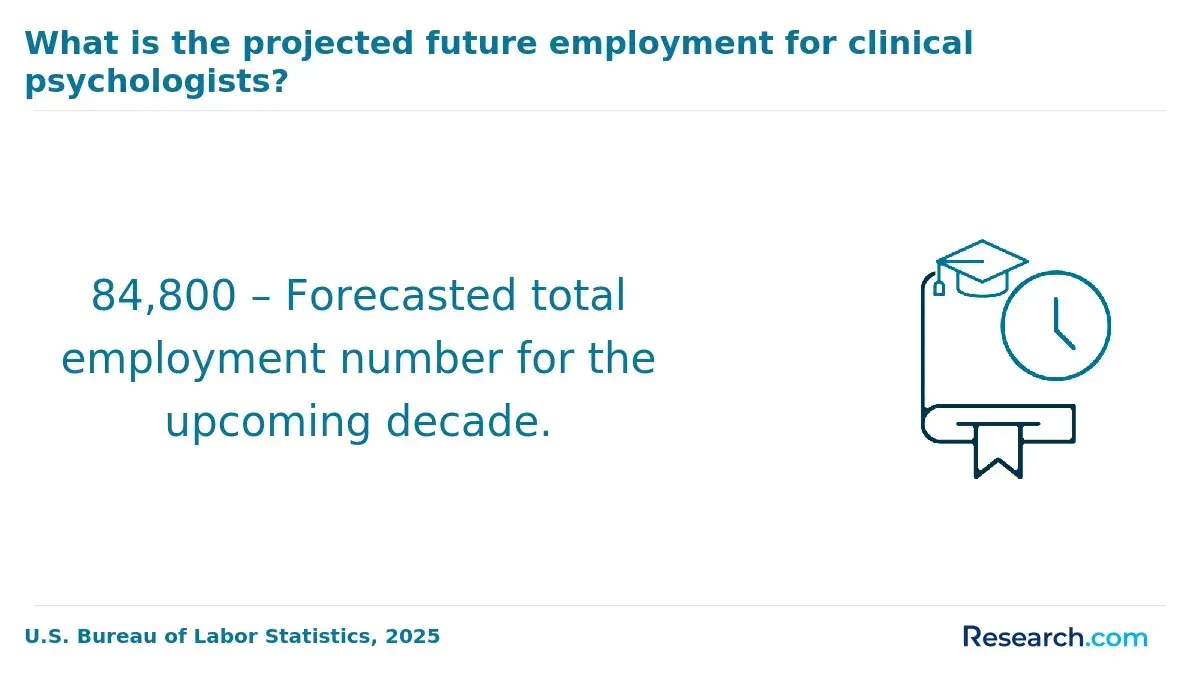
BLS data cited in this guide show that clinical and counseling psychologists account for 67,500 of the psychology workforce (BLS, 2023b), followed by school psychologists (62,200), other types of psychologists (56,300), and I/O psychologists (10,100).
For job outlook, clinical and counseling psychologists are expected to see an 8% employment increase from 2024 to 2034 (BLS, 2024). I/O psychologists show job growth at four percent, followed by all other psychologists at three percent and school psychologists at one percent.
The chart below shows U.S. Bureau of Labor Statistics data on the detailed distribution of psychologists in 2025.
Career paths with a master’s in psychology
A master’s in psychology can support more than one career direction, but it does not automatically qualify graduates for every role with “psychologist” in the title. Some roles require licensure, certification, supervised hours, or doctoral education. Students should match their program to a specific outcome before enrolling.
| Career direction | Relevant master’s focus | Important note |
| Research assistant or research coordinator | General psychology, experimental psychology, neuroscience, developmental psychology | Strong statistics and research methods training is important |
| Human resources or talent development | Industrial-organizational psychology, organizational psychology | Students with online HR degrees may find overlap with workplace psychology |
| Rehabilitation or human services | Rehabilitation counseling, human services counseling, applied psychology | Licensure and certification rules vary by role and state |
| School or educational support | Educational psychology, school psychology, child development | School-based credentials may be required |
| Forensic or legal-adjacent work | Forensic psychology, criminal justice-related psychology | May pair well with interests in law and justice systems |
| Doctoral preparation | Research-focused psychology, clinical preparation, PhD preparation | Look for thesis, faculty mentorship, and advanced research opportunities |
Although many students enter master’s programs after a psychology bachelor’s degree, others come from related fields such as sociology, philosophy, theology, anthropology, social work, education, and business. Interdisciplinary backgrounds can be valuable when paired with the right graduate specialization.
Current trends affecting psychology practice and graduate study
- Teletherapy and virtual care: Telehealth has changed how many mental health services are delivered, especially for clients in rural areas or those with mobility constraints. Students entering clinical or counseling-adjacent fields should understand telehealth ethics, privacy, and state practice rules.
- Artificial intelligence in mental health: AI tools are increasingly discussed in screening, documentation, treatment planning, and self-guided mental health apps. Students should learn both the benefits and limitations of these tools, especially around privacy, bias, and clinical responsibility.
- Workplace mental health: Employers are paying more attention to well-being, burnout, retention, and organizational culture, which creates opportunities for students interested in I/O psychology and workplace behavior.
- Integrated and holistic approaches: Many settings combine psychological science with mindfulness, behavioral health, health psychology, and wellness-oriented interventions.
- Cultural competence and diversity: Graduate psychology training increasingly emphasizes culturally responsive care, inclusive research, and ethical work with diverse populations.
- Neuroscience and cognitive-behavioral technologies: Advances in neuroscience and digital behavioral tools continue to influence assessment, intervention design, and understanding of cognitive and emotional disorders.
Is an online master’s in psychology a good investment?
An online master’s in psychology can be worthwhile when the program directly supports your next step and the cost is manageable. It is a weaker investment if the degree does not meet licensure expectations, lacks fieldwork support, or is too expensive relative to your likely career outcome.
Before enrolling, compare total program cost with career requirements, expected credential value, employer demand in your region, and whether you may need a doctorate afterward. Students interested in legal or justice-focused psychology can review master's in forensic psychology affordable online programs as one way to evaluate cost-conscious specialization options.
How accelerated online psychology programs can support career advancement
An accelerated online psychology degree may help students move more quickly into new roles, doctoral applications, or specialized graduate study. The format works best for students with strong time management skills and a clear career plan. Compressed courses can build momentum, but they also leave less room for falling behind.
For broader comparisons of shortened timelines, see this guide to an accelerated online psychology degree.
Challenges of online psychology master’s programs and how to handle them
Online psychology programs offer flexibility, but they also require discipline. Students must manage deadlines, participate actively, communicate clearly, and stay engaged without the routine of a physical campus.
| Common challenge | Why it happens | Better approach |
| Feeling isolated | Online students may have fewer casual interactions | Join study groups, attend live sessions, use office hours, and participate in forums |
| Technology problems | Courses rely on video platforms, learning systems, and digital submissions | Test tools early and know how to contact technical support |
| Time management issues | Flexible schedules can make procrastination easier | Block weekly study time and track all deadlines in one calendar |
| Fieldwork placement delays | Practicum sites may require approvals, background checks, or supervision agreements | Ask about placement support before enrolling and start planning early |
| Unclear clinical pathway | Program titles may not clearly show licensure outcomes | Contact the program and state licensing board before committing |
Students comparing future doctoral clinical pathways may also review affordable PsyD online programs, while remembering that doctoral-level training has additional practicum, internship, and licensure considerations.
How to succeed in an online master’s in psychology
- Create a weekly structure: Treat online study like a scheduled commitment, not optional free time. Reserve specific blocks for reading, lectures, writing, and discussion posts.
- Participate actively: Use live sessions, discussion boards, group projects, and faculty office hours to stay connected and deepen your understanding.
- Build professional communication habits: Clear writing and respectful online discussion are essential in psychology graduate study and professional practice.
- Organize research early: Use digital tools to manage articles, notes, citations, and assignment drafts.
- Use networking opportunities: Connect with faculty, classmates, alumni, and guest speakers. These relationships may lead to research opportunities, internships, or job leads.
- Seek practical experience: Volunteer work, internships, research assistant roles, and supervised projects can make your degree more valuable.
- Connect coursework to a career plan: If your goal is child psychology, counseling, I/O psychology, or doctoral study, choose papers, projects, and placements that support that direction.
If your goal is to work with children, this guide on how to become a child psychologist can help you understand the next steps.
Career support and job placement services to look for
Strong online psychology master’s programs often provide more than coursework. Career support may include resume reviews, mock interviews, alumni networking, practicum guidance, faculty mentoring, research opportunities, employer events, and job search support. Students should ask for specific examples rather than assuming that “career services” means individualized placement help.
Students interested in counseling-oriented roles can also compare the best mental health counseling master's programs to understand how counseling pathways differ from general psychology degrees.
Common mistakes to avoid when choosing an online psychology master’s
- Assuming every psychology master’s leads to licensure: Many programs are non-clinical or designed for research, applied work, or doctoral preparation.
- Looking only at tuition: Fees, travel, residencies, practicum costs, books, and delayed graduation can change the true price.
- Ignoring accreditation: Accreditation can affect financial aid, transfer credits, employer recognition, and licensure pathways.
- Choosing a specialization too quickly: Clinical psychology, counseling, school psychology, ABA, I/O psychology, and forensic psychology can lead to different credentials and jobs.
- Not checking state requirements: Licensure, certification, and supervised hours are controlled by state boards, not by marketing language on a program page.
- Underestimating online workload: Flexible does not mean easy. Short courses can require intensive weekly study.
- Failing to ask about field placement support: Students may struggle if they must find practicum sites on their own.
Questions to ask before applying
- Is this program designed for licensure, doctoral preparation, applied psychology work, or general graduate education?
- What institutional and specialized accreditation does the program hold?
- Does the program meet requirements in my state for the career I want?
- How many credits, units, or courses are required for graduation?
- What is the full cost, including fees, books, technology, travel, and practicum expenses?
- Are courses asynchronous, synchronous, hybrid, or residency-based?
- How are internships, practicums, or field experiences arranged?
- Can I transfer graduate credits into the program?
- What career services are available to online students?
- What percentage of students complete the program, and how long do they usually take?
References
- American Psychological Association. (2024, December). APA divisions. https://www.apa.org/about/division
- U.S. Bureau of Labor Statistics. (2025). Psychologists. https://www.bls.gov/ooh/life-physical-and-social-science/psychologists.htm
- U.S. Bureau of Labor Statistics. (2025). Psychologists: Occupational Outlook Handbook. BLS psychology occupational information
- U.S. Bureau of Labor Statistics. (2025). Psychologists: Occupational Outlook Handbook. https://www.bls.gov/ooh/life-physical-and-social-science/psychologists.htm
- U.S. Bureau of Labor Statistics. (2025). Psychologists: Occupational Outlook Handbook. BLS psychology occupational information
- College Factual. (2025). 2025 Psychology Degree Guide. https://www.collegefactual.com/majors/psychology/
Key Insights
- An online master’s in psychology is most valuable when it matches a specific goal, such as doctoral preparation, counseling-adjacent work, human factors, I/O psychology, rehabilitation counseling, ABA, or research.
- Do not assume a psychology master’s qualifies you for independent clinical practice. Licensure rules vary by state and often require specific coursework, supervised experience, exams, or doctoral education.
- Accreditation should be checked before cost, convenience, or ranking. Institutional accreditation is essential, and specialized accreditation may matter depending on your field.
- Online programs can still require live classes, campus visits, practicums, internships, and local site approvals. Confirm these requirements before enrolling.
- Affordability should be evaluated by total cost, not tuition alone. Include fees, travel, books, technology, residency requirements, and fieldwork expenses.
- The strongest applicants compare programs by outcomes: curriculum fit, faculty support, field placement help, licensure alignment, transfer policy, and career services.
Other Things You Should Know About Online Master’s Degree Programs in Psychology
For 2027, top online psychology master's programs typically require a bachelor’s degree in psychology or a related field, a minimum GPA (often 3.0 or higher), GRE scores, and relevant work experience. Some may also require letters of recommendation, a personal statement, and a resume or CV.
In 2027, several accredited universities offer recognized online master's degree programs in psychology, including Arizona State University, Pepperdine University, and University of Southern California. These programs are noted for their rigorous curriculum and flexible delivery formats, designed to meet professional standards in psychology.
Most of 2027's top online Master’s degree programs in psychology require completing between 36 to 48 credit hours. This can vary depending on the program's structure and whether it includes a thesis option or a practicum requirement.


