
2027 California Psychology Licensure Requirements – How to Become a Psychologist in California

Co-Founder and Chief Data Scientist
Becoming a licensed psychologist in California is a long, regulated process that usually requires a doctoral degree, supervised professional experience, state and national exams, background clearance, and ongoing continuing education. The rules matter because practicing psychology without the proper California authorization can delay your career, limit your employment options, or create legal and ethical problems.
This guide is for students planning a psychology career, doctoral candidates preparing for supervised practice, out-of-state psychologists considering relocation, and mental health professionals comparing psychology licensure with related credentials. You will learn the education path, exams, fees, renewal rules, career options, specialty choices, and common mistakes to avoid before investing years and money into this profession.
Quick answer: how do you become a licensed psychologist in California?
To become a licensed psychologist in California, you generally need a qualifying doctoral degree in psychology, at least 3,000 hours or two years of supervised professional experience, completion of required pre-licensure coursework, a background check, and passing scores on the Examination for Professional Practice in Psychology (EPPP) and the California Psychology Law and Ethics Examination (CPLEE). After approval, licensed psychologists renew their licenses every two years and complete continuing education.
| Requirement | California psychology licensure rule | Why it matters |
| Education | Qualifying doctoral degree in psychology | The doctoral degree is the core academic credential required for psychologist licensure. |
| Supervised experience | 3,000 hours or two years | California requires documented supervised practice before independent licensure. |
| Exams | EPPP and CPLEE | Applicants must show both professional psychology knowledge and California-specific law and ethics knowledge. |
| Background check | DOJ and FBI clearance through fingerprinting | The Board reviews applicant history as part of public protection. |
| Initial application fee | $236 | Applicants should budget for application, exam, licensure, and renewal costs. |
| Renewal cycle | Every two years | Psychologists must maintain an active license and meet continuing education rules. |
Key things you should know about California psychology licensure requirements
- California psychologist applicants need a doctoral degree in psychology and two years of supervised professional experience.
- The licensing process includes two exams: the national EPPP and the California-focused CPLEE.
- The initial application fee for a California psychology license is $236.
- All applicants must complete a background check during the application process.
- California psychologists renew their licenses on a two-year cycle.
- Clinical psychology, school psychology, and organizational psychology are among the specializations often associated with strong demand in California.
- Education requirements for California psychologist licensure
- Required psychology licensing exams in California
- California psychology license fees
- Step-by-step process to get licensed
- Career opportunities for licensed psychologists
- Using an out-of-state psychology license in California
- License renewal and continuing education
- Psychology specialties with strong demand in California
- Certifications that can strengthen psychology career optionsSpecialty comparison
- Ethical and legal standards for California psychologists
- Substance abuse counseling as an added practice area
- Emerging trends in California psychological practice
- BCBA certification and psychology careers
- California professional organizations for psychologists
- LPC licensure as a complementary credential
- Psychology and social work dual licensureCounseling credential comparison
- Reasons to specialize as a school psychologist
- Specializing in criminal psychology
- Common licensing challenges in California
- Financial assistance and loan forgiveness options
- Other California mental health licenses and certifications
- Educational pathways for future California psychologistsLicensure planning mistakes
- Affordable online PhD programs for working professionals
- Professional liability insurance for psychologists
- Starting with an online associate degree in psychologyEarly pathway planning
What California psychologists say about the profession
-
: "
"School psychology in California gives me the chance to support students academically and emotionally at the same time. The work can be intense because student needs are complex and communities are diverse, but helping young people access support and succeed in school makes the effort meaningful." — Sophie
"
-
: "
"Building a private practice in California has allowed me to shape services around the needs of my community. The independence is valuable, but it also requires constant learning, ethical decision-making, and careful business planning." — Donald
"
-
: "
"University research in child development lets me contribute to evidence that may improve services for children across the state. The opportunity to collaborate with researchers and translate findings into practice is one of the most rewarding parts of the work." — Brittany
"
What are the educational requirements to become a licensed psychologist in California?
California psychologist licensure is built around doctoral-level preparation. A bachelor’s degree may begin the path, and a master’s degree may help some students prepare for doctoral study, but independent psychologist licensure in California requires a qualifying doctorate, supervised experience, required coursework, and exams.
1. Start with a bachelor’s degree and complete psychology prerequisites
Most students begin with a bachelor’s degree in psychology or a closely related field. If your undergraduate major is not psychology, you may need additional prerequisite courses before entering a graduate psychology program.
A typical bachelor’s degree requires around 120 credits. Students sometimes compare psychology programs with other academic options, including programs at the best business colleges in California, but those planning psychology licensure should focus on prerequisites, research experience, statistics, abnormal psychology, developmental psychology, and faculty mentorship.
2. Decide whether a standalone master’s degree makes sense
A separate master’s degree in psychology is not always required before doctoral study. Some doctoral programs admit students after the bachelor’s degree, while others prefer or require graduate preparation. Standalone master’s programs commonly require between 30 and 40 credit hours and can often be completed in about two years of full-time study.
A master’s can be useful if you need stronger grades, research experience, clinical exposure, or clarity about specialization. It may be less efficient if your target doctoral programs do not require it and you are already a competitive applicant.
3. Earn a qualifying doctoral degree in psychology
The California Board of Psychology licenses psychologists, registered psychologists, and psychological assistants. For full psychologist licensure, applicants must hold a qualifying doctoral degree.
The two common doctoral routes are the Doctor of Psychology (PsyD) and the Doctor of Philosophy (PhD). A PsyD is usually more practice-oriented, while a PhD typically places greater emphasis on research. Both can lead to licensure when they meet California Board requirements.
California requires the psychology degree to come from a university accredited by an accrediting body recognized by the U.S. Department of Education. If your degree was earned outside North America, the Board requires an evaluation from a foreign credential evaluation service and may request additional documentation.
| Degree stage | Typical role in the licensure path | Decision point for students |
| Bachelor’s degree | Builds the academic foundation for graduate study | Choose courses and experiences that prepare you for doctoral admissions. |
| Standalone master’s degree | May strengthen preparation but is not always required | Consider it if you need research, clinical, or academic improvement before applying to doctoral programs. |
| PsyD | Doctoral route commonly focused on clinical practice | Often fits students who want applied assessment and therapy careers. |
| PhD | Doctoral route commonly focused on research and scholarship | Often fits students interested in research, teaching, clinical science, or academic careers. |
4. Complete 3,000 hours of supervised professional experience
California requires at least 3,000 hours, or two years, of supervised professional experience. Up to 1,500 hours may be completed before the doctoral degree is finished through a pre-doctoral internship, exempt setting, or registered psychological associate role.
The other 1,500 hours must be completed after the doctorate. Postdoctoral experience may be gained through a formal postdoctoral internship, an exempt setting, or work as a registered psychological associate.
5. Finish required pre-licensure coursework
California also requires specific coursework before licensure. These courses prepare psychologists for legally and ethically sensitive areas of practice.
- Human sexuality
- Alcohol or chemical dependency detection and treatment
- Child abuse assessment
- Spousal or partner abuse assessment
- Aging and long-term care training
- Suicide risk assessment and intervention
What exams do I need to pass to become a licensed psychologist in California?
California psychologist applicants must pass two major exams. One measures broad professional psychology knowledge, and the other focuses on California law, regulation, and ethics.
Examination for Professional Practice in Psychology (EPPP)
The EPPP is a national standardized examination administered by the Association of State and Provincial Psychology Boards (ASPPB). It assesses knowledge and skills needed for professional psychology practice.
The EPPP is offered at multiple testing locations around the country and costs around $600. Applicants may take it after completing the doctoral degree and obtaining at least 1,500 hours of supervised experience. The minimum passing score is 500 out of 800.
Some out-of-state psychologists with valid licenses may not need to retake the EPPP if they meet specified criteria.
California Psychology Law and Ethics Examination (CPLEE)
The CPLEE tests California-specific psychology law, professional regulation, and ethical practice standards, including concepts reflected in the American Psychological Association (APA) ethical code. It is administered through the California Board of Psychology process.
Applicants usually move to the CPLEE after passing the EPPP and meeting other licensing requirements. Psychologists who have held a license in good standing elsewhere for five years may be able to proceed directly to the CPLEE instead of taking the California Psychology Supplemental Examination.
| Exam | Primary focus | When it fits in the process | Important detail |
| EPPP | General professional psychology knowledge | After the doctorate and at least 1,500 supervised hours | Minimum passing score is 500 out of 800. |
| CPLEE | California psychology law and ethics | After EPPP approval and other requirements | Required for California-specific legal and ethical competence. |
What are the associated fees for obtaining a psychology license in California?
Psychology licensure in California involves multiple costs, not one single payment. Applicants should budget for application fees, examination fees, initial licensure, renewal, and potential delinquency or reactivation charges.
| Fee category | Fee item | Amount |
| Application | Initial Application | $236 |
| Application | CPLEE Application | $127 |
| Application | Initial Licensure | $231 |
| Examination | EPPP application fee | $50 |
| Examination | EPPP exam fee | $687.50 |
| Examination | CPLEE fee | $235.20 |
| Renewal | Renewal | $825 biennial |
| Renewal | Inactive | $241 biennial |
| Renewal | Renewal Delinquency Fee | $397.50 |
| Renewal | Inactive – Renewal Delinquency Fee | $110.50 |
| Reactivation | License Reactivation Fee | $23.92 per month from reactivation to scheduled renewal month plus $10 |
Fees can change, so applicants should verify current amounts with the California Board of Psychology before submitting forms or scheduling exams.
What is the step-by-step process for obtaining a psychology license in California?
The California licensure process is document-heavy. The most successful applicants usually track requirements early, keep signed supervision records, order transcripts in advance, and confirm that coursework meets Board expectations before applying.
Step 1: Submit your application to the California Board of Psychology
Initial applicants may apply online through BreEZe, the California Department of Consumer Affairs online licensing platform. Online applicants pay a $40 application fee. Applicants who submit by mail must include a $236 check payable to the Board of Psychology.
You may apply online or by mail. Required documents include the Supervision Agreement form, Verification of Experience form showing at least 1,500 hours of supervised experience, and official transcripts.
Step 2: Complete DOJ and FBI background clearance
Applicants must complete a background check. California uses Live Scan fingerprinting for this requirement, and applicants must disclose any criminal record when required.
A criminal record does not automatically prevent licensure. The Board considers whether a conviction is substantially related to the qualifications, functions, or duties of a psychologist.
Step 3: Understand rules for out-of-state and internationally trained psychologists
A psychologist licensed in another state or Canadian province may provide services in California temporarily for up to 30 days per year without a California psychology license, provided the applicable requirements are met. If the psychologist relocates to California or applies for California licensure, they may practice for up to 180 days while the application is being processed.
Those applicants must complete three major items: pass the required background check, finish specified coursework in areas such as substance abuse, child and spousal abuse, human sexuality, and aging, and complete one of the psychology licensing exam requirements.
Internationally educated psychologists must have their credentials reviewed by an organization that belongs to the National Association of Credential Evaluation Services.
Step 4: Pass the required California psychology licensing exams
Once the Board approves the application, applicants must pass the EPPP and then the CPLEE. Unofficial EPPP scores are usually available immediately after the test, while official results are mailed. Applicants who do not pass may retake the exam the following year. Many candidates use an EPPP practice exam as part of their study plan.
Step 5: Request the initial California psychology license
After passing both exams and completing required coursework, applicants submit the Request for Initial Licensure Form with the initial license fee. This form is provided after the CPLEE is completed.
The Board emails the California psychology license number within four to six weeks after approving the application. Psychologists who need certified license verification can request it from the California Board of Psychology.
Step 6: Plan for renewal before your first license cycle ends
Licensure is not finished once the license is issued. California psychologists must track continuing education, maintain records, and renew on schedule to avoid delinquency fees or inactive status.
What are the career opportunities available to licensed psychologists in California?
Licensed psychologists in California work in hospitals, private practices, schools, universities, government agencies, correctional settings, community clinics, and corporate environments. The right role depends on your doctoral training, supervised experience, specialty, risk tolerance, and preferred client population.
| Career path | Typical work | Median annual salary | Best fit for |
| Clinical Psychologist | Assessment, diagnosis, therapy, and treatment planning for people with mental health concerns | $111,401 | Professionals interested in direct clinical care and complex psychological conditions |
| Therapist | Individual, group, or family counseling; intake assessment; treatment planning | $80,598 | Clinicians who want ongoing client care and counseling-focused work |
| Psycho-diagnostician | Psychoeducational, developmental, and psychological testing and interpretation | $104,468 | Professionals who enjoy assessment, school collaboration, and diagnostic reports |
| Human Resources Manager | Staffing strategy, interviews, employee development, benefits administration, and policy enforcement | $131,294 | Psychology graduates who prefer organizational leadership over clinical practice |
| Organizational Psychologist | Workplace research, employee engagement, performance systems, training, and organizational improvement | $150,356 | Professionals interested in applying psychology to business and workforce performance |
Clinical Psychologist
Clinical psychologists help clients address mental health concerns that may range from short-term stressors to severe and chronic psychological conditions. Their work often includes diagnostic assessment, psychotherapy, crisis planning, and collaboration with other healthcare professionals.
Median annual salary: $111,401
Therapist
Therapists support individuals, couples, families, or groups through mental health challenges. They gather information about symptoms, stressors, personal history, and functioning, then create treatment plans tailored to client needs.
Median annual salary: $80,598
Psycho-diagnostician
Psycho-diagnosticians, sometimes called diagnostician/therapists, administer and interpret psychological, psychoeducational, and developmental assessments. Their evaluations can help identify learning, emotional, developmental, or behavioral concerns and guide support plans in schools and other settings.
Median annual salary: $104,468
Human Resources Manager
Human resources managers oversee employee-related operations in organizations. Their responsibilities may include workforce planning, interviewing, hiring, benefits administration, leave processes, staff development, and policy compliance.
Median annual salary: $131,294
Organizational Psychologist
Organizational psychologists, also known as industrial-organizational psychologists, use psychological science to improve workplace productivity, employee well-being, safety, motivation, and organizational effectiveness. They may support recruitment, training, conflict resolution, leadership development, and performance systems.
Median annual salary: $150,356
The following preserved resource provides additional detail on industries that employ industrial-organizational psychologists and their annual wages.
Which industries do industrial-organizational psychologists work in?
Can I use my psychology license from another state to practice in California?
Usually, an out-of-state psychology license does not automatically authorize full independent practice in California. California has limited temporary practice rules and endorsement pathways, but psychologists who want to live and practice in the state should plan to meet California Board requirements.
- Temporary practice: Psychologists licensed in other states may provide psychological services in California for up to 30 days per year when they satisfy the required conditions and notify the Board as required.
- Licensure by endorsement: Psychologists licensed in good standing in another jurisdiction with comparable standards may qualify for endorsement. Applicants must submit license verification, pass the CPLEE, and satisfy other Board requirements.
- Supervised practice while applying: During the California licensure process, eligible applicants may practice under the supervision of a California licensed psychologist for up to 180 days.
| Situation | What California allows | What to check before practicing |
| Short-term service in California | Temporary practice up to 30 days per year | Notification rules, eligibility, and service limits |
| Relocating to California | California licensure application is usually needed | Coursework, background check, CPLEE, and Board documentation |
| Application pending | Supervised practice may be available for up to 180 days | Supervisor qualifications and permitted scope |
How often do I need to renew my psychology license in California?
California psychologists renew their licenses every two years. Renewal is meant to keep licensed professionals current with law, ethics, clinical developments, and professional standards.
Continuing education requirements
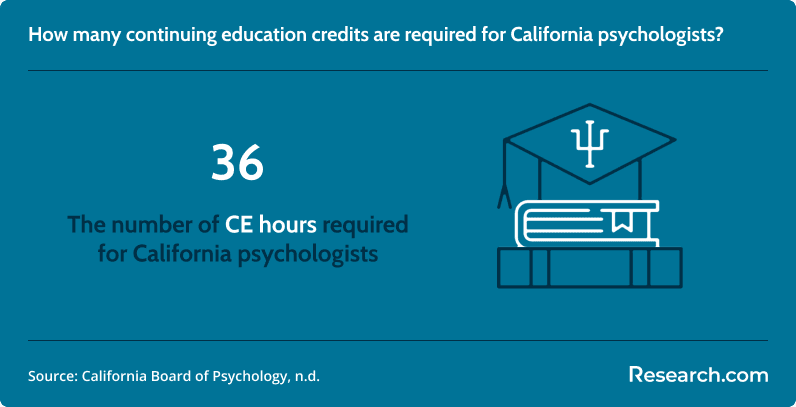
Psychologists must complete 36 credit hours of approved continuing education during each two-year license cycle. At least 4 hours must focus on Law and Ethics. The remaining 32 hours may cover general psychology topics or material related to the psychologist’s practice area.
Up to 27 hours, or 75%, may be completed through online learning or independent study.
The remaining hours must come from in-person workshops, conferences, or other approved formats.
| Renewal requirement | California rule | Planning tip |
| Renewal cycle | Every two years | Track your renewal date as soon as your license is issued. |
| Total continuing education | 36 credit hours | Do not wait until the final weeks of the cycle. |
| Law and Ethics | At least 4 hours | Prioritize California-specific updates. |
| Online or independent study limit | Maximum of 27 hours, or 75% | Make sure your remaining hours meet approved format rules. |
Which psychology specialties are in high demand in California?
California’s large and diverse population creates need across many psychology practice areas. Demand can vary by region, employer, insurance environment, school district, and specialty training, so students should evaluate both statewide trends and local opportunities before choosing a specialization.
Clinical Psychology
Clinical psychologists remain important in individual therapy, couples therapy, family therapy, group treatment, assessment, and integrated healthcare. Subfields such as child and adolescent psychology and geriatric psychology can be especially relevant because they address distinct developmental and life-stage needs.
School Psychology
School psychologists support student mental health, learning, behavioral functioning, and academic success. Their work often includes assessments, counseling, teacher consultation, parent collaboration, and school-based intervention planning.
Neuropsychology
Neuropsychologists assess cognition, memory, behavior, and brain-related functioning. Their expertise is valuable in cases involving neurological disorders such as Alzheimer’s disease and dementia, as well as other conditions affecting cognitive performance.
Forensic Psychology
Forensic psychologists apply psychological knowledge in legal contexts. They may evaluate competency, assess psychological factors in criminal or civil matters, consult with attorneys or courts, and work in correctional or public safety settings.
Organizational Psychology
Organizational psychologists help employers improve workforce systems, employee engagement, workplace culture, leadership, conflict management, training, and performance. This path often appeals to psychology professionals who prefer organizations over traditional therapy settings.
| Specialty | Common setting | Choose this if you want to... | Consider carefully if... |
| Clinical psychology | Clinics, hospitals, private practice, integrated care | Provide therapy, assessment, and treatment planning | You are uncomfortable with high clinical responsibility or documentation demands |
| School psychology | K-12 schools and education agencies | Work with students, families, teachers, and school systems | You prefer adult-only clinical work or independent private practice |
| Neuropsychology | Medical centers, rehabilitation settings, specialty clinics | Focus on brain-behavior relationships and cognitive assessment | You do not want extensive testing and report-writing responsibilities |
| Forensic psychology | Courts, correctional settings, legal consulting, public agencies | Apply psychology to legal questions and evaluations | You want a purely therapeutic relationship with clients |
| Organizational psychology | Companies, consulting firms, government, HR departments | Use psychology to improve workplaces and workforce outcomes | You want licensure-centered clinical practice as your main work |
How can psychology graduates enhance their career prospects through additional certifications?
A psychology degree can support many career directions, but targeted certifications may help graduates show specialized knowledge in human resources, behavior analysis, public health, project leadership, or forensic work. The best choice depends on the role you want, not simply on adding letters after your name.
- Human Resources Certifications: Psychology graduates pursuing HR roles may consider credentials such as the Society for Human Resource Management (SHRM) Certified Professional or the Professional in Human Resources (PHR), which signal knowledge of recruitment, employee relations, and organizational behavior.
- Certified Behavior Analyst (CBA): This credential may interest graduates who want to work with behavioral challenges in educational or therapeutic settings. CBAs help design and apply behavior intervention plans.
- Certified Health Education Specialist (CHES): Graduates interested in public health can use this certification to demonstrate preparation in planning, delivering, and evaluating health education programs.
- Project Management Professional (PMP): Psychology graduates moving into consulting, organizational development, or change management may benefit from a credential that validates project planning and team leadership skills.
- Certified Forensic Psychologist: Graduates interested in criminal justice may use forensic-focused preparation to strengthen readiness for forensic analysis, criminal profiling, or work with law enforcement agencies.
| Credential direction | Career goal it may support | Key caution |
| HR certification | Human resources, talent development, employee relations | It does not replace clinical licensure. |
| Behavior analysis certification | Autism services, behavior intervention, educational support | Confirm the exact credential required by employers and regulators. |
| Health education certification | Community health, prevention programs, public health education | It may lead away from traditional psychologist practice. |
| Project management certification | Consulting, organizational change, program leadership | It is most useful when paired with relevant work experience. |
| Forensic certification | Legal, correctional, or forensic consulting roles | Forensic work often requires specialized supervision and strong legal knowledge. |
What are the ethical codes of conduct that licensed psychologists in California must follow?
California psychologists must follow both professional ethics and state law. Ethical practice is not limited to avoiding misconduct; it also includes competence, informed consent, confidentiality, accurate documentation, appropriate boundaries, and careful handling of risk.
- American Psychological Association (APA) Ethical Principles of Psychologists and Code of Conduct: The APA code outlines broad professional values and standards involving competence, privacy, integrity, client welfare, assessment, therapy, teaching, research, and professional relationships.
- California Business and Professions Code (BPC) and California Code of Regulations (CCR): These state rules define legal requirements for California practice, including scope of practice, records, advertising, required reporting, disciplinary standards, and other licensure obligations.
Can integrating substance abuse counseling enhance my psychology practice in California?
Adding substance abuse counseling preparation can be valuable for psychologists who frequently work with co-occurring mental health and substance-related concerns. This pathway may expand assessment and treatment skills, strengthen referral coordination, and help clinicians serve communities where addiction and mental health needs overlap. If this direction fits your goals, review California substance abuse counselor requirements.
How are emerging trends reshaping psychological practice in California?
California psychological practice is being influenced by telehealth, integrated care, digital documentation tools, data-informed treatment planning, and growing coordination between behavioral health and medical services. These changes can improve access and efficiency, but they also require careful attention to privacy, informed consent, technology competence, and equity.
Some roles, including work as a health psychologist, increasingly combine traditional psychological services with prevention, chronic disease support, behavior change, and interdisciplinary healthcare collaboration.
Should I pursue a BCBA certification to complement my psychology career in California?
BCBA-related preparation may be useful if your psychology career focuses on behavior intervention, autism services, developmental disabilities, school consultation, or applied behavior analysis. It is not necessary for every psychologist, but it can make sense when your target employers or clients need behavior-analytic expertise. For a detailed credential pathway, see how to become a BCBA in California.
Are there any professional organizations specifically for psychologists in California?
Yes. California psychologists can join state, regional, and specialty organizations for continuing education, advocacy, networking, mentorship, and practice resources. Membership is not the same as licensure, but it can help professionals stay connected and informed.
- California Psychological Association (CPA): The CPA represents over 8,000 psychologists and offers continuing education, conferences, professional advocacy, and policy engagement.
- Los Angeles Psychological Association (LAPA): LAPA serves psychologists in Los Angeles County through networking, professional development, and public education activities.
- San Diego Psychological Association (SDPA): SDPA supports psychologists in San Diego County with resources, continuing education, conferences, public information, and advocacy for the profession.
- California Association of School Psychologists (CASP): CASP focuses on school psychologists and advocates for student mental health, school-based services, and professional development in educational settings.
How can obtaining an LPC license complement my psychology career in California?
A Licensed Professional Counselor pathway can complement psychology training for professionals who want broader counseling options, interdisciplinary practice, or a different route into mental health service delivery. It does not replace psychologist licensure, but it may be useful when your career goals include counseling-focused roles or expanded service settings. For requirements and steps, use this guide to becoming an LPC in California.
Can dual licensure in psychology and social work enhance my career prospects in California?
Dual preparation in psychology and social work can be helpful for professionals who want to combine clinical expertise with systems-level, community-based, or social service practice. This combination may fit integrated care settings, public agencies, community mental health programs, and leadership roles that require both individual treatment knowledge and resource coordination. To compare pathways, read what degree you need to be a social worker in California.
Why should I specialize as a school psychologist in California?
School psychology is a strong fit for professionals who want to work at the intersection of mental health, learning, development, behavior, and educational systems. School psychologists assess student needs, collaborate with educators and families, support interventions, and help schools respond to academic and emotional challenges. If this is your target pathway, review how to become a school psychologist in California.
How can I specialize in criminal psychology in California?
Criminal psychology requires more than a general interest in crime. Students and professionals should pursue training in forensic assessment, legal standards, criminal behavior, report writing, ethics, and work with courts, correctional systems, or public safety agencies. Supervised experience in legally involved settings is especially important. For a more focused roadmap, see how to become a criminal psychologist in California.
What are the common challenges faced during the licensure process in California?
California psychology licensure is achievable, but delays and mistakes are common. The process requires academic planning, accurate documentation, exam preparation, and financial readiness.
- Documenting supervised experience: Applicants must complete 3,000 hours of supervised practice and ensure that supervisors, settings, agreements, and verification forms meet Board standards.
- Preparing for the CPLEE: The CPLEE requires California-specific legal and ethical knowledge, so general psychology training alone is not enough.
- Waiting on application processing: Processing can take time, particularly when documents are missing, transcripts are delayed, or the Board needs clarification.
- Managing costs: Applicants must budget for application fees, exam fees, initial licensure, continuing education, and future renewals.
- Understanding detailed regulations: California’s requirements are specific. Incomplete forms, missing coursework, or misunderstood supervision rules can slow approval.
- Balancing work, study, and personal life: Doctoral study, supervised practice, exam preparation, and employment can create burnout without a realistic plan.
| Common mistake | Why it causes problems | Better approach |
| Choosing a program without checking accreditation | The degree may not satisfy California licensing expectations. | Confirm institutional accreditation and Board compatibility before enrolling. |
| Assuming all supervised hours will count | Hours may be rejected if the setting, supervisor, or paperwork is not compliant. | Review supervision rules before starting and keep signed documentation. |
| Focusing only on tuition | Exam fees, licensure fees, relocation, internships, and lost income also affect cost. | Build a full licensure budget, not just a school budget. |
| Waiting too long to study law and ethics | The CPLEE covers California-specific material that may be unfamiliar. | Study California law and ethics early in the application timeline. |
| Relying only on rankings | A highly ranked program may still be a poor fit for your specialization or location. | Compare accreditation, faculty, practicum sites, match outcomes, cost, and support. |
| Assuming salary outcomes are guaranteed | Pay varies by specialty, location, employer, experience, and practice model. | Use salary figures as planning benchmarks, not promises. |
Students who want a faster entry into psychology-related work may explore options such as the easiest psychology degree programs, but those programs should be viewed as early academic or career steps rather than substitutes for doctoral psychologist licensure.
Are there financial assistance or loan forgiveness programs for psychologists in California?
Some psychologists may qualify for federal or state support tied to service in underserved communities, public service, or targeted workforce needs. Availability depends on employer type, location, role, funding rules, and individual eligibility. Students should speak with financial aid offices, employers, professional associations, and loan servicers before assuming a program will apply to their situation.
Professionals considering additional counseling credentials may also compare costs and funding options related to California LPC license requirements, especially if their long-term goal includes broader counseling practice.
What other types of licenses or certifications are available to mental health professionals in California?
Psychologist licensure is only one mental health pathway in California. Depending on your career goals, you may also consider counseling, marriage and family therapy, social work, substance abuse counseling, behavior analysis, school psychology, or related credentials.
For example, professionals who want to work with couples and families may review the MFT license in California. Comparing licenses early can prevent choosing a doctoral route when a different mental health credential would better match your desired scope, timeline, and practice setting.
What are the top educational pathways for aspiring psychologists in California?
The strongest educational pathway depends on your starting point. A high school graduate, a bachelor’s student, a master’s graduate, and a licensed psychologist from another state will not follow the same timeline. The key is to choose accredited programs that support your target specialty and meet California’s licensure expectations.
| Starting point | Likely next step | What to prioritize |
| No college degree yet | Associate or bachelor’s degree in psychology or a related field | Transfer options, affordability, introductory psychology, statistics, and research exposure |
| Bachelor’s degree student | Doctoral program or master’s preparation | Research experience, faculty recommendations, clinical exposure, and prerequisites |
| Master’s graduate | Doctoral psychology program | Fit with PsyD or PhD goals, practicum opportunities, and licensure alignment |
| Doctoral student | Supervised experience and exams | Internship quality, documentation, EPPP preparation, and CPLEE readiness |
| Out-of-state psychologist | California endorsement or licensure review | License verification, CPLEE, background check, and California coursework |
Students comparing schools should look beyond reputation. Important factors include accreditation, faculty expertise, research opportunities, practicum and internship placements, cost, geographic access, student support, and alignment with specialties such as clinical psychology, neuropsychology, forensic psychology, and school psychology.
If you are comparing in-state options, start with this resource on the best colleges for psychology in California. Use it as a starting point, then verify each program’s accreditation, doctoral placement outcomes, supervised training opportunities, and fit with California licensure.
Questions to ask before choosing a psychology program
- Is the institution accredited by a body recognized by the U.S. Department of Education?
- Does the curriculum support California pre-licensure coursework requirements?
- What practicum, internship, and postdoctoral placement support is available?
- How does the program prepare students for the EPPP and CPLEE?
- What specialties do faculty supervise or research?
- How much will the full pathway cost, including fees, exams, relocation, and time out of the workforce?
- Do graduates commonly pursue licensure in California?
Are affordable online PhD programs a viable option for working professionals in California?
Online doctoral study can be attractive for working professionals, but California psychologist licensure requires careful program evaluation. Before enrolling, confirm accreditation, doctoral requirements, practicum and internship expectations, supervised experience compatibility, and whether the program supports California licensing goals.
Affordability matters, but the least expensive program is not always the best choice if it weakens internship options or creates licensure barriers. Working professionals can compare affordable online PhD programs in psychology while verifying that each option fits their intended California pathway.
Is professional liability insurance essential for licensed psychologists in California?
Professional liability insurance is an important risk-management tool for psychologists, especially those in private practice, assessment work, telehealth, consulting, or higher-risk clinical settings. It can help protect against claims related to alleged professional errors, documentation disputes, confidentiality issues, or treatment decisions.
Psychologists should compare policies based on practice setting, specialty, coverage limits, exclusions, telehealth coverage, employer coverage, and whether the policy follows them across settings. Professionals considering other credential pathways can also compare risk and scope issues through resources such as the shortest path to become a counselor in California.
How to kickstart your psychology career with an online associate degree?
An online associate degree in psychology can be a practical first step if you are not ready for a doctoral pathway. It will not qualify you to become a licensed psychologist in California, but it can introduce core concepts, help you test your interest in the field, and create a transfer route into a bachelor’s program.
Students considering this route can explore a 2-year psychology degree online as an early-stage option before committing to advanced study.
- Complete the online associate degree: Introductory coursework usually covers human development, psychological theories, research methods, and foundational behavioral science.
- Use the degree for entry-level exposure: Graduates may seek support roles in social services, human resources, mental health support, case management, or related fields where knowledge of human behavior is useful.
- Transfer into a bachelor’s program: Many associate programs are designed to support transfer, allowing students to continue toward a bachelor’s degree in psychology or a related field.
- Explore related specializations early: Students can use lower-division coursework to decide whether they are more interested in counseling, healthcare, education, HR, substance abuse services, or research.
- Build transferable skills: Communication, research literacy, critical thinking, observation, and cultural awareness are useful across psychology-related careers.
An associate degree is best viewed as a launchpad. If your goal is California psychologist licensure, you will still need to progress through a bachelor’s degree, doctoral education, supervised experience, exams, and Board approval.
Key insights
- California psychologist licensure is a doctoral-level pathway that requires a qualifying psychology doctorate, 3,000 supervised hours, required coursework, background clearance, and two exams.
- The EPPP tests broad psychology knowledge, while the CPLEE focuses on California law and ethics. Applicants should prepare for both, not just the national exam.
- Fees extend beyond the $236 initial application fee. Candidates should budget for EPPP, CPLEE, initial licensure, biennial renewal, and continuing education.
- Out-of-state psychologists usually cannot practice indefinitely in California using only another state’s license, although temporary practice, endorsement, and supervised practice options may apply.
- Specialty choice matters. Clinical, school, neuropsychology, forensic, and organizational paths differ in settings, daily work, documentation, and long-term career fit.
- Accreditation, supervised experience documentation, and California-specific coursework are common failure points. Verify requirements before enrolling, relocating, or starting supervised hours.
- Related credentials such as LPC, MFT, substance abuse counseling, BCBA-related preparation, or social work may fit some career goals better than psychologist licensure.
- An online associate degree can start the journey, but it does not lead directly to psychologist licensure in California.
Related Articles for Nearby States
- 2027 Nevada Psychology Licensure Requirements – How to Become a Psychologist in Nevada
- 2027 Oregon Psychology Licensure Requirements – How to Become a Psychologist in Oregon
- 2027 Arizona Psychology Licensure Requirements – How to Become a Psychologist in Arizona
- 2027 Idaho Psychology Licensure Requirements – How to Become a Psychologist in Idaho
- 2027 Utah Psychology Licensure Requirements – How to Become a Psychologist in Utah
- 2027 Washington Psychology Licensure Requirements – How to Become a Psychologist in Washington
- 2027 New Mexico Psychology Licensure Requirements – How to Become a Psychologist in New Mexico
- 2027 Colorado Psychology Licensure Requirements – How to Become a Psychologist in Colorado
- 2027 Montana Psychology Licensure Requirements – How to Become a Psychologist in Montana
- 2027 Wyoming Psychology Licensure Requirements – How to Become a Psychologist in Wyoming
Sources Used
- U.S. Bureau of Labor Statistics. (2025). Psychologists. https://www.bls.gov/ooh/life-physical-and-social-science/psychologists.htm
- U.S. Bureau of Labor Statistics. (2025). Psychologists: Occupational Outlook Handbook. https://www.bls.gov/ooh/life-physical-and-social-science/psychologists.htm
- Precedence Research. (2025). Behavioral Health Market Size to Hit USD 330.35 Billion By 2034. https://www.precedenceresearch.com/behavioral-health-market
- California Board of Psychology (2024). 2024 Fee Schedule. https://www.psychology.ca.gov/applicants/feeschedule_2024.shtml
- California Board of Psychology (n.d.). How to Apply for Licensure as a Psychologist (In-State Applicants). https://www.psychology.ca.gov/applicants/instructions.shtml
- California Board of Psychology (n.d.). Reactivating an Inactive License. https://www.psychology.ca.gov/licensees/license_react.shtml
- Salary.com (2024 February 26). Human Resources Manager Salary in California. https://www.salary.com/research/salary/benchmark/human-resources-manager-salary/ca
- Salary.com (2024 February 26). Mental Health Therapist Salary in California. https://www.salary.com/research/salary/listing/mental-health-therapist-salary/ca
- Salary.com (2024 February 26). Organizational Psychologist Salary in California. https://www.salary.com/research/salary/benchmark/organizational-psychologist-salary/ca
- ZipRecruiter (2024 March 5). Clinical Psychologist Salary in California. https://www.ziprecruiter.com/Salaries/Clinical-Psychologist-Salary--in-California
- ZipRecruiter (2024 March 5). Diagnostician Salary in California. https://www.ziprecruiter.com/Salaries/Diagnostician-Salary--in-California
Other Things You Should Know About The California Psychology Licensure Requirements
The first step to becoming a licensed psychologist in California in 2027 is to complete a doctoral degree in psychology from an accredited institution. This foundational education is essential to meeting the state's rigorous licensure requirements and initiating a career in psychology.
Licensed psychologists in California must complete 36 hours of continuing education biennially to maintain licensure. This includes courses on ethics, laws, and cultural competence. The California Board of Psychology mandates compliance with these requirements for license renewal every two years in 2027.
Board certification is not a mandatory requirement for practicing psychologists in California. However, it is a prestigious credential that can enhance a psychologist's professional reputation and demonstrate expertise in a specialized area, potentially influencing career opportunities and client trust.


