
2027 Best Online Nursing Programs in Texas – Accredited RN to BSN Programs

Co-Founder and Chief Data Scientist
Choosing an online nursing program in Texas is not just a question of convenience. It affects your licensure eligibility, clinical placement options, total cost, ability to keep working, and long-term career path. Texas has only about seven registered nurses for every 1,000 locals, and demand is expected to stay strong as chronic disease rates rise and the population ages through 2032.
This guide is designed for current RNs considering an RN to BSN program, prospective nursing students comparing online and campus options, and Texas healthcare workers planning their next credential. You will learn what online nursing programs in Texas include, how long they take, what they cost, how clinical requirements work, which schools offer strong RN to BSN options, and how to choose a program that fits your goals without risking licensure or transfer-credit problems.
Quick answer: Are online nursing programs in Texas worth considering?
Yes, online nursing programs in Texas can be a strong option if the program is accredited, approved for your intended licensure pathway, transparent about clinical requirements, and flexible enough for your work schedule. They are especially useful for licensed RNs who want to earn a BSN while continuing to work. However, students should not assume “online” means fully remote; nursing programs often include in-person clinical, practicum, simulation, or community-based requirements.
What are the benefits of getting an online nursing degree in Texas?
- Flexible career advancement: Online nursing programs let working nurses build academic credentials without leaving their current jobs or relocating.
- Broader career options: A nursing degree in Texas can support work in hospitals, public health agencies, schools, home health, hospice, telehealth, informatics, leadership, and specialty care.
- Strong state demand: Texas continues to need nurses across many care settings, and the state combines competitive nursing opportunities with a cost of living index of 93.00.
- Pathway to graduate study: A BSN can prepare nurses for advanced programs, including MSN, nurse practitioner, leadership, education, and dual-degree options.
What can I expect from an online nursing degree in Texas?
An online nursing degree in Texas usually combines remote coursework with local or arranged practical experiences. RN to BSN programs are often the most flexible because students already hold RN licensure and clinical experience. Pre-licensure programs, by contrast, require more hands-on learning and must prepare students for NCLEX-RN eligibility.
Students can expect courses in evidence-based practice, health assessment, leadership, community health, informatics, ethics, population health, and care coordination. Many programs use asynchronous coursework, discussion boards, virtual simulations, faculty feedback, and practicum projects completed in the student’s community.
Nursing is the most common major among nurses, selected by 79% of nurses on Zippia. Related online degree options may include health science, nursing science, or public health, but students who want RN licensure or advancement in clinical nursing should verify that the program aligns with Texas Board of Nursing requirements.
Where can I work with an online nursing degree in Texas?
Graduates of online nursing programs in Texas can work in many areas of healthcare, including pediatrics, oncology, geriatrics, community health, care coordination, school health, telehealth, home care, hospice, nursing education, research support, and health administration. Some nurses also move into consulting, case management, quality improvement, or nursing-related business roles.
The U.S. Bureau of Labor Statistics projects that employment of registered nurses will grow 6% nationwide by 2032. In Texas, the labor market is especially active, with projected openings across registered nursing, licensed vocational nursing, nurse practitioner roles, nursing assistants, and nurse anesthetists.
How much can I make with an online nursing degree?
Registered nurses in Texas earn an average annual salary of $79,830 a year, which is below the national average. Actual pay varies by location, experience, specialty, shift differential, employer type, and credentials. The lowest 10% of Texas RN earners make $61,950 or less, while the highest 10% earn more than $105,270.
Salary should be evaluated alongside cost of living. Texas has a cost of living index of 93.00, meaning everyday expenses may be lower than in many other states. For nurses comparing job offers, take-home value can depend as much on housing, commute, benefits, overtime rules, and tuition reimbursement as on base salary alone.
- Best Online Nursing Programs in Texas for 2027
- How long does an online nursing program in Texas take?
- Online vs. on-campus nursing programs in Texas
- Average cost of online nursing programs in Texas
- Financial aid options for Texas nursing students
- Online nursing program prerequisites
- How online nursing students complete clinical requirements
- Common online nursing courses
- Online nursing specializations
- How to choose the best online nursing program in Texas
- How to obtain nursing licensure in Texas
- Career paths for online nursing graduates in Texas
- Dual degree options for nursing leadership
- Texas job market for online nursing graduates
- Accelerated nurse practitioner programs
- Job placement and career advancement support
- LVN pathways in Texas nursing
- Trends shaping online nursing education
- Complementary healthcare roles for nurses
- Networking opportunities for nursing students and nurses
- Licensure exam success rates
- How to transition from LPN to RN or BSN in Texas
- Steps to secure a nursing license after graduation
- Challenges online nursing students face
- Advanced practice roles in Texas nursing
- Nursing certifications that can improve career prospects
Key Findings
- Becoming a nurse in Texas typically takes two to four years: ADN programs usually take about two years, while BSN programs usually take about four years.
- Online nursing programs from Texas schools can begin at about $200 per credit, though total cost depends on degree level, transfer credits, residency rules, and fees.
- RN to BSN coursework commonly includes advanced nursing practice, evidence-based nursing, leadership, community health, and healthcare technology.
- Online nursing education is not always fully remote because clinical, practicum, simulation, or field experiences may still require face-to-face participation.
- Accredited online nursing programs in Texas are held to recognized academic standards and can be comparable in rigor to campus-based programs.
- Texas demand remains strong: registered nurse roles are projected to grow by 17.1% until 2032.
List of the Best Online Nursing Programs for 2027
How do we rank schools?
For nurses planning to move into BSN-level, leadership, specialty, or graduate-study pathways, program choice matters. Research.com evaluates online nursing programs using data from established sources, including the IPEDS database, Peterson’s database, the Distance Learning Licensed Data Set from the College Scorecard database, and the National Center for Education Statistics. Programs are reviewed for factors such as academic quality, outcomes, reputation, and student fit. You can review the full process in our methodology section.
1. University of Texas at Arlington
The University of Texas at Arlington offers an online Registered Nurse to Bachelor of Science in Nursing program for working RNs who want stronger preparation in research-based nursing, leadership, clinical reasoning, and liberal arts-informed professional practice.
- Program Length: As few as nine months
- Tracks/concentrations: None specified
- Estimated Cost: $257 per credit hour
- Required Credits to Graduate: Varies
- Accreditation: Commission on Collegiate Nursing Education (CCNE)
2. University of Texas at Tyler
The University of Texas at Tyler’s online RN-BSN degree track is built for licensed nurses who want to complete a BSN while staying employed. Coursework emphasizes health assessment, care coordination, nursing leadership, and skills that support advancement in clinical and healthcare settings.
- Program Length: As little as 12 months
- Tracks/concentrations: None specified
- Estimated Cost: $9,895 (total cost)
- Required Credits to Graduate: 30 hours
- Accreditation: Commission on Collegiate Nursing Education (CCNE)
3. University of Mary Hardin-Baylor
The University of Mary Hardin-Baylor provides an online Registered Nurse to Bachelor of Science program for practicing RNs. The 30-credit curriculum uses a flexible format with competency-based assessments, faculty engagement, and support from success coaches.
- Program Length: As few as 10 months
- Tracks/concentrations: None specified
- Estimated Cost: $500 per credit hour
- Required Credits to Graduate: 30 credit hours
- Accreditation: Commission on Collegiate Nursing Education (CCNE)
4. Texas A&M University
Texas A&M University’s online RN-to-BSN program serves registered nurses who already hold an associate degree in nursing. The 30-credit-hour program is fully online, with practicum experiences completed in the student’s community. Applicants need an unencumbered RN license and required prerequisite coursework, and students may finish the curriculum in three or four semesters depending on entry term.
- Program Length: One to two years
- Tracks/concentrations: None specified
- Estimated Cost: $1,530 per credit hour (in-state rate), $5,268 per credit hour (out-of-state rate)
- Required Credits to Graduate: 30 credit hours
- Accreditation: Commission on Collegiate Nursing Education (CCNE)
5. Texas Woman’s University
Texas Woman's University offers an online RN-BSN program for RNs who want to balance BSN completion with full-time employment. The program uses 7-week courses and integrates clinical learning through class-based and capstone projects.
- Program Length: Two to three semesters
- Tracks/concentrations: None specified
- Estimated Cost: $238 per credit hour
- Required Credits to Graduate: 60 semester credit hours
- Accreditation: Commission on Collegiate Nursing Education (CCNE)
6. Texas Tech University
Texas Tech University’s RN to BSN program is intended for registered nurses with associate degrees who want to complete a bachelor’s degree online. The curriculum runs over two to three semesters and focuses on evidence-based care, critical thinking, holistic practice, and community-based practicum experiences.
- Program Length: Two to three semesters
- Tracks/concentrations: None specified
- Estimated Cost: $915 per credit (in-state rate), $1,335 per credit (out-of-state rate)
- Required Credits to Graduate: 30 semester credit hours
- Accreditation: Commission on Collegiate Nursing Education (CCNE)
7. West Texas A&M University
The West Texas A&M RN to BSN program is delivered fully online for working nurses who need geographic flexibility. Practicum case studies and applied experiences are included throughout the program, but students do not have to attend campus in person.
- Program Length: One to two years
- Tracks/concentrations: None specified
- Estimated Cost: $8,500 (total program cost)
- Required Credits to Graduate: 131 - 133 hours
- Accreditation: Commission on Collegiate Nursing Education (CCNE)
8. Midwestern State University
Midwestern State University’s RN to BSN program uses an online format that allows registered nurses to complete BSN coursework in three semesters while maintaining employment. The 27-credit program includes faculty mentorship and preparation for broader professional and leadership responsibilities.
- Program Length: As few as three semesters
- Tracks/concentrations: None specified
- Estimated Cost: $326 per credit (resident rate), $391 per credit (non-resident rate)
- Required Credits to Graduate: 27 credit hours
- Accreditation: Commission on Collegiate Nursing Education (CCNE)
9. University of Texas at El Paso
The University of Texas at El Paso provides an online RN to BSN program through UTEP’s College of Nursing. The program is designed for working professionals, offers a 100% online format, and allows students to progress at their own pace while taking courses one at a time.
- Program Length: As few as 12 months
- Tracks/concentrations: None specified
- Estimated Cost: $336 per credit
- Required Credits to Graduate: 120 hours
- Accreditation: Commission on Collegiate Nursing Education (CCNE)
10. Lamar University
Lamar University’s online RN to BSN program is offered by the Joanne Dishman School of Nursing and can be completed in as few as 13 months. The program covers community nursing, evidence-based practice, leadership, online learning activities, and faculty-guided practical experiences.
- Program Length: 13 months
- Tracks/concentrations: None specified
- Estimated Cost: $578 per credit (resident rate), $998 per credit (non-resident rate)
- Required Credits to Graduate: 120 hours
- Accreditation: Commission on Collegiate Nursing Education (CCNE)
What graduates say about earning a nursing degree online
-
: "
"I wanted to specialize in pediatrics, but my ADN program didn’t offer specialization tracks. I enrolled in an RN to BSN program to gain the necessary skills for career advancement. It was in-depth and interactive, and my credential gave me an edge as I applied to different children’s hospitals." - Sarah
"
-
: "
"I’m a travel nurse, so an online program was the only way to earn my BSN. The online format allowed me to connect with classmates and professors virtually, regardless of where I was. This experience broadened my perspective and enriched my learning experience." - Emily
"
-
: "
"My online nursing program reignited my love for my job after years as an RN. The courses were challenging but incredibly engaging, and I feel more confident in my role with what I know now." - Jessica
"
How long does it take to complete an online nursing program in Texas?
Most online nursing programs in Texas take two to four years, depending on the degree type and the student’s prior education. An ADN program usually takes about two years, while a traditional BSN program usually takes about four years. RN to BSN programs can be shorter because students enter with prior nursing education and RN licensure.
According to Zippia, 43% of nurses have a bachelor’s degree, but associate degrees remain a common route into nursing. After finishing an eligible nursing program, graduates must pass the NCLEX-RN exam to qualify for RN licensure, which can add several months after graduation.
Typical nursing education timelines in Texas
| Pathway | Best for | Typical timeline | Important note |
| ADN | Students seeking the fastest common RN-preparation route | About two years | Graduates still need to pass the NCLEX-RN for RN licensure. |
| Traditional BSN | Students who want a broader bachelor’s-level nursing education | About four years | Often preferred for leadership, specialty, and graduate-school preparation. |
| RN to BSN | Licensed RNs with an ADN or nursing diploma | Varies by program; some are under one year | Usually designed for working nurses and may include practicum or capstone work. |
| Graduate nursing pathway | RNs pursuing advanced practice, education, or leadership | Varies | May require RN licensure, a BSN, clinical experience, and specialty prerequisites. |
How does an online nursing program compare to an on-campus program?
The right format depends on how you learn, how much schedule control you need, and how easily you can travel to campus. Online programs usually offer more flexibility, especially for working nurses, parents, military-connected students, and students who live far from a nursing school. However, online learning requires consistent self-management and may provide fewer spontaneous in-person connections.
Campus programs offer structure, scheduled labs, in-person faculty contact, and built-in peer interaction. That can be valuable for students who learn best in a classroom or need frequent face-to-face support. The trade-off is less flexibility, fixed attendance requirements, and possible commuting or relocation costs.
| Factor | Online nursing program | On-campus nursing program |
| Schedule | More flexible, especially when coursework is asynchronous | More structured with set class, lab, and campus times |
| Clinical requirements | Often completed locally or through approved placements | Often coordinated near the campus or partner facilities |
| Best fit | Working RNs, remote students, and students with family or job responsibilities | Students who want in-person instruction and a highly structured routine |
| Main challenge | Requires strong time management and self-discipline | Requires commuting, scheduling flexibility, and regular campus attendance |
| Employer perception | Strong when the program is accredited and clinically credible | Familiar traditional format with direct in-person training |
What is the average cost of an online nursing program in Texas?
If you are asking, “How much does RN to BSN cost?”, Texas online nursing programs from top schools in this guide range from about $200 to $1,000 per credit. Credit requirements vary widely, from 30 to 133 credits, so comparing tuition per credit alone is not enough.
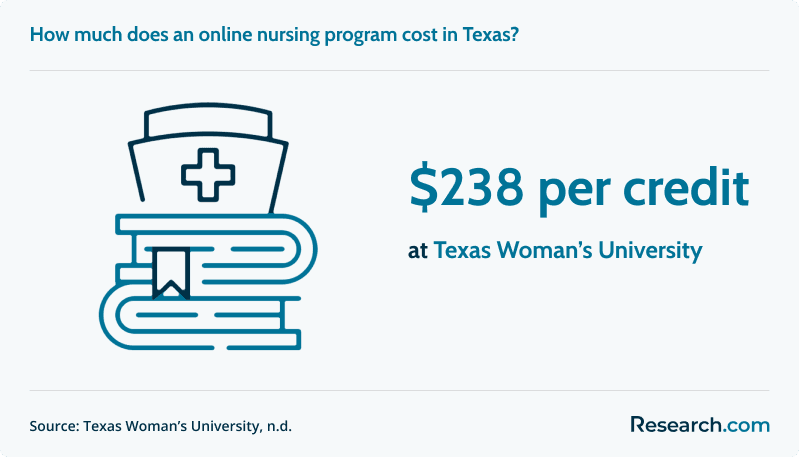
As with the top business schools in Texas, some nursing schools use one online tuition rate for both in-state and out-of-state students. For example, Texas Woman’s University lists its online RN to BSN program at $238 per credit.
Your final cost depends on the credential you pursue. A bachelor’s degree usually provides broader preparation but requires more credits, time, and tuition. An associate degree can be faster and less expensive, but some employers and advanced programs may prefer or require a BSN.
Public and private status also matters. For example, a two-year ADN program at Panola College, a public college, costs $190 per credit, while a four-year BSN program at the University of Mary Hardin-Baylor, a private university, costs $1,055 per credit.
Cost factors to compare before enrolling
| Cost factor | Why it matters | Question to ask |
| Tuition per credit | Useful for comparison, but it does not show the full program cost | How many credits will I personally need after transfer review? |
| Transfer credits | Can reduce both time and tuition | Which ADN, general education, or prior college credits will apply? |
| Fees | Technology, clinical, graduation, testing, and course fees can raise total cost | What fees are not included in advertised tuition? |
| Clinical or practicum costs | Students may need travel, background checks, immunizations, uniforms, or supplies | Who pays for placement-related requirements? |
| Time away from work | Even online programs can affect income if coursework or clinical hours conflict with shifts | Can I complete the program while working my current schedule? |
What are the financial aid options for students enrolling in an online nursing program in Texas?
Texas nursing students and graduates may qualify for scholarships, grants, employer tuition assistance, veterans benefits, federal aid, or loan repayment programs. Students pursuing a bachelor’s degree or repaying debt from online masters in nursing programs should review both state and federal options.
Texas Hazlewood Act
The Texas Hazlewood Act offers tuition exemption at public Texas institutions for eligible veterans, spouses, and dependent children. It does not cover living expenses, books, or supply fees.
- Amount: Up to 150 hours of tuition exemption at public colleges and universities in Texas
- Eligible Students: Qualified veterans, their spouses, and dependent children
Rural Communities Health Care Investment Program
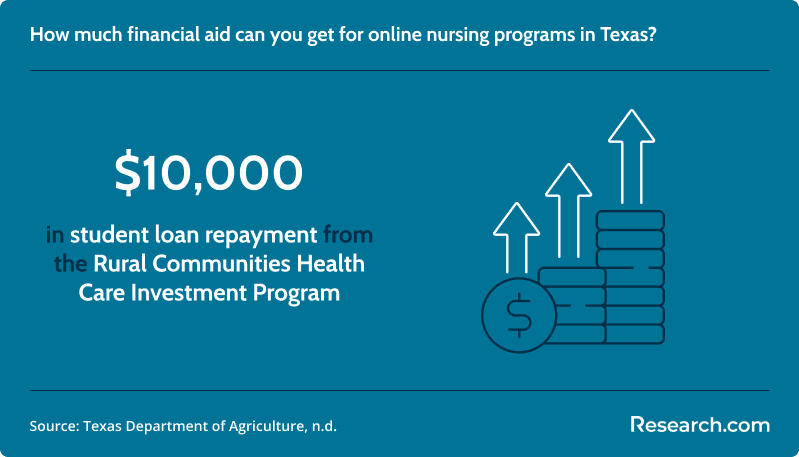
This program provides student loan repayment support for eligible healthcare professionals who serve in designated rural shortage areas in Texas.
- Amount: $10,000 in student loan repayment
- Eligible Students: Licensed healthcare providers (excluding physicians) who are practicing in a Texas county with 50,000 population or less
Nurse Corps Loan Repayment Program
The Nurse Corps Loan Repayment Program helps eligible nurses repay nursing education debt in exchange for service in approved facilities or nursing schools that address shortage needs.
- Amount: Repayment of up to 85% of unpaid nursing education debt
- Eligible Students: Licensed healthcare providers with qualifying debt, employed full-time at an eligible healthcare facility or nursing school
The Texas Department of State Health Services provides additional information about student loan repayment and financial aid programs.
What are the prerequisites for enrolling in an online nursing program?
Admission requirements vary by school and program level. RN to BSN programs usually expect applicants to already hold an RN license, while pre-licensure programs evaluate academic readiness and science preparation more heavily.
- Registered Nurse (RN) license: Many online programs in Texas are RN to BSN programs, meaning applicants typically need an active, valid RN license before enrolling.
- General education coursework: Schools commonly require classes in English, mathematics, biology, chemistry, anatomy, and physiology.
- Minimum GPA: Many programs set a minimum GPA, often between 2.5 and 3.0.
- Test scores: Some programs may ask for standardized exams such as the TEAS (Test of Essential Academic Skills) to evaluate readiness for nursing coursework.
- Compliance documents: Nursing students may also need immunizations, CPR certification, background checks, drug screening, health insurance, or proof of liability coverage depending on the program and clinical site.
How do online nursing students in Texas fulfill clinical requirements?
Online coursework can be remote, but nursing education still requires applied learning. Clinical and practicum experiences give students a supervised way to connect theory with patient care, health assessment, communication, documentation, quality improvement, and care coordination.
Most online nursing programs in Texas require approved hands-on learning at healthcare facilities, community agencies, schools, public health settings, or other approved sites. Some schools coordinate placements directly, while others allow students to propose local sites that meet program standards.
Students preparing for advanced roles should pay close attention to clinical expectations. Programs such as nurse practitioner programs in Texas usually require structured clinical experiences aligned with specialties such as family practice, pediatrics, or mental health.
Simulation labs and virtual clinical scenarios may supplement in-person work, but students should verify whether they replace any required hours or simply provide additional practice. Before enrolling, ask who secures clinical sites, what happens if a placement falls through, and whether the program can support students in your Texas region.
What courses are typically in an online nursing program?
Online nursing programs in Texas often combine clinical reasoning, leadership, population health, research, communication, and technology-focused coursework. As healthcare becomes more digital, many programs also address how technology is changing healthcare, including electronic records, telehealth, data-informed practice, and patient communication tools.
Course titles differ by institution, but common RN to BSN topics include:
- Nursing Theory and Practice
- Professional Nursing Ethics and Legal Issues
- Health Assessment
- Pathophysiology
- Pharmacology
- Communication and Collaboration in Healthcare
- Evidence-Based Practice
- Community and Population Health
- Nursing Leadership
- Nursing Informatics
Pre-licensure online or hybrid programs may include more direct clinical and lab components than RN to BSN programs. Students usually do not need to relocate if the school supports local clinical placements, but they should confirm this before applying.
What types of specializations are available in online nursing programs?
Not every RN to BSN program offers formal concentrations, but some allow students to choose electives, practicum projects, or capstone topics aligned with a practice interest. Common areas include:
- Women's Health: Focuses on care across the lifespan, including prenatal care, labor and delivery, and gynecology.
- School Nurse Education: Prepares nurses to support student health, education, screening, and school-based care coordination.
- Public Health Nursing: Emphasizes prevention, health promotion, community assessment, and population-level interventions.
- Informatics Nursing: Builds skills in health technology, data, electronic records, and workflow improvement.
- Leadership and Management: Develops preparation for unit leadership, team coordination, operations, and healthcare administration.
How to choose the best online nursing program in Texas
The best online nursing program is the one that matches your licensure status, career goal, budget, schedule, learning style, and clinical-placement needs. Start with accreditation and state approval, then compare total cost, transfer policy, student support, NCLEX or completion outcomes, and employer connections.
Program selection checklist
| What to check | Why it matters | What to ask the school |
| Accreditation | Accreditation from organizations such as the Commission on Collegiate Nursing Education (CCNE) or the Accreditation Commission for Education in Nursing (ACEN) signals recognized quality standards. | Is this exact program accredited, and by whom? |
| Texas licensure alignment | Pre-licensure students need a program that meets Texas Board of Nursing expectations. | Does this program qualify graduates for the licensure pathway I want? |
| Clinical placement support | Online students may still need local placements. | Does the school arrange placements, or must I find my own? |
| Transfer-credit review | Prior credits can shorten completion time and reduce cost. | Can I receive a written transfer evaluation before committing? |
| Course format | Asynchronous, synchronous, and hybrid formats demand different schedules. | Are lectures live, recorded, self-paced, or scheduled? |
| Student support | Advising, tutoring, technical support, and career services affect persistence. | What support is available outside standard business hours? |
| Outcomes | Completion, licensure, and employment outcomes can indicate program strength. | Where can I find recent NCLEX-RN pass rates and graduation outcomes? |
Who should choose an online nursing program?
- Licensed RNs who want a BSN but need to keep working.
- Students who live far from campus-based nursing programs.
- Self-directed learners who can manage deadlines without daily in-person structure.
- Nurses planning to pursue leadership, graduate study, public health, informatics, or advanced clinical roles.
Who may be better served by an on-campus or hybrid program?
- Students who need frequent face-to-face instruction and immediate instructor access.
- Students entering nursing for the first time who want structured lab and clinical routines.
- Learners who struggle with independent online coursework.
- Students who cannot secure reliable technology, internet access, or a quiet study environment.
Common mistakes to avoid when choosing an online nursing program
- Choosing a program before checking accreditation: Accreditation affects transferability, employer trust, graduate-school options, and sometimes licensure eligibility.
- Looking only at tuition per credit: Total cost also depends on required credits, transfer policy, fees, books, clinical expenses, and time away from work.
- Assuming online means no in-person work: Nursing programs often include clinical, practicum, simulation, or capstone requirements.
- Ignoring clinical placement rules: Ask whether the school guarantees placement support in your area before you enroll.
- Relying only on rankings: Rankings can help narrow choices, but your best program depends on licensure alignment, schedule, cost, and support.
- Assuming salary outcomes are guaranteed: Pay depends on specialty, employer, region, experience, shift, credentials, and labor market conditions.
How do I obtain nursing licensure in Texas?
After completing an accredited or approved nursing program, candidates typically need to pass the NCLEX-RN exam and submit a licensure application to the Texas Board of Nursing. The process includes official transcripts, required documentation, and a background check consistent with the Texas Nurse Practice Act. For a step-by-step overview, review our guide on how to become an RN in Texas.
What career paths are available for graduates of online nursing programs in Texas?
Graduates of online RN to BSN programs in Texas can pursue roles across clinical, community, administrative, educational, and technology-enabled healthcare settings. Some nursing careers may also be connected to the highest-paying medical jobs, especially when paired with experience, graduate education, specialty certification, or advanced practice credentials.
Traditional hospital settings
- Staff Nurse
- Nurse Manager
- Nurse Educator
Community and public health settings
- Public Health Nurse
- School Nurse
- Home Health Nurse
- Hospice Nurse
Non-traditional nursing roles
- Telehealth Nurse
- Nurse Informatics
- Policy and Advocacy
Nurses who want advanced clinical authority can also explore graduate pathways, including the best online nurse practitioner programs, depending on career goals and admission eligibility.
Can dual degree programs boost advanced leadership in nursing?
Dual degree programs can be useful for nurses who want to combine advanced clinical knowledge with business, finance, operations, or executive leadership skills. This path may fit nurses targeting healthcare administration, quality improvement, policy development, service-line management, or senior leadership roles. If you want a curriculum that blends nursing and management, compare MBA MSN dual degree programs online with standard MSN, MBA, and certificate options before committing.
What is the job market for graduates with an online nursing degree in Texas?
Texas has strong projected demand across multiple nursing roles. U.S. Bureau of Labor Statistics data indicates that demand for registered nurses in Texas will produce 16,210 openings annually until 2030, with additional openings in related nursing occupations.
Employer views of online nursing degrees continue to depend on program quality. A degree from an accredited online program is generally stronger than a non-accredited credential, and employers often focus on licensure, clinical competence, communication, experience, professionalism, and specialty preparation.
| Role | Projected Job Growth (2030) | Average Annual Openings (2030) |
| Licensed Practical and Licensed Vocational Nurses | 16.7% | 6,870 |
| Nurse Anesthetists | 24.6% | 250 |
| Nurse Practitioners | 66% | 2,010 |
| Nursing Assistants | 14.6% | 10,940 |
| Registered Nurses | 17.1% | 16,210 |
Is an accelerated nurse practitioner program the right next step for you?
An accelerated nurse practitioner program may make sense for experienced nurses who are ready for advanced practice coursework, specialized clinical preparation, and a faster academic pace. These programs can be demanding, so applicants should confirm clinical-hour expectations, preceptor support, state authorization, certification alignment, and workload requirements. If speed matters but quality cannot be compromised, compare options for a nurse practitioner accelerated program carefully.
How do Texas online nursing programs support job placement and career advancement?
Career support varies by school. Strong programs may offer resume review, interview preparation, faculty mentorship, alumni connections, virtual networking events, employer panels, job boards, clinical partnerships, and career advising. When comparing accredited nursing schools in Texas, ask whether career services are nursing-specific and whether online students receive the same support as campus students.
How does an LVN pathway fit into Texas’ nursing career ladder?
The LVN pathway can help students enter nursing-related patient care faster than a traditional RN route. LVNs provide foundational care and may later continue toward RN or BSN credentials. This path can be useful for students who want to start working in healthcare before committing to a longer degree. To understand training, licensure, and advancement steps, see our guide on how to become an LVN nurse in Texas.
What emerging trends are influencing online nursing education in Texas?
Online nursing education is being shaped by simulation tools, virtual clinical scenarios, telehealth training, digital documentation, interprofessional collaboration, and greater emphasis on evidence-based care. These tools do not remove the need for hands-on learning, but they can help students practice decision-making and communication before direct patient contact. Nurses planning advanced roles can also review how to become a nurse practitioner in Texas to understand how graduate-level preparation builds on these trends.
What complementary healthcare roles can bolster your nursing career in Texas?
Some nurses strengthen their career options by adding skills in administration, coding, billing, data workflows, compliance, or care coordination. These skills can support roles that combine clinical knowledge with operations, revenue cycle, documentation quality, or healthcare management. For example, learning how to become a medical biller and coder in Texas may be useful for nurses interested in documentation, coding accuracy, insurance processes, or non-bedside healthcare work.
What networking opportunities are available for nursing students and professionals in Texas?
Networking can help nursing students and practicing nurses learn about employers, specialties, preceptors, mentorship, continuing education, and leadership opportunities. Good networking options include:
- Nursing associations: Groups such as the Texas Nurses Association (TNA) can connect nurses with conferences, webinars, policy updates, and professional development.
- Student nurse organizations: Nursing students may join the National Student Nurses' Association (NSNA) or a school-based nursing organization for mentorship and peer connections.
- Conferences and workshops: Events such as the Texas Nursing Association Annual Conference or American Nurses Association (ANA) Conferences can help nurses learn, present, and meet professionals in different specialties.
- Social media and online platforms: LinkedIn groups and professional online communities can support virtual networking and career exploration.
- Local hospitals and health systems: Job fairs, open houses, residency information sessions, and employer workshops can create direct access to recruiters and nurse leaders.
What are the licensure exam success rates for Texas online nursing graduates?
Prospective students should review each program’s published NCLEX-RN pass rates, completion rates, licensure outcomes, and state approval status before applying. These metrics can help indicate whether students are being prepared effectively for licensure and entry-level practice. Students considering a different entry route can also review how to become an LPN in Texas.
How to Transition from LPN to RN or BSN in Texas
Licensed Practical Nurses who want broader responsibility can move toward RN or BSN credentials. This progression may expand access to acute care, specialty units, leadership roles, and graduate study, depending on the program completed and licensure achieved.
1. LPN to RN transition
LPN to RN programs build on practical nursing experience and prepare students for registered nursing responsibilities. Many students choose this route to qualify for RN roles in settings such as critical care, pediatrics, oncology, and medical-surgical nursing. Program length varies, but many pathways take 1-2 years depending on whether the student pursues an ADN or BSN route.
2. LPN to BSN programs in Texas
LPN to BSN programs provide a more direct route to a bachelor’s degree. This option can be useful for nurses who want long-term flexibility, leadership preparation, teaching opportunities, or later graduate study. Online options may help working LPNs continue employment while completing coursework, although clinical requirements still need to be planned carefully.
3. What to expect in LPN to RN or LPN to BSN programs
Students can expect coursework in anatomy and physiology, pharmacology, nursing theory, patient care, ethics, and clinical practice. Online formats may include virtual classes, interactive learning, simulations, and supervised clinical placements. If flexibility is your priority, compare online LPN to BSN programs with campus-based and hybrid alternatives.
What are the essential steps to secure your nursing license after graduation?
After graduation, confirm that your academic record is complete, prepare for the NCLEX-RN exam if applicable, submit required documentation to the state, complete background-check requirements, and follow Texas renewal and continuing education rules. Because requirements can vary by license type and applicant background, review nursing license requirements in Texas before your final term ends.
What challenges do online nursing students in Texas face?
Online nursing programs can be flexible, but they are not easy. Students often have to balance coursework, shift work, family responsibilities, clinical scheduling, technology requirements, and independent study. Clinical placement logistics can be one of the biggest challenges, especially for students in rural areas or regions with limited approved sites.
To reduce risk, choose a program with strong advising, clear clinical-placement policies, technical support, accessible faculty, and realistic workload expectations. Students exploring shorter healthcare routes or support roles may also compare medical assistant programs in Texas.
Which advanced practice roles can elevate your nursing career in Texas?
Advanced practice roles allow nurses to take on greater responsibility in assessment, diagnosis support, care planning, specialty care, patient education, and interdisciplinary leadership. Nurse midwifery is one example of a specialized pathway that combines clinical care, education, and advocacy. If this career direction interests you, review how to become a nurse midwife in Texas to understand the education, certification, and practice expectations.
Nursing Certifications That Boost Career Prospects in Texas
Additional certifications can help Texas nurses demonstrate specialty knowledge and compete for roles in areas such as critical care, pediatrics, gerontology, emergency care, leadership, informatics, and case management. Common examples include critical care (CCRN), pediatric nursing (CPN), and gerontology (GERO-BC).
Certification does not guarantee a higher salary or promotion, but it can strengthen applications for specialized units or roles where employers prefer verified expertise. To compare options, review this guide to the best certifications for nurses and match credentials to your specialty, experience level, and employer requirements.
Related Articles for Nearby States
- 2027 Best Online Nursing Programs in Louisiana – Accredited RN to BSN Programs
- 2027 Best Online Nursing Programs in Oklahoma – Accredited RN to BSN Programs
- 2027 Best Online Nursing Programs in Arkansas – Accredited RN to BSN Programs
- 2027 Best Online Nursing Programs in New Mexico – Accredited RN to BSN Programs
- 2027 Best Online Nursing Programs in Kansas – Accredited RN to BSN Programs
- 2027 Best Online Nursing Programs in Missouri – Accredited RN to BSN Programs
- 2027 Best Online Nursing Programs in Colorado – Accredited RN to BSN Programs
- 2027 Best Online Nursing Programs in Mississippi – Accredited RN to BSN Programs
- 2027 Best Online Nursing Programs in Tennessee – Accredited RN to BSN Programs
- 2027 Best Online Nursing Programs in Arizona – Accredited RN to BSN Programs
References:
- Bureau of Health Workforce. (2024, February 15). Apply to the Nurse Corps Loan Repayment Program | Bureau of Health Workforce. Bureau of Health Workforce. Retrieved February 26, 2024, from https://bhw.hrsa.gov/funding/apply-loan-repayment/nurse-corps
- Projections Central. (n.d.). https://projectionscentral.org/Projections/LongTerm?AreaName=texas&Name=nurs&items_per_page=1000. Projections Central. Retrieved February 26, 2024, from https://projectionscentral.org/Projections/LongTerm?AreaName=texas&Name=nurs&items_per_page=1000
- Texas Department of Agriculture. (n.d.). Rural Communities Health Care Investment Program (RCHIP). Texas Department of Agriculture. Retrieved February 26, 2024, from https://www.texasagriculture.gov/Grants-Services/RCHIP
- Texas Veterans Commission. (n.d.). Hazlewood and Education Services – Texas Veterans Commission. Texas Veterans Commission. Retrieved February 26, 2024, from https://www.tvc.texas.gov/education/hazlewood
- U.S. Bureau of Labor Statistics. (2025). Registered Nurses : Occupational Outlook Handbook: : U.S. Bureau of Labor Statistics. https://www.bls.gov/ooh/healthcare/registered-nurses.htm
- World Population Review. (n.d.). Cost of Living Index by State 2024. World Population Review. Retrieved February 25, 2024, from https://worldpopulationreview.com/state-rankings/cost-of-living-index-by-state
- Zippia. (2025). Best Colleges and Degrees For Nurses. Zippia. https://www.zippia.com/nurse-jobs/education
Key Insights
- Start with licensure fit, not convenience: An online nursing program is only useful if it supports your intended Texas licensure, advancement, or graduate-study goal.
- Accreditation is non-negotiable: Prioritize programs accredited by recognized nursing accreditors such as CCNE or ACEN and verify state approval when licensure is involved.
- Online does not mean fully remote: Expect clinical, practicum, simulation, or community-based requirements even when coursework is delivered online.
- Total cost matters more than sticker tuition: Compare required credits, transfer policies, fees, clinical expenses, and the ability to keep working while enrolled.
- RN to BSN programs are often the best online fit: They are designed for licensed nurses who already have clinical experience and want bachelor’s-level preparation.
- Texas offers strong opportunity but no guaranteed outcome: RN demand is high, with projected growth of 17.1% until 2032, but salary and advancement depend on location, specialty, experience, employer, and credentials.
- Ask practical questions before applying: Who arranges clinical placements? How many credits will transfer? Are online students eligible for the same career services? What are the NCLEX-RN pass rates? The answers will tell you more than rankings alone.
Other Things You Should Know About Online Nursing Programs in Texas
In 2027, online RN to BSN programs in Texas generally require courses like Nursing Research, Community Health Nursing, and Leadership in Nursing. These core courses ensure students gain advanced nursing skills and knowledge essential for professional practice and career advancement.
Students can verify the accreditation status by checking if the program is accredited by recognized agencies like the Commission on Collegiate Nursing Education (CCNE) or the Accreditation Commission for Education in Nursing (ACEN). These organizations ensure the program meets high-quality nursing education standards.


