
2027 How to Transition from BSN to CRNA: Length, Education & Training Requirements

Co-Founder and Chief Data Scientist
Becoming a Certified Registered Nurse Anesthetist (CRNA) is a highly rewarding career path for a BSN-prepared nurse, but the journey to get there is complex. As a career and education expert, I’ll guide you through this process, which is often shrouded in misinformation. Finding accurate details about the required length of schooling, specific educational prerequisites, and extensive training can be a significant hurdle.
This guide cuts through the noise to provide a clear, authoritative roadmap. We'll demystify the rigorous requirements and arm you with the precise knowledge needed to successfully transition from the bedside to the operating room.
What are the benefits of transitioning from BSN to CRNA?
- Career Advancement: The CRNA is an advanced practice provider, a leader in the clinical setting with a high degree of autonomy and responsibility in patient care.
- Earning Potential: CRNAs are among the highest-paid nursing professionals. The average salary is well over $200,000, with top earners exceeding $250,000 annually.
- Job Versatility: The role is in high demand across various settings, including hospitals, outpatient surgery centers, and military facilities, providing strong job security.
What can I expect from a doctoral nurse anesthesia program?
- Intensive curriculum: Coursework includes advanced pharmacology, human anatomy, physiology, pathophysiology, and anesthesia principles.
- Structured format: Programs combine classroom instruction with extensive, hands-on clinical training in diverse healthcare environments.
- Doctoral-level education: As of 2025, all new CRNAs must graduate from a doctoral program (DNP or DNAP), which emphasizes leadership, evidence-based practice, and scholarly projects.
- Significant clinical hours: Students complete more than 2,500 clinical hours and must meet case minimums to demonstrate competency across anesthesia techniques.
- Long-term commitment: Programs are full-time, typically lasting about three years.
- High-stakes skills: Training covers airway management, regional anesthesia, crisis management, and advanced monitoring, often reinforced with high-fidelity simulation.
- Collaborative learning: Students train alongside expert faculty and peers, preparing them for team-based care models in anesthesia practice.
Where can I work as a CRNA?
- Hospitals: The most common setting, administering anesthesia in operating rooms for a wide range of surgeries.
- Outpatient surgery centers: Provide anesthesia for same-day procedures in a fast-paced environment.
- Pain management clinics: Specialize in regional anesthesia and chronic pain treatments.
- Physician and dental offices: Deliver anesthesia for dental, cosmetic, and minor surgical procedures.
- Military and government: Serve in military hospitals or federal healthcare facilities, often with unique deployment opportunities.
- Birthing centers: Administer epidurals and anesthesia for labor and delivery.
- Trauma centers: Provide anesthesia as part of emergency and critical care teams.
How much can I make as a CRNA?
- Starting salary: Entry-level CRNAs with less than one year of experience typically earn $155,000 to $170,000.
- Experienced professionals: Average salaries range from $200,000 to $230,000, based on PayScale and Salary.com data.
- Senior & specialized roles: Experienced CRNAs, particularly in cardiac or pediatric anesthesia, can earn $250,000+, with some exceeding $300,000.
- Geographic variation: Salaries vary widely by state, with higher averages in California, Texas, and Washington.
- Facility type: Outpatient care centers and private practices often pay more than general hospital settings.
- Travel and locum tenens: Travel CRNAs may earn higher rates through premium hourly pay and housing stipends.
- How does one transition from BSN to CRNA in 2027? BSN to CRNA
- What courses and GPA best prepare a BSN to CRNA applicant? Courses
- How much ICU experience does a BSN to CRNA applicant need? ICU Experience
- Which certifications strengthen a BSN to CRNA application? Certifications
- What shadowing is required for BSN to CRNA admission? What shadowing is required for BSN to CRNA admission?
- What’s the difference between DNP and DNAP for BSN to CRNA students? DNP vs. DNAP
- What clinical skills and case minimums are required in BSN to CRNA training? Clinical Skills
- What are the steps to licensure and credentialing after BSN to CRNA graduation? Licensure
- What are the NCE pass rates and best prep strategies for BSN to CRNA applicants? What are the NCE pass rates and best prep strategies for BSN to CRNA applicants?
- What is the typical salary range after completing a BSN to CRNA program? Salaries
How does one transition from BSN to CRNA in 2027?
Becoming a Certified Registered Nurse Anesthetist (CRNA) from a BSN is a rigorous, step-by-step journey that blends critical-care experience with advanced graduate training. Use the roadmap below—from RN licensure and ICU experience to a doctoral anesthesia program, national certification, and state licensure—to navigate the process efficiently.
- Obtain a BSN degree. Complete a Bachelor of Science in Nursing from an accredited program. Many accelerated LPN to RN programs are available for you to start.
- Become a Registered Nurse (RN). Pass the National Council Licensure Examination (NCLEX-RN) to obtain your RN license.
- Gain critical care experience. Work as an RN in a critical care setting, such as an intensive care unit (ICU). Most programs require at least one year of full-time experience; two or more years are often preferred.
- Earn relevant certifications. Obtain certifications often required or preferred by CRNA programs, such as Advanced Cardiac Life Support (ACLS) and Pediatric Advanced Life Support (PALS); many programs also prefer or require Critical Care Registered Nurse (CCRN) certification.
- Enroll in a doctoral program. Apply to and be accepted into an accredited nurse anesthesia program. As of 2025, all new CRNAs must hold a doctoral-level degree (e.g., Doctor of Nursing Practice [DNP] or Doctor of Nurse Anesthesia Practice [DNAP]). These programs typically last about three years.
- Pass the National Certification Examination (NCE). After graduating from your doctoral program, pass the NCE administered by the National Board of Certification and Recertification for Nurse Anesthetists (NBCRNA).
- Obtain state licensure. Apply for and obtain a CRNA license in the state where you intend to practice. This generally requires proof of national certification and a current RN license.
According to 2024 BLS data, the highest concentration of nurse anesthetist jobs is found in a variety of states, with total employment figures ranging from several hundred to nearly 3,000. While states with larger economies like Minnesota and Tennessee lead with 2,320 and 2,950 jobs, respectively, smaller states such as South Dakota, Maine, and West Virginia also have a high job concentration, despite having lower total employment of 360, 390, and 470 roles, as shown in the graphic below.
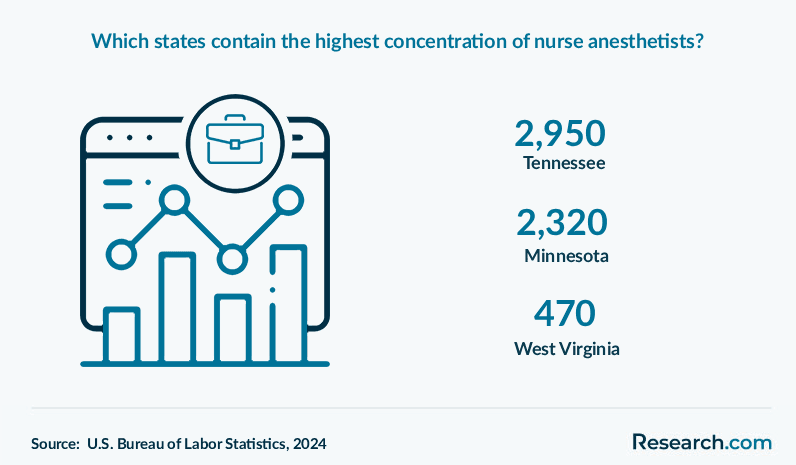
This trend suggests that job concentration is not solely dependent on a state's overall size. Therefore, professionals seeking a career as a nurse anesthetist may find strong employment markets in both large and smaller states.
What courses and GPA best prepare a BSN to CRNA applicant?
To position yourself for a CRNA program, having a strong academic record is crucial, especially in science-related courses. Most programs have specific GPA requirements, and exceeding these benchmarks can make your application more competitive.
- GPA benchmarks: Aim for a cumulative GPA of 3.0 or higher, though many competitive programs have an average accepted GPA of around 3.5 or higher.
- Science GPA: A separate science GPA is often calculated, and maintaining a high score in courses like chemistry, biology, and anatomy and physiology is essential.
- Chemistry: A basic course in chemistry is a common prerequisite, but some programs may also require or highly recommend organic chemistry or biochemistry.
- Statistics: A statistics course is a frequent requirement, as it’s foundational for understanding research and evidence-based practice.
- Pharmacology: Courses in pharmacology and advanced physiology are also vital for building the knowledge base needed for a CRNA curriculum.
- Anatomy & physiology: These courses are a fundamental requirement, often in a two-part series, to demonstrate a solid understanding of the human body.
- Physics: While not always required, some programs recommend or require a physics course to understand the principles of anesthesia equipment.
A strong academic foundation, particularly in the sciences, is a key indicator of your potential to succeed in a rigorous doctoral program. These are quite common among the most affordable DNP programs available.
According to the BLS 2024, the combined median pay for nurse anesthetists, nurse midwives, and nurse practitioners was $132,050 per year as of 2024. The profession, which typically requires a master's degree for entry, had 382,700 jobs in 2024.
A robust trend of significant growth is projected, with a 35% increase in employment from 2024 to 2034, which is described as much faster than the average for all occupations. This growth, shown in the graphic below, is expected to result in the addition of 134,000 jobs over the decade.
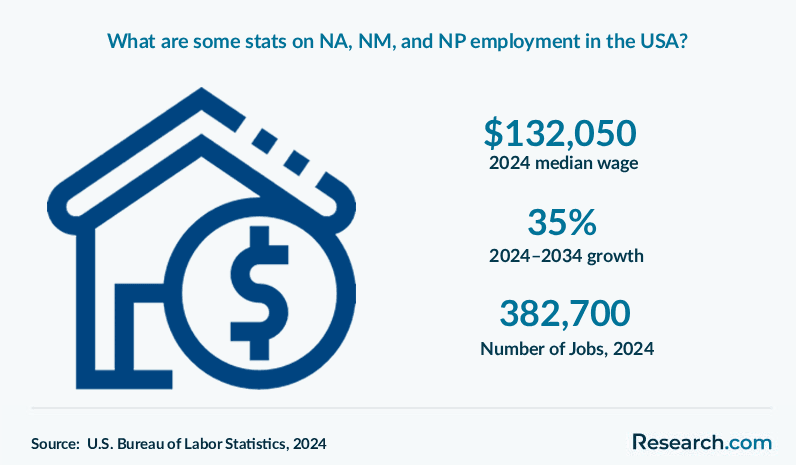
The data shows this to be a highly compensated career with a very favorable long-term job outlook.
How much ICU experience does a BSN to CRNA applicant need?
Gaining critical care experience is a mandatory step, as it provides the hands-on skills necessary to manage critically ill patients. The type and amount of experience are heavily weighed by admissions committees.
- Experience minimum: A minimum of one year of full-time ICU experience is required by most accredited programs, though two or more years are highly preferred and can significantly boost an application.
- High acuity: The most competitive experience comes from high-acuity units where you routinely manage invasive hemodynamic monitors, mechanical ventilation, and vasoactive infusions.
- SICU: Surgical Intensive Care Units are highly regarded because they often involve the direct management of complex post-operative patients, providing a strong foundation in surgical anatomy and patient recovery.
- MICU: Medical Intensive Care Units are also excellent, offering extensive experience with a wide variety of medical conditions like sepsis, respiratory failure, and multi-organ dysfunction.
- CVICU: Cardiovascular Intensive Care Units are considered a gold standard due to the intense management of cardiac patients and exposure to advanced life support devices.
- Neuro ICU: Neuro Intensive Care Units provide valuable experience with patients who have suffered strokes, traumatic brain injuries, or other neurological emergencies.
- Unacceptable experience: Experience in settings like the Emergency Room (ER) or Post-Anesthesia Care Unit (PACU) is typically not considered a substitute for a true critical care background.
The key is to seek out an environment where you are continuously making critical decisions and managing complex, unstable patient conditions. Acceptance to the easiest NP schools to get into does not always mean you will get the required ICU experience, so be careful.
Which certifications strengthen a BSN to CRNA application?
While some certifications are mandatory for admission, others are highly recommended and can signal a strong commitment to the profession, making your application more competitive.
- BLS: Basic Life Support is a fundamental requirement for all healthcare professionals and is a minimum standard for application.
- ACLS: Advanced Cardiac Life Support is a mandatory certification that demonstrates your ability to manage cardiac emergencies.
- PALS: Pediatric Advanced Life Support is often required before beginning clinical rotations, as CRNAs must be prepared to care for patients of all ages.
- CCRN: The Critical Care Registered Nurse certification is a highly valued and often recommended credential that proves a specialized knowledge base in critical care principles.
- TNCC: Trauma Nursing Core Course certification can be beneficial if your experience is in a trauma-focused ICU.
- ECMO/CRRT: Experience with advanced therapies like ECMO (extracorporeal membrane oxygenation) or CRRT (continuous renal replacement therapy) is also a strong asset.
While ACLS and PALS are typically required, obtaining the CCRN certification shows a proactive approach and dedication to advanced practice. Courses in online NP programs are not enough to meet CRNA requirements.
What shadowing is required for BSN to CRNA admission?
Shadowing a CRNA is a valuable and often mandatory component of the application process that provides firsthand insight into the profession. It is crucial to document this experience properly.
- Shadowing requirement: Many programs require a minimum number of shadowing hours, often ranging from 8 to 40 hours.
- Anesthesia exposure: This experience demonstrates your serious interest in the field and provides a realistic view of the daily responsibilities of a CRNA.
- Documentation: You must officially document your shadowing hours using a form provided by the program or by creating your own log.
- Log details: The log should include the date, number of hours, type of case, facility location, and the signature/contact information of the CRNA you shadowed.
- Multiple settings: It’s recommended to shadow more than one CRNA to see a variety of practice styles and settings.
Properly documenting your shadowing experience is a critical step that validates your commitment to the profession.
Additionally, understanding the broader healthcare landscape can be helpful for CRNA candidates considering administrative or leadership roles later in their careers, making it useful to research healthcare administration salary by state to inform long-term career planning and geographic considerations.
What’s the difference between DNP and DNAP for BSN to CRNA students?
As of 2025, a doctoral degree is required for entry into the CRNA profession, but programs offer two primary options: the Doctor of Nursing Practice (DNP) and the Doctor of Nurse Anesthesia Practice (DNAP).
- DNP: A practice-focused degree that prepares advanced practice nurses for leadership, healthcare policy, and clinical practice roles.
- DNAP: A degree specific to nurse anesthesia, focusing on clinical practice and anesthesia science.
- Curriculum: Both cover advanced pharmacology, physiology, and clinical training.
- Focus: DNP often includes more coursework in evidence-based practice, healthcare systems, and leadership.
- Program vs. degree: The choice often comes down to the program’s emphasis; content and training are very similar.
- Career goals: Either degree prepares you for clinical practice, research, or academia.
- Accreditation: Both are equally recognized if accredited by the Council on Accreditation of Nurse Anesthesia Educational Programs (COA).
Both degrees lead to the same CRNA certification, so the best choice depends on your personal and professional goals.
For those preparing to enter the field, it’s also important to understand how to get RNC certification, including eligibility requirements, exam preparation, and the application process, as this knowledge can help streamline the path from advanced nursing education to full professional licensure.
What clinical skills and case minimums are required in BSN to CRNA training?
Students must meet specific competencies and case minimums to graduate from a COA-accredited program.
- Anesthesia cases: Minimum of 550 required, though the average is over 850.
- Case diversity: Wide variety of cases and patient populations.
- Airway management: Proficiency in intubation and advanced airway devices.
- Monitoring: Competency in arterial and central line placement.
- Pharmacology: Safe administration/titration of anesthetic and non-anesthetic drugs.
- General anesthesia: Management of diverse surgical procedures.
- Regional anesthesia: Training in spinal and epidural techniques.
- Post-anesthesia care: Recovery room management.
These experiences ensure comprehensive readiness for independent practice.
In addition, nursing students may consider complementing their BSN curriculum with electives or minors that enhance their career flexibility and expertise—understanding what are good minors for nursing majors can help students develop skills in areas like healthcare administration, psychology, or public health, providing valuable knowledge that supports both clinical practice and leadership opportunities.
What are the steps to licensure and credentialing after BSN to CRNA graduation?
After completing a BSN to CRNA program and passing the national certification exam, graduates must take several key steps to become fully licensed and credentialed to practice. These steps include both national requirements and state-specific processes that vary by location.
- Pass the NCE: Successfully complete the National Certification Examination administered by the NBCRNA to earn the CRNA credential.
- Apply for state licensure: Obtain an Advanced Practice Registered Nurse (APRN) license in the state of practice. Requirements differ by state, with some requiring jurisprudence exams, additional paperwork, or higher fees.
- Maintain CRNA credentialing: Keep certification current through the NBCRNA, which is separate from state licensure and requires ongoing professional development.
- Secure hospital privileges: Gain institutional credentialing to practice within hospitals or surgical centers. This review covers education, certification, and clinical experience.
- Adapt to state regulations: In some states, CRNAs have full practice authority, while others require physician collaboration or supervision, affecting the level of autonomy and the credentialing process.
Together, these steps ensure that CRNAs meet both national and state standards, enabling them to practice safely and legally in a wide range of healthcare environments.
For students exploring complementary career paths or earlier stages of health-focused education, researching colleges with easy nutrition degree programs can provide accessible options to gain foundational knowledge in nutrition, wellness, and health sciences without the intensive prerequisites or course load of more rigorous programs.
A projected shortage of anesthesia providers is a significant trend in healthcare, with a deficit of approximately 12,500 professionals, or nearly 22% of the current staff, anticipated by 2033. This shortage, shown in the graphic below, is expected to disproportionately affect rural communities, exacerbating existing healthcare disparities.
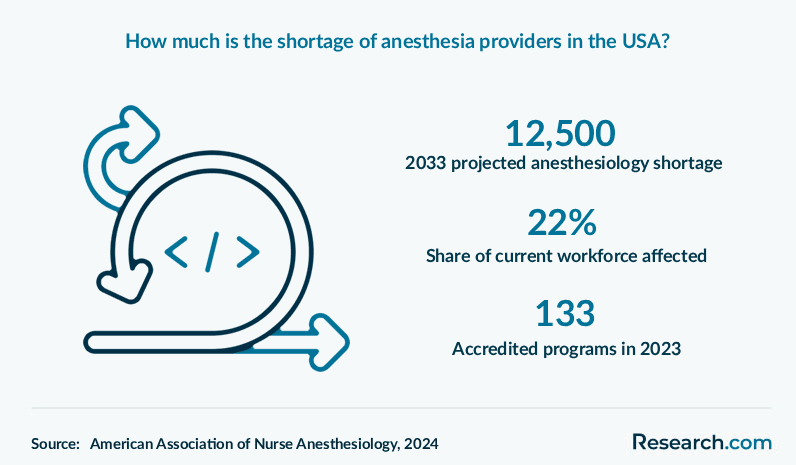
However, there is a growing interest in the field; as of 2023, nearly 8,500 residents were enrolled in 133 accredited nurse anesthesia programs, a promising indicator for the future. This influx of new talent is a promising sign for the future, but it highlights the critical need for continued education and training to meet the looming demand.
What are typical pass rates and prep strategies for the NBCRNA National Certification Examination (NCE)?
The National Certification Examination (NCE) is the final hurdle for BSN to CRNA graduates, testing the depth of knowledge and clinical judgment required to enter practice. Success on this exam depends on careful preparation, strong study habits, and effective stress management.
- Pass rates: First-time pass rates typically range from 80% to 85%, showing that most well-prepared candidates succeed on their initial attempt. Repeat test-takers may face lower pass rates, making preparation for the first attempt especially important.
- Study plan: A structured, time-bound study plan should cover all domains outlined in the NBCRNA exam handbook, balancing didactic review with practice testing.
- Study resources: Effective tools include textbooks, review guides, question banks, online review courses, and study groups to reinforce key material.
- Content focus: High-yield subjects include advanced anatomy, physiology, pharmacology, patient safety, and evidence-based practice.
- Practice questions: Completing thousands of practice questions is strongly recommended, since the NCE is a computer-adaptive test and rewards familiarity with diverse question types.
- Self-evaluation: Many CRNA programs administer the Self-Evaluation Examination (SEE), which helps students benchmark readiness and identify weak areas before taking the NCE.
- Test strategies: Developing pacing skills, reviewing rationales for both correct and incorrect answers, and simulating exam conditions can reduce test-day anxiety.
- Stress management: Maintaining adequate sleep, nutrition, and exercise throughout the study period helps ensure peak performance on exam day.
A comprehensive, structured approach that combines academic review with practice testing and personal wellness significantly improves the likelihood of passing the NCE on the first attempt.
As shown in the graph below, candidates who took the National Certification Examination (NCE) in 2024 reported a variety of clinical backgrounds. Approximately 14.2% of the candidates reported their background as ICU/CCU, which represented a decrease from 16.5% in 2023. Over the past five years, NCE examinees with backgrounds in CCU, neuro ICU, PICU, OR, and NICU have demonstrated the highest success rates on the exam.
The 2024 data shows that candidates with a CCU background had the highest pass rate at 92.7%, while those with an ICU/CCU background had a pass rate of 86.4%. These pass rates are not considered mutually exclusive, as clinical experiences are often diverse and complex.
In fact, due to the small sample sizes in the 2024 data, the National Board of Certification and Recertification for Nurse Anesthetists advises that the five-year trend data, which is based on a larger sample, is more reliable for comparisons. The total pass rate for all candidates in 2024 was 89.3%.
What is the typical salary range after completing a BSN to CRNA program?
CRNAs are among the highest-paid nursing professionals, reflecting their advanced education, specialized training, and critical role in patient care.
- Median salary: According to the U.S. Bureau of Labor Statistics (2024), the median annual wage for nurse anesthetists is $212,650.
- Top earners: The highest-paid 10% earn more than $239,200 annually, often in specialized hospitals or outpatient surgical centers.
- Entry-level pay: New BSN to CRNA graduates typically start around $170,000–$180,000 annually, depending on region and employer.
- Location impact: Rural areas often pay higher salaries to attract talent, while major metro hospitals may offer competitive salaries with added benefits.
- Industry differences: CRNAs working in outpatient care centers and specialty hospitals tend to earn the highest wages compared to those in general hospitals or educational services.
A BSN to CRNA pathway can more than double the earning potential of a registered nurse, making it one of the most lucrative advanced practice nursing careers.
According to 2025 PayScale data, the average salary for a certified registered nurse anesthetist (CRNA) is $192,387, with a typical range between $131,000 and $244,000. A clear trend of increasing compensation is visible with career progression; for instance, a chief nurse anesthetist can earn an average of $222,884, within a range of $167,000 to $263,000.
While the average salary for an anesthesiologist is higher at $254,341, within a range of $191,000 to $446,000, the CRNA's pay is comparable to that of a dean of nursing at $190,121, and on par with a nurse educator salary. This data, shown in the graph below, indicates that the role of a CRNA offers a high salary and significant financial growth potential through advanced positions.
Here's What Graduates Say About Their BSN to CRNA Degrees
- Avery: "Being a CRNA has given me the autonomy I always wanted in my career. I love the intellectual challenge of managing a patient's entire anesthetic care, and the deep satisfaction of knowing my advanced training in pharmacology and physiology makes a direct impact on their safety. The high earning potential and job security are great, but the true reward is the professional respect and confidence I've gained."
- Linda: "The journey from a BSN to a CRNA was intense, but it was absolutely worth it. The clinical training was so immersive, and I developed invaluable hands-on skills in airway management and regional anesthesia. Now, as a CRNA, I find immense fulfillment in working with patients across all ages and in a variety of clinical settings, from busy hospitals to small surgical centers."
- Edna: "My experience in the CRNA program transformed my entire perspective on nursing. The doctoral-level education pushed me to think critically and lead with confidence, knowing I have a profound understanding of complex medical conditions. I am so proud to be part of a profession that is vital to modern healthcare, and I am grateful for the deep sense of purpose it has given me."
Key Findings
- Median pay: According to BLS 2024 data, the combined median pay for nurse anesthetists, nurse midwives, and nurse practitioners was $132,050 per year as of 2024.
- Salary progression: According to 2025 PayScale data, the average salary for a certified registered nurse anesthetist (CRNA) is $192,387, with a clear trend of increasing compensation; for instance, a chief nurse anesthetist can earn an average of $222,884 within a range of $167,000 to $263,000.
- CRNA vs. other roles: CRNA average pay is comparable to that of a dean of nursing at $190,121, but significantly lower than anesthesiologists’ average of $254,341.
- Job growth: The profession had 382,700 jobs in 2024 with a projected 35% increase in employment by 2034—much faster than average—adding 134,000 jobs.
- Provider shortage: A deficit of approximately 12,500 anesthesia providers, or nearly 22% of current staff, is anticipated by 2033, which is expected to disproportionately affect rural communities.
- Field interest: As of 2023, there were nearly 8,500 residents enrolled in 133 accredited nurse anesthesia programs—a promising indicator for the future.
- Clinical backgrounds: In 2024, approximately 14.2% of National Certification Examination candidates reported an ICU/CCU background, down from 16.5% in 2023, while candidates with CCU and PICU backgrounds showed the highest success rates over the last five years.
- NCE pass rate: The total pass rate for all candidates on the 2024 National Certification Examination was 89.3%, with candidates from a coronary care unit (CCU) background achieving the highest pass rate at 92.7%.
- Geographic concentration: According to BLS 2024 data, the highest concentration of nurse anesthetist jobs is found in states with varied total employment, ranging from 360 jobs in South Dakota to 2,950 jobs in Tennessee.
References:
- American Association of Nurse Anesthesiology. (2024). What is the CRNA/nurse anesthesiologist job outlook? American Association of Nurse Anesthesiology
- American Association of Nurse Anesthesiology. (2025). CRNA salary: Your 2025 guide. AMN Healthcare.
- Bureau of Labor Statistics, U.S. Department of Labor. (2024). Nurse anesthetists, nurse midwives, and nurse practitioners: Occupational Outlook Handbook. U.S. Bureau of Labor Statistics.
- Bureau of Labor Statistics, U.S. Department of Labor. (2024, April). Occupational Employment and Wages, May 2023: 29-1151 nurse anesthetists. U.S. Bureau of Labor Statistics.
- Indeed. (2025). Certified registered nurse anesthetist salaries. Indeed.
- Indeed. (2025). How much does a nurse anesthetist make? Indeed.
- National Board of Certification and Recertification for Nurse Anesthetists. (2024). National Certification Examination (NCE): Candidate handbook. NBCRNA.
- National Board of Certification and Recertification for Nurse Anesthetists. (2025). Annual NCE and SEE report: Calendar year 2024. National Board of Certification and Recertification for Nurse Anesthetists.
- PayScale. (2025). Nurse anesthetist (CRNA) salary. PayScale.
- PayScale. (2024). Certified Registered Nurse Anesthetist (CRNA) salary. PayScale
- U.S. Bureau of Labor Statistics. (2024, April 3). Nurse anesthetists. U.S. Bureau of Labor Statistics.
Other Things You Should Know About BSN to CRNA Programs
Clinical experience in critical care settings is required, typically as a registered nurse. Applicants need at least one year working in environments like ICU or ER, where they manage patient airways, use invasive monitoring, and provide complex care.
Applicants can enhance their acceptance chances by maintaining a high GPA, gaining robust ICU experience, obtaining relevant certifications like CCRN, and engaging in CRNA shadowing. These elements demonstrate readiness and dedication to program standards.


