
2027 Best Ohio Psychology Degrees Online

Co-Founder and Chief Data Scientist
Choosing an online psychology degree in Ohio is not just a question of convenience. It is a decision about career direction, licensure options, cost, accreditation, and whether the program can support the kind of work you want to do after graduation. Ohio’s need for mental health knowledge is clear: according to the National Alliance on Mental Illness (NAMI) (2024), 2,059,000 adults in Ohio have experienced a mental health issue. At the same time, not every psychology degree leads to the same outcome, and not every online program prepares students for clinical licensure.
This guide is for students comparing online psychology programs in Ohio, working adults considering a career change, and graduates who want to understand the next step toward counseling, research, human resources, business psychology, forensic psychology, school psychology, or doctoral study. You will learn what online psychology programs usually include, how Ohio licensure works, what programs cost, which schools offer online or hybrid options, and how to evaluate whether a degree is worth the investment.
Quick Answer: Is an Online Psychology Degree in Ohio Worth It?
An online psychology degree in Ohio can be worth it if you choose an accredited program that matches your career goal. A bachelor’s degree can prepare you for entry-level roles in human services, business, research support, case management, marketing, or graduate school. To become a licensed psychologist in Ohio, however, you generally need a doctoral degree, supervised experience, the EPPP, and the Ohio jurisprudence exam.
Online study is especially useful for students who need flexibility, but psychology is still a hands-on field. If your goal is clinical practice, counseling, school psychology, or assessment work, confirm early whether the program includes required practicum, internship, supervision, or licensure preparation.
What are the main benefits of getting an online psychology degree in Ohio?
- Online psychology programs in Ohio can make college more accessible for students balancing work, family responsibilities, military service, or relocation limits.
- Students can build a foundation in human behavior, research methods, statistics, communication, ethics, and applied problem-solving.
- Clinical and counseling psychologists in Ohio can earn as much as $106,190. Some professionals may earn more depending on specialization, credentials, employer, and experience.
- Private practice is common in the profession, with 70.6% of Ohioan psychologists being self-employed.
- Online programs may help students enter graduate study, human services, business psychology, research, workforce development, behavioral health support, or other psychology-related fields.
What can I expect from an online degree in psychology in Ohio?
An online psychology degree in Ohio typically combines theory, research, writing, data analysis, and applied study of behavior. Students usually take courses in developmental psychology, abnormal psychology, social psychology, cognition, statistics, research methods, personality, ethics, and biological bases of behavior. Some programs also include concentrations such as sport psychology, forensic psychology, addiction studies, industrial-organizational psychology, or clinical and counseling psychology.
Online delivery does not mean the work is easier. Psychology programs require reading, research papers, discussion participation, statistical reasoning, and careful application of ethical standards. Students who plan to continue into graduate or doctoral study should also look for programs that offer faculty mentoring, research opportunities, and strong preparation in methods and statistics.
| What to Evaluate | Why It Matters | What to Ask Before Enrolling |
| Program level | A bachelor’s degree, master’s degree, and doctoral degree lead to different career options. | Does this degree qualify me for my intended role, or will I need graduate study? |
| Accreditation | Accreditation affects credit transfer, financial aid eligibility, graduate admissions, and licensure pathways. | Is the institution accredited by the appropriate accreditor, such as HLC? |
| Licensure alignment | Clinical practice usually requires specific graduate-level education and supervised experience. | Does this program meet Ohio licensure requirements for my career goal? |
| Applied experience | Internships, research, practicum, and fieldwork can strengthen applications and job readiness. | Are placements online, local to Ohio, or arranged by the student? |
| Online support | Remote students need advising, library access, tutoring, technical support, and career services. | Are online students eligible for the same services as campus students? |
Students in online psychology programs may also encounter:
- Flexible schedules, including part-time, weekday, evening, weekend, or asynchronous courses.
- Access to digital libraries, research databases, academic journals, and virtual discussion tools.
- Applied assignments, virtual simulations, telehealth-related activities, or remote research projects.
- Faculty advising and academic coaching designed for distance learners.
- Professional development through webinars, online conferences, student organizations, and department events.
Where can I work with an online degree in psychology in Ohio?
Psychology graduates work in many settings, but the specific role depends heavily on degree level and licensure. In 2024, 72.1% of psychologists in Ohio were self-employed (Ohio Department of Job and Family Services, 2024), showing the importance of private practice in the state. Still, many graduates begin in structured organizations before moving into independent work or advanced credentials.
- Hospitals, behavioral health clinics, telehealth organizations, and mental health centers
- Rehabilitation facilities and substance use treatment programs
- K-12 schools, colleges, universities, and student support offices
- Research centers, survey organizations, marketing teams, and consumer behavior departments
- Corporate wellness programs, human resources departments, training teams, and consulting firms
- Government agencies, community health organizations, and nonprofits
- Law enforcement agencies, courts, juvenile justice programs, correctional facilities, and legal settings
- Sports organizations, athletic departments, physical training centers, and performance-focused clinics
How much can I make with an online degree in psychology in Ohio?
Salary depends on the job title, degree level, licensure, employer, location, and years of experience. According to the most recent U.S. Bureau of Labor Statistics data cited for 2025, psychologists in Ohio have the following earning potentials:
| Role in Ohio | Earning Potential | Typical Education Consideration |
| Industrial-Organizational Psychologists | $115,480 | Often requires graduate-level training in psychology, organizational behavior, statistics, or related fields. |
| Clinical and Counseling Psychologists | $108,240 | Typically requires doctoral education, supervised experience, exams, and state licensure. |
| Other Psychologists | $111,560 | Requirements vary by specialization, employer, and whether the position involves independent practice. |
| Psychology Professors | $95,780 | Usually requires graduate or doctoral education and teaching or research experience. |
These figures should not be read as guaranteed outcomes for graduates. A bachelor’s degree in psychology usually does not lead directly to psychologist licensure, and entry-level psychology-adjacent jobs may pay less than licensed doctoral roles. Before choosing a program, compare salary data for the exact occupation you want, not just the broad field of psychology.
- 2027 List of the Best Ohio Psychology Degrees Online
- How do you become a psychologist in Ohio?
- How long does it take to complete an online psychology program in Ohio?
- How does an online psychology program compare to an on-campus program in Ohio?
- What is the average cost of an online psychology program in Ohio?
- What are the financial aid options for students enrolling in an online psychology program in Ohio?
- What are the prerequisites for enrolling in an online psychology program in Ohio?
- What are the accreditation standards for online psychology programs in Ohio?
- What career paths are available for graduates of online psychology programs in Ohio?
- What is the job market for graduates with an online psychology degree in Ohio?
- Do online psychology students in Ohio need telehealth training and certifications?
- How can Ohio psychology graduates engage in research and innovation to advance their careers?
- What emerging trends are shaping the future of psychology careers in Ohio?
- What further education or advanced training opportunities are open to psychology graduates in Ohio?
- How can Ohio psychology graduates transition into non-clinical careers with their degree?
- How can mentorship and professional networking accelerate career growth in Ohio psychology careers?
- Can accelerated online master’s programs fast-track psychology careers in Ohio?
- The Role of Forensic Psychology in Ohio: Careers and Opportunities
- What opportunities are available for graduates to apply their skills in business settings?
- How can specialized neuropsychology training boost career prospects in Ohio?
- Can supplemental certifications enhance career prospects for Ohio psychology graduates?
- How does ongoing professional development shape long-term career growth for Ohio psychology professionals?
- The Growing Importance of Mental Health Advocacy in Ohio Psychology Careers
2027 List of the Best Online Ohio Psychology Degrees
How do we rank schools?
Research.com evaluates psychology degree options with the understanding that college choice affects cost, career mobility, graduate school access, and licensure planning. This ranking was developed using Research.com’s established methodology and data inputs from the Integrated Postsecondary Education Data System, Peterson’s database and its Distance Learning Licensed Data Set, College Scorecard, and the National Center for Education Statistics (NCES). Students should use rankings as a starting point, then verify costs, transfer policies, residency rules, accreditation, and licensure fit directly with each school.
| School | Online or Hybrid Program | Cost per Credit | Credits Required | Accreditation |
| Ohio University | BS in Psychology | $307 (in-state), $312 (out-of-state) | 120 | Higher Learning Commission (HLC) |
| Cleveland State University | BA in Psychology | $520.95 (in-state), $744.30 (out-of-state) | 120 | HLC |
| Ohio Christian University | BA in Psychology | $425 | 120 | HLC |
| Kent State University | BS in Sport, Exercise, and Performance Psychology | $575.70 (in-state), $585.70 (out-of-state) | 120 | HLC |
| Notre Dame College | BA in Psychology | $530 | 120 | HLC |
| Miami University E-Campus | BA in Psychological Science | $303.26 (in-state), $350 (out-of-state) | 42–120 | HLC |
| Franklin University | BS in Psychology | $398 | 120 | HLC |
| Union Institute & University | BA in Psychology | $395 | 120 | HLC |
| Walsh University | BA in Organizational Leadership | $510 | 45–120 | HLC |
| Tiffin University | MS in Psychology | $630 | 37 | HLC |
1. Ohio University
Ohio University, founded in 1804, offers an online undergraduate psychology program for students seeking a broad foundation in psychological science. The BS in Psychology emphasizes core concepts, research awareness, and applied learning through virtual labs and interactive assignments. Students who may later pursue clinical doctoral study should also note that the university offers an APA-accredited PhD in Clinical Psychology on campus.
- Program Length: Four years
- Tracks/Concentrations: BS in Psychology
- Cost per Credit: $307 (in-state), $312 (out-of-state)
- Required Credits to Graduate: 120
- Accreditation: Higher Learning Commission (HLC)
2. Cleveland State University
Cleveland State University offers a hybrid BA in Psychology built around the discipline’s major foundations and applied learning. Students can strengthen their preparation through research, internships, and service learning. The university also offers an in-person APA-accredited PhD in Counseling Psychology, which may interest students planning for doctoral-level practice or academic work.
- Program Length: Four years
- Tracks/Concentrations: BA in Psychology
- Cost per Credit: $520.95 (in-state), $744.30 (out-of-state)
- Required Credits to Graduate: 120
- Accreditation: HLC
3. Ohio Christian University
Ohio Christian University offers a BA in Psychology within a Christ-centered academic setting. The program integrates psychological study with a biblical worldview and includes exposure to supervised work. This may be a good fit for students who want psychology training connected to faith-based service, counseling preparation, or community-focused work.
- Program Length: Four years
- Tracks/Concentrations: BA in Psychology
- Cost per Credit: $425
- Required Credits to Graduate: 120
- Accreditation: HLC
4. Kent State University
Kent State University offers an online BS in Sport, Exercise, and Performance Psychology for students interested in motivation, performance, athletic behavior, coaching contexts, and wellness-related applications. The program develops research and critical thinking skills while helping students apply psychology in sport and performance environments. Kent State also offers face-to-face APA-accredited PhD programs in School and Clinical Psychology.
- Program Length: Four years
- Tracks/Concentrations: BS in Sport, Exercise, and Performance Psychology
- Cost per Credit: $575.70 (in-state), $585.70 (out-of-state)
- Required Credits to Graduate: 120
- Accreditation: HLC
5. Notre Dame College
Notre Dame College offers an online psychology program grounded in a liberal arts education. The curriculum is designed to help students apply psychological concepts in professional, community, and service settings. Students may complete online learning experiences such as research projects and internships, which can be valuable for graduate applications or entry-level experience.
- Program Length: Four years
- Tracks/Concentrations: BA in Clinical and Counseling PsychologyDevelopmental PsychologyPsychology as a ScienceApplied Psychology
- Cost per Credit: $530
- Required Credits to Graduate: 120
- Accreditation: HLC
6. Miami University E-Campus
Miami University E-Campus offers a BA in Psychological Science with coursework in psychological foundations, research methods, and statistical analysis. The program is designed to build critical thinking, communication, and ethical reasoning through online learning. Students considering doctoral study may also note that Miami University offers an in-person APA-accredited PhD in Clinical Psychology.
- Program Length: Four years
- Tracks/Concentrations: BA in Psychological Science
- Cost per Credit: $303.26 (in-state), $350 (out-of-state)
- Required Credits to Graduate: 42–120
- Accreditation: HLC
7. Franklin University
Franklin University offers an online BS in Psychology designed for students who want flexibility and applied preparation. The program lets students shape their study around career interests and includes the option to complete either a research project or a practicum. Franklin also offers graduate programs in business psychology for students interested in applying psychological principles to workplace behavior and organizational performance.
- Program Length: Four years
- Tracks/Concentrations: BS in Psychology
- Cost per Credit: $398
- Required Credits to Graduate: 120
- Accreditation: HLC
8. Union Institute & University
Union Institute & University has offered programs since 1964 with an emphasis on social justice, diversity, and applied learning. Its BA in Psychology includes concentration options that can support careers or graduate study in areas such as addiction, forensic psychology, holistic studies, and industrial-organizational psychology. The program is structured for students who want a psychology foundation connected to real-world practice.
- Program Length: Four years
- Tracks/Concentrations: BA in Addiction StudiesForensic PsychologyHolistic StudiesIndustrial-Organizational Psychology
- Cost per Credit: $395
- Required Credits to Graduate: 120
- Accreditation: HLC
9. Walsh University
Walsh University offers an online BA in Organizational Leadership that draws from psychology, sociology, communication, and ethics. While not a traditional psychology major, the curriculum includes psychology-related coursework and may fit working students who want to apply behavioral knowledge in leadership, management, consumer behavior, or organizational settings. Courses include social research methods, consumer behavior, digital marketing, and industrial/organizational psychology.
- Program Length: Three and a half to four years
- Tracks/Concentrations: BA in Organizational Leadership
- Cost per Credit: $510
- Required Credits to Graduate: 45–120
- Accreditation: HLC
10. Tiffin University
Tiffin University offers an online MS in Psychology designed as a non-licensure pathway. The program uses theoretical and scientific study to strengthen students’ understanding of psychological principles, research design, statistics, and psychopathology. This option may be useful for students pursuing research, applied psychology, doctoral preparation, or non-clinical advancement, but students seeking counseling or psychologist licensure should verify whether additional programs or credentials are required.
- Program Length: 18 months
- Tracks/Concentrations: MS in Psychology
- Cost per Credit: $630
- Required Credits to Graduate: 37
- Accreditation: HLC
What graduates say about online psychology programs
- “Online psychology courses gave me the flexibility to keep my schedule manageable while still learning about clinical concepts, research, and human behavior. The best part was being able to connect class assignments to real situations I was seeing in volunteer and internship settings.” - Gemma
- “I chose an online program in Ohio because I wanted a path toward eventually becoming licensed without leaving my job. The format helped me balance school with practical experience, and each course helped me understand what graduate study would require.” - Carson
- “Studying psychology online worked well for me because I could move through readings and assignments on a schedule that fit my life. I also appreciated having access to classmates and professors with different professional goals and backgrounds.” - Elizabeth
Key Findings
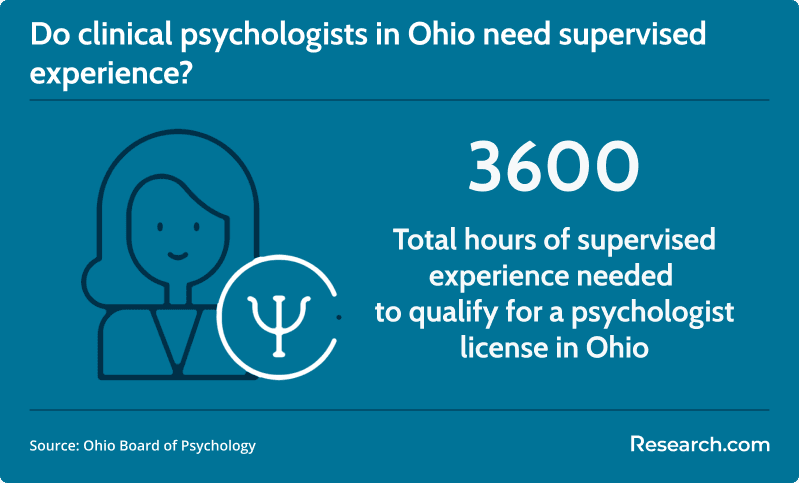
- Ohio students pursuing clinical psychologist licensure must complete 3,600 hours of supervised experience.
- Public four-year institutions in Ohio published tuition and fees of $13,440 for in-state students and $29,670 for out-of-state students from 2024 to 2025.
- The job employment for psychologists in Ohio until 2032 is 10.6%.
- National figures show that 85% of female students chose school psychology programs, 38% of male students chose IO psychology programs, and 10% of nonbinary, two-spirit, or persons with unknown genders chose social psychology.
- School psychologists, among the common psychologist roles in Ohio, earn as much as $90,040 each year.
How do you become a psychologist in Ohio?
Becoming a licensed psychologist in Ohio requires more than completing an online bachelor’s degree. The usual pathway includes undergraduate study, doctoral education, supervised experience, examinations, and state board approval. Students should confirm requirements with the Ohio Board of Psychology before making enrollment decisions because licensure rules can affect program choice, internship planning, and timeline.
- Earn a bachelor’s degree, often in psychology or a closely related field, then choose a specialization when comparing psychology graduate online programs.
- Complete an accredited doctoral program in clinical psychology or the appropriate psychology specialty.
- Finish 3,600 hours of pre- and post-doctoral supervised experience.
- Pass the Examination for Professional Practice in Psychology (EPPP).
- Pass Ohio’s jurisprudence exam.
- Submit the required application materials to the Ohio Board of Psychology and wait for license approval.
Applicants should also expect a background check, three reference letters from licensed psychologists, and application and exam fees. After licensure, psychologists must meet ongoing renewal and continuing education requirements to keep practicing.
| Career Goal | Minimum Education Usually Needed | Licensure Consideration |
| Entry-level human services or behavioral health support | Bachelor’s degree | May not require psychologist licensure, but employer requirements vary. |
| Industrial-organizational or applied research roles | Often master’s degree or higher | Licensure may not be required for many non-clinical roles. |
| Licensed clinical psychologist | Doctoral degree | Requires supervised experience, exams, and state licensure. |
| Psychology professor or advanced researcher | Often doctoral degree | Licensure depends on whether the role includes clinical practice. |
How long does it take to complete an online psychology program in Ohio?
The timeline depends on the degree level, transfer credits, enrollment status, and whether the program includes internships or clinical requirements. A bachelor’s degree in psychology commonly takes four years. A master’s degree may take about two years of full-time study or around three years part time. Some schools offer accelerated formats that shorten the route from bachelor’s to master’s study.
Doctoral programs require the longest commitment. PsyD and PhD in Psychology programs differ in emphasis and structure, but both can require several years of advanced training. A Doctor of Psychology (PsyD) may take four to five years, while a Doctor of Philosophy (PhD) in Psychology can extend up to seven years.
| Degree Level | Typical Timeline | Best For |
| Bachelor’s in Psychology | Four years | Students seeking a foundation for entry-level roles or graduate school. |
| Master’s in Psychology | Two years full time or around three years part time | Students pursuing applied, research, organizational, or graduate-preparation roles. |
| PsyD | Four to five years | Students focused on practice-oriented doctoral psychology training. |
| PhD in Psychology | Up to seven years | Students interested in research, academia, clinical training, or specialized doctoral work. |
How does an online psychology program compare to an on-campus program in Ohio?
Online and campus psychology programs can cover the same academic content, but the learning experience can be very different. Students comparing popular online degrees with campus-based psychology programs should consider schedule, clinical requirements, networking, research access, and learning style.
| Factor | Online Psychology Program | On-Campus Psychology Program |
| Schedule | Often more flexible, with asynchronous or evening options. | Usually follows set class times and campus calendars. |
| Location | Students can study from home if they have reliable internet access. | Students must commute, live near campus, or relocate. |
| Interaction | Uses video, discussion boards, email, and virtual meetings. | Provides face-to-face classroom and informal campus interaction. |
| Research and labs | May use virtual labs, remote projects, or limited campus visits. | May offer easier access to faculty labs and in-person research teams. |
| Field experience | May require students to arrange local placements or attend intensives. | May have established local partnerships for practicum and internship work. |
| Networking | Works best for proactive students who join virtual events and professional groups. | Offers more spontaneous peer, faculty, and campus networking opportunities. |
Because psychologists often perform assessment, therapy, supervision, and research duties that require direct skill development, many doctoral programs are still delivered in person or in hybrid formats. Some online doctoral programs also require campus residencies or in-person clinical experiences. Choose online study if you need flexibility and can stay self-directed; consider campus study if you want more direct access to labs, faculty, classmates, and clinical training sites.
What is the average cost of an online psychology program in Ohio?
The cost of an online psychology program in Ohio varies by school type, degree level, residency status, transfer credits, technology fees, books, and clinical placement costs. The cost for bachelor's degree in psychology can range from $10,000 to $40,000 per year, while graduate programs may range from $15,000 to $80,000 per year.
Public four-year institutions in Ohio charged $11,350 for in-state and $26,450 for out-of-state tuition and fees for the 2024-2025 academic year (Mateo-Berganza & Pender, 2024). The average cost of master’s degrees in the U.S. is $61,500, and the average tuition for doctorate programs is $135,900 (Hanson, 2025).
Online programs are not always cheaper than campus programs. While students can find affordable undergraduate and affordable online masters degree options, some online programs charge technology fees, digital resource fees, tuition differentials, or course-specific costs that narrow the savings.
How to compare psychology program costs accurately
- Calculate total tuition by multiplying cost per credit by required credits.
- Ask whether online students pay separate distance learning, technology, or digital textbook fees.
- Confirm whether tuition differs for in-state and out-of-state online learners.
- Check how many transfer credits the school will accept before estimating your final cost.
- Ask whether internships, practicums, background checks, liability insurance, or travel add extra costs.
- Compare net price after scholarships, employer benefits, grants, and aid—not just published tuition.
What are the financial aid options for students enrolling in an online psychology program in Ohio?
Students can reduce costs by comparing aid packages, applying early, and considering the best affordable colleges for psychology. Financial aid may include federal aid, institutional scholarships, private scholarships, grants, assistantships, employer tuition assistance, and student loans.
- Michael Sullivan Diversity Scholarship - Supports graduate psychology students whose research addresses diversity and inclusion.
- Inez Beverly Prosser Scholarship - Supports African American psychology graduate students.
- Ohio Women in Psychology Grant - Supports female students or faculty pursuing research or training in women’s studies.
- Psi Chi Undergraduate Scholarship - Supports undergraduate psychology students who are members of Psi Chi, the International Honor Society in Psychology.
Graduate students may also find assistantship opportunities in psychology departments or related organizations. These may provide stipends, tuition waivers, or other benefits in exchange for teaching, research, or administrative work. Online students should ask whether assistantships are open to distance learners because some opportunities require campus presence.
In 2024, 31.8% of Ohioans reported symptoms of anxiety or depression (Kaiser Family Foundation, 2024). For students who want to work in mental health, managing education costs is not only a personal finance issue; it can also affect whether they can afford the long training path required for advanced clinical roles.
What are the prerequisites for enrolling in an online psychology program in Ohio?
Admissions requirements vary by school and degree level. Undergraduate programs usually focus on high school preparation and general admissions materials. Graduate and doctoral programs are more selective and often evaluate academic background, research readiness, professional goals, recommendation letters, and relevant experience.
- High school diploma or equivalent for undergraduate programs
- Bachelor’s degree in psychology for master’s programs
- Master’s degree in psychology for doctoral programs
- At least 2.0 GPA for undergraduate applicants or 3.0 GPA for graduate applicants
- Official transcripts
- ACT, SAT, GRE, or GMAT scores if required
- Personal statement, essay, or statement of purpose
- Letters of recommendation
- Resume or curriculum vitae
Applicants to a doctorate degree in psychology may need to show research experience, clinical exposure, volunteer work, or mental health-related employment. PhD applicants may also be asked for academic writing samples, research papers, or portfolios.
International applicants commonly need proof of English proficiency. Students without prior psychology coursework may be required to complete prerequisites in introductory psychology, statistics, biology, anatomy, human development, child development, or experimental methods before entering advanced courses.
National enrollment patterns show how varied psychology interests can be. In the U.S., school psychology is the most popular field of doctoral psychology studies among female students (82.1%), while male psychology students preferred IO psychology programs (32.9%). Among nonbinary, two-spirit, or persons with unknown genders, social psychology (12.3%) was the most preferred doctoral concentration from 2024 to 2025 (APA, 2025). Students should use these trends as context, not as a reason to follow a path that does not fit their goals.
What are the accreditation standards for online psychology programs in Ohio?
Accreditation is one of the most important checks before enrolling in an online psychology program. For bachelor’s and master’s degrees, institutional accreditation is usually the key standard. In Ohio, many institutions are accredited by the Higher Learning Commission (HLC). Some counseling-related master’s programs may also be reviewed by the Council for Accreditation of Counseling and Related Educational Programs (CACREP) or the Commission on Accreditation for Marriage and Family Therapy Education (COAMFTE). Doctoral psychology programs are commonly accredited by the American Psychological Association (APA).
Students should not assume that every online psychology degree is acceptable for licensure or graduate school. Accreditation, program design, supervised experience, and state rules all matter.
Accreditation and quality checklist
- Confirm the institution’s accreditation status with the accreditor, not only the school website.
- Ask whether the specific program prepares students for licensure, graduate school, or non-clinical careers.
- Review faculty credentials, research interests, and experience in the specialization you want.
- Check whether the program includes internships, practicum, clinical experience, or research placements.
- Ask what student support services are available to online learners.
- Review online library access, statistical software, databases, and digital learning tools.
- Compare course scheduling flexibility with your work and family obligations.
- Request available data on alumni outcomes, graduate school placement, licensure exam performance, or employment pathways.
What career paths are available for graduates of online psychology programs in Ohio?
Psychology graduates can work in clinical and non-clinical fields, but job options depend on education level and licensure. Licensed clinical and counseling psychologists provide assessment, therapy, diagnosis, consultation, and treatment services. Other graduates use psychology training in schools, businesses, research, marketing, sports, law, and community programs. Students comparing researcher roles, organizational psychology salary pathways, or behavioral health jobs should map the degree requirement for each role before enrolling.
| Career Path | What the Work Involves | Important Preparation |
| School psychologists | Support academic, behavioral, social-emotional, and mental health needs in educational settings. | Graduate training, supervised practice, and school-related credentialing may be required. |
| Educational psychologists | Study learning, instruction, curriculum, and interventions that improve educational outcomes. | Research, assessment, development, and education-focused training are useful. |
| IO psychologists | Use psychology to improve hiring, training, performance, leadership, and organizational systems. | Students asking what can you do with a master's degree in psychology often consider this path. |
| Researchers | Design studies, analyze data, publish findings, and contribute to evidence-based practice. | Strong statistics, research methods, writing, and graduate study are often important. |
| Consumer behavior specialists | Analyze how people make purchasing decisions and respond to products, brands, and messaging. | Training in psychology, statistics, marketing, and survey research can help. |
| Sports psychologists | Help athletes, coaches, and teams strengthen motivation, performance, resilience, and mental skills. | Sport psychology coursework and supervised applied experience are valuable. |
| Neuropsychologists | Study and assess the connection between brain function, behavior, cognition, and neurological conditions. | Advanced doctoral and specialized neuropsychology training are commonly needed. |
| Forensic psychologists | Apply psychology in courts, corrections, law enforcement, evaluations, and expert testimony. | Graduate training in forensic psychology, assessment, ethics, and legal systems is important. |
What is the job market for graduates with an online psychology degree in Ohio?
Ohio has a meaningful employment base for psychology professionals. Reports show that Ohio had 2,340 clinical and counseling psychologists, making it the eighth state with the highest number of employed psychologists in 2024 (Bureau of Labor Statistics, 2024). For clinical, counseling, and school psychologists in Ohio, projected growth is 9%, with 450 yearly openings across a decade (Projections Central, 2025).
Graduates may also explore psychology career pathways outside Ohio. Nationally, the job outlook is listed at 8.4%, or approximately 1.1 million new jobs every year from 2024 to 2034 (U.S. Bureau of Labor Statistics, 2024). These projections do not guarantee employment for any individual graduate, but they show that psychology-related expertise remains relevant across healthcare, education, research, business, and community settings.
Do online psychology students in Ohio need telehealth training and certifications?
Telehealth training is increasingly useful for psychology students, especially those planning to work in counseling, behavioral health, assessment, or community mental health. Online students should learn how remote care affects privacy, informed consent, crisis response, documentation, technology reliability, cross-state practice, and therapeutic rapport.
Some online psychology programs include telehealth modules or certificates. Others expect students to pursue continuing education or supplemental training after graduation. Students should ask whether telehealth instruction is tied to Ohio-specific legal and ethical requirements and whether it is relevant to the student’s intended role.
Students pursuing specialized pathways, including forensic psychology master's online accredited programs, may also need training in virtual interviews, remote assessments, legal documentation, and ethical limits in digital settings. Telehealth skills are not a substitute for supervised clinical training, but they can make graduates better prepared for modern service delivery.
How can Ohio psychology graduates engage in research and innovation to advance their careers?
Research experience can help psychology graduates qualify for graduate school, academic roles, policy work, program evaluation, and evidence-based practice positions. Ohio graduates can look for research assistant roles, faculty-led projects, hospital-based studies, nonprofit evaluation work, public health collaborations, or government research initiatives.
Students interested in advanced research careers may consider doctoral pathways such as the best developmental psychology PhD programs. Strong research preparation usually includes statistics, experimental design, writing, literature review, ethics approval procedures, and experience presenting findings.
What emerging trends are shaping the future of psychology careers in Ohio?
Psychology careers are being shaped by telehealth, digital assessment tools, data-informed care, interdisciplinary work, workplace mental health initiatives, and growing attention to access and equity. Graduates should also watch how artificial intelligence is used in screening, behavioral analysis, documentation, and administrative workflows. These tools can support care and research, but they also raise ethical questions about privacy, bias, oversight, and professional responsibility.
Students planning graduate study should weigh cost alongside career goals. A useful next step is comparing tuition and program design in resources such as How much does a masters degree in psychology cost?.
What further education or advanced training opportunities are open to psychology graduates in Ohio?
Ohio licensed clinical psychologists must renew their licenses every two years. They must complete 23 hours of continuing education from approved CE providers, including options offered through PsyD online institutions and other accredited sources. The continuing education requirement must include four hours in ethics or cultural competency.
Graduates can also pursue specialty certifications, advanced workshops, supervision groups, or postgraduate training in areas such as trauma, assessment, neuropsychology, telehealth, school psychology, forensic practice, or organizational consulting. Undergraduate students can benefit from joining organizations such as the Ohio Psychological Association, the American Psychological Association, or psychology honor societies for mentoring, conferences, networking, EPPP preparation, study groups, and professional development.
How can Ohio psychology graduates transition into non-clinical careers with their degree?
Many psychology graduates do not become licensed psychologists. That does not make the degree unusable. Psychology develops skills in research, communication, motivation, behavior change, conflict resolution, survey design, data interpretation, and ethical decision-making. Those skills can transfer into business, education, nonprofit, technology, healthcare administration, and public service roles.
- Human Resources Specialist: Applies knowledge of motivation, behavior, and communication to recruitment, employee relations, engagement, performance management, and workplace well-being.
- Market Research Analyst: Uses survey design, consumer behavior, and data analysis to help organizations understand audiences, products, and market trends.
- User Experience Researcher: Studies how people interact with websites, apps, platforms, and digital tools through interviews, usability tests, and behavioral research.
- Public Relations Specialist: Uses communication and audience insight to shape messaging, reputation, and relationships between organizations and the public.
- Health Educator: Promotes wellness, mental health awareness, prevention, and community education through programs and outreach.
- Corporate Trainer: Designs learning experiences that improve leadership, teamwork, communication, customer service, and employee performance.
How can mentorship and professional networking accelerate career growth in Ohio psychology careers?
Mentorship helps psychology students understand what different careers actually require. A mentor can explain licensure steps, recommend internships, review graduate school plans, introduce professional contacts, and help students avoid expensive mistakes. Networking through conferences, student organizations, alumni groups, faculty research teams, and professional associations can also reveal job openings and training opportunities that are not obvious from program websites.
Students interested in behavioral analysis or related applied credentials may also compare options such as the most affordable BCBA degrees online. The right credential depends on the intended population, work setting, and state or employer requirements.
Can accelerated online master’s programs fast-track psychology careers in Ohio?
Accelerated online master’s programs can help some students move more quickly into advanced roles, but speed should not be the only factor. A shorter program is useful only if it still provides rigorous coursework, qualified faculty, applied experience, advising, and alignment with the student’s career goal. For non-licensure careers, accelerated programs may support advancement in research, business, education, or human services. For licensure-related careers, students must verify requirements carefully.
Students comparing faster options can review the fastest masters in psychology programs, then confirm accreditation, total cost, course load, transfer rules, and whether field experience is included.
The Role of Forensic Psychology in Ohio: Careers and Opportunities
Forensic psychology connects psychological science with legal, correctional, and public safety systems. Professionals in this area may support courts, law enforcement, correctional facilities, juvenile justice programs, victim services, competency evaluations, risk assessments, or expert testimony. Because the work can influence legal decisions, forensic psychology requires strong ethics, assessment training, documentation skills, and understanding of legal standards.
What does a forensic psychologist do?
- Conduct psychological evaluations related to competency, risk, or legal questions.
- Provide expert testimony or written reports for courts and attorneys.
- Support law enforcement through consultation, threat assessment, or behavioral analysis.
- Assist correctional and juvenile justice systems with mental health assessment and rehabilitation planning.
Where can forensic psychology graduates work in Ohio?
- Law enforcement agencies: Supporting threat assessment, behavioral consultation, and investigative work.
- Correctional facilities: Evaluating mental health needs and contributing to treatment or rehabilitation plans.
- Juvenile justice systems: Working with youth who need psychological assessment, intervention, and support.
- Private practice or consulting: Providing expert witness services or evaluations in civil and criminal cases.
Educational pathways for forensic psychology
Students interested in forensic psychology should expect graduate training for many specialized roles. A master’s degree can be a step toward applied work or doctoral preparation. Students comparing flexible programs can explore forensic psychology master's programs online and verify whether the curriculum supports their target role.
Why choose forensic psychology?
Forensic psychology may fit students who want to apply behavioral science in legal systems, public safety, rehabilitation, or justice reform. It can be meaningful work, but it also requires emotional resilience, careful documentation, strong ethics, and comfort working in high-stakes environments.
What opportunities are available for graduates to apply their skills in business settings?
Psychology graduates can bring value to business roles that depend on motivation, decision-making, leadership, training, consumer behavior, workplace culture, and organizational change. Students interested in this path may consider a business psychology major or related coursework in industrial-organizational psychology, management, analytics, marketing, and human resources.
Common business applications include talent management, employee engagement, learning and development, organizational consulting, customer research, leadership coaching, change management, and workplace well-being initiatives. This route can be a strong option for students who like psychology but do not want a clinical career.
How can specialized neuropsychology training boost career prospects in Ohio?
Neuropsychology focuses on the relationship between brain function, cognition, emotion, and behavior. Specialized training can strengthen a graduate’s ability to work with neurological conditions, cognitive assessment, rehabilitation teams, brain injury programs, aging-related concerns, and research settings. Because the work is complex, advanced education and supervised clinical training are generally important.
Students aiming for this specialty may compare doctoral pathways such as PsyD neuropsychology programs. Before enrolling, they should verify clinical training requirements, faculty expertise, practicum access, internship expectations, and whether the program can support future specialization.
Can supplemental certifications enhance career prospects for Ohio psychology graduates?
Supplemental certifications can help psychology graduates demonstrate focused skills, but they should complement—not replace—the degree or license required for a role. Useful areas may include telehealth, crisis intervention, trauma-informed care, behavioral interventions, data analysis, coaching, program evaluation, or specialized assessment tools.
Students considering therapy-related paths should also understand credential boundaries. Some people enter therapy-adjacent fields through routes outside a traditional psychology major, and resources such as degree to be a therapist can help clarify alternative paths. Always verify whether a certification is recognized by employers, licensure boards, or professional associations before paying for it.
How does ongoing professional development shape long-term career growth for Ohio psychology professionals?
Psychology changes as research, technology, laws, ethics, and client needs evolve. Ongoing professional development helps practitioners maintain competence, update methods, improve cultural responsiveness, and stay aligned with evidence-based care. For non-clinical professionals, continuing education can support advancement in analytics, leadership, organizational development, training, or public health.
Professionals who want additional clinical mental health training may compare options such as the fastest online master's programs clinical mental health counseling, while keeping in mind that faster programs still need to meet quality, accreditation, and licensure expectations.
The Growing Importance of Mental Health Advocacy in Ohio Psychology Careers
Mental health advocacy is an important part of many psychology careers in Ohio. Graduates can contribute by improving public awareness, reducing stigma, supporting early intervention, helping underserved communities find services, and participating in policy or community education efforts.
Advocacy does not always require a clinical role. Psychology graduates may work with nonprofits, schools, healthcare organizations, public agencies, crisis programs, community coalitions, or workplace wellness initiatives. These roles can use skills in communication, research, program evaluation, training, and behavior change.
Students who want to combine meaningful impact with strong earning potential can review highest paid psychologist roles, but salary should be evaluated alongside training length, licensure requirements, debt, work setting, and personal fit.
Common Mistakes to Avoid When Choosing an Online Psychology Program in Ohio
| Mistake | Why It Can Hurt You | Better Approach |
| Assuming any psychology degree leads to licensure | A bachelor’s or non-licensure master’s program usually does not qualify graduates to become licensed psychologists. | Work backward from your target license or job title before choosing a program. |
| Checking tuition but ignoring total cost | Fees, books, technology charges, travel, and practicum expenses can change affordability. | Request a full cost estimate and compare net price after aid. |
| Skipping accreditation checks | Unaccredited or poorly aligned programs may affect transfer, aid, graduate admission, or licensure. | Verify institutional and programmatic accreditation through official accreditor sources. |
| Choosing online study without considering fieldwork | Some psychology careers require supervised, in-person experience. | Ask how practicums, internships, and supervision are arranged for online students. |
| Relying only on rankings | A highly ranked program may still be a poor fit for your schedule, budget, or career goal. | Use rankings as one input, then compare curriculum, outcomes, support, and licensure fit. |
| Assuming salary outcomes are guaranteed | Published salary data often reflects licensed or advanced professionals, not all graduates. | Research salary by job title, degree level, region, and employer type. |
Questions to Ask Before Enrolling
- Is the institution accredited, and is the psychology program aligned with my career goal?
- Does the program prepare students for graduate school, employment, licensure, or a non-clinical path?
- Are online students eligible for the same advising, tutoring, library, research, and career services as campus students?
- How many transfer credits can I apply, and how will that affect cost and graduation time?
- Does the program include statistics, research methods, writing, and ethics courses strong enough for graduate study?
- If fieldwork is required, who finds the placement—the school or the student?
- Are there residency, campus visit, internship, practicum, or proctored exam requirements?
- What are recent graduate outcomes, licensure results, graduate school placements, or employment patterns?
- What is the full cost after fees, books, technology charges, and financial aid?
References:
- American Psychological Association. (2025). Graduate Study in Psychology 2025: Enrollment and Degrees Awarded. https://www.apa.org/education-career/gradstudy/data
- American Psychological Association. (2024). CWS Data Tool: Degrees in Psychology. https://www.apa.org/workforce/data-tools/degrees-psychology
- College Board. (2024). Trends in College Pricing and Student Aid 2024. https://research.collegeboard.org/media/pdf/trends-in-college-pricing-student-aid-2024.pdf
- Ohio Department of Job and Family Services. (2024). Ohio 2022-2032 Occupational Projections. https://ohiolmi.com/Home/Projections/Occupational_Projections_2022-2032
- Hanson, M. (2025, May 15). Average Cost of a Master’s Degree. Education Data Initiative. https://educationdata.org/average-cost-of-a-masters-degree
- Mateo-Berganza, M., & Pender, M. (2024). Trends in College Pricing and Student Aid 2024. College Board. https://research.collegeboard.org/media/pdf/trends-in-college-pricing-student-aid-2024.pdf
- Kaiser Family Foundation. (2024). Mental Health and Substance Use State Fact Sheets: Ohio. https://www.kff.org/statedata/mental-health-and-substance-use-state-fact-sheets/ohio/Average cost of a doctorate degree
- Psychology.org. (2025). Fastest Growing Careers In Psychology. https://www.psychology.org/resources/fastest-growing-careers-in-psychology/
- Psychology.org. (2025, October 6). Best Types Of Online Psychology Degrees 2025. https://www.psychology.org/degrees/
- Projections Central. (2024). Long-Term Occupational Projections (2022-2032) - Ohio. https://projectionscentral.org/Projections/LongTerm
- U.S. Bureau of Labor Statistics. (2025). Psychologists: Occupational Outlook Handbook. https://www.bls.gov/ooh/life-physical-and-social-science/psychologists.htm
- U.S. Bureau of Labor Statistics. (2025). Occupational Employment and Wage Statistics: May 2024 State Occupational Employment and Wage Estimates, Ohio. https://www.bls.gov/oes/current/oes_oh.htm
- U.S. Bureau of Labor Statistics. (2025). Occupational Employment and Wage Statistics: Industrial-Organizational Psychologists (May 2024). https://www.bls.gov/oes/current/oes193032.htm
- U.S. Bureau of Labor Statistics. (2025). Occupational Employment and Wage Statistics: Clinical and Counseling Psychologists (May 2024). https://www.bls.gov/oes/current/oes193033.htm
- U.S. Bureau of Labor Statistics. (2025). Occupational Employment and Wage Statistics: Psychologists, All Other (May 2024). https://www.bls.gov/oes/current/oes193039.htm
- U.S. Bureau of Labor Statistics. (2025). Occupational Employment and Wage Statistics: Psychology Teachers, Postsecondary (25-1066). https://www.bls.gov/oes/current/oes251066.htm
Key Insights
- An online psychology degree in Ohio can be a strong option for flexible study, but the right program depends on whether your goal is graduate school, clinical licensure, research, business, education, or human services.
- A bachelor’s degree in psychology is usually not enough to become a licensed psychologist. Ohio clinical psychologist licensure typically requires doctoral education, 3,600 hours of supervised experience, the EPPP, the Ohio jurisprudence exam, and board approval.
- Accreditation should be checked before cost, convenience, or ranking. For Ohio schools, HLC accreditation is common at the institutional level, while APA accreditation is important for doctoral psychology programs.
- Online programs can save commuting time and improve schedule flexibility, but students pursuing clinical or assessment careers must confirm practicum, internship, supervision, and residency requirements.
- Costs vary widely. Compare total program cost, transfer credit policies, fees, financial aid, and time to completion before deciding whether a program is affordable.
- Psychology graduates can work beyond therapy. Ohio students can apply psychology training in human resources, research, marketing, UX, education, forensic settings, sports performance, advocacy, and organizational development.
- The best choice is the program that fits your target role, not simply the cheapest, fastest, or highest-ranked option.
Other Things You Should Know About Online Psychology Programs in Ohio
In 2027, Ohio's online psychology degrees are highly praised for their flexibility and accessibility. These programs often offer asynchronous classes, allowing students to learn at their own pace. Many universities also provide 24/7 technical support and personalized academic advising, ensuring students can navigate their studies seamlessly.
Admission requirements typically include a completed application, transcripts showing a minimum GPA of 2.5, and letters of recommendation. Some programs may require a personal statement or interview. Check individual program guidelines for specific criteria for 2027.


