
2027 Best Psychology Schools in Texas – Accredited Colleges & Programs

Co-Founder and Chief Data Scientist
Texas students choosing a psychology school are weighing more than campus reputation. The decision affects licensure eligibility, graduate school options, internship access, cost, and long-term career flexibility. Texas already has the second largest mental health workforce in the nation, yet the state still needs 702 more psychologists to meet demand, which makes program quality and career preparation especially important for future mental health professionals.
This guide explains how psychology programs in Texas work, which schools stand out, what salaries and job paths may look like, how online programs compare with campus-based options, and what steps are required to become licensed. It is designed for students considering undergraduate psychology, graduate psychology, counseling-related careers, school psychology, or specialized paths such as industrial-organizational psychology, family therapy, forensic psychology, or health psychology.
Quick answer: What should you look for in a Texas psychology school?
The best psychology school in Texas for you is the one that matches your career goal, budget, learning format, and licensure plan. Students aiming to become licensed psychologists usually need a doctoral degree, supervised experience, and passing exam scores. Students interested in counseling, school psychology, behavior analysis, or organizational psychology may need different graduate degrees, credentials, or licenses. Before enrolling, verify accreditation, program outcomes, clinical or research training, cost per credit, internship support, and whether the curriculum aligns with Texas licensing requirements.
What are the benefits of getting a psychology degree?
- Broad career use: Psychology training can lead to roles in clinical care, schools, research, business, human services, and people-focused organizational work.
- Flexible study options: Online psychology programs may reduce commuting, housing, and campus-related expenses while allowing students to keep working.
- Competitive earnings in advanced roles: Texas clinical and counseling psychologists earn a mean annual wage of $82,420, showing that graduate-level psychology careers can offer solid financial potential.
What can I expect from a psychology program in Texas?
A Texas psychology program typically teaches how people think, feel, develop, learn, and behave. Undergraduate programs usually build a foundation in research methods, statistics, biological psychology, development, social behavior, and abnormal psychology. Graduate programs become more specialized and may emphasize clinical practice, counseling, assessment, neuroscience, school psychology, organizational behavior, or research.
Most bachelor’s programs take four years. Graduate study can take two to six years depending on the degree, specialization, and whether the student is pursuing a master’s, Ph.D., or Psy.D. Strong programs usually provide faculty mentorship, research labs, practicum placements, internships, and preparation for licensing or doctoral study. For clinical psychology, American Psychological Association accreditation is especially important because it can affect internship competitiveness, licensure mobility, and employer confidence.
| Program level | Typical length | Best fit | Important decision point |
| Associate degree | Typically completed in two years | Students starting at a lower-cost college before transfer | Check whether credits transfer into a Texas bachelor’s program |
| Bachelor’s degree | Usually four years | Students preparing for graduate school or entry-level human services, research, or business roles | A bachelor’s alone usually does not qualify graduates to practice independently as psychologists |
| Master’s degree | About two to three years | Students pursuing counseling-related, school, organizational, or specialist roles | Confirm whether the degree meets the credential or licensure route you want |
| Doctoral degree | Four to seven years | Students seeking psychologist licensure, advanced research, clinical leadership, or academic roles | Review accreditation, supervised experience requirements, and internship placement support |
Where can I work with a psychology degree in Texas?
Psychology graduates in Texas work across healthcare, education, government, corporate, nonprofit, and research environments. Your options depend heavily on degree level and license type. A bachelor’s degree may qualify you for entry-level roles, while independent clinical practice as a psychologist requires doctoral-level preparation and licensure.
Common industries include:
- Hospitals, behavioral health centers, and private clinics
- K-12 schools, colleges, universities, and testing or assessment services
- Corporate departments focused on human resources management, employee satisfaction, organizational efficiency, and workforce development
- State and local government agencies involved in public health, community programs, policy advising, and social services
Texas locations to consider:
- Large metro areas such as Houston, Dallas, and Austin often offer more openings because they have larger healthcare systems, more universities, and broader business networks.
- West Odessa and Carrollton are noted for offering some of the highest salaries for psychologists in Texas, which may matter for students comparing location and earning potential.
Texas offers multiple career settings for psychology graduates, but location, specialty, license level, and employer type can change both salary and job availability. Students should compare the type of work they want with the credentials required in that setting.
How much can I make with a psychology degree in Texas?
Psychology salaries in Texas differ by specialty, work setting, experience, and credential. According to the Bureau of Labor Statistics (BLS), selected psychology-related roles in Texas report the following average annual wages:
| Role | Average annual wage in Texas | Mean hourly wage | What the role generally involves |
| Clinical and Counseling Psychologists | $82,420 | Approximately $39.62 | Assessment, diagnosis, therapy, and treatment planning for mental and behavioral health concerns |
| School Psychologists | $80,610 | $38.76 | Student assessment, intervention planning, behavioral support, and consultation with schools and families |
| Psychologists, All Other | $120,040 | $60.37 | Specialized psychology roles not grouped under the main clinical, counseling, or school categories |
| Postsecondary Psychology Teachers | 90,080 | Not stated | Teaching, academic advising, research, and curriculum development in colleges or universities |
These figures show that psychology can be financially viable in Texas, especially for students who complete the graduate education, supervised training, and licensure needed for advanced practice. However, salary outcomes are not guaranteed and can vary widely by region, employer, specialization, and experience.
- 2027 best psychology schools in Texas
- How long does it take to complete psychology programs in Texas?
- How do online psychology schools compare to campus programs?
- What is the average cost of psychology programs in Texas?
- What financial aid is available for Texas psychology students?
- What are the admissions requirements for psychology programs?
- What courses are common in psychology programs?
- What psychology specializations can students pursue in Texas?
- How should you choose a psychology program in Texas?
- What are the licensing requirements for psychologists in Texas?
- How can I specialize in family therapy in Texas?
- What career paths are available for psychology graduates?
- What is the job market for psychology graduates?
- How can I become a board certified behavior analyst in Texas?
- How are clinical mental health counselors and clinical psychologists different?
- How can health psychology strengthen wellness programs in Texas?
- How can I become a forensic scientist in Texas?
- How do I obtain and maintain a Texas psychology license?
- What is the fastest route to becoming a counselor in Texas?
- How can I become a mental health counselor in Texas?
- How can I specialize in criminal psychology in Texas?
- What are the requirements for school psychologists in Texas?
- How can I specialize in organizational psychology in Texas?
- How can I become a substance abuse counselor in Texas?
- What licensing requirements apply to marriage and family therapists in Texas?
- How can I become a marriage counselor in Texas?
2027 Best Psychology Schools in Texas
The schools below represent strong psychology options in Texas for students comparing research opportunities, program scope, graduate pathways, and professional preparation. If you need a flexible format, Research.com’s guide to online schools for psychology can help you compare remote bachelor’s options alongside campus-based programs.
How do we rank schools?
Research.com builds school lists through structured research and data review. You can read more in our methodology section. Ranking inputs include multiple education data sources, such as:
- IPEDS database
- Peterson’s database
- Distance Learning Licensed Data Set, College Scorecard database
- The National Center for Education Statistics
1. The University of Texas at Austin
The University of Texas at Austin is a strong option for students who want a research-intensive psychology education with wide coverage across human behavior, culture, development, perception, neuroscience, and social processes. The department emphasizes experimental design, statistics, and research training, while also offering a notable LSSP pathway. Students can benefit from extensive university libraries, research facilities, and faculty-led projects.
- Program Length: Four years (undergraduate), Two to five years (graduate)
- Tracks/concentrations: Behavioral Neuroscience; Clinical Psychology; Cognition, Brain, and Behavior; Developmental Psychology; Individual Differences and Evolutionary Psychology; Perception, Brain, and Behavior; and Social Psychology (graduate)
- Estimated Cost per Credit: $724 (undergraduate), $992 (graduate)
- Required Credits to Graduate: 120 (undergraduate), 30-99 (graduate)
- Accreditation: American Psychological Association (APA)
2. University of Houston
The University of Houston offers psychology study at both undergraduate and graduate levels, with doctoral training in areas such as clinical, cognitive, social, and I-O psychology. Students can participate in research supported by specialized laboratories and faculty mentorship. The university reports a 96% licensure rate among doctoral alumni within two to ten years of graduation.
- Program Length: Four years (undergraduate), Five years (graduate)
- Tracks/concentrations: Clinical, Developmental Cognitive Neuroscience, Industrial/Organizational, and Social Psychology (graduate)
- Estimated Cost per Credit: $386 (undergraduate), $320-$470 (graduate)
- Required Credits to Graduate: 120 (undergraduate), 72 (graduate)
- Accreditation: American Psychological Association (APA)
3. University of North Texas
The University of North Texas offers psychology programs that combine classroom theory, research methods, applied training, community engagement, and internships. UNT is also known for LSSP preparation. Its Clinical Psychology Ph.D. program is highly selective, admitting only 9 out of 229 applicants in 2024.
- Program Length: Four years (undergraduate), Four to six years (graduate)
- Tracks/concentrations: Educational Psychology, Behavioral Science, Clinical Psychology, Counseling Psychology (graduate)
- Estimated Cost per Credit: $600 (undergraduate), $900 (graduate)
- Required Credits to Graduate: 120 (undergraduate), 113 (graduate)
- Accreditation: American Psychological Association (APA)
4. Texas A&M University
Texas A&M University in College Station provides psychology programs at the bachelor’s, master’s, and doctoral levels. Its areas include behavioral neuroscience, industrial-organizational psychology, social psychology, and other graduate concentrations. Students are encouraged to engage in research and internship opportunities early. The graduate programs admit about 100 students annually to maintain a 2:1 student-to-faculty ratio.
- Program Length: Four years (undergraduate), Four to five years (graduate)
- Tracks/concentrations: Behavioral and Cellular Neuroscience, Clinical, Cognitive, Developmental, Industrial-Organizational, and Social Psychology (graduate)
- Estimated Cost per Credit: $707 (undergraduate), $804 (graduate)
- Required Credits to Graduate: 120 (undergraduate), 33-60 (graduate)
- Accreditation: American Psychological Association (APA)
5. Baylor University
Baylor University in Waco offers psychology and neuroscience study in a private Christian university setting. Students can pursue undergraduate neuroscience as well as advanced Psy.D. and Ph.D. options. Baylor combines academic coursework with applied training and states a commitment to equity, diversity, inclusion, and respectful learning environments.
- Program Length: Four years (undergraduate), Five years (graduate)
- Tracks/concentrations: Neuroscience (undergraduate), Behavioral Neuroscience, Social Psychology, General Experimental Psychology, Clinical Psychology (graduate)
- Estimated Cost per Credit: $1,828 (undergraduate), $608 (graduate)
- Required Credits to Graduate: 120 (undergraduate), 78-115 (graduate)
- Accreditation: American Psychological Association (APA)
What graduates say about studying psychology in Texas
- Psychology helped me understand behavior in a deeper and more compassionate way. My internship experiences were the part that made the classroom material feel real, and they gave me confidence before entering professional settings. Cherry
- Online study made it possible for me to continue working while earning my psychology degree. The virtual classes were interactive, and meeting classmates from different places expanded how I think about mental health needs. Alex
- My psychology program changed how I approach people and problems. I learned theories, but more importantly, I learned how those ideas can be used to support people and promote mental health awareness. Joy
Key findings for Texas psychology students
- Clinical and Counseling Psychologists in Texas earn an average annual salary of $82,420.
- School Psychologists have a median hourly wage of $37.47, which points to meaningful earning potential in educational settings.
- Psychologists in other specializations not separately classified earn an average annual salary of $120,040.
- Postsecondary Psychology Teachers earn an average of $90,080 annually.
- Texas shows promising job growth for psychologists, creating opportunities for graduates who choose the right degree path and meet credentialing requirements.
How long does it take to complete psychology programs in Texas?
The time required depends on whether you are pursuing a foundation degree, a graduate credential, or full psychologist licensure. Students who plan to practice independently should expect a longer timeline because doctoral education, supervised experience, exams, and continuing education are part of the process.
- Associate’s Degree in Psychology: Typically completed in two years.
- Bachelor’s Degree in Psychology: Usually requires four years of study.
- Master’s Degree in Psychology: Generally takes about two to three years, depending on full-time or part-time enrollment.
- Doctoral Degree in Psychology: Typically requires four to seven years. A Ph.D. generally takes five to seven years, while a Psy.D. can be completed in four to six years.
After licensure, Texas psychologists must complete 40 hours of continuing education every two years, including required content in diversity and ethics.
How do online psychology schools compare to an on-campus program?
Online psychology programs can be a strong choice when they are properly accredited, academically comparable to campus programs, and aligned with the student’s career goal. Employer confidence is generally stronger when the online program is offered by an established institution with recognized accreditation and, in many cases, a physical campus. As shown below, 76% of academic leaders believe online programs are comparable to on-campus degrees if the institution also has a physical campus presence. That figure rises to 89% if the college has a traditional campus.
Students should also consider reputation, fieldwork access, faculty support, and whether the program offers the same curriculum standards as the on-campus version. This matters for students seeking high-paying psychology careers with a bachelor’s degree or those planning to use an online degree as a stepping stone into graduate school. A well-known university brand can help, but accreditation, outcomes, and fit matter more than format alone.
| Factor | Online psychology program | On-campus psychology program | Best choice when... |
| Flexibility | Often better for working students or students with family obligations | Requires scheduled campus attendance | Choose online if you need location or schedule flexibility |
| Research and lab access | May be available remotely or through limited campus visits | Often easier to access in-person labs and faculty projects | Choose campus if research mentorship is central to your plan |
| Clinical or field placement | May require approved local placements | May offer stronger local placement networks near campus | Ask how placements are arranged before enrolling |
| Employer perception | Strongest when regionally accredited and tied to an established institution | Usually familiar to employers and graduate committees | Choose either format if accreditation and outcomes are strong |
What is the average cost of psychology programs in Texas?
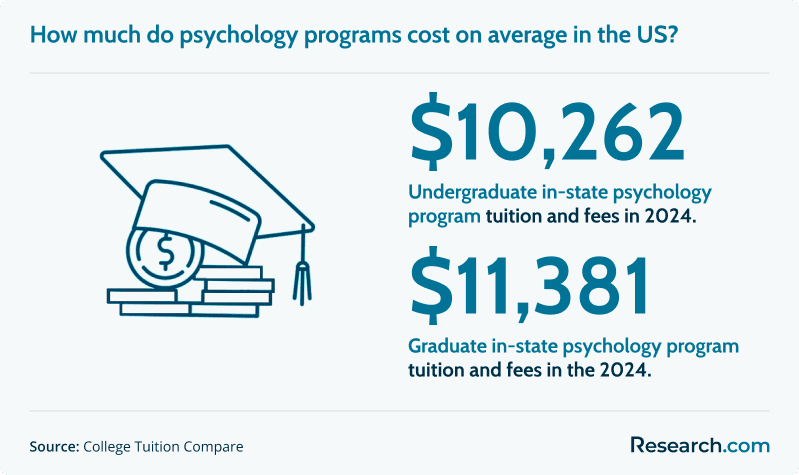
Psychology program costs in Texas vary by institution, residency status, degree level, and enrollment format. For in-state students, undergraduate tuition typically costs around $10,262, while graduate tuition is about $11,381 per year.
Texas pricing is close to national psychology tuition averages. As the image below shows, the average undergraduate tuition for psychology programs is $10,287 for state residents, compared with $10,262 in Texas. Graduate tuition in Texas is slightly above the national average of $11,311, at $11,381. Students comparing programs should look beyond tuition and review fees, books, housing, technology costs, transportation, clinical placement expenses, and lost income if they plan to study full time.
What are the financial aid options for students enrolling in psychology programs in Texas?
Financial aid can make a psychology degree more manageable, but students should compare the full aid package rather than focusing only on advertised tuition. Common funding sources include federal aid, state aid, institutional scholarships, work-study, and private scholarships.
Federal and state aid:
- Students should complete the Free Application for Federal Student Aid (FAFSA) to be considered for federal grants, loans, and work-study.
- Texas state grant opportunities may also use FAFSA information, so submitting it early can improve access to available aid.
Scholarships:
- Scholarships may come from colleges, private foundations, professional organizations, research programs, or community groups.
- Eligibility may be based on academic merit, financial need, research interests, service commitments, identity-based criteria, or intended specialization.
Work-study programs:
- Work-study allows eligible students to earn money through part-time employment while enrolled.
- Psychology students should ask whether work-study jobs are available in research labs, advising offices, tutoring centers, or mental health-related campus services.
Students attending the best psychology schools in Texas should also ask each school’s financial aid office about department-level awards, graduate assistantships, tuition waivers, research assistant roles, and scholarships tied to clinical or school-based training.
What are the prerequisites for enrolling in psychology programs?
Admissions requirements vary by school, degree level, and specialization. Undergraduate programs usually evaluate academic readiness, while graduate programs look more closely at prior coursework, research experience, professional goals, references, and readiness for advanced study.
Undergraduate programs commonly require:
- High school diploma or GED
- SAT or ACT scores at many institutions
- Recommended or required high school preparation in subjects such as biology or math
- Personal statement or statement of interest at some schools
Graduate programs commonly require:
- Bachelor’s degree, preferably in psychology or a closely related field
- Minimum undergraduate GPA, often around 3.0
- GRE scores for programs that still require them
- Two or three letters of recommendation from academic or professional references
- Research, clinical, volunteer, or work experience when required or preferred
Specialized pathways may add extra expectations. For example, students pursuing industrial-organizational psychology may need stronger preparation in statistics, research design, workplace behavior, or business-related topics. Always check the program’s official admissions page before applying.
What courses are typically in psychology programs?
Psychology curricula move from broad foundations to specialized applications. Undergraduate study teaches the scientific basis of psychology, while graduate coursework develops advanced research, assessment, intervention, and professional skills.
Common undergraduate courses include:
- Introduction to Psychology: Survey of major psychological theories, concepts, and areas of practice.
- Research Methods and Statistics: Training in study design, data analysis, measurement, and interpretation.
- Biological Bases of Behavior: Study of how brain systems, physiology, genetics, and biology influence behavior.
- Developmental Psychology: Examination of human growth and change from infancy through adulthood.
- Social Psychology: Study of how groups, culture, social settings, and relationships shape behavior.
- Abnormal Psychology: Introduction to psychological disorders, symptoms, classification, and treatment approaches.
Common graduate courses include:
- Advanced Research Methods: In-depth study of psychological research designs, methods, and analysis.
- Clinical Psychology: Preparation for assessment, diagnosis, treatment planning, and clinical intervention.
- Cognitive and Affective Bases of Behavior: Advanced study of thinking, emotion, attention, memory, and emotional regulation.
- Neuropsychology: Study of brain-behavior relationships and the effects of neurological conditions on cognition and functioning.
- Industrial-Organizational Psychology: Application of psychological science to workplace performance, leadership, selection, motivation, and employee well-being.
Students planning graduate school should prioritize programs with statistics, research, writing, and lab experience. Students planning clinical or counseling work should also look for practicum readiness, ethical training, and exposure to diverse populations.
What types of specializations are available in psychology schools in Texas?
Texas psychology schools offer specializations that prepare students for different types of work. Choosing a specialization should depend on whether you want to provide direct services, conduct research, support students, improve workplaces, teach, or work in health systems.
| Specialization | Main focus | Common work setting | Best fit for students who... |
| Clinical and Counseling Psychology | Assessment, diagnosis, and treatment of mental health and behavioral disorders | Hospitals, clinics, private practice, community mental health | Want advanced clinical practice and are prepared for graduate study and licensure |
| School Psychology | Student learning, mental health, behavioral support, and educational assessment | K-12 schools, districts, educational agencies | Want to work with children, educators, and families in school systems |
| Industrial-Organizational Psychology | Workplace behavior, employee performance, leadership, hiring, and organizational systems | Corporations, consulting firms, government, HR analytics | Want to apply psychology in business and organizational settings |
| Postsecondary Teaching in Psychology | College teaching, research, mentoring, and curriculum development | Colleges and universities | Want academic roles and are comfortable with research and graduate-level training |
Texas employment data shows meaningful demand in several areas. Clinical and counseling psychologists in Texas account for 4,240 employed professionals, while school psychologists account for 6,180 employed individuals. Like the positive job outlook for counselors, psychology employment in Texas is expected to grow in several roles.
How to Choose the Best Psychology Programs in Texas
The right psychology program should prepare you for your next credential, not just award a degree. If you want to become a licensed psychologist, confirm the program aligns with Texas State Board of Examiners of Psychologists requirements and, when relevant, APA accreditation expectations. If you want counseling, behavior analysis, school psychology, or organizational work, check the correct licensing or certification route for that profession.
Use this checklist before applying:
- Accreditation: Confirm institutional accreditation and, when relevant, programmatic accreditation such as American Psychological Association accreditation.
- Licensure alignment: Ask whether the curriculum, supervised experience, and degree level meet Texas requirements for your intended profession.
- Fieldwork support: Review practicum, internship, research, and job placement support.
- Graduate outcomes: Compare licensure rates, doctoral admissions, internship matches, employment outcomes, and alumni roles when available.
- Total cost: Look at tuition, fees, books, living costs, commuting, technology, and whether assistantships or scholarships are available.
- Faculty fit: For graduate study, identify faculty whose research or clinical interests match yours.
- Format fit: Decide whether online, hybrid, or campus learning gives you enough access to mentoring, labs, and field placements.
Graduates may work in healthcare, schools, social services, research, government, or business settings in cities such as Houston, Dallas, and Austin. Students interested in corporate roles can also review the best business schools in Texas for programs that combine psychology, analytics, management, and workplace strategy.
Common mistakes to avoid when choosing a psychology school
| Mistake | Why it matters | Better approach |
| Choosing a school based only on rankings | A highly ranked school may not offer your specialization or preferred licensure path | Compare rankings with accreditation, outcomes, faculty fit, and cost |
| Ignoring accreditation | Accreditation can affect graduate admissions, licensure, internships, and employer trust | Verify accreditation through official school and accreditor sources |
| Assuming a bachelor’s degree qualifies you as a psychologist | Independent psychologist practice requires doctoral education and licensure | Map the full education and licensing timeline before enrolling |
| Focusing only on tuition | Fees, housing, commuting, books, and lost income can change the true cost | Calculate total cost of attendance and compare net price after aid |
| Assuming every online program meets fieldwork or licensure needs | Some online programs may require local placements or may not align with state requirements | Ask specific questions about practicum placement, supervision, and state eligibility |
What are the licensing requirements for psychologists in Texas?
To practice as a licensed psychologist in Texas, candidates must complete doctoral-level education, supervised professional experience, required exams, and the state application process. Requirements can change, so applicants should verify current rules with the Texas Behavioral Health Executive Council and the Texas State Board of Examiners of Psychologists.
- Earn the required degree: Complete a doctoral degree in psychology from an accredited program. This typically takes 5 to 7 years and includes advanced coursework in psychological theory, research, assessment, and clinical practice.
- Complete supervised experience: Obtain at least 1,500 hours of supervised professional experience through approved internship or postdoctoral settings under a licensed psychologist.
- Pass required examinations: Pass the Examination for Professional Practice in Psychology (EPPP) and the Texas Jurisprudence Exam, which covers Texas laws and ethics related to psychology practice.
- Submit the license application: Apply through the Texas State Board of Examiners of Psychologists and provide required materials such as transcripts, supervised experience documentation, and exam results.
- Maintain the license: Complete 40 hours of continuing education every two years to stay current and maintain compliance with Texas requirements.
How can I pursue a specialization in family therapy in Texas?
Students who want to work with couples and families should choose a graduate path that matches marriage and family therapy requirements. A common route is a Master’s in Marriage and Family Therapy (MFT) or a closely related accredited program with coursework in family systems, counseling methods, ethics, assessment, and culturally responsive care.
After graduation, future family therapists complete supervised clinical experience that develops practical skills with couples, families, and relational challenges. Texas licensure also includes passing the Association of Marital and Family Therapy Regulatory Boards (AMFTRB) exam. Students can review the full process in Research.com’s guide to MFT licensing requirements in Texas.
Licensed professionals must also maintain continuing education, often including ethics and culturally competent care. This ongoing training helps practitioners stay current while serving Texas families with diverse needs.
What career paths are available for graduates of psychology degrees?
Psychology graduates can pursue direct service, research, education, business, and human services roles. The best path depends on degree level and licensure. Some careers require a doctoral degree, while others may be available with a bachelor’s or master’s degree plus the appropriate credential.
Psychology career paths and salaries:
- Clinical and Counseling Psychologists: Assess, diagnose, and treat mental health conditions, with an average annual salary of $82,420.
- School Psychologists: Support students’ learning, behavior, and mental health in educational settings, earning around $80,610 annually.
- Psychologists, All Other: Includes psychology roles not grouped elsewhere, such as certain experimental or specialized roles, with annual earnings of $120,040.
- Postsecondary Psychology Teachers: Teach psychology at the college level and often conduct research, with an average salary of $90,080.
Related and alternative careers:
- Industrial-Organizational Psychologists: Improve workplace systems, productivity, selection, and employee relations, earning a median salary of $147,420.
- Market Research Analysts: Study markets, customers, and demand for products or services, earning $74,680.
- School and Career Counselors: Help students develop academic, career, and social skills, with a median salary of $61,710.
- Social Workers: Connect people with resources and support them through life challenges, typically earning $58,380.
- Marriage and Family Therapists: Work with couples and families on relationship and emotional concerns, with a median salary of $58,510.
If you are asking what you can do with a child psychology degree, the answer depends on whether you pursue counseling, school psychology, research, child development, or another path. Salary and credential requirements vary, so always check Texas psychology licensing requirements before planning a practice-oriented career.
What is the job market for graduates of psychology degrees?
The job market for psychology graduates is strongest for students who match their education to a clear credential or occupational goal. Nationally, approximately 2,640 new positions are expected to open annually for psychologists. In Texas, projected growth is especially notable in several behavioral health roles.
Psychiatrists in Texas are expected to see a job growth rate of 21.3%, compared with the national average of 12.5%. Clinical and counseling psychologists are projected to grow 15.2% in Texas, also above the national rate. These trends suggest continued demand for mental health and behavioral health expertise, but students should remember that competition, licensing requirements, location, and specialization can affect actual job prospects.
How can I become a board certified behavior analyst in Texas?
Students interested in applied behavior analysis should pursue graduate preparation that covers behavior assessment, intervention design, ethics, and supervised fieldwork. Becoming a board certified behavior analyst (BCBA) requires meeting certification standards and obtaining practical experience in settings such as schools, clinics, autism services, or behavioral health programs. For a step-by-step explanation, review Research.com’s guide on how to become a BCBA in Texas.
What is the clinical mental health counselor vs clinical psychologist difference?
Clinical mental health counselors and clinical psychologists both support mental health, but their preparation and scope differ. Counselors typically focus on therapy, crisis support, treatment planning, and client-centered counseling. Clinical psychologists often receive broader doctoral training in assessment, diagnosis, research, and advanced psychological interventions. Understanding the clinical mental health counselor vs clinical psychologist difference can help Texas students choose the correct degree, license, and career timeline.
How can health psychology improve wellness programs in Texas?
Health psychology studies how biological, psychological, and social factors influence health, illness, prevention, and behavior change. In Texas, this field can support wellness programs serving a large and diverse population facing challenges such as diabetes and heart disease.
- Specialized training for psychologists: Texas programs can prepare students to work where mental health, physical health, behavior change, and public health overlap.
- Collaborative wellness programs: Health psychologists can partner with physicians, community organizations, employers, and public agencies to design programs for prevention, chronic disease management, and mental health support.
- Research and development: Psychology departments can study behavior change, health disparities, social determinants of health, and interventions that improve wellness outcomes.
- Community outreach and education: Health psychologists can help communities understand how stress, habits, relationships, and lifestyle choices affect physical and mental health.
- Policy advocacy: Psychologists can contribute evidence to policies that promote integrated, whole-person healthcare.
Students interested in this area can explore health psychology careers to understand possible roles in public health, healthcare systems, research, and wellness program design.
How can I become a forensic scientist in Texas?
A forensic science career in Texas typically requires strong science training, laboratory skills, and familiarity with legal procedures. Students should look for programs with hands-on lab work, internships, and partnerships with law enforcement or forensic agencies. Staying current with analytical tools and forensic technology can also improve competitiveness. For more detail, see Research.com’s guide to degrees needed to work in forensic science in Texas.
How do I obtain and maintain my psychology license in Texas?
Texas psychologist licensure requires a qualifying degree, supervised experience, required examinations, application materials, and ongoing compliance with professional standards. Once licensed, psychologists must complete continuing education and follow ethical rules. Because requirements can change, applicants should keep documentation organized and review current board guidance. Research.com’s guide to Texas psychology license requirements explains the process in more depth.
What is the fastest way to become a counselor in Texas?
The fastest counseling path depends on your current education level, transfer credits, program format, clinical placement availability, and the license you want. Students trying to reduce time should compare accredited programs with efficient course sequencing, strong practicum placement support, and clear alignment with Texas counseling rules. Bridge programs, accelerated schedules, and competency-based options may help some students move faster. Review the fastest way to become a counselor in Texas for a focused timeline.
How can I become a mental health counselor in Texas?
To become a mental health counselor in Texas, students generally need a master’s degree from an accredited program that meets state expectations, supervised clinical experience, and passing performance on the required licensing examination. Program choice matters because coursework, practicum quality, and supervision access can affect licensing progress. Research.com’s guide on how to become a mental health counselor in Texas outlines the educational and clinical steps.
How can I pursue a specialization in criminal psychology in Texas?
Criminal psychology combines psychological science with criminal behavior, legal systems, assessment, and forensic contexts. Students should build a strong foundation in psychology, then seek graduate coursework or research in forensic assessment, behavioral analysis, law, and criminal justice settings. Internships or collaborations with legal and law enforcement organizations can help connect theory to practice. For a detailed pathway, see how to become a criminal psychologist in Texas.
What are the school psychologist requirements in Texas?
School psychologists in Texas need specialized graduate preparation, field experience in educational settings, and required credentialing steps. Training usually includes child development, psychoeducational assessment, intervention, consultation, counseling strategies, ethics, and supervised practicum work. Candidates must also pass required examinations and complete ongoing professional development. Research.com’s guide to school psychologist requirements in Texas explains the route in detail.
How can I specialize in organizational psychology in Texas?
Organizational psychology is useful for students interested in workplace behavior, employee selection, performance, leadership, training, and organizational decision-making. Texas students can prepare by choosing graduate programs that combine psychological theory with data analysis, consulting projects, and internships. A flexible option such as an affordable online master's in organizational psychology may work well for professionals who want to keep working while developing specialized skills.
How can I become a substance abuse counselor in Texas?
Substance abuse counseling in Texas generally involves relevant education in counseling, psychology, or a related field, followed by supervised clinical experience in addiction treatment environments. Students should choose programs that cover addiction theory, counseling skills, ethics, relapse prevention, co-occurring disorders, and culturally responsive care. For a practical breakdown, read How to become a substance abuse counselor in Texas?.
What licensing requirements must I meet to practice marriage and family therapy in Texas?
Future marriage and family therapists in Texas must complete a graduate-level program suitable for MFT practice, gain supervised clinical hours, and pass the required standardized exam. Licensure also requires ethical practice and continuing education after approval. Students should confirm that their program satisfies Texas requirements before enrolling. For more guidance, review Texas MFT license requirements.
How can I specialize to become a marriage counselor in Texas?
Becoming a marriage counselor in Texas requires a planned sequence of education, clinical training, examination, and licensure. The process is not instant, but students can make it more efficient by choosing the correct graduate program early and confirming supervised hour requirements before graduation.
- Complete a Bachelor’s Degree: Start with a bachelor’s degree in psychology, social work, or a related field. This usually takes about four years and should include courses in human behavior, communication, development, and psychology.
- Earn a Master's Degree in Marriage and Family Therapy: Enroll in a graduate program focused on marriage and family therapy. Most MFT programs take about two to three years and cover counseling methods, family systems, ethics, assessment, and mental health.
- Complete Clinical Training and Supervised Hours: After graduate school, Texas candidates complete 2,000 to 4,000 hours of supervised clinical work, applying therapy skills with individuals, couples, and families.
- Obtain Licensure: To practice independently as a licensed marriage and family therapist (LMFT) in Texas, candidates must pass the state licensure exam.
- Continue Professional Development: After licensure, professionals must complete continuing education to stay current with research, ethics, and counseling practice.
If you are asking, “how long does it take to become a marriage counselor?,” the full process usually takes 6 to 8 years, including undergraduate study, graduate education, supervised clinical experience, and licensure.
Key Insights
- The best Texas psychology program depends on your end goal: bachelor’s-level work, graduate school, psychologist licensure, counseling, school psychology, behavior analysis, or organizational psychology.
- Licensure-focused students should prioritize accreditation, supervised experience pathways, exam preparation, and alignment with Texas board requirements.
- Online psychology programs can be credible when they are accredited, tied to a reputable institution, and transparent about field placements and outcomes.
- Costs vary, so compare total cost of attendance, not only tuition. Financial aid, scholarships, assistantships, and transfer credits can change affordability.
- Advanced psychology careers in Texas can offer competitive salaries, but salary depends on specialization, location, license level, employer, and experience.
- Students should avoid choosing a school only by name or ranking. The stronger choice is the program that fits your specialization, budget, format, and credential plan.
Related Articles for Nearby States
- 2027 Best Psychology Schools in Louisiana – Accredited Colleges & Programs
- 2027 Best Psychology Schools in Oklahoma – Accredited Colleges & Programs
- 2027 Best Psychology Schools in Arkansas – Accredited Colleges & Programs
- 2027 Best Psychology Schools in New Mexico – Accredited Colleges & Programs
- 2027 Best Psychology Schools in Kansas – Accredited Colleges & Programs
- 2027 Best Psychology Schools in Missouri – Accredited Colleges & Programs
- 2027 Best Psychology Schools in Colorado – Accredited Colleges & Programs
- 2027 Best Psychology Schools in Mississippi – Accredited Colleges & Programs
- 2027 Best Psychology Schools in Arizona – Accredited Colleges & Programs
- 2027 Best Psychology Schools in Alabama – Accredited Colleges & Programs
References:
- Glasmeier, A. K., & Massachusetts Institute of Technology. (n.d.). Living Wage Calculator. Living Wage Calculator.
- Kaiser Family Foundation. (2025, December 31). Mental Health Care Health Professional Shortage Areas (HPSAs). KFF.
- Projections Central. (n.d.). Labor Market Projections. Projections Central.
- Texas Behavioral Health Executive Council. (n.d.). Applying for a License Texas Behavioral Health Executive Council. Texas Behavioral Health Executive Council.
- Texas Behavioral Health Executive Council. (2023, June). Consolidated Rulebook for Professional Counseling [PDF]. Texas Behavioral Health Executive Council.
- Texas Psychological Association. (n.d.). Steps to Becoming a Licensed Psychologist in Texas. Texas Psychological Association.
- Texas State Board Of Examiners Of Psychologists. (n.d.). Texas Administrative Code. Texas Administrative Code.
- U.S. Bureau of Labor Statistics. (2024, May). Occupational Employment and Wage Statistics. Area: Texas Bureau of Labor Statistics.
Other Things You Should Know About The Best Psychology Schools in Texas
In 2027, some of the top-ranked psychology programs in Texas include those at the University of Texas at Austin, Rice University, and Texas A&M University. These programs are noted for their strong faculty, research opportunities, and comprehensive curriculum that prepare students for varied careers in psychology.
Top psychology schools in Texas, such as those at UT Austin and Texas A&M, offer clinical training through partnerships with local hospitals, mental health clinics, and private practices. These programs may include internships, supervised practica, and hands-on experiences starting from the first year.


