
2027 Best Online MBA Programs

Co-Founder and Chief Data Scientist
An online MBA can be a smart move if you want broader management responsibility, a career change, stronger business judgment, or access to leadership roles without leaving your job to study full time. It is also a major financial and time commitment, so the best program is not simply the most recognizable brand or the lowest tuition. The right choice depends on accreditation, career support, schedule format, total cost, employer reputation, specialization options, and how well the program fits your work and life constraints.
This guide is designed for working professionals, career changers, aspiring executives, entrepreneurs, and international learners comparing online MBA programs for 2027. You will learn what online MBA programs include, how long they take, what they cost, what jobs they can lead to, how online and campus formats differ, and how to evaluate return on investment before enrolling.
Quick Answer: Is an Online MBA Worth Considering?
An online MBA is worth considering if you need graduate-level business training but cannot pause your career for a residential program. Strong programs teach finance, strategy, operations, marketing, leadership, analytics, and decision-making through online coursework, live sessions, team projects, simulations, and capstones. The estimated median starting salary for MBA graduates in the U.S. was $125,000 in 2023, up from $115,000 in 2022, but outcomes vary by role, industry, school reputation, location, experience, and networking effort.
Online MBA graduates may pursue roles such as vice president of finance, management consultant, chief technology officer, marketing manager, operations manager, financial manager, HR manager, project manager, entrepreneur, or startup founder. The main advantage of the online format is flexibility; the main risk is choosing a program without checking accreditation, total cost, career services, and whether the format gives you enough interaction with faculty and peers.
What are the main benefits of earning an online MBA?
- The estimated median starting salary for MBA graduates in the U.S. was $125,000 in 2023.
- MBA graduates can compete for senior management, consulting, finance, technology, marketing, operations, and executive roles, including vice president of finance, management consultant, chief technology officer, marketing manager, and operations manager.
- Online MBA programs can make graduate business education more practical for professionals who must balance coursework with employment, family responsibilities, travel, or relocation limits.
What can I expect from an online MBA program?
An online MBA is a graduate business degree built around leadership, strategic thinking, quantitative analysis, and cross-functional decision-making. Instead of attending most classes on campus, students complete coursework through learning platforms, live video sessions, recorded lectures, discussion boards, online simulations, virtual team projects, and sometimes short campus or international residencies.
In a well-designed online MBA program, you can generally expect the following:
- Flexible scheduling: Many programs let students complete readings, lectures, assignments, and discussions outside standard business hours.
- Live and asynchronous learning: Some courses combine recorded material with scheduled virtual classes, seminars, or faculty-led discussions.
- Business technology use: Students may work with collaboration software, analytics platforms, presentation tools, spreadsheets, financial models, and learning-management apps.
- Team-based work: Group projects remain common because MBA programs are designed to build collaboration, persuasion, and leadership skills.
- Broad business curriculum: Core coursework usually covers accounting, finance, economics, marketing, operations, leadership, strategy, business ethics, and analytics.
- Applied learning: Many programs include simulations, consulting-style projects, internships, immersion experiences, or capstone projects.
- Professional networking: Online students often build relationships with faculty, classmates, alumni, mentors, and employers through structured career programming and virtual events.
Where can I work with an online MBA degree?
An online MBA can be used across many sectors because the curriculum is intentionally broad. Graduates may work in corporate management, finance, consulting, healthcare, technology, data analytics, marketing, operations, supply chain, nonprofit management, government, or entrepreneurship. Many Fortune 500 companies employ leaders with MBA training, but the degree is also relevant for startup founders, small business owners, internal consultants, and professionals moving from technical roles into management.
| Career area | How an MBA may be used | Common fit |
| Finance | Budgeting, corporate finance, investment analysis, risk management, financial planning | Professionals targeting financial manager, analyst, or finance leadership roles |
| Technology | Product strategy, technology management, analytics, innovation, digital transformation | Technical workers moving into product, operations, or executive leadership |
| Healthcare | Operations, administration, compliance-aware decision-making, organizational leadership | Clinicians, administrators, and managers seeking healthcare leadership roles |
| Consulting | Problem framing, research, data interpretation, client communication, strategy execution | Career changers and analytical professionals who enjoy project-based work |
| Entrepreneurship | Business planning, finance, marketing, hiring, operations, growth strategy | Founders, small business owners, and innovation-focused professionals |
How much can I make with an online MBA degree?
Salary outcomes depend heavily on your pre-MBA experience, industry, employer, region, school network, specialization, and the role you pursue after graduation. Industry reports indicate that MBA graduates could potentially earn $125,000 as their median starting salary in 2023. In 2022, the estimated median starting salary for MBA graduates was $115,000.
Based on U.S. Bureau of Labor Statistics (2023) mean annual wage data for roles commonly associated with MBA-level career paths, earnings can vary widely:
| Role | Mean annual wage |
| Chief Executives | $246,440 |
| General and Operations Managers | $122,860 |
| Marketing and Sales Managers | $153,470 |
| Financial Managers | $166,050 |
| Administrative Services Managers | $115,640 |
These figures should be used as labor-market context, not as a guarantee. An MBA may improve your competitiveness, but compensation still depends on performance, employer demand, seniority, geography, and career strategy.
- Best online MBA programs for 2027
- Online MBA completion timelines
- Online MBA vs. campus MBA comparison
- Average online MBA cost
- Financial aid options for online MBA students
- Online MBA admission requirements
- Typical online MBA courses
- Online MBA specialization options
- How to choose the right online MBA
- Managing the cost of an online MBA
- Networking and mentorship in online MBA programs
- Soft skills developed in online MBA programs
- Affordable online MBA programs and career growth
- Trends changing online MBA education
- Accelerated online MBA programs
- Experiential learning in online MBA programs
- Support for international online MBA students
- Business law, compliance, and strategic decisions
- Career paths after an online MBA
- Job market for online MBA graduates
- Entrepreneurial skills gained in an online MBA
- How to evaluate online MBA ROI
- Why AACSB accreditation matters
2027 List of the Best Online MBA Programs
How do we rank schools?
An online MBA can cost tens of thousands of dollars and may shape your career options for years, so rankings should be used as one input rather than the only decision factor. Research.com’s review process is intended to help prospective students compare credible programs using consistent academic and institutional data.
To build this list, Research.com reviewed information from established datasets and education sources. You can review Research.com’s ranking methodology for more detail. Program ranking data comes from the Integrated Postsecondary Education Data System, Peterson’s database and its Distance Learning Licensed Data Set, College Scorecard, and the National Center for Education Statistics.
| School | Program length | Cost information | Credits | Accreditation |
| University of Southern California Marshall School of Business | 21 months | $112,072 for five semesters | 51 | AACSB |
| Carnegie Mellon University Tepper School of Business | Six semesters in 24 months | $758 per credit | 144 | AACSB |
| Rice University Jesse H. Jones Graduate School of Business | 24 months | $2,130 per credit | 54 | AACSB |
| University of Washington Foster School of Business | 21 months | $93,000 | 62 | AACSB |
| Indiana University Kelley School of Business | Two years | $88,320.17 with a three-year lock-in rate starting from the term in which the student first enrolls in courses | 54 | AACSB |
| University of Florida Warrington College of Business | 24 months | $58,000 | 48 | AACSB |
| University of North Carolina- Kenan Flagler Business School | 18 to 36 months | $125,589.06 | 62 | AACSB |
| Arizona State University W.P. Carey School of Business | 21 months | $66,266 | 49 | AACSB |
| Rochester Institute of Technology Saunders College of Business | 17 months | $78,000 | 47 | AACSB |
| University of Kansas School of Business | 27 months | $865 per credit | 42 | AACSB |
1. University of Southern California Marshall School of Business
The online MBA from the University of Southern California Marshall School of Business is built for working professionals who want a flexible but structured graduate business experience. Students study core business areas such as accounting, entrepreneurship, finance, management, and marketing. The program combines asynchronous work with live evening sessions, and students can access Graduate Career Services beginning on their first day. USC Marshall also allows students who need to pause their studies to resume the following semester.
- Program Length: 21 months
- Tracks/Concentrations: Master of Business Administration
- Program Cost: $112,072 (for five semesters)
- Required Credits to Graduate: 51
- Accreditation: Association to Advance Collegiate Schools of Business (AACSB)
2. Carnegie Mellon University Tepper School of Business
The online hybrid accelerated MBA at Carnegie Mellon University Tepper School of Business is intended for students who completed undergraduate business coursework in the last 10 years and have three to seven years of work experience. Coursework emphasizes analytics, communication, corporate strategy, and data-informed management. Students also work with a leadership coach on a personalized leadership development plan and can participate in recruiting, corporate presentations, and job connections. Tepper also offers a part-time online hybrid MBA that is 32 months long, with asynchronous lectures, live online classes two evenings each week, and several Access Weekends.
- Program Length: Six semesters in 24 months
- Tracks/Concentrations: STEM-designated MBA
- Cost per Credit: $758
- Required Credits to Graduate: 144
- Accreditation: AACSB
3. Rice University Jesse H. Jones Graduate School of Business
The online MBA from Rice University Jesse H. Jones Graduate School of Business combines small class sizes, mobile-accessible coursework, collaborative assignments, video simulations, and real business cases. Students build a foundation in business analytics, financial accounting, leadership, marketing strategy, and related disciplines while using electives to shape a focus area. Qualified applicants may receive a GMAT/GRE waiver. Live classes are delivered through Zoom, and the program includes occasional Rice Residential events on campus.
- Program Length: 24 months
- Tracks/Concentrations: General Management Approach; Corporate Strategy; Corporate Finance; Investment Management; Marketing; Entrepreneurship; Energy; Healthcare
- Cost per Credit: $2,130
- Required Credits to Graduate: 54
- Accreditation: AACSB
4. University of Washington Foster School of Business
The hybrid MBA from the University of Washington Foster School of Business is 95% online and designed for busy professionals who can handle a full credit load and have at least three years of professional full-time work experience. The remaining 5% requires an on-campus visit once each quarter. Although the program does not offer a formal concentration, students may select electives in areas such as sustainable design of global supply chains, business analytics and tools for big data, digital strategies and systems, mergers and acquisitions, and successful negotiations. Students attend live weekday sessions, complete online discussions and cases, and visit the UW Seattle campus at the start of each quarter for a required intensive immersion. An optional international study tour is also available.
- Program Length: 21 months
- Tracks/Concentrations: Master of Business Administration
- Program Cost: $93,000
- Required Credits to Graduate: 62
- Accreditation: AACSB
5. Indiana University Kelley School of Business
The Direct Online MBA from Indiana University Kelley School of Business gives students substantial room to personalize the degree because 50% of the curriculum consists of electives. Students can pursue a 12-credit major, then use 18 credits for additional electives, a certificate, a minor, or a second major. Online learners work with a career coach from day one, and courses are taught by full-time in-house faculty. The format includes live evening classes averaging two 75-minute sessions weekly, two in-person experiences, and optional domestic and international immersions.
- Program Length: Two years
- Tracks/Concentrations: Business Analytics; Digital Technology; Management; Entrepreneurship and Corporate Innovation; Finance; Marketing Strategy and Leadership; Supply Chain and Operations
- Program Cost: $88,320.17 (with a three-year lock-in rate starting from the term in which the student first enrolls in courses)
- Required Credits to Graduate: 54 (27 credits of required core courses and 27 credits of electives)
- Accreditation: AACSB
6. University of Florida Warrington College of Business
The online MBA from the University of Florida Warrington College of Business is designed for flexibility and limits class size to 65 students. Applicants need at least two years of full-time professional work experience. Students come from many types of organizations, including government agencies, nonprofits, and Fortune 500 companies. The program uses asynchronous coursework, readings, individual assignments, group projects, an online lecture library, a required orientation at the Gainesville Campus, and one experiential learning course. Warrington also offers a 16-month accelerated online MBA.
- Program Length: 24 months
- Tracks/Concentrations: Master of Business Administration
- Program Cost: $58,000
- Required Credits to Graduate: 48
- Accreditation: AACSB
7. University of North Carolina- Kenan Flagler Business School
The online MBA from the University of North Carolina Kenan Flagler Business School allows students to choose an accelerated path, a lighter course load, six concentrations, or a customized plan with more than 35 electives. Elective options include subjects such as innovation and entrepreneurship in emerging economies, Python for business analytics, and technology strategy and business innovation. Applicants with less than five years of full-time professional work experience must submit GMAT/GRE scores, although GMAT waiver requests may be considered. Students complete weekly live Zoom classes, asynchronous coursework, and two immersive Summits at Chapel Hill and global cities; in-person attendance is optional but included in the total program cost.
- Program Length: 18 to 36 months
- Tracks/concentrations: Data Analytics and Decision Making; Entrepreneurship; Finance; Marketing Management and Leadership; Strategy and Consulting
- Program Cost: $125,589.06
- Required Credits to Graduate: 62
- Accreditation: AACSB
8. Arizona State University W.P. Carey School of Business
The online MBA at Arizona State University W.P. Carey School of Business does not require GMAT/GRE scores and offers three start dates each year. ASU has delivered this online degree for about 20 years and supports students with career management and technical assistance. Learners can choose from available concentrations or pursue concurrent degrees through the university’s College of Law or Schools of Engineering. Coursework is delivered 100% online, while team projects and discussions can be scheduled around student availability.
- Program Length: 21 months
- Tracks/Concentrations: Business Data Analytics; Finance; Entrepreneurship; International Business Leadership; Marketing; Supply Chain Management
- Program Cost: $66,266
- Required Credits to Graduate: 49
- Accreditation: AACSB
9. Rochester Institute of Technology Saunders College of Business
The online Executive MBA at Rochester Institute of Technology Saunders College of Business is designed for mid- to upper-level professionals who want to sharpen leadership and business capabilities. The cohort-based program has two start dates each year, and students remain with assigned teams throughout the degree. Coursework covers finance, economics, international business, marketing, negotiations, statistics, strategy, technology, and related areas. RIT offers exclusive scholarships for qualified Executive MBA applicants. The format includes weekly live sessions that are recorded, digital course materials, a required three-day on-campus orientation, and an international 8-10 day business and cultural seminar trip near the end of the program.
- Program Length: 17 months
- Tracks/Concentrations: Executive Master of Business Administration
- Program Cost: $78,000 (includes an iPad, electronic textbooks, and travel expenditures for the on-campus orientation and international trip)
- Required Credits to Graduate: 47
- Accreditation: AACSB
10. University of Kansas School of Business
The online MBA from the University of Kansas School of Business is a part-time program with eight-week courses and three annual start dates. The curriculum includes 30 credits of core business coursework, 12 credits in one of three focus areas, and a six-credit capstone project. Instead of the GMAT, applicants take an Executive Assessment Exam, though qualified candidates may receive a waiver. KU accepts students from around the world and generally prefers applicants with at least two years of work experience. Learners complete discussions, recorded lectures, research, and self-reflection activities through asynchronous coursework using the Canvas Student mobile app.
- Program Length: 27 months
- Tracks/Concentrations: Finance, Management and Leadership, Marketing
- Cost per Credit: $865
- Required Credits to Graduate: 42
- Accreditation: AACSB
What Online MBA Graduates Often Value
Students commonly cite flexibility, career relevance, and immediate workplace application as major advantages of online MBA study. One graduate, Allie, described the ability to balance work, family, and accelerated coursework as a decisive benefit. Damion emphasized user-friendly online delivery, supportive instructors, and simulations that helped connect theory to business practice. Kaci noted that a fully online structure made it possible to keep working abroad while applying course concepts to real situations.
Key Findings for Prospective Online MBA Students
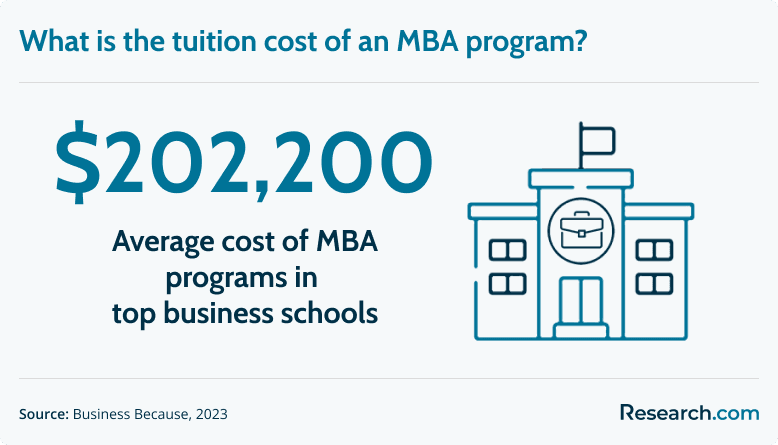
- The average cost of an MBA in top business schools is $202,200.
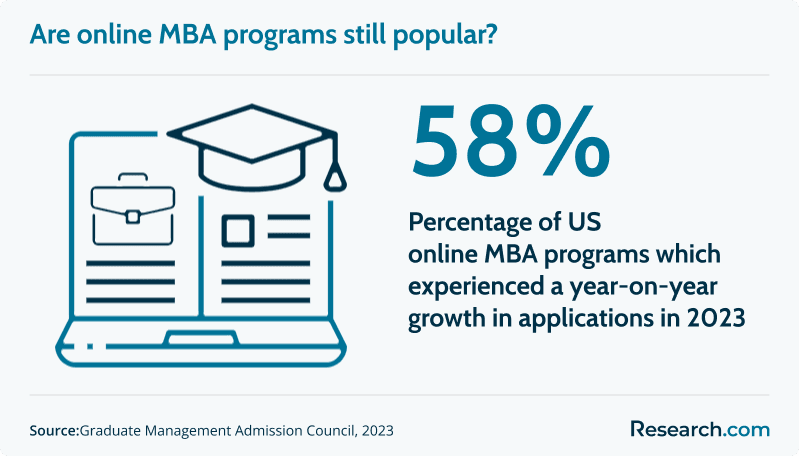
- 58% of U.S. online MBA programs experienced year-on-year growth in applications in 2023.
- 91% of consulting businesses, 75% of finance/accounting organizations, and 89% of technology groups hired candidates with an MBA in 2022.
- A study on online MBA students’ perceptions of online learning found that 50% of surveyed participants would prefer more human interaction in their courses.
- The United States remains a common destination for graduate management education because financial aid availability tends to be stronger there.
How long does it take to complete an online MBA program?
A typical full-time online MBA takes 18 to 24 months. Part-time programs for working professionals may take around 36 months. Some schools offer accelerated formats, including fast online MBA degree options, that may allow students to finish in 12 to 15 months by taking a heavier course load.
Completion time depends on program design, transfer policies, pacing, residency requirements, course availability, and specialization requirements. A shorter program can reduce time to completion, but it may also intensify weekly workload and leave less room for networking, internships, or career exploration.
| Program format | Typical timeline | Best for | Trade-off |
| Accelerated online MBA | 12 to 15 months | Students who can handle a demanding schedule and want faster completion | Less flexibility and heavier weekly workload |
| Full-time online MBA | 18 to 24 months | Professionals who want a structured pace without the longest timeline | May still require significant weekly study time |
| Part-time online MBA | Around 36 months | Working adults with major job, family, or travel commitments | Longer time before full degree benefits are realized |
How does an online MBA compare to an on-campus program?
Online and campus MBA programs often cover similar business fundamentals, but the experience differs. Online programs prioritize flexibility and digital collaboration, while campus programs provide more face-to-face interaction, physical resources, and spontaneous networking.
| Factor | Online MBA | On-campus MBA |
| Schedule | Often more compatible with full-time employment and travel | Usually more structured around class meeting times |
| Networking | Built through virtual events, group projects, alumni platforms, and residencies | Often easier through daily in-person contact and campus activities |
| Learning environment | Requires self-discipline, time management, and comfort with technology | Provides more immediate access to faculty, classmates, libraries, and campus services |
| Geographic access | Allows students to enroll without relocating in many cases | May require relocation or commuting |
| Best fit | Working professionals who need flexibility | Students who want a traditional academic environment and intensive in-person networking |
The right format depends on your goals, schedule, learning style, and career needs. Professionals interested in executive-level formats can also compare online executive MBA programs. According to the Graduate Management Admission Council’s survey (2023a), 91% of consulting businesses, 75% of finance/accounting organizations, and 89% of technology groups hired candidates with an MBA in 2022.
The chart below summarizes hiring trends for MBA degree holders in 2022 across three major industries.
What is the average cost of an online MBA program?
Online MBA costs vary substantially by school type, reputation, residency requirements, program length, credit load, technology fees, and required travel. Research cited in this guide found that the average cost of MBA programs in top business schools can reach $202,200. In addition, the average MBA cost in the U.S. in 2023 was $232,985, representing a 3.3% increase from 2022.
When comparing programs, do not stop at tuition. Add application fees, books, course materials, technology requirements, distance-learning fees, travel for residencies, lodging, international immersion costs, and the opportunity cost of reduced work hours if applicable.
| Cost category | Why it matters |
| Tuition | The largest cost, usually charged per credit, per semester, or for the full program |
| Fees | May include technology, distance learning, student services, or program fees |
| Residency travel | Hybrid or immersion programs may require campus visits, lodging, transportation, and meals |
| Materials and software | Digital textbooks, analytics tools, and required devices can add to total cost |
| Time away from work | Accelerated or intensive formats may affect overtime, promotions, travel, or availability |
What are the financial aid options for students enrolling in an online MBA program?
Cost is often the deciding factor when students ask whether an online MBA is worth it. Many students combine several funding sources rather than relying on one option.
- Scholarships: Universities and private organizations may offer merit-based, need-based, demographic, industry-specific, or leadership-focused awards. Examples include the Mary Elizabeth Lockwood Beneventi MBA Scholarship, Robert Toigo Foundation MBA Fellowships, Forté Fellows Program, and Ritchie-Jennings Memorial Scholarship Program.
- Grants: Some students may qualify for need-based aid from federal agencies, schools, or private organizations.
- Loans: Federal aid, nonprofit lenders, and credit institutions may provide education loans, though repayment terms should be reviewed carefully.
- Employer tuition reimbursement: Some employers fund part or all of an MBA when the degree supports leadership, management, or business needs.
GMAC (2023b) reported that the United States remains a popular option for graduate management education in part because financial aid tends to be more available there.
What are the prerequisites for enrolling in an online MBA program?
Admission requirements differ by school, but most online MBA programs ask for evidence that applicants can handle graduate-level business coursework and contribute meaningful professional experience to class discussions.
- Bachelor’s degree from an accredited institution
- Official transcripts
- A minimum GPA of 3.0
- Completed application form
- Personal statement
- Letters of recommendation
- Professional resume or curriculum vitae
Some programs also require work experience, leadership experience, professional certifications, interviews, GMAT or GRE scores, or prerequisite courses. Common prerequisite areas include accounting, economics, finance, marketing, information systems, management, operations management, statistics, and calculus. Always verify the admissions page for each school because waiver policies and experience expectations vary significantly.
What courses are typically in an online MBA program?
Online MBA curricula usually combine required core courses with electives or concentrations. The goal is to build a common business foundation while allowing students to develop expertise in areas tied to their career plans.
- Financial Accounting: Teaches students to read, interpret, and communicate financial information about an organization.
- Marketing Management: Covers market research, positioning, customer behavior, brand strategy, and marketing planning.
- Operations Management: Examines how organizations design, improve, and manage processes that deliver products and services.
- Business Ethics and Law: Explores legal and ethical issues that affect management decisions and organizational risk.
- Organizational Behavior: Studies how individuals and teams function inside organizations, with attention to leadership and motivation.
- Capstone Project or Thesis: Requires students to apply MBA concepts to a practical business problem or integrated final project.
What types of specializations are available in online MBA programs?
Specializations help students align the MBA with specific career targets. Some flexible programs allow students to customize electives, while others offer formal concentrations. Applicants seeking accessible admission options may also compare online MBA programs with less restrictive entry pathways.
| Specialization | What it emphasizes | Best suited for |
| General Management | Leadership, strategy, decision-making, and broad business operations | Professionals seeking management mobility across functions |
| International Business | Global markets, cross-cultural management, and international strategy | Students targeting multinational organizations or global roles |
| Finance | Financial management, investment decisions, risk, and corporate finance | Professionals pursuing finance leadership or investment-related careers |
| Marketing | Market analysis, brand management, digital marketing, and customer strategy | Students interested in product, advertising, growth, or market research roles |
| IT or Technology Management | Business intelligence, IT strategy, analytics, and technology-enabled operations | Technical professionals moving into management |
| Consulting | Problem-solving, data analysis, client communication, and project leadership | Career changers and internal advisors |
| Entrepreneurship | New venture creation, innovation, business development, and growth strategy | Founders, startup employees, and intrapreneurs |
| Human Resource Management | Talent strategy, workforce planning, organizational development, and HR analytics | HR professionals pursuing strategic leadership |
| Healthcare Management | Healthcare administration, policy, operations, and organizational strategy | Students targeting hospitals, healthcare systems, insurers, or health organizations |
How to choose the best online MBA programs?
The best online MBA is the one that fits your career objective, budget, schedule, learning preferences, and risk tolerance. Comparing accelerated MBA programs can be useful, but speed should not outweigh accreditation, academic quality, career support, and fit.
| Selection factor | What to check | Why it matters |
| Accreditation | Confirm institutional accreditation and business-school accreditation such as AACSB when relevant | Accreditation signals academic quality and may affect employer perception, transferability, and aid eligibility |
| Reputation and faculty | Review faculty credentials, industry experience, research, and employer recognition | Strong faculty and reputation can improve learning quality and network value |
| Admissions selectivity | Look at acceptance expectations, cohort profile, and student-to-faculty support | GMAC (2023c) reported that 58% of U.S. online MBA programs experienced year-on-year growth in applications in 2023 |
| Industry connections | Ask about employer events, internships, guest speakers, consulting projects, and corporate partnerships | Career outcomes often depend on access to employers, not just coursework |
| Alumni network and career services | Evaluate coaching, job boards, alumni mentoring, interview preparation, and placement support | Career support can influence post-graduation mobility |
| Student experience | Read student reviews and speak with current learners or graduates when possible | Format, workload, responsiveness, and community quality can vary widely |
| Support resources | Confirm academic advising, technology support, tutoring, library access, and mental health resources | Online students need reliable support outside traditional campus hours |
| Flexibility | Compare asynchronous work, live class times, residency requirements, and pacing options | The schedule must be realistic alongside work and personal obligations |
Questions to ask before enrolling
- Is the business school accredited, and is the MBA recognized by employers in my target field?
- What is the total program cost after fees, travel, technology, and required materials?
- How many live sessions are required, and when are they held?
- Does the program offer the specialization or electives I need for my career goal?
- What career services are available to online students, not just campus students?
- Can I speak with alumni who pursued roles similar to the ones I want?
- What are the GMAT/GRE waiver rules, prerequisite courses, and work experience expectations?
- How much weekly time should I realistically expect to spend on coursework?
How to navigate financial challenges when pursuing an online MBA?
The cost of an online MBA can be intimidating, but careful planning can make the degree more manageable. Start by calculating the full cost of attendance, then compare that figure with expected career value, employer support, scholarship availability, and your personal repayment capacity.
First, ask your employer about tuition reimbursement or sponsorship. Some organizations support graduate business education when it strengthens leadership, finance, analytics, operations, or management capacity. If reimbursement is available, clarify grade requirements, annual caps, repayment obligations if you leave the company, and whether the program must be preapproved.
Second, contact each school’s financial aid office and admissions team. Ask specifically about scholarships for online MBA students, application deadlines, merit criteria, need-based aid, and whether awards renew automatically. Completing the Free Application for Federal Student Aid (FAFSA) may help eligible students access federal loan options, while private education loans should be compared carefully for rates, repayment terms, and borrower protections.
Third, consider whether admission-test flexibility lowers your total cost. Some affordable online MBA programs with no GMAT requirement may reduce test-preparation expenses and shorten the application process. However, no-GMAT admission should not be the only reason to choose a school; review accreditation, curriculum, faculty, student outcomes, and career services as well.
Finally, budget throughout the program. Plan for tuition, fees, course materials, travel, technology, and temporary changes in work hours. A lower-cost program may be a stronger financial choice if it still provides the network, specialization, and employer credibility needed for your goals.
How do networking and mentorship opportunities impact your online MBA experience?
Networking is one of the main reasons many students pursue an MBA, and online programs must be evaluated on how intentionally they create those connections. Strong programs use virtual career events, alumni panels, mentorship platforms, cohort-based projects, employer presentations, and residencies to connect students with professionals in their target industries.
These relationships can help students explore roles, practice interviews, identify hiring channels, and learn how leadership decisions are made in real organizations. Professionals targeting competitive positions, including some of the highest-paying MBA jobs, should examine whether online learners receive the same career coaching and employer access as campus students.
How do online MBA programs cultivate essential soft skills for professional success?
Technical knowledge is only part of MBA value. Online MBA programs also develop communication, teamwork, adaptability, negotiation, conflict management, and leadership judgment through group projects, case discussions, peer feedback, presentations, simulations, and live problem-solving exercises.
Because students often collaborate across time zones, industries, and cultures, online coursework can mirror the communication challenges of modern distributed teams. Learners who want a more accessible starting point can also review MBA programs that are easier to get into, while still checking whether those programs provide enough academic rigor and professional development support.
Are affordable online MBA programs effective for career advancement?
Affordable online MBA programs can support career advancement when they combine credible accreditation, relevant curriculum, active faculty, practical projects, and strong career support. A lower tuition price does not automatically mean weak quality, just as a high price does not guarantee better outcomes.
Students comparing low-cost online MBA options should look for evidence of employer engagement, alumni activity, elective depth, graduation support, and whether the program’s format fits their schedule. The best affordable option is not merely the cheapest; it is the program that provides the strongest value for your career target.
What emerging trends are redefining online MBA programs?
Online MBA programs are increasingly shaped by digital collaboration, analytics-focused coursework, virtual simulations, modular learning, and employer demand for practical skills. Many programs are also reconsidering flexibility, pacing, and cost as working adults seek graduate credentials that do not require long career interruptions.
Another visible shift is the use of shorter credentials and stackable learning experiences that allow professionals to update skills over time. Executive-format students focused on cost may want to compare more affordable online executive MBA programs while also reviewing residency requirements, networking intensity, and leadership coaching.
Can an accelerated online MBA fast-track your career success?
An accelerated online MBA can shorten the time required to earn the degree, which may help students pursue promotions or career pivots sooner. These programs usually compress core business coursework, projects, and leadership development into a more demanding schedule.
Before choosing an online one-year MBA program, ask whether you can maintain work performance while completing intensive assignments, live sessions, and group projects. Acceleration works best for students with clear goals, strong time management, and enough professional experience to absorb fast-paced material.
How do online MBA programs offer experiential learning opportunities?
Experiential learning helps online MBA students practice business decision-making rather than only reading about it. Common formats include live case studies, consulting-style assignments, virtual simulations, capstone projects, industry workshops, mentorship activities, and group projects based on real market conditions.
These applied experiences can strengthen problem-solving, leadership, communication, and data-informed decision-making. Students who are still exploring business education pathways may also review fast online business administration degree options to understand how undergraduate and graduate business programs differ in pace and purpose.
How do online MBA programs support international students?
International students should look closely at scheduling, technology requirements, academic advising, language support, time-zone expectations, and residency or travel obligations. Strong online MBA programs help international learners adjust through virtual orientations, clear communication, flexible participation options, and culturally diverse cohorts.
Global networking can be a major advantage when programs connect students with multinational faculty, classmates, alumni, and employers. Students looking for shorter business pathways may also compare accelerated online business management degree programs, depending on their current education level and career goals.
How does legal expertise enhance strategic decision-making in online MBA programs?
Business leaders regularly make decisions involving contracts, compliance, employment rules, intellectual property, privacy, risk, and ethics. Online MBA programs often address these issues through business law, ethics, governance, and regulatory topics, helping students understand how legal considerations affect strategy.
Professionals who need deeper legal expertise for compliance, operations, consulting, or executive decision-making may consider supplementing MBA training with a business law master's degree online. This can be especially useful for roles where legal risk and business strategy overlap.
What career paths are available for graduates of online MBA programs?
Online MBA graduates can pursue traditional business leadership roles as well as specialized and nontraditional careers. The best path depends on prior experience, concentration, internship or project work, and the strength of the student’s network.
- Chief officer
- Small business owner
- Financial analyst
- Digital marketing strategist
- Management consultant
- Data analyst
- Healthcare administrator
- HR manager
- Project manager
- Public relations manager
MBAs remain popular because they can support career changes, function changes, and movement into leadership. The degree can also broaden access to varied MBA career paths and salary possibilities, although results depend on the student’s field, experience, and execution.
Beyond corporate roles, MBA graduates may work in government agencies, law enforcement, education management, entertainment and sports, food and beverage, social and community services, or construction. This flexibility is one reason the degree remains attractive to professionals who want portable business skills.
What is the job market for graduates with an online MBA program?
The job market for MBA graduates is broad because the degree applies to management, finance, marketing, HR, operations, consulting, and analytics roles. Employers often value MBA training for strategic thinking, communication, leadership, financial literacy, and problem-solving, but the credential is most powerful when paired with relevant experience and a clear career direction.
U.S. Bureau of Labor Statistics projections from 2022 to 2032 show different growth rates for roles commonly pursued by MBA graduates:
- The job outlook of HR managers will increase by 5% between 2022 and 2032.
- The outlook for sales managers will expect a 4% job growth in the same timeframe.
- The job outlook for marketing specialists is projected to have a 13% job growth.
- Financial managers can expect a job growth of 16%.
The chart below uses U.S. Bureau of Labor Statistics data to show employment projections for selected roles that MBA graduates may pursue.
How does an online MBA program enhance your entrepreneurial skills?
An online MBA can help aspiring entrepreneurs move from an idea to a more disciplined business model. The value comes from learning how to test markets, manage money, lead people, and make decisions under uncertainty.
- Business planning: Students often learn how to research markets, define customers, create financial projections, and build operating plans.
- Financial management: MBA coursework can strengthen budgeting, accounting, cash-flow management, investment decisions, and profitability analysis.
- Risk assessment and management: Students learn to identify business risks, evaluate trade-offs, and create mitigation strategies before launching or scaling a venture.
- Leadership and team building: Courses and projects develop skills in hiring, motivation, conflict resolution, communication, and culture-building.
- Marketing strategies: Students study how to target audiences, position products, build campaigns, and use traditional and digital channels effectively.
- Networking opportunities: MBA programs may connect students with mentors, investors, founders, alumni, and potential partners.
How to evaluate the return on investment (ROI) for an online MBA?
Online MBA ROI is not just a tuition-versus-salary calculation. It should include cost, financing, time commitment, opportunity cost, career mobility, employer support, network value, and whether the degree helps you reach a specific professional goal.
- Tuition Costs and Financial Aid: Calculate the full cost of tuition, fees, books, technology, residencies, and materials. Then subtract scholarships, grants, employer reimbursement, and other aid.
- Post-Graduation Salary Boost: Research alumni outcomes in your target industry and role. Salary gains are more likely when the MBA aligns with a realistic career move.
- Job Placement and Career Support: Review coaching, employer events, networking opportunities, job boards, mentorship, and internship or project access for online students.
- Program Duration and Flexibility: A shorter or flexible program may improve ROI if you can keep earning while studying and avoid career interruption.
- Long-Term Career Growth: Consider whether the program opens leadership pathways, improves decision-making, or strengthens specialized skills. For example, an affordable online MBA in data analytics may be useful for professionals moving toward data-driven leadership roles.
| ROI question | Why it matters |
| Will this MBA help me qualify for a role I cannot realistically reach now? | If the answer is no, the degree may provide knowledge but limited financial return. |
| Does the program have strong career support for online students? | Networking and career services often influence outcomes as much as coursework. |
| Can I complete the program without excessive debt stress? | High debt can reduce the practical value of salary gains. |
| Is the specialization connected to market demand in my field? | Focused skills may improve employability when matched to real hiring needs. |
Importance of AACSB Accreditation in Online MBA Programs
AACSB accreditation is one of the most important quality signals in business education. The Association to Advance Collegiate Schools of Business sets standards for business schools and evaluates areas such as faculty quality, curriculum, learning outcomes, strategic management, and continuous improvement.
- Quality Assurance: AACSB accreditation indicates that a business school has met rigorous academic and operational standards.
- Enhanced Career Opportunities: Some employers view AACSB-accredited programs more favorably because they reflect recognized business education standards.
- Global Recognition: Only 6% of business schools worldwide hold AACSB accreditation, giving the credential international weight.
- Strong Alumni Networks: Many AACSB-accredited schools maintain active alumni communities that can support mentoring, networking, and career growth.
Students who want both quality and value can compare AACSB-accredited online MBA programs that balance recognized accreditation with more manageable costs.
Common Mistakes to Avoid When Choosing an Online MBA
| Mistake | Better approach |
| Choosing based only on tuition | Compare total cost, accreditation, career services, alumni access, specialization fit, and employer reputation. |
| Ignoring accreditation | Verify institutional accreditation and business-school accreditation before applying. |
| Assuming online means self-paced | Check live class requirements, group work, residency dates, and weekly workload. |
| Relying only on rankings | Use rankings as a starting point, then evaluate fit, outcomes, cost, and support services. |
| Overestimating salary guarantees | Use salary data as context, not a promise. Outcomes depend on experience, industry, location, and career execution. |
| Not speaking with alumni | Ask graduates about workload, faculty responsiveness, career support, and whether the degree helped them reach their goals. |
Other things you should know about online MBA programs
What is the difference between a Masters and an MBA?
A master’s degree is a broad graduate credential that can focus on many academic or professional fields, including science, arts, engineering, education, public policy, and business. An MBA is a specific professional master’s degree focused on business management, leadership, strategy, finance, marketing, operations, and organizational decision-making. Traditional master’s programs may be more specialized or research-oriented, while MBA programs are usually designed for professionals seeking practical management advancement.
What size will my MBA classes be?
MBA class sizes vary by school and format. Many classes range from 20 to 60 students. Smaller classes of 15 to 35 students may allow more faculty interaction and discussion, while larger classes can provide broader peer diversity and networking. The best class size depends on whether you prefer close interaction, a wider network, or a mix of both.
Which online MBA has the highest salary?
There is no single online MBA that guarantees the highest salary for every student. Salary outcomes depend on industry, geography, prior experience, job function, employer, school reputation, and the student’s use of career services and networking. Programs with strong brands, selective admissions, active alumni networks, and industry-relevant concentrations may be associated with stronger outcomes, but students should verify program-specific career data rather than relying on reputation alone.
How flexible are the scheduling options in online MBA programs?
Flexibility varies widely. Some programs are fully online, while others use hybrid formats with required campus visits. Asynchronous courses allow students to complete work at convenient times, while synchronous lectures, live discussions, and residencies require attendance at scheduled times. Before enrolling, compare the weekly calendar with your work obligations, family responsibilities, and travel schedule.
How do online MBA programs foster connections with industry professionals?
Programs may connect students with industry professionals through virtual networking events, alumni groups, guest lectures, employer presentations, consulting projects, mentorship programs, internships, and career fairs. The strongest online MBA programs make these opportunities accessible to remote learners, not just students who live near campus.
What are common challenges faced by students in online MBA programs?
Common challenges include time management, remote-learning fatigue, limited informal interaction, technology issues, and difficulty coordinating group projects across schedules. A study on online MBA students’ perceptions of online learning published in 2023 by Kim et al. found that 50% of surveyed participants wanted more human interaction in their courses. Students can reduce these challenges by choosing programs with live engagement, faculty access, cohort activities, strong advising, and reliable technical support.
Key Insights
- An online MBA is best for professionals who need flexibility but still want graduate-level business training, leadership development, and career mobility.
- Accreditation, especially AACSB accreditation, should be checked early because it affects quality signals and employer confidence.
- Costs vary widely, and the full price includes more than tuition. Add fees, materials, technology, residencies, travel, and opportunity costs before comparing programs.
- The estimated median starting salary for MBA graduates in the U.S. was $125,000 in 2023, but individual outcomes depend on experience, industry, location, school network, and career execution.
- Program format matters. Accelerated options can shorten completion time, while part-time formats may be more sustainable for demanding work and family schedules.
- The best online MBA is not automatically the highest-ranked or cheapest program. It is the program with the strongest fit for your career goal, budget, schedule, specialization, and support needs.
References:
- Graduate Management Admission Council. (2023a, July). Corporate recruiters survey: 2023 summary report. https://www.gmac.com/-/media/files/gmac/research/employment-outlook/2023_gmac_corporaterecruiters_report.pdf
- Graduate Management Admission Council. (2023b, April). GMAC prospective students survey: 2023 summary report. https://www.gmac.com/-/media/files/gmac/research/prospective-student-data/2023_prospectivestudentsummary_v2.pdf
- Graduate Management Admission Council. (2023c). Application trends survey: 2023 summary report. https://www.gmac.com/-/media/files/gmac/research/admissions-and-application-trends/2023_gmac_ats_report_regionalprofile_us.pdf
- U.S. Bureau of Labor Statistics. (2023, April 25). May 2022 national occupational employment and wage estimates, United States. Occupational Employment and Wage Statistics. https://www.bls.gov/oes/current/oes_nat.htm
Other things you should know about online MBA programs
In 2027, top online MBA programs offer diverse formats, including live virtual classrooms and self-paced modules, to meet various learning preferences. Many programs integrate adaptive learning technology, allowing customized content delivery based on individual progress and understanding, ensuring a personalized educational experience.
Top 2027 online MBA programs usually offer merit-based and need-based scholarships. Applicants may find scholarships provided by the school itself or affiliated organizations. Each program has unique criteria, so check specific program websites for details on eligibility and application processes.
Tuition costs for top online MBA programs in 2027 vary widely, ranging from $30,000 to over $100,000. Factors influencing cost include the school's prestige, faculty credentials, and available networking opportunities. Prospective students should research and compare programs to find one that offers the best value for their career goals and financial situation.


