
2027 MBA vs. PhD: Which Degree Should You Pursue?

Co-Founder and Chief Data Scientist
With applications to top business programs on the rise, the pressure to make the right choice has never been higher. The decision between these two paths isn’t just about a degree; it’s about choosing a professional identity. Will you be a strategic applicator of existing knowledge, trained to lead complex organizations with an MBA degree? Or will you be an original creator of new knowledge, trained to push the boundaries of an entire field?
This guide, prepared by career planning experts with more than 10 years of experience, is designed to give you clarity. In 2024, global applications to graduate business programs jumped 12% over the prior year. We’ll break down what each path demands and where it might lead so you can choose your future with confidence.
Key Things You Should Know About MBA & PhD Degrees
- The primary goal of an MBA degree is to train strategic leaders, while a PhD degree is designed to train original researchers.
- You will typically complete a full-time MBA in two years, whereas a PhD requires five to seven years or more.
- The MBA involves high, often self-funded tuition, while the PhD's real cost comes from the significant opportunity cost of lost earnings over its long duration.
- Admission to a top MBA program requires three to five years of meaningful work experience, while PhD programs prioritize undergraduate research experience.
- MBA graduates often step into high-paying business roles immediately, while PhDs typically start with more modest salaries in academic or R&D positions.
- What is an MBA vs. a PhD degree? MBA vs. PhD
- What jobs can you get with an MBA vs. a PhD? Best Jobs
- How much can you earn with an MBA vs. a PhD? Earnings
- What is the job outlook for graduates of MBA and PhD degrees? Job Outlook
- Where can you work with an MBA vs. a PhD? Work Environments
- What skills do you learn with an MBA and PhD degrees? What skills do you learn with an MBA and PhD degrees?
- What are the education requirements to enroll in an MBA vs. a PhD? Educational Requirements
- What are the alternative paths available? What are the alternative paths available?
- What are the typical career paths for an MBA and a PhD? Career Paths
- How do you choose the right path for you? How do you choose the right path for you?
- What are the networking opportunities like for an MBA vs. a PhD? Networking
- Is an MBA or a PhD worth it? Is an MBA or a PhD worth it?
- What financial support options are available for MBA and PhD programs? What financial support options are available for MBA and PhD programs?
What is an MBA vs. a PhD degree?
An MBA, or Master of Business Administration, is a professional degree focused on developing broad competence across all functions of a business, from finance to marketing. Its purpose is to train effective leaders who can manage complex organizations.
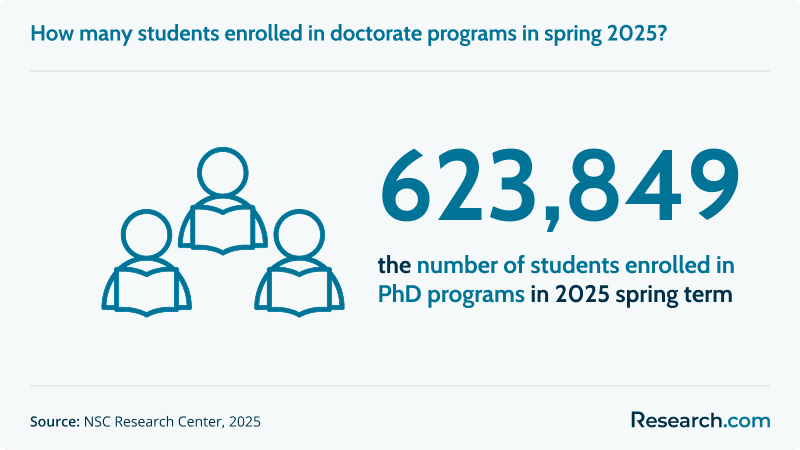
Meanwhile, a Doctor of Philosophy, or PhD, is the highest academic degree, designed to train a student in original research to create new knowledge within a highly specialized field. The scale of these programs reflects their different goals, with over 623,849 students pursuing a PhD degree compared to the 215,789 in AACSB-accredited MBA programs.
This fundamental difference in purpose—breadth versus depth—is the most important thing to understand as you consider the choice between an MBA vs. PhD.
The Strategist's Toolkit: Swiss Army Knife vs. Scalpel
A useful way to think about this choice is to consider the kind of tool you want to become. An MBA shapes you into a professional Swiss Army knife. It gives you a versatile set of tool, such as finance, strategy, operations, and marketing, allowing you to tackle a wide range of business problems and lead teams effectively. You have the right tool for almost any common situation.
A PhD, on the other hand, shapes you into a scalpel. It is an instrument of extreme precision, designed to perform one function flawlessly: to cut to the deepest level of a problem and uncover new knowledge. The choice isn't about which tool is better, but which one is right for the work you want to do.
If you’re also weighing research-intensive programs beyond the PhD, it’s worth noting the distinctions in PhD vs MD training. While both are doctoral-level, PhDs focus on research and theory creation, whereas MDs emphasize clinical application and patient care.
What jobs can you get with an MBA vs. a PhD?
Each degree opens doors to very different professional worlds. An MBA degree prepares you for leadership roles within existing business structures, while a PhD prepares you for roles centered on research and discovery.
Here are the typical starting points for each path:
- MBA Roles: These are roles focused on strategy, finance, and management, such as Management Consultant, Investment Banker, Product Manager, or Corporate Strategy associate.
- PhD Roles: These are roles that require deep subject matter expertise, like University Professor, Industrial Research Scientist, Quantitative Analyst, or Data Scientist.
While the MBA path is relatively straightforward, the career options for PhDs are more diverse than most people assume.
Three PhD Archetypes in Business
The most common misconception is that a PhD degree only leads to a professorship. In reality, most PhDs now work in industry, typically fitting into one of three roles.
The first is the Subject Matter Expert, where you work as a deep specialist in your field, like a research scientist at a pharmaceutical company or an economist at a bank.
The second is the Methodological Expert, where you leverage your research skills. Top consulting firms hire PhDs for their structured problem-solving, and the rigorous quantitative training from an online degree in physics is directly applicable to fields like financial modeling.
Finally, there is the Founder-Scientist. This is the entrepreneurial path where you use your unique discovery to build a new company, often in biotech or deep tech.
How much can you earn with an MBA vs. a PhD?
The salary outcomes for these two degrees are quite different, and the details matter. Graduates from top MBA programs often receive starting total compensation packages of over $200,000. In contrast, a PhD graduate who takes a traditional academic path might start with a salary around $70,000.
However, for PhDs who enter the private sector, the story changes. In high-demand fields like technology or finance, a starting salary can easily exceed $150,000. While an MBA generally leads to a higher starting salary on average, it's no longer a universal rule.
Why Your Field of Study is Everything for a PhD
For an MBA, the school's brand is the primary driver of your salary. For a PhD degree, your specific field of study is the single biggest factor. The "war for talent" in the tech industry means that a PhD in artificial intelligence or machine learning can command a salary that rivals or even surpasses that of a top MBA graduate.
This is a critical point for anyone considering a PhD with financial concerns. The earning potential for a humanities PhD in the corporate world is often more modest. For a STEM PhD in a hot field, however, the financial trade-off can be resolved, allowing you to pursue your intellectual passion while also achieving a significant financial outcome.
If your focus is on business or accounting, comparing CPA vs MBA outcomes can also clarify salary expectations. A CPA credential can lead to strong early-career stability, while an MBA often provides broader management and leadership earning potential over time.
What is the job outlook for graduates of MBA and PhD degrees?
The job outlook for these degrees reflects the different markets they serve. With applications to graduate business programs increasing by 8.1%, the demand for the skills an MBA degree provides remains strong, and the outlook for graduates of top programs is consistently excellent.
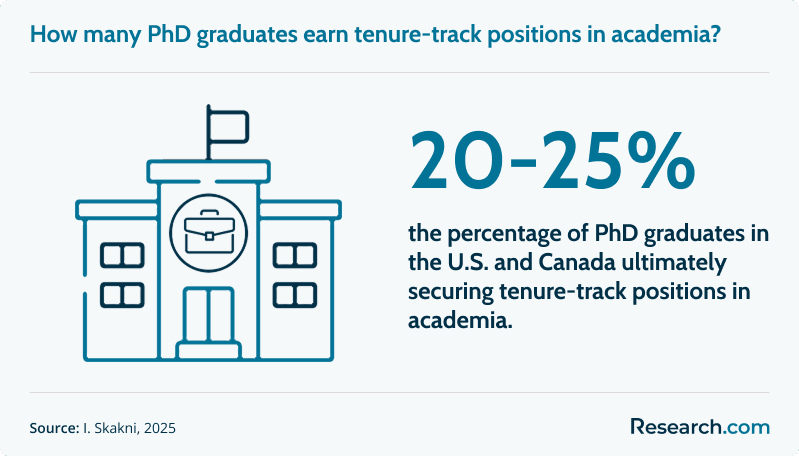
For PhDs, the picture is split. The traditional academic job market is challenging, with fewer than 10% of graduates securing tenure-track positions. This is a critical reality to accept. However, the industry job outlook for PhDs in high-demand fields like tech, biotech, and quantitative finance is excellent and continues to grow.
The 'Alt-Ac' Revolution: Academia's Loss is Industry's Gain
The scarcity of university jobs has led to what is often called the "adjunctification" of higher education, making the tenure track a precarious goal. This difficult situation, however, has fueled a revolution in "alternative-academic" (alt-ac) careers.
Industry has recognized the immense value of the rigorous training a PhD provides. As a result, the private sector has become the default career path for the majority of PhD graduates.
This shift means that while the old "ivory tower" dream is less attainable, a new, often more lucrative, set of opportunities has opened up for those who are prepared to look beyond academia. Programs like doctorate vs masters in psychology illustrate similar dynamics—while master’s graduates enter practice more quickly, doctorate holders have access to higher research and academic opportunities.
Where can you work with an MBA vs. a PhD?
The physical environment and culture you work in will be fundamentally different depending on your degree.
MBA graduates typically work in corporate offices located in major global business hubs like New York, London, or Hong Kong. The work is centered in the fast-paced heart of the commercial world. PhDs, on the other hand, are more likely to work on university campuses, in corporate R&D centers located in suburban tech parks, or in national government laboratories.
The location itself is a major lifestyle choice, but the day-to-day culture of these places is an even more critical factor for your long-term satisfaction.
Culture and Lifestyle: Choosing Your Environment
The typical MBA work environment is collaborative, team-oriented, and moves at a rapid pace. Success is often defined by your ability to influence groups and drive projects forward. In contrast, the PhD environment, whether in academia or an R&D lab, values quiet, reflective, and autonomous work. Success is defined by your individual contribution and deep, focused thought.
Choosing the right culture for your personality is just as important as choosing the right job. And with the rise of new tech and business hubs in cities like Austin or Raleigh, you may no longer have to choose between a top-tier career and a location with a better work-life balance.
Some professionals also explore hybrid academic-industry pathways similar to those discussed in PharMD vs PhD career comparisons. Both doctoral routes lead to high-impact research roles, but PharmDs often focus on clinical innovation and patient outcomes, while PhDs typically work in drug discovery, data science, or policy research.
What skills do you learn with MBA and PhD degrees?
The skills you develop in each program are fundamentally different, tailored to the problems you will be expected to solve. An MBA degree focuses on developing the soft skills and strategic frameworks needed for leadership. You learn negotiation, corporate finance, and strategy—skills that lead to successful organizational communication careers and management roles.
A PhD degree, in contrast, is about building hard, methodological skills. You learn how to design a research study, perform rigorous statistical analysis, and contribute a piece of original knowledge to your field. These are not "impractical" skills; they are elite problem-solving abilities applied to a very deep, narrow set of questions.
Two Philosophies of Problem-Solving
This difference in skills training reflects two distinct philosophies of problem-solving. The MBA trains you to lead a team to find an 80% correct answer quickly. It values speed, collaboration, and effective decision-making with incomplete information.
The value of a PhD lies in how it trains you to work with patience and precision, often alone, to find a 100% correct answer to a particular question. It focuses on rigor, accuracy, and intellectual honesty above all else. Understanding which of these two approaches aligns with your natural thinking style is a key part of making the right choice.
What are the education requirements to enroll in an MBA vs. a PhD?
The path to admission is very different for each degree. For a top MBA program, you will need a bachelor's degree, a strong GMAT or GRE score, and, most importantly, three to five years of meaningful, full-time work experience.
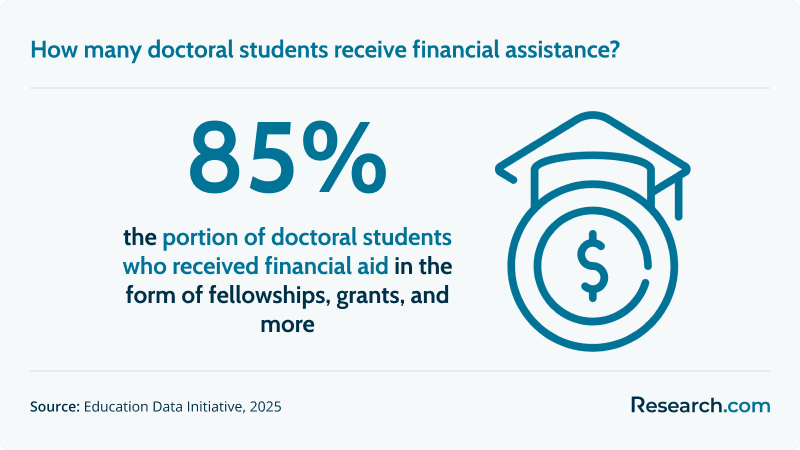
For a PhD program, the requirements are a bachelor's degree (and often a master's), a high GPA and GRE score, and significant undergraduate research experience. While funding is a concern for many, it's helpful to know that 85% of doctoral students receive some form of financial aid, often in the form of tuition waivers and stipends.
It's About Fit: Work Experience vs. Research Fit
The key to a successful application for either path is understanding the concept of "fit," but it means two completely different things.
For an MBA, "fit" is about your professional experience. Your work history is non-negotiable because it provides the real-world context that fuels classroom case studies and discussions. You are admitted based on what you can contribute to the learning of your peers.
For a PhD, "fit" is about your research interests. You are essentially being admitted as an apprentice to a specific professor. Demonstrating a deep alignment with that faculty member's research is the single most important part of your application. For those needing to build a stronger academic foundation, a credential like a natural sciences degree online can be a critical first step.
What are the alternative paths available?
A full-time, two-year MBA or a five-plus-year PhD are not the only options available. The world of graduate education is more flexible than ever.
For those on the business track, alternatives include the Executive MBA (for seasoned leaders), the Part-Time MBA (for those who want to keep working), and specialized master's degrees in fields like finance or business analytics. For those on the research track, alternatives include professional doctorates, like a Doctor of Business Administration (DBA), or a terminal master's degree that provides advanced technical skills without the dissertation.
The Rise of the Specialized Master's
One of the most significant trends in graduate education is the explosion of one-year, specialized business master's programs. With over 1 million graduate students studying part-time, the demand for flexible and efficient credentials is clear. These programs offer a faster, more focused, and often more affordable route to acquiring specific technical business skills than a traditional MBA.
This trend extends to doctoral studies as well, with a growing number of flexible options available. The availability of the best online doctorate programs in human services and other fields shows that advanced education is adapting to the needs of modern professionals. For many, these alternatives represent a powerful way to get the precise skills they need.
What are the typical career paths for an MBA and a PhD?
The long-term career paths for an MBA vs. PhD are fundamentally about climbing two different kinds of ladders.
The MBA path is a ladder of increasing managerial responsibility. A typical trajectory moves from analyst to manager, then to director and vice president. Your focus shifts over time from executing tasks to managing people and, eventually, to setting the strategy for an entire organization.
The PhD path is a ladder of increasing intellectual autonomy and authority. In academia, this looks like moving from a postdoctoral fellow to an assistant professor and finally to a tenured professor who sets their own research agenda. In the industry, it means moving from a scientist to a senior scientist and then to a research fellow, the company's most respected technical expert.
Leadership vs. Authority: Two Models of Influence
This distinction reveals two different models of professional influence. An MBA career builds organizational power. Your influence grows as you gain control over budgets, resources, and teams. You make an impact by leading people to execute a vision.
A PhD career builds intellectual authority. Your influence comes from your expertise and your original contributions to a field. You make an impact by creating new knowledge that others then build upon.
It's important to note that the MBA is not the only path to leadership; many fields have their own specialized credentials, such as online DNP programs in leadership for nursing.
How do you choose the right path for you?
This is where the decision becomes deeply personal. I can't give you the answer, but I can give you the right questions to ask yourself. The most important step you can take is to answer these with complete honesty.
- What is your core driver? Is it the application of knowledge to solve problems and achieve a tangible business impact? Or is it the discovery of new knowledge for its own sake and the thrill of pushing a field forward?
- What is your ideal work style? Do you get your energy from working in fast-paced, collaborative teams where you are constantly interacting with others? Or do you do your best work in a quiet environment with deep, solitary, and autonomous focus?
- What is your ultimate ambition? Do you want to lead an organization of people and be responsible for its success? Or do you want to become a leading authority in a field of ideas, respected for your expertise?
A Note on Honesty and Prototyping
It's very easy to talk yourself into an answer that seems more prestigious or financially rewarding. But a choice that doesn't align with your core identity will almost certainly lead to frustration down the road.
A helpful way to find your true answer is to "prototype" your interest. Before you commit years of your life, talk to people who have walked both paths. Ask them about the best and worst parts of their day. Read a few academic papers in your field of interest. This kind of small-scale experiment can provide the clarity you need to make the big decision with confidence.
What are the networking opportunities like for an MBA vs. a PhD?
The network you build in each program is a powerful asset, but the two are fundamentally different in their structure and purpose.
The MBA network is intentionally broad and transactional. It is designed to connect you with a diverse group of professionals across many industries, creating a lifelong resource for career opportunities, business partnerships, and expert advice. The alumni network is one of the most valuable assets you acquire.
The PhD network is deep and specialized. It is built organically through research collaborations and academic conferences, connecting you with the other leading experts in your specific sub-field. This network is essential for sharing ideas, securing research funding, and finding academic or specialized industry positions.
Activating Your Network
For MBA students, activating the network means actively participating in student clubs, attending alumni events, and being willing to both ask for and offer help. It is a constantly managed resource.
For PhD students, the key is to be an excellent research collaborator. However, the most successful PhDs also learn to build a broader, "MBA-style" network. By attending industry events and using platforms like LinkedIn to connect with people outside of academia, you can create a significant career advantage for yourself when it comes time to graduate.
Is an MBA or a PhD worth it?
An MBA is absolutely worth it if you are committed to a career in business leadership and can gain admission to a top-tier program. The return on investment, both financially and in terms of your career trajectory, is well-documented and reliable.
A PhD is worth it if you are driven by a deep and genuine passion for discovery, have a high tolerance for risk and delayed gratification, and enter the program with a clear-eyed view of the career options both inside and outside of academia. Its value is often measured in intellectual fulfillment and autonomy as much as in salary.
The Ultimate Trade-Off: Certainty vs. Serendipity
Ultimately, the choice can be framed as a trade-off between certainty and serendipity. The MBA is a more certain path to a well-defined, high-paying, and impactful career in the business world. The PhD is a less certain path into the unknown, one that requires a significant financial and personal investment.
However, it is a path that offers the potential for true serendipity—the chance to create something entirely new and change the way we see the world.
Here’s What Graduates Have to Say About Their MBA & PhD
- Sonny: "People think a PhD is just about your specific topic, but it's really training in how to handle ambiguity. My dissertation on medieval literature taught me how to manage a massive, unstructured project over five years with no clear answers. Now, as a consultant, when a client gives me a complex problem, that training in structured thinking is my single biggest asset."
- Paula: "I came from a purely technical background and felt like I was hitting a ceiling. The online MBA was my bridge to management. Suddenly, I understood the financial implications of our engineering decisions and could speak the same language as our executive team. Six months after graduating, I was leading the entire division."
- Enna: "I was worried a PhD in biology would lock me into an academic path, but the opposite happened. The rigorous training in experimental design and data analysis made me a prime candidate for biotech R&D. Industry labs are desperate for people who can think critically and solve problems from first principles, and my dissertation was the ultimate proof I could do that."
Key Findings
- The 8.1% increase in applications to graduate business programs signals strong, sustained confidence in the MBA as a direct path to leadership and career advancement.
- With over 623,849 students in PhD programs versus 215,789 in accredited MBA programs, the sheer scale highlights that these degrees serve fundamentally different career ecosystems.
- While 85% of doctoral students receive financial aid, this support is designed to offset tuition, shifting the true cost calculation to the significant lost earnings over a 5-to-7-year period.
- The demand for flexible education is undeniable, with over 1 million graduate students studying part-time, making alternative pathways essential for professionals avoiding a career pause.
- Despite aid, the financial risk of a PhD is significant, as median debt for graduates can exceed $100,000 in key fields, requiring a careful assessment of long-term earning potential.
- The rising competition for business school slots underscores a key reality: the powerful networking and recruiting advantages of an MBA are most concentrated within top-tier programs.
What financial support options are available for MBA and PhD programs?
For MBA candidates, financing options extend beyond traditional scholarships and employer sponsorships to include innovative models such as exploring low cost MBA online programs, which can offer flexibility with reduced tuition fees. In contrast, PhD programs commonly provide tuition waivers, research stipends, and assistantship roles that help manage educational costs while fostering academic development. Evaluating tailored financial aid packages, including grants, fellowship opportunities, and structured loan programs, is critical to ensuring a sustainable investment in your future.
References:
- AACSB International. (2024). Master’s enrollment trends at AACSB-accredited schools. AACSB
- Council of Graduate Schools. (2023). PhD career pathways: A 2023 report. CGS
- Education Data Initiative. (2024). Average cost of a doctorate degree. EducationData.org
- Graduate Management Admission Council. (2024). Application trends survey: 2024 summary report. GMAC
- National Student Clearinghouse Research Center. (2024). Current term enrollment estimates. NSCRC
Other Things You Should Know About MBA & PhD Degrees
In 2027, the decision between an MBA and a PhD may depend on career goals, industry needs, and personal interests. An MBA often appeals to those seeking leadership roles in business, while a PhD is tailored for careers in academia or specialized research fields.
To pursue an MBA in 2027, you typically need a bachelor's degree and several years of work experience. PhD programs usually require a master's degree or significant research experience, plus GRE scores. PhD applicants may also need to submit a research proposal.


