
2027 PharmD vs. PhD vs. Master of Science in Pharmaceutical Sciences: Which Degree Should You Pursue?

Co-Founder and Chief Data Scientist
Choosing between a PharmD, a PhD, and a master’s in pharmaceutical science can be challenging for students and professionals seeking the right path in pharmaceutical education. Each program offers distinct outcomes—ranging from clinical practice to research and drug development—which often leads to uncertainty about which degree best aligns with one’s career goals. According to the U.S. Bureau of Labor Statistics (BLS), life, physical, and social science occupations—including pharmaceutical research—are projected to have about 144,700 openings per year from 2024 to 2034.
This article clarifies the differences among these degrees, their admission requirements, duration, career prospects, and long-term value to help readers make an informed academic decision.
Key Things You Should Know About PharmD vs. PhD vs. Master of Science in Pharmaceutical Sciences
- PharmD is a professional degree that prepares students for clinical practice and patient care.
- The PhD in Pharmaceutical Sciences focuses on research, discovery, and innovation in drug development.
- The master’s in pharmaceutical science bridges these two paths, emphasizing advanced scientific training for industry or academic roles.
- PharmD graduates typically become licensed pharmacists, while PhD holders often pursue research or academic careers.
- A master’s in pharmaceutical science often leads to industry-based roles in formulation, manufacturing, or quality control.
- PharmD generally takes four years, the PhD may span five to seven years, and a master’s in pharmaceutical science takes around two years to complete.
- What is the difference between a PharmD, a PhD in pharmaceutical sciences, and a master’s in pharmaceutical sciences? PharmD vs. PhD vs. MS
- What are the admission requirements for PharmD, PhD, and MS programs in pharmaceutical sciences? Admission Requirements
- How long does it take to complete a PharmD, PhD, or MS in Pharmaceutical Sciences? Completion Time
- What career options are available after earning a PharmD, PhD, or MS in Pharmaceutical Sciences? Career Options
- How much do PharmD, PhD, and MS in Pharmaceutical Sciences graduates earn on average in 2027? Median Wages
- How much does it cost to earn a PharmD, PhD, or MS in Pharmaceutical Sciences in 2027? Tuition Costs
- Are PhD or MS programs in Pharmaceutical Sciences accredited by the same organizations as PharmD programs? Are PhD or MS programs in Pharmaceutical Sciences accredited by the same organizations as PharmD programs?
- How do you decide whether a PharmD, PhD, or MS is right for you? How to Choose
- Can you switch from a PharmD to a PhD pathway later on? Can you switch from a PharmD to a PhD pathway later on?
- How will global health challenges affect the demand for PharmD, PhD, and MS professionals? Global Demand
PharmD vs. PhD vs. Master’s in Pharmaceutical Sciences: How to Choose the Right Degree
The best pharmaceutical sciences degree depends less on prestige and more on the work you want to do after graduation. A PharmD, a PhD in Pharmaceutical Sciences, and a master’s in pharmaceutical science can all sound similar, but they prepare students for very different careers: licensed pharmacy practice, scientific research, drug development, regulatory work, manufacturing, quality systems, or academic leadership.
This guide is for students deciding between pharmacy school, research-based doctoral study, and shorter graduate training for industry roles. You will learn how these degrees compare by purpose, admissions expectations, time commitment, cost, accreditation, career paths, salary potential, and flexibility so you can choose the option that fits your professional goal instead of paying for training you may not need.
Quick Answer: Which Pharmaceutical Sciences Degree Is Best?
Choose a PharmD if you want to become a licensed pharmacist and work with patients, prescriptions, medication therapy, and healthcare teams. Choose a PhD in Pharmaceutical Sciences if your goal is advanced research in drug discovery, pharmaceutical development, biotechnology, or academia. Choose a master’s in pharmaceutical science if you want a shorter graduate route into applied industry roles such as formulation, quality assurance, regulatory affairs, drug safety, or manufacturing.
| Degree | Best For | Main Focus | Typical Outcome |
| PharmD | Students planning to pursue clinical pharmacy licensure | Medication therapy, patient care, and supervised clinical rotations | Pharmacist, clinical pharmacist, or pharmacy manager |
| PhD in Pharmaceutical Sciences | Students aiming for research-intensive scientific careers | Drug discovery, experimental design, and dissertation research | Research scientist, professor, formulation scientist, or development scientist |
| Master’s in Pharmaceutical Science | Students who want applied pharmaceutical industry preparation on a shorter timeline | Laboratory methods, formulation, regulatory systems, and manufacturing practice | Regulatory affairs associate, quality analyst, or manufacturing supervisor |
What is the difference between a PharmD, a PhD in pharmaceutical sciences, and a master’s in pharmaceutical sciences?
The clearest distinction is the career each degree is built to support. The PharmD is a professional clinical doctorate for future pharmacists. The PhD in Pharmaceutical Sciences is a research doctorate for students who want to produce original scientific work. The master’s in pharmaceutical science is an applied graduate degree for students seeking technical, regulatory, laboratory, or industry-facing roles without completing a doctorate.
PharmD: Professional Doctorate for Pharmacy Practice
The Doctor of Pharmacy, commonly called the PharmD, is designed for students who want to practice pharmacy in clinical or patient-facing settings. Programs usually combine biomedical science, pharmacology, therapeutics, medication safety, healthcare systems, and structured experiential learning.
Most graduates pursue pharmacist licensure and work in settings such as hospitals, community pharmacies, ambulatory care clinics, long-term care organizations, managed care, or other medication-focused services. If you want a deeper look at possible roles, Research.com’s guide to careers with a doctorate in pharmacy explains common PharmD outcomes and practice settings.
PhD in Pharmaceutical Sciences: Research Doctorate for Discovery and Innovation
A PhD in Pharmaceutical Sciences centers on original research. Students investigate scientific problems connected to drug action, delivery systems, formulation, toxicology, pharmacokinetics, medicinal chemistry, and related areas. The degree commonly includes advanced coursework, laboratory or computational research, scholarly writing, publications, and a dissertation.
This pathway is not primarily about dispensing medications or counseling patients. It is better suited to students who want to generate evidence, develop new therapies, improve delivery technologies, or advance pharmaceutical science through research. Common destinations include universities, biotechnology companies, pharmaceutical research and development groups, and senior scientific roles.
Master’s in Pharmaceutical Science: Applied Graduate Training for Industry Roles
A master’s in pharmaceutical science provides specialized scientific preparation without the length of a doctoral program. Depending on the curriculum, students may study laboratory techniques, formulation, regulatory affairs, manufacturing systems, data applications, quality control, or drug safety.
Some graduates use the degree as preparation for later PhD study, especially if they want more research experience before applying. Others enter the workforce directly in industry roles where advanced technical knowledge is useful but a doctorate is not always required.
| Question | PharmD | PhD in Pharmaceutical Sciences | Master’s in Pharmaceutical Science |
| Is the program mainly clinical? | Yes | No | Usually no |
| Is the program mainly research-based? | Partly, depending on electives, projects, or dual-degree options | Yes | Sometimes, although many programs are applied |
| Can it prepare students for pharmacist licensure? | Yes, when completed through an eligible accredited program | No | No |
| Is a dissertation usually required? | Usually no | Yes | Program-dependent |
| Best fit if you enjoy... | Patient care, medication decisions, and healthcare delivery | Experiments, publications, and scientific problem-solving | Industry applications, regulatory systems, and lab operations |
What are the admission requirements for PharmD, PhD, and MS programs in pharmaceutical sciences?
Admission standards differ because each degree measures a different type of preparation. PharmD programs usually emphasize prerequisite science courses and readiness for patient-centered professional training. PhD programs focus heavily on research potential and fit with faculty expertise. Master’s programs typically review scientific background, academic performance, and alignment with the program’s applied concentration.
If you need to strengthen your science background before applying, a related credential such as one of the online biotechnology graduate certificate programs may help you build relevant preparation, depending on the expectations of the schools you plan to target.
PharmD Admission Requirements
- Completion of required prerequisite courses, often including biology, chemistry, anatomy, and mathematics
- Pharmacy College Admission Test (PCAT) scores, if the program still requires them
- Minimum GPA requirement, often 3.0 or higher
- Recommendation letters and a personal statement describing interest in pharmacy practice
- Interview, situational judgment exercise, or practical evaluation, depending on the school
PhD in Pharmaceutical Sciences Admission Requirements
- Bachelor’s or master’s degree in pharmacy, chemistry, biological sciences, or a closely related field
- Research experience, laboratory work, or publications when available
- GRE scores, although some universities identify them as optional
- Statement of purpose outlining research interests and possible faculty alignment
- Academic references, usually from professors, principal investigators, or research supervisors
Master’s in Pharmaceutical Science Admission Requirements
- Bachelor’s degree in a relevant scientific field
- GPA of 3.0 or above
- English proficiency documentation for international applicants
- Research, laboratory, or industry experience, if the program requires it
| Application Factor | Most Important For | Why It Matters |
| Prerequisite coursework | PharmD and master’s applicants | Shows that you can handle advanced science and professional coursework |
| Research experience | PhD applicants | Helps faculty judge whether you are ready for dissertation-based study |
| Clinical or pharmacy exposure | PharmD applicants | Shows that you understand patient care, medication use, and pharmacy practice |
| Faculty research fit | PhD applicants | Can determine whether the program has the lab, mentor, and research environment you need |
| Industry goals | Master’s applicants | Helps you select a program connected to regulation, formulation, manufacturing, safety, or quality roles |
How long does it take to complete a PharmD, PhD, or MS in Pharmaceutical Sciences?
Time to completion depends on whether the degree is organized around clinical education, research milestones, or applied graduate coursework. Students comparing accelerated or bridge-style healthcare pathways may also find examples such as online MSN to PhD bridge programs useful because they show how some fields connect professional training with doctoral research.
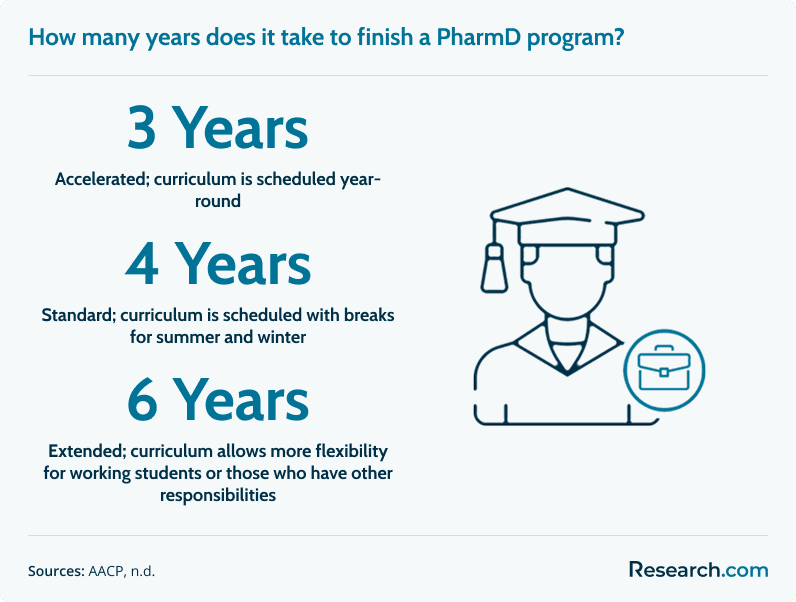
- PharmD: Usually takes four years after pre-pharmacy coursework, which commonly takes two years.
- PhD in Pharmaceutical Sciences: Typically takes five to seven years, depending on the research project, dissertation progress, and program expectations.
- Master’s in Pharmaceutical Science: Generally takes two years full-time, though accelerated and part-time formats may be available.
Some schools offer combined PharmD/PhD pathways for students who want both clinical pharmacy preparation and advanced research training. These programs integrate the two routes and may allow students to complete both credentials in about seven years total.
| Path | Typical Time Commitment | Main Time Drivers | Best For |
| PharmD | Four years after pre-pharmacy coursework | Professional classes, clinical rotations, and licensure preparation | Students committed to pharmacy practice |
| PhD in Pharmaceutical Sciences | Five to seven years | Research planning, experiments, publications, and dissertation completion | Students pursuing research-intensive careers |
| Master’s in Pharmaceutical Science | Two years full-time | Credit requirements, thesis or capstone work, lab components, or industry projects | Students seeking quicker entry into applied industry roles |
| Dual PharmD/PhD | About seven years total | Integrated clinical training and doctoral research development | Students who want to connect pharmacy practice with research |
What career options are available after earning a PharmD, PhD, or MS in Pharmaceutical Sciences?
The three degrees lead to noticeably different job markets. PharmD graduates most often pursue licensed pharmacy practice and clinical medication roles. PhD graduates commonly move into research, academia, biotechnology, pharmaceutical development, or scientific leadership. Master’s graduates often enter applied industry positions in regulation, quality systems, manufacturing, formulation, or drug safety. If you are comparing healthcare quality and safety careers, Research.com’s overview of the MSN in patient safety and healthcare quality career path offers a useful parallel.
PharmD Career Paths
- Clinical pharmacist
- Hospital or community pharmacy manager
- Pharmaceutical industry consultant
- Clinical researcher or educator
PhD in Pharmaceutical Sciences Career Paths
- Research scientist or principal investigator
- University professor or academic researcher
- Regulatory affairs specialist
- Drug formulation or development scientist
Master’s in Pharmaceutical Science Career Paths
- Quality assurance analyst
- Regulatory affairs associate
- Formulation development scientist
- Pharmaceutical manufacturing supervisor
The chart below adds context on related occupations and employment projections.
How much do PharmD, PhD, and MS in Pharmaceutical Sciences graduates earn on average in 2027?
Pay varies by employer, location, experience, licensure, specialization, and whether the position is clinical, academic, regulatory, or industry-based. Students evaluating research-heavy graduate pathways may also want to compare related opportunities in master’s in bioinformatics jobs, which can overlap with pharmaceutical research, biotechnology, and data analysis.
- PharmD: Median annual salary ranges from $120,000 to $140,000, particularly for licensed pharmacists.
- PhD in Pharmaceutical Sciences: Average earnings are around $90,000 to $115,000, depending on research funding and academic positions.
- Master’s in Pharmaceutical Science: Typically ranges from $70,000 to $95,000, particularly in industry and regulatory sectors.
PharmD graduates may have stronger early earning potential because pharmacist licensure connects directly to established clinical roles. PhD and master’s graduates may increase earnings over time through scientific leadership, industry specialization, regulatory expertise, or management responsibilities. These ranges should be treated as general guidance, not guaranteed outcomes.
| Degree | Reported Salary Range | Why Pay May Vary |
| PharmD | $120,000 to $140,000 | Licensure status, practice setting, geographic market, and management duties |
| PhD in Pharmaceutical Sciences | $90,000 to $115,000 | Academic or industry setting, research funding, specialization, and leadership level |
| Master’s in Pharmaceutical Science | $70,000 to $95,000 | Industry segment, regulatory experience, manufacturing knowledge, and technical skill set |
How much does it cost to earn a PharmD, PhD, or MS in Pharmaceutical Sciences in 2027?
Total cost depends on institution type, residency status, program length, mandatory fees, living expenses, clinical or laboratory requirements, and whether the student receives funding. If you are still choosing an undergraduate direction before pharmacy or pharmaceutical sciences graduate study, Research.com’s guide to health science major options can help you compare possible academic foundations.
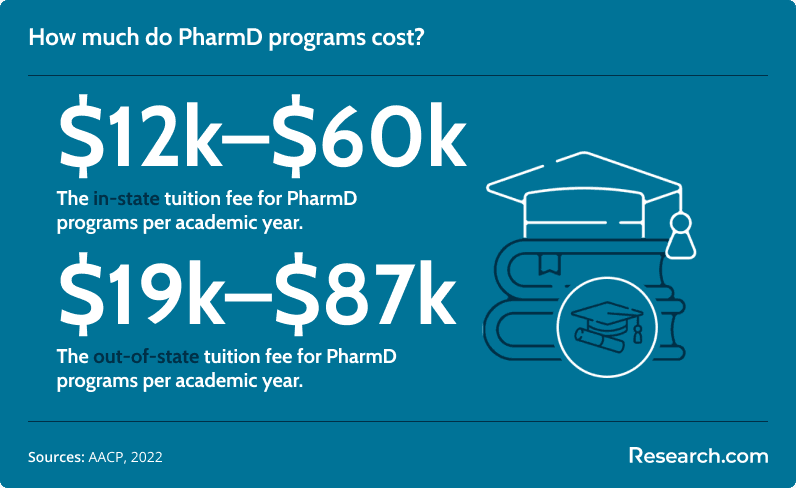
- PharmD: Average tuition ranges between $150,000–$250,000 total, including clinical rotations and licensing fees.
- PhD in Pharmaceutical Sciences: Often fully funded through stipends or research assistantships, though living expenses still apply.
- Master’s in Pharmaceutical Science: Costs $40,000–$80,000 total, depending on credit load and program length.
Scholarships, assistantships, institutional grants, and financial aid can reduce what students pay out of pocket. For research doctorates, funding should be a central part of the decision. For PharmD and master’s programs, compare the full cost of attendance rather than tuition alone.
| Cost Factor | Why It Matters | Questions to Ask |
| Tuition and mandatory fees | This is often the largest published expense, but it does not capture the full cost. | What is the total program cost for my residency status or enrollment format? |
| Clinical rotations or lab expenses | Programs may require travel, equipment, immunizations, supplies, or site-related costs. | Are placement, rotation, or lab expenses included in the tuition estimate? |
| Funding availability | PhD students may receive stipends or assistantships, while professional programs may offer less funding. | Is funding guaranteed, competitive, renewable, or linked to teaching or research work? |
| Time out of the workforce | Longer programs can increase the opportunity cost of not working full-time. | Can I study part-time, work during the program, or use paid internships? |
| Licensure and exam costs | PharmD students should plan for expenses connected to becoming licensed. | Which state board, licensing, and exam costs should I include in my budget? |
Are PhD or MS programs in Pharmaceutical Sciences accredited by the same organizations as PharmD programs?
No. PharmD programs and graduate pharmaceutical sciences programs are reviewed through different quality systems because they have different purposes. PharmD accreditation is tied to professional preparation for pharmacist licensure. PhD and master’s programs are generally evaluated through institutional accreditation and academic quality standards, not through pharmacist licensing requirements.
PharmD Accreditation
In the United States, PharmD programs are accredited by the Accreditation Council for Pharmacy Education (ACPE). This is important because graduates generally need to complete an ACPE-accredited program to be eligible for the North American Pharmacist Licensure Examination (NAPLEX) and state pharmacist licensure. ACPE review focuses on professional pharmacy competencies, clinical training, medication safety, and readiness for patient care.
PhD and Master’s in Pharmaceutical Science Accreditation
PhD and master’s programs in pharmaceutical science do not use the same professional accreditation model as PharmD programs. They usually operate under institutional or regional higher education accreditation, such as MSCHE, SACSCOC, or WASC. These reviews examine academic quality, faculty qualifications, student support, research resources, and institutional standards.
This difference matters for career planning. A research-focused pharmaceutical sciences degree can be academically strong without making a graduate eligible to practice as a pharmacist. A PharmD, by contrast, is the professional education route connected to licensure when all licensing requirements are satisfied. Research.com’s guide to the difference between a pharmacist and a PharmD explains why earning the degree and holding the professional license are related but not the same thing.
| Program Type | Primary Accreditation Concern | Licensure Connection |
| PharmD | Quality of professional pharmacy education | Directly connected to pharmacist licensure eligibility |
| PhD in Pharmaceutical Sciences | Institutional quality, research expectations, and faculty expertise | Does not lead to pharmacist licensure by itself |
| Master’s in Pharmaceutical Science | Institutional quality and graduate academic standards | Does not lead to pharmacist licensure by itself |
How do you decide whether a PharmD, PhD, or MS is right for you?
Start with the job you want, then work backward to the credential that prepares you for it. If you want to counsel patients, review prescriptions, manage medication therapy, and work inside healthcare delivery, the PharmD is the appropriate route. If you want to design studies, run experiments, publish findings, and contribute to drug discovery, the PhD is usually the stronger fit. If you want applied scientific preparation for industry and prefer a shorter timeline, the master’s may be the most practical choice.
Choose a PharmD If...
- You plan to become a licensed pharmacist.
- You are drawn to medication management, patient counseling, and clinical decision-making.
- You are ready for professional coursework, clinical rotations, and licensure requirements.
- You prefer settings such as hospitals, community pharmacies, clinics, managed care, or other healthcare environments.
Choose a PhD in Pharmaceutical Sciences If...
- You want a research-focused career in drug discovery, pharmacology, formulation, biotechnology, or a related area.
- You can handle long research timelines, uncertainty, data analysis, and dissertation work.
- You may want to teach in higher education or lead scientific research teams.
- You are motivated by experiments, publications, grant activity, and original contributions to science.
Choose a Master’s in Pharmaceutical Science If...
- You want graduate-level science training without committing to five to seven years in a doctoral program.
- You are targeting pharmaceutical roles in regulatory affairs, quality assurance, formulation, manufacturing, or drug safety.
- You want a credential that can support near-term industry employment while keeping later doctoral study possible.
- You are interested in pharmaceutical R&D but prefer a shorter applied pathway.
It can also help to compare this decision with credential choices in other health fields. Research.com’s guide to a medical assistant certificate versus an associate degree shows how shorter credentials and longer academic programs can lead to different preparation levels, responsibilities, and opportunities.
| Your Priority | Most Suitable Degree | Why |
| Becoming a practicing pharmacist | PharmD | This is the professional pathway connected to pharmacist licensure. |
| Leading independent research | PhD in Pharmaceutical Sciences | This provides the dissertation-based training expected for advanced scientific roles. |
| Entering industry faster | Master’s in Pharmaceutical Science | This offers applied technical preparation with a shorter timeline. |
| Combining patient insight with research | Dual PharmD/PhD or sequential pathway | This can connect clinical knowledge with laboratory, translational, or drug development research. |
| Keeping doctoral study optional | Master’s in Pharmaceutical Science | This can support industry employment while leaving room for future PhD applications. |
Can you switch from a PharmD to a PhD pathway later on?
Yes. Some students earn a PharmD first and later apply to a PhD in Pharmaceutical Sciences, while others enter joint or dual PharmD–PhD programs from the start. The better option depends on how certain you are about research training and whether you want to practice pharmacy before committing to doctoral research.
How a PharmD-to-PhD Transition Usually Works
PharmD graduates can bring a valuable clinical perspective to research areas such as pharmacology, pharmacokinetics, medication safety, clinical pharmacology, and translational medicine. Even so, PhD admission still requires evidence of research readiness. Applicants may need laboratory experience, a focused research interest, faculty alignment, and a strong statement of purpose.
Why Dual or Sequential Training Can Be Valuable
Combining a PharmD with a PhD can prepare graduates to connect medication use in real patients with the science behind therapeutic development and innovation. This combination may be useful in academia, clinical research, pharmaceutical development, and translational science.
A master’s degree can also work as a bridge to PhD study, especially for students who need stronger research preparation before applying. The decision resembles other healthcare credential choices where clinical and doctoral pathways overlap but support different goals. Research.com’s comparison of DNP and NP salary and role differences offers another example of how clinical preparation and advanced academic training can influence career direction.
Common Mistakes to Avoid When Choosing a Pharmaceutical Sciences Degree
- Believing every pharmacy-related degree qualifies you to become a pharmacist. The PharmD is the professional pathway tied to pharmacist licensure; a PhD or master’s in pharmaceutical science does not provide that eligibility by itself.
- Making the decision only from salary ranges. Earnings depend on role, location, licensure, sector, and experience, so the highest reported range may not represent the best personal fit.
- Skipping accreditation checks. PharmD applicants should verify ACPE accreditation, while PhD and master’s applicants should confirm institutional accreditation and program quality.
- Underestimating opportunity cost. A five- to seven-year PhD can be valuable for research careers but may be unnecessary for some industry roles that accept master’s-level training.
- Applying to PhD programs without studying faculty fit. A strong match with a potential advisor or research group can matter as much as the university name.
- Looking only at tuition. Fees, relocation, laboratory expenses, clinical placement costs, living expenses, and lost wages can substantially change total cost.
- Assuming flexible or online formats meet all career requirements. Always confirm whether the program format supports required labs, rotations, internships, placements, or licensure expectations.
Questions to Ask Before You Apply
| Question | Why It Matters |
| Does this program prepare students for the career I want? | Similar-sounding degree names can lead to very different professional outcomes. |
| Is the PharmD program ACPE-accredited? | In the U.S., accreditation is critical for pharmacist licensure eligibility. |
| Which labs, faculty members, or research centers match my interests? | This is especially important for PhD applicants and thesis-based master’s students. |
| What share of students receive funding or assistantships? | Funding can significantly change the affordability of research-focused degrees. |
| Where are recent graduates employed? | Graduate outcomes can show whether the program is connected to your target field. |
| Are internships, clinical rotations, or industry partnerships available? | Hands-on experience can be essential for PharmD and master’s students. |
| Can credits transfer or apply to a later degree? | This matters if you may move from a master’s program to a PhD or pursue additional credentials later. |
How will global health challenges affect the demand for PharmD, PhD, and MS professionals?
Global health needs continue to influence opportunities for pharmacy and pharmaceutical sciences professionals. Emerging diseases, aging populations, antimicrobial resistance, vaccine development, biotechnology advances, and supply chain concerns all require expertise across the medication lifecycle, from clinical use to research, regulation, manufacturing, and safety monitoring.
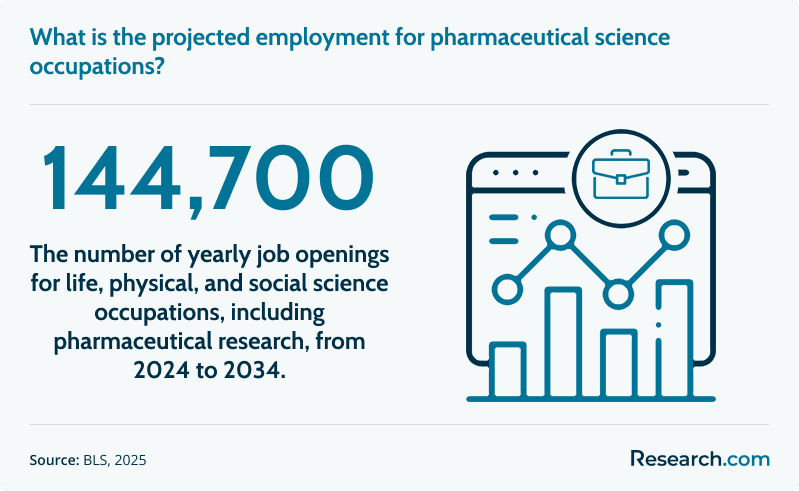
It is estimated that 144,700 job openings will open up for life, physical, and social science occupations, including pharmaceutical research. The infographic below adds more detail.
Why PharmD Professionals Remain Important
PharmD-trained pharmacists support medication safety, patient counseling, chronic disease management, antimicrobial stewardship, and collaboration within healthcare teams. Public health emergencies have also shown the value of accessible medication experts in both community and hospital settings.
Why PhD and Master’s Graduates Matter to Drug Development
PhD and master’s graduates contribute to the scientific and operational systems that bring medications to patients. Their work may involve drug formulation, vaccine development, quality assurance, regulatory documentation, manufacturing processes, drug delivery technologies, or safety evaluation.
Pharmaceutical companies, universities, biotechnology firms, government agencies, and research organizations need professionals who can translate complex science into products and processes that are safe, effective, and compliant. Healthcare work is also increasingly interdisciplinary, and students comparing career environments may find Research.com’s overview of where family nurse practitioners can work useful for understanding how clinical and research professionals collaborate across settings.
In 2027, graduates are likely to be strongest in the job market when they combine technical knowledge with adaptability, communication skills, regulatory awareness, and the ability to work across clinical and scientific teams.
What Graduates Say About PharmD, PhD, and Master’s Pathways
-
: "My PharmD led directly into hospital rotations, where I saw how medication decisions affect patients in real time. The clinical pace was intense, but it built the judgment I needed. After licensure, I moved into a community hospital role within months. Later, I supported a small pharmacokinetics study, which helped me see how practice and research can strengthen each other.
— Maria"
-
: "The PhD in Pharmaceutical Sciences required me to think like a researcher every day. I had to design experiments, write proposals, analyze data, and defend my dissertation. Some parts were difficult and isolating, but publishing work that influenced how others understood a formulation made the effort worthwhile. I now lead a research group studying targeted delivery systems, and the independence is what I value most.
— James"
-
: "I chose the master’s route because I wanted stronger laboratory and industry skills without spending years in a doctoral program. My regulatory affairs internship connected closely with my coursework, and I joined a biotech startup within a year. The combination of lab work, data interpretation, and applied projects helped me identify where I fit in the pharmaceutical field.
— Lina"
Key Insights
- The PharmD, PhD, and master’s serve different career goals. A PharmD is tied to pharmacist licensure and patient care, while PhD and master’s programs focus on research, industry, regulation, manufacturing, or technical pharmaceutical work.
- Your target role should drive the degree choice. Choose the PharmD for direct pharmacy practice, the PhD for independent research, and the master’s for applied industry preparation on a shorter timeline.
- Accreditation has different implications by degree. U.S. PharmD applicants should confirm ACPE accreditation because it affects licensure eligibility; PhD and master’s applicants should evaluate institutional accreditation, faculty strength, research resources, and industry connections.
- Time commitment can change the return on investment. A PharmD usually takes four years after pre-pharmacy coursework, a PhD typically takes five to seven years, and a master’s generally takes two years full-time.
- Funding can make one path much more affordable than another. PhD programs are often fully funded through stipends or research assistantships, while PharmD and master’s students should compare total program cost, not only tuition.
- Dual and sequential pathways are possible, but they require a clear reason. A PharmD/PhD can be powerful for students who want both clinical and research expertise, but it is a long route best suited to a specific long-term goal.
References:
- AACP. (2022). 2022-23 Tuition and fees at U.S. colleges and schools of pharmacy. public.tableau.com.
- AACP. (n.d.). Pharm.D. Program Structures. aacp.org.
- BLS. (2025, August 28). Chemists and materials scientists. bls.gov.
- BLS. (2025, August 28). Life, physical, and social science occupations. bls.gov.
- BLS. (2025, August 28). Medical scientists. bls.gov.
- BLS. (2025, August 28). Pharmacists. bls.gov.
Other Things You Should Know About PharmD vs. PhD vs. Master of Science in Pharmaceutical Sciences
In 2027, a PharmD focuses on clinical practice, preparing graduates for patient care in settings like hospitals or community pharmacies. A PhD emphasizes research, leading to careers in academia or drug development. A Master of Science in Pharmaceutical Sciences blends the two, often serving as a stepping-stone to higher degrees or research roles in the pharmaceutical industry.
In 2027, the PharmD program typically emphasizes experiential learning the most, as it focuses on clinical practice and prepares students for direct patient care roles. PhD and Master’s programs may incorporate some practical components but are generally more research-focused.
Typical prerequisite courses for a 2027 PharmD program include general chemistry, organic chemistry, biology, anatomy, physiology, and calculus. Additional requirements may vary by institution, but these foundational sciences are generally essential for admission into most PharmD programs.


