
2027 Medical Assistant Associate Degree vs. Certificate: Explaining the Difference

Co-Founder and Chief Data Scientist
Making a career move into healthcare feels like a high-stakes decision, where every dollar and every month counts. This is a common reality, especially considering the average medical assistant is 36.9 years old—an age where efficiency is key. The challenge isn't finding the "best" program, but the one that perfectly aligns with your personal timeline and career goals.
This guide, prepared by career planning experts with more than 10 years of experience, cuts through the confusion. We'll directly compare the medical assistant certificate and the medical assistant degree to give you the clarity needed to choose with confidence.
Key Things You Should Know About Medical Assistant Degree vs. Medical Assistant Certificate
- Certificate programs are faster, typically taking 9–12 months, while an associate's degree path takes about 24 months.
- Program costs vary widely, with median tuition ranging from about $4,310 for public programs to $17,325 for private ones.
- In 2023, schools awarded over 47,000 medical assistant certificates, compared to just over 5,000 associate's degrees.
- The career field is very stable, with a projected job growth of 12% between 2024 and 2034.
- The national median salary for medical assistants is approximately $44,200 per year.
- Medical Assistant Associate Degree vs. Certificate: Explaining the Difference Degree vs. Certificate
- What are the pros and cons of a medical assistant degree? Pros & Cons
- What are the pros and cons of a medical assistant certificate? What are the pros and cons of a medical assistant certificate?
- What courses can you expect in medical assistant programs? Typical Courses
- What are the requirements to enroll in a medical assistant program? Requirements
- How much does a medical assistant degree or certificate cost? Program Cost
- What financial aid is available for medical assistant students? Financial Aid
- What does a medical assistant do on a daily basis What does a medical assistant do on a daily basis
- What is the job outlook for medical assistants? Job Outlook
- How much can you earn with a medical assistant credential? Earning Potential
- What are the career advancement paths for medical assistants? What are the career advancement paths for medical assistants?
- Medical Assistant Associate Degree vs. Certificate: Which one is right for you? Medical Assistant Associate Degree vs. Certificate: Which one is right for you?
Medical Assistant Associate Degree vs. Certificate: Explaining the Difference
The core difference comes down to scope and purpose. A medical assistant certificate is focused job training designed for speed, getting you into the workforce as quickly as possible. A medical assistant degree is a broader career education designed for long-term flexibility, building a foundation for future growth.
Many people see the general education courses in a degree program—like English or psychology—as unnecessary. The reality is that these courses develop the critical thinking and communication skills that are essential for moving into leadership roles later on. This distinction is the key to deciding which path aligns with your personal career timeline.
Here’s a quick breakdown of how the two paths compare:
| Feature | Medical Assistant Certificate | Medical Assistant Associate Degree |
| Typical Duration | 9-12 months | ~24 months |
| Primary Focus | Core job-specific clinical & administrative skills | Core skills + general education (e.g., English, Math) |
| Best For | Fast entry into the workforce (Speed-to-Market) | Building a foundation for future growth (Long-Term Optionality) |
| Typical Outcome | Qualifies for immediate entry-level employment | Prepares for entry-level roles and future advancement |
| Credit Transferability | Credits are often non-transferable | Credits are generally transferable to a bachelor's degree |
Just as with other fields—such as comparing a difference between a dental assistant certificate and an associate's degree—the distinction often comes down to long-term opportunity versus short-term speed. Certificates get you working sooner, while degrees build broader career potential.
Why Accreditation is Non-Negotiable
Before you compare any other program features, you must check for accreditation. This is the single most important mark of a quality program. Look for accreditation from agencies recognized by the U.S. Department of Education, such as the Commission on Accreditation of Allied Health Education Programs (CAAHEP) or the Accrediting Bureau of Health Education Schools (ABHES).
Accreditation is not just a seal of approval; it is a requirement to receive federal financial aid and to be eligible to sit for key certification exams. Enrolling in an unaccredited program is one of the biggest risks you can take.
What are the pros and cons of a medical assistant degree?
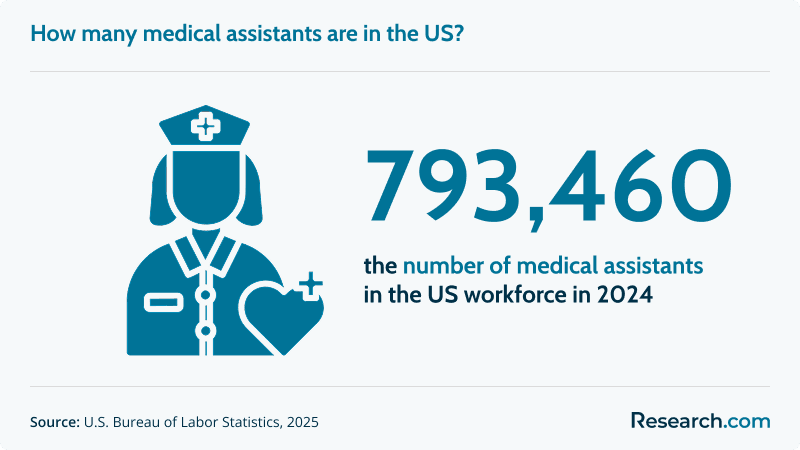
Choosing a medical assistant degree is a strategic investment in your long-term career. In a field with over 793,400 professionals, this path is designed to give you a competitive edge for future growth, though it requires a greater commitment upfront.
Pros of a Medical Assistant Degree
- Deeper Knowledge Base: You gain all the core clinical and administrative skills, plus a foundation in communication and critical thinking from general education courses.
- Clearer Advancement Pathways: This credential is often preferred for leadership roles like office manager and provides a direct stepping stone to further education, which is why an online associate degree in medical assistant program has become an attractive option.
- Foundation for Further Education: Credits earned in an associate's degree program are generally transferable, creating a smooth transition to a bachelor's degree in nursing or healthcare administration.
Cons of a Medical Assistant Degree
- Higher Upfront Cost: A degree program involves more courses, resulting in higher overall tuition and expenses compared to a certificate.
- Longer Time Commitment: Completing an associate's degree typically takes around two years of full-time study, a significant time investment.
The key takeaway is that the return on this investment is realized over the course of your career, not necessarily in your first paycheck. Now, let's look at the other side of the coin.
What are the pros and cons of a medical assistant certificate?
A quality, accredited medical assistant certificate is the most direct and efficient path to starting your career. This option is designed for individuals whose primary goal is to gain job-ready skills and enter the workforce as quickly as possible.
Pros of a Medical Assistant Certificate
- Faster Entry to the Workforce: Most certificate programs can be completed in just 9 to 12 months, allowing for a rapid transition into a new role.
- Lower Overall Cost: With fewer courses and a shorter duration, the total financial investment for a certificate is significantly lower than for a degree.
- Job-Focused Curriculum: The coursework concentrates exclusively on the essential clinical and administrative skills required for an entry-level position. This focus on accessibility is why finding a medical assistant certificate online has become a popular option for busy students.
Cons of a Medical Assistant Certificate
- Limited Advancement Paths: The focused nature of the training can create a "career ceiling," making it more difficult to move into management or leadership roles without returning to school.
- Non-Transferable Credits: Credits earned in most certificate programs are considered vocational and typically do not transfer to an associate's or bachelor's degree program.
Essentially, a certificate prioritizes immediate employment over long-term educational flexibility. Now that you understand the strategic differences, let's look at the specific courses involved.
What courses can you expect in medical assistant programs?
All accredited medical assistant programs are built around a core set of clinical and administrative skills. The main difference is that a degree program supplements this core training with general education courses to provide a more well-rounded academic foundation.
Core Clinical & Administrative Skills (Both Paths)
Your training will focus on the hands-on skills needed for the job from day one. Expect courses covering:
- Clinical Procedures: Phlebotomy (drawing blood), administering injections, and performing EKGs.
- Patient Care: Taking vital signs, recording patient histories, and preparing patients for exams.
- Administrative Tasks: Medical billing and coding, managing electronic health records (EHRs), and appointment scheduling.
- Medical Law and Ethics: Understanding patient confidentiality (HIPAA) and professional standards.
Additional General Education Courses (Associate's Degree)
A degree program adds courses that build broader skills, such as:
- English Composition
- Psychology or Sociology
- College-Level Math
- Anatomy and Physiology II
Program Formats and Pacing
The healthcare field is always evolving, and training programs are adapting to include new technologies like telehealth protocols. While most certificate programs take several months, some online schools with 6 week courses offer even more accelerated formats for students on a tight schedule.
With a clear picture of the curriculum, the next step is to understand what you'll need to get accepted into a program.
What are the requirements to enroll in a medical assistant program?
The good news is that the entry requirements for medical assistant programs are very straightforward. The primary requirement for nearly every accredited program is a high school diploma or a GED.
Common Enrollment Requirements
Beyond your diploma, you will typically need to provide a few standard items for both a certificate and a medical assistant degree program. These include:
- Criminal Background Check: This is a critical step. A failed background check can prevent you from being accepted or from attending required clinical externships.
- Immunization Records: You will need to provide proof of up-to-date vaccinations to comply with clinical site regulations.
- CPR Certification: Most programs require a valid CPR certification before you can begin hands-on clinical training.
The main difference you might encounter is that some colleges may require a placement test for math and English to ensure you are ready for degree-level coursework.
Beyond the Basics: Application Logistics
It’s wise to gather all your documents ahead of time so you can apply as soon as you find the right program. For those eager to begin their studies without delay, it's worth noting that many online colleges with weekly start dates offer rolling admissions.
Now that you know what it takes to get in, the next practical question is about cost.
How much does a medical assistant degree or certificate cost?
Costs can vary significantly depending on the type of school you choose. For medical assistant programs, the median tuition is around $4,310 for in-state public schools and can go up to $17,325 for out-of-state private institutions.
Naturally, a two-year medical assistant degree will have a higher total tuition than a one-year medical assistant certificate. It's also critical to remember that tuition is not the total cost. When creating your budget, be sure to account for additional expenses like textbooks, scrubs, lab fees, and the cost of certification exams.
Thinking of Cost as an Investment
It's helpful to think of your education not as an expense, but as an investment in your future earning potential. The right choice depends entirely on your personal career goals and what kind of return you are looking for.
To help manage this investment, always check if potential employers offer tuition reimbursement programs. Some large healthcare systems will help pay for your education as a way to recruit and retain skilled employees. This can be a significant opportunity to reduce your out-of-pocket costs.
There are, of course, other financial aid options available.
When comparing tuition, remember that affordability matters across many fields — even those outside healthcare. For instance, students often weigh whether is online college cheaper than in person programs to balance cost, flexibility, and long-term returns.
What financial aid is available for medical assistant students?
Your most important first step in funding your education is to fill out the Free Application for Federal Student Aid (FAFSA). This single form determines your eligibility for the most common types of financial assistance. This is only possible if you choose an accredited school.
Here are the main types of aid the FAFSA can unlock:
- Pell Grants: This is a form of federal aid that does not have to be repaid, awarded to students with significant financial need.
- Federal Student Loans: These are government-backed loans that you must repay, but they typically offer lower interest rates and more flexible repayment options than private loans.
- Scholarships: Many schools and private organizations offer scholarships based on academic merit, financial need, or other criteria.
- Federal Work-Study: This program provides funding for part-time jobs for students, allowing you to earn money to help pay for educational expenses.
Financial aid options also vary by program type, similar to what students encounter when considering degree or certificate in project management programs—where different funding and grant options apply depending on program length and accreditation.
Where to Look for Scholarships
Beyond the aid offered directly by your school, look for scholarships from professional organizations like the American Association of Medical Assistants (AAMA). It is also a smart strategy to check with large local hospitals and clinic systems. Many offer scholarships as a way to build their talent pipeline and invest in their future workforce.
You now have a clear path for enrollment and funding. Next, let's explore what the job looks like on a daily basis.
What does a medical assistant do on a daily basis
A medical assistant's day is a dynamic blend of administrative and clinical responsibilities, setting them apart from purely administrative staff. The exact mix of these duties depends heavily on your work environment. A small private practice will have a very different feel than a large, specialized hospital department, though physicians' offices remain the largest employer with over 448,000 MAs.
Administrative Duties
- Front Office Management: You'll be responsible for scheduling appointments, answering phones, and greeting patients.
- Record Keeping: A key part of the job is updating and filing patient electronic health records (EHRs).
- Financial Tasks: You will often handle billing, coding for insurance claims, and processing payments.
Clinical Duties
- Patient Prep: This includes taking patient vital signs, recording medical histories, and preparing patients for exams.
- Assisting with Procedures: You'll prepare treatment rooms, sterilize instruments, and assist physicians during examinations.
- Hands-On Care: You may administer injections, draw blood (phlebotomy), or perform basic lab tests, distinct from the personal care duties of a CNA.
The specific blend of these tasks often depends on where you work, as the chart below illustrates.
The Trend of the 'Expanded Role'
In modern healthcare, the role is growing. Many MAs in team-based care settings are taking on more advanced responsibilities like patient coaching or helping with care coordination. This trend offers a great opportunity for professional growth, but it's important to ensure that compensation keeps pace with these expanded duties to avoid burnout.
Now that you have a feel for the daily work, let's look at the long-term stability of this career path.
What is the job outlook for medical assistants?
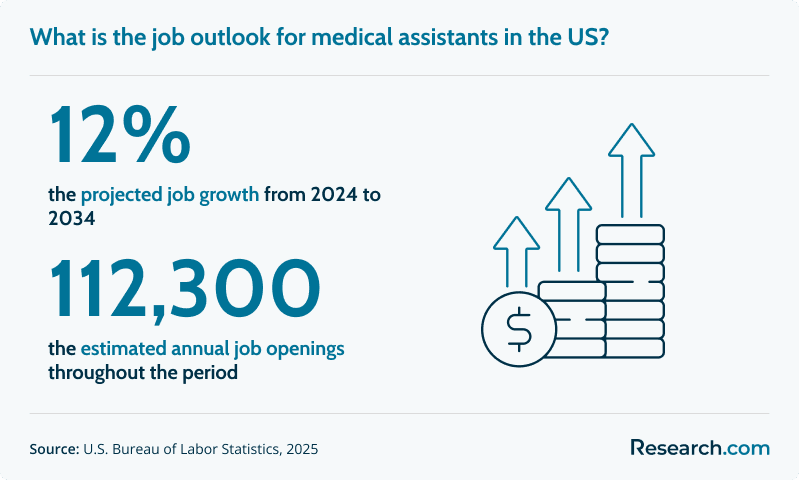
The job outlook for medical assistants is excellent. This is one of the most secure and stable entry points into the healthcare field you can find. The U.S. Bureau of Labor Statistics projects that employment for medical assistants will grow by 12% between 2024 and 2034, which is much faster than the average for all occupations.
This strong demand translates to an estimated 112,300 job openings each year over the next decade. The growth is primarily driven by two major factors: the needs of an aging population and the healthcare industry's increasing reliance on outpatient care settings. This high demand means that certified medical assistants are consistently sought after by employers.
Where the Jobs Are
While physicians' offices remain the largest employer of medical assistants, the fastest job growth is occurring in outpatient care centers. This reflects a broader shift in how healthcare is delivered. Geographically, states with large populations like California (110,350) and Texas (72,280) have the highest number of medical assistant jobs, offering a wide range of opportunities.
This strong job outlook provides a secure foundation for your career. Now, let's look at the earning potential that comes with it.
If you’re exploring growth beyond medical assisting, a health science degree to nursing pathway is a practical next step—building on your clinical experience and opening doors to higher-paying, licensed healthcare roles.
How much can you earn with a medical assistant credential?
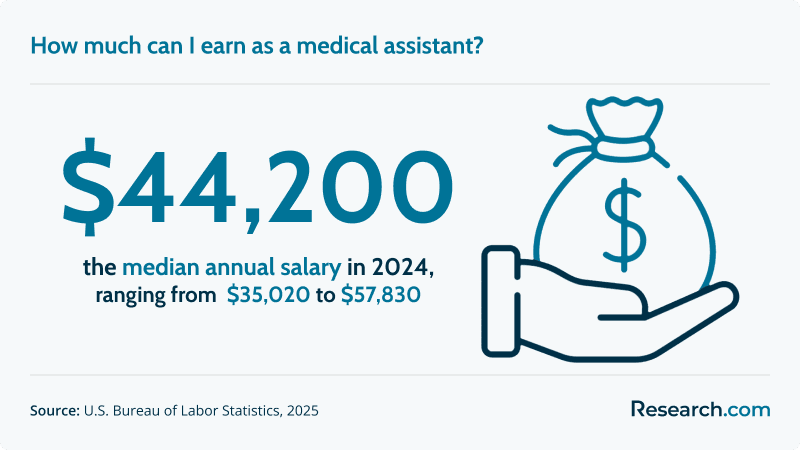
In 2024, the national median annual wage for medical assistants was approximately $44,200. This median wage is the benchmark for professionals entering the field, whether they have completed a medical assistant certificate or a degree program. Most professionals earn between $35,020 and $57,830 per year.
It's a common belief that a degree automatically leads to a higher starting salary, but that's not always the case. Your first paycheck is influenced more by location and employer than credential type. The financial benefit of a medical assistant degree is typically realized over the long term through access to higher-paying leadership and specialized roles.
Factors That Influence Your Salary
Your earning potential is not a fixed number; it's shaped by several key factors. Experience is a major driver, as seasoned medical assistants can command higher pay. Your geographic location also plays a significant role, with states like Washington offering a median wage over $55,000.
Finally, your choice of industry matters. While most MAs work in clinical settings, some of the highest-paying jobs are in non-traditional sectors like scientific research ($51,180) and social advocacy organizations ($53,330).
By understanding these factors, you can strategically position yourself for higher earnings. This leads to the next logical question: how do you move up in your career?
What are the career advancement paths for medical assistants?
Advancement for a medical assistant typically follows one of three main paths. This is the point where your initial choice of credential has the most significant impact on your long-term career trajectory.
While it is possible to advance with a certificate, research shows that career ladders can be unclear. A medical assistant degree is specifically designed to provide a smoother, more direct route to leadership and further education.
Here are the primary pathways for growth:
- Specialization: You can gain advanced certification in a specific area, such as becoming a Certified EKG Technician (CET) or a Certified Phlebotomy Technician (CPT).
- Leadership: With experience and the right skills, you can move into supervisory roles like clinical team lead or medical office manager.
- Further Education: Your educational background can serve as a foundation for another degree, most commonly in nursing or healthcare administration.
Advancement Through Further Education
The path to becoming a registered nurse is a popular long-term goal for many medical assistants. This is where a degree offers a distinct advantage, as the credits are generally transferable, saving you significant time and money. This path can also dramatically increase earning potential, a fact reflected in the average ER nurse salary.
Medical Assistant Associate Degree vs. Certificate: Which one is right for you?
After reviewing all the facts, the right choice isn't about which credential is "better," but which one is the best fit for your life right now. Your personal timeline, budget, and long-term career ambitions are the only factors that matter.
A Certificate is Likely Right for You If...
- Your primary goal is to enter the workforce as quickly as possible.
- You are working with a tighter budget and need a more affordable option.
- You want a focused, job-ready medical assistant certificate curriculum without general education requirements.
An Associate's Degree is Likely Right for You If...
- You see your first job as a stepping stone and have long-term goals for leadership or management.
- You plan to continue your education to become a nurse or healthcare administrator in the future.
- You are willing to invest more time and money upfront for greater long-term career flexibility.
As you can see from the chart below, the certificate is the most common choice.
The Most Popular Path
When you look at the numbers, it's clear that most people choose the certificate route. In 2023 alone, schools awarded over 47,000 certificates compared to just over 5,000 associate's degrees. This shows that the speed and efficiency of a certificate program meet the needs of the majority of students entering the field. It's a practical, proven, and popular first step into a rewarding career.
Here’s What Graduates Have to Say about Their Medical Assistant Degree vs. Medical Assistant Certificate Choice
- Isabella: "As a single mom, I couldn't just quit my job to go back to school. The online certificate program let me study after my kids were in bed. I finished in less than a year, and now I have a stable 9-to-5 with benefits, which is exactly what my family needed. It feels so good to have that security."
- Carla: "I just wanted the fastest path to a good job in healthcare, and that's what the certificate gave me. The program was completely focused on the skills for the certification exam and the job itself. There was no wasted time, and I appreciated how direct the whole process was."
- Andrew: "I was surprised by how much I use the 'gen-ed' courses from my degree program. The psychology class helps me understand and calm anxious patients, and the writing skills I learned make my reports so much clearer. I can already see how this foundation will help me move into a team lead role down the line."
Key Findings
- The field's excellent stability is confirmed by a projected 12% job growth through 2034, providing strong job security for those seeking a confident career move.
- With a national median salary of approximately $44,200, a medical assistant credential offers a solid, middle-class income, providing a clear return on the educational investment.
- The certificate is the most common path into the profession by a wide margin, with over 47,000 awarded in 2023 compared to just 5,000 associate's degrees, highlighting its role as the primary route for fast entry.
- The significant cost difference between programs, with median tuition ranging from about $4,310 to $17,325, underscores the importance of choosing an accredited program that aligns with your personal budget.
- Real-world studies confirm that medical assistants often face unclear advancement requirements and increased responsibility without a matching increase in pay, making a degree a strategic tool for navigating this career ladder challenge.
- In a competitive field with nearly 800,000 professionals, an associate's degree can serve as a key differentiator for long-term advancement, while a certificate remains the fastest way to join this large and stable workforce.
References:
- Data USA. (2025). Medical assistant. Retrieved May 24, 2024, from Data USA.
- Data USA. (2025). Medical assistants. Retrieved May 24, 2024, from Data USA.
- U.S. Bureau of Labor Statistics. (2025). Medical assistants. Occupational Outlook Handbook. Retrieved May 24, 2024, from BLS.
- U.S. Bureau of Labor Statistics. (2025). Occupational employment and wage statistics: 31-9092 Medical assistants. Retrieved May 24, 2024, from BLS.
Other Things You Should Know About Medical Assistant Degree vs. Medical Assistant Certificate
The Associate Degree typically requires two years to complete, offering a broader curriculum with general education courses. A Certificate program is shorter, often between 6-12 months, focusing on core medical assisting skills. This affects educational depth but not necessarily initial job roles in 2027.
Clinical experiences in a Medical Assistant Associate Degree are often more extensive, including supervised hours in healthcare settings, whereas a certificate may offer limited hands-on training, focusing more on theoretical knowledge. This can influence skill proficiency and job readiness in 2027.


