
2027 Accounting Careers: Guide to Career Paths, Options & Salary

Co-Founder and Chief Data Scientist
Accounting is no longer just a back-office recordkeeping function. For students, career changers, and early-career professionals, the bigger question is whether accounting still offers a stable, worthwhile path as automation, cloud platforms, analytics, and artificial intelligence reshape finance work. The short answer is yes—but the strongest opportunities increasingly go to accounting professionals who can combine technical accounting knowledge with software fluency, data interpretation, communication, and business judgment.
Among professional accountants, 90% agree that being willing to learn and use new technologies is now as important as traditional accounting knowledge for success in the field (Intuit QuickBooks, 2024). That does not mean technology is eliminating the profession. While concerns about automation and job displacement are real in many occupations, current evidence suggests that accounting technology is changing the kind of work accountants do, creating demand for professionals who can review automated outputs, advise leaders, strengthen controls, and interpret financial data.
This guide explains how accounting careers work, what education and credentials can help, which roles are available at each degree level, how salaries vary, and what skills matter most in 2026. If you are considering an associate’s or bachelor’s degree in accounting, preparing for certification, or deciding whether to move into public accounting, private industry, consulting, or education, use this article to compare your options and plan your next step.
Quick answer: Is accounting a good career path?
Accounting can be a strong career choice for people who enjoy working with financial information, solving business problems, meeting deadlines, and using technology to improve decision-making. The field offers multiple entry points, from bookkeeping and accounting clerk roles to auditing, tax, financial analysis, management consulting, financial management, and teaching. The best long-term prospects are usually tied to a bachelor’s degree, relevant experience, accounting software skills, and, for many public accounting or senior roles, professional certification such as the CPA.
The profession is also becoming more advisory. Routine transaction processing is increasingly automated, but employers still need people who can verify accuracy, explain financial results, evaluate risk, interpret regulations, and help leaders make better decisions.
Accounting Careers Table of Contents
- Why pursue a career in accounting?
- Accounting Career Outlook
- What Are the Best Ways to Gain Practical Experience in Accounting?
- How do online and traditional accounting degrees compare?
- Required Skills for Accounting
- What strategies can future-proof your accounting career?Review core accounting skills
- What are the emerging trends shaping the future of accounting?
- How Do I Choose the Right Accounting Degree Program?
- What specialized certifications can further enhance my accounting career?
- What factors influence accounting salary variations?
- How much does an accounting degree cost?
- How to Start Your Career in Accounting
- How can I advance my career in accounting?
- Alternative Career Options for Accounting
Why pursue a career in accounting?
Accounting is appealing because it supports nearly every type of organization. Businesses, government agencies, nonprofits, universities, healthcare systems, financial institutions, and consulting firms all need reliable financial information. Accountants help produce that information, test its accuracy, explain what it means, and use it to support planning, compliance, cost control, and strategy.
The profession has changed significantly from its traditional image. As accounting work has evolved, accountants have moved beyond maintaining ledgers and filing reports. Many now advise leaders on operational performance, business risks, tax strategy, technology adoption, internal controls, and long-term planning. This makes accounting useful not only for people who want a finance career but also for those who want a business role with measurable impact.
Technology is one reason the field is changing. In 2024, 85% of firms agreed that technology adoption improved their ability to serve clients more efficiently. Among finance and accounting leaders, 82% said continuing professional development in digital tools and data analytics was a priority for their teams, especially as organizations rely more heavily on the best accounting platforms. In the same year, 48% of accounting firms identified new technology adoption as a top priority.
Accounting also remains tied to regulation and accountability. Accountants must understand financial reporting rules, tax requirements, audit standards, and state laws that affect how organizations record and disclose information. That combination of compliance knowledge and business analysis is why many accountants move into leadership, consulting, risk management, or financial planning roles.
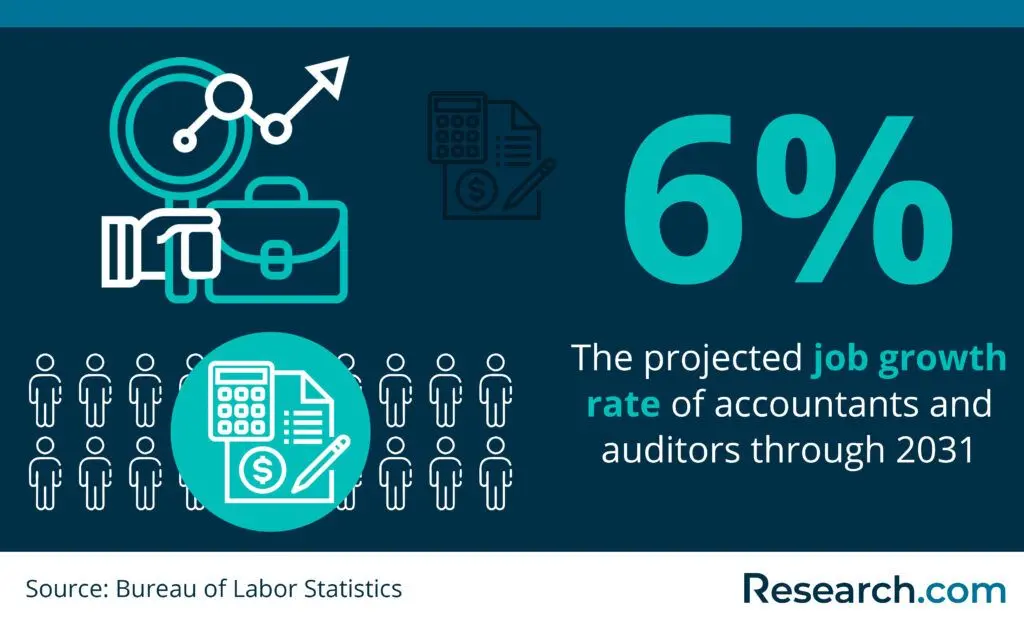
According to current Bureau of Labor Statistics projections, employment for accountants and auditors is expected to grow by 4% from 2022 to 2032. A career in accounting often includes strategic analysis for management, making it a practical path for people who want to influence decisions rather than only prepare reports.
Accounting Career Outlook
Accountants and auditors help organizations understand financial performance, comply with requirements, and identify operational risks. As of 2024, the median annual wage for accountants and auditors is $81,680, and demand is projected at 124,200 job openings per year through 2034 (Bureau of Labor Statistics, 2024). Pay varies by role, experience, credential, employer, and sector, with accounting graduates in finance and insurance often earning more than those in some other industries.
The table below shows selected accounting-related occupations, salary figures, and projected demand as stated in the available data. Use these figures as a comparison point, not as a guaranteed outcome. Actual compensation can differ widely by location, employer size, specialization, and certification status.
| Role | Salary | Demand |
| Financial Clerk | $38,830 | -3% |
| Bookkeeper | $45,560 | -5% |
| Accounting Clerk | $45,560 | -5% |
| Budget Analyst | $79,940 | 3% |
| Cost Estimator | $65,170 | -2% |
| Management Analyst | $93,000 | 11% |
| Personal Financial Advisor | $94,170 | 15% |
| Financial Manager | $131,710 | 17% |
| Loan Officer | $63,380 | 4% |
| Tax Examiner | $56,780 | -7% |
One important takeaway is that “accounting career” does not refer to one job. Some roles focus on transaction processing, some on compliance, some on analysis, and others on management. Positions involving advisory work, finance leadership, analytics, and client strategy often have different growth prospects than roles centered mainly on repetitive data entry.
What Are the Best Ways to Gain Practical Experience in Accounting?
Employers usually look for evidence that you can apply classroom concepts to real financial records, deadlines, software systems, and business problems. Practical experience can come from internships, cooperative education, part-time accounting support jobs, tax preparation work, campus finance offices, nonprofit volunteering, or project-based work with small businesses.
If you are still in school, prioritize opportunities that let you reconcile accounts, prepare basic reports, work with invoices, support audits, assist with tax documents, or use accounting software. These experiences help you talk about specific responsibilities in interviews instead of relying only on coursework.
| Experience option | Best for | What you can learn |
| Internship | Students pursuing public accounting, corporate accounting, or audit roles | Month-end tasks, documentation, client service, tax support, audit preparation, and professional communication |
| Part-time bookkeeping or accounting assistant work | Students and career changers who need entry-level exposure | Accounts payable, accounts receivable, reconciliations, invoices, and routine reporting |
| Volunteer financial work | Learners who need experience before they qualify for paid roles | Budget tracking, nonprofit records, expense documentation, and basic reporting |
| Mentorship | Anyone choosing between public, private, consulting, or government accounting | Career expectations, credential planning, workplace norms, and specialization choices |
| Workshops and professional events | Students building a network and learning current tools | Technology trends, employer expectations, software exposure, and professional contacts |
Students who want a structured starting point can also explore accounting certifications for beginners. A certificate will not replace experience, but it can help validate foundational knowledge and make it easier to qualify for bookkeeping, tax preparation, or accounting support roles.
How do online and traditional accounting degrees compare?
Online and campus-based accounting degrees can both prepare students for accounting careers, but they fit different learners. The better option depends on your schedule, learning style, access to local employers, need for flexibility, and whether the program supports your career goals.
Online programs are often attractive to working adults, parents, military learners, and students who cannot relocate. Traditional campus programs may be a better fit for students who want face-to-face structure, in-person networking, student organizations, and easier access to campus recruiting. Before enrolling, compare curriculum, faculty access, internship support, accreditation, transfer policies, and whether the program aligns with certification goals. For a fuller comparison, review the guide to online degree vs traditional degree options in accounting.
| Factor | Online accounting degree | Traditional accounting degree |
| Schedule | Often better for learners balancing work, family, or other obligations | Usually follows a more fixed campus schedule |
| Networking | May rely on virtual events, online advising, and remote employer connections | May offer easier access to in-person clubs, career fairs, and faculty interaction |
| Learning format | Works best for self-directed students who can manage deadlines independently | Works best for students who prefer regular classroom meetings and campus support |
| Career preparation | Can be strong if the program offers internships, career advising, and software-based coursework | Can be strong if the school has employer partnerships and active recruiting channels |
| Best fit | Working adults, transfer students, remote learners, and career changers | Recent high school graduates and students who want a campus-based experience |
Required Skills for Accounting
Accounting careers require more than comfort with numbers. Professionals must understand financial rules, use software accurately, communicate findings, identify unusual patterns, and manage deadlines. In 2020, 63% of accounting professionals identified client service and management as important for meeting client needs (Sage, 2020).
Research by Bressler and Pence (2019), published in the Journal of Organizational Psychology, highlighted how quickly expectations are changing for new accounting graduates. Their study concluded that universities should teach skills such as applying and interpreting statistical methods, maintaining respect for clients, continuous auditing, data mining, ERP systems, English language competency, highly technical AIS systems, and time management. They also noted that employers play a role in developing business analytics, foreign languages, listening, persuasion, problem-solving, relational databases, strategic thinking, and teamwork.
The most competitive accounting candidates are usually those who can connect technical accuracy with business usefulness. In practice, that means you need to prepare clean records, explain what they show, and help people act on the information.
Essential Skills for Accounting
- Analytical skills. Accountants review transactions, detect errors, identify unusual activity, interpret financial statements, and assess whether records make sense. These skills matter in auditing, reporting, fraud detection, budgeting, and tax preparation, including work supported by the best tax software.
- Math skills. Software handles many calculations, but accountants still need enough mathematical fluency to check results, understand ratios, prepare charts, evaluate formulas, and explain financial relationships clearly.
- Accounting software proficiency. Accounting is increasingly digital. A joint AICPA-NASBA study found that fewer than 50% of accounting departments cover topics such as predictive analytics, digital acumen, or cybersecurity in depth (The CPA Journal, 2025). This gap makes software knowledge, data literacy, and technology confidence especially valuable.
- Organizational skills. Accounting work depends on documentation. Contracts, invoices, receipts, reconciliations, approvals, and tax records must be stored and reviewed carefully so financial reports remain accurate and compliant.
General Skills
- Leadership skills. Accounting professionals are increasingly asked to guide teams, strengthen controls, protect data, and explain financial consequences to decision-makers. Although the CPA Evolution initiative launched in 2024 to address technology gaps, a joint AICPA-NASBA study found that fewer than 50% of accounting departments cover areas such as IT governance, predictive analytics, or cybersecurity in depth (The CPA Journal, 2025).
- Communication skills. Accountants must translate complex financial details for managers, clients, auditors, regulators, and nonfinancial teams. Strong communication skills in accounting help professionals explain risk, defend recommendations, and support decisions without overwhelming the audience.
- Critical thinking skills. Accountants must question whether information is complete, consistent, and reasonable. Critical thinking is essential when investigating discrepancies, reviewing financial statements, testing controls, or evaluating whether transactions have been recorded properly.
- Time management skills. Tax filing dates, audit schedules, month-end closes, and reporting deadlines leave little room for poor planning. Strong accountants know how to prioritize recurring tasks, unexpected requests, and compliance deadlines without sacrificing accuracy.
What strategies can future-proof your accounting career?
Future-proofing an accounting career means preparing for work that cannot be reduced to routine data entry. The safest strategy is to build skills that make you useful when software becomes more powerful: judgment, review, analysis, advisory communication, controls, cybersecurity awareness, and regulatory understanding.
Start by treating learning as part of the job. Keep improving your knowledge of accounting platforms, spreadsheets, analytics tools, data visualization, audit technology, and cybersecurity principles. Add credentials when they support a specific goal rather than collecting certifications without a plan. Join professional organizations, seek mentors, and follow changes in reporting rules, tax requirements, and industry expectations. For broader long-term planning, see this guide to the accountant future outlook.
| Career risk | Better strategy |
| Relying only on manual bookkeeping tasks | Learn reconciliation review, reporting, software workflows, and exception analysis |
| Ignoring analytics and automation | Build comfort with data tools, dashboards, and automated accounting systems |
| Staying only in compliance mode | Practice explaining how financial results affect operations, planning, and risk |
| Waiting too long to specialize | Explore tax, audit, forensic accounting, management accounting, advisory, systems, or financial analysis early |
| Assuming a degree alone is enough | Combine education with internships, projects, software experience, and professional networking |
What are the emerging trends shaping the future of accounting?
Several trends are changing what employers expect from accounting professionals. Cloud-based systems are making financial records more accessible across teams. Automation is reducing repetitive entry and matching work. Artificial intelligence and analytics are helping identify patterns, flag anomalies, and support forecasting. Remote and hybrid work are also changing how accounting teams collaborate, review documentation, and serve clients.
At the same time, cybersecurity and data governance are becoming more important because accounting systems contain sensitive financial and personal information. Sustainability reporting and evolving regulatory standards are also expanding the type of information organizations may need to measure and disclose. These trends do not remove the need for accounting knowledge; they raise the value of professionals who can connect accounting principles with technology, controls, and business advice. If your goal is to compare higher-earning paths in the field, review this overview of accounting careers.
How Do I Choose the Right Accounting Degree Program?
The right accounting degree program should match your career goal, budget, schedule, transfer history, and certification plans. Do not choose a program based only on convenience or advertising. Accounting is a credential-sensitive field, so accreditation, curriculum quality, faculty expertise, software exposure, and career support all matter.
If you are starting with a lower-cost pathway, an associate program can help you enter bookkeeping, accounting clerk, or tax support work before moving into a bachelor’s program. Students comparing cost-conscious options can review the cheapest associates degree in accounting online guide.
| Question to ask | Why it matters |
| Is the institution properly accredited? | Accreditation can affect transfer credit, employer recognition, graduate school admission, and financial aid eligibility. |
| Does the curriculum include tax, audit, financial accounting, managerial accounting, systems, analytics, and ethics? | A broad curriculum keeps more career paths open and can support future certification planning. |
| Does the program use current accounting software and data tools? | Employers increasingly expect graduates to understand digital workflows, not only accounting theory. |
| Are internships, employer partnerships, or career services available? | Practical experience can make a major difference when applying for entry-level roles. |
| Will credits transfer into a bachelor’s or graduate program? | Transfer rules affect total cost, time to completion, and whether an associate degree can become a stepping stone. |
| Does the program support CPA or other certification goals? | Certification requirements vary, so students should confirm whether coursework aligns with their intended credential path. |
What specialized certifications can further enhance my accounting career?
Accounting certifications can help demonstrate specialized knowledge, but the best credential depends on the work you want to do. A CPA is widely recognized for public accounting, audit, tax, and many leadership roles. Other credentials may be better aligned with management accounting, internal auditing, information systems auditing, investment analysis, or bookkeeping.
For professionals focused on bookkeeping and financial records, the CPB certification can show competence in maintaining books and working with accounting systems. Before pursuing any credential, compare eligibility rules, exam requirements, renewal obligations, employer demand, and whether the certification supports your target role.
| Certification | Common fit | When it may make sense |
| CPA | Public accounting, audit, tax, controller-track roles, and senior accounting positions | Useful when your career requires broad professional recognition and advanced accounting authority |
| CMA | Management accounting, corporate finance, budgeting, and performance analysis | Helpful for professionals who want to work inside organizations on planning and decision support |
| CIA | Internal audit, risk, and controls | Relevant for those who want to evaluate processes, compliance, and organizational risk |
| CISA | Information systems audit and technology controls | Strong fit for accounting professionals interested in cybersecurity, IT governance, and systems assurance |
| CFA | Investment analysis and financial research | More relevant for finance and investment roles than traditional accounting operations |
| CGMA | Global management accounting and strategic finance | Useful for professionals focused on advisory work, business performance, and management decision-making |
What factors influence accounting salary variations?
Accounting salaries vary because the field includes many roles and settings. Location, industry, employer size, specialization, experience, credential status, and job scope all affect pay. Accountants with advanced credentials such as the CPA often have access to roles with greater responsibility, though no credential guarantees a specific salary.
Geography also matters. Employers in high-cost areas and major business centers may offer higher pay, while compensation in smaller markets may differ. Industry can have a major effect as well, with finance, insurance, consulting, corporate leadership, and specialized advisory roles often paying differently from entry-level administrative accounting positions. For location-based comparisons, review this state-by-state guide to CPA salary in US.
| Salary factor | How it can affect earnings |
| Education level | Higher-level roles often require or prefer a bachelor’s or graduate degree. |
| Certification | Credentials such as CPA, CMA, CIA, CISA, CFA, or CGMA can support specialized or senior roles. |
| Industry | Finance, insurance, consulting, government, nonprofit, and corporate accounting can have different pay structures. |
| Location | Regional labor markets and cost of living influence compensation. |
| Technology skills | Experience with accounting platforms, analytics, ERP systems, and cybersecurity concepts can strengthen competitiveness. |
| Responsibility level | Supervisory, advisory, audit, tax strategy, and finance leadership roles usually differ from routine clerical work. |
How much does an accounting degree cost?
The cost of an accounting degree depends on the institution, program level, delivery format, residency status, transfer credits, books, software, fees, and financial aid. Tuition is only one part of the total cost. Students should also consider technology requirements, exam preparation, certification fees, transportation or housing for campus programs, and lost income if they reduce work hours to study.
Online programs may reduce commuting or relocation costs, while campus programs may provide more direct access to in-person recruiting and facilities. The most affordable option is not always the best value if it lacks accreditation, transferability, career support, or relevant coursework. For a deeper affordability comparison, review this guide to the cost for accounting degree.
| Cost item | What to check before enrolling |
| Tuition and fees | Compare total program cost, not only the listed cost per course. |
| Books and software | Ask whether accounting platforms, spreadsheets, tax tools, or access codes are included. |
| Transfer credits | Confirm how many previously earned credits will apply to the degree. |
| Financial aid | Check grants, scholarships, employer tuition assistance, and payment plans. |
| Certification preparation | Ask whether coursework supports CPA or other credential goals and whether exam prep is included. |
| Career services | Evaluate internship support, resume help, employer connections, and alumni outcomes. |
How to Start Your Career in Accounting
Most accounting careers begin with either a two-year associate degree or a four-year bachelor’s degree. In the 2023-2024 school year, 11,900 students completed an associate degree and 53,800 students earned a bachelor’s degree in accounting (AICPA, 2025). Admission requirements vary by school, but applicants commonly submit a high school transcript, GED or SAT scores, and any additional materials required by the institution.
Your starting path should reflect the type of work you want. An associate degree may be enough for bookkeeping, accounting clerk, payroll support, or tax assistant roles. A bachelor’s degree is the more common route for staff accountant, auditor, analyst, and CPA-track positions. Students comparing business-related majors and salary expectations can also review this guide to accounting major salary considerations.
| Private Accounting Path | Public Accounting Path | Consulting Path | Teaching Path | |
| Work within one organization’s finance or accounting department. | Serve outside clients through services such as tax preparation, audit, and assurance. | Advise clients on finances, taxes, investments, insurance, or organizational performance. | Teach accounting concepts and, at more advanced levels, conduct academic research. | |
| Entry Level Jobs | Accounts Payable Specialist ($66,560) | Bookkeeper ($42,598) | Cost Estimator ($65,170) | Teaching Assistant of Accounting ($43,658) |
| Junior Management Jobs | Junior Accountant ($87,052) | Auditor ($88,980) | Labor Relations Consultant ($77,010) | Professor of Accounting ($79,640) |
| Middle Management Jobs | Tax Manager ($100,403) | Management Analyst ($93,000) | Personal Financial Advisor ($94,170) | Full Professor of Accounting ($124,618) |
| Senior Management Jobs | Chief Finance Officer ($131,170) | Senior Partner ($189,360) | Fundraising Director ($121,730) | Senior Professor of Accounting ($147,440) |
What can I do with an associate’s degree in accounting?
Accounting Clerk
Accounting clerks help keep financial records current and organized. They may prepare routine reports, reconcile bank statements, review entries, support accounts payable or accounts receivable, and check the accuracy of information produced through accounting software. As automated systems handle more data processing, clerks are often responsible for spotting errors, following up on missing documentation, and helping maintain clean records.
Median salary: $45,560
Tax Examiner
Tax examiners usually work for federal, state, or local government agencies. They review tax returns, determine tax obligations, evaluate deductions and credits, and verify whether filings comply with applicable rules. This role requires attention to detail, knowledge of tax procedures, and the ability to interpret documentation.
Median salary: $56,780
Bookkeeper
Bookkeepers maintain day-to-day financial records for businesses, organizations, or clients. In 2024, among approximately 1.2 million bookkeeping, accounting, and auditing clerks, 74,000 were self-employed (BLS, 2025). Because many routine bookkeeping tasks are now automated, bookkeepers increasingly review system outputs, resolve discrepancies, match invoices and payments, and make sure records are complete before reports are prepared.
Median salary: $45,560
What can I do with a bachelor’s degree in accounting?
Cost Estimator
Cost estimators collect and analyze information about labor, materials, time, and money required for projects, products, or services. Their work supports pricing, budgeting, bidding, and cost-control decisions. Strong cost estimators understand both numbers and operations, allowing them to identify cost drivers and recommend ways to improve efficiency.
Median salary: $65,170
Budget Analyst
Budget analysts help organizations plan spending, review funding requests, prepare budget reports, and monitor financial performance. They often work with program managers to compare proposals, evaluate cost-benefit trade-offs, and support responsible resource allocation.
Median salary: $79,940
Post-Secondary Teacher
Some accounting graduates move into education, teaching accounting or related subjects at public or private colleges and universities. In addition to teaching, post-secondary instructors may develop course materials, advise students, participate in committees, and contribute to academic programs.
Median salary: $79,640
Can you get an accounting job with just a certificate?
Yes. Some accounting certificates provide enough foundational training for entry-level work in income tax preparation, bookkeeping support, payroll assistance, or small business accounting. These programs generally require no more than 30 credits and take less than two years to complete. Applicants typically need at least a high school diploma or GED certificate.
A certificate is usually most useful when you want a fast entry point, need to test whether accounting fits you, or already have experience in another field and need accounting-specific coursework. It may not be enough for CPA-track roles, senior accounting positions, or jobs that require a bachelor’s degree.
How can I advance my career in accounting?
Career advancement in accounting usually comes from a combination of education, experience, certification, specialization, and leadership ability. Many professionals begin in staff, clerk, bookkeeping, or analyst roles, then move into senior accountant, auditor, manager, controller, consultant, or finance leadership positions.
Students who plan to earn a graduate degree in accounting usually need a bachelor’s degree in accounting, business, or a related field. Before entering a master’s in accounting program, applicants may need to complete prerequisites, submit transcripts, take the GMAT or GRE, write required essays, and meet other school-specific requirements. In the 2023-2024 school year, 21,300 students earned master’s degrees and 42 students earned doctorate degrees in accounting (AICPA, 2025).
What can I do with a master’s in accounting?
Financial Analyst
Financial analysts study business, economic, and market information to recommend investments or support organizational decisions. Inside companies, they build financial models, evaluate performance, and use data to forecast future results. Financial analysts are typically required to have a license issued by the Financial Industry Regulatory Authority and certified by the Chartered Financial Analyst Institute.
Median salary: $95,570
Management Analyst
Management analysts, also called management consultants, review revenue, expenses, staffing, workflows, and operational data to find ways organizations can improve. They advise leaders on reducing costs, increasing revenue, and making processes more effective.
Median salary: $93,000
Personal Financial Advisor
Personal financial advisors help clients plan for goals such as retirement, taxes, insurance, mortgages, estate planning, and other financial decisions. Because they may provide investment guidance or sell financial products, they often need licenses from state boards or other regulatory bodies depending on the services they offer.
Median salary: $94,170
What kind of job can I get with a doctorate in accounting?
Accounting Professor
Accounting professors teach advanced and foundational accounting topics, mentor students, and often guide research. Many hold a doctorate in accounting and work in higher education, where they may also contribute to curriculum development, scholarly publication, and academic leadership.
Median salary: $133,804
Sales Manager
Sales managers lead sales teams, set targets, monitor performance, approve budgets, and evaluate profitability. An accounting background can be useful in this role because sales leaders must understand pricing, expenses, revenue forecasts, customer acquisition costs, and budget trade-offs.
Median salary: $127,490
Chief Audit Executive
A chief audit executive oversees an organization’s audit function and internal control system. This leader plans audit activities, reviews risk, monitors compliance, verifies the accuracy of records, and helps ensure that assets and transactions are properly controlled.
Median salary: $172,915
Which certification is best for accounting?
The best accounting certification depends on your target role. The certified public accountant credential is the most widely recognized option for public accounting, audit, tax, and many senior accounting roles. However, it is not the only useful credential.
Other recognized certifications include certified management accountant (CMA), certified internal auditor (CIA), certified information systems auditor (CISA), chartered financial analyst (CFA), and chartered global management accountant (CGMA). Choose a certification only after confirming that it is valued in the jobs you want, fits your education and experience, and supports a realistic career plan.
Alternative Career Options for Accounting
An accounting background can lead to roles outside traditional accounting departments. Because accountants understand financial systems, controls, reporting, risk, and business operations, they can move into adjacent careers that rely on financial judgment.
- Financial writer. Financial writers explain markets, accounting standards, investment topics, business performance, and finance concepts for professional or public audiences. Accounting knowledge helps writers produce more accurate and credible analysis.
- Non-profit accountant. Nonprofit organizations need accountants who understand budgets, restricted funds, grants, compliance, and transparent reporting. A significant shortage of accountants in the nonprofit sector remains a concern, connected to the broader decline in the accounting pipeline; for example, the number of candidates sitting for the CPA Exam in 2023 decreased by 12.5% from the previous year (AICPA, 2024).
- Insurance manager. Accounting skills can transfer well to insurance roles because policy management, risk evaluation, premium analysis, budgets, and claims-related financial decisions all require strong numeracy and documentation skills.
Common mistakes to avoid when planning an accounting career
| Mistake | Why it can hurt you | Better approach |
| Choosing a school without checking accreditation | It can affect credit transfer, employer recognition, graduate admission, or financial aid. | Verify accreditation before applying or enrolling. |
| Looking only at tuition | Books, software, fees, certification preparation, commuting, and lost work time can change the true cost. | Compare total cost and available aid. |
| Assuming every online program fits certification goals | Coursework may not align with licensing or credential requirements. | Ask advisors how the curriculum supports CPA or other certification plans. |
| Ignoring internships until graduation | Graduates without experience may struggle to stand out for entry-level roles. | Pursue internships, volunteer accounting work, or part-time finance roles while studying. |
| Relying only on rankings | A highly ranked program may not fit your budget, schedule, transfer needs, or career target. | Use rankings as one input, not the entire decision. |
| Assuming salary outcomes are guaranteed | Pay depends on role, location, employer, experience, certification, and industry. | Compare multiple roles and build skills that match higher-responsibility work. |
Accounting Careers Offer Many Paths, But Planning Matters
Accounting can lead to stable entry-level work, specialized technical roles, advisory careers, management positions, consulting opportunities, and academic paths. The best route depends on your goals. If you want public accounting, audit, or tax leadership, prepare early for the CPA path. If you prefer working inside one organization, private accounting, budgeting, management accounting, or financial analysis may fit better. If you enjoy advising clients, consulting or personal financial planning may be more appealing.
Accounting is sometimes described as one of the careers ideal for introverts, but modern accountants often collaborate closely with clients, executives, technology teams, auditors, regulators, and managers. The work still rewards precision and independent focus, but communication and advisory ability now matter more than ever.
The profession will continue to change as automation, analytics, cloud systems, and AI become more common. That change does not make accounting obsolete. It makes narrow, manual-only skill sets less secure and increases the value of accountants who can interpret data, evaluate systems, protect information, and connect financial results to business decisions.
Key Insights
- Accounting remains relevant, but the work is changing. Routine data processing is increasingly automated, while demand is growing for professionals who can review outputs, analyze results, manage controls, and advise decision-makers.
- Technology skills are no longer optional. Accountants need confidence with accounting platforms, analytics, ERP systems, cybersecurity concepts, and digital workflows alongside traditional accounting knowledge.
- Education level affects career options. Certificates and associate degrees can support entry-level bookkeeping, clerk, and tax support roles, while bachelor’s degrees are more common for staff accountant, audit, analyst, and CPA-track positions.
- Certifications should match your career goal. CPA, CMA, CIA, CISA, CFA, CGMA, and bookkeeping credentials serve different purposes. Choose based on the role you want, not simply on name recognition.
- Salary depends on more than the job title. Location, sector, employer size, experience, technology skills, specialization, and credentials all influence compensation.
- Practical experience is a major advantage. Internships, part-time accounting work, volunteer finance projects, and software-based assignments can help you compete for stronger roles after graduation.
- Program choice matters. Before enrolling, check accreditation, curriculum, transfer rules, career services, software exposure, internship access, and alignment with certification requirements.
References:
- AICPA. (2024, July). 2023 Trends in the Supply of Accounting Graduates and the Demand for Public Accounting Recruits. AICPA.org. https://www.aicpa-cima.com/resources/download/2023-trends-in-the-supply-of-accounting-graduates-and-the-demand-for-public-accounting-recruits
- AICPA. (2025). 2025 Trends in the Supply of Accounting Graduates and the Demand for Public Accounting Recruits. https://www.aicpa.org/content/dam/aicpa/interestareas/accountingeducation/newsandpublications/downloadabledocuments/2025-trends-report.pdf
- Bureau of Labor Statistics. (2024). Accountants and Auditors: Occupational Outlook Handbook. U.S. Department of Labor. https://www.bls.gov/ooh/business-and-financial/accountants-and-auditors.htm
- Bureau of Labor Statistics. (2024). Occupational Outlook Handbook: Accountants and Auditors. https://www.bls.gov/ooh/business-and-financial/accountants-and-auditors.htm
- Intuit QuickBooks. (2024). QuickBooks Accountant Technology Survey 2024. https://quickbooks.intuit.com/r/accountant-reports/accountant-technology-survey-2024/
- Robert Half. (2024). The Demand for Skilled Talent: 2024 Trends and Insights. https://www.roberthalf.com/research-and-insights/demand-for-skilled-talent
- The CPA Journal. (2025). Alternatives in Accounting Education. https://www.cpajournal.com/2025/10/29/alternatives-in-accounting-education/
- U.S. Bureau of Labor Statistics. (2025, January 24). Current Population Survey, Annual Averages. https://www.bls.gov/cps/tables.htm#annual
- Wolters Kluwer. (2024). 2024 Future Ready Accountant Survey. https://www.wolterskluwer.com/en/news/wolters-kluwer-releases-2024-future-ready-accountant-survey-results
Other Things You Should Know About Accounting Careers
In 2027, high-demand accounting roles include forensic accountants, financial analysts, and auditors. These positions require staying updated with industry regulations and leveraging technology to interpret financial data, with many organizations looking for expertise in data analytics and financial software.
Top internship opportunities for accounting students in 2027 include positions at Big Four firms like Deloitte and PwC, offering hands-on experience in auditing and tax services. Internships with financial institutions or government agencies are also valuable for understanding regulatory frameworks and financial management.
You can start your career in accounting by earning an associate or bachelor’s degree in accounting. These programs provide foundational knowledge and skills, and upon graduation, you can pursue entry-level positions such as accounting clerk, bookkeeper, or tax examiner.
Advanced degrees like a master’s in accounting or an MBA with a focus on accounting can help in career advancement. Certifications such as Certified Public Accountant (CPA), Certified Management Accountant (CMA), and Chartered Financial Analyst (CFA) are also valuable for career growth.
Technology has significantly impacted the accounting profession by automating routine tasks, enabling accountants to focus on strategic activities. Technology literacy is now a critical skill, and accountants must stay updated with the latest accounting software and digital tools.
Yes, you can get entry-level accounting jobs with a certificate in accounting. These jobs include positions like income tax preparer and small business accountant, which provide a broad overview of accounting practices.


