
2027 Best Nursing Schools with No TEAS or HESI Exams Requirement

Co-Founder and Chief Data Scientist
In 2023, more than 65,000 qualified applicants were turned away from nursing schools. For many aspiring nurses, this intense competition is made even more stressful by a single high-stakes exam like the TEAS or HESI standing between them and their career goals. The good news is that many excellent, accredited nursing schools with no TEAS or HESI requirement now focus on your academic record instead of a single test score.
To help you find the right path, our career planning experts, with over a decade of experience, have created this comprehensive guide. We'll show you exactly how to build a strong application for these programs and launch your nursing career with confidence.
What are the benefits of enrolling in nursing schools with no TEAS or HESI requirement?
- This path prepares you for high-demand registered nurse roles in settings like hospitals, outpatient clinics, and community health, helping to address a critical global need for skilled healthcare professionals.
- You can expect to earn a competitive salary, with an average of $42.24 per hour, though your specific pay will depend on your geographic location, specialty, and years of experience.
- The most immediate benefit is avoiding months of stressful test preparation, allowing you to focus your application on your proven academic strengths and accelerate your entry into the nursing profession.
What can I expect from enrolling in nursing schools with no TEAS or HESI requirement?
You can expect a fully accredited and rigorous BSN curriculum that is identical to programs requiring entrance exams. The quality and content of your education are not determined by a school's admission policies but by national professional standards.
Accreditation bodies mandate a standardized core curriculum for all BSN programs. This ensures every graduate is prepared to pass the NCLEX licensure exam and practice safely and effectively. The system is designed to produce highly capable professionals, with the average competency level among nurses being exceptionally high.
Choosing a program without an entrance exam doesn't mean you're taking an easier route. It simply means the school has chosen to evaluate your potential based on your entire academic record rather than a single test score.
Where can I work with a degree from nursing schools with no TEAS or HESI requirement?
Graduates with a BSN from a no-exam school can work in any healthcare setting that hires registered nurses. Here are five common workplaces for BSN graduates:
- Hospitals: The largest employment sector, offering roles in diverse specialties like emergency, critical care, and pediatrics.
- Ambulatory Healthcare Services: Includes outpatient clinics, physicians' offices, and surgical centers that provide scheduled care.
- Nursing and Residential Care Facilities: These settings focus on providing long-term care for elderly or disabled populations.
- Government: Federal, state, and local government agencies hire nurses for roles in public health, military service, and veteran care.
- Educational Services: Opportunities exist in schools and universities for health education, student wellness, and clinical instruction.
How much can I make with a degree from nursing schools with no TEAS or HESI requirement?
Graduates from these programs can expect to earn an average of $87,868 per year, as pay is determined by market factors, not school admission criteria. Several key elements influence your specific earning potential.
- Geographic Location: Your location is a primary driver; while the U.S. average is around $42.24 per hour, nurses in high-demand states like California can earn over $64 per hour.
- Specialty: Specializing in a high-acuity field like a critical care unit can lead to an average salary of over $95,000, compared to other generalist roles.
- Years of Experience: Compensation grows with expertise, as an experienced RN can earn significantly more than an entry-level nurse, whose salary typically starts around $60,000.
- Work Setting: An outpatient surgical center, for example, may offer higher average pay than a residential care facility due to the different nature of the work.
- Further Education: Earning an MSN to become a Nurse Practitioner can dramatically increase your earning potential to over $120,000 a year.
- List of the Best Nursing Schools with No TEAS or HESI Exam Requirement for 2027 Best Nursing Schools
- How long does it take to complete a nursing program at nursing schools with no TEAS or HESI requirements? Completion Time
- How do nursing schools without TEAS or HESI exams compare to traditional programs? How do nursing schools without TEAS or HESI exams compare to traditional programs?
- What is the average cost of attending nursing schools with no TEAS or HESI requirement? Program Cost
- What are the financial aid options for students enrolling in nursing schools with no TEAS or HESI requirement? Financial Aid
- What are the prerequisites for enrolling in nursing schools with no TEAS or HESI requirement? What are the prerequisites for enrolling in nursing schools with no TEAS or HESI requirement?
- What courses are typically offered in nursing schools without TEAS or HESI exams? What courses are typically offered in nursing schools without TEAS or HESI exams?
- What types of specializations are available in nursing schools with no TEAS or HESI requirement? Specializations
- How to Choose the Best Nursing Schools with No TEAS or HESI Exam Requirement How to Choose the Best Nursing Schools with No TEAS or HESI Exam Requirement
- What career paths are available for graduates of nursing schools with no TEAS or HESI requirements? Career Paths
- What is the job market for graduates of nursing schools with no TEAS or HESI requirement? Job Market
- What are the opportunities for online advancement in nursing education? What are the opportunities for online advancement in nursing education?
- What support services contribute to student success in no-exam nursing programs? What support services contribute to student success in no-exam nursing programs?
Best Nursing Schools With No TEAS or HESI Exam Requirement for 2027
Applying to nursing school is stressful enough without adding another high-stakes entrance exam. Some accredited BSN programs no longer require the TEAS or HESI A2, which can be especially helpful for strong students, career changers, transfer applicants, and working adults who would rather be evaluated on coursework, healthcare experience, essays, recommendations, and overall readiness for nursing.
This guide explains how no-TEAS and no-HESI nursing programs work, how they compare with traditional exam-based admissions, what they cost, what prerequisites you may need, and how to choose a program that prepares you for licensure and employment. The goal is not just to list schools, but to help you decide whether this admissions path fits your background and career plans.
Quick answer: Are nursing schools with no TEAS or HESI legitimate?
Yes. A nursing program can be academically rigorous, accredited, clinically intensive, and licensure-focused even if it does not require the TEAS or HESI for admission. The key is to verify institutional and nursing accreditation, NCLEX preparation, clinical placement quality, graduation requirements, and state licensure alignment before enrolling.
How to use this list
Use the schools below as a starting point, not as a final decision. Admission policies can change, and some programs may waive the TEAS or HESI only for specific pathways, applicant types, or admission cycles. Before applying, confirm requirements directly with the nursing school, ask whether the program is ACEN- or CCNE-accredited, and check whether graduates are eligible for RN licensure in the state where you plan to practice.
How do we rank schools?
Because nursing school is a major academic and financial commitment, the ranking process is built around transparent data and practical student outcomes. Research.com uses sources such as the IPEDS database, Peterson's database, the College Scorecard database, and The National Center for Education Statistics to evaluate institutions and programs.
These sources help compare schools using consistent information rather than marketing claims. You can review the broader evaluation process on Research.com’s methodology page.
| School and program | Program length | Credits or units | Published cost information | Institutional accreditation |
| California State University, Fullerton — Traditional BSN | 4-5 years | 24 units | $29,880 (in-state); $80,280 (out-of-state) | WASC Senior College and University Commission (WSCUC) |
| Drexel University — BSN-Co-op | 4-5 years | 181 credits | $247,368 | Middle States Commission on Higher Education (MSCHE) |
| Northern Illinois University — B.S. in Nursing | 5 semesters (approximately 2.5 years) | 91-94 credits | $42,968.88 | Higher Learning Commission (HLC) |
| Oregon Health & Science University — B.S. with a Major in Nursing | 3 years (9 terms) | 180 credits | $442 (in-state); $811 (out-of-state) per credit | Northwest Commission on Colleges and Universities (NWCCU) |
| Samuel Merritt University — Bachelor of Science in Nursing | 2 years | 67 units | $788 per credit | WASC Senior College and University Commission (WSCUC) |
| University of North Carolina at Chapel Hill — Bachelor of Science in Nursing | 5 semesters (approximately 2.5 years) | 60 credits | $17,547.50 (in-state); $107,880 (out-of-state) | Southern Association of Colleges and Schools Commission on Colleges (SACSCOC) |
| University of South Florida — BSN Pathways | 4-5 semesters | 67 credit hours | $211.19 (in-state); $611.39 (out-of-state) per credit | Southern Association of Colleges and Schools Commission on Colleges (SACSCOC) |
| University of Tennessee Health Science Center — BSN Program | 12 months (Accelerated) or 4 semesters (Traditional) | 50-60 credit hours | $9,023-$13,535 (in-state); $25,715-$38,571 (out-of-state) | Southern Association of Colleges and Schools Commission on Colleges (SACSCOC) |
1. California State University, Fullerton - Traditional BSN
California State University, Fullerton offers a traditional BSN pathway that considers applicants through a broader review process rather than relying only on a nursing entrance test. The program is designed for students who want a full undergraduate nursing experience and a curriculum that builds clinical judgment, patient-care skills, and readiness for professional nursing practice.
- Program Length: 4-5 years
- Required Credits to Graduate: 24 units
- Total Tuition: $29,880 (in-state); $80,280 (out-of-state)
- Accreditation: WASC Senior College and University Commission (WSCUC)
2. Drexel University - BSN-Co-op
Drexel University combines nursing coursework with its cooperative education model, giving students the opportunity to complete one to three paid co-op placements. This structure may appeal to applicants who want structured work experience alongside classroom learning and clinical training.
- Program Length: 4-5 years
- Required Credits to Graduate: 181 credits
- Total Tuition: $247,368
- Accreditation: Middle States Commission on Higher Education (MSCHE)
3. Northern Illinois University - B.S. in Nursing
Northern Illinois University offers a five-semester nursing major that places heavy weight on prerequisite preparation, especially in science courses. The curriculum prepares graduates for generalist RN practice by combining nursing theory, skills development, and direct and indirect patient-care experience.
- Program Length: 5 semesters (approximately 2.5 years)
- Required Credits to Graduate: 91-94 credits
- Total Tuition: $42,968.88
- Accreditation: Higher Learning Commission (HLC)
4. Oregon Health & Science University - B.S. with a Major in Nursing
Oregon Health & Science University provides a BSN option across five regional campuses, which can be useful for students who want clinical exposure in different communities. Its competency-based structure supports hands-on learning and can create a foundation for later graduate study or career advancement within healthcare.
- Program Length: 3 years (9 terms)
- Required Credits to Graduate: 180 credits
- Cost per Credit: $442 (in-state); $811 (out-of-state)
- Accreditation: Northwest Commission on Colleges and Universities (NWCCU)
5. Samuel Merritt University - Bachelor of Science in Nursing
Samuel Merritt University offers a two-year BSN designed for students ready for a concentrated nursing curriculum. The program blends classroom learning with clinical practice and emphasizes professional preparation, compassionate care, and service to diverse patient populations.
- Program Length: 2 years
- Required Credits to Graduate: 67 units
- Cost per Credit: $788
- Accreditation: WASC Senior College and University Commission (WSCUC)
6. University of North Carolina at Chapel Hill - Bachelor of Science in Nursing
The University of North Carolina at Chapel Hill evaluates BSN applicants through academic records, written responses, and evidence of service orientation. Students should expect strong emphasis on science preparation because clinical nursing depends on anatomy, physiology, pharmacology, and evidence-based decision-making.
- Program Length: 5 semesters (approximately 2.5 years)
- Required Credits to Graduate: 60 credits
- Total Tuition: $17,547.50 (in-state); $107,880 (out-of-state)
- Accreditation: Southern Association of Colleges and Schools Commission on Colleges (SACSCOC)
7. University of South Florida - BSN Pathways
The University of South Florida offers several BSN routes, including traditional, accelerated, and freshman-direct entry options. This range of pathways can serve first-time college students, transfer students, and applicants who already hold prior college credit and want a more efficient path into nursing.
- Program Length: 4-5 semesters
- Required Credits to Graduate: 67 credit hours
- Cost per Credit: $211.19 (in-state); $611.39 (out-of-state)
- Accreditation: Southern Association of Colleges and Schools Commission on Colleges (SACSCOC)
8. University of Tennessee Health Science Center - BSN Program
The University of Tennessee Health Science Center offers traditional and accelerated BSN options built around a concept-based curriculum. The program emphasizes major nursing concepts such as safety, ethics, and clinical reasoning, and reports a 98.8% first-time NCLEX pass rate.
- Program Length: 12 months (Accelerated) or 4 semesters (Traditional)
- Required Credits to Graduate: 50-60 credit hours
- Total Tuition: $9,023-$13,535 (in-state); $25,715-$38,571 (out-of-state)
- Accreditation: Southern Association of Colleges and Schools Commission on Colleges (SACSCOC)
How Long Does It Take to Complete a Nursing Program With No TEAS or HESI Requirement?
A traditional BSN generally takes four years for students entering college for the first time. An Accelerated BSN (ABSN), intended for students who already completed a bachelor's degree in another field, can often be finished in 12 to 18 months.
The main time advantage of a no-exam nursing school is usually before admission. Instead of spending 2-4 months preparing for an entrance exam, applicants can focus on prerequisites, transcripts, essays, recommendations, and clinical or volunteer experience. This can matter for career changers comparing the fastest way to become a nurse and for students trying to strengthen their nursing school application without delaying admission.
The BSN remains a common route into registered nursing. Data shows that 51.1% of the nursing workforce holds a bachelor's degree, making the BSN a widely used credential for entering and advancing in the profession.
| Applicant type | Common program option | Typical time commitment | Best fit |
| First-time college student | Traditional BSN | Four years | Students who want a full undergraduate nursing pathway |
| Student with a non-nursing bachelor's degree | Accelerated BSN | 12 to 18 months | Career changers who have completed prior college-level study |
| Transfer student with prerequisites | Upper-division BSN or transfer BSN | Varies by accepted credits | Students who want to apply existing coursework toward a nursing degree |
How Do No-TEAS and No-HESI Nursing Schools Compare With Traditional Nursing Programs?
No-exam nursing programs are not automatically easier, shorter, or less respected. The difference is usually the admissions model. Instead of using TEAS or HESI scores as a screening tool, these schools may evaluate GPA, prerequisite grades, essays, recommendations, prior healthcare exposure, interviews, and readiness for clinical training.
Once admitted, students still complete nursing theory courses, simulation labs, supervised clinical rotations, and NCLEX preparation. The important question is not whether the program requires an entrance exam, but whether it is accredited, rigorous, and aligned with RN licensure requirements.
| Factor | No-TEAS or no-HESI programs | Traditional exam-based programs |
| Admissions focus | Holistic review, prerequisite performance, essays, recommendations, and broader readiness indicators | Entrance exam scores plus GPA, prerequisites, and other application materials |
| Best for | Strong students whose records show sustained academic effort but who may not want one test to dominate admission | Applicants who test well and want another way to demonstrate academic readiness |
| Curriculum | Comparable nursing coursework, labs, clinical practice, and NCLEX preparation | Comparable nursing coursework, labs, clinical practice, and NCLEX preparation |
| Risk to check | Admission may be highly competitive because fewer barriers can mean more applicants | A low exam score may weaken an otherwise strong application |
| Decision question | Does my GPA, prerequisite record, and experience make me competitive without a test score? | Can I earn a test score strong enough to support my application? |
No-exam nursing programs
These programs are often a good match for applicants with consistent grades, strong science coursework, thoughtful essays, and meaningful work or volunteer experience. They allow schools to assess performance over time rather than relying heavily on a single exam day.
Traditional nursing programs
Programs that require the TEAS or HESI often use those scores to compare large applicant pools. This can help schools standardize part of the admissions process, but it may disadvantage applicants whose academic records are stronger than their standardized test performance. Students with a prior bachelor's degree may also compare advanced routes, including direct entry MSN programs for non-nurses online, depending on long-term goals.
What Is the Average Cost of Nursing Schools With No TEAS or HESI Requirement?
The cost of a no-TEAS or no-HESI nursing program is generally similar to the cost of other nursing programs because tuition is driven by institution type, residency status, credit load, clinical fees, and financial aid rather than the entrance exam policy. Published tuition averages around $72,000 for in-state public universities and $111,000 for private institutions.
Program prices can differ sharply. Some listed options cost as little as $14,000, while others exceed $247,000 for the full degree. Because published tuition is not the same as net cost, students should compare aid offers, scholarships, fees, housing, transportation to clinical sites, and lost income if they plan to study full time.
If your long-term plan includes advanced practice nursing, factor in future education early. For example, understanding how to transition from BSN to CRNA can help you anticipate additional prerequisites, graduate-level training, and future cost considerations.
| Cost factor | Why it matters | Question to ask before enrolling |
| Residency status | Public universities often charge different rates for in-state and out-of-state students. | Can I qualify for in-state tuition, or will I pay the out-of-state rate? |
| Clinical-related expenses | Students may need transportation, uniforms, health screenings, insurance, and supplies. | Which costs are not included in published tuition? |
| Financial aid package | Scholarships and grants can reduce the actual amount paid. | What is my estimated net price after aid? |
| Program format | Accelerated programs may reduce time in school but can limit ability to work. | Can I realistically work while completing this program? |
| Credit transfer policy | Accepted credits can reduce repeated coursework and total cost. | Which prerequisites or general education credits will transfer? |
What Financial Aid Is Available for Students in No-TEAS or No-HESI Nursing Schools?
Financial aid eligibility does not depend on whether a nursing school requires the TEAS or HESI. Students in eligible programs may still pursue federal, state, institutional, and private aid. More than 96% of undergraduate nursing students receive some type of aid, so applicants should treat financial planning as a core part of the school selection process.
Common funding options include:
- Federal grants: Need-based aid, such as the Pell Grant, that generally does not have to be repaid.
- Scholarships: Awards from schools, healthcare organizations, community groups, or government programs based on merit, need, service, background, or career goals.
- Student loans: Federal or private borrowing that can help pay tuition and living costs but must be repaid with interest.
- Work-study programs: Part-time employment opportunities funded through federal aid programs to help students cover educational expenses.
- The FAFSA: The Free Application for Federal Student Aid (FAFSA) is the central application used to determine eligibility for many federal, state, and school-based aid programs.
How to reduce nursing school costs
- Complete transferable prerequisites at a lower-cost institution if the nursing school accepts them.
- Compare net price, not just tuition.
- Ask whether scholarships renew automatically or require a minimum GPA.
- Check whether accelerated study will prevent you from working while enrolled.
- Look for employer tuition assistance if you already work in healthcare.
What Prerequisites Do Nursing Schools Without TEAS or HESI Exams Usually Require?
When a program removes the entrance exam, the rest of the application often becomes more important. Schools may look closely at whether your grades show you can handle nursing science, pharmacology, clinical reasoning, and fast-paced patient-care environments.
Typical requirements include:
- Minimum GPA: Many programs expect at least a 3.0 on a 4.0 scale, with particular attention to science grades.
- Prerequisite coursework: Common courses include Anatomy and Physiology I & II, Microbiology, General Chemistry, and Statistics.
- Personal essay: A statement explaining why you want to become a nurse, what has prepared you, and how you fit the program’s mission.
- Letters of recommendation: Usually two to three letters from instructors, supervisors, or healthcare professionals who can speak to your readiness, maturity, and work ethic.
- Resume or CV: A record of employment, volunteer service, healthcare exposure, leadership, certifications, and relevant responsibilities.
| Application area | What schools may look for | How to strengthen it |
| Science prerequisites | Evidence that you can handle demanding nursing content | Retake weak prerequisites if allowed and focus on consistent performance |
| Essay | Clear motivation, realistic understanding of nursing, and communication ability | Use specific examples from work, caregiving, volunteering, or academic experience |
| Recommendations | Professionalism, reliability, compassion, and academic discipline | Choose references who know your work well and can provide detailed comments |
| Healthcare experience | Exposure to patients, teamwork, and service environments | Document paid roles, volunteer work, shadowing, or caregiving responsibilities |
What Courses Are Typically Offered in No-TEAS or No-HESI Nursing Programs?
Nursing schools that waive entrance exams still teach the core content expected of BSN programs. Accrediting standards and licensure expectations require students to develop competence in patient assessment, clinical reasoning, safe medication administration, population health, and evidence-based care.
Common nursing courses include:
- Fundamentals of Nursing: Introduces the nursing process, patient safety, basic care skills, documentation, and professional responsibilities.
- Pharmacology: Covers medication classes, mechanisms, dosing principles, side effects, and safe administration practices.
- Health Assessment: Teaches physical, psychosocial, cultural, and developmental assessment skills.
- Medical-Surgical Nursing: Focuses on adult patients with acute and chronic conditions and is often one of the most important clinical areas in the BSN curriculum.
- Maternal and Pediatric Nursing: Prepares students to care for pregnant patients, newborns, children, and adolescents.
- Community Health Nursing: Examines public health, prevention, health education, access to care, and nursing roles in community settings.
These courses are designed to prepare students for real nursing roles. Hospitals remain the largest employment setting for RNs, with 58% of all RNs working in hospitals.
Students who already work in healthcare may be able to use their experience to make a stronger application. For example, someone exploring a surgical tech to RN pathway can highlight operating room exposure, patient-care familiarity, and teamwork in clinical settings.
What Nursing Specializations Can You Explore in Programs Without TEAS or HESI Requirements?
BSN students usually do not choose a formal nursing specialty in the same way a graduate student might. Instead, they build a generalist RN foundation while using clinical rotations, electives, externships, and preceptorships to discover areas of interest.
- Clinical rotations: Students rotate through settings such as critical care, pediatrics, labor and delivery, mental health, community health, and medical-surgical units.
- Nursing electives: Some schools offer focused coursework in areas such as gerontology, palliative care, informatics, leadership, or public health.
- Senior preceptorship: A capstone experience may pair a student with an experienced RN in a clinical setting that matches career interests.
- Student nurse externships: Paid summer or part-time positions can help students gain experience in specialty units before graduation.
- Post-graduate fellowships: Hospitals may offer transition-to-practice programs that help new nurses move into specialized areas after earning RN licensure.
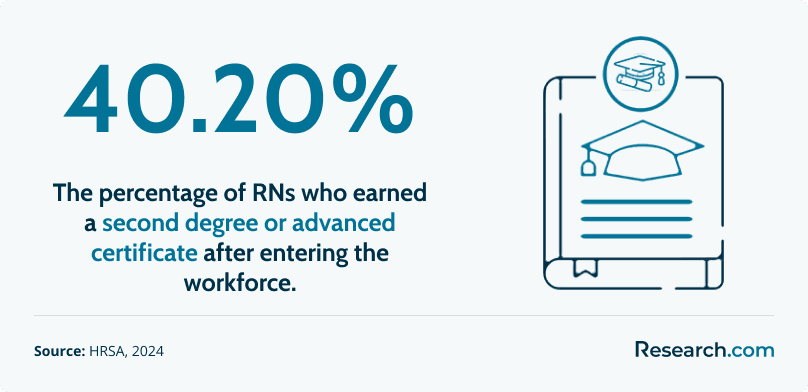
The BSN can also support later specialization through graduate education. Among RNs who earned a second degree, 40.20% pursued an MSN.
Specialization can also affect long-term income and work setting. Students interested in end-of-life care, for instance, may want to review how much do hospice nurses make while comparing clinical interests and career goals.
How to Choose the Best Nursing School With No TEAS or HESI Requirement
A no-exam admissions policy can make a program more accessible, but it should not be the main reason you enroll. The best nursing school is the one that is accredited, affordable for your situation, clinically strong, transparent about outcomes, and aligned with your licensure and career goals.
Key factors to compare
- Accreditation: Confirm institutional accreditation and verify whether the nursing program is accredited by ACEN or CCNE, especially if you plan to pursue RN licensure or graduate study.
- NCLEX pass rate: A strong first-time pass rate can indicate effective preparation, although it should be reviewed alongside graduation rates, admission selectivity, and student support.
- Clinical placements: Ask where students complete rotations, how placements are assigned, and whether the school has relationships with hospitals, clinics, community agencies, or specialty sites.
- Student support: Look for tutoring, simulation labs, advising, remediation plans, mental health resources, and career services.
- Total net cost: Compare tuition, fees, living expenses, aid, travel to clinical sites, and the income you may lose if you cannot work while enrolled.
- Future education plans: If you may later become an advanced practice nurse, compare how the BSN connects to graduate options, including accessible pathways such as the easiest MSN programs to get into.
Questions to ask admissions advisors
| Topic | Question to ask | Why it matters |
| Exam policy | Is the TEAS or HESI waived for all applicants or only for certain pathways? | Some schools have different rules by campus, cohort, or applicant type. |
| Licensure | Does the program meet RN licensure education requirements in my state? | Online, out-of-state, and multi-campus programs may require extra verification. |
| Clinical placement | Does the school assign clinical sites, or must students find their own? | Clinical access can affect graduation timeline and readiness. |
| Transfer credits | Which prerequisites will transfer, and what grade is required? | Transfer rules can change cost, timeline, and admission competitiveness. |
| Student outcomes | What are the NCLEX pass rate, graduation rate, and job placement support? | These indicators help you assess whether the program supports students through completion and licensure. |
Common mistakes to avoid
- Choosing a school only because it does not require the TEAS or HESI.
- Assuming “no entrance exam” means the program is easier.
- Ignoring nursing program accreditation and focusing only on institutional accreditation.
- Comparing tuition without including fees, supplies, transportation, and financial aid.
- Assuming every online or hybrid nursing program meets licensure requirements in every state.
- Relying only on rankings instead of reviewing clinical sites, outcomes, and student support.
- Waiting until after admission to ask about credit transfer and prerequisite expiration rules.
What Career Paths Are Available After Graduating From a No-TEAS or No-HESI Nursing Program?
Graduates of accredited nursing programs that do not require the TEAS or HESI can pursue the same RN career paths as graduates of exam-based programs, provided they meet licensure requirements and pass the NCLEX. The admissions policy does not appear on your license; your education, clinical preparation, licensure, and work experience matter far more.
| Career path | What the role involves | Median salary |
| Medical-Surgical Nurse | Provides care for adult patients with medical conditions or those preparing for or recovering from surgery. | $77,600 per year |
| Emergency Room Nurse | Assesses and treats patients with urgent illnesses or injuries in fast-moving emergency settings. | $78,500 per year |
| Pediatric Nurse | Cares for infants, children, and adolescents in hospitals, clinics, schools, and other pediatric settings. | $77,600 per year |
| Public Health Nurse | Works with communities on prevention, education, immunization, access to care, and health equity initiatives. | $75,900 per year |
| Home Health Nurse | Provides patient care in home settings, often supporting wound care, medication management, chronic conditions, and patient education. | $78,200 per year |
1. Medical-Surgical Nurse
Medical-surgical nurses care for adult patients with a wide range of diagnoses. Many new nurses start here because the role develops broad clinical skills, time management, assessment ability, and confidence with diverse patient needs.
Median salary: $77,600 per year.
2. Emergency Room Nurse
Emergency room nurses work in high-pressure settings where patients may arrive with sudden illness, trauma, or unstable conditions. The role requires rapid assessment, triage, teamwork, and the ability to make sound decisions quickly.
Median salary: $78,500 per year.
3. Pediatric Nurse
Pediatric nurses specialize in caring for children from infancy through adolescence. They may provide wellness care, administer immunizations, support families, and treat childhood illnesses in hospitals, clinics, schools, or specialty practices.
Median salary: $77,600 per year.
4. Public Health Nurse
Public health nurses focus on communities rather than only individual patients. They may work for government agencies, nonprofits, clinics, or outreach programs that address prevention, education, immunization, and health disparities. Students interested in this path can explore different community health nurse jobs.
Median salary: $75,900 per year.
5. Home Health Nurse
Home health nurses provide one-on-one care in patients’ homes. The work can involve wound care, medication teaching, chronic disease management, and coordination with families and providers. For salary context, review how much does a home health nurse make.
Median salary: $78,200 per year.
What Is the Job Market for Graduates of Nursing Schools With No TEAS or HESI Requirement?
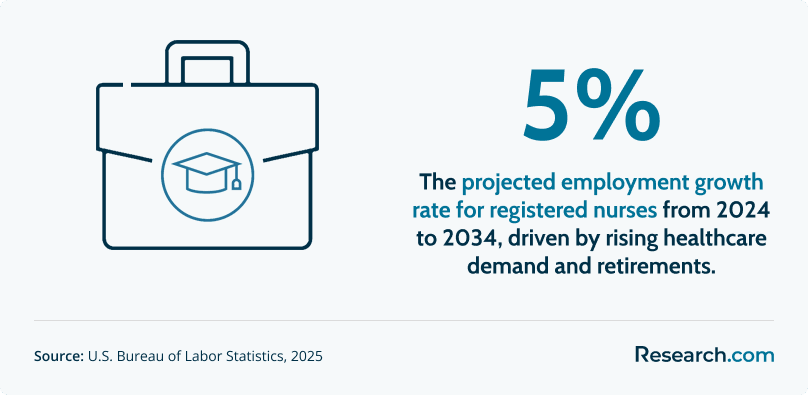
The job market for BSN-prepared nurses remains favorable. The U.S. Bureau of Labor Statistics projects employment for registered nurses to grow 5% from 2024 to 2034, faster than the average for all occupations. Demand is shaped by healthcare needs, an aging population, and ongoing workforce replacement needs.
Graduates should still approach the job market strategically. Location, clinical experience, specialty interest, licensure compact rules, and employer partnerships can all affect opportunities. If you are flexible about where to work after graduation, comparing the best places for nurses to live can help you weigh pay, demand, cost of living, and quality-of-life factors.
How AI and technology are changing nursing preparation
AI, electronic health records, clinical decision-support tools, telehealth, remote monitoring, and simulation-based learning are increasingly part of healthcare environments. Nursing students should look for programs that teach safe technology use, documentation accuracy, patient privacy, informatics basics, and critical thinking. Technology can support nurses, but it does not replace clinical judgment, communication, compassion, or hands-on care.
Graduate Perspectives on Nursing Schools With No TEAS or HESI Exam Requirement
- Andrea: "I already had a biology degree, so another standardized exam felt unnecessary. The application process gave more weight to the science coursework I had completed and helped me show that I was ready for nursing school through my academic record, not just a test score."
- Jane: "I had worked hard for my grades, and I did not want one exam to outweigh years of effort. The program reviewed my prerequisites, essays, and commitment to nursing, which made the process feel more complete and fair."
- Ivy: "At first, I wondered whether a program without an entrance exam would still be demanding. It was. The coursework, labs, and clinical expectations were serious, and I felt prepared when it was time for the NCLEX and my first nursing role."
What Are the Opportunities for Online Advancement in Nursing Education?
Online nursing education is most useful after a student has already become licensed or when a program combines online coursework with approved in-person clinical requirements. Working RNs often use online pathways to complete a BSN, prepare for leadership roles, or meet employer expectations while continuing to work.
If you are already an RN and want a flexible bachelor’s completion option, an easy RN to BSN program online may help you compare programs designed for licensed nurses. Applicants should still verify accreditation, clinical or practicum expectations, transfer credit rules, and whether the program fits their state and employer requirements.
What Support Services Help Students Succeed in No-Exam Nursing Programs?
Removing the TEAS or HESI from admissions does not remove the academic demands of nursing school. Strong support systems can make the difference between being admitted and actually graduating prepared for licensure.
Helpful services include academic advising, prerequisite planning, tutoring, simulation labs, dosage-calculation support, NCLEX preparation, remediation plans, mental health resources, faculty mentoring, career coaching, and clinical placement coordination. These services are especially important for accelerated students, first-generation college students, working adults, and applicants returning to school after time away.
Students with long-term advanced practice goals should also evaluate whether a school offers clear progression into graduate nursing education. For doctoral planning, review options such as what is the easiest DNP program? while remembering that “easiest” should never be the only criterion; accreditation, clinical quality, and licensure alignment matter more.
References
- American Association of Colleges of Nursing. (2023). New AACN data points to enrollment challenges facing U.S. schools of nursing. Retrieved from AACN Nursing.
- Data USA. (n.d.). Registered nursing profile. Retrieved from Data USA.
- Emory University. (n.d.). Tuition, financial aid, and scholarships. Retrieved from Nursing Emory.
- Health Resources and Services Administration. (2022). National sample survey of registered nurses: Education and training report. Retrieved from HRSA.
- Journal of Nursing Regulation. (2023). Nurse licensure compact: Evidence from practice and policy. Retrieved from Journal of Nursing Regulation.
- National Council of State Boards of Nursing. (2022). Annual program report aggregate data. Retrieved from NCSBN.
- National Library of Medicine. (2023). Nursing workforce crisis in the United States. Journal of Nursing Scholarship. Retrieved from PMC.
- National Library of Medicine. (2024). Trends in nursing education and practice. Journal of Nursing Regulation. Retrieved from PMC.
- ATI Testing. (n.d.). TEAS test-taker research. Retrieved from ATI Testing.
- ZipRecruiter. (2024). Registered nurse salary. Retrieved from ZipRecruiter.
Key Insights
- No-TEAS and no-HESI nursing schools can be legitimate, rigorous options when they are accredited and prepare students for RN licensure and the NCLEX.
- The admissions difference is mainly philosophical: no-exam programs often rely more on GPA, prerequisite grades, essays, recommendations, and healthcare experience.
- A no-exam policy does not guarantee easier admission. Competitive programs may place even more weight on science grades and overall application quality.
- Program cost varies widely, from options as low as $14,000 to programs exceeding $247,000, so students should compare net price after aid rather than tuition alone.
- Before applying, confirm the current entrance exam policy, nursing accreditation, clinical placement process, NCLEX outcomes, transfer credit rules, and state licensure eligibility.
- The best program is not simply the one without a test requirement. It is the one that fits your academic record, budget, location, support needs, and long-term nursing goals.
Other Things You Should Know About Nursing Schools with No TEAS or HESI Exam Requirement
In 2027, several reputable nursing schools offer programs without requiring TEAS or HESI exams. These include Western Governors University, Chamberlain University, and Marian University. They provide robust curricula while focusing on holistic criteria for admissions, ensuring quality education without standardized testing barriers.
In 2027, nursing schools that don't require TEAS or HESI exams may use GPA, letters of recommendation, and personal interviews to assess candidates. Some may also consider previous healthcare experience or other entrance exams tailored to evaluate relevant skills and competencies.


