
2027 Home Health Nurse Salary by State?

Co-Founder and Chief Data Scientist
Home health nursing has grown into a major sector of U.S. healthcare, offering patients skilled services in the comfort of their homes. According to the Bureau of Labor Statistics, 187,670 registered nurses were employed in Home Health Care Services in May 2024, showing just how significant this practice setting has become (U.S. Bureau of Labor Statistics, 2025). With more patients seeking care at home, salaries for these nurses are shaped not only by clinical skill but also by geography, demand, and employer incentives.
In this guide, I will break down how salaries for a home health nurse compare across states, what kinds of bonuses and benefits employers are offering, and how cost of living and tax differences affect real take-home pay. I will also examine how experience, education, certifications, and leadership roles influence compensation, giving you a clear view of what to expect in this career.
Key Things About Home Health Nurse Salaries
- The highest average pay for a home health nurse is in California at $77/hour, followed by Oregon at $68/hour, and Minnesota at $65/hour, reflecting strong regional demand.
- Nome, Alaska reports the highest average pay for a home health nurse at $126,179 annually, or $60.66/hour, reflecting premiums for remote recruitment.
- Minnesota offers one of the strongest cost-adjusted outcomes, with an average of $65/hour paired with moderate living costs that allow nurses to retain more real income.
- What is the average home health nurse salary by state? Salary by State
- What signing and retention bonuses are common for home health nurse roles? Bonuses
- Which states offer the best cost of living adjusted pay for a home health nurse? High-Paying States
- How do hourly, per visit, and per diem salary models compare for home health nurses? How do hourly, per visit, and per diem salary models compare for home health nurses?
- What states have the lowest tax rates for a home health nurse? Tax Rates
- How much does a new home health nurse earn in their first year? First-year Salary
- How do years of experience impact home health nurse salary growth? How do years of experience impact home health nurse salary growth?
- What advanced degrees can influence a home health nurse salary? Continuing Education
- Which certifications most reliably increase home health nurse pay? Certifications
- What leadership opportunities improve pay for a home health nurse? What leadership opportunities improve pay for a home health nurse?
- How can home health nurses effectively negotiate their salaries? How can home health nurses effectively negotiate their salaries?
What is the average home health nurse salary by state?
Earnings for a home health nurse differ across the country because agencies must account for travel time, visit loads, and local payer systems. State-level posting data shows that the West Coast and parts of the Upper Midwest consistently lead in pay, while mid-Atlantic and interior states offer steady but lower averages.
The following are ten representative state averages as of September 2025 job data:
- California: $77/hour, with some offers reaching $109/hour.
- Oregon: $68/hour, reflecting sustained demand in urban and rural markets.
- Minnesota: $65/hour, supported by statewide system needs.
- New York: $59/hour, where metro areas raise statewide averages.
- Delaware: $55/hour, a strong figure for a small market.
- Wisconsin: $49/hour, consistent with regional living costs.
- New Mexico: $49/hour, offering competitive rates in the Southwest.
- Colorado: $49/hour, shaped by demand along the Front Range.
- Maryland: $49/hour, bolstered by proximity to Washington, DC.
- Illinois: $48/hour, influenced by Chicago-area agency hiring.
For national benchmarks, Glassdoor reports a median total pay of about $100,000 annually for home health registered nurses, with most salaries falling in the $86,000–$116,000 range. ZipRecruiter lists an average of $101,717 annually, equivalent to $48.90/hour.
These figures also highlight why many nurses complete bridge programs such as RN to BSN fast pathways, since higher credentials expand opportunities to pursue top-paying roles in specialized home health and leadership.
What are the highest paying cities for a home health nurse?
National averages provide a baseline, but the sharpest pay differences emerge at the city level. Data show that remote Alaskan towns and California’s Bay Area dominate the top tier. Remote areas must pay a premium to recruit and retain nurses, while metropolitan hubs reflect intense cost pressures and concentrated healthcare systems.
The ten highest paying cities for a home health nurse are:
- Nome, Alaska: $126,179 annually, or $60.66/hour, leading the nation due to isolation and limited workforce supply.
- Cupertino, California: $125,492 annually, or $60.33/hour, reflecting Silicon Valley’s high costs and dense health sector.
- Berkeley, California: $124,546 annually, or $59.88/hour, lifted by Bay Area hospital and agency demand.
- Redwood City, California: $124,537 annually, or $59.87/hour, another Bay Area hub with strong competition for staff.
- Aspen, Colorado: $122,947 annually, or $59.11/hour, where resort housing markets drive wages higher.
- Sitka, Alaska: $122,536 annually, or $58.91/hour, demonstrating how Alaskan communities compensate for remoteness.
- San Bruno, California: $121,520 annually, or $58.42/hour, influenced by proximity to San Francisco.
- Wyoming, Wyoming: $121,310 annually, or $58.32/hour, a statewide posting still ranked among the top city figures.
- Mountain View, California: $119,993 annually, or $57.69/hour, part of the Silicon Valley corridor.
- Menlo Park, California: $119,869 annually, or $57.63/hour, closing out the Bay Area cluster.
These results point to two clear drivers of higher pay: premiums used to attract staff to isolated Alaskan cities and the sustained wage competition in California’s Bay Area. Both yield six-figure salaries, but the underlying conditions shaping them are very different.
As nurses compare career options, it can also be helpful to look at hospice nurse salary by state, since many home health nurses eventually transition into hospice work. State-level pay data highlights how cost of living, workforce shortages, and regional demand all play a role in shaping long-term earning potential.
What signing and retention bonuses are common for home health nurse roles?
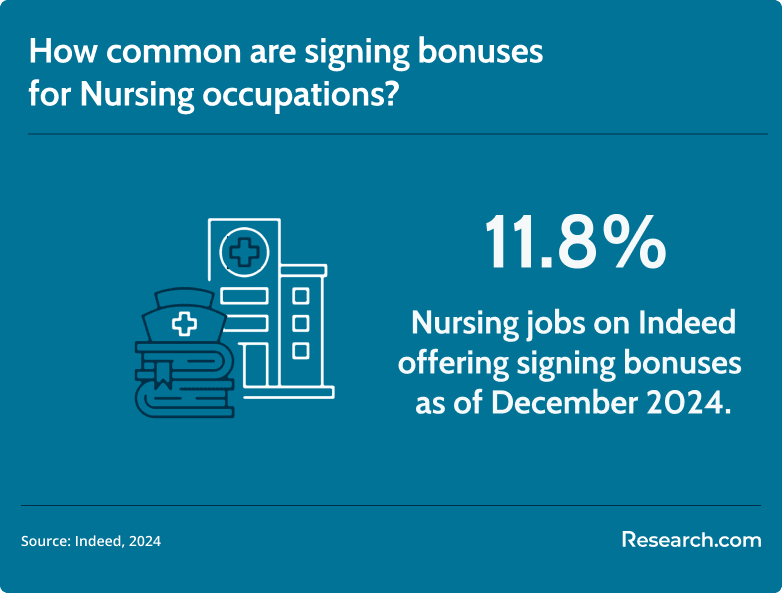
Competition for qualified nurses has pushed many home health agencies to use bonuses as a central part of recruitment. In December 2024, 3.7% of U.S. job postings on Indeed mentioned a signing bonus, with healthcare among the heaviest users (Hiring Lab, 2025). These incentives are structured to encourage both immediate hiring and longer-term retention.
The most common types of bonus programs include:
- Signing bonuses: More than half of home health agencies reported offering them, and the average RN sign-on bonus was $7,474 across 1,079 agencies, a broad but variable adoption tied to local labor markets.
- Retention bonuses: State-administered programs illustrate common designs. For example, Massachusetts extended a quarterly retention bonus for continuous skilled nursing in home health through June 2024, paying $1,200 at 260 hours, $2,000 at 360 hours, and $3,250 at 480 hours worked in a quarter.
- Prevalence context: Healthcare remains one of the sectors most likely to advertise signing bonuses, even as overall usage has cooled from 2022 peaks. Employers use these one-time payments to compete without permanently raising base rates.
Bonus programs operate as deliberate workforce strategies. For candidates, the key is to read the terms. Confirm payout timing and any hourly or service-hour thresholds, as well as repayment conditions if you intend to leave before the commitment ends.
For nursing students planning their education with future earnings in mind, exploring the best minors for nursing majors can also strengthen one’s resume and long-term career flexibility. Fields like public health, psychology, business administration, and gerontology often complement clinical training and may better position graduates for competitive roles that include signing and retention bonuses.
Which states offer the best cost of living adjusted pay for a home health nurse?
Hourly wages provide a starting point, but how far that income goes depends on local housing, daily expenses, and state tax rules. A home health nurse averaging $77/hour in California may not retain the same value as a nurse earning less in a lower-cost state.
Looking at adjusted pay helps reveal where do the happiest nurses live, since financial security and affordability often shape overall job satisfaction.
The following states illustrate where adjusted income compares most favorably:
- Wisconsin: $49/hour. Regional price levels run below national averages, letting steady wages carry further in daily expenses.
- New Mexico: $49/hour. Relatively low costs in housing and utilities strengthen the value of midrange hourly rates.
- Illinois: $48/hour. Chicago pushes wages higher, while lower costs in much of the state enhance real income outside the metro area.
- Minnesota: $65/hour. Strong wages combined with manageable living costs boost adjusted pay compared with many coastal states.
- Delaware: $55/hour. Moderate statewide prices and access to East Coast opportunities make earnings more competitive than raw figures suggest (Vivian Health, 2025).
When evaluating offers, pair the hourly rate with regional price parity and the state’s income tax regime. In many cases, a $40–$50 hourly offer in these states yields more day-to-day value than higher posted wages in expensive, high-tax jurisdictions.
The chart below presents average hourly wages for a home health nurse by state, offering a clear view of how core pay levels compare with cost of living on the state level.
How do hourly, per visit, and per diem salary models compare for home health nurses?
Pay structures in home health nursing are not uniform. Agencies choose models that balance caseload stability, reimbursement patterns, and workforce flexibility. Each system carries distinct advantages and trade-offs for nurses in the field.
Understanding these pay systems also helps clarify what does a home health nurse do, since earnings often connect directly to visits, travel, and shift availability.
Hourly pay
Hourly roles provide predictable income because wages are tied to every hour worked. LeadingAge’s 2024 survey of agencies reported median hourly pay at $43.00 in visiting nurse associations, $41.29 in hospital-based agencies, $38.72 in not-for-profits, and $36.86 in for-profits. The model ensures overtime protections and is favored by larger employers that can guarantee steady caseloads.
Per visit pay
Visit-based compensation ties earnings to completed encounters. An example from MacNeal Home Care in Illinois lists $30 per visit plus mileage reimbursement. While efficiency can raise income, cancellations or long drive times can reduce consistency. Federal rules also require counting compensable travel and calculating overtime on the true regular rate, which adds compliance complexity.
Per diem pay
Per diem arrangements trade guaranteed hours for flexibility. ZipRecruiter data in 2025 reported average annual earnings near $101,700 for per diem for home health RNs, or about $48.90/hour. Pay may spike when coverage is needed, but income depends on shift availability.
Each model sets a different balance: hourly emphasizes stability, per visit links pay to productivity, and per diem offers flexibility with variable scheduling.
The chart below shows the largest occupations in home health care services, showing how roles like registered nurses, aides, and therapists make up the bulk of the workforce.
What states have the lowest tax rates for a home health nurse?
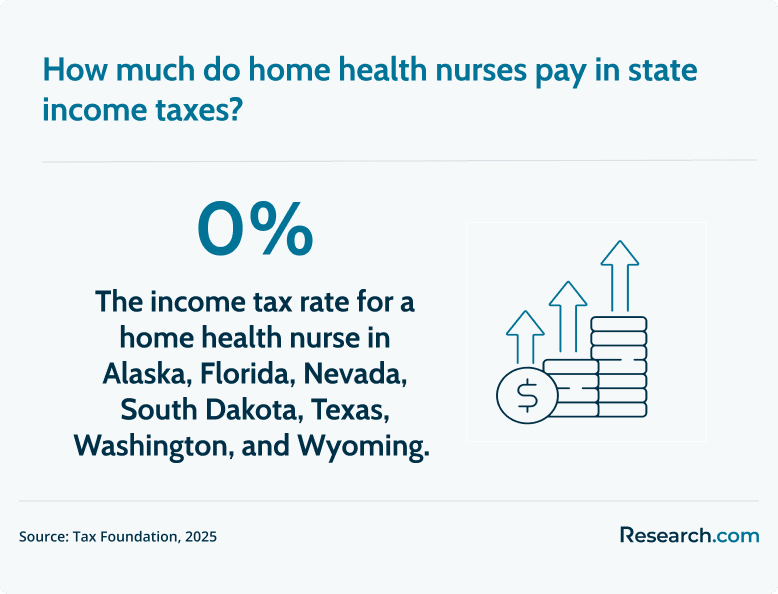
Comparing pay across states requires more than just looking at posted hourly rates. State income tax rules directly affect how much of that wage stays in a nurse’s pocket. The most favorable environments are the states that impose no individual income tax on wages.
The following states do not have state taxes, which means posted wages align much more closely with actual take-home pay.
- Alaska
- Florida
- Nevada
- South Dakota
- Texas
- Washington
- Wyoming
Low-tax environments like these show how states can improve the value of hourly wages by reducing or eliminating deductions, giving home health nurses a clearer advantage in net income. For nurses planning long-term career moves, pursuing additional specialty credentials—such as the RNC nursing certification—can further strengthen earning potential and open the door to high-demand practice areas within these favorable states.
How much does a new home health nurse earn in their first year?
First-year pay closely tracks active staff rates in each market. The national average for a home health nurse is $45.81 per hour, which equals about $95,285 annually (BLS, 2024). This figure reflects current staff postings and provides a realistic baseline for entry into the field.
Geography also sets expectations, as you can see in the current average hourly wages per state below:
- California at $77/hour (about $160,160 annually)
- Oregon at $68/hour (about $141,440 annually)
- Minnesota at $65/hour (about $135,200 annually)
- Delaware at $55/hour (about $114,400 annually)
- Illinois at $48/hour (about $99,840 annually).
New hires typically start near the prevailing local staff rate, with adjustments for schedule, shift differentials, and agency needs.
Early earnings also depend on workload and orientation. Agencies pay for onboarding and required training, and many offer evening or weekend differentials that can lift total income once nurses are independently managing visits. Taken together, first-year compensation is driven primarily by the local hourly average and the mix of assigned shifts, then grows as caseload efficiency improves.
For those entering nursing from another clinical role, completing a surgical tech to RN bridge program can be a strategic way to transition into home health with stronger clinical training and a faster path to higher wages.
How do years of experience impact home health nurse salary growth?
Salary progression in home health nursing reflects how experience deepens both clinical judgment and efficiency with independent patient care. Market data show that earnings steadily rise with tenure, though the size of increases varies by region and employer type.
A national survey of home care agencies in late 2024 reported that registered nurses with less than one year of experience averaged about $74,000 annually, while those with 5–9 years earned closer to $82,000.
Meanwhile, nurses with 10–19 years reported averages above $90,000, and those with 20 or more years exceeded $95,000 (Hospital & Healthcare Compensation Service, 2024). These increments reflect how agencies value retention, advanced skill sets, and the ability to manage complex caseloads without direct supervision.
Experience also positions nurses for premium pay through charge roles, mentorship responsibilities, or specialized assignments such as palliative care. Many agencies tie structured raises to service milestones, ensuring predictable growth even outside of promotions. Over time, the combination of hourly wage increases and supplemental responsibilities helps experienced home health nurses secure a strong long-term income trajectory.
The following chart illustrates the types of bonuses given to nonproduction employees and how they are distributed among private and public sectors.
What advanced degrees can influence a home health nurse salary?
Advanced education expands role scope and access to higher-level positions in home health. Federal and professional sources note that graduate preparation is associated with advanced practice and leadership opportunities that typically command stronger compensation.
Entry-level pathways such as the best online CNA to RN programs can also serve as stepping stones toward these advanced degrees.
The degrees below most directly impact earning potential:
- Bachelor of Science in Nursing (BSN): Preferred or required by many employers for hiring and advancement; expands eligibility for charge, supervisory, and care coordination roles.
- Master of Science in Nursing (MSN): Qualifies nurses for advanced clinical tracks such as nurse practitioner or clinical nurse specialist, as well as education roles within home health programs.
- Doctor of Nursing Practice (DNP): Prepares clinicians for systems-level practice, quality improvement leadership, and senior clinical roles that guide agency standards and outcomes.
- Master of Health Administration (MHA) or MSN/MBA: Builds management and operations expertise for roles such as clinical manager, program director, or service line leader in home health organizations.
Selecting among these pathways should align with career goals. Clinical advancement favors MSN and DNP preparation, while management trajectories benefit from BSN-plus leadership experience and graduate training in administration.
Which certifications most reliably increase home health nurse pay?
Professional certifications signal advanced skill and commitment, which many home health agencies reward with higher compensation or access to specialized assignments. They also strengthen credibility with patients and payers, which directly supports long-term earnings.
The following certifications are recognized across the field:
- Certified Hospice and Palliative Nurse (CHPN): Awarded by the Hospice and Palliative Credentialing Center, this certification validates expertise in end-of-life and symptom management, a specialty central to home health practice.
- Certified Wound Care Nurse (CWCN): Issued by the Wound, Ostomy and Continence Nursing Certification Board, this credential demonstrates advanced knowledge in wound and ostomy care, an area where home health nurses often provide intensive support.
- Certified Case Manager (CCM): Granted by the Commission for Case Manager Certification, this certification highlights competence in coordinating complex care, which is valuable in home health agencies that rely on efficient patient transitions and outcomes.
- Certified Diabetes Care and Education Specialist (CDCES): Provided by the Certification Board for Diabetes Care and Education, this credential equips nurses to manage chronic conditions that affect many patients in community settings.
Certifications matter because they expand scope, improve reimbursement eligibility, and prepare nurses for leadership or specialty roles. They provide a measurable way for nurses to differentiate themselves and secure stronger pay within home health.
What leadership opportunities improve pay for a home health nurse?
Leadership roles in home health are linked to stronger compensation because they combine clinical expertise with management responsibilities. Nurses who advance into these positions oversee teams, guide quality initiatives, and often interact with payers, making their work central to agency performance.
For many entering leadership after bridge or entry programs such as the most affordable online certified nursing assistant programs, these opportunities mark the next stage of professional and financial growth.
The most common opportunities include:
- Clinical Supervisor ($79,349): Provides oversight for new nurses, ensures compliance with state regulations, and maintains quality standards. Supervisory responsibility is typically accompanied by higher pay.
- Case Management Leader ($123,611): Directs the coordination of patient care across providers and services. Managing efficiency and outcomes can increase both salary and professional visibility.
- Director of Nursing (DON) ($108,675): Oversees the clinical operations of a home health agency, including staffing, training, and regulatory compliance. This senior role commands some of the strongest pay in the sector.
- Executive or Administrative Roles (Approximately $86,704) : Positions such as program coordinator or regional manager involve budget oversight, staffing, and strategy. Nurses in these roles often move well beyond standard wage scales.
- Quality Improvement Manager ($90,275): Focuses on patient safety, outcome tracking, and compliance with federal standards, supporting both higher earnings and career advancement potential.
Leadership paths demonstrate how nurses can increase earnings by pairing clinical skill with administrative and supervisory responsibilities, offering a clear trajectory for long-term growth.
Key Findings
- California reports the highest earnings for a home health nurse, averaging about $160,000 annually, shaped primarily by a large healthcare market and high service demand.
- Bay Area cities like Cupertino, Berkeley, and Redwood City offer salaries above $124,000 annually, with hourly rates near $60, driven by metropolitan demand and high living costs.
- More than half of home health agencies offer signing bonuses, averaging $7,474, while retention programs like Massachusetts’ quarterly payouts can reach $3,250 for sustained service.
- Wisconsin and New Mexico both average $49/hour, and with relatively low housing costs, nurses in these states often see stronger purchasing power than in higher-wage coastal markets.
- Home health nurses in Alaska, Florida, Nevada, South Dakota, Texas, Washington, and Wyoming keep more of their pay since these states impose no individual income tax on wages.
How can home health nurses effectively negotiate their salaries?
Home health nurses can enhance their overall compensation through effective negotiation strategies. A well-prepared approach begins with researching local pay benchmarks and gathering data on comparable roles to build a strong case for a higher salary. Documenting achievements, such as driving improved patient outcomes or managing complex care schedules, can further reinforce their market value during discussions. Highlighting advanced credentials, including certifications and credentials from programs like easy RN to BSN online degrees, can provide additional leverage for securing better pay and benefits. Tailoring the negotiation to emphasize clear, measurable contributions helps ensure that offers reflect both expertise and an understanding of regional market demands.
References:
- Bureau of Economic Analysis. (2024, December 12). Regional Price Parities By State And Metro Area. https://www.bea.gov/data/prices-inflation/regional-price-parities-state-and-metro-area
- Bureau of Labor Statistics. (2024, September 19). What types of nonproduction bonuses are available to workers? https://www.bls.gov/ebs/factsheets/nonproduction-bonuses.htm
- Bureau of Labor Statistics. (2025). Data Tables for OEWS Industry Charts, May 2024. Occupational Employment and Wage Statistics. https://www.bls.gov/oes/2024/may/ind_emp_chart/ind_emp_chart_data.htm
- Glassdoor. (2025). Home Health RN Salaries. https://www.glassdoor.com/Salaries/home-health-rn-salary-SRCH_KO0%2C14.htm
- Hospital & Healthcare Compensation Service. (2024, November). 2024 Home Care press release. https://hhcsinc.com/wp-content/uploads/2024/11/2024-Home-Care-Press-Release.pdf
- Indeed Hiring Lab. (2025, January 28). January 2025 US labor market update: Signing bonus usage has fallen but remains high. https://www.hiringlab.org/2025/01/28/january-labor-market-update-signing-bonus/
- MassHealth. (2024, February). Home Health Agency Bulletin 91: Amended retention bonuses for nurses providing continuous skilled nursing services. https://www.mass.gov/doc/home-health-agency-bulletin-91-amended-home-health-agency-retention-bonuses-for-nurses-providing-continuous-skilled-nursing-services-0/download
- Tax Foundation. (2025, February 18). State Individual Income Tax Rates And Brackets, 2025. https://taxfoundation.org/data/all/state/state-income-tax-rates/
- Vivian Health. (2025, September 6). Home Health Nurse Salary Guide. https://www.vivian.com/nursing/home-health-nurse/salary/
- ZipRecruiter. (2025). Home Health Registered Nurse Salary. https://www.ziprecruiter.com/Salaries/Home-Health-Registered-Nurse-Salary
Other Things You Should Know About Home Health Nurse Salaries
Yes, geographic location greatly affects job opportunities for home health nurses in 2027. Urban areas typically offer more positions due to higher demand, while rural settings may provide fewer options but sometimes offer higher salaries to attract qualified professionals.
Multistate licensure through the Nurse Licensure Compact (NLC) makes it easier for home health nurses to cross state lines for work. A single multistate license allows practice in all participating states without the expense and delay of securing additional licenses.
This flexibility expands access to labor markets where wages and demand are stronger. For example, a nurse licensed in North Carolina can also accept assignments in Texas or Arizona, two compact states experiencing growth in home health services. While compact participation does not raise wages on its own, it increases the ability to pursue higher-paying opportunities where they exist.
In 2027, home health nurse salaries vary significantly by state. For example, California offers some of the highest salaries, averaging around $98,000 annually, while states like Mississippi and Arkansas have lower averages, closer to $70,000. This disparity highlights the need for nurses to consider geographic location when evaluating potential earnings.


