
2027 Most Affordable Online MLIS - Master’s Degrees in Library Science

Co-Founder and Chief Data Scientist
Despite the growing importance of library science, aspiring individuals face challenges in finding affordable online master’s programs. In 2025, the American Library Association found that libraries are hustling to adapt to the changes introduced by technology and innovation. From the rise of virtual resources to the accessibility of digital shelves, my 10+ years of experience as a career planning expert led me to foresee the increasing relevance of a degree in library science. The demand for skilled librarians is increasing, but the cost of education remains a significant barrier for many.
As such, I have conducted extensive research to provide comprehensive and credible information on the costs, return on investment, and other relevant information that aspiring individuals may want to know before getting an online master’s degree in library science.
What are the benefits of getting an affordable online library science degree?
- Graduates with an online library science degree can explore a range of employment settings, including libraries, government, research institutions, and corporate environments, expanding their career options beyond traditional library roles.
- Pursuing an online library science degree offers the flexibility of asynchronous coursework, accommodating the schedules of working professionals while enabling professional growth.
- Librarians and media collections specialists with an MLIS degree can enjoy a median annual salary of $64,320, with opportunities to earn up to $100,880 in specific industries.
What can I expect from an affordable online library science degree?
An online master’s degree in library and information science (MLIS) provides a comprehensive curriculum covering information organization, collection development, and information technology. Core courses often include cataloging, reference services, and library management. The average tuition for these programs ranges from $5,000 to $25,000, with variations based on the institution’s reputation, program features, and student location. Program length typically spans 1.5 to 2 years for full-time students, but part-time options can extend the duration. The flexible format of online MLIS programs accommodates working professionals, offering asynchronous coursework and virtual engagement with faculty and peers.
Where can I work with an affordable online library science degree?
During my research, I found that while graduates of a library degree online are likely to work in libraries, they can also find positions in different settings like government, research, and corporate settings. An online master’s degree in library science ensures that students can not only manage libraries but also organize and utilize massive databases of information. As a result, the BLS indicates that the highest levels of employment for MLIS graduates are within elementary and secondary schools, local government offices, colleges and universities, and web search portals and library information services. Graduates can qualify for educational, administrative, management, and even healthcare occupations.
How much can I make with an affordable online library science degree?
The BLS estimates that the annual median salary for librarians and media collections specialists is $64,320, with the potential to earn as much as $100,880 in select industries. Ultimately, wages can differ depending on the nature of the occupation and setting, as well as the location. Librarians in D.C., Washington, and California, for instance, earn more than any other state. Additionally, top-paying industries include:
- Federal Executive Branch ($102,320)
- Scientific Research and Development Services ($93,100)
- Legal Services ($90,840)
- Management of Companies and Enterprises ($84,400)
- Grantmaking and Giving Services ($81,260)
- 2027 List of affordable online master’s degrees in library science List of Programs
- How long does it take to complete an online library science degree? Program Duration
- How does an online library science program compare to an on-campus program? Online vs Campus
- What is the average cost of an online library science program? Program Cost
- What are the financial aid options for students enrolling in online library science programs? Financial Aid
- What are the prerequisites for enrolling in online library science programs? Admission Requirements
- What courses are typically in an online library science program? Curriculum
- What technology skills are essential for online MLIS students? What technology skills are essential for online MLIS students?
- What types of specializations are available in online library science programs? What types of specializations are available in online library science programs?
- What does accreditation mean for online library science programs and why it matters? What does accreditation mean for online library science programs and why it matters?
- Can an affordable online library science degree unlock interdisciplinary career opportunities? Can an affordable online library science degree unlock interdisciplinary career opportunities?
- How to choose the best online library science program? How to choose the best online library science program?
- What career paths are available for graduates of online library science programs? What career paths are available for graduates of online library science programs?
- What is the job market for graduates with an online library science degree? What is the job market for graduates with an online library science degree?
- What are the emerging trends in library science education? What are the emerging trends in library science education?
- How can online MLIS programs boost your professional networking and mentorship? How can online MLIS programs boost your professional networking and mentorship?
- How can I maximize the return on investment with an online MLIS degree? How can I maximize the return on investment with an online MLIS degree?
- How are hands-on practical experiences integrated into online MLIS programs? How are hands-on practical experiences integrated into online MLIS programs?
- How can I balance work, study, and personal life while pursuing an online MLIS degree? How can I balance work, study, and personal life while pursuing an online MLIS degree?
- How do online MLIS programs provide comprehensive academic support? How do online MLIS programs provide comprehensive academic support?
2027 Guide to Affordable Online Master’s Degrees in Library Science
An online master’s degree in library science can be a practical route into librarianship, school media, archives, digital collections, and information management, but the right program depends on more than the lowest tuition. Students also need to compare accreditation, state licensure alignment, field experience, technology training, course format, and whether the degree supports their intended career setting.
This guide is designed for prospective graduate students who want an affordable online library science program without choosing blindly. It explains how the listed programs compare, what online MLIS and school library media programs usually require, how long they take, what they may cost, what careers they can support, and what questions to ask before enrolling.
Quick answer: What is an affordable online master’s in library science?
An affordable online master’s in library science is a graduate program delivered primarily online that prepares students for work in libraries, archives, school media centers, digital information services, or related information roles at a lower total cost than many traditional graduate options. The programs in this guide include tuition figures such as $299.73 per credit hour, $348.78 per credit hour, $399.50 per credit hour, and $480 per credit hour, as well as semester-based tuition models. The best choice is not always the cheapest option; students should first confirm accreditation, career fit, licensure requirements, credit requirements, and fieldwork expectations.
How we evaluate affordable online library science programs
Graduate school is a major financial decision, so affordability rankings should be transparent and grounded in reliable education data. Research.com uses established sources such as the IPEDS database, Peterson’s database, the College Scorecard database, and the National Center for Education Statistics to review institutional and program information. The goal is to help readers identify affordable online master’s degrees in library science while still considering academic quality, accreditation, program structure, and student outcomes. For more detail on how Research.com builds rankings, see our methodology page.
Affordable online library science programs at a glance
| School | Program focus | Published cost | Credits | Accreditation listed |
| Northeastern State University | PK-12 school librarianship, library media, information technology | $6,564 per semester for residents; $12,936 per semester for non-residents | 33 credit hours for the MS track; 23 credit hours for the certification track | CAEP, AASL |
| University of Central Missouri | MLIS, school librarian concentration, initial teacher certification option | $399.50 per credit hour in-state; $600.00 per credit hour out-of-state | 36 | CAEP, AASL, ALA |
| Fort Hays State University | Library media specialist preparation and endorsement coursework | $348.78 per credit hour | 36 credits for degree seekers; 18 credits for current teacher license holders | CAEP |
| North Carolina Central University | Academic, archives, digital, law, public, school, and special librarianship | $299.73 per credit hour in-state; $1,038.07 per credit hour out-of-state | 36 | ALA |
| Marshall University | School library media | $521.75 per credit hour | 33 | CAEP, AASL |
| Georgia College & State University | MEd in Library Media and instructional technology certification option | $697.50 per credit hour | 36 | CAEP |
| University of Central Arkansas | Library media and information technologies | $519.41 per credit hour | 30 | CAEP, AASL |
| University of Alabama | MLIS with archival studies and school library media options | $480 per credit hour | 36 | ALA |
| Jacksonville State University | Library media P-12 master’s and Ed.S. options | $410 per credit hour | 36-40 | CAEP |
| Pittsburg State University | Educational technology and library media specialist preparation | $4,756.50 per semester in-state; $10,172.50 per semester out-of-state | 30 | NCATE |
1. Northeastern State University
Northeastern State University offers a Master’s in Library Media and Information Technology Program built for students preparing to serve as PK-12 school librarians. The curriculum connects teaching, learning, information access, resource evaluation, program leadership, and ethical use of information and technology. Students can pursue the Library Media & Information Technology Program MS Degree or the Library Media & Information Technology Program Certification. The MS track requires 33 credit hours, while the certification track requires 23 credit hours. Listed tuition is $6,564 per semester for residents and $12,936 per semester for non-residents. Accreditation listed includes the Council for the Accreditation of Educator Preparation (CAEP) and the American Association of School Librarians (AASL).
2. University of Central Missouri
The University of Central Missouri provides an online master’s degree in library science with several routes for students who want flexibility in career planning. The program includes core coursework aligned with ALA Core Competencies plus 12 elective credits. Students may choose the MLIS track, the School Librarian concentration, or the School Librarian + Initial Teacher Certification track. The teacher certification route includes additional education coursework and a student-teaching internship. The program requires 36 credits and lists tuition at $399.50 per credit hour for in-state students and $600.00 per credit hour for out-of-state students. Accreditation listed includes CAEP, AASL, and the American Library Association (ALA).
3. Fort Hays State University
Fort Hays State University’s online library media specialist program is designed for candidates who want preparation in selection, organization, school library administration, and practical library media experience. Degree-seeking students without a master’s degree complete broader graduate coursework that may include technology integration, educational research, and cultural diversity. The program offers a degree-seeking track and a current teacher license holder track. Degree seekers complete 36 credits, while current teacher license holders complete 18 credits. Tuition is listed at $348.78 per credit hour, and accreditation listed is CAEP.
4. North Carolina Central University
North Carolina Central University offers an ALA-accredited Master of Library Science program for students interested in multiple library and information settings. The program covers library foundations, information services, information systems, and research methods, then lets students build expertise through concentrations. Available areas include Academic Librarian, Archives and Records Manager, Digital Librarian, Law Librarian, Public Librarian, School Media Coordinator, and Special Librarian. The degree requires 36 credits. Tuition is listed at $299.73 per credit hour for in-state students and $1,038.07 per credit hour for out-of-state students.
5. Marshall University
Marshall University’s online school librarian program is focused on school library media and prepares students to manage media centers, support information literacy, promote resources for children and adolescents, and integrate technology into learning environments. The curriculum aligns with AASL’s common beliefs and is designed for students who want to work in school library settings. The program requires 33 credits, lists tuition at $521.75 per credit hour, and includes CAEP and AASL accreditation.
6. Georgia College & State University
Georgia College & State University offers an online Master of Education in Library Media that connects library media preparation with school improvement. The program can serve educators from different instructional backgrounds and includes coursework related to library media, educational technology, and school-level improvement challenges. Students may pursue the Degree Program track or the Non-Degree Instructional Technology Certification track. The degree requires 36 credits, lists tuition at $697.50 per credit hour, and includes CAEP accreditation.
7. University of Central Arkansas
The University of Central Arkansas offers a Master of Education in Library Media and Information Technologies aligned with AASL’s Empowering Learners framework and core standards. Coursework includes research methods, copyright, global information services, collection development, teaching and learning in school libraries, literature issues, and library management. The program emphasizes practical assessments in areas such as instructional design, technical services, and information program planning. The concentration is Library Media and Information Technologies. Listed tuition is $519.41 per credit hour, the program requires 30 credits, and accreditation listed includes CAEP and AASL.
8. University of Alabama
The University of Alabama offers an online MLIS designed for students seeking leadership roles in library and information services. The program emphasizes socially responsible information use across personal, educational, and organizational contexts. Students learn in a cohort model with synchronous online classes one night per week. Core study areas include Information and Media, Information in Communities, and Professional Paths. Concentrations listed include Archival Studies and School Library Media. The program requires 36 credits, lists tuition at $480 per credit hour, and is ALA accredited.
9. Jacksonville State University
Jacksonville State University offers online graduate study in library media through master’s and Ed.S. pathways. The program prepares service-oriented library media specialists with training in technology, instructional design, collaboration, research in education, diversity issues, learning psychology, digital literacy, and school-based technology use. Graduates are eligible for master’s-level professional educator certification in Library Media P-12. Tracks include the Master’s track and the Ed.S. track. Tuition is listed at $410 per credit hour, required credits range from 36-40, and accreditation listed is CAEP.
10. Pittsburg State University
Pittsburg State University offers an online graduate program in educational technology and library media for students preparing to manage learning resource centers in elementary, middle, and secondary schools. Students can focus on Technology Integration Specialists or Library Media Specialists. Completing the library media emphasis can support eligibility for licensure as a Kansas school library media specialist. Coursework includes topics such as Organizing & Developing School Library Collections and Advanced Children’s and Adolescent Literature. Tuition is listed at $4,756.50 per semester for in-state students and $10,172.50 per semester for out-of-state students. The program requires 30 credits and lists National Council for Accreditation of Teacher Education (NCATE) accreditation.
What online library science graduates often value most
- : "The online format gave me the flexibility to keep working and meet family responsibilities while completing my coursework. Being able to attend class, review materials, and interact with classmates from home made the degree possible for me. — Beatrice"
- : "My online master’s experience helped me connect classroom ideas with my work in a local library almost immediately. The discussions exposed me to different viewpoints, and the schedule made it easier to keep learning while staying active professionally. — Jade"
- : "The program strengthened both my library knowledge and my confidence with technology. Online collaboration, digital tools, and networking opportunities helped me see how modern library work blends service, information access, and technical skill. — Mary"
Key findings before choosing an affordable online library science program
- The lowest tuition is only one part of affordability. Total credits, student fees, books, residency rules, fieldwork travel, and licensure costs can change the real price.
- ALA accreditation is especially important for many librarian roles, while CAEP, AASL, and state education approval matter for school library media pathways.
- Students seeking K-12 school librarian roles should verify teacher certification and state licensure requirements before enrolling.
- Online programs can be a strong fit for working adults, but synchronous class meetings, practicum requirements, and group projects may still require fixed weekly availability.
- Technology training now matters. Digital collections, metadata, databases, accessibility, user experience, and information systems are increasingly central to library work.
How long does an online master’s degree in library science take?
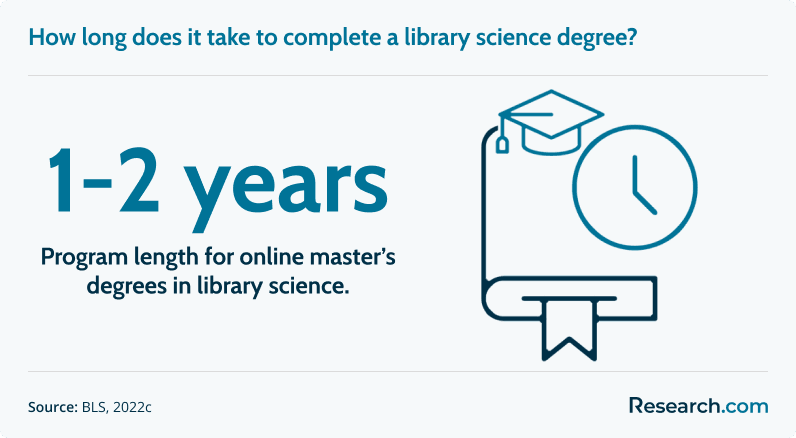
The BLS estimates that a master’s degree in library science can take 1 to 2 years to complete. Program length depends on enrollment status, total credits, whether the student pursues certification, and whether field experience is required. Some online master’s degree in library science options can be completed in 12 months at most, while part-time study offers more flexibility but extends the timeline. Some online master’s in library science programs include additional certification requirements that push the program beyond 36 credits. Accelerated programs and non-degree certification routes can shorten the path for students who already meet certain requirements.
| Enrollment path | Best for | Typical trade-off |
| Full-time online master’s | Students who can prioritize school and want to finish faster | Heavier weekly workload and less schedule flexibility |
| Part-time online master’s | Working adults, caregivers, and students paying as they go | Longer time to graduation |
| Certification-only route | Licensed teachers or professionals who already hold qualifying credentials | May not lead to a full master’s degree |
| Accelerated online route | Students with strong time management and clear career goals | Compressed courses can be demanding |
Online vs. on-campus library science programs: Which format is better?
Online and campus-based library science programs can lead to similar academic goals, but they fit different students. Online study is usually better for learners who need location flexibility, want to keep working, or cannot relocate. Campus-based study may be better for students who value in-person relationships, direct access to physical collections, and a more structured weekly routine. Students comparing formats should also review whether a broader library science degree guide better matches their starting point.
| Factor | Online master’s in library science | On-campus master’s in library science |
| Schedule | Often more flexible, especially with asynchronous courses | Usually follows fixed class times and campus attendance |
| Networking | Relies on virtual cohorts, online events, discussion boards, and remote mentorship | Provides more face-to-face interaction with classmates, faculty, and local library partners |
| Technology exposure | Often integrates digital platforms, online collaboration, and remote information systems | May offer more direct experience with physical collections, archives, and campus facilities |
| Access | Useful for students who cannot relocate or commute | Best for students near a strong program or specialized library resources |
| Fieldwork | May require local placements, virtual projects, or approved practicum sites | May use campus library systems and nearby partner institutions |
What does an affordable online library science program cost?
For 2023-2024, NCES estimates the average cost for graduate-level education at public institutions at $11,554, while private institutions average $20,015. Online library science master’s programs may reduce some campus-related expenses, though students should still account for technology fees, books, software, background checks, field placement costs, and graduation fees. The programs listed above include tuition figures that range from $300 to $500 per credit hour, which equates to $10,000 to $18,000 for 36-credit programs.
The chart below shows average tuition costs for graduate students at public and private universities.
Cost factors students often overlook
- Per-credit pricing versus semester pricing: A lower semester price may not be cheaper if the program takes more terms, while a per-credit program depends heavily on total required credits.
- Residency rules: In-state and out-of-state rates can differ sharply, as shown by several programs in this guide.
- Certification add-ons: Teacher certification, school media licensure, or endorsement pathways may add courses, exams, internships, and fees.
- Field experience expenses: Practicum placements may require travel, background checks, immunizations, or time away from work.
- Technology costs: Online students may need a reliable computer, webcam, software access, and high-speed internet.
Financial aid options for online library science students
Students in online library science programs may be able to reduce out-of-pocket costs through federal aid, scholarships, grants, employer benefits, and professional association funding. Aid availability depends on the institution, enrollment status, accreditation, financial need, and program eligibility.
- Federal aid: Students can complete the FAFSA to be considered for eligible federal aid programs, including Direct Loans, Federal Work-Study, and other aid options where applicable.
- Scholarships: Universities, foundations, and library organizations may offer awards for students entering librarianship, school media, archives, or information science.
- Grants: Grants may come from federal, state, institutional, or private sources and generally do not require repayment.
- Employer assistance: Libraries, school districts, universities, government agencies, and private employers may provide tuition reimbursement or professional development funding.
- Professional associations: Library organizations can be valuable funding sources. The ALA maintains a financial assistance resource for students interested in library and information science education.
- Institutional aid: Graduate departments may offer scholarships, assistantships, grants, or work-study opportunities for eligible students.
Admission requirements for affordable online library science programs
Most online master’s in library science programs require a bachelor’s degree from an accredited institution. Some programs accept applicants from any undergraduate major, while school library media programs may prefer or require teaching experience, educator licensure, or eligibility for teacher certification. Requirements vary, so applicants should review each program’s admission page carefully.
- Minimum GPA: Many programs require a GPA in the 2.5 to 3.0 range on a 4.0 scale.
- Recommendation letters: Programs may request academic or professional references who can speak to the applicant’s readiness for graduate work.
- Statement of purpose: Applicants often explain why they want to study library science, what career path they plan to pursue, and why the program is a good fit.
- Resume or CV: Schools commonly ask for a current record of work history, volunteer experience, teaching experience, library work, or related skills.
- Standardized test scores: Some programs no longer require tests such as the GRE, while others may still review scores as part of the application.
- Interview: Certain programs may use an interview to evaluate professional goals, communication skills, and fit for the program.
Common courses in an online master’s in library science program
Online library science master’s programs usually combine theory, information organization, service skills, management, and technology. Coursework may prepare students for public libraries, academic libraries, school libraries, archives, digital collections, special libraries, and related library science career paths. Electives and concentrations help students tailor the degree to a specific setting.
- Foundations of Library and Information Science: Introduces the history, values, ethics, and professional responsibilities of library and information work.
- Cataloging and Classification: Teaches how materials are described, organized, and made findable through classification and cataloging systems.
- Information Retrieval and Reference Services: Builds skills for helping users define questions, locate credible sources, and evaluate information.
- Collection Development: Covers selecting, maintaining, assessing, and weeding library collections for specific communities.
- Information Technology in Libraries: Examines systems, digital tools, and technology trends used in library services.
- Management of Libraries and Information Centers: Explores budgeting, staffing, policy, leadership, and operations in library environments.
- Digital Libraries: Focuses on building, preserving, organizing, and providing access to digital collections.
- Archives and Records Management: Introduces archival practice, preservation, appraisal, records systems, and historical documentation.
- School Librarianship: Applies library science to K-12 settings, curriculum support, student learning, and information literacy.
- Research Methods in Library Science: Prepares students to conduct, interpret, and apply research in information settings.
- Internship or Capstone Project: Provides applied experience through fieldwork, a portfolio, a research project, or a professional problem-solving assignment.
Technology skills online MLIS students should build
Modern library work increasingly depends on digital systems, searchable collections, accessibility tools, and data-informed services. Online MLIS students should use their coursework, projects, and internships to build technical confidence, especially if they want to work in digital librarianship, archives, academic libraries, or library technology roles.
| Technology skill | Why it matters in library science |
| Metadata and digital cataloging | Standards such as MARC, Dublin Core, and XML help professionals describe, organize, and retrieve materials across physical and digital collections. |
| Database searching and information retrieval | Librarians help users navigate databases, indexes, archives, and discovery systems efficiently. |
| Library management systems | Tools such as Koha, Alma, and Sierra support circulation, acquisitions, cataloging, and resource tracking. |
| Digital preservation | Archives, museums, and special collections need professionals who understand file formats, preservation workflows, and long-term access. |
| User experience design | UX knowledge helps improve library websites, catalogs, research guides, and online service interfaces. |
| Basic coding and web skills | HTML, CSS, or Python can support digital exhibits, data cleanup, web customization, and automation tasks. |
Specializations available in online library science programs
Library science programs can prepare students for many environments, including schools, universities, archives, law libraries, public libraries, healthcare organizations, and corporate information centers. Students interested in education-focused roles may also compare library media pathways with online teaching programs, especially when state educator licensure is involved.
- Archives and Preservation: Focuses on long-term stewardship of archival materials, historical records, manuscripts, and special collections.
- Digital Librarianship: Prepares students to manage, curate, preserve, and deliver access to digital resources.
- Youth Services or School Librarianship: Centers on children, adolescents, information literacy, curriculum support, and reading engagement.
- Health Informatics: Applies information organization and retrieval to medical libraries and healthcare information settings.
- Information Management: Emphasizes organizing, governing, retrieving, and using information within organizations.
- Knowledge Management: Focuses on capturing, structuring, sharing, and applying organizational knowledge.
- Law Librarianship: Develops legal research, legal information retrieval, and law library service skills.
- Public Librarianship: Prepares graduates to serve communities through programming, outreach, collections, and public service leadership.
- Academic Librarianship: Supports student learning, faculty research, scholarly communication, and higher education collections.
- Special Libraries: Applies library and information skills in corporate, government, medical, nonprofit, or technical settings.
Why accreditation matters for online library science degrees
Accreditation helps students verify that a school or program meets recognized standards for curriculum, faculty qualifications, student support, assessment, and institutional quality. Choosing from accredited online colleges and universities can also affect financial aid eligibility, transfer options, employer recognition, and future graduate study.
In library science, ALA accreditation is especially important for many professional librarian roles. School library media programs may also rely on CAEP, AASL, state education agency approval, or related educator preparation standards. Students should not assume that every online library science degree leads to the same professional outcome. A program may be academically legitimate but still not meet a specific state’s school librarian licensure requirements.
Accreditation and licensure checklist
- Confirm whether the institution is accredited by a recognized institutional accreditor.
- Check whether the library science program is ALA accredited if your target jobs prefer or require it.
- For school librarian roles, ask whether the program meets your state’s educator licensure or endorsement requirements.
- Verify whether fieldwork, student teaching, or a practicum must be completed in your state.
- Ask whether graduates from your state have successfully obtained the credential you want.
Can an online library science degree support interdisciplinary careers?
Yes. A library science degree can support careers beyond traditional librarianship because students build skills in research, information organization, digital resources, metadata, user support, training, and communication. These abilities can apply to education technology, corporate knowledge management, research support, archives, content strategy, healthcare information, and government records work.
Students comparing service-oriented careers may want to look beyond library settings as well. For example, someone weighing library work against family, healthcare, or student-support roles might compare duties and earnings using a guide to child life specialist careers. The important step is to compare required credentials, salary expectations, work settings, and daily responsibilities before choosing a graduate program.
How to choose the best affordable online library science program
The best affordable program is the one that meets your career goal at the lowest realistic total cost, not simply the one with the lowest advertised tuition. Before applying, compare accreditation, curriculum, delivery format, licensure alignment, fieldwork, faculty experience, student support, and graduate outcomes. If you are looking specifically for literacy or reading specialist work rather than library media work, compare the curriculum carefully with an online master’s in reading so you do not choose the wrong credential.
| Question to ask | Why it matters |
| Is the program ALA, CAEP, AASL, NCATE, or otherwise appropriately accredited for my goal? | Accreditation affects employer recognition, aid eligibility, and licensure pathways. |
| Does the program meet school librarian requirements in my state? | School library media roles often involve state-specific educator credentialing rules. |
| What is the total cost after fees, books, fieldwork, and certification expenses? | Tuition alone does not show the full price of attendance. |
| Are classes asynchronous, synchronous, or hybrid? | The format determines whether the program will fit your work and family schedule. |
| Does the curriculum match my target career setting? | Public librarianship, archives, school media, and digital librarianship require different electives and experiences. |
| Is an internship, practicum, student teaching, or capstone required? | Applied requirements can strengthen experience but may affect time and location flexibility. |
| What career support and networking opportunities are available online? | Remote students still need mentoring, job search help, and professional connections. |
Career paths for graduates of affordable online library science programs
Graduates of online library science master’s programs can pursue roles in public libraries, schools, universities, archives, government agencies, museums, law firms, corporations, technology organizations, and nonprofit institutions. Common roles include archivists ($61,570), curators ($61,770), and library technicians ($42,570), along with professional librarian and information-focused positions.
- Public Librarian: Serves community members, develops collections, supports programs, and helps patrons access information.
- Academic Librarian: Works in colleges or universities, supporting research, instruction, scholarly resources, and faculty or student needs.
- School Librarian or Media Specialist: Supports K-12 learning, information literacy, digital citizenship, and school library services.
- Information Architect: Designs structures that make information easier to find, navigate, and use.
- Knowledge Manager: Organizes institutional knowledge so employees can access and apply information effectively.
- Special Librarian: Provides information services in corporate, law, medical, government, or specialized research environments.
- Research Analyst: Collects, evaluates, and interprets information to support decisions.
- UX Librarian: Improves the usability and accessibility of digital library services, catalogs, and research tools.
- Content Curator: Selects, organizes, and manages information resources for digital platforms or organizations.
- Library Technology Specialist: Implements and manages technology systems that support library operations and user access.
The chart below illustrates annual median pay for librarians and related occupations based on BLS estimates.
Job market outlook for online library science graduates
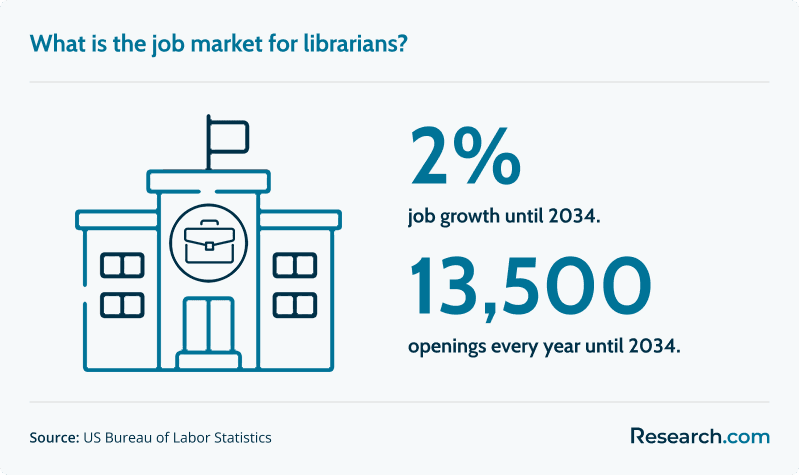
The employment outlook for graduates with an online master’s degree in library science is moderately positive. The cited projection shows 2% growth in job opportunities from 202 to 2034, which aligns with the average across all occupations. About 13,500 openings for librarians and library media specialists are expected each year, partly due to replacement needs as workers retire or move into other occupations.
The ALA also identifies developments that may influence the field, including enhanced library cards, broader digital library access, and virtual worlds in library services. These changes point to continued demand for professionals who combine user service, information access, digital literacy, and technology skills.
Trends shaping library science education
Library science education is adapting as libraries become more digital, community-centered, data-informed, and equity-focused. Students should look for programs that teach both traditional librarianship and modern information practice.
- Digital literacy and data management: Librarians increasingly work with e-resources, online catalogs, digital archives, metadata standards, digital curation, and artificial intelligence applications in information management.
- Information science integration: Many programs include data analytics, research methods, and evidence-based decision-making to help graduates manage large datasets and interpret usage patterns.
- User experience and accessibility: Library websites, databases, and discovery tools must be usable for diverse communities, making UX and accessibility more important.
- Social justice and inclusive access: Programs increasingly address privacy, equitable information access, diverse collections, and community needs.
- Hybrid service models: Libraries now often combine in-person services with virtual reference, digital lending, online programming, and remote research support.
Networking and mentorship in online MLIS programs
Online MLIS programs can still provide meaningful professional connections when they intentionally build networking into the student experience. Strong programs may offer virtual conferences, alumni panels, discussion groups, portfolio reviews, career events, association partnerships, and mentorship with practicing librarians.
Students should also think broadly about career direction. Those comparing education-related roles may find it useful to review career options connected to a teaching degree, especially if they are deciding between classroom teaching, school library media, instructional technology, or education leadership.
How to maximize ROI from an online MLIS degree
Return on investment depends on program cost, debt, completion time, credential value, local job availability, specialization, and career mobility. Students can improve ROI by choosing an accredited program that directly fits their target jobs, applying for aid, using employer reimbursement when available, selecting marketable electives, and gaining experience before graduation.
- Prioritize programs that match your desired work setting, such as public libraries, schools, archives, or digital services.
- Choose electives in areas with broad use, such as metadata, digital preservation, data services, UX, instruction, or management.
- Complete internships, practicums, assistantships, or volunteer projects that produce portfolio evidence.
- Join professional associations and attend virtual events to build contacts before entering the job market.
- Compare local salary expectations against total program cost before borrowing.
- If long-term plans include senior administration or higher education leadership, compare whether an advanced route such as accelerated online EdD programs is relevant later rather than paying for credentials too early.
How online MLIS programs provide hands-on experience
Quality online MLIS programs do not rely only on readings and discussion boards. They often include practical assignments that simulate or connect directly to library work. Students may complete virtual internships, local practicums, digital collection projects, metadata assignments, cataloging labs, community needs assessments, instructional design projects, or capstone portfolios.
Students interested in school library media should also compare library media requirements with related education graduate options, including affordable online master’s degrees in teaching, because teaching credentials and school librarian credentials may follow different rules.
How leadership study can complement an online MLIS degree
Leadership training can help MLIS graduates move from front-line service roles into management, department leadership, school district roles, academic library administration, or information strategy. Useful leadership topics include organizational change, budgeting, personnel supervision, policy development, strategic planning, assessment, and community partnerships.
Library professionals considering senior administrative roles may later compare doctoral-level leadership options, including an online doctorate in organizational leadership. This path is not necessary for most entry-level library roles, but it may be relevant for professionals aiming at high-level administration or cross-sector leadership.
How to balance work, school, and personal responsibilities in an online MLIS program
Online learning offers flexibility, but it also requires planning. Students who work full time or manage family responsibilities should evaluate weekly workload, course pacing, synchronous meeting requirements, and field placement expectations before enrolling.
- Build a realistic weekly schedule: Reserve set blocks for reading, assignments, discussion posts, group work, and live sessions.
- Clarify synchronous requirements: A program with weekly live classes may not fit a changing work schedule.
- Communicate early: Let employers, family members, and instructors know when major deadlines or practicum hours may affect availability.
- Break large projects into milestones: Cataloging assignments, research papers, portfolios, and capstones are easier to manage in stages.
- Use support services: Academic advisors, writing centers, library staff, career counselors, and technical support can help online students stay on track.
- Compare accelerated options carefully: Students seeking a faster route can review affordable accelerated online master’s programs, but speed should not come at the expense of licensure fit or accreditation.
Academic support services to expect in an online MLIS program
Strong online MLIS programs provide more than course access. Students should look for dedicated academic advising, responsive technical help, digital library access, research support, tutoring, career counseling, virtual workshops, internship guidance, and portfolio support. These services are especially important for students returning to school after time away or balancing graduate study with full-time work.
Students planning for long-term education leadership roles may also compare graduate library science pathways with doctoral options such as affordable online doctorates in educational leadership. This comparison is most relevant for professionals who want leadership roles in schools, districts, universities, or educational organizations.
How online MLIS programs address diversity, equity, and inclusion
Library science programs increasingly include diversity, equity, and inclusion because libraries serve communities with different languages, abilities, identities, access needs, and information challenges. Relevant coursework may cover culturally responsive service, inclusive collection development, information access, privacy, accessibility, community engagement, and technology design for diverse users.
Students interested in inclusive education settings may also compare library media preparation with online master’s degrees in special education, especially if they want to support students with varied learning needs through school libraries, assistive technology, accessible materials, or collaborative educational services.
Common mistakes to avoid when choosing an affordable online MLIS program
| Mistake | Better approach |
| Choosing the cheapest tuition without checking accreditation | Confirm institutional accreditation and program-level accreditation or approval relevant to your target job. |
| Assuming all online programs meet school librarian licensure rules | Contact the program and your state education agency before enrolling. |
| Comparing only per-credit tuition | Calculate total cost using credits, fees, books, technology, fieldwork, and certification expenses. |
| Ignoring field experience requirements | Ask where placements occur, whether remote options are allowed, and how many hours are required. |
| Choosing a specialization too late | Review electives before applying so the program supports your intended setting. |
| Assuming salary outcomes are guaranteed | Use labor market data as a reference point, then research your region, employer type, and experience level. |
| Relying only on rankings | Use rankings as a starting point, then compare fit, accreditation, support, cost, and outcomes. |
Key Insights
- An affordable online master’s in library science can be worthwhile when it is accredited, career-aligned, and priced realistically after fees and fieldwork costs.
- ALA accreditation is especially important for many librarian roles, while CAEP, AASL, NCATE, and state approval matter for school library media pathways.
- Program format matters. Online study can help working adults, but synchronous classes, practicums, and certification requirements may still limit flexibility.
- Students should compare total credits, tuition model, residency rates, licensure alignment, and specialization options before applying.
- Technology skills such as metadata, database searching, digital preservation, UX, and library systems experience can improve career readiness.
- The cited job outlook shows 2% growth from 202 to 2034 and about 13,500 annual openings for librarians and library media specialists, so graduates should build practical experience and marketable specializations to compete effectively.
- The best program is not simply the lowest-cost program; it is the one that leads to the credential, skills, and career setting you actually want.
References:
- American Library Association (ALA). (2025). The State of America’s Libraries: A Snapshot of 2024. ALA.
- Bureau of Labor Statistics (BLS). (2025). 25-4031 Library Technicians. BLS.
- Bureau of Labor Statistics (BLS). (2025). 25-9031 Instructional Coordinators. Occupational Outlook Handbook. BLS.
- Bureau of Labor Statistics (BLS). (2025). Archivists, Curators, and Museum Workers. BLS.
- Bureau of Labor Statistics (BLS). (2025). Kindergarten and Elementary School Teachers. BLS.
- Bureau of Labor Statistics (BLS). (2025). Library Technicians and Assistants. BLS.
- Bureau of Labor Statistics (BLS). (2025). Librarians and Library Media Specialists. BLS.
- National Center for Education Statistics (NCES). (2023). Student Charges: What is the average amount of tuition and required fees for full-time graduate students at private postsecondary institutions operating on an academic year calendar system? Trend Generator. NCES.
Other things you should know about affordable online master’s degrees in library science
The minimum GPA requirement for admission to the 2026 affordable online MLIS programs typically ranges from 2.5 to 3.0, depending on the institution. Prospective students should check specific program criteria, as requirements can vary between different universities.
The most affordable online MLIS programs in 2027 often feature lower tuition rates, flexible scheduling, and minimal residency requirements. They frequently offer digital resources instead of physical materials, cutting costs further. Additionally, these programs typically have financial aid options and scholarships specifically for online students.


