
2027 Dental Assisting Associate Degree vs. Certificate: Which Path Should You Pursue

Co-Founder and Chief Data Scientist
Becoming a dental assistant offers a quick path into a career of providing support to dentists. The U.S. Bureau of Labor Statistics (BLS) projects employment of dental assistants to grow 6% from 2024 to 2034, a rate faster than the average for all occupations. This steady growth ensures robust job opportunities, but prospective assistants must first choose between a streamlined dental assisting certificate or a comprehensive dental assisting degree.
In this article, I will explain the core difference between the certificate path and the associate degree path, compare the time typically required for completion, and analyze the potential salary difference between graduates of the two programs. I will also cover key factors like typical admissions criteria, mandatory prerequisites, and financial aid opportunities, helping you determine which path best aligns with your career goals.
Key Things You Should Know About Dental Assisting Programs
- A dental assisting certificate (9-12 months) focuses on clinical skills, while the dental assisting degree (2 years) includes general education for advanced career mobility.
- Of the two, the certificate is the most affordable path, typically costing $2,500–$15,000 in tuition, compared to $10,000–$30,000 for an AAS dental assisting degree.
- The largest driver of salary for dental assistants is certification, with CDAs earning 15% more per hour than non-certified peers.
- What is the core difference between a dental assisting degree program and a dental assisting certificate program? Certificate Vs. Degree
- How does the typical admissions criteria for a dental assisting certificate compare to an associate degree? How does the typical admissions criteria for a dental assisting certificate compare to an associate degree?
- What are the mandatory prerequisites before applying to an entry-level dental assisting certificate program? Prerequisites
- What is the average total cost of a dental assisting certificate versus an associate degree? Average Cost
- How do financial aid opportunities differ among dental assisting certificate programs by duration? Financial Aid
- How much less time is typically required to complete a dental assisting certificate versus an associate degree? Program Length
- What is the difference in day-to-day duties between a dental assistant with an associate degree and one with a certificate? What is the difference in day-to-day duties between a dental assistant with an associate degree and one with a certificate?
- What is the potential salary difference between graduates of a dental assisting degree and certificate programs? Salary
- How are job market projections different between dental assistants with an associate degree and certificate holders? Job Market
- Which path is best for an adult career changer: a dental assisting certificate or an associate degree? Which path is best for an adult career changer: a dental assisting certificate or an associate degree?
What is the core difference between a dental assisting degree program and a dental assisting certificate program?
Certificate programs are designed for speed and direct entry into the workforce, focusing strictly on entry-level clinical and administrative competencies. Meanwhile, an associate degree integrates general education, which offers a more comprehensive foundation for long-term career growth.
The key differences between a certificate and an associate degree in dental assisting are outlined below:
- Curriculum Breadth: Certificate programs focus solely on technical skills, such as chairside assisting and infection control. Associate of Applied Science (AAS) degree programs, however, include 15-30 additional credits in general education subjects like composition and psychology.
- Time to Completion: The certificate typically requires 9-12 months of full-time study for fast entry into the workforce. The AAS degree track takes substantially longer, generally requiring approximately 2 years of full-time enrollment to complete the mandatory general education courses.
- Career Trajectory: A certificate is a fast, direct route to the job market, meeting the educational requirements for the Certified Dental Assistant (CDA) exam by the Dental Assisting National Board (DANB). The AAS degree is viewed as a career ladder, offering a better foundation for advancement.
- Accreditation Structure: Both certificates and degrees should be from programs accredited by the Commission on Dental Accreditation (CODA) to ensure quality and exam eligibility. Degree program credits are generally more easily transferable than non-degree certificate credits.
Ultimately, the choice hinges on personal goals: the certificate is the fastest, most direct route to the chairside, while the dental assisting degree provides greater academic depth and enhanced flexibility for career change or pursuit of higher credentials. This comparison mirrors the difference between certificate and degree, which often determines how much long-term educational mobility a student will have.
How does the typical admissions criteria for a dental assisting certificate compare to an associate degree?
Admissions standards for dental assisting programs differ based on program length. Certificate programs typically have open or simple admissions because they focus on quick career entry. In contrast, associate degree programs often use a competitive or point-based selection process that emphasizes academic readiness and prior coursework.
The following criteria highlight the difference in requirements:
- Prerequisite Coursework: Certificate programs primarily require a high school diploma or General Education Development (GED). Associate degree programs frequently require college-level prerequisites, such as English composition, public speaking, or medical terminology, all passed with a minimum grade of "C" or better.
- Minimum GPA: Certificate programs rarely impose a strict cumulative Grade Point Average (GPA) requirement. Selective degree programs, however, often mandate a minimum high school or college GPA of 2.0 or 2.5 on a 4.0 scale for application.
- Observation Hours: Most certificate programs do not require formal clinical observation before applying. Many competitive associate degree tracks require applicants to document 8-16 hours of observation in a working dental office.
- Health and Background Screening: Both paths require non-academic clearances, but the degree path is more structured. Certificate programs typically mandate a background check and proof of immunizations closer to the program start. Degree programs often require these checks, including a physical exam, as part of the initial application packet.
For those planning to advance their career into dental hygiene, the associate degree's transferable credits can be especially advantageous over a certificate, particularly when researching best online dental assistant to dental hygienist bridge programs.
What are the mandatory prerequisites before applying to an entry-level dental assisting certificate program?
Entry-level certificate programs require applicants to satisfy critical non-academic and health prerequisites to ensure safety in the clinical setting. Since the curriculum moves quickly, all administrative and compliance tasks must be finalized before the program starts.
The most common non-academic and health prerequisites include:
- Up-to-Date Immunization Records: Comprehensive proof of immunity to several infectious diseases is mandatory. The Hepatitis B vaccine series is often critical, as it can take up to six months to complete. Programs require proof via titer if vaccination history is incomplete.
- Current CPR/BLS Certification: Certification in Cardiopulmonary Resuscitation (CPR) at the Basic Life Support (BLS) for Healthcare Providers level is mandatory. Programs generally require a hands-on course, rejecting online-only options for this credential.
- Physical and Emotional Capacity: Candidates must attest that they meet the technical standards for the profession. This confirms their ability to perform tasks like standing for long periods, lifting up to 10 pounds, and possessing the fine motor skills necessary for chairside dental procedures.
- Clearance Checks: Due to the risk inherent in patient care, every applicant must submit to both a criminal background check and a drug screening. Failure to receive a clear report from these screenings typically results in the denial of final program acceptance.
- Foundational Science Competency: While few college-level courses are required, many programs recommend or require applicants to have passed a high school science course, such as biology or chemistry, with a grade of "C" or higher.
These stringent health and safety requirements are universally applied to every candidate, reflecting the regulatory standards set by the Occupational Safety and Health Administration (OSHA) for clinical environments. Comparable technical fields often have similar entry conditions, such as those seen in medical assistant associate degree vs certificate salary programs, where health prerequisites are also essential before clinical placement.
What is the average total cost of a dental assisting certificate versus an associate degree?
The required financial outlay for a dental assisting program varies significantly between the two educational tracks, largely because the associate degree incorporates general education components. The short-term certificate route consistently presents the quickest and most economical path to initial employment.
The typical costs associated with each program type demonstrate this variance:
- Certificate Program Tuition: The instructional fees for a certificate obtained at a public community college typically fall within the $2,500–$12,000 range for residents. Accelerated programs at private vocational schools generally charge between $8,000–$15,000. The reduced curriculum keeps the overall tuition lower since non-dental coursework is excluded.
- Associate Degree Tuition: The overall tuition for an Associate of Applied Science (AAS) degree commonly ranges from $10,000–$30,000. This increased expenditure covers the mandatory inclusion of 15 to 30 extra credits for non-clinical academic subjects, extending the total time and financial commitment.
- Institutional Cost Factor: Tuition and fees at private, for-profit career colleges averaged $16,300 in 2022–2023. Conversely, local community college fees are substantially lower, with in-district rates spanning from $1,440–$8,660 in 2024–2025. In-state students seeking a dental assisting certificate at public institutions benefit from the greatest fiscal efficiency.
- Professional Exam Fees: Both education paths incur necessary expenses for professional credentialing. Fees for the DANB exam are usually around $450. Pursuing specialized certifications can add hundreds more to the final cost.
The certificate option is the most budget-friendly choice for immediate entry. However, the higher cost of the dental assisting degree provides better value through transferable academic units and a more solid foundation for future advancement, comparable to how advanced nursing requires specific credentials like the CPNP-PC certification.
What hidden fees or unexpected costs should you consider?
When budgeting for a dental assisting program, students must look beyond published tuition rates, as several mandatory expenses can significantly inflate the total financial commitment. These additional fees apply to both degree and certificate students, often totaling hundreds or thousands of dollars.
Unexpected financial requirements often include:
- Specialty Equipment and Kits: Students must buy unique items like instrument kits, specialized dental models, lab coats, and multiple sets of scrubs for preclinical and lab work. These supplies are required before starting hands-on instruction.
- Lab and Clinical Fees: Institutions charge dedicated fees to cover consumables used in clinical and laboratory settings, such as sterilization supplies and equipment maintenance.
- Compliance and Screening Costs: Programs require payment for mandated background checks, drug screenings, and student professional liability insurance necessary for clinical site placement.
- Ongoing Certification Costs: After training, students must pay for national certification exams, like those from the Dental Assisting National Board (DANB). They must also budget for the annual renewal fees to maintain their credentials.
Carefully examining the detailed cost sheet provided by the program, rather than just the tuition figure, is essential to calculate the actual total investment accurately. Similarly, when exploring career-related expenses, understanding the total value of professional credentials—such as in AAPC or AHIMA coding certification—helps gauge the real cost of entry into healthcare support fields.
How do financial aid opportunities differ among dental assisting certificate programs by duration?
Students in longer programs (2 years) typically have guaranteed access to federal aid, whereas students in compressed programs (9 months) face stricter eligibility rules tied to the program's clock hours and official recognition.
9-month Programs
Shorter dental assisting programs, including those leading to a diploma or certificate, face federal aid scrutiny based on their length, as they often fall below the traditional minimum academic year threshold.
- Pell Grant Eligibility: Programs shorter than one year must meet strict minimums: 600 clock hours, 16 semester hours, or 24 quarter hours, and must span at least 15 weeks of instruction.
- Loan Access Limitations: Federal Direct Loans are often restricted for preparatory coursework, even in aid-eligible programs. Students in very short certificate programs may have fewer federal loan options compared to degree-seekers and may need to rely on institutional payment plans or private educational loans.
- WIOA/Workforce Grants: These shorter programs frequently qualify for dedicated state or workforce grants, such as the Workforce Innovation and Opportunity Act (WIOA) funds, which are designed to fund technical certificates for quick labor market entry.
2-year Programs
Associate degree programs are considered standard undergraduate courses of study, providing students with the most comprehensive access to federal and institutional financial resources.
- Guaranteed FAFSA Access: Since these programs meet the definition of a traditional undergraduate degree track, students who file the FAFSA and demonstrate need are eligible for the full spectrum of federal aid, including Pell Grants and federal loans.
- Satisfactory Academic Progress (SAP): To maintain federal aid over two years, students must consistently meet SAP requirements, which include keeping a minimum GPA and completing a set percentage of attempted courses each semester.
- State and Institutional Aid: The longer enrollment period makes students automatically eligible for institutional scholarships and state-based grants designed for degree candidates, potentially providing more funding sources than shorter options.
The extended length of the degree program simplifies the financial aid process significantly, offering a more reliable funding package over the course of the enrollment period. For comparison, similar differences exist in other professional fields, such as paralegal certification vs degree, where aid eligibility and program length directly affect how much financial support students can access.
How much less time is typically required to complete a dental assisting certificate versus an associate degree?
A full AAS degree in dental assisting generally requires four to five semesters, spanning roughly 2 years of full-time enrollment. This longer duration is necessary to complete the additional 15 to 30 credits of general education courses, such as college composition and humanities, which supplement the core clinical training.
In contrast, a dental assisting certificate program is intensely focused on vocational skills and is specifically designed for rapid labor market entry. These compressed programs typically require only three to four semesters of study, resulting in a completion time of approximately 9 to 12 months.
Certain accelerated certificate programs can be completed in as few as 9 months, positioning graduates for employment much faster than those in 2-year tracks. Both educational paths include mandatory clinical training hours, but the certificate streamlines the academic load for maximum time efficiency.
The quick completion time and specialized training align well with the goal of quickly finding employment, which is often tied to researching what jobs can you get with a dental assistant certification.
How do clinical externship hours compare between the two programs?
Clinical externship hours show surprising parity between the short and long pathways. This is because accreditation standards, specifically those set by CODA, mandate a minimum number of clinical practice hours, often 300 hours, that all graduates must complete. Whether a student is in a 9-month certificate or a 2-year degree, this core hands-on requirement must be met to ensure eligibility for national certification.
The difference lies in the scheduling.
Degree programs often distribute the clinical hours across four semesters, integrating them with general education coursework. Certificate programs condense the 300+ hours into intensive blocks, typically during the final months of the program, prioritizing immediate patient exposure.
The time it takes to become a certified dental assistant depends on the path you choose. The graph below shows the different possible timelines for this career.
What is the difference in day-to-day duties between a dental assistant with an associate degree and one with a certificate?
The fundamental tasks performed by dental assistants holding either a certificate or an associate degree are largely the same. They prepare the operatory, sterilize instruments, and provide four-handed assistance to the dentist. However, the associate degree often grants a distinct advantage by pre-qualifying graduates for advanced duties and positioning them for administrative or supervisory roles.
The key differences in roles and career path based on credential are:
- Basic Chairside Duties: Both credentials fully prepare graduates for core responsibilities like patient seating, recordkeeping, instruction on oral hygiene, and operating dental radiography equipment. These foundational tasks are dictated by state law, not the level of education.
- Expanded Functions Dental Assistant (EFDA): The associate degree curriculum frequently includes or streamlines the educational requirements for expanded functions, depending on state delegation. Certificate holders usually require separate coursework and experience to reach EFDA status.
- Administrative Leadership: Graduates with an associate degree often possess a competitive edge for moving into non-clinical management roles due to the inclusion of business, communication, and management courses in their curriculum.
- Career Advancement: The associate degree is more often viewed as a steppingstone toward a dental hygienist or dental school application, whereas the certificate is primarily a qualification for immediate entry and specialized certification.
While the short training of a certificate grants fast entry into essential chairside functions, the comprehensive nature of the degree better supports career advancement, especially into leadership or expanded functions roles that may be restricted for diploma holders.
What is the potential salary difference between graduates of a dental assisting degree and certificate programs?
The BLS does not distinguish between dental assisting degree and certificate holders in its median wage reporting. However, the greater potential for increased earnings lies in the specialized roles and upward mobility afforded by the degree's broader foundation.
Key factors that influence salary potential include:
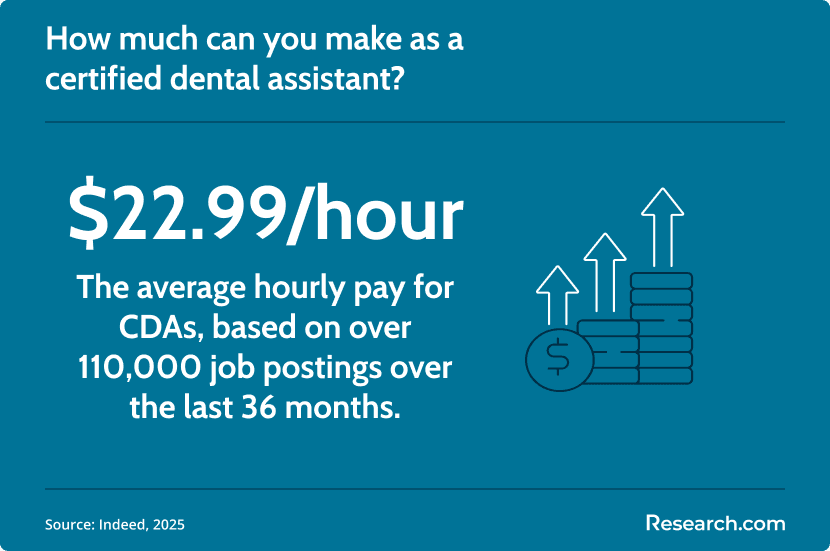
- Certification Premium: Earning the CDA credential, regardless of the path taken, is the largest driver of immediate salary growth. Certified assistants earned a median hourly pay of $26 in 2024, which is 15% more per hour than the $22.50 earned by non-certified assistants.
- Expanded Functions: Graduates who qualify as EFDAs typically see a significant pay boost, averaging $2.67 more per hour than non-EF assistants. The associate degree often streamlines the coursework necessary to achieve this advanced status and its associated higher wage.
- Geographic and Specialty Variance: Location and practice type remain major salary determinants. For example, salaries for EFDAs in oral surgery or orthodontic specialties can range from $55,000–$75,000 annually. Salary figures are highly localized, making resources that track dental assistant salary by state essential for accurate earnings estimates.
- Long-Term Earning Ceiling: While the starting pay is similar, the degree provides a higher long-term ceiling. The transferable credits aid in pursuing higher-paying roles like Dental Hygienist or Dental Office Manager, where the salary can reach $85,000 or more with experience and additional training.
The path to maximizing income focuses less on the credential type and more on achieving advanced certification, specialization, and leveraging the comprehensive training of a degree for leadership roles.
The graph below compares several reported salary data for dental assistants based on multiple sources.
How are job market projections different between dental assistants with an associate degree and certificate holders?
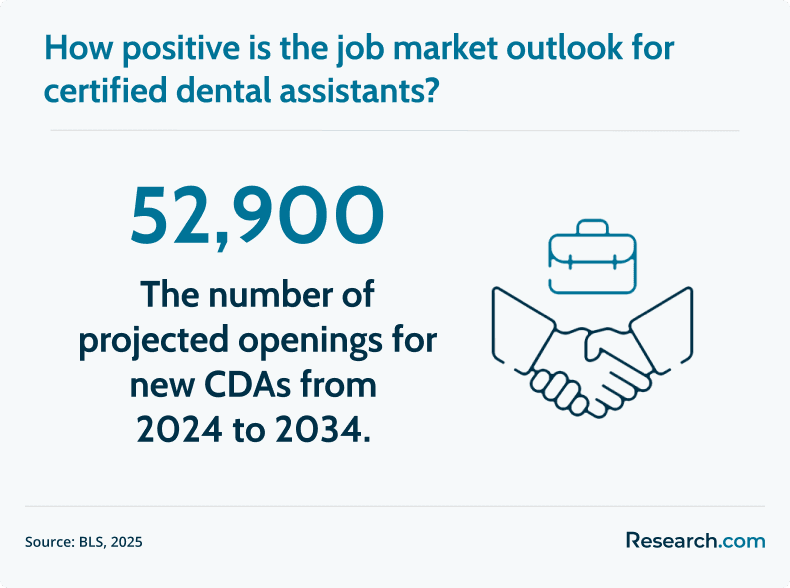
Employment projections for dental assistants indicate high, sustained demand for the next decade, with 52,900 average annual openings projected due to industry growth and workforce replacement (BLS, 2025).
This favorable outlook ensures that graduates from both certificate and associate degree pathways find employment quickly in diverse settings. However, the key difference lies not in the initial hiring rate, but in market value and long-term role stability.
The labor market’s future is increasingly focused on specialized roles. The associate degree provides a distinct job market advantage because the comprehensive training enables graduates to meet the rising demand for EFDAs and professionals capable of administrative leadership.
Many states require more formal education, which the degree provides, to qualify for EFDAs roles that include advanced clinical procedures like applying sealants and restorations.
While the short-term certificate meets the high volume need for entry-level chairside assistants, the degree is the stronger credential for accessing higher-paying roles and advancing toward positions like office manager or dental educator.
In conclusion, the certificate prioritizes speed-to-market, while the degree prioritizes career value, complexity of role, and long-term advancement potential.
Which path is best for an adult career changer: a dental assisting certificate or an associate degree?
For adult career changers, the choice between the certificate and the degree pathway fundamentally depends on their existing financial and educational status. The certificate path is overwhelmingly preferred by those prioritizing speed and minimal disruption to their current income stream.
Since these non-degree programs are typically completed in 9 to 12 months, they allow the adult student to enter the new field quickly without incurring the greater expense and two-year time commitment of the associate degree.
Furthermore, existing college degrees or relevant professional experience often satisfy the few academic prerequisites required for certificate programs, making the transition seamless. The associate degree, however, holds more value for the career changer who views dental assisting as a springboard to a higher-paying career like dental hygiene or office management.
The degree's integrated general education courses provide transferable credits that can be applied directly to a bachelor's degree or a dental hygiene program, maximizing the long-term return on investment. The degree, therefore, provides a clearer and more robust answer to the question, what can you do with an associate's degree in dental assisting.
For career changers with the financial flexibility to manage the longer two-year timeline, the associate degree offers greater long-term job security and advancement potential, particularly for competitive Expanded Functions roles. Conversely, if the goal is rapid employment and debt avoidance, the certificate remains the ideal entry point.
Industry also dictates salary data for dental assistants, as shown in the following chart.
Key Findings
- A certificate requires only a high school diploma, while the degree path is more competitive, demanding a minimum GPA of 2.0 to 2.5 and college prerequisites.
- A certificate is usually more cost-effective, ranging from $2,500–$15,000, lower than the $10,000–$30,000 cost of an associate degree.
- Mandatory non-tuition costs, clinical fees, liability insurance, and certification exam fees, are unexpected expenses that can add over $1,000 to the total cost of any dental assisting program.
- Financial aid access differs significantly by program duration: 2-year programs offer comprehensive, guaranteed access to federal grants and loans for eligible students.
- Shorter, 9-month certificate programs may qualify for federal Pell Grants only if they meet strict minimum thresholds of 600 clock hours and span at least 15 weeks of instruction.
- The fastest route to employment is the certificate program, which is completed in approximately 9 to 12 months, saving students roughly one full year compared to the 2-year AAS degree.
- Job demand creates 52,900 average annual openings with the associate degree being the stronger credential for high-demand EFDA or leadership roles.
References:
- All Allied Health Schools. (2025). What Education Do Dental Assistants Need? https://www.allalliedhealthschools.com/dental-assisting/dental-assistant-school-degrees/
- American Dental Assistants Association (ADAA). (2025). Dental Assisting Info By State. https://adaausa.org/resources/dental-assisting-info-by-state/
- American Dental Association, Commission on Dental Accreditation. (2023). CODA-Accredited Programs. https://coda.ada.org/accreditation
- Bureau of Labor Statistics. (2025). Dental Assistants: Occupational Outlook Handbook. U.S. Department of Labor. https://www.bls.gov/ooh/healthcare/dental-assistants.htm
- CLASP. (2022). Pell Grants. https://www.clasp.org/sites/default/files/public/documents/Pell-Grants.pdf
- Coursera. (2024). Dental Assistant Salary: Your Earnings and Career Guide. https://www.coursera.org/articles/dental-assistant-salary
- Dental Care. (2025). Dental Assisting/Dental Assistant - Oral Health Care: A Whole New Language. https://www.dentalcare.com/en-us/ce-courses/ce21/dental-assisting-dental-assistant
- EduMed.org. (2025). Compare Online Dental Assistant Schools with Financial Aid. https://www.edumed.org/online-schools/dental-assistant-programs/financial-aid/
- Federal Student Aid. (2025). College Grade Level in 2024–25 School Year. https://studentaid.gov/2425/help/college-grade-level
- Federal Student Aid. (2025). Eligibility Requirements. https://studentaid.gov/understand-aid/eligibility
- Indeed. (2025). Dental assistant salary in United States. https://www.indeed.com/career/dental-assistant/salaries
- Stepful. (2025). How Much Do Dental Assistant Classes & Certification Cost? https://www.stepful.com/post/how-long-does-it-take-to-become-a-dental-assistant
Other Things You Should Know About Dental Assisting Degrees
The transferability of credits from a dental assisting certificate to an associate degree in 2027 varies by institution. Some colleges allow credit transfers for courses that match degree requirements, typically general education and introductory courses, but students should confirm transfer policies with the specific institution.
In 2027, a dental assisting certificate typically offers a faster return on investment compared to an associate degree. While a degree may lead to more career advancement opportunities, a certificate allows you to enter the workforce sooner, leading to quicker earnings to offset educational costs.
A dental assisting certificate typically allows for quicker entry into the workforce, often taking less than a year to complete. While an associate degree provides more comprehensive education, a certificate is more advantageous for those seeking fast employment in dental clinics by 2026.


