
2027 Degrees vs Certificate Programs: Explaining the Difference

Co-Founder and Chief Data Scientist
Choosing between a degree program and a certificate program has become a critical decision for students mapping their career paths. With bachelor’s and associate degree enrollments rising by 2.1% and 6.3% respectively (NCES, 2024), and 72% of workers agreeing certifications are an affordable way to gain skills for a new job, understanding these options is essential (SHRM, 2022).
In this article, I will explain how degree and certificate programs differ in structure, cost, and career outcomes. I will also share how to evaluate which option aligns best with professional goals, time commitments, and industry demands for lasting success.
Key Points About Degree vs Certificate Programs
- Degree programs enhance career versatility, equipping graduates with comprehensive knowledge and credentials recognized across industries.
- Certificate programs accelerate job readiness, offering specialized training that meets immediate workforce demands.
- Certificate programs often require less time and financial investment, making them ideal for skill upgrading or career transitions, whereas degree programs demand greater commitment but offer broader academic depth and long-term career benefits.
Affordable Quick Online Degree Programs With High Acceptance Rates
1. Nursing
A Nursing program offers a comprehensive, science-based education that trains students to provide safe, compassionate, and effective patient care. Coursework encompasses anatomy, physiology, pharmacology, and hands-on clinical practice, with an emphasis on health promotion, disease prevention, and patient advocacy. Graduates are well-prepared to lead in healthcare settings and pursue a stable, in-demand career in the medical field.
2. Computer Science
A computer science program focuses on the theory of computation alongside the practical development of software and hardware systems. Students explore topics like algorithms, data structures, programming languages, and specialized fields such as AI, cybersecurity, and software engineering. This education equips graduates with strong analytical and problem-solving skills to design, build, and refine advanced technological solutions.
3. Healthcare Administration
A Healthcare Administration program provides a comprehensive foundation in the management, leadership, and operational aspects of healthcare organizations. Coursework covers healthcare policy, finance, ethics, quality improvement, and strategic planning, combined with practical training in healthcare systems and management tools. Graduates gain the skills to oversee healthcare operations efficiently, ensuring high-quality patient care while navigating complex regulatory environments, preparing them for impactful careers in a growing and vital sector.
4. Management
A Management program offers a broad education in leadership, organizational behavior, and strategic decision-making. Coursework includes principles of management, business communication, human resources, and project planning, with practical training in problem-solving and team leadership. Graduates are prepared to lead diverse organizations effectively, fostering innovation and operational efficiency for a successful career in business and administration.
5. Management Information Systems (MIS)
Management Information Systems (MIS) combines business knowledge with technology to improve organizational efficiency and decision-making. The program teaches students how to use information systems to solve business problems, optimize operations, and support strategic goals. Unlike computer science, MIS focuses on the practical and strategic use of technology to drive business success and maintain a competitive edge.
6. Social Work
A Social Work program prepares students to assist individuals, families, and communities in overcoming challenges and improving the quality of life. It emphasizes understanding human behavior, promoting social justice, and analyzing policies that impact diverse populations. Graduates are equipped to advocate for vulnerable groups and work in various settings such as schools, healthcare facilities, nonprofits, and government agencies.
7. Business Administration
A Business Administration degree provides a broad understanding of how organizations function and make strategic decisions. It combines core areas such as accounting, finance, marketing, and management to build a solid foundation in business operations. This versatile program prepares graduates with adaptable skills suited for various industries, supporting success in both entry-level and leadership roles.
8. Economics
An Economics program provides a deep understanding of how resources are produced, distributed, and consumed in society. Coursework covers microeconomics, macroeconomics, econometrics, and economic policy analysis, blending theory with real-world applications. Graduates develop critical thinking and analytical skills, enabling them to assess economic trends, influence policy, and pursue careers in business, government, or research.
9. Accounting
An Accounting program delivers essential knowledge in financial reporting, auditing, taxation, and managerial accounting. Coursework emphasizes accuracy, ethics, and compliance with financial regulations, paired with hands-on training in accounting software and practices. Graduates are equipped to manage financial records, ensure fiscal accountability, and pursue stable, in-demand careers in accounting, finance, and auditing.
10. Special Education
A Special Education program trains students to support and teach individuals with diverse learning needs and disabilities. Coursework includes psychology, instructional strategies, curriculum adaptation, and behavior management, with practical field experience. Graduates gain the expertise to design inclusive learning environments, advocate for students, and build rewarding careers in education, therapy, and special needs support.
- What is the main difference between a degree and a certificate program? Degrees vs. Certificates
- What types of degrees and certificates are available at the undergraduate and graduate levels? Degree & Certification Types
- How do degree programs and certificate programs differ in length and credit requirements? Program Length & Requirements
- How does the depth of learning and curriculum structure differ between a degree and a certificate program? How does the depth of learning and curriculum structure differ between a degree and a certificate program?
- How do tuition costs and financial aid options compare between degree and certificate programs? Tuition Costs
- What career opportunities can a degree or certificate open? Career Opportunities
- Can credits earned from a certificate program be transferred into a degree program? Can credits earned from a certificate program be transferred into a degree program?
- Can earning a certificate help you qualify for or accelerate a degree program later? Can earning a certificate help you qualify for or accelerate a degree program later?
- What industries benefit most from certificate programs versus degree programs? What industries benefit most from certificate programs versus degree programs?
- How do I choose between a degree and a certificate program? Selection Tips
- What are the long-term career growth and earnings potentials of each option? What are the long-term career growth and earnings potentials of each option?
What is the main difference between a degree and a certificate program?
As students navigate diverse postsecondary options, distinguishing between a degree and a certificate program becomes crucial for aligning education with career goals. Both pathways validate learning and enhance employability, yet they differ in depth, duration, and long-term outcomes. For those exploring accessible pathways, easy college degrees can offer a streamlined option for earning a degree with flexibility while maintaining academic quality.
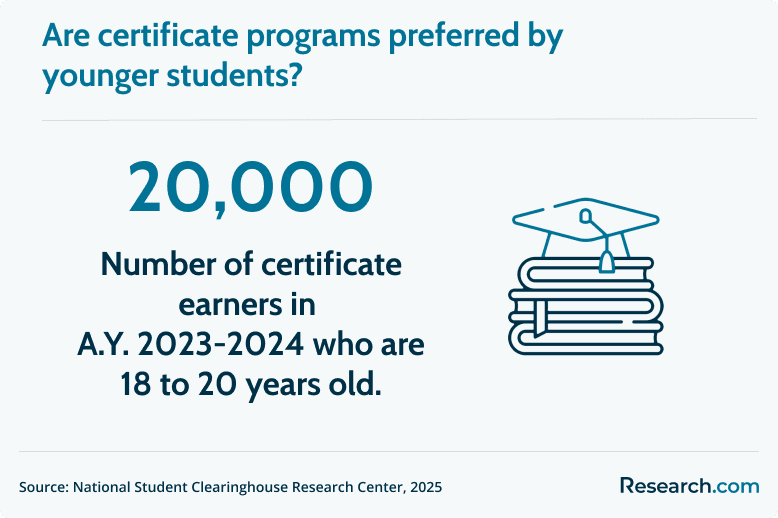
A degree program offers comprehensive academic preparation and critical thinking skills for sustained professional growth, while a certificate program delivers focused, skill-based training for immediate industry application. Notably, certificate earners are getting younger, with completers aged 18 to 20 increasing by nearly 20,000 (17.8%) from 2023 to 2024, reflecting a growing trend among younger learners seeking faster, career-focused entry into the workforce.
Review the distinctions below to make a more informed decision and choose the most strategic path for personal and professional growth.
Focus and Outcomes of Degree Programs
Degree programs emphasize comprehensive education and intellectual development. They integrate general education, major-specific coursework, and research, forming a foundation for both career flexibility and academic progression.
- Comprehensive Academic Scope: Cover multiple disciplines, such as business, science, and humanities, to cultivate critical reasoning and leadership skills.
- Structured Progression: Offer sequential learning that builds from foundational theories to advanced concepts, preparing students for managerial or specialized roles.
- Research and Analytical Depth: Include capstone projects, internships, or thesis work that develop analytical and problem-solving skills.
- Global Recognition: Lead to associate, bachelor’s, or master’s degrees accredited by universities and recognized by employers worldwide.
- Career Versatility: Equip graduates for roles that demand broad expertise, such as project managers, healthcare administrators, or educators, and create pathways to graduate study.
Focus and Outcomes of Certificate Programs
Certificate programs emphasize short-term, practical training aligned with specific job skills or industry standards. They appeal to professionals seeking to upskill, reskill, or enter new fields without the extended commitment of a degree.
- Targeted Skill Development: Focus on specific competencies such as data analytics, phlebotomy, or cybersecurity, aligning directly with workforce needs.
- Applied Learning Approach: Emphasize hands-on training, simulations, and certifications relevant to technical or trade-based roles.
- Accelerated Timeline: Enable learners to earn credentials quickly, ideal for those balancing work, family, or financial responsibilities.
- Industry Recognition: Often designed in collaboration with employers or industry associations, ensuring direct relevance to job requirements.
- Career Agility: Support rapid entry or advancement in fast-evolving fields, helping workers adapt to technological change or labor market shifts.
What types of degrees and certificates are available at the undergraduate and graduate levels?
As postsecondary enrollment rises, up 3.2% this spring, with undergraduate enrollment reaching 15.3 million students, learners now have broader opportunities to pursue education aligned with their goals and career stages.
Educational pathways vary widely, enabling students to align their learning with their personal goals and professional interests. Undergraduate programs introduce core concepts, while graduate programs foster expertise and leadership readiness. Certificates, in contrast, provide flexible, skill-focused options that complement academic degrees or support direct workforce entry.
Here’s an overview of what to expect from both degree and certificate programs:
Undergraduate Degrees
- Associate of Arts (AA): Centers on humanities, social sciences, and transfer preparation.
- Associate of Science (AS): Technical and applied learning for healthcare, IT, or business.
- Bachelor of Arts (BA): Liberal education promoting communication, critical thinking, and analysis.
- Bachelor of Science (BS): Technical and data-driven disciplines such as finance, biology, or engineering, with some programs recognized as the easiest bachelor degree to get online, offering streamlined coursework while maintaining academic quality and flexibility for working students.
Graduate Degrees
- Master of Arts (MA): Deepens theoretical study in fields like psychology, communication, or education.
- Master of Science (MS): Specializes in advanced technical, analytical, or business fields
- MBA (Master of Business Administration): Develops managerial and strategic decision-making skills.
- Doctoral Degrees (Ph.D., Ed.D.): Focus on scholarly research and innovation in academia or leadership.
Certificate Types
- Professional Certificate: Issued by professional bodies, such as Google, PMI, CompTIA, for industry recognition
- Postgraduate Certificate: Enhances qualifications after a master’s degree for academic or executive advancement.
- Continuing Education Certificate: Offered through universities or online platforms for working professionals.
- Vocational Certificate: Focuses on skilled trades such as electrical work, culinary arts, or healthcare support.
This chart from the National Student Clearinghouse Research Center illustrates the rise in degree enrollment.
How do degree programs and certificate programs differ in length and credit requirements?
As students weigh their educational options, understanding how degree and certificate programs differ in time and credit requirements is essential for making informed decisions. These two pathways reflect distinct commitments; degrees offer comprehensive academic depth over several years, while certificates deliver focused skill training in a shorter timeframe. The distinction not only affects duration but also influences the level of expertise, career outcomes, and long-term academic progression.
Degree programs offer a longer, credit-intensive path that develops advanced knowledge and leadership skills, while certificate programs provide short, targeted learning for quick upskilling and workforce adaptability.
Here’s how degree and certification programs differ in length and credit requirements:
Requirements of Degree Programs
- Associate Degree: Requires about 60 credits over two years, providing general education and technical foundations for entry-level roles or transfer to a bachelor’s program. Many students now pursue an associate's degree online, offering the same academic rigor and credit requirements while providing flexibility to balance work, life, and study.
- Bachelor’s Degree: Involves 120 to 130 credits across four years, combining core courses, electives, and internships for well-rounded academic and professional preparation.
- Master’s Degree: Spans 30 to 60 credits in one to two years, emphasizing research, leadership, and specialized expertise for career advancement.
- Doctoral Degree: Extends to 60 to 90 credits beyond the master’s level, focusing on original research, scholarly contribution, or advanced professional practice.
Requirements of Certificate Programs
- Undergraduate Certificate: Typically 12 to 30 credits, concentrating on job-ready skills such as data analytics, healthcare support, or IT systems.
- Post-Baccalaureate Certificate: Designed for graduates seeking advanced specialization without pursuing a full degree.
- Graduate Certificate: Ranges from 12 to 18 credits, ideal for professionals enhancing credentials in fields like project management, education, or cybersecurity.
- Micro-Credentials or Digital Badges: Compact programs of 3 to 6 credits that validate niche competencies and can be stacked toward broader qualifications.
How does the depth of learning and curriculum structure differ between a degree and a certificate program?
While both a degree and a certificate program enhance professional readiness, they take distinctly different approaches to knowledge building and skill application. Degree programs are designed for comprehensive academic growth, cultivating intellectual depth, research ability, and leadership potential through broad, theory-based learning. Certificate programs, on the other hand, prioritize immediate workforce relevance, offering streamlined, skill-focused curricula that meet current industry demands.
The curriculum of each program reflects its purpose: degrees foster interdisciplinary understanding and long-term development, whereas certificates emphasize technical mastery and job readiness.
Curriculum Structure of Degree Programs
- Interdisciplinary Learning: Combines general education, electives, and specialized courses to build a well-rounded foundation across multiple fields.
- Research and Theory: Encourages deep engagement with concepts, methodologies, and academic writing to sharpen critical thinking and innovation.
- Capstone or Thesis Projects: Allow students to synthesize learning through independent research or applied problem-solving initiatives.
- Holistic Competence: Strengthens communication, analytical reasoning, and leadership skills essential for sustained advancement and adaptability.
Curriculum Structure of Certificate Programs
- Targeted Curriculum: Concentrates on one area, such as UX design, medical coding, or cloud computing, to deliver industry-relevant expertise.
- Applied Learning: Focuses on experiential methods, including labs, practicums, and simulations, to build practical proficiency.
- Employer Relevance: Frequently developed with industry partners to ensure alignment with emerging trends and hiring needs.
- Accelerated Mastery: Offers compact, high-impact learning ideal for upskilling, reskilling, or entering new professional fields quickly.
The same contrast can be seen when comparing an early childhood education certificate vs degree—a certificate equips you for classroom support roles more quickly, while a degree provides the full pedagogical and leadership foundation for long-term careers in education.
How do tuition costs and financial aid options compare between degree and certificate programs?
Tuition costs and financial aid options vary significantly between degree and certificate programs, reflecting their different scopes, durations, and career objectives. Degree programs typically demand a higher financial investment, as they involve multiple years of study, comprehensive coursework, and broad academic development.
Conversely, certificate programs are shorter and more affordable, providing focused, career-specific training that fits the needs of professionals seeking quick upskilling or specialization.
Here’s how degree and certificate programs differ in tuition costs and financial aid options:
Tuition Cost for Degree Programs
Degree pathways, whether associate, bachelor’s, or graduate levels, require more credits and longer study durations, which often translates to higher tuition. However, they also open access to extensive financial aid and funding opportunities.
- Cost Range: Associate degrees cost approximately $3,000 to $4,000 per year, while bachelor’s programs at public universities average around $10,000 annually. Graduate tuition varies widely, from $20,000 to $60,000, depending on specialization and institution.
- Financial Aid Options: Students pursuing degree programs can apply for federal grants, scholarships, and low-interest student loans through the Free Application for Federal Student Aid (FAFSA). Many universities also offer institutional or merit-based scholarships, which help reduce overall tuition costs.
- Work-Study Programs: The Federal Work-Study Program allows eligible students to earn part-time income while gaining valuable experience related to their field of study.
- Military and Employer Benefits: Active-duty military personnel, veterans, and their families may qualify for tuition assistance under the GI Bill®. Moreover, some employers offer tuition reimbursement for employees pursuing degree-relevant education.
Tuition Cost for Certificate Programs
Certificate programs provide an economical, time-efficient path to acquire practical, job-ready skills, ideal for individuals seeking promotion, career transition, or immediate workforce entry.
- Cost Range: Most certificate programs range from $1,000 to $5,000, depending on the subject area, duration, and institution.
- Employer Sponsorship: Many companies fund professional certifications to enhance workforce competencies and retain talent. Learners should check if their employers participate in tuition assistance programs.
- Federal Aid Eligibility: While not all certificates qualify, accredited or workforce development programs may be eligible for select federal or state financial aid.
- Flexible Payment Options: Many online providers, such as Coursera and edX, offer subscription-based or installment payment models, making professional learning more accessible.
When choosing between a dental assistant certificate vs associate degree, the same financial logic applies: certificates cost less and lead to faster entry-level employment, while associate degrees open doors to broader roles and higher long-term earnings.
What career opportunities can a degree or certificate open?
Career opportunities vary in scope, specialization, and advancement potential depending on whether learners pursue a degree or certificate. Degree programs typically lead to strategic, leadership, or research-oriented roles that demand theoretical grounding and interdisciplinary understanding. In contrast, certificate programs offer targeted, practical training designed for immediate application in specialized or technical fields.
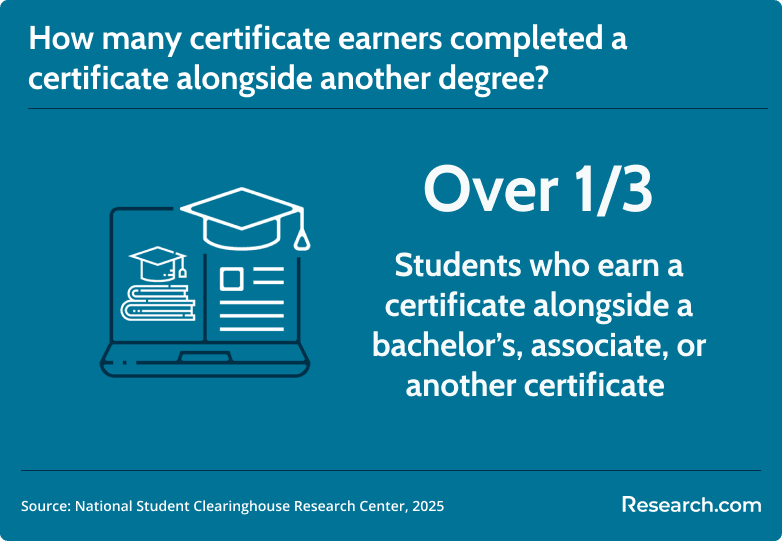
Notably, educational trends show increasing overlap between these pathways; more than one-third of all completers earning a certificate (34.5% in 2023–24) received that certificate within the same year as a bachelor’s, associate, or another credential, reflecting a growing preference for stacking academic and professional qualifications to enhance employability.
Degrees emphasize broad academic and theoretical knowledge, while certificate programs center on practical, applied expertise, as illustrated below:
Career Opportunities for Degree Holders
Earning a degree equips graduates with the academic foundation, analytical skills, and leadership competencies needed for advancement across diverse industries. These careers often emphasize strategic decision-making, innovation, and continuous learning.
- Human Resources Manager: Directs workforce planning, employee development, and organizational culture strategies within corporate or nonprofit settings.
- Marketing Director: Leads data-driven campaigns, brand positioning, and market expansion strategies to drive business growth.
- Financial Analyst: Evaluates investment performance, financial data, and market trends to guide strategic business decisions.
- Software Engineer: Designs, develops, and maintains applications or systems that support digital transformation and innovation.
- Healthcare Administrator: Manages clinical operations, policy compliance, and patient services in hospitals, clinics, or public health organizations.
- Education Specialist: Develops curriculum, instructional programs, or academic policy initiatives in schools and higher education institutions.
Career Opportunities for Certificate Holders
Certificate programs provide focused, industry-aligned credentials that enable professionals to upskill quickly or transition into new roles. These opportunities emphasize technical proficiency, applied knowledge, and alignment with current market demands.
- Data Analyst: Interprets data trends and creates actionable insights using analytical tools such as Excel, SQL, or Python.
- Certified Medical Assistant: Supports physicians with patient care, record management, and clinical tasks in medical facilities.
- Cybersecurity Technician: Protects digital systems from threats through network monitoring, vulnerability assessments, and incident response.
- Digital Marketing Specialist: Executes targeted advertising, SEO optimization, and social media campaigns for online brand engagement.
- IT Support Specialist: Provides troubleshooting, system maintenance, and user support across hardware and software environments.
- Bookkeeping or Payroll Clerk: Manages financial records, reconciliations, and compliance processes for businesses and organizations, with skills often enhanced through a bookkeeping certification online to increase credibility and job readiness.
Can credits earned from a certificate program be transferred into a degree program?
As demand grows for both practical skills and academic credentials, stackable credentials are reshaping higher education. Certificate programs increasingly act as entry points to degree programs, with credits designed to transfer toward associate or bachelor’s degrees. This structure enables learners to combine fast skill acquisition with deeper academic growth, fostering flexible, lifelong learning pathways.
Research underscores the impact of this approach. Among those who stack credentials, most progress to earn a degree: RAND’s study (2021) in Ohio found that 71% of such individuals earned an associate’s degree, and 9% completed a bachelor’s degree. This trend demonstrates how certificates can serve as strategic building blocks rather than standalone credentials.
Employer perspectives further reinforce the value of this model, with 87% of executives and 90% of HR professionals recognizing that workers with alternative credentials bring highly relevant skills to the workplace. Credit transferability, however, depends on institutional policies, accreditation, and curriculum alignment, prompting many institutions to design certificate programs that seamlessly integrate with degree requirements to maximize career advancement opportunities.
Some examples of credit transferability pathways include:
- Business Certificates: Courses in marketing, accounting, or management can apply toward an associate or bachelor’s degree in business administration.
- Healthcare Pathways: Nursing assistants (CNA) or licensed practical nurses (LPN) may transfer earned credits into Bachelor of Science in Nursing (BSN) programs.
- Information Technology: Industry certifications such as CompTIA, Cisco, or AWS often satisfy elective or foundational credits in IT or computer science degrees.
- Education: Early childhood teaching certification courses frequently transfer toward associate or bachelor’s degrees in education.
- Cybersecurity: Technical security certificates, including cyber security certifications online, can fulfill key requirements in computer science or information systems degree tracks, enhancing both skills and employability.
- Engineering Technology: Applied engineering or CAD design certificates may articulate into associate or bachelor’s engineering programs.
This chart from SHRM highlights professionals’ perspectives on the value that individuals with alternative credentials bring to the workplace.
Can earning a certificate help you qualify for or accelerate a degree program later?
Certificates often serve as strategic stepping stones, helping learners qualify for or accelerate degree programs later. They provide focused training, validate skills, and can shorten academic timelines by allowing credits to transfer directly into degree pathways. This approach reflects a growing trend in higher education, where short-term credentials increasingly act as gateways to broader academic and career advancement.
In the US, one million students earn college certificates each year, with many pursuing additional credentials afterward (NCES, 2024). Short-term certificates often act as an on-ramp to degree programs, particularly in community colleges, creating opportunities for learners to build toward advanced study more efficiently.
A similar model exists in healthcare education. For example, professionals in unrelated fields can bridge into advanced nursing pathways through non nursing degree to MSN programs—demonstrating how certificate-level preparation can serve as a foundation for higher credentials in other disciplines as well.
What industries benefit most from certificate programs versus degree programs?
Different industries value educational credentials in ways that align with their specific skill demands and career structures. Certificate programs excel in sectors where practical, targeted skills drive immediate productivity, while degree programs remain essential in fields requiring broad theoretical knowledge, leadership preparation, and advanced expertise. This distinction shapes how workers approach education based on their career goals and industry expectations.
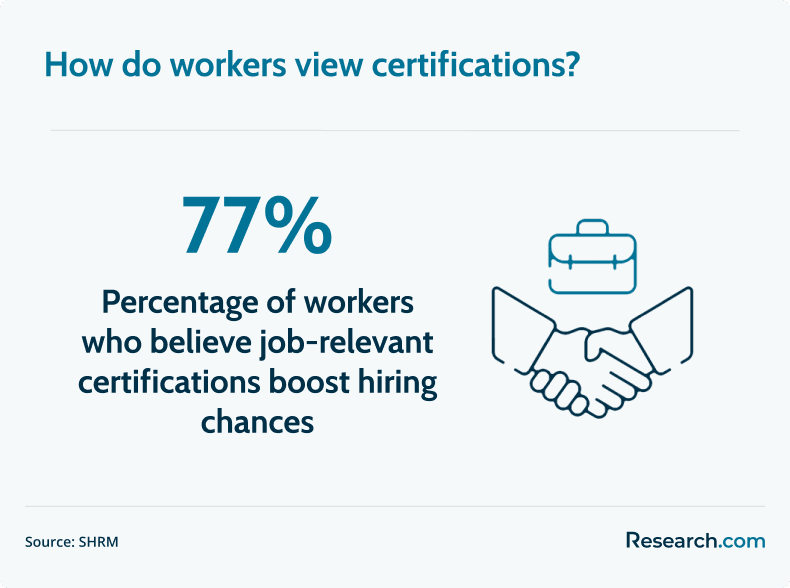
A Gallup report shows that 41% of Americans hold a professional certification, and 81% of them are employed, compared to 68% of those without a certification. Furthermore, 77% of workers agree that having a job-relevant alternative certification increases—or would increase—their chances of being hired, highlighting certificates’ growing value in today’s workforce.
Certificates are often the fastest path to employment in skill-based fields, while degrees open doors to leadership, research, and professions that require broad expertise.
Here are the industries where certificate holders can find employment:
- Technology: Certifications in cybersecurity, software support, and cloud computing equip workers with specialized, in-demand technical skills.
- Healthcare: Credentials in phlebotomy, medical billing, and patient care provide rapid entry into clinical roles.
- Digital Marketing: Certifications in SEO, social media management, and content optimization address fast-evolving digital strategies.
- Design and Multimedia: Certificates in graphic design, UX/UI, and web design deliver practical expertise for creative industries.
- Construction and Trades: HVAC, plumbing, and electrical certifications offer targeted training for high-demand trade work.
On the other hand, these are the industries that favor degree programs:
- Business and Finance: Degrees prepare leaders for management, analytics, and strategic decision-making roles.
- Education: Teaching, curriculum design, and administrative leadership require a comprehensive academic grounding.
- Engineering: Civil, mechanical, and computer engineering demand deep technical knowledge built through degree programs.
- Public Health and Policy: Degrees in these fields support research, epidemiology, and community planning roles.
- Social Work: Academic credentials underpin leadership and case management in public welfare and nonprofit sectors.
In psychology, for example, understanding where do clinical psychologists work demonstrates how a degree program enables entry into hospitals, schools, and research settings—industries that depend on advanced academic preparation rather than short-term certification.
How do I choose between a degree and a certificate program?
Choosing between a degree and a certificate starts with understanding how each will impact your career trajectory. As constantly highlighted in this article, a degree builds deep knowledge, analytical skills, and leadership potential, while a certificate delivers targeted expertise designed for immediate workforce entry or advancement.
Align your choice with your career vision to actively shape your professional future. Here are some steps to help you decide between a degree program and a certificate program:
- Define Career Goals: Pinpoint whether your aim is long-term advancement, industry leadership, or quick entry into a specialized role.
- Analyze Industry Needs: Investigate hiring trends and credential requirements in your desired field to ensure your choice aligns with demand.
- Evaluate Time and Budget: Match program length and cost with your availability and financial capacity.
- Leverage Stackable Credentials: Choose programs that allow credits to transfer toward a degree, accelerating your education.
- Consult Experts: Engage with advisors, mentors, or industry professionals to clarify the best path forward.
What Graduates Say About Completing a Degree or a Certificate Program
- Mira: "Completing my degree program gave me a deep understanding of my field and opened doors to leadership opportunities I never imagined. The rigorous coursework challenged me, while the practical projects prepared me for real-world success. It was a transformative experience for my career and confidence. "
- James: "Earning a certificate program allowed me to gain specialized skills quickly without putting my life on hold. I was able to apply what I learned immediately at work, boosting my performance and earning recognition. It truly accelerated my career transition. "
- Helena: "My degree program not only expanded my knowledge but also taught me how to think critically and adapt in any situation. The learning process was demanding but deeply rewarding, giving me both skills and self-assurance for long-term growth. It was one of the best decisions I’ve made."
What are the long-term career growth and earnings potentials of each option?
Recent studies indicate that comprehensive degree programs may offer higher long-term earnings and broader opportunities for career advancement, thanks to their emphasis on critical thinking, research, and interdisciplinary skills. In contrast, certificate programs provide rapid entry into the workforce and can lead to early career boosts in specialized fields, though they may offer a more limited upward trajectory in roles that require extensive academic credentials. Employers value degrees for leadership and strategic roles, while certificates can be perfect for niche technical positions. Considering these differences can help professionals align their educational investments with long-term career goals, similar to those found in quick online degrees.
Key Findings
- Certificate earners aged 18 to 20 grew nearly 20,000 from 2023 to 2024, showing rising interest among young workers.
- Postsecondary enrollment rose 3.2% this spring, with undergraduates reaching 15.3 million, reflecting growing demand for credentials.
- Over one-third of certificate earners complete them alongside another degree, highlighting a stacking credentials trend.
- 78% of executives and 90% of HR professionals value alternative credentials for relevant workforce skills.
- 77% of workers say job-relevant certifications improve hiring prospects, emphasizing their career importance.
References:
- National Student Clearinghouse Research Center (2025). Undergraduate Degree Earners. Retrieved from https://nscresearchcenter.org/undergraduate-degree-earners/
- NCES (2024). Postsecondary Certificates and Degrees Conferred. Retrieved from https://nces.ed.gov/programs/coe/indicator/cts
- RAND (2021). Building Ohio's Workforce Through Stackable Credentials. Retrieved from https://www.rand.org/pubs/research_briefs/RBA207-1.html
- SHRM (2022). SHRM Report: Survey Finds a Rise of Alternative Credentials in Hiring. Retrieved from https://www.shrm.org/about/press-room/shrm-report-survey-finds-rise-alternative-credentials-hiring
Other Things You Should Know About Degrees and Certificate Programs
In 2027, a certificate program is typically more beneficial for quick upskilling or career changes due to its shorter duration and practical focus. However, a degree might offer broader and deeper knowledge, which could be advantageous for long-term career growth or specific fields.
Employers typically value degrees for their comprehensive education and evidence of long-term commitment to a field. Certificates, meanwhile, are seen as proof of specialized expertise or up-to-date technical skills, especially in rapidly changing industries like IT, business, or healthcare.
No, certificates and certifications differ in purpose and recognition. Certificates are academic credentials awarded by colleges or universities upon course completion, while certifications are industry-recognized credentials issued by professional organizations that often require passing an exam and renewal. Both can enhance employability and demonstrate career readiness.


