
2027 Where Do Clinical Psychologists, Therapists, & Counselors Work?

Co-Founder and Chief Data Scientist
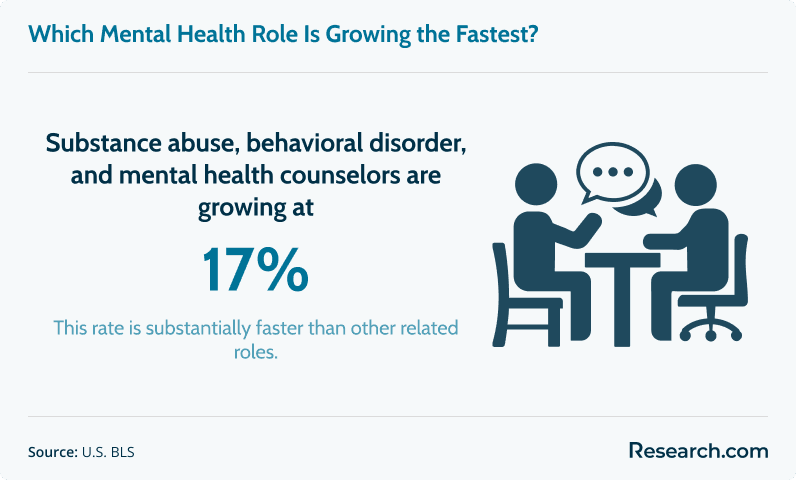
In 2027, mental health careers are in high demand. Clinical psychologists, therapists, and counselors are seeing rapid growth as awareness of mental health rises in the U.S. Employment for substance abuse, behavioral disorder, and mental health counselors is projected to grow 17% until 2032. This growth is creating more opportunities for professionals to specialize, develop skills, and make an impact in an evolving field.
In this article, we’ll explore the key trends shaping where mental health professionals work, the types of roles available, and the opportunities for growth and specialization. Whether you’re considering a career in this field or looking to understand the landscape better, you’ll get a clear picture of what to expect in 2027.
Key Things to Know About Clinical Psychologists, Therapists, and Counselors
- Clinical psychologists, therapists, and counselors work in various settings, including schools, hospitals, private practices, and government agencies.
- The increasing awareness of mental health issues has led to a higher demand for professional services.
- In 2027, clinical psychologists earn an average annual income of $209,186.
- Where do clinical psychologists, therapists, and counselors typically work in 2027? Common Work Settings
- Which industries actively hire clinical psychologists, therapists, and counselors? Top Industries
- What is the work-life balance like for clinical psychologists, therapists, and counselors? Work-Life Balance
- What are the turnover rates for clinical psychologists, therapists, and counselors in 2027? What are the turnover rates for clinical psychologists, therapists, and counselors in 2027?
- How do clinical psychologists, therapists, and counselors advance in their careers? Career Advancement
- What core skills do clinical psychologists, therapists, and counselors need in 2027? Skills
- What training programs are available for clinical psychologists, therapists, and counselors? What training programs are available for clinical psychologists, therapists, and counselors?
- What is the average salary for clinical psychologists, therapists, and counselors in 2027? Average Salary
- What emerging opportunities exist for clinical psychologists, therapists, and counselors? What emerging opportunities exist for clinical psychologists, therapists, and counselors?
- What challenges are emerging for clinical psychologists, therapists, and counselors? What challenges are emerging for clinical psychologists, therapists, and counselors?
- What additional certifications can boost career progression? What additional certifications can boost career progression?
Where do clinical psychologists, therapists, and counselors typically work in 2027?
Mental health professionals practice in a wide range of work settings that directly influence how they interact with clients. Each setting offers different opportunities, challenges, and scopes of care.
Here are some of them:
Healthcare Facilities
Many mental health professionals work in hospitals, outpatient care centers, and rehabilitation clinics. Approximately 7,430 clinical and counseling psychologists are employed in outpatient care centers, and around 6,720 work in offices of physicians. They provide assessment, therapy, and ongoing support to clients.
Private Practice
Many mental health professionals work independently or in group practices. These settings allow them to deliver individualized care to clients and provide flexibility in specialization and focus. Private practice remains one of the most common settings for clinical psychologists, therapists, and counselors.
Educational Institutions
About 27% of psychologists work in educational settings. Schools, colleges, and universities employ mental health professionals to support students’ academic, career, and social-emotional development.
Government and Public Agencies
Federal, state, and local agencies hire practitioners to provide public mental health services, work in correctional facilities, and support community programs. Roughly 8% of psychologists are employed in government roles.
Nonprofit Organizations and Community Centers
Many professionals work in nonprofit mental health centers, youth programs, and community initiatives, focusing on accessibility and underserved populations.
Licensing also affects where professionals can practice. For example, those researching what states allow you to practice with a master's in psychology will find that regulations differ widely—some states offer provisional or limited practice authority under supervision, while others require a doctorate for independent licensure.
Which industries actively hire clinical psychologists, therapists, and counselors?
Clinical psychologists, therapists, and counselors are increasingly sought after in industries outside of traditional healthcare. Sectors like education, social services, and corporate programs are expanding mental health initiatives, creating opportunities for professionals to provide counseling and wellness support.
- Healthcare and Social Assistance: This sector employs a significant number of mental health professionals, including clinical psychologists, therapists, and counselors. These professionals provide essential services in hospitals, outpatient care centers, and residential facilities, addressing a wide range of mental health needs.
- Education Services: Educational institutions, such as schools and universities, employ mental health professionals to support students' emotional and psychological well-being. These positions are ideal for those exploring 'what can you do with a health education degree?' They involve counseling, crisis intervention, and developmental support that promote a healthier learning environment.
- Government and Public Administration: Various government agencies hire mental health professionals to work in public health departments, correctional facilities, and community outreach programs. These positions focus on public mental health initiatives and policy implementation.
- Nonprofit Organizations: Nonprofit organizations, including community mental health centers and advocacy groups, employ mental health professionals to provide services to underserved populations. These roles often focus on accessibility and community-based care.
- Private Sector: The private sector, encompassing private practices and corporate wellness programs, offers opportunities for mental health professionals to provide individualized care. These roles allow for specialization and flexibility in client focus.
What is the work-life balance like for clinical psychologists, therapists, and counselors?
Mental health practitioners are under increasing strain, and many are reporting that balancing work with personal life is becoming harder. More than half (52%) of mental health professionals said they’ve experienced burnout in the past year.
Some of their key challenges include heavy caseloads, administrative tasks, and emotional exhaustion. Nearly 55% point to administrative burdens, and 54% report compassion fatigue as a factor. About 29% of practitioners said they’ve thought about exiting the field due to burnout.
However, practitioners in certain settings find that their work naturally supports a healthier balance. Those in private practice often have more control over schedules and caseloads, which helps reduce stress.
School-based professionals also benefit from predictable hours and academic breaks, giving them more personal time. These environments allow practitioners to sustain balance while still finding fulfillment in supporting their clients’ mental health.
Still, as more faith-based counseling programs expand, many professionals are comparing philosophical approaches like biblical vs christian counseling, which differ in their use of scripture and clinical integration. Understanding such frameworks can influence how counselors maintain alignment between personal beliefs and professional practice—an important factor for long-term balance and job satisfaction.
What are the turnover rates for clinical psychologists, therapists, and counselors in 2027?
Turnover rates for clinical psychologists, therapists, and counselors are among the highest in healthcare. In community behavioral health settings, annual turnover averages 30-35%. Therapists in community mental health programs experience even higher turnover, ranging from 25-60% per year, depending on workplace conditions.
Substance use disorder counselors face some of the steepest challenges, with programs reporting turnover between 33-74% over a two-year period. A longitudinal study also found that nearly 47% of substance use disorder counselors leave within four years.
These numbers show how burnout, heavy workloads, and limited resources continue to fuel high exit rates in mental health care.
Education and specialization may influence retention too. For instance, professionals pursuing advanced credentials—whether a PhD vs PsyD in clinical psychology—often find their choice affects not just pay and prestige, but also the settings and stability of their roles. Doctoral-level practitioners typically have greater autonomy, which can reduce turnover risk.
How do clinical psychologists, therapists, and counselors advance in their careers?
Advancing in a career can help reduce the stress that often contributes to administrative burnout. When mental health professionals move into roles such as supervisors, program directors, or clinical leaders, they no longer handle heavy caseloads alone. Instead, they manage teams and influence organizational decisions.
This shift gives them more control over schedules, workloads, and resources. As a result, it helps prevent the exhaustion common in purely clinical positions.
Clinical psychologists, therapists, and counselors advance by gaining specialized certifications, pursuing higher degrees, or moving into supervisory and administrative roles. Many start in entry-level clinical practice. With experience, they progress to positions such as lead therapist, clinical supervisor, or program director.
In academic and healthcare settings, advancement often comes through research, teaching, or leadership opportunities. Some professionals even explore alternative routes to get a master’s in education, which can open doors to teaching or program development roles. About 75% of psychologists in academic health centers hold at least one leadership role.
Others grow their careers by opening private practices or specializing in areas like trauma therapy or child psychology. Some transition into policy, advocacy, or consulting work. These pathways provide steady professional growth and greater influence in shaping mental health services.
What core skills do clinical psychologists, therapists, and counselors need in 2027?
Mental health professionals need a blend of technical expertise and interpersonal strengths to meet growing demands. Their effectiveness depends not only on clinical training but also on skills that support engagement, adaptability, and evidence-based care.
- Client Rapport and Trust-Building: Building trust, empathy, and rapport is central to successful outcomes. Research shows that common relationship factors such as alliance, empathy, and warmth account for about 30% of client improvement in therapy.
- Proficiency in Digital Mental Health Tools: Since the pandemic, many providers have shifted to remote or hybrid practices. Surveys report that 88% of psychologists now use telehealth models in some form. As more services adapt to virtual formats, it raises questions for other professionals, such as "Can SLPAs do teletherapy?"
- Collaboration and Teamwork: Many mental health practitioners now work in integrated care settings. In these settings, they collaborate with physicians, nurses, and social workers to ensure comprehensive treatment for clients.
- Cultural Competence: Developing cultural awareness and linguistic sensitivity is essential to effectively serve diverse populations.
- Evidence-Based Decision-Making: Practitioners must continuously apply current research to treatment planning. This ensures that interventions are both scientifically grounded and personalized.
What training programs are available for clinical psychologists, therapists, and counselors?
Specialized training is what sets mental health professionals apart. Clinical psychologists can pursue advanced programs that develop expertise in assessment, research, and clinical treatment. Therapists and counselors can choose training that sharpens their skills in specific areas such as family therapy, school counseling, or addiction services.
These tailored tracks allow professionals to align their education with the issues they want to serve most.
- Master’s in Clinical Psychology or Counseling Practice: These offer broad-based training in assessment, intervention, theory, and research. Students complete two years of coursework followed by a supervised clinical practicum. This hands-on experience exposes them to diverse client populations and evidence-based therapeutic approaches.
- Doctoral Internship Programs: This gives psychology doctoral students supervised experience working with clients and developing a professional identity. Interns participate in mentoring, supervision, case presentations, and hands-on work with diverse clinical cases. The experience prepares students for independent practice and advanced professional roles in clinical and counseling settings.
- Clinical or Community Mental Health Counseling Master’s Programs: These prepare trainees to become licensed counselors with strong foundations in evidence-based practice, cultural competence, and trauma-informed care. The University of Utah’s program is one example. It follows CACREP core standards and includes around 700 hours of supervised clinical placement.
- Specialized Certification Courses: Programs specific to evidence-based therapy models let therapists, counselors, and psychologists develop expert skills in specific modalities. For example, the Association for Psychological Therapies offers 4-week online college credit courses in CBT (Essentials and Masterclass levels) that count toward continuing education hours.
What is the average salary for clinical psychologists, therapists, and counselors in 2027?
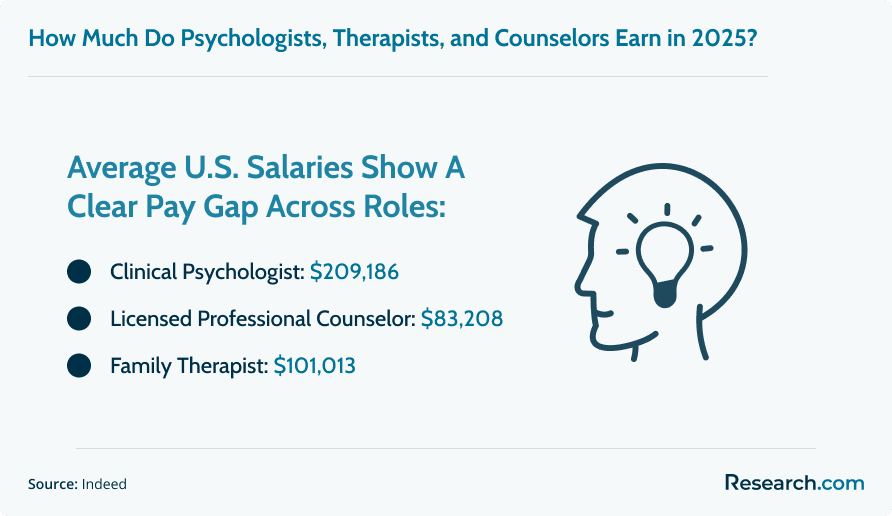
Salary levels among mental health professionals vary widely. The average base salary for a licensed professional counselor (LPC) is about $83,208 a year, while therapists average slightly higher at $101,013 per year. In sharp contrast, clinical psychologists earn an annual average of $209,186, more than double the earnings of counselors and therapists.
Part of this gap comes from differences in education, credentials, and scope. Psychologists often hold doctoral degrees and may conduct assessments, testing, or more advanced diagnostic work, which tend to be higher-paid tasks.
Meanwhile, counselors and therapists may carry master’s training from the best online MHA programs with no GRE requirement. They may have narrower scopes or fewer billing possibilities. The pay gap also reflects variation by employer, specialization, location, and years of experience.
What emerging opportunities exist for clinical psychologists, therapists, and counselors?
The demand for clinical psychologists, therapists, and counselors is creating strong new career opportunities. The Bureau of Labor Statistics projects jobs in substance abuse, behavioral disorder, and mental health counseling to grow 17% from 2022 to 2032. This is much faster than the national average for all occupations. This rapid growth highlights the rising recognition of mental health as a critical part of overall healthcare.
Telehealth is also expanding the field. It allows professionals to reach clients in rural or underserved areas while offering more flexible work models. Schools are another area of growth. Rising concerns about student well-being are driving demand for more counselors, especially in regions facing staff shortages.
Gender trends also shape opportunities. Women make up 77.5% of mental health counselors and 83% of counseling psychologists. This imbalance reflects social expectations that place caregiving roles on women. It also shows the appeal of counseling as a career that emphasizes relational and empathetic work.
The strong female presence has advanced women’s leadership within the profession. At the same time, there is growing room to encourage more men to enter counseling. A more balanced workforce could diversify therapeutic approaches and give clients greater choice based on their comfort level.
As mental health becomes more integrated with physical care, roles that bridge disciplines—such as behavioral specialists in hospitals—are gaining value. Salaries in these hybrid areas are rising, comparable to niche roles like salary of a forensic psychologist, where advanced training and specialized environments lead to higher earnings.
What challenges are emerging for clinical psychologists, therapists, and counselors?
Mental health professionals are facing a severe workforce shortage, especially in underserved and rural areas. As of 2024, over 122 million Americans live in regions designated as mental health provider shortage areas.
This shortage places immense pressure on existing providers, contributing directly to high burnout rates. Ninety-three percent (93%) of behavioral health workers report experiencing burnout, and 62% say the burnout is moderate to severe.
Additionally, the lack of diversity in the workforce creates cultural and linguistic mismatches between providers and clients. Nearly 86% of psychologists and 88% of mental health counselors in the U.S. are white.
This gap can lead to reduced access to culturally competent care, lower treatment engagement, and disparities in mental health outcomes for minority populations.
What additional certifications can boost career progression?
Targeted certifications offer mental health professionals an effective way to diversify expertise and secure specialized roles. Advanced credentials—such as certifications in behavior analysis, trauma-informed practices, or neuropsychological rehabilitation—provide additional avenues for career growth beyond traditional degree programs. Pursuing these certifications can refine clinical skills, improve treatment outcomes, and enhance professional credibility in a competitive market. For example, clinicians looking to expand their scope may explore options like the cheapest board certified behavior analyst programs online to build a strong foundation in behavior analysis and meet increasing industry demand.
Here’s What Clinical Psychologists, Therapists, and Counselors Have to Say About Their Careers
- Julia: "Working in a hospital’s mental health unit has exposed me to complex cases that challenge my problem-solving skills daily. Collaborating with psychiatrists and social workers on patient treatment plans means I’m constantly learning while making a direct impact on recovery. It’s demanding, but seeing patients regain stability and confidence is incredibly rewarding."
- Alex: "My role in a community clinic allows me to support families struggling with addiction, which has been both humbling and transformative. Each breakthrough, no matter how small, feels like a step forward. Not just for the client but for me as well. Helping people navigate changes they once thought were out of reach reminds me why I chose this career."
- Althea: "As a school counselor, I get to work closely with students during pivotal years of their development. The balance of structured schedules and meaningful one-on-one time has been ideal for maintaining both effectiveness at work and a healthy personal life. Seeing students thrive academically and emotionally has been the most rewarding part of my job."
Key Findings
- Clinical psychologists, therapists, and counselors often work in outpatient mental health and substance abuse centers, hospitals, individual and family services, and offices of health practitioners.
- 48,300 openings for substance abuse, behavioral disorder, and mental health counselors are expected each year over the decade.
- Most positions in this field require at least a master's degree and relevant licensure.
- Clinical and counseling psychologists had a median annual wage of $95,830, while substance abuse, behavioral disorder, and mental health counselors had a median annual wage of $59,190.
- The rise of telehealth has expanded access to mental health services, allowing professionals to reach clients remotely.
References:
- American Psychological Association. (2018, February). Data point: Psychology workforce. APA Monitor on Psychology. https://www.apa.org/monitor/2018/02/datapoint
- Data USA. (n.d.). Clinical and counseling psychologists. Retrieved October 3, 2025, from https://datausa.io/profile/soc/clinical-and-counseling-psychologists
- Digital Repository at the University of Washington. (2020). Mental health workforce research. University of Washington Libraries. https://digital.lib.washington.edu/researchworks/items/df181fc3-767c-42c7-9282-3917526e0378
- Indeed. (n.d.). Career guide. Retrieved October 3, 2025, from https://www.indeed.com/career/
- National Council for Mental Wellbeing. (2022, March). Help wanted: Projections of shortages in mental health and substance use treatment providers. https://www.thenationalcouncil.org/news/help-wanted/
- Olfson, M., Wall, M., Wang, S., Crystal, S., Gerhard, T., Blanco, C. (2019). Shortages of psychiatrists and other mental health providers in the United States. Psychiatric Services, 70(9), 852–858. https://psychiatryonline.org/doi/10.1176/appi.ps.201900169
- Petkari, E., & Pienaar, J. (2020). A meta-analysis of the prevalence of burnout in mental health professionals. Psychiatry Research, 284, 112695. https://pmc.ncbi.nlm.nih.gov/articles/PMC7083521/
- Substance Abuse and Mental Health Services Administration. (2012). Report to Congress on the Nation’s Substance Abuse and Mental Health Workforce Issues. U.S. Department of Health and Human Services. https://pubmed.ncbi.nlm.nih.gov/22116013/
- Thomas, K. C., Ellis, A. R., Konrad, T. R., Holzer, C. E., & Morrissey, J. P. (2012). County-level estimates of mental health professional shortage in the United States. Psychiatric Services, 63(6), 589–594. https://pubmed.ncbi.nlm.nih.gov/30829142/
Other Things You Should Know About Clinical Psychologists, Therapists, and Counselors
In 2027, clinical psychologists, therapists, and counselors commonly work in hospitals, private practices, and community health centers. They are increasingly found in digital healthcare platforms, enhancing accessibility and convenience for patients. Academic institutions and corporate environments also seek their expertise for mental health support services.
In 2027, there is an increasing trend toward virtual counseling environments driven by advancements in telehealth technology. Additionally, more professionals are working in integrated healthcare systems, collaborating with medical teams to provide holistic care. Community-based mental health services are also expanding in response to public demand for accessible mental health care.
The question "Where do clinical psychologists, therapists, and counselors typically work in 2027?" may insufficiently cover emerging settings, focusing primarily on traditional environments like private practices, hospitals, or schools. However, understanding new trends like virtual platforms or holistic wellness centers in 2027 could be more valuable.
In 2027, clinical psychologists, therapists, and counselors increasingly work in telehealth, community health centers, and integrated healthcare teams. The shift towards virtual settings and collaborative care models reflects a growing emphasis on accessibility and holistic patient care.


