
2027 DNP vs. NP: Explaining the Difference

Co-Founder and Chief Data Scientist
Choosing between becoming a nurse practitioner (NP) or advancing to a Doctor of Nursing Practice (DNP) is a pivotal decision for nurses planning their future. Employment for advanced practice registered nurses is projected to grow 35 percent until 2034, far outpacing the average for all occupations, which underscores the strong demand for both roles.
With such rapid growth ahead, it is essential to understand the differences in education, responsibilities, and career potential. This guide provides a clear comparison to help you make an informed choice that aligns with your professional goals.
Key things you should know about the difference between DNP vs. NP
- An NP is a role earned through a master’s or doctoral program, while a DNP is a terminal degree that emphasizes advanced clinical practice, leadership, and systems-level impact.
- NPs primarily concentrate on providing direct patient care, whereas DNP-prepared nurses may combine clinical practice with roles in leadership, policy, or academia.
- Completing a DNP can open doors to higher-level positions and may enhance earning potential, while an NP credential alone is sufficient for entering advanced clinical practice.
- What is the difference between a DNP and an NP? DNP vs. NP
- How long does it take to become an NP vs. a DNP? Completion Time
- What are the typical coursework and clinical hours for NP programs compared to DNP programs? Coursework
- What certification exams do NPs take versus DNP graduates? What certification exams do NPs take versus DNP graduates?
- How much can you make as an NP with a DNP? Average Salary
- How does an NP's scope of practice compare to the clinical responsibilities of a DNP? Scope of Practice
- How do I decide between finishing as an NP (MSN) or pursuing a DNP? How do I decide between finishing as an NP (MSN) or pursuing a DNP?
- What additional clinical competencies do DNP programs emphasize compared with NP programs? Clinical Competencies
- What career tracks are common for NPs versus DNP-prepared nurses? What career tracks are common for NPs versus DNP-prepared nurses?
- What is the job outlook for general nurse practitioners in the U.S.? Job Outlook
What is the difference between a DNP and an NP?
Understanding the difference between a DNP and a nurse practitioner is essential for nurses considering advanced career options. While the two are closely related, they represent different aspects of nursing—one is a degree and the other is a role.
The breakdown below highlights the key distinctions in education, responsibilities, and career opportunities.
Educational Difference
- NP: Nurse practitioners qualify to practice after completing either a master’s or doctoral program that emphasizes advanced clinical knowledge and population-focused care. These programs typically take two to three years and prepare graduates for national certification in a specialty.
- DNP: A Doctor of Nursing Practice is a terminal degree in nursing that builds on clinical skills while also focusing on leadership, quality improvement, and health systems change. This degree may take three to four years post-BSN and represents the highest level of practice-oriented nursing education.
To put it in perspective, many prospective students first ask what is the difference between BS and BSN in nursing, since understanding this earlier distinction helps clarify the later progression from BSN to MSN or DNP programs.
Role and Scope of Practice
- NP: NPs are licensed providers who assess, diagnose, prescribe, and manage treatment plans for patients in a variety of healthcare settings. Their scope of practice varies by state, with some enjoying full practice authority while others require physician collaboration.
- DNP: DNP-prepared nurses can function as NPs if certified, but also bring added training in policy, leadership, and organizational change. According to the American Association of Colleges of Nursing (AACN), this preparation allows them to influence healthcare delivery beyond individual patient encounters, often at a system or policy level.
Career Opportunities
- NP: Common career paths for NPs include primary care, pediatrics, acute care, psychiatric mental health, and specialty practices such as cardiology or oncology. These roles are patient-facing and remain in high demand across hospitals, clinics, and private practices.
- DNP: In addition to clinical practice, DNP-prepared nurses are positioned for leadership roles such as academic faculty, health system executives, or directors of clinical quality. Their advanced training makes them competitive for positions that blend patient care with administrative, teaching, or policy responsibilities.
How long does it take to become an NP vs. a DNP?
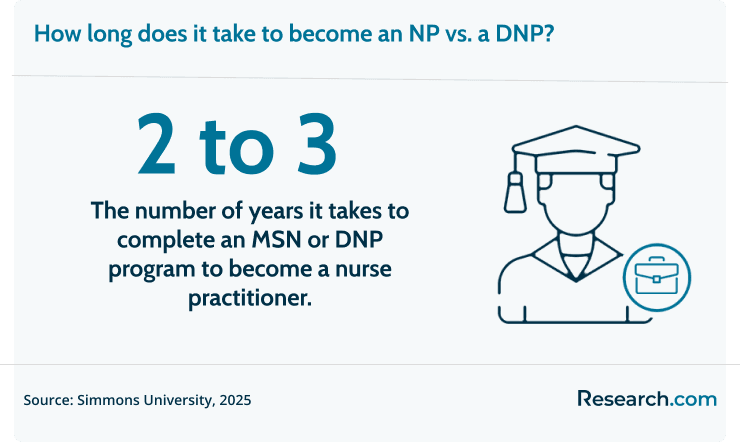
Becoming a nurse practitioner typically requires completing a Master of Science in Nursing (MSN) program after earning a Bachelor of Science in Nursing (BSN) and becoming a licensed registered nurse. Most MSN-NP programs take about two to three years of full-time study, although part-time students may need longer.
Coursework usually combines advanced pathophysiology, pharmacology, and clinical practice rotations. By the time students graduate, they are prepared to sit for national NP certification exams and begin practicing in their chosen specialty.
Pursuing a Doctor of Nursing Practice (DNP) generally takes more time than the NP track because it is a terminal degree. A BSN-to-DNP pathway often requires three to four years of full-time study, while MSN-to-DNP options may be completed in one to two years.
These programs emphasize not only advanced clinical care but also leadership, health policy, and quality improvement projects. Graduates are trained for both clinical expertise and system-level leadership, making them highly competitive in advanced practice roles.
For some, especially those coming from non-nursing backgrounds, accelerated bridge programs can shorten the process. Examples include ABSN or direct-entry options—many applicants research are ABSN programs worth it before deciding, as these intensive formats can fast-track qualified students toward NP or DNP-level study.
What are the typical coursework and clinical hours for NP programs compared to DNP programs?
Understanding the coursework differences between NP and DNP programs is key to recognizing how each prepares nurses for advanced practice. NP programs focus heavily on direct patient care and specialty training, while DNP programs extend into leadership, systems improvement, and policy.
Below are some common courses for each pathway.
- Advanced Pharmacology: This course explores drug classifications, mechanisms of action, and therapeutic uses across patient populations. It also trains students in safe prescribing practices and monitoring for adverse effects.
- Advanced Pathophysiology: Students study complex biological and physiological processes underlying disease across the lifespan. The focus is on developing the ability to connect clinical symptoms to underlying pathophysiology for accurate diagnosis.
- Advanced Health Assessment: This course builds advanced skills in physical examinations, diagnostic testing, and differential diagnosis. Students practice integrating findings into comprehensive patient care plans.
- Population-Focused Specialty Courses: Coursework in areas such as family practice, pediatrics, psychiatric mental health, or adult-gerontology prepares students for board certification. These classes ensure NPs develop expertise tailored to their chosen patient population.
- Evidence-Based Practice Foundations: Students learn to critically appraise research studies and apply findings to clinical decision-making. This prepares them to deliver care that is informed by the latest scientific evidence.
- Evidence-Based Practice and Quality Improvement: This course emphasizes designing and implementing changes that improve patient care and safety. Students also gain experience in evaluating the effectiveness of these initiatives.
- Healthcare Leadership and Management: Students develop skills to lead teams, manage resources, and influence decision-making in healthcare organizations. Courses such as those in online MSN nurse executive leadership programs highlight strategies for balancing clinical duties with administrative responsibilities.
- Health Policy and Advocacy: This course examines how laws and regulations shape nursing practice and patient access to care. Students learn how to advocate for policy changes that improve healthcare outcomes.
In addition to coursework, both programs require substantial clinical training. NP programs typically mandate 500 to 700 supervised clinical hours, ensuring competency in patient assessment, diagnosis, and management.
DNP programs require a minimum of 1,000 post-baccalaureate clinical hours, which often integrate leadership and systems-level projects to demonstrate doctoral-level expertise.
What certification exams do NPs take versus DNP graduates?
Choosing the right certification exam is a critical step for nurse practitioners, but it can sometimes be confusing when comparing NP and DNP pathways. It’s important to remember that a DNP is a degree, not a separate certification, so graduates still sit for the same NP exams as those with an MSN.
- Family Nurse Practitioner Certification (AANP or ANCC): NPs who specialize in family practice can take certification exams offered by the American Academy of Nurse Practitioners (AANP) or the American Nurses Credentialing Center (ANCC). These exams validate clinical knowledge and are required for licensure in most states.
- Adult-Gerontology Primary Care NP Certification (ANCC or AANP): This exam is designed for NPs focusing on adult and older adult populations. It assesses advanced skills in health assessment, disease management, and preventive care.
- Psychiatric-Mental Health NP Certification (ANCC): NPs in psychiatric and mental health settings can sit for the ANCC’s exam, which evaluates expertise in diagnosing and managing mental health conditions.
- Pediatric NP Certification (PNCB or ANCC): Pediatric-focused NPs can certify through the Pediatric Nursing Certification Board (PNCB) or the ANCC. These exams focus on delivering safe and effective care to infants, children, and adolescents.
- Women’s Health NP Certification (NCC): The National Certification Corporation (NCC) offers this exam to NPs specializing in reproductive, obstetric, and gynecologic health. Passing it demonstrates advanced competency in women’s health practice.
- DNP Graduates: A DNP is a degree rather than a role, so graduates still take the same NP certification exams as MSN-prepared nurse practitioners. However, their doctoral-level education may strengthen their preparation for exams and expand career opportunities.
When choosing between certification bodies, candidates often ask about what is the difference between ANCC and AANP certification, since both assess similar competencies but differ slightly in focus and recognition across states and employers.
How much can you make as an NP with a DNP?
If you hold a DNP and work in a clinical NP role, your compensation can vary depending on your specialty, location, experience, and employer setting. To provide benchmarks, the U.S. Bureau of Labor Statistics reports that the median annual wage for nurse anesthetists, nurse midwives, and nurse practitioners was $132,050 as of May 2024.
In addition, recent workforce surveys estimate that the average annual salary for DNP-educated nurses is about $117,859, reflecting the added value of doctoral preparation in both clinical and leadership settings.
In practice, DNP credentials may help you negotiate a higher salary, qualify for specialized leadership roles, or benefit from incentive structures tied to advanced qualifications.
Some employers offer salary differentials or additional stipends for DNP-prepared NPs, particularly in academic, administrative, or high-demand clinical specialties, especially for those who have completed the best online MSN in nurse executive leadership programs as a foundation.
While the exact salary boost varies by state, employer, and specialty, the combination of national wage data and DNP averages suggests a meaningful financial return on investment. The chart below shows the difference between the salaries of NPs compared to DNP graduates in the U.S.
How does an NP's scope of practice compare to the clinical responsibilities of a DNP?
Understanding the scope of practice for NPs compared to the clinical responsibilities of DNP-prepared nurses is essential when considering career paths. While both roles involve advanced practice, the scope of authority and focus often differ depending on education, certification, and state regulations.
- NP Scope of Practice: Nurse practitioners focus primarily on providing direct patient care, including diagnosing illnesses, prescribing medications, ordering diagnostic tests, and managing treatment plans. Their scope of practice varies by state, with some states granting full practice authority while others require physician oversight.
- DNP Clinical Responsibilities: A DNP-prepared nurse can perform all the same clinical duties as an NP if they are certified in a specialty, but their doctoral education prepares them for additional responsibilities. These include leading quality improvement projects, shaping healthcare policy, and applying evidence-based research to improve patient outcomes at both the individual and system levels.
Because both NP and DNP roles emphasize advanced education, professionals sometimes compare them to leadership distinctions in other fields—like nurse leader vs nurse manager—where education and organizational scope define how far one’s influence extends within healthcare systems.
How do I decide between finishing as an NP (MSN) or pursuing a DNP?
Deciding between completing an MSN to become a nurse practitioner or continuing on to a Doctor of Nursing Practice depends largely on your long-term career goals, timeline, and financial considerations.
If your primary objective is to provide direct patient care as an NP, an MSN program is typically the fastest and most cost-effective route, preparing you for certification and practice within about two to three years.
On the other hand, a DNP may be the better choice if you’re interested in leadership, policy influence, systems improvement, or academic positions in addition to advanced clinical practice.
DNP programs require a greater time commitment, often three to four years from a BSN or one to two years from an MSN, but they also provide training in areas like health policy, quality improvement, and organizational leadership, which can expand your career opportunities beyond the bedside.
To help you decide, the list below shows the top industries where nurse anesthetists, nurse midwives, and nurse practitioners commonly work, along with their median annual salaries:
- Hospitals; state, local, and private ($137,790): Practitioners in hospital environments manage complex patient cases, collaborate with interdisciplinary teams, and often cover rotating shifts, including nights and weekends.
- Outpatient care centers ($137,640): Outpatient roles emphasize preventive and ambulatory care, usually offering more predictable schedules and consistent patient follow-up compared to inpatient work.
- Educational services; state, local, and private ($132,070): In academic institutions, advanced practice nurses often balance teaching responsibilities, supervising clinical training, and contributing to curriculum development.
- Offices of physicians ($129,820): Positions in physician offices focus on primary and specialty care, emphasizing continuity of care and collaboration within smaller, practice-based teams.
- Offices of other health practitioners ($117,780): Practitioners in these settings often work in allied health or nurse-managed clinics, providing community-focused care with greater flexibility and autonomy.
Ultimately, whether you stop at the NP level or continue to a DNP, your career path and earning potential will depend heavily on the industry and setting you choose. Pathways like online MSN nursing education also shape how nurses prepare for specialized roles and leadership opportunities.
The chart below shows how salaries vary across these industries, helping you weigh financial considerations alongside your long-term career goals.
What additional clinical competencies do DNP programs emphasize compared with NP programs?
DNP programs build on the foundation of NP education but go further by emphasizing additional clinical and leadership competencies. These competencies prepare graduates not only for patient care but also for influencing healthcare systems, policy, and outcomes at a broader level.
- Systems-Level Leadership: DNP programs train students to lead interprofessional teams and manage organizational change that directly impacts healthcare delivery. They also emphasize developing strategic decision-making skills that prepare nurses for executive and administrative roles.
- Clinical Scholarship: Students learn to critically evaluate and apply research to practice in order to close the gap between science and clinical care. They also design and implement quality improvement projects that measure outcomes and advance evidence-based practice.
- Health Policy and Advocacy: Coursework prepares students to analyze and interpret healthcare policy at local, state, and national levels. Graduates are trained to advocate for laws and reforms that expand access and reduce inequities in care, and some advance further through MSN to PhD nursing programs to strengthen their expertise in research and policy development.
- Population Health Management: DNP programs emphasize assessing community health needs and implementing data-driven strategies to reduce disparities. Students learn to integrate social determinants of health into care planning to improve outcomes across populations.
- Healthcare Informatics: Students develop skills in using electronic health records, data systems, and emerging technologies to improve clinical decision-making. They also learn to leverage big data analytics to drive system-level improvements and patient safety initiatives.
What career tracks are common for NPs versus DNP-prepared nurses?
Nurse practitioners and DNP–prepared nurses often share clinical responsibilities but diverge in long-term career opportunities. While NPs typically focus on direct patient care, DNP-prepared nurses may expand into leadership, policy, academic, and systems-level roles.
- Primary Care Practice: Nurse practitioners often work in family practice, pediatrics, women’s health, or adult-gerontology primary care, providing diagnosis, treatment, and ongoing patient management. They serve as frontline providers in clinics, hospitals, and private practices.
- Specialty Clinical Roles: Many NPs choose to specialize in fields such as cardiology, oncology, dermatology, or psychiatry, applying advanced training to deliver targeted care. These positions typically require additional certification, and those pursuing pediatrics often explore the best online pediatric care nurse practitioner DNP programs to gain expertise in serving younger patient populations.
- Acute and Emergency Care: NPs frequently practice in urgent care, emergency departments, or intensive care units, managing high-acuity patients. Their training prepares them to handle diagnostics, prescribing, and rapid clinical decision-making.
- Leadership and Administration: DNP-prepared nurses are often recruited into leadership roles such as nurse manager, director of nursing, or chief nursing officer. These positions emphasize systems thinking, health policy, and organizational strategy to improve patient outcomes at scale.
- Academic and Faculty Positions: With a DNP, nurses may teach in nursing programs, supervise clinical training, and contribute to shaping the next generation of healthcare professionals. Their doctoral preparation ensures they can blend teaching with applied clinical expertise.
- Health Policy and Advocacy: DNP-prepared nurses frequently engage in shaping health policy, legislative work, and advocacy initiatives. They leverage their doctoral-level training to influence healthcare regulations, access, and delivery models.
What is the job outlook for general nurse practitioners in the U.S.?
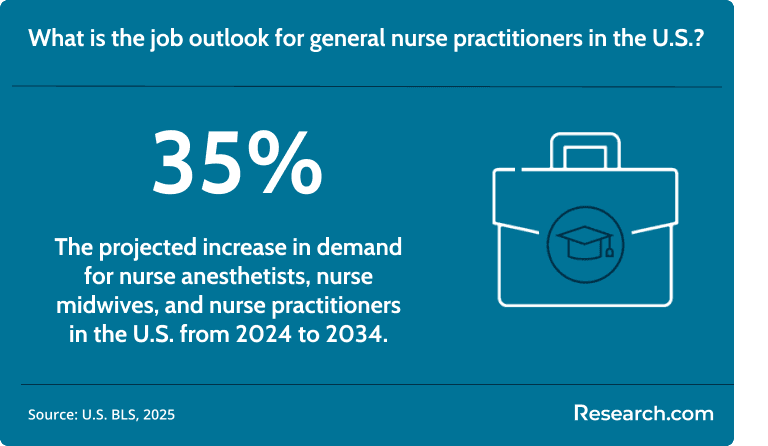
The job outlook for general nurse practitioners in the U.S. is exceedingly strong, reflecting broad demand across healthcare settings. According to the U.S. Bureau of Labor Statistics, overall employment of nurse anesthetists, nurse midwives, and nurse practitioners is projected to grow 35 percent from 2024 to 2034, a rate much faster than the average for all occupations.
Over that same period, the BLS estimates there will be about 32,700 openings per year, on average, resulting from both growth needs and the need to replace practitioners who exit the workforce.
This strong projected growth is driven by factors such as an aging population, rising prevalence of chronic disease, and expanded roles for advanced practice providers in primary and specialty care.
Moreover, as health systems seek to control costs and improve access, NPs are increasingly used in team-based and independent practice models. For nurses considering advanced degrees like the DNP, including options such as online DNP AGACNP programs, this favorable job climate reinforces that the investment in NP roles remains well aligned with market demand.
Here’s what graduates have to say about their DNP and NP degrees:
- Jessica: "Studying for my NP degree online allowed me to keep working full-time while gaining the advanced clinical skills I needed. The flexibility meant I could log in after shifts, and I still felt connected to professors and classmates through virtual discussions. I’m proud to now provide care at a higher level. "
- Michael: "Completing my DNP online gave me the chance to focus on leadership and quality improvement projects that directly impacted my workplace. The program’s structure allowed me to apply coursework in real time, which made the learning feel practical and rewarding. Earning this degree boosted my confidence and opened new doors. "
- Samantha: "The online NP track fit perfectly with my life as a working parent, and I never felt like I was missing out compared to in-person students. I gained hands-on experience through arranged clinical placements while enjoying the convenience of online lectures. Balancing school and family felt achievable, and that was life-changing. "
Key Findings
- NP programs generally require 500–700 clinical hours, while DNP programs mandate a minimum of 1,000 post-baccalaureate clinical hours.
- The median annual wage for nurse anesthetists, nurse midwives, and nurse practitioners was $132,050 in 2023, highlighting strong earning potential for advanced practice nurses.
- DNP-prepared nurses often pursue careers in administration, academia, and policy, whereas MSN-prepared NPs typically concentrate on direct patient care.
- Overall employment for these roles is projected to grow 35% from 2024 to 2034, far faster than the average for all occupations.
- An NP represents a clinical role that can be achieved with a master’s degree, while the DNP is a terminal degree focused on leadership, policy, and system-level change.
References:
- Burger, C. (2025). NP, DNP, and Ph.D. in Nursing: How High-Level Nursing Salaries Compare to MD Salaries. RegisteredNursing.org
- Indeed. (2025). FAQ: How Much Do NPs and DNPs Make? (With Definitions). Indeed
- Simmons University. (2025). The Simmons Doctor of Nursing Practice | Online. Simmons
- U.S. Bureau of Labor Statistics. (2025). Occupational Outlook Handbook: Nurse Anesthetists, Nurse Midwives, and Nurse Practitioners. U.S. BLS
Other things you should know about the difference between a DNP and an NP
In 2027, NP programs typically require a master’s degree over two to three years, focusing on clinical practice. DNP programs expand this with an additional one to two years, emphasizing leadership, healthcare systems, and evidence-based practice, culminating in a doctoral level of education.
In 2027, DNP programs emphasize leadership, policy, and clinical research, requiring around 1,000 clinical hours. NP programs focus on clinical practice specialties, requiring 500-700 hours. DNP curricula include courses like healthcare economics, while NPs focus more on advanced pathophysiology and pharmacology.


