
2027 Is an ABSN Degree Worth It? Program Length, Cost & Salary

Co-Founder and Chief Data Scientist
The stability, meaning, and professional respect of a nursing career are compelling reasons to consider a change. In fact, employment for RNs is projected to grow 5% until 2034, according to the U.S. Bureau of Labor Statistics. But if you already hold a bachelor’s degree, the thought of another four years of school can feel like an insurmountable barrier, making you question if your prior education was a waste.
That’s where the Accelerated Bachelor of Science in Nursing (ABSN) comes in. This unique pathway is designed to leverage your existing degree, not replace it, turning it into your greatest asset. This guide will provide a clear, data-driven analysis to help you answer the essential question: Is an ABSN degree worth it? We will break down the costs, timeline, and salary potential to see if this accelerated career pivot is the right move for you.
Key Things You Should Know About ABSN Degrees
- An ABSN program allows you to earn a full BSN degree in a compressed timeframe, typically 12-24 months. It’s important to note this timeline does not include the science prerequisites you must complete before you can apply.
- The investment in an ABSN leads to a strong financial return. As of 2024, the median annual pay for registered nurses was $93,600, with excellent long-term career prospects.
- The speed and quality of an ABSN program come at a price. Tuition can be high, and the intense, full-time schedule means you likely won't be able to work while you study.
- These programs are specifically created for students who, like you, already have a bachelor's degree in a non-nursing field, allowing you to focus exclusively on nursing coursework.
- The nursing field is projected to grow 6% until 2033, a rate faster than the average for all occupations, ensuring high demand for graduates.
- Is an ABSN degree a good investment today? Return on Investment
- How much does it cost to get an ABSN degree? Program Cost
- How long does it take to get an ABSN degree? Completion Time
- What is the job outlook for ABSN graduates? Job Outlook
- What is the earning potential and salary progression of an ABSN career? Earning Potential
- What are the benefits of getting an ABSN degree? Advantages
- What does the long-term career progression for an ABSN degree look like? What does the long-term career progression for an ABSN degree look like?
- What is the biggest risk of getting an ABSN degree? Risk Factors
- Who is an ABSN degree a great fit for? Who is an ABSN degree a great fit for?
- What are the top alternative careers to consider for an ABSN degree? Alternative Careers
- How do you calculate your personal ROI for an ABSN career? How do you calculate your personal ROI for an ABSN career?
- How do you decide if an ABSN career is worth it for you? How do you decide if an ABSN career is worth it for you?
Is an ABSN a good investment today?
Yes, from the perspective of market demand and long-term career stability, an ABSN is a sound investment to consider. A critical factor in answering the question, "Is an ABSN degree worth it?" is understanding the fundamental health of the nursing profession, and current data reveal a powerful trend ensuring high demand for years to come.
The healthcare industry is facing a major demographic shift. The current registered nurse workforce is aging, with almost 40% of nurses being 55 or older, according to the latest nursing workforce data. This points to a significant wave of upcoming retirements, which will create a substantial and sustained need for new, BSN-prepared nurses to fill these essential roles.
For a career changer, this demographic reality translates directly into strong job security and opportunity. It confirms that you would be entering a field with a clear, predictable, and urgent need for new talent, making the investment a strategic one.
This also highlights an important distinction in nursing education—similar to the difference between BSN and BS in nursing, where the former is designed for professional licensure and clinical readiness, while the latter focuses more on theory and general science. Choosing the right degree path directly impacts long-term career outcomes.
The market demand is strong. Now, let's quantify the first part of your personal investment: the financial cost.
How much does it cost to get an ABSN degree?
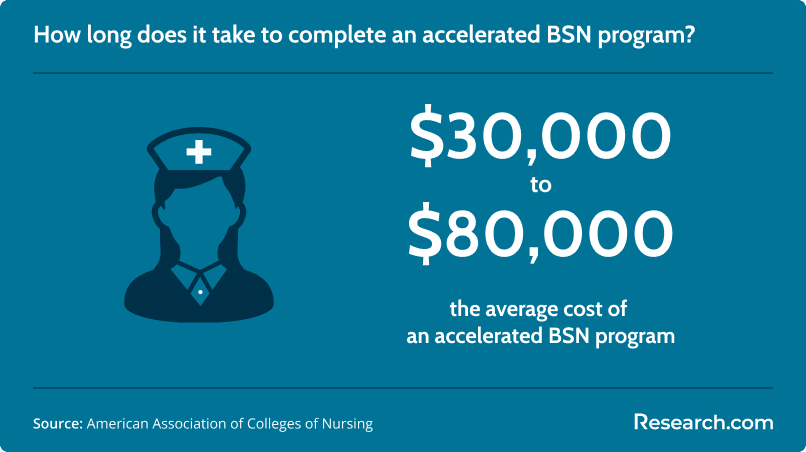
The typical tuition cost for an ABSN program ranges from $30,000 to $80,000+. This figure is the primary financial investment for the program and the first major variable in calculating your personal return on investment.
The most significant factor influencing where a program falls in this range is the type of institution. Private universities tend to be on the higher end, while public, state-funded universities often have more affordable tuition, particularly for in-state residents.
Note that the cost is for tuition and core fees; it does not include living expenses, books, or the potential loss of income while studying.
As a post-baccalaureate student, you should also explore all financial aid options, as there may be specific scholarships or loans for career changers entering high-need fields like nursing. To know the types of federal aid available to you, you can apply for the Free Application for Federal Student Aid (FAFSA).
If you are coming from another field entirely, going back to college as an adult may influence your total financial plan — including time management, income adjustments, and potential eligibility for nontraditional student aid programs.
How long does it take to get an ABSN degree?
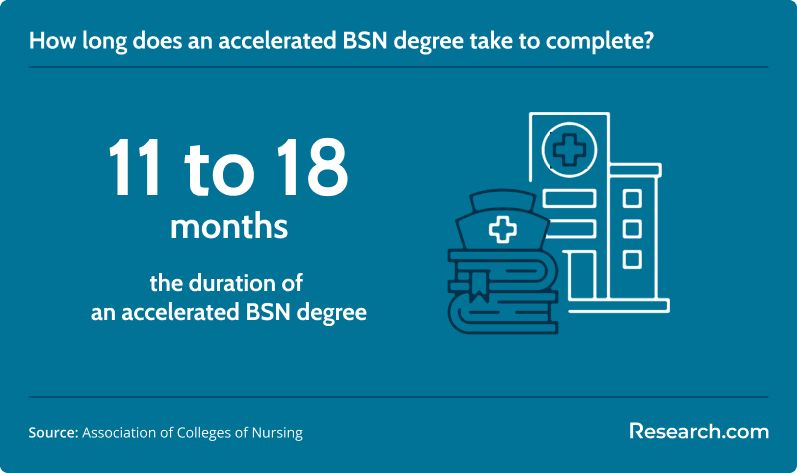
An ABSN program typically takes between 11 to 18 months of continuous, full-time study to complete. This rapid timeline is the central value proposition for career changers who want to enter the nursing field as efficiently as possible.
The program achieves this speed by focusing exclusively on nursing coursework, building upon the general education credits you've already earned with your first bachelor's degree.
Understanding the Total Timeline
It is crucial to understand that the 11- to 18-month timeframe refers to the core nursing program itself. This does not include the time it may take to complete any required science prerequisites. Many programs require courses like anatomy and physiology, microbiology, and chemistry, and if these were not part of your original degree, you will need to complete them before you can be admitted.
When planning your career transition, you must account for this prerequisite phase, which could add one or two semesters to your total timeline before the accelerated program even begins.
This timeline consideration is similar to other healthcare career transitions — for example, professionals becoming a nurse practitioner with a non-nursing bachelor's degree must complete additional coursework and licensure steps before entering practice.
Now that we've defined the investment in cost and time, let's examine the return. What does the job market look like upon graduation?
What is the job outlook for ABSN graduates?
The job outlook for ABSN graduates is strong, as they enter the workforce with the same valued credential as their peers from traditional programs. The U.S. Bureau of Labor Statistics projects that the job outlook for registered nurses will grow 6% until 2033, a rate that is faster than the average for all occupations. This provides a secure foundation for your career investment.
In addition, there are over 12,000 job openings for registered nurse roles, according to the job portal Indeed.
It's important to understand that an ABSN is a shortcut in time, not in quality. Graduates earn a full Bachelor of Science in Nursing and sit for the same national licensure exam (the NCLEX-RN) as students from four-year programs.
Employers, especially top-tier hospital systems and Magnet-recognized facilities, highly value BSN-prepared nurses for their critical thinking and leadership skills. In fact, your previous degree and life experience are often seen as additional assets, making you a mature and desirable candidate in the job market.
This positive outlook is also reflected when comparing other advanced nursing paths—such as NP vs DNP salary differences—where continued education and specialization lead to significantly higher earning potential over time.
Job security is the foundation. Now for the number that drives the ROI calculation: what can you expect to earn?
What is the earning potential and salary progression of an ABSN career?
The median annual pay for Registered Nurses was $93,600 as of May 2024. The strong earning potential is a central component when you ponder "Is an ABSN degree worth it?" as it forms the foundation of the return on your educational investment.
While the national median provides an excellent baseline, your actual starting salary and long-term earning potential will be influenced by several key factors.
Factors That Drive a Nurse's Salary
Your income as a nurse is not a static number. It is shaped by your specific circumstances and choices within the profession. Key variables include:
- Geography: Nurses working in metropolitan areas with a high cost of living and high demand often earn significantly more than those in rural areas.
- Clinical Specialty: Your choice of specialty plays a major role. High-acuity fields like critical care, surgical nursing, or obstetrics typically command higher salaries than general practice.
- Work Setting: As the data shows, hospitals are the largest employers, but salaries can differ between large urban medical centers, smaller community hospitals, government facilities, and outpatient clinics.
- Experience and Advancement: Your earning potential will continue to grow throughout your career as you gain experience and potentially pursue advanced certifications or move into leadership roles.
Beyond the excellent salary, what are the other core benefits of choosing this specific, accelerated path?
The chart below shows the industries where RNs work mostly.
What are the benefits of getting an ABSN degree?
For the motivated career changer, an ABSN program offers a powerful combination of speed and strategic value. The benefits go beyond simply entering a new field quickly; they center on leveraging your past education to build a more secure and rewarding professional future.
- Achieve the fastest possible career transformation. The most significant advantage is speed. An ABSN condenses a full nursing education into as little as 11-18 months, allowing you to transition into a professional nursing role and begin earning a salary much faster than a traditional four-year program.
- Leverage your existing degree for maximum efficiency. Your prior bachelor's degree is the key that unlocks this pathway. Because you have already completed all general education requirements, the program can focus entirely on the core nursing curriculum, saving you time and redundant coursework.
- Earn the valuable BSN credential. Graduating from an ABSN program makes you a BSN-prepared nurse, the gold standard in the profession. This credential not only makes you a more competitive candidate for top jobs but also serves as the necessary foundation for future career advancement.
- Secure a strong and immediate return on investment. The accelerated timeline means you start earning a professional salary sooner, which is a critical factor in the ROI calculation. With a median pay of over $93,000 for RNs, the financial return on your investment begins almost immediately upon graduation.
- Enter a stable and high-demand profession. With faster-than-average job growth and a wave of impending retirements in the field, nursing offers exceptional long-term career security. An ABSN is one of the most direct routes into this stable and essential sector of the economy.
We've established the immediate return on your investment. Let's now look at the bigger picture: what does a full career built on this foundation look like?
What does the long-term career progression for an ABSN look like?
Because an ABSN program provides you with a full BSN, the pathways for long-term career progression are excellent. While the initial goal is to become a skilled registered nurse, the BSN is the essential credential that unlocks a high ceiling for professional growth, positioning you to move beyond the bedside into roles with greater responsibility, autonomy, and earning potential.
After gaining clinical experience, your BSN serves as the foundation for advancement into leadership tracks to become a nurse manager or unit director. With a large percentage of the current RN workforce nearing retirement, a significant leadership vacuum is expected in the coming years, creating clear opportunities for ambitious BSN graduates.
Furthermore, the BSN is the prerequisite for graduate studies. If you aspire to the highest levels of clinical practice, you can pursue a Master of Science in Nursing (MSN) or a Doctor of Nursing Practice (DNP) to become an Advanced Practice Registered Nurse (APRN), such as a Nurse Practitioner.
Just as prospective students compare the professional scope of a PT vs chiropractor, it's important to understand that a BSN is the gateway to the advanced autonomy these graduate-level roles provide.
The long-term potential is high, but any high-stakes decision requires an honest look at the downsides. What is the single biggest risk you must consider?
The visual below shows that RNs are well represented in various age brackets.
What is the biggest risk of getting an ABSN degree?
The biggest risk of getting an ABSN degree is not financial or career-related; it is the sheer intensity of the program itself. The condensed timeframe demands an enormous personal and academic commitment, and while the career outcomes are strong, the path to get there is a demanding sprint.
You will be learning a vast amount of complex clinical information and mastering hands-on skills at a relentless pace, which carries a real risk of burnout. For many, the true test of answering the question, "Is an ABSN degree worth it?" comes down to weathering this intense process.
For 11 to 18 months, your studies will likely be the central focus of your life, leaving little time for work or other commitments. This risk can be managed with strong organizational skills and a robust support system, but it is a crucial factor in your decision.
If this level of intensity feels like a poor fit for your learning style or life circumstances, it's worth exploring other healthcare pathways. Understanding what is the difference between CMA and RMA, for example, can open up rewarding, hands-on clinical roles that may offer a less demanding educational entry point.
Understanding this risk is crucial. So, given the intensity, what kind of person is most likely to succeed and thrive in this environment?
Who is an ABSN degree a great fit for?
An ABSN degree is a great fit for a disciplined, highly motivated career changer who has a strong prior academic record and is ready to make their studies the central focus of their life for 12 to 18 months.
Successful candidates are not just looking for a change; they are goal-oriented individuals who thrive in a fast-paced, structured environment and possess excellent time management skills. They understand that the program is an intense, short-term sacrifice for a long-term professional gain and have a robust personal support system in place to help them navigate the demanding schedule.
Why Your First Degree Matters
The requirement of a prior bachelor's degree is not just an administrative checkbox; it is the core of the program's design. As the American Association of Colleges of Nursing (AACN) explains, an ABSN is a post-baccalaureate program where the "accelerated" nature is possible because students have already completed all general education requirements.
This proves you have the academic maturity and discipline to handle rigorous, university-level coursework. This focus on proven academic ability is what separates this path from other valuable healthcare roles.
While understanding what is a medical administrative assistant salary is important for those drawn to the organizational side of healthcare, the ABSN path is built for those with a demonstrated aptitude for science and a clear desire for hands-on, clinical responsibility.
If this profile sounds like you, that's a great sign. But to be certain, let's compare the RN career to other high-level clinical roles you might be considering.
What are the top alternative careers to consider for an ABSN degree?
While an ABSN offers the fastest route to becoming a BSN-prepared RN, it is wise to compare it to other advanced clinical careers that also leverage a prior bachelor's degree. Each of these paths requires graduate-level study and leads to a rewarding, high-demand profession.
- Physician Assistant (PA): A PA is a clinical professional who practices medicine on a team under the supervision of physicians, responsible for diagnosing illnesses and developing treatment plans. This career requires a master's degree.
- Physical Therapist (PT): A PT is a healthcare professional who helps patients recover from injuries and illnesses to regain movement and manage pain. This career requires a Doctor of Physical Therapy (DPT) degree.
- Occupational Therapist (OT): An OT is a professional focused on helping people with injuries, illnesses, or disabilities participate in the activities of everyday life. This career requires a doctoral degree (OTD).
- Speech-Language Pathologist (SLP): An SLP is a professional who assesses, diagnoses, and treats communication and swallowing disorders in patients of all ages. This career requires a master's degree.
- Licensed Practical Nurse (LPN): For those seeking the fastest and most affordable entry point into hands-on nursing, becoming an LPN is a strong option. This path requires a certificate or diploma and can serve as a strategic first step before bridging to an RN.
Other allied health careers can be potential alternatives since medical knowledge and the intensive practices required in nursing can be leveraged in other areas, as seen in EMT vs MA comparisons.
With all the data and comparisons on the table, it's time to build the tool that brings it all together for your personal situation.
How do you calculate your personal ROI for an ABSN career?
You can calculate your personal return on investment (ROI) by comparing your total estimated investment against your projected increase in earnings over a set period. A simple framework is to first calculate your total cost, then estimate your future earnings, and finally determine how long it will take for your increased salary to pay back your initial investment.
- Calculate Total Investment: (Total Program Tuition) + (Lost Wages During Study) = Total Investment
- Calculate Annual Gain: (Expected Annual RN Salary) - (Your Current Annual Salary) = Annual Gain in Income
- Determine Payback Period: (Total Investment) / (Annual Gain in Income) = Years to Recoup Investment
The Most Important Variable: Opportunity Cost
The most crucial and often overlooked part of this calculation is the opportunity cost. This refers to the salary you will forgo by leaving your current job to study full-time. For example, if you leave a $60,000/year job for an 18-month (1.5 years) program, your lost wages are $90,000. Adding this to a tuition of $60,000 brings your total investment to $150,000.
While this number seems high, it provides the most accurate picture of the true cost, allowing you to make a fully informed financial decision.
You have the financial calculation. Now for the final step: putting it all together to make your decision.
How do you decide if an ABSN career is worth it for you?
The final decision of whether an ABSN is the right path for you comes down to answering two essential questions. After analyzing the market demand, career potential, costs, and risks, you must validate both the financial logic and your personal readiness for this unique challenge.
Answering "yes" to both of these questions is a strong indicator that this accelerated pathway is a great fit. So, is an ABSN degree worth it? How do you decide? Start here.
1. Does the financial ROI work for your specific situation?
Run the numbers using the ROI framework from the previous section. Is the payback period acceptable to you? Are you financially prepared to handle the upfront costs of tuition and the opportunity cost of lost wages? A positive financial return is the logical foundation for this career pivot.
2. Are you personally prepared for the commitment?
Be honest with yourself about the intensity. Do you have the academic discipline, time management skills, and personal support system to succeed in a demanding, full-time program for 11 to 18 months? A "yes" to this question confirms you are not only choosing a smart investment but one that you are personally equipped to handle.
Exploring Niche Roles in Healthcare
If your ROI calculation is positive but you hesitate on the personal commitment, it’s a sign to explore all your options. A career in healthcare is vast, and there are many paths to a fulfilling, stable role. While a podiatry medical assistant salary may differ from that of an RN, such specialized clinical support roles can offer an excellent career with a less intensive educational entry point.
The best choice is one that aligns with both your financial goals and your personal capacity, setting you up for long-term success.
Here’s What Graduates Have to Say about Their ABSN Degree Program
- Conan: "The idea of being out of the workforce for four years was just not an option for me. The 16-month timeline of my ABSN program was the main reason I chose it. It was a complete whirlwind, and I basically lived at the library and in the clinical labs. But being able to go from my old marketing job to a registered nurse in under two years was exactly the rapid transformation I needed."
- Jordan: "One of the best parts of the program was the people in my cohort. We were all career changers from different backgrounds—teachers, business analysts, even a graphic designer. That maturity and shared sense of purpose created an incredible support system. We studied together, practiced skills on each other, and got through the toughest exam weeks as a team."
- Sona: "I was concerned that "accelerated" might mean "watered down," but that couldn't have been further from the truth. The amount of clinical and scientific knowledge we were expected to master was immense. The clinical rotations started almost immediately, so we were applying what we learned in a real hospital setting from the very beginning. I felt incredibly well-prepared to take the NCLEX and start my first job."
Key Findings
- The primary value of an ABSN is its speed, compressing a full BSN education into an 11- to 18-month timeline, making it the most efficient path for degree-holders to enter the nursing profession.
- With a median annual salary of $93,600 for Registered Nurses, the financial return on the significant tuition investment is substantial and provides a clear pathway to high earning potential.
- The nursing profession offers strong job security, with a projected growth rate of 6% between 2023 and 2033, ensuring that the demand for graduates remains high.
- A major demographic trend, with 13.2% of the current RN workforce aged 65 or older, indicates a massive wave of retirements that will create significant opportunities and a leadership vacuum for new nurses.
- The biggest risk is not a poor career outcome but the intense academic and personal burnout from the program's rigor, which requires a full-time commitment.
- The total cost of an ABSN program goes beyond the typical $30,000 to $80,000+ in tuition; a true ROI calculation must also include the opportunity cost of lost wages during the study period.
References:
- Health Resources and Services Administration. (2024, March). 2022 National Sample Survey of Registered Nurses: Snapshot. Retrieved October 15, 2025, from https://bhw.hrsa.gov/sites/default/files/bureau-health-workforce/Nurse-Survey-Fact-Sheet-2024.pdf
- Smiley, R. A., Kaminski-Ozturk, N., Reid, M., Burwell, P., Oliveira, C. M., Shobo, Y., ... & Martin, B. (2025). The 2024 National Nursing Workforce Survey. Journal of Nursing Regulation, 16(1), S1-S88. https://doi.org/10.1016/S2155-8256(23)00047-9
- U.S. Bureau of Labor Statistics. (2024, April 3). 29-1141 Registered nurses. Occupational Employment and Wage Statistics. Retrieved October 15, 2025, from https://www.bls.gov/oes/2023/may/oes291141.htm
- U.S. Bureau of Labor Statistics. (2025, August 28). Registered nurses. Occupational Outlook Handbook. Retrieved October 15, 2025, from https://www.bls.gov/ooh/healthcare/registered-nurses.htm
- Zippia. (2025, January 8). Registered nurse education requirements. Retrieved October 15, 2025, from https://www.zippia.com/registered-nurse-jobs/education/
Other Things You Should Know About an ABSN Degree
In 2027, second-degree students in ABSN programs may access various financial aid options, including federal loans, scholarships, and grants. While some schools offer merit-based or need-based aid, students should also explore private scholarships targeted at nursing students.
To enroll in an ABSN program in 2027, you typically need a bachelor's degree in a non-nursing field and a minimum GPA, often 3.0 or higher. Prerequisite courses may include human anatomy, physiology, microbiology, and statistics, depending on the program.


