
2027 Nurse Practitioner MSN vs. DNP vs. BSN: Explaining the Difference

Co-Founder and Chief Data Scientist
More than 431,000 nurse practitioners are licensed in the U.S. today, and the demand for advanced nursing roles is only growing. Yet for many aspiring nurses, the choice between a BSN, MSN, and DNP is confusing.
This article breaks down what each degree means, how much it costs, the career paths it opens, and the salaries graduates can expect. By the end, you’ll have a clear comparison to help decide which track best aligns with your career goals in nursing.
Key Things You Should Know About Nurse Practitioner MSN, DNP, and BSN
- A BSN (Bachelor of Science in Nursing) is the entry-level degree for registered nurses, providing the foundation for licensure and clinical practice. It is often required for advanced education and serves as the stepping stone toward MSN or DNP programs.
- An MSN (Master of Science in Nursing) qualifies nurses to become nurse practitioners or specialize in fields like administration, education, or advanced clinical roles. It typically takes two years after a BSN and is the minimum degree for NP practice.
- A DNP (Doctor of Nursing Practice) is the terminal practice-focused doctorate in nursing. It prepares NPs for leadership, policy, and top-level clinical expertise. While longer and more costly, it can provide greater autonomy, influence, and higher earning potential.
- What is the difference between nurse practitioner MSN vs. DNP, and BSN? MSN vs DNP vs BSN
- How long does it take to complete a BSN, MSN (NP track), or DNP program? Completion Time
- What are the costs and financial investment for BSN, MSN and DNP? Education Costs & Investment
- What career opportunities and job titles can I get with an NP-MSN vs DNP vs BSN? Career Paths
- How do salaries compare between NP-MSN, NP-DNP, and BSN-prepared nurses? Salary by Degree
- What are the clinical hours and practicum requirements for MSN vs DNP vs BSN? Clinical Hours & Practicum
- Is the DNP becoming the required entry degree for nurse practitioners? DNP Entry Requirement
- Can I go from BSN directly to DNP (BSN-to-DNP), or do I need to do an MSN first? BSN-to-DNP Path
- What are the pros and cons of choosing an MSN versus a DNP for NP practice? What are the pros and cons of choosing an MSN versus a DNP for NP practice?
- How should I decide whether NP-MSN, DNP, or BSN is right for me? How should I decide whether NP-MSN, DNP, or BSN is right for me?
What is the difference between nurse practitioner MSN vs. DNP, and BSN?
Choosing between an MSN, DNP, or BSN depends on where you are in your nursing career and how far you want to advance. Each program serves a different purpose: the BSN is the entry point, the MSN unlocks advanced practice opportunities, and the DNP represents the highest level of clinical and leadership training. Understanding these distinctions helps prospective nurses align their education with their career goals, scope of practice, and long-term professional growth.
Nurse Practitioner—Master of Science in Nursing
The MSN (Master of Science in Nursing) is the degree that allows nurses to step into advanced practice roles, including becoming nurse practitioners, educators, or administrators. It typically takes two years beyond the BSN and focuses on both clinical expertise and leadership skills. This program is suited for registered nurses who want to expand their scope of practice, gain prescriptive authority, or specialize in areas like pediatrics, geriatrics, or mental health. MSN students can pursue different tracks depending on their career goals, as outlined in the types of MSN degrees. The MSN is also the minimum requirement to become a nurse practitioner in the U.S., making it a critical step for those seeking advanced responsibilities.
Doctor of Nursing Practice
The Doctor of Nursing Practice (DNP) is a practice-focused doctoral degree and the terminal credential for nurses who want the highest level of clinical and leadership preparation. Unlike a PhD, which is research-oriented, the DNP emphasizes applying evidence-based practice to improve patient outcomes and healthcare systems. This degree often takes three to four years beyond the MSN and prepares graduates for top-level roles such as healthcare executives, policy advisors, or highly autonomous nurse practitioners. The DNP is ideal for those aiming to influence healthcare delivery at the systems level or advance into leadership while maintaining a clinical practice focus.
Bachelor of Science in Nursing
The Bachelor of Science in Nursing (BSN) is the entry-level degree for aspiring registered nurses and is required for licensure. A BSN usually takes four years to complete and covers a wide range of topics, including anatomy, pharmacology, public health, and leadership in nursing. It balances classroom learning with clinical rotations, preparing students for the NCLEX-RN exam and the realities of patient care. The BSN is designed for students starting their nursing journey, but it also serves as the foundation for advanced programs like the MSN or DNP. In today’s job market, a BSN is often the minimum qualification for hospital-based positions and is essential for long-term career advancement.
How long does it take to complete a BSN, MSN (NP track), or DNP program?
A BSN program generally takes four years to complete if pursued full-time, though accelerated options can shorten the timeline to 12–18 months for those who already hold a degree in another field. The BSN provides the foundational training required to become a registered nurse and prepares students for advanced studies.
An MSN program, including nurse practitioner tracks, usually takes two years beyond the BSN when studied full-time. However, part-time and online programs may stretch the timeline to three or more years, especially for working professionals. These programs combine advanced clinical practice with coursework in research, leadership, and specialized tracks such as family, pediatric, or psychiatric nursing.
A DNP program often takes three to four years if pursued after the MSN, or up to six years if entering directly from the BSN. DNP programs are more intensive and focus on clinical leadership, evidence-based practice, and healthcare systems. For nurses who want to complete their doctorate faster, there are fastest DNP programs that can be finished in as little as 18–24 months.
The timelines highlight how each step builds on the last—BSN as entry-level preparation, MSN as the gateway to advanced practice, and DNP as the terminal degree for practice and leadership.
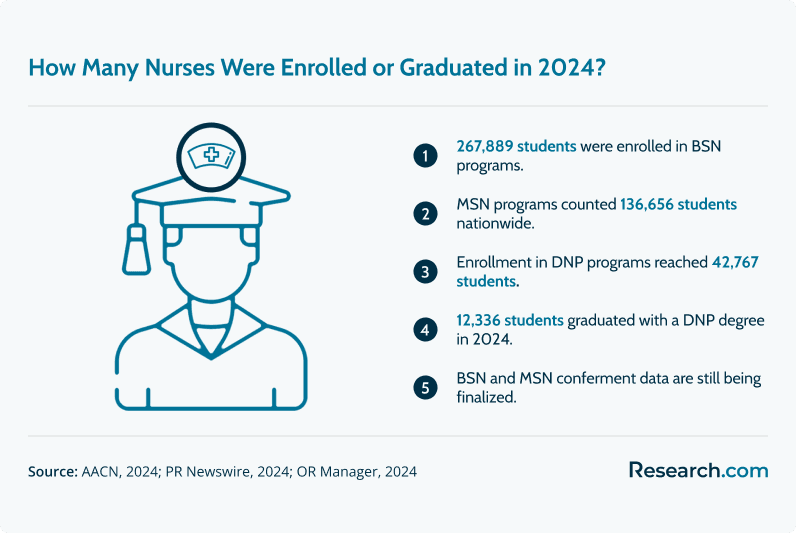
The infographic below shows the latest enrollment and graduation figures for 2024. It adds context to these timelines by illustrating how many students are actually entering or completing BSN, MSN, and DNP programs nationwide.
What are the costs and financial investment for BSN, MSN, and DNP?
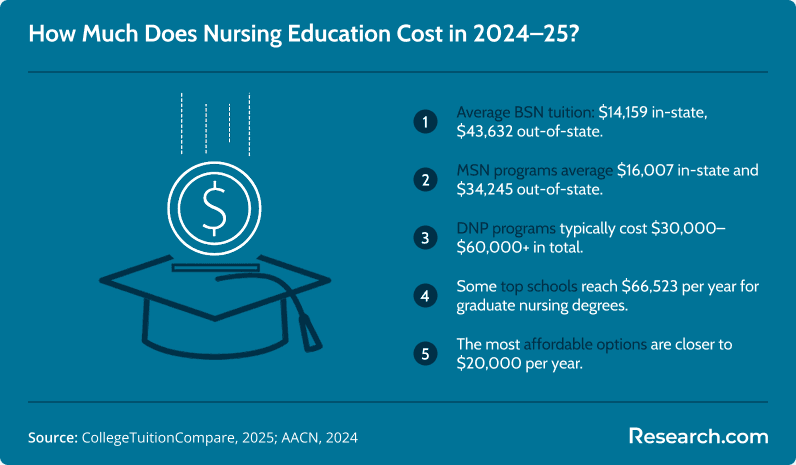
The cost of earning a BSN, MSN, or DNP varies widely depending on the school, state residency, and program format. On average, a BSN degree costs $14,159 per year for in-state students and $43,632 for out-of-state students. This makes the BSN one of the more significant financial commitments at the undergraduate level, especially for students attending private or out-of-state institutions.
For graduate studies, an MSN program averages $16,007 annually for in-state tuition and $34,245 for out-of-state tuition. Costs may rise significantly at elite universities, where tuition can exceed $50,000 annually. Despite this, MSN graduates often see higher earning potential and career mobility, making the investment worthwhile for many.
A DNP degree is the most expensive, typically ranging between $30,000 and $60,000+ in total. Some of the most prestigious schools list tuition as high as $66,523 per year, while more affordable programs may cost closer to $20,000 annually. While costly, the DNP is the terminal degree for nursing practice and positions graduates for top clinical and leadership roles.
When evaluating long-term ROI, students can compare nursing education to other high-investment fields such as pharmacist vs Pharm D, where advanced credentials require significant financial outlay but lead to strong professional payoffs.
The infographic below breaks down the average costs for each degree path. It offers a snapshot of how expenses escalate from BSN to MSN and ultimately to the DNP, helping future students plan their financial investment more realistically.
What career opportunities and job titles can I get with an NP-MSN vs DNP vs BSN?
With a BSN, MSN, or DNP, the range of career opportunities expands significantly, with higher degrees generally leading to more advanced roles, greater autonomy, and higher salaries. A BSN graduate qualifies for entry-level registered nurse positions, while an MSN opens pathways into advanced practice and leadership. The DNP, as the highest practice-focused degree in nursing, equips graduates for specialized clinical and executive-level roles.
Career opportunities with an NP-MSN:
- Nurse Practitioner (various specialties such as family, acute care, pediatrics, or psychiatric)
- Clinical Nurse Specialist
- Nurse Educator
- Nurse Manager or Administrator
- Advanced Clinical Research Nurse
Career opportunities with a DNP:
- Nurse Practitioner with expanded scope and leadership responsibilities
- Clinical Director or Chief Nursing Officer
- Health Policy Advisor
- Academic Faculty in Nursing Schools
- Advanced Practice Nurse in specialized fields (oncology, cardiology, critical care)
Career opportunities with a BSN:
- Registered Nurse (hospital, outpatient, community health)
- Public Health Nurse
- School Nurse
- Case Manager
- Charge Nurse or Unit Supervisor
This progression shows how advancing from BSN to MSN to DNP directly broadens career options, with each stage offering increased authority, influence, and earning potential. The hierarchy is similar to distinctions seen in business or academia, such as difference between masters and PhD, where each level opens distinct professional pathways and salary ranges.
How do salaries compare between NP-MSN, NP-DNP, and BSN-prepared nurses?
Nurses with an MSN or DNP generally earn more than those with a BSN, but the margin depends on role and specialization. According to BLS (2024), nurse practitioners — regardless of whether they hold an MSN or DNP — earned a median annual salary of $129,480, with the top 10% making over $165,000. In comparison, registered nurses, most of whom are BSN-prepared, reported a median of $93,600. This shows a significant salary premium for advancing to NP-level roles.
Self-reported data from Zippia (2025) adds more nuance. NP-MSN graduates average around $110,875, while NP-DNP holders earn about $110,237—indicating little difference between the two. Among nurses, those with a master’s degree make about $79,847, compared to $63,583 for BSN-prepared RNs, and $65,766 for doctorate-prepared nurses in non-NP tracks.
The big picture: salaries rise with education, but the largest jump comes when advancing into nurse practitioner roles. For more granular comparisons, especially by region, see the Doctor of Nursing practice salary data by state.
The chart below highlights how salaries shift based on degree level, helping you weigh the financial trade-offs between staying at the BSN level or advancing into MSN and DNP preparation. These figures make it clear that career path and education level both play a role in long-term compensation.
What are the clinical hours and practicum requirements for MSN vs DNP vs BSN?
Clinical hours and practicum requirements vary widely between BSN, MSN, and DNP programs, but each has a defined experiential component to ensure competency. BSN programs generally require around 600–800 clinical hours, spread across core areas like pediatrics, adult health, obstetrics, and community care. These experiences introduce students to direct patient care while strengthening critical thinking and communication skills.
MSN programs with a nurse practitioner focus usually demand 500–700 supervised clinical hours, though some schools may require more depending on the NP track. The goal is to deepen clinical expertise and prepare students for advanced practice roles, often in primary or specialty care settings.
DNP programs require the most: typically 1,000 or more post-baccalaureate practice hours, which may combine MSN-level hours with additional DNP-level residency or project work. This expanded training emphasizes leadership, evidence-based practice, and systems-level care improvement, preparing graduates for top-tier clinical or administrative roles.
The chart below illustrates how employers prioritize licensure and hands-on clinical experience when hiring NPs and RNs. These requirements align with the emphasis placed on practicum hours in nursing education and highlight how training standards match job market expectations. For students seeking faster pathways, some accelerated online RN programs 1 year offer condensed formats but still integrate required clinical hours.
Is the DNP becoming the required entry degree for nurse practitioners?
The Doctor of Nursing Practice (DNP) is not yet a universal requirement for nurse practitioners, but the trend is moving in that direction. Currently, most NPs enter practice with a Master of Science in Nursing (MSN), which still meets state licensure and certification requirements across the United States. However, nursing organizations, including the American Association of Colleges of Nursing (AACN), have long advocated for the DNP to become the standard entry-level degree.
This push is driven by the growing complexity of healthcare delivery, which demands advanced skills in leadership, clinical judgment, and systems management. A DNP equips graduates with deeper expertise in evidence-based practice, healthcare policy, and quality improvement compared to MSN programs. Still, shifting the requirement has faced challenges, such as program costs, the capacity of nursing schools, and workforce demand for NPs.
In practice, MSN-prepared NPs continue to dominate the workforce, but the steady rise in DNP enrollment and conferrals shows the profession may ultimately transition toward making the DNP the expected credential. This mirrors the gradual evolution seen in education degrees — for instance, the master of arts in teaching vs master of education distinction reflects similar specialization trends within professional advancement.
Can I go from BSN directly to DNP (BSN-to-DNP), or do I need to do an MSN first?
Yes, many nursing schools now offer BSN-to-DNP programs that allow students to skip a standalone MSN and move directly into doctoral-level training. These pathways are designed for BSN-prepared nurses who want to advance their practice without completing a separate master’s degree. Instead, the curriculum combines core MSN-level coursework with the additional clinical hours, research, and leadership training required for a Doctor of Nursing Practice degree.
Program lengths vary but often take three to four years of full-time study, which is longer than an MSN but shorter than completing an MSN and then a DNP separately. Students can usually choose a population focus such as family practice, pediatrics, or acute care, tailoring their degree toward their intended specialty. These programs provide a streamlined route for motivated nurses who want to maximize their education and long-term career opportunities.
For those seeking cost-conscious options, many institutions now offer affordable online BSN to DNP degree programs, which make it possible to pursue this track without relocating or significantly interrupting full-time work. This flexibility has helped make BSN-to-DNP pathways one of the fastest-growing options in advanced nursing education.
What are the pros and cons of choosing an MSN versus a DNP for NP practice?
The main difference between pursuing an MSN versus a DNP lies in the balance between time, cost, and long-term career benefits. An MSN remains the faster and more common route into nurse practitioner practice, while the DNP offers the highest level of clinical training and leadership preparation.
MSN Pros:
- Shorter time to completion, often 2 years full-time.
- Lower tuition compared to doctoral programs.
- Meets all current licensure requirements for NP practice.
- Broad choice of specialties and flexible study formats.
MSN Cons:
- May face future pressure if the DNP becomes the standard.
- Less emphasis on research, policy, and leadership training.
DNP Pros:
- Highest level of clinical preparation for advanced practice nurses.
- Strong focus on leadership, evidence-based practice, and healthcare systems.
- Competitive advantage for academic, research, and policy roles.
- May align with future entry-level expectations.
DNP Cons:
- Requires 3–4 years of study after a BSN, longer than MSN.
- Higher total cost of education.
- Less common as an entry route, though growing steadily.
Ultimately, the decision depends on your goals and resources. Students should weigh the benefits of getting a doctorate degree in education in the same way — higher credentials bring broader influence, but they also demand more time, money, and long-term commitment.
How should I decide whether NP-MSN, DNP, or BSN is right for me?
Deciding between a BSN, MSN, or DNP depends on your career goals, time commitment, and financial situation. Each program offers unique advantages and prepares you for different roles within nursing.
Considerations for a BSN
- Best starting point for those entering nursing.
- Required for RN licensure and bedside practice.
- Provides foundational clinical and academic training.
- Shorter time to completion compared to graduate degrees.
- Can serve as a stepping stone toward advanced practice.
Considerations for an MSN
- Leads directly to nurse practitioner roles and higher salaries.
- Allows for specialization in fields such as family, pediatric, or acute care.
- Often available through flexible RN to MSN online programs.
- Shorter path to advanced practice compared to a DNP.
- Balances affordability with access to higher-level careers.
Considerations for a DNP
- Designed for the highest level of nursing practice.
- Equips graduates for leadership, research translation, and policy work.
- Longer and more expensive, but offers broad influence in healthcare systems.
- May provide competitive edge as more institutions prefer DNP-trained NPs.
- Ideal for those seeking academic or executive roles in nursing.
The chart below shows projected job growth for RNs and NPs, illustrating why advanced degrees often provide stronger long-term opportunities in both career advancement and job security.
Here's What Graduates Have to Say About Their Nurse Practitioner MSN, DNP, and BSN Programs
- Leona: "Completing my MSN online gave me the flexibility to keep working as an RN while advancing my education. The coursework was rigorous but manageable, and the focus on clinical practice prepared me to step into a nurse practitioner role confidently. "
- Marisol: "The DNP program challenged me to think beyond bedside care. Online classes let me balance family life with research projects, and I came out equipped to influence policies and mentor future nurses. "
- Soren: "Earning my BSN online opened doors I didn’t expect. The program strengthened my leadership skills, exposed me to evidence-based practice, and gave me the confidence to pursue graduate studies while continuing full-time hospital work. "
Key Findings
- Nurse practitioners with an MSN earn a median salary of $110,875, while those with a DNP earn $110,237.
- Nurses with only a BSN earn a median of $63,583 annually.
- The job outlook for NPs is +38% from 2024–2034, compared to +5% for RNs.
- BSN programs had 267,889 enrolled students in 2024, while DNP programs had 42,767.
- MSN tuition averages $16,007 in-state, while DNP programs often cost $30,000–$60,000+ in total.
- Employers list licensure (21.15% of postings for NPs; 26.59% for RNs) and clinical experience as top hiring priorities.
References:
- AACN (American Association of Colleges of Nursing). DNP Fact Sheet.
- AACN (American Association of Colleges of Nursing). Schools of Nursing Enrollment Increases Across Most Program Levels.
- AANP (American Association of Nurse Practitioners). NP Facts.
- AANP (American Association of Nurse Practitioners). Nurse Practitioners Secure No. 1 Spot Across Three U.S. News & World Report Best Jobs Rankings.
- AANP (American Association of Nurse Practitioners). NP Infographic 2022.
- AANP (American Association of Nurse Practitioners). NP Student Snapshot PC AC PMH 2015–2024.
- AANPCB (American Association of Nurse Practitioners Certification Board). 2023 Annual Report.
- APEA (Advanced Practice Education Associates). 2024 Nurse Practitioner Certification Pass Rates.
- BLS (U.S. Bureau of Labor Statistics). Nurse Anesthetists, Nurse Midwives, and Nurse Practitioners.
- BLS (U.S. Bureau of Labor Statistics). Registered Nurses.
- CollegeTuitionCompare. Best Nursing Schools.
- CollegeTuitionCompare. Best Nurse Practitioner: Adult Colleges.
- CollegeTuitionCompare. Best Nurse Practitioner: Family Colleges.
- Kaplan Test Prep. NCLEX Pass Rates: What You Need to Know.
- Media.Nurse.org. 2024 State of Nursing.
- OR Manager. Survey: Nursing School Enrollment Grows but PhD Programs Continue Decline.
- PMC (PubMed Central). Nurse Practitioner Workforce Trends Article.
- PR Newswire. Schools of Nursing See Enrollment Increases Across Most Program Levels.
- Zippia. Nurse Jobs Overview.
- Zippia. Nurse Practitioner Jobs Overview.
- ZipRecruiter. NP Must-Have Resume Skills and Keywords.
- ZipRecruiter. RN Must-Have Resume Skills and Keywords.
Other Things You Should Know About Nurse Practitioner MSN, DNP, and BSN Programs
In 2027, a BSN is an undergraduate degree and the entry-level requirement for becoming a registered nurse. An MSN allows nurses to specialize and become a Nurse Practitioner, while a DNP is a terminal degree focusing on clinical practice and leadership. Each builds on the previous education level.
In 2027, a BSN prepares nurses for entry-level roles in hospitals, clinics, or community settings. An MSN enables advanced practice roles like Nurse Practitioner or Clinical Nurse Specialist. A DNP emphasizes leadership, focusing on executive positions, healthcare policy, or advanced clinical practice.


