
2027 MAE vs. MAT vs. EdS vs. EdD: Comparison of Graduate Degrees in Education

Co-Founder and Chief Data Scientist
Choosing the right advanced credential in education—MAE, MAT, EdS, or EdD—is often a major professional pivot, yet reliable information is surprisingly fragmented. Many aspiring leaders become stalled trying to distinguish between a classroom-focused Master of Arts in Teaching and a systemic Doctor of Education. The acronyms look similar, but their career destinations—from instructional coaching to district superintendency—demand completely different academic preparations. As your dedicated career planning and education expert, I recognize the friction caused by this lack of clarity.
This resource cuts through the confusion, offering precise comparisons of program lengths, salary potential, and job market trends for each degree. My goal is to equip you with the accurate data needed to make a confident, impactful decision for your future.
What are the benefits of getting a graduate degree in education?
- Career Advancement: Opens doors to leadership, teaching specialization, curriculum design, higher education roles, and district-level positions.
- Earning Potential: Graduate degrees in education lead to higher salaries, with averages ranging from $65,000 to $125,000 depending on degree level and role.
- Flexible Learning: Many programs are available online or in hybrid format, enabling educators to balance professional work with advanced studies.
What can I expect from an online graduate program in education?
- Focused Advanced Topics: Depending on the degree, courses include pedagogy, educational leadership, curriculum design, instructional technology, or policy studies.
- Structured Curriculum: Programs combine theory, research, practica (MAT, MAE), or field-based capstone projects (EdS, EdD).
- Applied Strategic Knowledge: Strong emphasis on applying theory to real-world classrooms or district-wide leadership issues.
- Condensed or Extended Timeline: MAT or MAE programs can be completed in 1–2 years; EdS around 2 years; EdD often 3–5 years.
- Networking Opportunities: Connect with experienced faculty and peers across school systems, higher education, and policy organizations.
Where can I work with a graduate degree in education?
- K–12 Schools: Teacher, Instructional Coach, Curriculum Specialist, or Educational Leader.
- Higher Education: Roles in academic advising, administration, or teaching at the college/university level.
- District & State Leadership: Superintendent, Policy Advisor, or Director of Curriculum and Instruction.
- Nonprofits & Education Policy: Develop or analyze educational programs and policies.
- Consulting & Training: Work as an education consultant, instructional designer, or professional development trainer.
- Pathway to Leadership: Strong preparation for principal, dean, or superintendent-level roles.
How much can I make with a graduate degree in education?
- MAE (Master of Arts in Education): Median salaries range from $65,000 to $80,000 (Teacher, Curriculum Specialist, Instructional Coordinator) [Payscale, Salary.com].
- MAT (Master of Arts in Teaching): Median salaries range from $60,000 to $75,000 (Classroom Teacher, Literacy Specialist, ESL Educator) [Indeed, Payscale].
- EdS (Education Specialist): Salaries average $75,000 to $95,000 (School Psychologist, District Data Analyst, Curriculum Director) [Salary.com, Payscale].
- EdD (Doctor of Education): Salaries typically range from $90,000 to $125,000+, with superintendents, higher education administrators, and senior instructional leaders often earning $110,000–$160,000 [Salary.com].
- What are the similarities and differences between MAE, MAT, EdS, and EdD degrees? MAE vs. MAT vs. EdS vs. EdD
- How long does it take to complete an MAE, MAT, EdS, or EdD program? Program Duration
- What are the career opportunities available with MAE, MAT, EdS, and EdD credentials? Career opportunities
- What are the typical salaries for MAE, MAT, EdS, and EdD graduates? Salaries
- What is the job market outlook for educators with MAE, MAT, EdS, and EdD degrees? Job market
- What professional pathways and functions are associated with MAE, MAT, EdS, and EdD degrees? Professional pathways
- How do online EdD programs support work-life balance and career advancement? How do online EdD programs support work-life balance and career advancement?
- Which universities and colleges in the USA offer MAE, MAT, EdS, and EdD programs? Universities
- What are the biggest challenges faced by professionals holding MAE, MAT, EdS, and EdD degrees? What are the biggest challenges faced by professionals holding MAE, MAT, EdS, and EdD degrees?
- What are the advantages and career opportunities of pursuing an EdS or EdD over an MAE or MAT? What are the advantages and career opportunities of pursuing an EdS or EdD over an MAE or MAT?
- What are some current and future trends related to MAE, MAT, EdS, and EdD programs in the USA? Trends
What are the similarities and differences between MAE, MAT, EdS, and EdD degrees?
These four credentials represent various levels of expertise in the field of education, ranging from instructional mastery to high-level systemic leadership.
Similarities
- All degrees are designed to advance professional practice and leadership in the field of education.
- All programs emphasize improved instructional effectiveness, educational outcomes, and systemic improvement.
- Capstone projects, applied learning, or research components are common across the programs, though the scope varies.
- Each degree offers pathways to career advancement, from classroom teaching to district-level or higher education leadership.
Differences
- Academic Level: MAE and MAT are master's degrees, EdS is a post-master's specialization, and EdD is a terminal doctorate.
- Administration Focus: MAE often includes pathways for administration, curriculum design, or specialized teaching roles outside the classroom.
- Curriculum Emphasis (MAE): Broad focus on educational theory, policy, curriculum development, and instructional design principles.
- Curriculum Emphasis (MAT): Concentrated on pedagogy, clinical experience, and subject-specific teaching for classroom application.
- Dissertation Requirement (EdD): Nearly always includes a dissertation or applied capstone project solving real-world institutional problems.
- Dissertation Requirement (EdS/MAT/MAE): Typically does not include a dissertation, substituting capstone projects, exams, or portfolios.
- EdD Purpose: Geared toward practitioner-scholars who want to lead systemic reform and implement research-based solutions.
- EdS Purpose: A post-master's degree for specialized administrative certification (e.g., superintendent, principal) without full doctoral research.
- Licensure Pathway (MAT): Often designed as an initial pathway to K-12 certification for those without prior teaching credentials.
- Licensure Pathway (MAE): Typically requires prior teaching certification, adding endorsements or advanced expertise.
- Role Focus (MAE/MAT): Concentrated on classroom practice, instructional improvement, and student learning.
- Role Focus (EdS/EdD): Concentrated on executive leadership, policy analysis, and organizational management at district or university levels.
Understanding the difference in focus, from classroom practice to district policy, is key to selecting the appropriate degree path. Ultimately, the best degree depends on whether an individual seeks deep instructional expertise or broad organizational leadership influence.
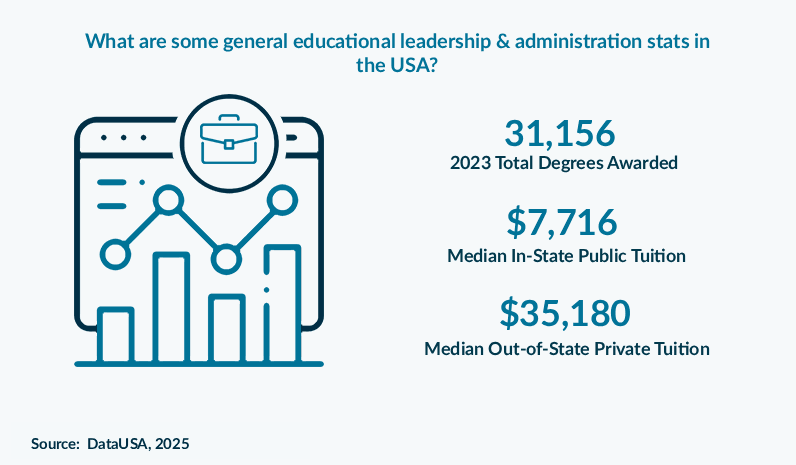
In 2023, 31,156 degrees were awarded in educational leadership and administration, reflecting a 5.61% decline that suggests a slight decrease in new graduates. Despite this, average wages rose 3.46% to $66,881, while the workforce remained stable at 5.15 million, growing 0.595%, with the average employee age at 46.3 years, increasing by just 0.157% (DataUSA, 2025). Tuition costs show a clear divide: median in-state public tuition was $7,716, rising 0.784%, whereas median out-of-state private tuition was $35,180, with a 3.78% increase. The cheapest online educational leadership programs may reverse this trend in the future.
These figures, shown in the graphic below, indicate steady wages and workforce stability alongside a widening financial gap between public and private education options that prospective students should consider (DataUSA, 2025).
How long does it take to complete an MAE, MAT, EdS, or EdD program?
The time required to complete one of these advanced education degrees varies significantly based on the degree level, full-time or part-time enrollment, and the presence of thesis or dissertation requirements. Generally, the commitment progresses incrementally from the master's to the specialist and doctoral levels, reflecting the depth of study involved.
- MAE/MAT Full-Time: Typically requires 1 to 2 years of full-time study, as these programs often mandate 30-45 credit hours
- MAE/MAT Part-Time: Can extend to 2 to 4 years, suitable for working teachers who take courses during evenings, weekends, or summer breaks
- EdS Accelerated: Some full-time, highly structured Educational Specialist programs can be completed in 1 to 1.5 years post-master's degree
- EdS Traditional: Usually requires 1.5 to 2 years of post-master's coursework, involving 30-40 additional credit hours focusing on a specific specialization
- EdD Accelerated: A few streamlined, cohort-based, or executive EdD programs designed for working leaders can be completed in 2 to 3 years
- EdD Full-Time: Generally requires 3 to 5 years, including core coursework (often 60 credits or more post-master's) and dissertation research
- EdD Part-Time: Can take anywhere from 4 to 7 years, as candidates balance demanding professional careers with the rigor of doctoral research and writing
- Dissertation Phase Impact: The final 1-2 years of an EdD program are typically dedicated solely to the capstone or dissertation, which heavily influences the total completion time
- Transfer Credits: Students entering an EdD program with an EdS degree may be able to transfer 30-40 credits, significantly reducing the doctorate’s duration
- Program Structure: Cohort-model programs, which move a group of students through the curriculum together, often stick to a fixed, faster timeline (3-4 years for an EdD) compared to traditional formats
- Residency Requirements: Some doctoral programs require brief, on-campus residencies (often 1-2 weeks per year) that must be factored into the time commitment
- Thesis/Capstone Impact (Master's): Programs requiring a research thesis typically take longer than those that substitute a final project or comprehensive examination
The total time commitment is a crucial consideration, with EdD programs representing the most significant, multi-year investment, particularly for working professionals. The path taken depends heavily on the individual's existing credentials and their ability to dedicate time to research alongside professional duties. A wide variety of Master of Education job opportunities await successful graduates.
What are the career opportunities available with MAE, MAT, EdS, and EdD credentials?
These four degrees open distinct but sometimes overlapping career pathways, with master's degrees predominantly focusing on instructional roles and doctoral/specialist degrees focusing on administrative and systemic leadership. Advancing along this degree path unlocks increasingly influential roles outside of the traditional classroom setting.
- Chief Academic Officer: An executive leadership role, often in higher education or large school districts, typically requiring an EdD
- College/University Professor: Teaching in a collegiate setting, especially in education departments, often requires an EdD (or a related PhD); online Phd in Higher Education programs are the usual pathways for this.
- Curriculum and Instruction Director: Leading curriculum development and oversight for a school district or large school, suitable for advanced MAE, EdS, or EdD holders
- Department Chair/Instructional Coach: Leadership roles within a school that focus on mentoring teachers and improving subject-specific instruction, often held by experienced MAE/MAT graduates
- Elementary/Secondary School Teacher: The primary destination for MAT graduates, especially those seeking initial certification, and a common role for MAE holders
- Higher Education Administrator (e.g., Dean, Provost): Executive management positions at universities, where an EdD provides the necessary policy and organizational expertise
- Instructional Coordinator: Overseeing and training teachers on curriculum standards and assessment methods, a common position for MAE or EdS graduates
- Organizational Trainer/Learning Consultant: Applying educational theory to corporate or non-profit settings for employee training and development, suitable for EdD graduates
- P-12 School Principal: Administrative leadership of a single school, requiring certification often obtained through an EdS or advanced MAE program
- School Counselor/Psychologist: Specialized roles focusing on student support and mental health, often attained through specialized MAE or EdS tracks
- School Superintendent: The highest administrative role in a school district, almost always requiring an EdS or EdD for the required state licensure and executive leadership skills
- Special Education Coordinator: Managing specialized instructional programs for students with disabilities across a school or district, commonly with an MAE or EdS in Special Education
- Teacher Mentor/Lead Teacher: Experienced classroom roles focusing on guiding new teachers, typically achieved with an MAT or MAE
- Educational Policy Analyst: Researching and shaping education policy, often requiring EdD-level expertise to influence statewide or national policy directions
What are the typical salaries for MAE, MAT, EdS, and EdD graduates?
Higher degrees in education generally correlate with higher potential earnings, though specific salaries depend heavily on role, institution, experience, and geography.
Postsecondary Education Administrators
- Median annual wage: $103,960 (Bureau of Labor Statistics, 2024)
- 10th percentile: $63,820; 90th percentile: $212,420+ (Bureau of Labor Statistics, 2024)
- State colleges/universities median: $107,600 (Bureau of Labor Statistics, 2024)
Instructional Coordinators
- Median annual wage: $74,720 (Bureau of Labor Statistics, 2024)
- Range: $46,560 (10th percentile) to $115,410 (90th percentile) (Bureau of Labor Statistics, 2024)
- Average salary: $72,000 (PayScale, 2025)
Postsecondary Teachers / Professors
- Median annual wage: $83,980 (Bureau of Labor Statistics, 2024)
- Salaries vary widely by institution, tenure status, and field
Doctor of Education (EdD) Holders
- Average base salary: $92,000 (PayScale, 2025)
- Training & Development Manager roles: $127,000 (Bureau of Labor Statistics, 2024)
K–12 Education Administrators (Principals / Superintendents)
- Median salary for K–12 administrators: $106,690 (Bureau of Labor Statistics, 2023)
- Superintendents in large districts: $150,000–$250,000+ (Salary.com, 2024)
Education Administrators, All Other
- Mean annual wage: $100,720 (Bureau of Labor Statistics, 2023)
Earning an advanced education degree often leads to higher salaries, especially when moving from classroom teaching into administrative leadership. MAE/MAT graduates typically earn $60,000–$75,000, with instructional coordinators averaging $70,000 (PayScale) and up to $80,000 in similar roles, while postsecondary teachers/professors command a median of $80,840.
At the post-master’s and doctoral levels, salaries rise sharply. EdS graduates average around $75,000–$95,000, slightly less than EdD holders, who average $90,000–$125,000+. Specialized administrative roles like "Education Administrators, All Other" report averages of $97,020, while postsecondary administrators earn a median of $99,940, and K–12 principals surpass that at $103,460, as shown in the graph below.
At the highest tiers, largely occupied by EdD professionals, salaries reach into six figures, with Training & Development Managers averaging $120,000 and Superintendents in large districts averaging $156,468. These figures clearly show that EdS and EdD degrees create a direct pathway to the best-paid executive leadership roles in education.
Given these numbers, many educators ask is earning an EdD in higher education worth it—and for professionals aiming for administrative, policy, or postsecondary leadership roles, the data strongly suggests that it is.
Compensation is heavily influenced by the public school salary schedule, years of experience, and whether the position is in an affluent or high-cost-of-living area .Salaries also differ substantially across states; administrators in high-cost states such as California and New York often earn 20–30% more than peers in rural regions.
What is the job market outlook for educators with MAE, MAT, EdS, and EdD degrees?
One might ask, "What can I do with a Masters in Education?" The outlook for advanced education professionals is generally stable, with modest growth in leadership and higher education roles, and strong replacement demand across all levels.
- Instructional Coordinators: Projected to grow 1% from 2024–2034, slower than average, with about 2,900 new positions expected. States and districts’ continued focus on accountability and achievement sustains demand for Instructional Coordinators, especially those with MAE, EdS, or EdD credentials (Bureau of Labor Statistics, 2024).
- Postsecondary Education Administrators: Employment is projected to grow 3% over the next decade, on par with the average for all occupations. Most openings will come from turnover and restructuring, but administrators with EdD credentials hold a competitive edge (Bureau of Labor Statistics, 2024).
- K–12 Education Administrators (Principals, Superintendents): Median annual pay is about $101,320. Growth for principals is limited, making advanced credentials (EdS/EdD) essential for standing out. Superintendents remain in steady demand due to retirement-driven replacement needs (Bureau of Labor Statistics, 2023).
- Postsecondary Teachers / Professors: Employment is projected to grow 8% from 2024–2034, faster than average, with strong demand in high-enrollment disciplines and online learning. EdD and PhD holders are well-positioned for these opportunities (Bureau of Labor Statistics, 2024).
- Teacher Demand (MAT/MAE): Persistent shortages in special education, math, and science ensure strong job prospects for MAT graduates and certified MAE educators. Teacher turnover and geographic shortages also drive consistent openings (Statista, 2024).
- Executive Leadership Roles (EdD): Growth in top executive positions across education and organizations is projected to be faster than average, creating pathways for EdD graduates in university leadership, policy, and large-scale institutional management (O*NET, 2024).
- Dissertation Advantage (EdD): The ability to complete and apply research provides a major competitive edge for EdD graduates, particularly in top administrative and policy-making positions.
- Micro-Credential Development (EdD): The rise of modular learning and micro-credentials is fueling demand for leaders who can design and oversee these innovative programs, an emerging niche for EdD holders.
- Specialization Value (EdS): EdS graduates remain highly desirable for district-level specialties, such as school psychology, principalship, and supervision, especially where administrative certification is required.
- General Trends Across All Degrees: Replacement needs will drive the majority of job openings in education. Budget constraints may limit new hiring, but equity initiatives, digital transformation, and specialized certifications continue to create opportunities across MAE, MAT, EdS, and EdD pathways.
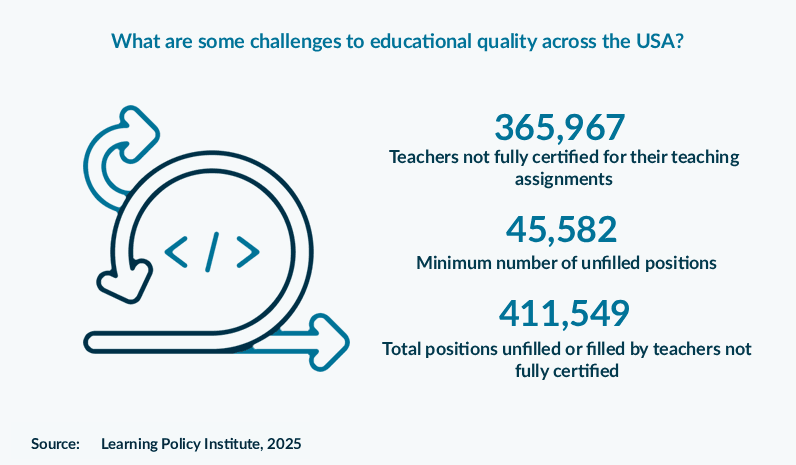
The latest national scan reveals a persistent and significant teacher shortage across the United States, marked by many positions either remaining vacant or being filled by under-qualified personnel. Data from 31 states plus the District of Columbia indicate at least 45,582 unfilled teaching positions. This situation becomes more concerning when compared to the total of 3,253,091 full-time equivalent (FTE) teachers currently employed nationwide.
The most widespread problem is the high number of underqualified staff, with an estimated 365,967 teachers lacking full certification for their teaching assignments across 48 states plus the District of Columbia. Together, these factors amount to 411,549 teaching positions that are either vacant or staffed by individuals without full qualifications (Learning Policy Institute, 2025).
This trend, shown in the graphic below, highlights a critical need for enhanced recruitment and retention efforts, as over 10 percent of all teaching roles nationwide are affected by shortages or under-certification, which directly undermines the quality of student learning.
What professional pathways and functions are associated with MAE, MAT, EdS, and EdD degrees?
Each of these four degrees is intrinsically linked to distinct professional functions, creating structured pathways that guide an educator's career progression from the classroom to the boardroom. The pathways reflect an increasing shift from direct student instruction to institutional influence and organizational management.
- Clinical Instruction (MAT): The primary pathway is focused on developing and refining expert teaching methods, classroom management, and subject-specific pedagogy
- Curriculum Development (MAE): Functions include designing, evaluating, and revising instructional materials and entire subject curricula across a school or department
- Data-Driven Reform (EdD): Professionals function as change agents, using quantitative and qualitative data to analyze educational challenges and implement evidence-based solutions at the system level
- District Administration (EdS, EdD): Pathways lead to central office roles, focusing on human resources, budget management, public relations, and educational policy implementation
- Executive Leadership (EdD): The function is to manage large organizations (universities, major school districts, or non-profits), setting strategic vision and overseeing all institutional operations
- Instructional Specialization (MAE): Functions involve gaining expertise in a niche area like Special Education, English as a Second Language, or Educational Technology for improved classroom delivery; even the cheapest online special education master's degree programs cover this highly specialized area.
- K-12 School Leadership (EdS, EdD): Pathways target principal and assistant principal roles, focusing on managing daily operations, staff evaluation, and fostering positive school culture
- Policy Analysis (EdD): Professionals work in government, research institutions, or think tanks to analyze and influence the creation of educational law and funding structures
- Practitioner Research (EdD): The function involves applying existing academic research to address immediate, on-the-ground problems within a specific educational institution
- Teacher Mentorship (MAT, MAE): Functions include training, coaching, and supervising less experienced teachers to improve their instructional skills and professional practice
- Terminal Certification (EdS): The primary pathway to high-level administrative certification (e.g., Superintendent licensure) without committing to the full dissertation process
- Corporate Learning Leadership: EdD graduates often pursue roles as Chief Learning Officers in corporate training and development
Recent data from October 2024, as shown in the figure below, indicates that staffing deficits remain a major challenge in public schools, especially in specialized and support roles. Over one-third of schools reported shortages in special education (34%) and custodial staff (34%), reflecting strains on both mandated student services and basic operations.
Essential support positions are also heavily affected, with classroom aides understaffed in 32% of schools and mental health professionals—including psychologists and social workers—short in 28%. Instructional roles show smaller but still notable gaps, with general elementary teachers at 22% and mathematics teachers at 16%.
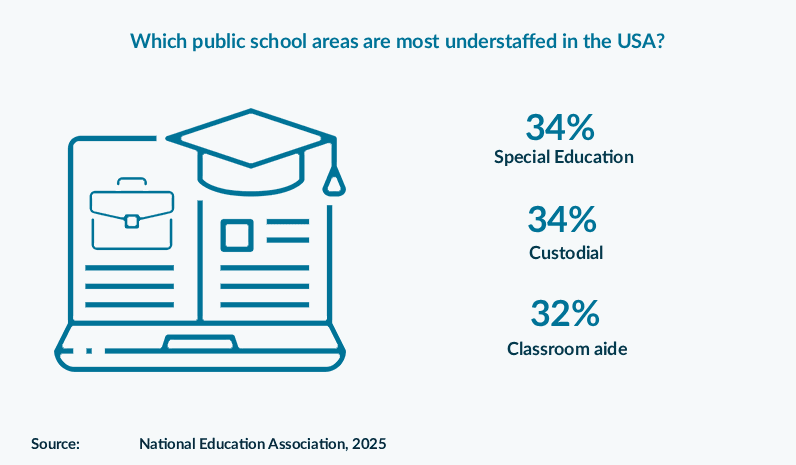
These trends point to disproportionate shortages in specialized and support services, underscoring the growing demand for certified professionals and advanced credentials in areas such as special education and student mental health.
How do online EdD programs support work-life balance and career advancement?
Online EdD programs offer a flexible structure that enables working professionals to integrate advanced leadership training into their demanding schedules. These programs are designed with asynchronous coursework, interactive virtual workshops, and real-time collaboration to ensure robust academic rigor while accommodating professional responsibilities. The digital format allows for immediate access to contemporary research, global networking opportunities, and targeted skill development that directly translate to organizational leadership and policy innovation. For those seeking a fast-tracked, adaptable credential, online EdD programs provide a strategic pathway to efficiently advance both career prospects and personal competencies.
Which universities and colleges in the USA offer MAE, MAT, EdS, and EdD programs?
A wide range of accredited institutions across the United States, from large public research universities to specialized private colleges, offer one or more of these advanced education degrees. Availability often depends on the institution’s mission, with larger universities tending to offer the full spectrum, including terminal doctorates. One can start from the cheapest online bachelor's degree in education programs as a prerequisite.
MAE (Master of Arts in Education / Master of Education)
- Boston College (Lynch School of Education & Human Development): Offers MA programs emphasizing theory-to-practice integration, preparing graduates for curriculum development, higher education leadership, and educational policy, with extensive practicum placements in Boston-area schools, hospitals, and nonprofits.
- New York University (NYU Steinhardt): The MA in Educational Leadership, Politics, and Advocacy prepares students for leadership in policy and reform, emphasizing community partnerships, equity-driven education, and applied experiences in New York City schools.
- University of Pennsylvania (Penn GSE): Known for integrating policy analysis with leadership development, Penn’s master’s programs emphasize real-world problem-solving and strong connections to Philadelphia’s education ecosystem.
MAT (Master of Arts in Teaching)
- Boston College (Lynch School of Education & Human Development): Designed for career changers and new teachers seeking licensure, the MAT emphasizes immersive clinical experiences in Boston-area schools, combining coursework with mentorship in diverse classrooms.
- New York University (NYU Steinhardt): Features residency-based MAT programs that place students in paid, year-long mentored teaching roles, integrating subject specialization with intensive pedagogy for fast, high-quality licensure.
- University of Southern California (USC Rossier School of Education): Offers an online MAT program combining flexibility with rigor, with a strong focus on urban education, culturally responsive teaching, and partnerships with California school districts.
EdS (Education Specialist)
- Johns Hopkins University (School of Education): Provides EdS programs with concentrations in leadership, school psychology, and administration, emphasizing data-driven accountability and preparation for district-level roles.
- University of Alabama: Offers online EdS programs in Educational Leadership, aligned with Alabama state licensure requirements for principals and district leaders, balancing flexibility with accreditation rigor.
- Vanderbilt University (Peabody College): Known for rigorous EdS programs in leadership and school psychology, Vanderbilt integrates applied research with leadership training to prepare graduates for advanced certification and practice.
EdD (Doctor of Education)
- Boston College (Lynch School of Education & Human Development): The EdD in Educational Leadership integrates superintendent licensure modules with doctoral coursework, delivered in a cohort model with a 96% three-year completion rate.
- Harvard University (Graduate School of Education): Offers the prestigious EdLD program (EdD equivalent), preparing graduates for executive leadership in education with training in leadership, policy, and finance.
- New York University (NYU Steinhardt): Provides multiple EdD options, including Educational Leadership & Policy Studies and Higher Education Administration, with flexible online or hybrid delivery and applied problem-of-practice projects.
- University of California, Los Angeles (UCLA): Focuses on urban education leadership, preparing reform-oriented leaders for diverse school districts with an emphasis on equity and social justice.
- University of Pennsylvania (Penn GSE): The Mid-Career EdD in Educational Leadership is designed for senior professionals, emphasizing applied research and preparing leaders for superintendent and executive roles.
- University of Texas at Austin: Offers the Executive EdD in Cooperative Superintendency, a direct pathway to superintendent certification with strong ties to Texas school systems.
- Vanderbilt University (Peabody College): Renowned for EdD programs in K–12 and Higher Education Leadership & Policy, delivered in a cohort-based model that emphasizes networking and applied leadership research.
What are the biggest challenges faced by professionals holding MAE, MAT, EdS, and EdD degrees?
While advanced degrees open doors to influential roles, professionals across all levels face systemic challenges tied to policy, resources, and institutional expectations.
- Addressing Equity: Ensuring equitable outcomes across diverse student populations remains a persistent challenge for EdS and EdD leaders
- Budget Constraints: Shrinking budgets require difficult choices about staffing, programs, and resources at all levels of administration
- Curriculum Overload: Teachers and instructional leaders must balance mandated coverage with foundational skill development
- Data Literacy Gaps: Leaders face difficulties implementing evidence-based decisions when staff lack strong data analysis skills
- Lack of Autonomy: Teachers often feel restricted by centralized policies limiting classroom flexibility
- Managing Resistance: Administrators face pushback from staff, parents, or communities when implementing reforms
- Policy Implementation Gap: Bridging the divide between research-driven policy and on-the-ground practice is a frequent obstacle
- Professional Burnout: Teachers, principals, and administrators struggle with high stress and workload demands
- Resource Limitations: Curriculum development is often constrained by funding and personnel shortages
- Teacher Retention: District leaders must continuously address teacher turnover and shortages
- Technological Integration: Keeping pace with evolving digital learning tools and ensuring staff training is an ongoing challenge
- Work-Life Balance: Long hours and demanding roles in administration create challenges for EdS/EdD professionals
These systemic pressures mirror those seen in other high-responsibility fields, such as leadership and management in nursing, where professionals must balance policy, staffing, and ethical obligations while sustaining performance under resource constraints. Both fields demand a blend of technical competence, empathy, and resilience to lead effectively through institutional challenges.
What are the advantages and career opportunities of pursuing an EdS or EdD over an MAE or MAT?
Pursuing an EdS or EdD beyond a master’s degree fundamentally shifts a professional’s trajectory from instructional practice to systemic leadership and organizational reform.
- Executive Certification: EdS provides direct pathways to administrative licensure such as superintendent or director roles
- Highest Salary Tier: EdD holders qualify for the most lucrative administrative and leadership roles in education
- Increased Job Security: Terminal degrees like the EdD ensure a strong competitive edge and very low unemployment rates
- Leadership Authority: The EdD confers the title of “Dr.,” adding credibility in negotiations and policymaking
- Organizational Influence: EdS and EdD graduates move from classroom impact to influencing district or institutional strategy
- Postsecondary Teaching: An EdD is often a prerequisite for tenure-track teaching positions in higher education
- Research-Driven Practice: EdD graduates apply advanced research to solve complex organizational problems
- Systemic Change Agent: EdD professionals are trained to lead institutional reform in policy, finance, and culture
- Transferable Skills: Data analysis, strategic planning, and organizational theory training extend to non-profit and corporate leadership
- Wider Career Scope: EdS/EdD unlocks roles in consulting, higher education administration, and government policy work
The national data for the 2023–2024 academic year reveals a stark geographical disparity in the average salaries of public school teachers, showing that the highest compensated states significantly outpace the lowest compensated ones. According to the National Education Association, the top ten states and the District of Columbia reported average salaries ranging from a high of $101,084 in California (Rank 1) to a low of $78,256 in Alaska (Rank 10). This upper tier is highly concentrated in expensive metropolitan areas, with New York at $95,615 (Rank 2) and Massachusetts at $92,076 (Rank 3).
Conversely, the bottom ten states fell into a much narrower salary band, ranging from Kentucky at $58,325 (Rank 42) down to Mississippi at $53,704 (Rank 51). The lowest average salary of $53,704 in Mississippi is nearly half that of the top-ranked state, highlighting the powerful influence of regional cost of living and state education funding models on compensation. The overall trend, displayed in the graph below, shows that educators in the top ten states earn substantially more than their counterparts in the bottom ten, confirming that location remains the dominant factor in determining a public school teacher's salary.
For aspiring administrators and specialists comparing academic paths, the best online education specialist degrees offer a streamlined way to earn EdS credentials and move into these high-impact roles without stepping away from full-time employment.
What are some current and future trends related to MAE, MAT, EdS, and EdD programs in the USA?
Advanced education programs are adapting to new realities in technology, equity, and workforce needs, creating more practical and accessible pathways for professionals.
- Applied Research Focus: EdD programs increasingly emphasize applied projects over theoretical dissertations
- Digital Leadership Specializations: New concentrations are emerging in areas like data analytics, cybersecurity, and ed-tech leadership
- Equity and Inclusion Training: Programs integrate equity, diversity, and inclusion modules across EdS/EdD curricula
- Hybrid/Online Delivery: Many EdS and EdD programs are now offered fully online or in hybrid cohort models
- Focus on Lifelong Learning: Programs emphasize continuous professional development and modular credentialing
- International Collaboration: Some EdD programs integrate global perspectives and exchange opportunities
- Integration of AI: MAE/MAT programs are beginning to train educators in ethical and instructional uses of AI
- Accelerated Master’s Pathways: Many MAE/MAT programs are now 12–18 months to fast-track teacher licensure
- Stackable Credits: EdS credits often transfer directly into EdD programs, reducing time to completion
- Skills-Based Hiring: Market demand is shifting toward demonstrated skills such as data literacy and leadership
- Residency Models: MAT programs increasingly include year-long, paid teaching residencies with mentorship
For early-career educators, these evolving formats also raise questions like is a master's in curriculum and instruction worth it, given that shorter, specialized master’s programs now compete with post-master’s credentials. The trend toward modular learning, stackable certificates, and hybrid EdD pathways shows that the answer depends on career intent—teaching excellence vs. executive leadership.
Here's What Graduates Say About Their MAE vs. MAT vs. EdS vs. EdD degrees
- Demi: "Earning my MAE in Curriculum and Instruction dramatically shifted my focus from just teaching content to designing the entire learning experience. The depth of knowledge I gained in curriculum development immediately increased my district stipend and prepared me for my new role as department lead. I feel a genuine sense of fulfillment knowing my passion for effective pedagogy now impacts dozens of classrooms, not just my own."
- Eldrin: "The EdS in Educational Leadership was exactly the fast-track credential I needed to become a school administrator and secure a six-figure salary without committing to a full doctorate yet. The program's practical focus on school law and resource management was intense but directly relevant, giving me the confidence to step into the principal's office ready to lead. My biggest takeaway is the profound realization that leadership is about empowering others, and I cherish that power every day."
- Iman: "Pursuing my EdD in Higher Education Policy was challenging, but the focus on applied research allowed me to solve a critical enrollment problem at my university, which was incredibly rewarding. Now, as a Director, I command a high executive salary and have the "Dr." title, which instantly adds credibility when I propose large-scale policy changes to the board. It truly prepared me to become a high-level agent of systemic change."
Key Findings
- Teacher Salary Disparity: The extreme geographic divide in teacher compensation shows the highest compensated state, California ($101,084), earning nearly twice as much as the lowest, Mississippi ($53,704), confirming location is the dominant compensation factor (National Education Association, 2025).
- Advanced Degree Compensation: Average earnings for education professionals rise significantly with degree level, starting with MAE/MAT graduates (averaging $60,000–$75,000) and climbing to EdD holders (averaging $90,000–$125,000+).
- Administrative Salary Tiers: Transitioning to administrative roles guarantees higher salaries, with K–12 principals earning a median of $103,460 and superintendents in large districts averaging $156,468.
- Workforce and Wage Growth: Despite a minor 5.61% decline in degrees awarded, the education workforce remains stable at 5.15 million (growing 0.595%), while the average wage grew positively by 3.46% to $$66,881 (DataUSA, 2025).
- Educational Cost Divide: Tuition costs show a widening financial gap: median in-state public tuition is $7,716 (rising only 0.784%), while median out-of-state private tuition is $35,180 (rising 3.78%) (DataUSA, 2025).
- Total Staffing Deficit: A severe national teacher shortage means 411,549 teaching positions are either vacant or staffed by under-certified individuals, impacting over ten percent of all 3,253,091 full-time teacher roles (Learning Policy Institute, 2025).
- Under-certified Teacher Crisis: The majority of the deficit stems from a lack of qualified personnel, with an estimated 365,967 teachers not fully certified for their assignments reported across 48 states plus the District of Columbia (Learning Policy Institute, 2025).
- Specialized Support Shortages: Public schools are most heavily understaffed in specialized and support roles as of October 2024, with 34% of schools reporting shortages in both special education and custodial staff, closely followed by 32% feeling the strain for classroom aides.
References:
- Comai, S., Patrick, S. K., & Tan, T. S. (2025, July 15). 2025 update: Latest national scan shows teacher shortages persist. Learning Policy Institute.
- Data USA. (2025). General educational leadership & administration (CIP 13.0401). Data USA.
- National Center for Education Statistics. (2024, December 12). Nation’s public school enrollment rebounds slightly in 2022–23 after pandemic declines. U.S. Department of Education. National Center for Education Statistics.
- National Education Association. (2025). Rankings and estimates: Rankings of the states 2025 and estimates of school statistics 2024. National Education Association.
- ONET Online. (2024). Postsecondary education administrators. National Center for ONET Development.
- PayScale. (2025). Doctor of Education (EdD) salary. PayScale.
- PayScale. (2025). Instructional coordinator salary. PayScale.
- Salary.com. (2024). Superintendent salary in the United States. Salary.com.
- Statista. (2024). Teacher shortages in the United States – key data and figures. Statista.
- U.S. Bureau of Labor Statistics. (2023). Education administrators, all other. Occupational Employment and Wage Statistics. U.S. Department of Labor.
- U.S. Bureau of Labor Statistics. (2023). Education administrators, kindergarten through secondary. Occupational Employment and Wage Statistics. U.S. Department of Labor.
- U.S. Bureau of Labor Statistics. (2024). Instructional coordinators. Occupational Outlook Handbook. U.S. Department of Labor.
- U.S. Bureau of Labor Statistics. (2024). Postsecondary education administrators. Occupational Outlook Handbook. U.S. Department of Labor.
- U.S. Bureau of Labor Statistics. (2024). Postsecondary teachers. Occupational Outlook Handbook. U.S. Department of Labor.
Other Things You Should Know About MAE vs. MAT vs. EdS vs. EdD Degrees
The MAE (Master of Arts in Education) typically emphasizes broad educational theories and leadership skills, which can apply to various educational settings. In contrast, the MAT (Master of Arts in Teaching) is more focused on pedagogy, curriculum development, and direct classroom instruction, preparing educators to refine their teaching practices.
In 2027, EdS graduates can pursue roles like school principals, educational supervisors, or curriculum specialists. The EdS is designed for leadership in education but does not qualify for positions typically requiring a doctorate, such as university professor roles.


