
2027 Leadership vs. Management in Nursing: Which Path Should You Pursue?

Co-Founder and Chief Data Scientist
With nearly 25% of all nurse leaders considering leaving their positions, making the right career move has never been more critical. For many experienced nurses, the choice between a path in leadership in nursing versus management in nursing feels like a career crossroads with no clear map. This decision defines not just your title, but your entire impact on patient care.
To provide that clarity, our career planning experts with more than 10 years of experience have developed this guide. It offers a straightforward framework to help you confidently decide which path best aligns with your skills, personality, and professional goals.
Key Things You Should Know About Leadership vs. Management in Nursing
- Leadership is about inspiring a future vision, while management is about executing on present objectives.
- Leadership relies on influence and strategic communication, whereas management depends on planning and process optimization.
- The median pay for medical and health services managers was $117,960 in 2024.
- The field is projected to grow by 23% between 2024 and 2034, much faster than the average for all occupations.
- An MSN or DNP is the standard requirement for most senior roles in either path.
- Leadership vs. Management in Nursing: Explaining the Difference Differences
- What are the pros and cons of pursuing leadership in nursing? Leadership Pros & Cons
- What are the pros and cons of pursuing management in nursing? Management Pros & Cons
- What are the key roles in nursing leadership and nursing management? Key Roles
- What skills are essential for leadership and management in nursing? Core Skills
- What are the educational pathways for leadership and management in nursing? Educational Paths
- How much can you earn in nursing leadership and management roles? Salary
- What is the job outlook for nurse leaders and managers? Job Outlook
- What is the work environment like in nursing leadership and management roles? What is the work environment like in nursing leadership and management roles?
- Leadership vs. Management in Nursing: Which path fits your personality? Leadership vs. Management in Nursing: Which path fits your personality?
- How to Get Started on Your Nursing Leadership or Management Career How to Get Started on Your Nursing Leadership or Management Career
- Is pursuing nursing leadership or management worth it? Is pursuing nursing leadership or management worth it?
Leadership vs. Management in Nursing: Explaining the Difference
The core difference between leadership vs. management in nursing comes down to focus. Leadership is about the “why” and the “where”—it involves setting a vision, motivating people through change, and inspiring a shared purpose for the future. Management, on the other hand, is about the “how” and the “when.” It focuses on organizing resources, creating stable systems, and ensuring that day-to-day tasks are completed efficiently and correctly.
While the best professionals can do both, their primary mindset and responsibilities fall into one of these two distinct camps. It's not that leaders are simply "born" with these skills; they are developed competencies, just like the skills of an effective manager.
The Impact of Your Choice on Patient Care
This distinction has a direct impact on the work environment and patient outcomes. Leadership is often described as transformational. A strong leader shapes the culture, promotes responsibility, and reduces workplace incivility, which in turn improves the performance of the entire nursing staff.
Management is more transactional. A skilled manager ensures that the vision set by leadership is achievable by creating the schedules, budgets, and processes that support high-quality care. One inspires the direction; the other builds the road to get there.
For example, advanced practice nurses often move into leadership positions after years in direct care. Understanding where do family nurse practitioners work can help illustrate how their leadership extends beyond clinical duties into program development and policy guidance.
What are the pros and cons of pursuing leadership in nursing?
Choosing a path in leadership in nursing means aiming for large-scale impact, but it comes with a unique set of pressures. It's less about direct authority and more about your ability to influence people and systems. Here’s a clear-eyed look at what that means.
- Pro: Shape the future of healthcare. You get to be at the forefront of innovation, driving systemic changes that can improve care for entire patient populations.
- Con: Face high levels of pressure. You are ultimately accountable for outcomes that are often beyond your direct control, which can be a significant source of stress.
- Pro: Mentor the next generation. A core part of leadership is identifying and developing talent, allowing you to leave a lasting legacy through others.
- Con: Navigate resistance and politics. Driving change means challenging the status quo, and that often involves navigating complex organizational dynamics and resistance from colleagues.
Leading the Future of Healthcare
The primary appeal of leadership is the chance to solve the biggest problems in healthcare. Leaders are the ones redesigning how care is delivered. Right now, that means focusing on key advancements like the expansion of virtual care, which 32% of leaders are prioritizing.
They are also heavily focused on fostering interdisciplinary collaboration (30%) and upskilling their teams to manage growing complexities (21%). As a leader, your work is centered on these strategic, forward-thinking initiatives.
The chart below breaks down the top priorities for nurse leaders in the coming year.
What are the pros and cons of pursuing management in nursing?
If leadership is about shaping the future, a career in management in nursing is about mastering the present. This path is for the nurse who finds deep satisfaction in creating order, optimizing systems, and making a tangible, daily impact on a clinical unit. Far from being a boring desk job, it's a highly dynamic role that requires constant problem-solving.
- Pro: Create stability and efficiency. You directly improve the work lives of your staff by ensuring they have the resources and processes needed to provide excellent care.
- Con: Face constant operational pressure. You are on the front line of solving daily challenges related to staffing shortages, budget constraints, and patient flow.
- Pro: Hold clear authority and responsibilities. Your scope is well-defined, allowing you to make concrete, measurable improvements at the unit or department level.
- Con: Act as the buffer between staff and administration. This position often requires you to enforce policies you didn't create while advocating for your team's needs to upper management.
The management track offers a powerful way to improve patient care by ensuring the clinical environment is as safe, effective, and supportive as possible. With a clear understanding of the trade-offs for both paths, let's look at the specific jobs they lead to.
If you’re coming from another academic route, such as biology or public health, you might be wondering how to become a nurse with a biology degree. That transition is entirely possible—and often gives future nurse managers a strong foundation in scientific reasoning and data interpretation.
What are the key roles in nursing leadership and nursing management?
These paths are not just abstract ideas; they lead to distinct roles with very different scopes of responsibility. The crucial difference between them is their scale of impact—whether you are shaping the care of an individual patient, a single unit, or an entire organization.
Key Leadership Roles
- Clinical Nurse Leader (CNL): This is a master's-prepared role focused on improving quality and safety outcomes for a specific group of patients, often at the unit level. Unlike a charge nurse who manages a shift, a CNL is a clinical expert who guides the entire care team using evidence-based practice.
- Nurse Executive: This is a high-level, strategic role, often at the C-suite level (like a Chief Nursing Officer). The Nurse Executive sets the vision and strategy for nursing practice across the entire healthcare organization.
Key Management Roles
- Nurse Administrator: This role is focused on the operational side of a specific unit or department. A Nurse Administrator handles budgeting, staffing, and the day-to-day logistics to ensure the unit runs smoothly.
- Case Manager: This role involves managing the entire care journey for individual patients. A Case Manager coordinates services and resources to ensure a patient navigates the healthcare system efficiently and effectively.
Specialized Pathways and Credentials
While these are common long-term goals, you don't always need a full degree to start building specialized skills. Beyond full degree programs, it's worth understanding what are the benefits of a graduate certificate as a flexible career development tool.
What skills are essential for leadership and management in nursing?
Knowing the different roles is one thing, but success comes down to having the right tools for the job. The core difference in skills for leadership vs. management in nursing is about your primary orientation: Are you built to inspire change or to create stability?
Think about where you naturally excel as you review these essential competencies.
Leadership Skills
The leadership in nursing toolkit is focused on influencing people and shaping the future.
- Vision: The ability to see where an organization needs to go and articulate that future state clearly.
- Strategic Communication: Inspiring and persuading others to work toward a common goal.
- Emotional Intelligence: Understanding and managing your own emotions and recognizing them in others to guide thinking and behavior.
- Mentorship: Developing the skills and confidence of your team members.
Management Skills
The management in nursing toolkit is focused on executing plans and optimizing systems.
- Planning: Organizing resources, setting timelines, and establishing clear, actionable steps.
- Budgeting: Managing financial resources effectively to meet departmental goals.
- Process Optimization: Identifying and eliminating inefficiencies in daily workflows.
- Regulatory Compliance: Ensuring that your unit or department adheres to all healthcare laws and standards.
It’s a mistake to think of leadership abilities as just "soft skills." Both of these are highly professional skill sets that require dedicated development. Graduate programs are specifically designed to build these distinct competencies, which leads to the next logical question: What education do you need?
Those pursuing advanced credentials will often compare certifications such as ANCC vs AANP, especially when charting a path toward leadership roles that blend clinical expertise with administrative authority.
What are the educational pathways for leadership and management in nursing?
The standard educational requirement for these advanced roles is a graduate degree, typically a Master of Science in Nursing (MSN) or a Doctor of Nursing Practice (DNP). The specific specialization you choose, such as "Nursing Leadership" or "Nursing Administration," is what truly shapes your career path.
For nurses with an Associate Degree in Nursing (ADN), the journey is more direct than you might think. Many universities offer streamlined RN-to-MSN bridge programs. These are designed to efficiently build upon your existing education and clinical experience, providing a clear path to a graduate degree without starting from scratch.
It's also important to know the difference between a DNP, which is a practice-focused doctorate designed for clinical leaders, and a PhD, which is a research-focused degree for those who want to become scientists or academics. To manage the cost, always look into financial aid options like FAFSA, scholarships, and employer tuition reimbursement programs.
The Value of an Advanced Degree
The data shows a clear trend toward the MSN as the primary credential for these roles. In 2023, the vast majority of nursing administration graduate credentials awarded were master's degrees (6,525). While an MSN is the most common path, there are compelling reasons to get your DNP degree, especially for those aspiring to top executive roles.
Of course, this requires a significant investment. The median in-state public tuition for a nursing administration degree is around $7,706, while the median for an out-of-state private institution is about $33,700. The chart below provides a full breakdown of degrees awarded.
How much can you earn in nursing leadership and management roles?
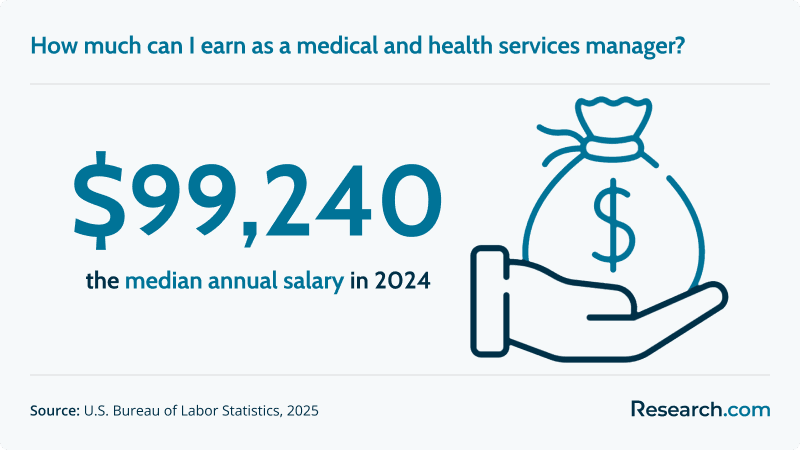
The earning potential is significant. The median annual pay for medical and health services managers was $117,960 in 2024.
That figure is a national median across many roles, so your actual starting salary will depend on your specific position, location, and years of experience. It's not about making six figures the day you graduate; it's about the long-term financial trajectory these advanced degrees unlock.
A Closer Look: Average Salaries for Key Nursing Roles
To give you a more realistic picture, here are the average salaries for some of the specific roles we discussed for 2025:
- Nurse administrator: The average salary is around $84,334.
- Clinical nurse leader: This role averages about $89,949.
- Nurse executive: You can expect to earn around $93,552.
- Nurse case manager: With high demand, the average salary is approximately $98,869.
These figures represent strong starting points, with the potential to grow toward that six-figure median as you gain experience. Of course, salary is only one part of the equation. Job security is just as important.
For nurses choosing their degree path, understanding the salary implications of BSN vs BS in nursing can help clarify long-term earnings potential before committing to a leadership or management track.
What is the job outlook for nurse leaders and managers?
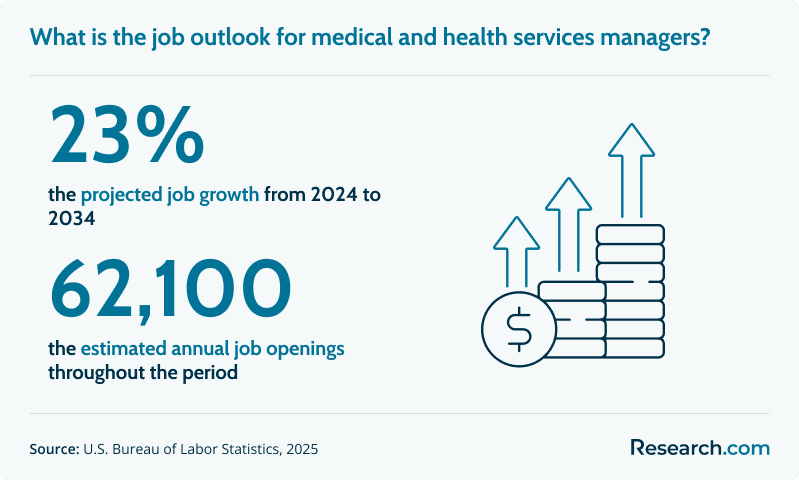
The job outlook is excellent. Employment in this field is projected to grow 23% from 2024 to 2034, which is much faster than the average for all occupations. This growth translates to about 62,100 job openings for medical and health services managers each year.
While the field is competitive, this strong demand means that a graduate degree is a direct investment in your long-term career security. The high number of openings isn't just due to new positions being created; it's also about the constant movement within the field.
A Dynamic Field: Why Openings Are Common
One of the biggest factors driving this demand is the "leadership vacuum" being created as a large generation of experienced Baby Boomer nurses begins to retire. Healthcare systems are actively looking for the next generation of leaders to step up and fill these critical roles.
Additionally, the field is very dynamic. Many leaders and managers move into more senior positions, creating openings for others to advance. In fact, of the nurse leaders who intend to leave their current role, 39% are doing so because they are looking for a promotion or a new opportunity. This constant movement creates a steady stream of chances for ambitious nurses to advance their careers.
With a clear picture of the strong financial and career security, it's time to consider the day-to-day realities of the work itself.
What is the work environment like in nursing leadership and management roles?
The day-to-day environment for these roles can be quite different. Both are excellent examples of non bedside nurse jobs that allow experienced clinicians to apply their skills away from the physical demands of direct patient care, but the setting and focus vary significantly.
Management roles are often unit-based. You can expect a mix of office work for tasks like scheduling and budgeting, combined with time on the floor interacting directly with staff and overseeing daily operations. Leadership roles, on the other hand, are typically more corporate. Your days are more likely to be filled with strategic planning meetings, presentations to stakeholders, and work that is focused on the entire organization rather than a single department.
The Pressures of the Role
A critical factor to consider is the different type of stress each path involves. Management stress is often immediate and operational—solving an unexpected staffing shortage or dealing with a patient complaint right now. Leadership stress tends to be more long-term and strategic—being accountable for the success of a major initiative over the next year.
These pressures are real and contribute to turnover. As the chart below shows, a significant number of leaders consider leaving their positions, with 37% of them citing the negative effects on their health and well-being as a key reason. Understanding which type of pressure you handle better is key to making a sustainable career choice.
Leadership vs. Management in Nursing: Which path fits your personality?
After weighing all the external factors, the most important question is the internal one: Which path aligns with who you are? This isn't about being an extrovert or an introvert; it's about what fundamentally drives and energizes you at work.
These are not rigid boxes, but a way to identify your dominant professional style. Ask yourself honestly:
- Are you a change agent or a stabilizer? Do you get more satisfaction from pioneering a new initiative or from perfecting an existing process?
- Do you prefer vision or execution? Are you more energized by brainstorming a five-year plan or by creating the weekly schedule that makes the unit run flawlessly?
- Is your focus on people or systems? Do you thrive on motivating teams through ambiguity, or do you excel at creating the clear, reliable systems that help people succeed?
Considering All Your Options
Answering these questions helps clarify whether you are drawn to a strategic or an operational role. As you weigh your options, it's also important to recognize that leadership and management are distinct from advanced clinical practice; for instance, many nurses who want to focus on patient diagnosis and treatment explore FNP specializations instead.
Choosing the right fit is the best way to avoid burnout. When leaders decide to leave their roles, it's often due to a mismatch between their personality and the job's demands. Top reasons include the strain on their well-being (37%) and challenges with colleagues (25%), highlighting the intense personal pressures of these roles.
Once you have a clearer sense of your personal fit, it's time to take the first concrete steps.
How to Get Started on Your Nursing Leadership or Management Career
Once you have a clear sense of which path fits you best, the next step is to take concrete, strategic action. Many nurses think the first step is to apply to graduate school, but the most successful candidates start building their resume for these roles long before they submit an application.
Here are the three most important steps to take now:
- Gain Relevant Experience. Volunteer for a quality improvement project, take the lead on a new workflow, or join a hospital committee. This kind of practical experience is invaluable when building your resume for a future in management in nursing.
- Find a Mentor. Identify a leader you admire and ask for an informational interview. A mentor who is already established in leadership in nursing can provide priceless guidance, advocacy, and insight that you can't find anywhere else.
- Research Accredited Programs. Begin looking into graduate programs that align with your chosen path. For ADN-prepared nurses, the first and most important step is to identify efficient RN-to-MSN bridge programs that honor your existing experience.
Your years of clinical practice are your greatest asset. And for those who entered the profession on a different timeline, understanding how to become a nurse later in life can provide a unique perspective. The key is to start building your case for that next role today.
Is pursuing nursing leadership or management worth it?
Yes, absolutely. From a purely practical standpoint, the combination of high salary potential and exceptional job growth creates a clear and compelling return on your investment of time and money. It is not just a step up; it is a strategic move into a more secure and rewarding future.
The healthcare field needs skilled, educated nurses to guide it. With a projected job growth of 23%, the demand for professionals with these advanced skills is undeniable. This powerful statistic, shown below, confirms that you are moving toward a field with abundant opportunities.
The Impact You Can Have
The ultimate worth of these paths goes beyond the numbers. The true value of a career in leadership in nursing is the ability to shape the future of patient care on a systemic level, while the worth of a career in management in nursing comes from making that future possible through operational excellence.
The entire healthcare system is in a state of transformation, driven by new technologies and evolving patient needs. By choosing the right path, you are positioning yourself at the center of healthcare's evolution. You are not just advancing your career; you are stepping up to solve the critical challenges that will define the next decade of care.
Here’s What Graduates Have to Say about Their Leadership vs. Management in Nursing Choices
- Gina: "I was stuck at a career crossroads, unsure if I was a leader or a manager. The MSN in Nursing Leadership program really clarified the difference for me and helped me see where my true strengths were. Studying online allowed me to reflect on my daily work in a new way, connecting theory to my actual job. Now I know exactly what kind of impact I want to make, and I have a clear path to get there."
- Jennifer: "I had hit a salary ceiling with my BSN and knew I needed something more to advance. My MSN in Nurse Administration gave me the business and financial skills I was missing, which were immediately applicable to my unit's operations. The promotion and pay increase I received six months after graduating more than justified the investment in the degree."
- Bethany: "With my associate degree, I often felt I had to prove my experience was just as valuable as a credential. Earning my master's completely changed that dynamic and gave me a new level of confidence. In my online capstone project, I developed a new workflow that our hospital actually implemented. Now, I finally have the degree to back up my years of clinical knowledge."
Key Findings
- The projected 23% job growth for medical and health services managers through 2034 provides a clear solution for nurses feeling they've hit a career ceiling, confirming a strong return on investment for a graduate degree.
- With a median annual pay of $117,960 in 2024 for these advanced roles, the earning potential offers the ROI confidence needed to justify the educational investment.
- The fact that 6,525 MSN degrees in nursing administration were awarded in 2023—far more than any other credential—clarifies the most efficient and standard educational pathway for aspiring leaders and managers.
- With 37% of nurse leaders who consider leaving their role citing negative impacts on their health and well-being, it is critical for aspirants to choose a path that aligns with their personality to avoid burnout.
- The focus of today's nurse leaders on key advancements like virtual care (32%) and interdisciplinary collaboration (30%) provides an inspiring vision of a future where they can shape the evolution of healthcare.
- The financial landscape for specific roles becomes clearer with average 2025 salaries showing distinct potentials: nurse case managers at approximately $98,869, nurse executives at $93,552, and nurse administrators at $84,334.
References:
- American Organization for Nursing Leadership. (2025). Nursing leadership insight study. Retrieved October 7, 2025, from AONL.
- Bureau of Labor Statistics. (2025). Medical and health services managers. Retrieved October 7, 2025, from BLS.
- Bureau of Labor Statistics. (2025). Occupational employment and wage statistics (OEWS) profiles - May 2024 11-9111 Medical and health services managers. Retrieved October 7, 2025, from BLS.
- ZipRecruiter. (2025). Clinical nurse leader salary. Retrieved October 7, 2025, from ZipRecruiter.
- ZipRecruiter. (2025). Nurse administrator salary. Retrieved October 7, 2025, from ZipRecruiter.
- ZipRecruiter. (2025). Nurse case manager salary. Retrieved October 7, 2025, from ZipRecruiter.
- ZipRecruiter. (2025). Nurse executive salary. Retrieved October 7, 2025, from ZipRecruiter.
Other Things You Should Know About Leadership vs. Management in Nursing
In 2027, leadership roles in nursing generally require a Bachelor of Science in Nursing (BSN) as a minimum, with many positions preferring or requiring a Master of Science in Nursing (MSN). Advanced certifications, such as the Nurse Executive Certification, can enhance eligibility.
In 2027, leadership roles in nursing focus on inspiring and guiding teams towards achieving quality patient care, emphasizing vision and innovation. Management roles, however, concentrate on overseeing the day-to-day operations, including budgeting and staffing. Both paths are vital, but they cater to different skill sets and ambitions, offering distinct yet complementary career opportunities.


