
2027 Returning to College as an Adult: How to Finish Your Degree

Co-Founder and Chief Data Scientist
Returning to college as an adult in the United States is a bold and meaningful step, yet many find the process clouded by scattered, outdated, or inconsistent information. As a career planning and education expert, I see adults struggle to identify which programs accept prior credits, which schools offer flexible scheduling, and how realistic salary outcomes are portrayed.
Misleading claims, hidden costs, and vague program descriptions can leave even determined learners uncertain. This guide is designed to cut through the confusion and provide clear, reliable insights so you can complete your degree with confidence and informed direction.
What are the benefits of returning to college as an adult?
- Career Advancement: Completing a degree opens doors to promotions, professional licenses, and management roles across industries.
- Earning Potential: Adults with a bachelor’s degree earn a median of $1,543/week (~$80,000/year), compared to $930/week (~$48,000/year) with only a high school diploma.
- Flexible Learning: Online, evening, and hybrid programs allow adult students to balance work, family, and education.
What can I expect when returning to college as an adult?
- Focused Course Options: Programs often emphasize practical skills, industry certifications, and career-ready knowledge.
- Structured Curriculum: Classes may combine online lectures, live sessions, and applied projects tailored for working professionals.
- Applied Knowledge: Adult learners bring real-world experience, which enriches discussions and problem-solving.
- Condensed Timelines: Degree-completion and accelerated pathways allow many adults to finish in 12–24 months.
- Networking Opportunities: Access to alumni networks, career services, and peer groups of other adult learners.
Where can I work after finishing my degree as an adult?
- Business & Management: Move into supervisory or leadership positions in corporate settings.
- Healthcare: Qualify for clinical, administrative, or advanced practice roles with higher credentials.
- Education: Transition into teaching, training, or education administration positions.
- Technology & IT: Leverage degrees in IT, computer science, or data analytics to enter high-demand fields.
- Public Sector: Advance in government, nonprofit, or policy-related careers requiring a degree.
- Leadership Pathway: A degree provides a foundation for senior roles such as director, executive, or program manager.
How much can I make after finishing my degree as an adult?
- Associate’s Degree: About $57,100/year (based on $1,099/week).
- Bachelor’s Degree: About $80,200/year (based on $1,543/week).
- Master’s Degree: About $95,700/year (based on $1,840/week).
- Professional Degree: About $122,900/year (based on $2,363/week).
- Doctoral Degree: About $118,500/year (based on $2,278/week).
- High School Only: About $48,400/year (based on $930/week).
- How do adults return to college and finish their degree? Returning to College
- Why do adults decide to go back to school? Comeback Reasons
- What are the common challenges adults face when returning to school? Common Challenges
- Are there specific degree programs designed for adult learners? Programs for Adults
- What are the financial benefits of getting a degree? Financial Benefits
- How can you choose the right college for your goals? Right College
- Is it possible to get credit for previous work and life experience? Credits for Work
- How do adults manage financial aid, scholarships, and tuition costs? Financial Aid
- How can you navigate new technology and online learning platforms? How can you navigate new technology and online learning platforms?
- What are the benefits of completing your degree later in life? What are the benefits of completing your degree later in life?
- Are fast online degrees a smart option for adult learners? Are fast online degrees a smart option for adult learners?
How do adults return to college and finish their degree?
Returning to college as an adult can seem daunting, but it’s a journey that many successfully navigate by taking a systematic approach. The process often begins with careful self-reflection and planning to ensure the educational path aligns with personal and professional goals.
- Assess your motivations and goals: Reflect on why you want to return to school. Is it for a career change, a promotion, personal fulfillment, or to finish what you started?
- Research colleges and programs: Look for institutions with a reputation for supporting adult learners, considering factors like accreditation, program flexibility, and student support services.
- Review academic records: Request transcripts from any previous colleges you attended to see which credits you can transfer, saving you both time and money.
- Evaluate financial options: Research and apply for financial aid, scholarships, and grants specifically for adult learners to help offset the cost of tuition and fees.
- Create a support network: Inform your family, friends, and employer about your decision so they can provide emotional support and help you manage your time and commitments.
- Develop a study schedule: Plan out your academic week, blocking dedicated time for classes, studying, homework, and test preparation to maintain balance.
- Utilize student services: Take advantage of resources like academic advising, career counseling, tutoring, and writing centers to enhance your success.
- Adapt to new learning methods: Be open to different teaching styles, technologies, and academic routines that may have changed since you were last in school.
- Manage your time effectively: Use a planner or digital calendar to track assignments, deadlines, and personal obligations to avoid feeling overwhelmed.
- Stay in communication: Regularly check in with your professors, advisors, and classmates to stay informed and address any questions or challenges as they arise.
- Be patient and persistent: Understand that there may be challenges along the way. Stay focused on your long-term goal and celebrate your progress.
- Prepare for a career after graduation: Work with career services to update your résumé and learn how to leverage your new degree in your chosen field.
Returning to college is a marathon, not a sprint. By taking a thoughtful and strategic approach, adults can successfully re-enter academia and achieve their educational goals.
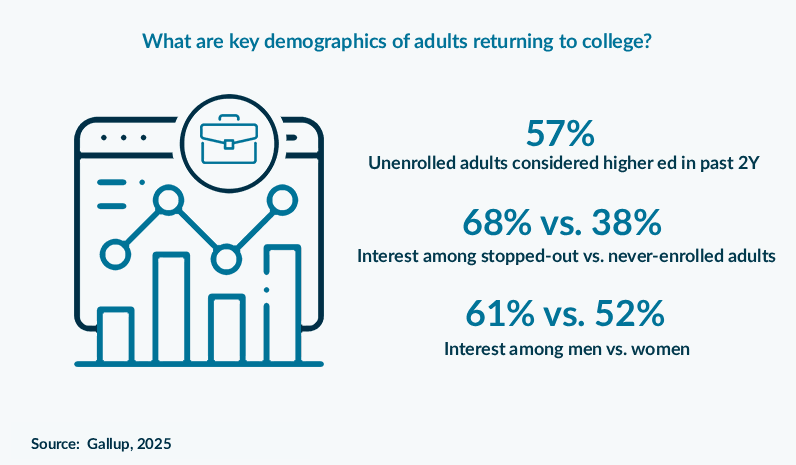
Let's look at some recent data. More than half of unenrolled adults have considered higher education in the past two years. According to a 2025 Gallup survey of 13,933 adults, 57% of adults aged 18-59 have considered returning to school. This suggests a significant pool of potential students, especially among those who previously attended. The data shows that 68% of adults who have stopped out of a program are interested in re-enrolling, compared to only 38% of those who have never enrolled, indicating that past students are more likely to return, as shown in the graphic below.
Interest in returning to higher education varies by gender and race. Men expressed higher interest than women, with 61% of men considering higher education compared to 52% of women. Among racial groups, White adults showed the lowest interest at 52%, highlighting a potential area for targeted outreach. This demonstrates that motivations and barriers to enrollment may differ across demographic groups.
For instance, some adults considering health-related degrees may weigh career flexibility options, such as comparing LPN vs. RN vs. BSN nursing degrees, before deciding on the right educational track. These comparisons can help determine the best pathway based on time, cost, and long-term career goals.
Why do adults decide to go back to school?
Adults choose to return to college for a variety of personal and professional reasons. The decision is often significant, driven by a desire for career advancement, personal growth, or financial stability.
- Career advancement: Many adults return to school to earn a promotion, gain a required credential for a new position, or qualify for a higher-level management role.
- Career change: A degree is often the necessary credential to transition into a new industry or field that better aligns with a person’s interests and goals.
- Increased earning potential: A college degree is often directly linked to a higher salary over the course of a career.
- Job security: In a competitive job market, an advanced degree can help an adult learner stay relevant and secure in their current role.
- Completing a degree: Some adults return to finish a degree they started earlier in life, driven by a desire to fulfill a long-held personal goal.
- Personal fulfillment: Learning can be a lifelong passion, and a degree program provides a structured way to explore a subject of interest.
- Skills development: A degree program provides a way to update and acquire new knowledge in a rapidly evolving job market.
- Role modeling for family: Many adults return to school to set an example for their children or family members, showing the importance of lifelong learning.
- Meeting professional requirements: Some industries, such as healthcare certifications or education, require employees to have a specific degree or continuing education.
- Expanded network: College provides the opportunity to connect with classmates and professors who can become professional contacts and mentors.
- Changing economic landscape: As job requirements evolve, many adults find they need a degree to stay competitive.
- New challenges: For some, returning to school provides a new intellectual challenge and a chance to expand their horizons.
For many adults, returning to college is not taken lightly; it is a strategic investment in their future. The benefits often extend far beyond the classroom.
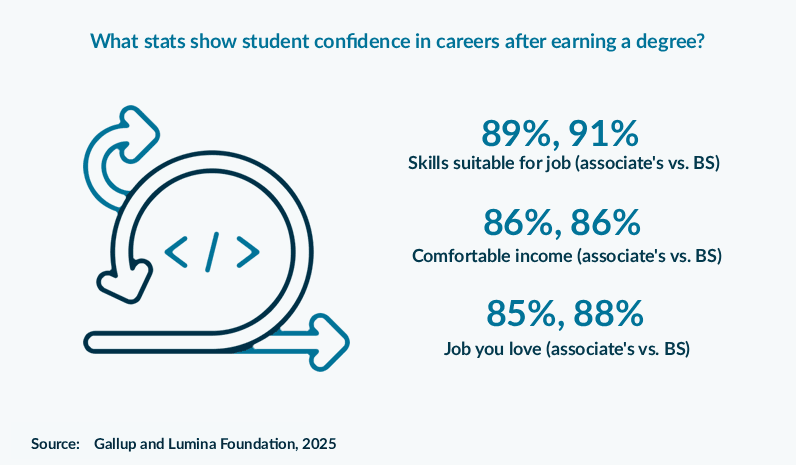
The Gallup and Lumina Foundation's 2025 "Bridging the Gap" report shows that current students are highly confident that their degrees will help them achieve their career goals, as shown in the graphic below. A total of 89% of students pursuing an associate degree and 91% of those working toward a bachelor's degree believe their education will teach them the skills they need for their desired job.
The confidence in making enough money to live comfortably is identical for both groups, with 86% of students in each category agreeing. When it comes to finding a job they love, 88% of bachelor's degree students and 85% of associate degree students are confident in their degree's ability to help.
Adults seeking specialized credentials—such as those wondering how to get a PPS credential in California—may be motivated by professional licensing requirements or a desire to qualify for higher-paying positions in education or counseling.
What are the common challenges adults face when returning to school?
Returning to school as an adult can come with a unique set of challenges that differ from those of traditional students. These obstacles are often tied to juggling multiple responsibilities and adapting to a new academic environment.
- Time management: Balancing coursework with work, family, and personal commitments can be the most significant challenge for adult learners.
- Financial concerns: Paying for tuition, books, and other expenses can be a major hurdle, especially when managing a household budget.
- Lack of confidence: Many adults experience self-doubt or imposter syndrome after a long break from academics, worrying they’ve forgotten how to study.
- Technological gap: The shift to digital platforms and online learning can be difficult for those unfamiliar with learning management systems, video conferencing, and other tools.
- Balancing life and school: Successfully managing the demands of school, work, and family requires strong communication and support.
- Finding a support system: It can be challenging to connect with peers who are in a different life stage, leading to feelings of isolation.
- Re-learning study skills: Academic habits like note-taking, research, and test preparation may need to be refreshed.
- Managing stress: The added pressure of a heavy workload can lead to stress and burnout if not managed effectively.
- Finding a program that fits: It can be difficult to locate a program with the flexibility to accommodate a full-time job and other responsibilities.
- Securing child care: Parents may struggle to find reliable and affordable childcare during class or study times.
- Lack of employer support: Some employers may not provide flexible hours or tuition assistance, making it harder to balance work and school.
- Navigating the application process: The admissions process can be complex, and adult learners may need to track down old transcripts and other documents.
By proactively addressing these challenges, adult learners can set themselves up for success when returning to college. Planning and using available resources can make a major difference in their academic journey.
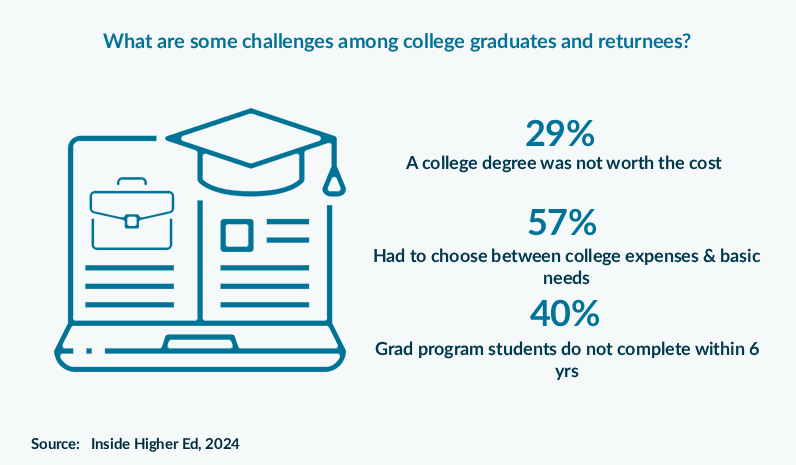
According to a 2024 report by Inside Higher Ed, a significant number of college graduates, specifically 29% of Americans, feel their degree was not worth the financial cost. This sentiment is often rooted in the high price of higher education, with 57% of students having to choose between college expenses and basic needs, highlighting the financial strain that accompanies their studies.
The difficulty in completing a degree is another key challenge. The report shows that 40% of students who enter graduate programs do not complete their degree within six years, suggesting that a lack of completion remains a significant issue.
These figures, shown in the graphic below, indicate that while many see value in higher education, a substantial number of students face financial and academic hurdles that can impact their overall experience and ability to finish their program.
Some adults consider changing fields entirely—for example, moving from therapy to education or vice versa—prompting comparisons such as occupational therapy vs ABA. Understanding these program differences early can help adults select a degree that aligns with both their schedule and long-term goals.
Are there specific degree programs designed for adult learners?
Many colleges and universities have developed programs tailored to the unique needs of adult learners. These options are designed with flexibility in mind, making it easier to balance education with work and family responsibilities. Here are a few of the more popular programs for adult learners:
Accounting and Finance
This field blends the tracking of financial transactions (accounting) with the strategic management of capital (finance). Students study financial accounting, auditing, taxation, corporate finance, and investment analysis. Graduates often become staff accountants, financial analysts, budget analysts, or internal auditors across various industries. Earning a CPA (Certified Public Accountant) is a key milestone for those aiming for senior accounting roles.
Computer Science
Computer Science explores how computers process information through algorithms and computational theory. Courses include data structures, algorithms, programming languages (e.g., Python, Java), and systems design. Graduates pursue roles like software developer, systems analyst, IT manager, or programmer in tech-driven sectors. The field offers strong growth and branches into areas like AI, cybersecurity, and data science.
Criminal Justice
Criminal Justice examines law enforcement, judicial systems, corrections, and the roots of criminal behavior (criminology). Key subjects include criminal law, constitutional law, corrections, ethics, and investigative techniques. Careers include police officer, probation officer, forensic technician, loss prevention specialist, and federal agent. This degree suits those who are interested in public safety, security, or rehabilitation services.
Education
Education degrees prepare students for teaching and leadership in academic and training environments. Topics include curriculum design, instructional methods, educational psychology, assessment, and special education. Bachelor's graduates become teachers, while master's holders advance to principals, coordinators, curriculum experts, or trainers. The M.Ed. supports specialization and administrative advancement with higher earning potential.
Healthcare Administration
This field trains professionals to manage healthcare organizations and improve operational efficiency. Courses cover healthcare law, finance, strategic planning, ethics, and health IT systems. Graduates become health services managers, financial managers, medical directors, or consultants in various care settings. Their work ensures quality, compliance, and effective patient service delivery.
Information Technology (IT)
IT focuses on building and maintaining secure systems and networks for business operations. Students learn networking, cybersecurity, databases, cloud computing, and systems analysis, with hands-on programming. Careers include network administrator, security analyst, DBA, and IT project manager across industries. IT is ideal for career changers due to its demand and specialization options.
Nursing (BSN/MSN)
Nursing programs prepare professionals for clinical leadership and specialized healthcare roles. MSN builds on BSN with advanced studies in pathophysiology, pharmacology, health policy, and leadership. Graduates become nurse practitioners, educators, administrators, or clinical specialists, expanding their responsibilities and income. These degrees help experienced RNs transition into advanced or non-clinical positions.
These specialized programs recognize the demands of non-traditional students and provide clear, flexible pathways to achieving both academic and professional goals. These are only a few of the popular programs for adult learners - you can check out some more of the best online degree programs for working adults.
What are the financial benefits of getting a degree?
Earning a college degree offers substantial financial advantages, from higher salaries and lower unemployment rates to better long-term stability and career growth opportunities.
- Higher weekly earnings: Full-time workers age 25+ with a bachelor’s degree had median usual weekly earnings of $1,543 in 2024, significantly more than those with only a high school diploma ($930).
- Even greater pay for advanced degrees: Those with a master’s degree earned around $1,840/week, and doctoral degree-holders earned about $2,278/week in 2024.
- Lower unemployment rates: In 2024, workers with a bachelor’s degree had an unemployment rate of 2.5%, compared to 4.2% for high school graduates.
- Steep drop in unemployment with highest credentials: Workers with a doctoral degree had only 1.2% unemployment, and those with a professional degree had 1.3%.
- Earnings gap for some college but no degree: People who attended college but didn’t finish a degree still earn more than those with a high school diploma only, but their earnings ($1,020/week) are noticeably lower than those with a degree.
- Worst outcomes without a high school diploma: Full‐time workers with less than a high school diploma had median weekly earnings of only $738 in 2024 and an unemployment rate of 6.2%.
- Total median across all education levels: The average for all full‐time workers age 25+ was $1,221/week in 2024 with an overall unemployment rate of 3.3%.
- Reduced risk of being unemployed in a downturn: As the educational attainment rises, unemployment tends to fall—degree holders are more sheltered in economic slumps.
- Better return on investment over time: While exact lifetime ROI depends on field and cost, the consistent difference in median earnings across education levels shows the payoff for investing time and money in completing a degree.
Data from 2024, shown in the graph below, indicates a clear correlation between higher education and both increased earnings and lower unemployment. Individuals with a professional degree earned the highest median weekly wage at $2,363, followed closely by those with a doctoral degree at $2,278.
Conversely, those with less than a high school diploma had the lowest weekly earnings at $738. This trend extends to every level of education, with earnings increasing incrementally for each degree achieved, from a high school diploma ($930) to a bachelor's degree ($1,543) and a master's degree ($1,840). This trend is true even for the most popular college majors.
This pattern is also reflected in unemployment rates. The unemployment rate was lowest for individuals with a professional degree at 1.3% and a doctoral degree at 1.2%, and highest for those with less than a high school diploma at 6.2%. The unemployment rate decreases with each level of education attained, from 4.2% for those with a high school diploma to 2.5% for bachelor's degree holders and 2.2% for master's degree holders.
The data overwhelmingly demonstrates that investing in education provides a significant return in both financial stability and career prospects.
How can you choose the right college for your goals?
Selecting the right college is one of the most important steps for adult learners. Beyond reputation, the best fit comes from alignment with your personal circumstances and long-term goals.
- Accreditation: Verify the school is accredited by a recognized agency for degree validity and financial aid eligibility.
- Program flexibility: Look for options like evening, hybrid, or online classes that work with your schedule. Accredited self-paced online colleges work well for busy working adults.
- Student support services: Check for resources such as tutoring, academic advising, career counseling, and adult learner programs.
- Financial aid options: Explore scholarships and grants available to non-traditional students.
- Transfer credit policies: Ensure previous coursework is recognized to reduce time and costs.
- Location and commute: For in-person programs, consider accessibility and travel time.
- Student testimonials: Read reviews or connect with current adult students for insight.
- Career outcomes: Research graduate employment rates and alumni success.
- Admissions counselors: Speak with representatives about their experience with adult learners.
- Campus resources: Look into libraries, labs, alumni networks, and career services.
- Reputation in your field: Ensure the school is respected in your intended career area.
A college that offers both flexibility and strong support services will give adult learners the best chance at long-term success.
Is it possible to get credit for previous work and life experience?
Many institutions allow adult learners to earn credit for prior experience, often through Prior Learning Assessment (PLA). This can shorten the time to graduation and reduce costs.
- Professional certifications: Credentials like Project Management Professional (PMP) or Certified Public Accountant (CPA) may qualify for credit.
- Military service: Training and experience are frequently recognized for academic credit. There are several military friendly online colleges that you might be interested in.
- Portfolio assessments: Students compile evidence of knowledge gained from work or volunteer experience for evaluation.
- CLEP and DSST exams: Standardized tests that award credit for demonstrating college-level knowledge.
- Employer-sponsored training: Some workplace training may translate into course credit.
- Work experience: Years of professional experience can sometimes count toward degree requirements.
- Volunteer service: Extensive volunteer work, especially in relevant fields, may also be considered.
Asking about PLA policies during admissions can be a smart strategy to accelerate progress toward your degree.
How do adults manage financial aid, scholarships, and tuition costs?
Financing a return to college is often a top concern. Fortunately, adults have access to multiple options for making education affordable.
- FAFSA: Completing the Free Application for Federal Student Aid opens eligibility for grants, loans, and work-study programs. There are many online colleges that accept FAFSA, so be sure to apply for it.
- Scholarships: Many are available specifically for adult learners, parents, or career changers.
- Employer tuition assistance: Some companies provide reimbursement or direct support.
- Grants: State, federal, and private organizations offer grants that don’t require repayment.
- Student loans: Federal loans generally have better terms than private ones, though borrowing should be done carefully.
- Public colleges: In-state universities and community colleges often have lower tuition costs.
- Payment plans: Monthly tuition installment plans can make costs more manageable.
- Flexible programs: Online and accelerated formats may lower costs and allow continued full-time work.
- Prior Learning Assessment: Earning credits for prior experience reduces required coursework.
- Tax benefits: Credits like the American Opportunity Tax Credit can help offset expenses.
- Student lines of credit: May provide more flexible borrowing options.
- Student discounts: Schools often offer reduced prices on transportation, software, or services.
A strong financial plan combining aid, scholarships, and cost-saving strategies can make higher education more attainable.
According to the Gallup and Lumina Foundation's 2025 "Cost of College" report, student loans have had a significant impact on life decisions for both current and previous borrowers. The most commonly delayed life event is buying a home, with 29% of all borrowers saying they have postponed this due to student loan debt.
Following closely, 28% of borrowers have delayed buying a car, and 22% have put off moving out of their parents' home. Other significant delays include starting their own business (20%), having children (15%), and getting married (13%). These figures, shown in the graph below, suggest that student loan debt is a major obstacle to achieving traditional life milestones.
How can you navigate new technology and online learning platforms?
Technology is central to modern education, and adapting to it is essential for success. While it may feel overwhelming at first, with practice, adult learners can gain confidence.
- Orientation sessions: Most colleges provide introductions to their learning platforms.
- Learn core tools: Familiarize yourself with Microsoft Office, Google Docs, and video conferencing platforms like Zoom.
- Use technical support: Contact IT help desks for assistance when needed.
- Explore learning platforms: Practice navigating your course portal (e.g., Canvas, Blackboard, Moodle) before classes begin.
- Digital literacy courses: Many schools offer workshops to refresh computer skills.
- Organize files: Create a system for digital notes and assignments using cloud storage.
- Ask professors: Don’t hesitate to request help with course technology.
- Connect with classmates: Collaborate through study groups to troubleshoot issues together.
- Mobile apps: Use LMS mobile apps to stay connected on the go.
- Reliable internet: Ensure consistent access for online work.
- Backup files: Save documents to cloud services or external drives.
- Use digital calendars: Track deadlines and assignments within your course platform.
By embracing technology, adult learners can turn potential obstacles into tools for flexibility and efficiency.
By embracing technology, adult learners can turn potential obstacles into tools for flexibility and efficiency. Those who want structured online education might consider fields with strong distance-learning options, such as best online photography degree programs, where practical creativity meets digital flexibility—an ideal fit for adults balancing work and study.
What are the benefits of completing your degree later in life?
Earning a degree later in life comes with unique advantages. Adult learners bring maturity and life experience that enrich both their own learning and the classroom environment.
- Increased earning potential: A degree often leads to higher salaries and job security.
- Career advancement: Opens doors to promotions and leadership roles.
- Personal satisfaction: Completing unfinished goals boosts confidence and pride.
- Expanded professional network: Connections with professors and peers can lead to new opportunities.
- Improved critical thinking: College hones analytical and problem-solving skills.
- Greater job satisfaction: Education can lead to work that aligns more closely with personal values.
- Time management skills: Balancing responsibilities strengthens organization.
- Demonstrated resilience: Completing a degree shows determination and perseverance.
- Role modeling: Inspires children and family members to pursue education.
- Deeper understanding: Life experience can make academic concepts more relatable.
- Adaptability: Demonstrates commitment to lifelong learning in a changing world.
- Quality of life: A fulfilling career and higher income improve overall well-being.
The benefits—both tangible and intangible—prove it is never too late to invest in education and achieve long-held goals.
Here's What Graduates Say About Returning to College as an Adult
- Anika: "Returning to college was the best decision I could have made. After 15 years in a job with no upward mobility, my degree in healthcare administration opened doors I never thought possible, leading to a promotion and a 30% salary increase. The confidence I gained from balancing a full-time job and my studies has been incredible."
- Jericho: "I was so intimidated by the thought of going back, but the flexibility of the online program made it manageable. The most surprising part was how my life experience added so much to the classroom discussions; I felt respected and my contributions were valued by my professors and younger classmates. I am so proud to have finally finished my bachelor's degree."
- Chloe: "Going back to school at 45 was a huge step, and the personal satisfaction of earning my degree is beyond words. I got credit for my prior work experience, which saved me so much time and money, and the career services team helped me land my dream job in a completely new field. It proves you're never too old to pursue what you're passionate about."
Are fast online degrees a smart option for adult learners?
Adult learners seeking to accelerate their academic journey may find that streamlined online programs offer a valuable alternative. These accelerated options, such as fast online degrees, are designed with condensed curricula and flexible delivery methods that help balance professional and personal responsibilities while quickening the path to degree completion. Evaluating factors like accreditation, curriculum rigor, and institutional support is essential to ensure the chosen fast-track approach delivers both quality education and a timely return on investment.
Key Findings
- Interest in Higher Education: A 2025 Gallup survey of 13,933 adults found that 57% of adults aged 18–59 have considered returning to school in the past two years, highlighting a large pool of potential students (Gallup & Lumina Foundation, 2025).
- Likelihood of Re-Enrollment: The same survey shows 68% of adults who stopped out of a program are interested in returning, compared to 38% of those who never enrolled, suggesting past students are most likely to re-enroll (Gallup & Lumina Foundation, 2025).
- Demographic Differences in Interest: Men report higher interest than women, 61% vs. 52%, and White adults report the lowest at 52%, indicating that motivations and barriers vary across groups (Gallup & Lumina Foundation, 2025).
- Confidence in Career Skills: The Gallup & Lumina Foundation’s 2025 report shows 89% of associate degree students and 91% of bachelor’s students believe their education will provide the skills needed for their desired job.
- Confidence in Financial Outcomes: 86% of both associate and bachelor’s students are confident they will make enough money to live comfortably, while 88% of bachelor’s students and 85% of associate students believe their degree will help them find a job they love (Gallup & Lumina Foundation, 2025).
- Degree Value Concerns: A 2024 Inside Higher Ed survey reports that 29% of graduates feel their degree was not worth the cost, with 57% of students choosing between tuition and basic needs during study.
- Completion Challenges: The same report notes that 40% of graduate students fail to complete their program within six years, underscoring persistence and completion as ongoing issues (Inside Higher Ed, 2024).
- Education and Earnings: 2024 BLS data shows median weekly earnings rise with education level, from $738 (no diploma) to $930 (high school), $1,543 (bachelor’s), $1,840 (master’s), and $2,363 (professional degree), confirming strong financial returns (U.S. Bureau of Labor Statistics, 2025).
References:
- Bureau of Labor Statistics, U.S. Department of Labor. (2025, April). Education pays. U.S. Bureau of Labor Statistics, Current Population Survey. Bureau of Labor Statistics.
- Gallup & Lumina Foundation. (2025). *Bridging the gap report*. Gallup.
- Gallup & Lumina Foundation. (2025). Cost of college report. Gallup.
- National Student Clearinghouse Research Center. (2025, June 4). Some college, no credential: 2025. National Student Clearinghouse.
- National Student Clearinghouse Research Center. (2025, May 22). Current term enrollment estimates, spring 2025. National Student Clearinghouse.
- Ray, J. (2025, May 6). Interest in higher education remains high: Demand strong, but pursuit is not without obstacles. Gallup.
- U.S. Department of Education, National Center for Education Statistics. (2025, January 7). Postsecondary enrollment rises in fall 2023. Institute of Education Sciences.
- U.S. Department of Education, National Center for Education Statistics. (2025). IPEDS trend generator: Students ages 25 and over, fall 2023. Institute of Education Sciences.
- Inside Higher Ed. (2024, December 20). Trends in higher education and student success: 2025 outlook. Inside Higher Ed.
Other Things You Should Know About Adults Returning to College
Admission requirements for adults returning to college in 2027 typically include a high school diploma or equivalent, prior college transcripts if applicable, and sometimes standardized test scores. Some colleges may require a personal statement or interviews to assess fit for the program.
In 2027, adults returning to college can access various financial aid options, including federal grants like the Pell Grant, low-interest loans, scholarships specifically for non-traditional students, and tuition reimbursement programs offered by some employers. It's important to fill out the FAFSA to determine eligibility.


