
2027 M.D. vs. PhD Degrees: Explaining the Difference

Co-Founder and Chief Data Scientist
As students consider advancing their education, understanding the distinction between an M.D. degree and a PhD degree is critical for making informed career decisions. Both paths offer unique opportunities, but they cater to different goals: one is patient-focused and clinically oriented, while the other emphasizes research, innovation, and academic contribution. Choosing the right program impacts not only your career trajectory but also your lifestyle, earning potential, and long-term professional satisfaction.
I have spent years researching graduate education and career outcomes, and my team and I aim to guide you through the key differences. In this article, we will explore program focus, training structure, career opportunities, and earning potential, helping you decide which path aligns best with your ambitions.
Key Things to Know About M.D. Degrees and PhD Degrees
- M.D. degrees prepare students for clinical practice and patient care, while PhD degrees focus on research, knowledge creation, and academic contribution in a specialized field.
- M.D. programs are highly structured, typically requiring 4 years of medical school while PhD programs generally last 5–7 years.
- M.D. graduates earn a median of $239,200+ annually, while PhD salaries vary, with top-paying areas like Immunology averaging $182,342.
Affordable Quick Online Degree Programs With High Acceptance Rates
1. Nursing
Online nursing programs are highly accessible and offer flexible schedules for working students. Many programs focus on practical skills, including patient care, clinical procedures, and healthcare ethics. Accelerated options exist for those with prior healthcare experience, allowing students to earn a degree quickly. High acceptance rates make nursing an attainable field for many aspiring healthcare professionals.
2. Computer Science
Online computer science degrees provide training in programming, software development, algorithms, and data structures. Students can often specialize in areas like cybersecurity, artificial intelligence, or web development. These programs emphasize practical skills and project-based learning, preparing graduates for in-demand tech roles. Flexible online formats allow students to complete coursework while balancing work or personal commitments.
3. Healthcare Administration
Healthcare administration programs teach management, policy, and organizational skills needed for hospitals and clinics. Online degrees often cover topics like health law, ethics, finance, and operational management. Graduates can pursue careers as administrators, practice managers, or policy advisors in healthcare organizations. Many programs offer accelerated tracks and have high acceptance rates for students seeking a management role in the health sector.
4. Management
Online management programs focus on leadership, organizational behavior, and strategic decision-making. Students learn how to manage teams, resources, and projects effectively in various industries. Courses often include case studies and real-world business simulations to build practical skills. High acceptance rates and flexible schedules make management degrees accessible to a wide range of learners.
5. Management Information Systems (MIS)
MIS programs combine business knowledge with technical skills to manage information systems effectively. Students learn database management, network administration, cybersecurity, and systems analysis. Graduates can work as IT managers, systems analysts, or technology consultants in businesses and organizations. Online formats with flexible pacing and high acceptance rates make this a practical option for career advancement.
6. Economics
Online economics programs cover microeconomics, macroeconomics, statistics, and econometrics. Students develop analytical and quantitative skills to understand markets, policies, and financial systems. Graduates can pursue careers in finance, government, research, or consulting. Many programs are designed to be flexible and have high acceptance rates, making them accessible to diverse learners.
7. Social Work
Online social work degrees prepare students to support individuals, families, and communities through social services. Courses often cover human behavior, counseling techniques, ethics, and policy. Graduates can work as social workers, case managers, or community service coordinators. High acceptance rates and flexible online options make social work degrees attainable for those passionate about helping others.
8. Business Administration
Online business administration programs focus on core business principles, including marketing, finance, management, and operations. Students gain skills in strategic planning, leadership, and decision-making. Graduates can pursue roles in corporate management, entrepreneurship, or consultancy. Many online programs offer accelerated tracks and have high acceptance rates, catering to students seeking a versatile business education.
9. Accounting
Online accounting degrees provide knowledge of financial reporting, auditing, taxation, and managerial accounting. Programs often include practical software training for bookkeeping and financial management. Graduates can work as accountants, auditors, or financial analysts in public or private sectors. Flexible online formats and high acceptance rates make accounting an attractive option for career advancement.
10. Special Education
Special education programs train students to work with learners with disabilities or special needs. Online courses cover instructional strategies, individualized education planning, and behavioral interventions. Graduates can work in schools, clinics, or private practice as special education teachers or coordinators. High acceptance rates and online accessibility make it easier for aspiring educators to enter this field.
- How does the primary goal of an M.D. degree differ from that of a PhD degree? MD vs. PhD
- How does the scope of work of an M.D. degree program compare to that of a PhD degree? Scope of Work
- How long does it take to complete an M.D. degree vs. a PhD degree? Duration
- Do you need a science-related bachelor’s degree to apply for an M.D. degree or a PhD degree? Do you need a science-related bachelor’s degree to apply for an M.D. degree or a PhD degree?
- How are students in an M.D. degree program evaluated compared to those in a PhD degree program? How are students in an M.D. degree program evaluated compared to those in a PhD degree program?
- How much is the tuition cost for the M.D. degree program vs the PhD degree program? Tuition Fee
- What kind of careers can you expect after earning an M.D. degree compared to a PhD degree? Career Paths
- How do salaries compare between M.D. degree and PhD degree professionals? Salaries
- Can someone with an M.D. degree switch to research like a Ph.D. degree holder, or vice versa? Can someone with an M.D. degree switch to research like a Ph.D. degree holder, or vice versa?
- Is earning an M.D. degree more challenging than completing a PhD degree? Is earning an M.D. degree more challenging than completing a PhD degree?
- What is the long-term return on investment for an M.D. degree vs. a PhD degree? What is the long-term return on investment for an M.D. degree vs. a PhD degree?
How does the primary goal of an M.D. degree differ from that of a PhD degree?
The primary goal of an M.D. degree is to train individuals to become competent, licensed medical doctors who can diagnose, treat, and manage patient health. It focuses on clinical skills, medical ethics, and direct patient care through classroom instruction, laboratory work, and clinical rotations.
In contrast, the PhD degree aims to develop scholars who contribute to knowledge creation through original research, experimentation, and publication. PhD candidates explore theories, conduct in-depth studies, and generate findings that advance science or other disciplines.
While the M.D. degree prepares practitioners for hands-on medical practice, the PhD degree prepares researchers to deepen understanding and innovate within their academic or scientific fields. For those pursuing a career in psychology instead of medicine, a related consideration is where can you get licensed with a master's in psychology, since this defines whether a degree qualifies for independent clinical work.
How does the scope of work of an M.D. degree program compare to that of a PhD degree?
The scope of work in both programs differs significantly, reflecting their distinct academic and professional purposes. Here are the main areas of difference:
Structured Training vs. Independent Study
M.D. degree programs follow a structured sequence of coursework and clinical rotations under supervision. PhD degree programs are more self-directed, allowing candidates to define their research questions, design methodologies, and work independently toward a dissertation.
Clinical Practice vs. Research Focus
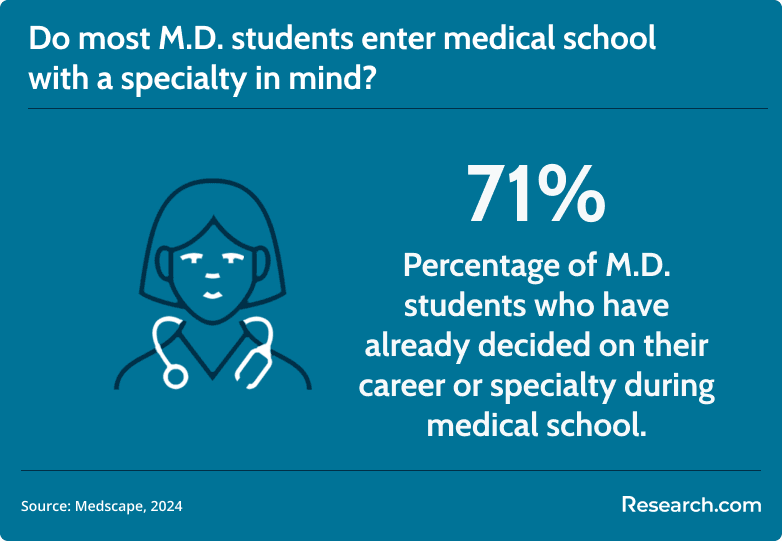
An M.D. degree program emphasizes clinical experience. Students learn to diagnose illnesses, perform medical procedures, and care for patients in hospitals and clinics. Notably, 71% of M.D. students have already chosen their career or specialty during medical school, highlighting the structured trajectory toward clinical practice (Medscape, 2024).
A PhD degree program, on the other hand, centers on research—students conduct experiments, analyze data, and develop theories or innovations that contribute to academic literature. Those drawn to applied healthcare work but not necessarily medical school sometimes compare ABA therapy vs occupational therapy, since both involve hands-on interventions but differ in focus and required training.
How long does it take to complete an M.D. degree vs. a PhD degree?
The time it takes to complete an M.D. degree and a PhD degree varies depending on the country, institution, and specialization, but generally, the M.D. path is shorter in formal schooling yet longer in total training due to clinical requirements. An M.D. degree usually requires about four years of medical school, including two years of classroom and laboratory instruction followed by two years of clinical rotations.
After graduation, however, students must complete a residency program lasting three to seven years, depending on the chosen specialty. A PhD degree, meanwhile, typically takes five to seven years to finish. The duration depends on the complexity of the research, dissertation progress, and funding availability.
While the M.D. degree focuses on applied clinical practice, the PhD degree emphasizes in-depth research that can take longer due to experimentation, peer review, and publication processes. For context, how many years is a doctorate degree depends on the discipline—medicine, psychology, and education doctorates all follow different timelines and requirements.
Do you need a science-related bachelor’s degree to apply for an M.D. degree or a PhD degree?
Admission requirements for M.D. and PhD degrees vary, but both generally favor applicants with a strong academic foundation. Here’s how they differ:
M.D. Degree Requirements
Most M.D. programs require applicants to have a bachelor’s degree with coursework in biology, chemistry, physics, and mathematics. While the degree itself doesn’t have to be in a science major, students must complete these prerequisite subjects to demonstrate readiness for medical training.
For those wondering, is biology good for medical school—the answer is yes. Biology is one of the most common and advantageous majors for pre-med students because it closely aligns with medical school prerequisites and helps build a solid foundation in human anatomy, physiology, and biochemistry.
PhD Degree Requirements
A PhD degree often requires a relevant undergraduate or master’s degree in the intended field of study. For science-based PhD programs, a background in the natural or applied sciences is essential, while in fields like the humanities or social sciences, applicants may come from a wider range of academic disciplines as long as they show research competence and academic excellence.
How are students in an M.D. degree program evaluated compared to those in a PhD degree program?
Students in an M.D. degree program and a PhD degree program undergo distinct types of assessments that reflect their different learning outcomes and professional goals. M.D. programs emphasize clinical competence, while PhD programs focus on research productivity and academic contribution. Below is a breakdown of their common evaluation methods:
- M.D. Degree Assessments. M.D. students are evaluated through a combination of classroom, laboratory, and clinical measures. These include written and practical examinations, clinical rotations, case presentations, Objective Structured Clinical Examinations (OSCEs), and standardized licensing exams such as the United States Medical Licensing Examination (USMLE) or local equivalents. Faculty also assess professionalism, communication, and ethical decision-making during patient interactions.
- PhD Degree Assessments. PhD students are evaluated based on their ability to conduct independent research and produce scholarly work. Common assessments include comprehensive or qualifying exams, research proposal defenses, progress reviews, publications in peer-reviewed journals, conference presentations, and the final dissertation defense. Supervisors and committees assess the originality, depth, and impact of the research rather than clinical or procedural skills.
In applied mental health fields, evaluation may also vary depending on credentials—such as LICSW vs LCSW—which determine whether graduates can provide therapy, supervise others, or focus on policy-level social work.
How much is the tuition cost for the M.D. degree program vs the PhD degree program?
The tuition cost gap between U.S. M.D. and PhD programs is often quite large, though many PhD programs offer funding that offsets or eliminates tuition charges for students.
At Harvard Medical School, the M.D. program is among the most expensive medical programs in the United States, while most PhD programs at Harvard’s Graduate School of Arts and Sciences (GSAS) are heavily subsidized through fellowships and stipends.
For the M.D. degree program, tuition for the 2025–2026 academic year is approximately US $73,874 per year, according to Harvard Medical School data. Over the standard four-year duration, total tuition alone can reach around US $442,381, excluding living expenses, books, and insurance fees.
Meanwhile, for the PhD degree program under Harvard GSAS, tuition costs are much lower, and most students receive full financial support. The full tuition rate is US $57,328 per year for the first two years, after which the rate drops to US $14,904 per year for advanced study years.
Overall, the M.D. degree program at Harvard is substantially more expensive than the PhD degree program. However, most PhD students receive funding that covers tuition and living expenses, while M.D. students typically finance their education through loans, scholarships, or personal resources.
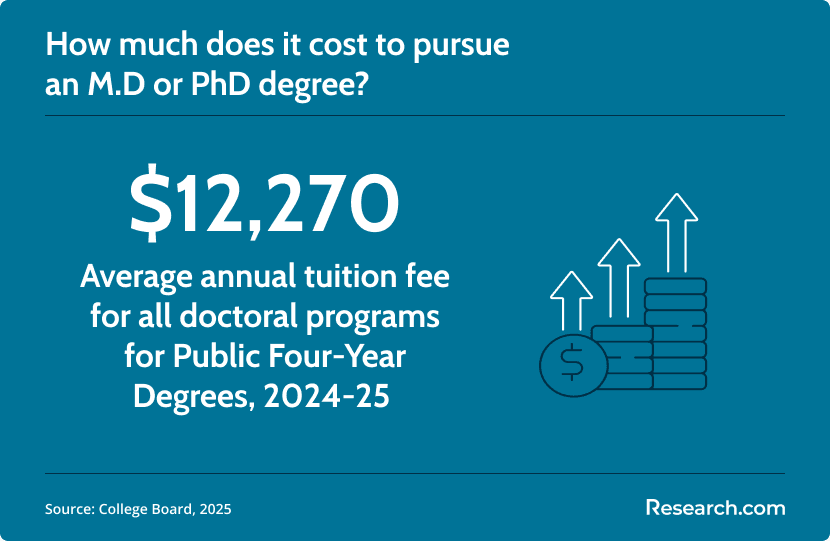
According to the College Board (2025), the average published tuition for doctoral programs, including M.D. and PhD studies, is $12,270 per year. Master’s programs for the school year 2024-25 are slightly lower at $9,560 per year, while bachelor’s programs average $8,990 per year.
What kind of careers can you expect after earning an M.D. degree compared to a PhD degree?
The career paths for PhD degree holders and M.D. degree holders differ significantly due to the unique focus of each program. PhD graduates typically enter academic, research, or industry roles centered on discovery and innovation. They often work as university professors, research scientists, policy analysts, consultants, or leaders in technology and innovation sectors. While their careers may not involve direct patient care, PhD holders play a crucial role in advancing science, developing new technologies, and contributing to evidence-based practices across disciplines.
In contrast, M.D. degree holders usually pursue careers that involve direct patient care, working as physicians, surgeons, specialists, or healthcare administrators. Some M.D. holders also transition into careers clinical research, medical education, or health policy, but their primary expertise is clinical practice.
According to the data below, the top choices for M.D. specialties include Internal Medicine (14%), Family Practice (10%), Emergency Medicine (8%), Psychiatry (7%), and Pediatrics (7%). These fields reflect the diverse clinical paths available to M.D. graduates, balancing patient care, research, and leadership opportunities in the medical field.
How do salaries compare between M.D. degree and PhD degree professionals?
M.D. degree holders, especially in high-earning specialties, tend to earn significantly more on average than PhD degree holders. However, a PhD in certain lucrative or in-demand fields can still command a high salary — often in a different risk/reward and work-life balance domain than clinical medicine.
According to the Bureau of Labor Statistics (2024), the median annual wage for physicians and surgeons is $239,200 or more. Certain specialties far exceed that; for example, pediatric surgeons, cardiologists, and orthopedic surgeons often have average salaries well above $300,000.
Based on the chart below, the top five highest-paying PhD degree jobs demonstrate the strong earning potential of advanced research and technical fields. At the top of the list is Immunology, with an average annual salary of $182,342, reflecting the growing demand for experts in medical and biological research. Other lucrative PhD degrees include Pharmacology at $120,351, Mathematics at $109,968, Economics at $109,261, and Clinical Psychology at $111,575 per year.
Other PhD professions, while still offering competitive pay, generally fall below the $100,000 mark. For instance, Biomedical Engineer salary is $86,755, while professionals in fields such as Statistics ($87,655), Environmental Science ($87,560), Biology ($78,191), and Nursing ($71,358) also demonstrate strong but moderate income potential compared to clinical physicians.
Can someone with an M.D. degree switch to research like a Ph.D. degree holder, or vice versa?
Individuals with an M.D. degree can transition into research or academic roles, though additional training or experience may be required. Many physicians engage in clinical trials, translational research, or laboratory studies while maintaining part-time clinical duties. Those with a DNP pediatric primary care nurse practitioner specialty can also participate in research, applying their clinical expertise to studies, quality improvement projects, or health policy initiatives.
Conversely, Ph.D. degree holders can move into applied medical research, pharmaceutical development, or healthcare consulting, leveraging their research expertise to inform clinical practice or medical innovation.
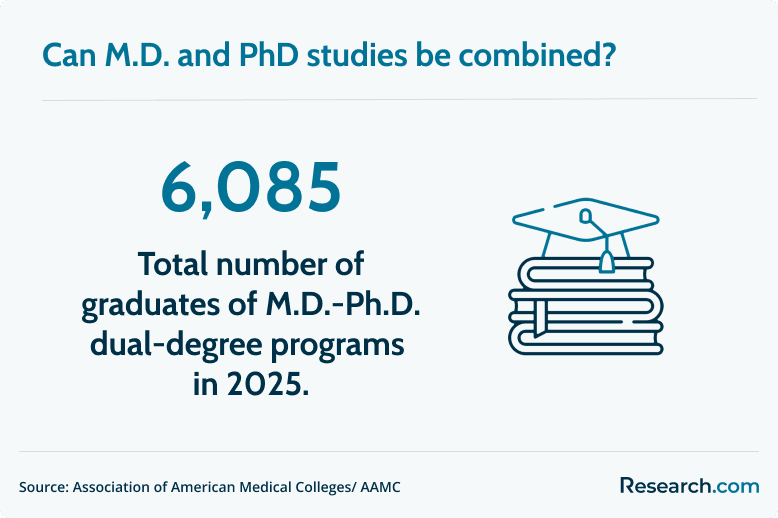
For individuals interested in formally combining both paths, many U.S. medical schools offer dual-degree M.D.-Ph.D. programs, which train graduates to become physician-scientists capable of bridging clinical practice and research. In the 2024–2025 academic year, a total of 6,085 students were enrolled in M.D.-Ph.D. programs across U.S. M.D.-granting medical schools (Association of American Medical Colleges [AAMC], 2025). These graduates are uniquely positioned to conduct translational research that directly informs patient care while maintaining clinical competencies.
Is earning an M.D. degree more challenging than completing a PhD degree?
Earning an M.D. degree and completing a Ph.D. degree each present unique challenges, making direct comparisons difficult. The M.D. degree demands mastery of extensive medical knowledge, hands-on clinical skills, and the ability to perform under high-pressure situations during rotations and residency.
Even those in low stress physician specialties face rigorous coursework, long hours, and the responsibility of patient care, which can be mentally and physically taxing. Ph.D. programs, on the other hand, require sustained intellectual effort, independent research, and the creation of original scholarly work, often under tight deadlines for publications and dissertation completion.
While M.D. students face structured clinical and academic demands, Ph.D. students navigate more flexible but intensely self-directed research, making both degrees highly challenging in different ways.
What is the long-term return on investment for an M.D. degree vs. a PhD degree?
Evaluating long-term return on investment (ROI) involves analyzing cumulative career earnings, debt obligations, and advancement opportunities rather than initial salary figures alone. M.D. degree holders often incur substantial upfront costs and extended residency requirements, which may delay full earning potential despite high compensation in later years. Conversely, Ph.D. students typically benefit from funding packages that reduce tuition burdens, allowing earlier entry into research or academic roles with steady salary increments. These differences not only impact net earnings over a career but also influence decisions regarding further certifications and professional development, including pursuing fast online degrees to diversify skill sets.
Key Findings
- Roughly 71% of M.D. students have selected their career path or specialty before completing medical school.
- Doctoral program tuition, including both M.D. and Ph.D. studies, averages around $12,270 per year.
- Among M.D. students, the most frequently chosen specialties are Internal Medicine (14%), Family Practice (10%), and Emergency Medicine (8%).
- The median yearly income for U.S. physicians and surgeons is $239,200 or higher.
- High-paying Ph.D. fields include Pharmacology ($120,351), Clinical Psychology ($111,575), Mathematics ($109,968), and Economics ($109,261) annually.
References:
- Bureau of Labor Statistics. (2024). Physicians and surgeons: Occupational outlook handbook. U.S. Department of Labor. https://www.bls.gov/ooh/healthcare/physicians-and-surgeons.htm#tab-5
- Indeed. (2025). 20 of the highest paying PhD degrees (plus salaries). https://www.indeed.com/career-advice/pay-salary/highest-paying-phd
- Medscape. (2024). 2024 medical student report. https://www.medscape.com/slideshow/2024-medical-student-report-6017682
- U.S. Department of Education, College Board. (2024). Trends in college pricing and student aid 2024. https://research.collegeboard.org/media/pdf/Trends-in-College-Pricing-and-Student-Aid-2024-ADA.pdf
- Harvard University. (2024). Tuition and fees. Harvard College. https://registrar.fas.harvard.edu/tuition-and-fees
- Harvard Medical School. (2024). Cost of attendance. https://hms.harvard.edu/education-admissions/md-program/cost-aid/cost-attendance
Other Things You Should Know About M.D. Degrees and. PhD Degrees
In 2027, an M.D. typically requires 4 years of medical school plus 3-7 years of residency. A Ph.D. often takes 3-7 years, centered on research and a dissertation. The M.D. path emphasizes clinical training, whereas the Ph.D. focuses on extensive research.
While not always strictly required, prior research experience significantly strengthens a Ph.D. application. Admissions committees look for evidence that candidates can conduct independent research, critically analyze data, and persist through long-term projects. Many successful applicants have worked as research assistants, completed senior theses, or participated in internships before applying.
After earning an M.D., graduates typically enter residency programs, which last 3–7 years depending on the specialty, and may include fellowships for further subspecialization. In contrast, Ph.D. graduates may pursue postdoctoral research, academic appointments, or industry positions, often focusing on developing expertise, publishing research, and building a professional network in their field.


