
2027 CPA vs. MBA: Explaining the Difference

Co-Founder and Chief Data Scientist
The Certified Public Accountant (CPA) license and the Master of Business Administration (MBA) serve different career objectives, with the CPA offering technical expertise and the MBA providing broad leadership training.
Your choice should align with whether you envision a future in specialized practice or in executive leadership. The U.S. Bureau of Labor Statistics projects about 124,200 annual openings for accountants and auditors through 2034, highlighting the sustained demand for specialized financial skills.
In this article, I will compare the fundamental differences between the CPA and MBA, examining the total costs, time commitments, and educational requirements for each path. I will also analyze starting salaries, executive earning potential, and job marketability to help you decide which credential best aligns with your professional goals.
Key Things You Should Know About CPA and MBA Programs
- A CPA is a state-issued professional license for technical accounting, while an MBA is a university-awarded academic degree focused on broad, strategic business management.
- Direct costs for a CPA license are about $2,000-$3,000, while a top-tier MBA's tuition alone exceeds $200,000, not including significant opportunity costs.
- A full-time MBA is a concentrated two-year program, while the multi-stage CPA licensure process of education, exams, and experience typically takes three or more years.
- What is the fundamental difference between a CPA and an MBA? CPA vs. MBA
- Which path is better for a technical career: CPA or MBA? Career Paths
- What is the total cost of obtaining a CPA vs. a top-tier MBA? Cost Comparison
- Which credential takes longer to earn: the CPA or the MBA? Duration Comparison
- What mandatory accounting credits are needed for the CPA exam? What mandatory accounting credits are needed for the CPA exam?
- Which MBA specializations meet the core CPA coursework criteria? Which MBA specializations meet the core CPA coursework criteria?
- What is the average starting salary for a new CPA vs. a new MBA graduate? Salary Comparison
- Which credential offers a higher potential executive salary: CPA or MBA? Which credential offers a higher potential executive salary: CPA or MBA?
- Which credential is more valuable for corporate finance job marketability? Job Marketability
- What is the overall value of having both a CPA and an MBA? What is the overall value of having both a CPA and an MBA?
- What is the long-term return on investment for a CPA versus an MBA? What is the long-term return on investment for a CPA versus an MBA?
What is the fundamental difference between a CPA and an MBA?
While both the CPA and MBA are recognized symbols of advanced business acumen, they represent fundamentally different professional pathways. The CPA is a specialized license that grants the authority to perform specific accounting functions, whereas the MBA is a generalist academic degree designed to develop broad leadership and management capabilities across an entire organization.
The primary differences are rooted in their scope, purpose, and application in the business world.
- Credential Type: The CPA is a state-issued professional license required to practice public accounting and issue audit reports. The MBA is a graduate academic degree from a university, signifying advanced mastery of general business administration.
- Core Focus: CPA training is highly specialized in technical accounting, auditing, tax, and financial regulation. An MBA curriculum is broad and strategic, covering management, finance, marketing, and leadership across different business functions.
- Governing Authority: The CPA is governed by uniform state board requirements for education, examination, and experience, plus a professional code of conduct. MBA programs are governed by individual universities, which results in significant curricular variation between schools.
The choice between a CPA and an MBA is a decision between professional specialization and managerial generalization. A CPA career is built on technical financial mastery and public trust, while an MBA career is designed for leading organizations and shaping corporate strategy.
In the same way professionals compare healthcare roles such as LPC vs MSW, business professionals often evaluate whether their goals align more with specialized licensure or broad managerial training.
Which credential is more focused: the CPA or the MBA?
The CPA license is the more focused credential. It is a specialized designation designed for deep technical proficiency in accounting, while the MBA is an academic degree providing a broad, strategic understanding of all major business functions. The CPA's narrow focus is a direct result of the Uniform CPA Examination, which standardizes the profession.
The exam requires candidates to master three core sections in Auditing and Attestation, Financial Accounting and Reporting, and Taxation and Regulation. This structure ensures every CPA possesses a verifiable expertise in the technical rules of accounting, making it a credential for specialists, distinct from more niche credentials like the CRFAC certification.
In contrast, the MBA curriculum is intentionally generalist. Core coursework covers corporate finance, marketing, operations management, and organizational leadership. While students can pursue concentrations, the primary goal of an MBA is to develop versatile executives who can manage complex organizations from an integrated, high-level perspective.
Ultimately, the CPA is a credential of technical depth, designed for a specific professional function. The MBA is a degree of strategic breadth, intended to prepare leaders with a holistic view of an entire enterprise.
Which path is better for a technical career: CPA or MBA?
For professionals building a career on deep technical expertise in accounting and finance, the Certified Public Accountant license is the definitive choice. The purpose of the CPA is to validate a specific, verifiable skill set in accounting, auditing, and taxation. An MBA, by design, develops general management skills and is not intended for technical specialization.
The CPA's superiority for a technical career is evident in its requirements and market application.
- Validated Technical Expertise: The Uniform CPA Exam rigorously tests detailed knowledge of U.S. Generally Accepted Accounting Principles, tax codes, and auditing standards, serving as the primary benchmark for technical accounting competence.
- Gateway to Specialized Roles: The CPA is a prerequisite for many technical positions in forensic accounting, risk assurance, and internal audit, where many also learn how to earn your CFE credential for deeper specialization.
- Foundation for Public Accounting: The Big Four and other public accounting firms, which are the primary employers for technical accounting roles, treat the CPA as the essential credential for advancement on their technical and assurance career tracks.
While an MBA provides a valuable strategic framework for business leadership, it does not offer the granular, rule-based knowledge required for a technical career. The CPA remains the unparalleled credential for professionals whose value is rooted in their mastery of complex financial and regulatory systems.
What is the total cost of obtaining a CPA vs. a top-tier MBA?
The cost difference between a CPA license and a top-tier MBA is substantial. A CPA requires manageable fees for exams and licensure, making it a low-cost credential. Conversely, a top-tier MBA represents a major educational investment with costs that consistently exceed six figures.
The primary cost drivers for each path are outlined below.
- CPA Total Cost: The direct costs for the CPA license, including application, exam, and state licensing fees, are typically in the $2,000-$3,000 range. This total does not account for any prerequisite educational credits or optional review courses.
- Top-Tier MBA Total Cost: Tuition and fees for a top-tier, two-year MBA program exceed $200,000. Living expenses, health insurance, and other associated costs can add another $50,000-$80,000 to this total.
- Opportunity Cost: CPA candidates usually study while remaining employed, thus avoiding lost income. In contrast, full-time MBA students typically leave the workforce for two years, incurring significant opportunity costs from forfeited salary.
The CPA is a financially accessible credential where the main investment is time and study. A top-tier MBA is a capital-intensive undertaking, representing a fundamentally different scale of financial commitment.
For those exploring budget-friendly alternatives in education, searches for cheapest historically black colleges and universities or affordable graduate programs offer useful context on cost variability across disciplines.
How much do CPA review courses add to the total CPA cost?
CPA review courses are an optional but standard expense that can equal or exceed the direct costs of the exams themselves. These programs provide structured study materials specifically designed to prepare candidates for the rigorous Uniform CPA Examination.
Prices vary by provider, but the leading courses fall within a predictable range.
- Premium Course Packages: Top-tier providers like Becker offer comprehensive packages for $3,000-$4,000. These typically include video lectures, thousands of practice questions, digital textbooks, and personalized support.
- Competitive Mid-Range Options: Other established providers such as UWorld and Gleim offer courses ranging from $2,000 to $3,000, often featuring adaptive learning technology and extensive question banks.
- Supplemental and A La Carte Pricing: Most providers also sell materials for individual exam sections, usually for $500-$700 each. This allows candidates to purchase content as needed or to supplement another course.
Most candidates view this as a strategic investment. The primary goal of a quality review course is to increase the likelihood of passing exams on the first attempt, saving both time and the cost of re-examination fees.
Most candidates view this as a strategic investment. The primary goal of a quality review course is to increase the likelihood of passing exams on the first attempt, saving both time and the cost of re-examination fees. Similarly, comparing certification options such as AAPC vs AHIMA helps illustrate how preparation resources can vary in cost and comprehensiveness depending on the profession.
Which credential takes longer to earn: the CPA or the MBA?
An MBA from a full-time program has a defined, concentrated timeline, while the path to CPA licensure is a flexible but multi-stage process that typically takes longer to complete from start to finish. The MBA is an academic sprint, whereas the CPA is a professional marathon integrated with a career.
The time commitments for each path are structured differently.
- Full-Time MBA Timeline: A traditional, full-time MBA is a structured academic program requiring approximately two years of continuous, immersive study. During this period, students are typically not employed, dedicating their full attention to coursework, internships, and networking.
- CPA Licensure Timeline: The CPA path is a multi-year journey completed in stages, usually while working. It involves meeting the 150-hour education rule, passing the four-part Uniform CPA Exam within a 30-month rolling window, and completing one to two years of verified professional experience under a licensed CPA.
- Pacing and Structure: The MBA timeline is fixed and intense. In contrast, the CPA timeline is self-paced and extended, meaning the total elapsed time from a bachelor's degree to full licensure often takes three years or more to complete.
An MBA is a fixed, two-year academic commitment. In contrast, the CPA is a longer, multi-stage professional journey that unfolds alongside a full-time career. The pacing difference between these two is similar to how medical certifications compare, such as PTCB (PTCE) or NHA (EXCPT), where candidates balance structured timelines against flexible, experience-based completion paths.
What mandatory accounting credits are needed for the CPA exam?
Candidates must satisfy specific educational requirements set by their state board of accountancy to be eligible for the Uniform CPA Examination. While each state has its own rules, most jurisdictions have adopted a common framework that mandates a minimum number of upper-division accounting credits as part of the broader 150-hour requirement.
While the best schools for exceptional students often design their accounting programs to meet these standards, the ultimate responsibility for compliance rests with the candidate.
The core accounting coursework required by most states typically includes:
- Financial Accounting: This is the foundational requirement, almost always including intermediate and advanced financial accounting and reporting courses that cover complex topics like consolidations, derivatives, and governmental accounting.
- Auditing and Attestation: Coursework in auditing standards and procedures is mandatory, as it forms a core competency for licensed CPAs who perform assurance services.
- Taxation: States require credit in taxation, often specifying courses in both individual and corporate or entity taxation to ensure a comprehensive understanding of tax law and compliance.
- Managerial or Cost Accounting: This requirement covers the principles of internal accounting used for management decision-making, including budgeting, costing systems, and performance evaluation.
Beyond these core subjects, many states also require credits in business law, accounting information systems, and ethics. Because requirements are not uniform, candidates must verify the precise mandates with their specific state board. The American Institute of Certified Public Accountants (AICPA) also provides a comprehensive list of requirements for every state and territory.
Which MBA specializations meet the core CPA coursework criteria?
There is currently no standard MBA specialization designed to meet the technical accounting coursework required for CPA licensure. An MBA's purpose is to develop strategic business knowledge, while CPA requirements demand a granular, rule-based mastery of accounting that an MBA curriculum does not provide.
While there is no direct path, some areas offer partial alignment.
- MBA with an Accounting Concentration: This is the only specialization that may offer courses in advanced financial reporting or corporate taxation that could satisfy certain state board requirements.
- Fulfillment of General Business Credits: General MBA courses in finance, economics, and business law can satisfy the non-accounting business credit portion of the 150-hour rule, but not the specific upper-level accounting mandates.
An MBA is not an efficient pathway for CPA prerequisites. Professionals seeking both credentials, similar to those pursuing an RN to MBA for management skills, must typically complete the required accounting coursework separately from their graduate business degree.
What is the average starting salary for a new CPA vs. a new MBA graduate?
Graduates from top MBA programs command significantly higher starting salaries than newly licensed CPAs, a difference that reflects their distinct entry points into the workforce. A new CPA typically begins in a technical accounting role with a standardized salary band, while a top MBA graduate is recruited for high-paying positions in consulting, finance, or corporate strategy.
The key differences in starting compensation are outlined below.
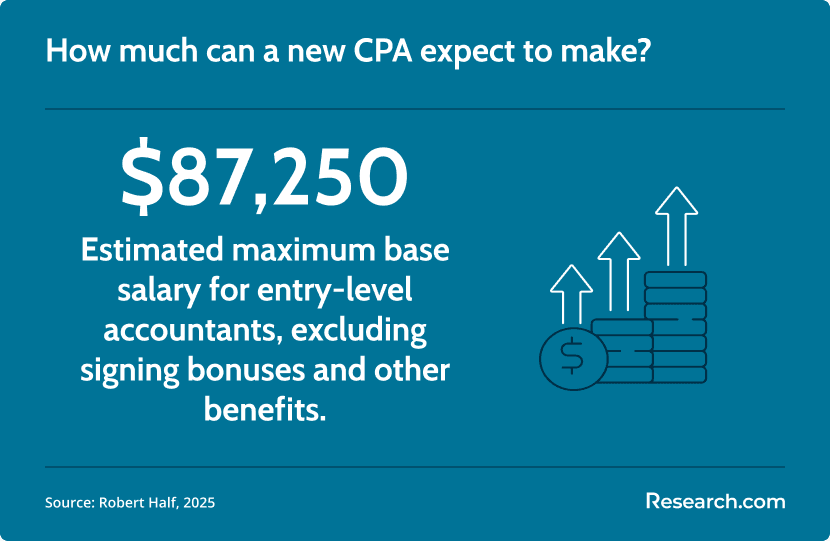
- New CPA Starting Salary: A first-year public accountant at a large firm, a common role for a new CPA, can expect to earn a starting salary between $61,000 and $87,250, according to the Robert Half 2026 Salary Guide. This figure is for a base salary and does not typically include a significant signing bonus.
- Top-Tier MBA Starting Salary: The median base salary for graduates of top-25 U.S. MBA programs consistently reaches $175,000. This figure reflects the high demand from elite employers in finance and consulting who recruit directly from these institutions.
- Additional MBA Compensation: In addition to a high base salary, the majority of top MBA graduates receive a substantial signing bonus. For the graduating class of 2024, the median signing bonus reported by top business schools was approximately $30,000.
The immediate return on investment for a top-tier MBA is substantially higher in the first year after graduation. This reflects the different career paths each credential initiates. A CPA's salary is expected to grow steadily with experience and promotion, while an MBA from an elite program provides direct access to some of the highest-paying entry-level corporate jobs available.
Which credential offers a higher potential executive salary: CPA or MBA?
While both a CPA and an MBA can lead to executive-level positions, a degree from a top-tier MBA program generally offers a higher ceiling for potential executive salary. The MBA is designed to produce general managers prepared for the broadest C-suite responsibilities, while the CPA provides a more direct, but specialized, path to the top of the finance function.
The earning potential for each credential at the executive level breaks down as follows.
- The CPA and the CFO Role: The CPA is the foundational credential for a career track culminating in the Chief Financial Officer position. According to the 2026 Robert Half Salary Guide, the salary range for a CFO is $195,500 to $321,750, with the high end of the range representing experienced executives at large companies.
- The MBA and the Broader C-Suite: An MBA from an elite program is a common pathway to the highest-paying executive roles, including Chief Executive Officer. The median pay package for CEOs at S&P 500 companies was $16.3 million in 2023, reflecting a compensation structure tied to the overall strategic leadership and performance of the entire enterprise.
- Scope and Earning Limits: The CPA provides a clear and reliable path to a lucrative executive role within the finance vertical. However, the MBA's broad, strategy-focused curriculum opens doors to a wider range of C-suite positions, such as CEO and COO, which represent the absolute peak of corporate earning potential.
While a CPA is the premier qualification for a high-paying CFO role, the MBA provides a more versatile foundation for ascending to top executive positions. The increasing availability of the degree through flexible formats, such as online colleges that start weekly, has made this strategic path more accessible to professionals aiming for the roles that command the highest salaries in the corporate world.
In addition to a degree, location matters in compensation equally. The chart below shows median salaries reported by MBA graduates by region.
Which credential is more valuable for corporate finance job marketability?
For corporate finance job marketability, the value of a CPA versus an MBA is determined by the specific role. A CPA is superior for positions in accounting and financial control, while an MBA is favored for roles centered on strategic finance and corporate development.
The CPA is the essential credential for technical roles such as corporate controller, financial reporting director, and internal audit manager. Employers in these areas require the CPA as it guarantees proficiency in accounting rules and regulatory compliance, making it the most marketable credential for corporate accounting functions.
An MBA from a top program holds more value for strategic finance positions, including Mergers and Acquisitions (M&A), treasury, and senior-level Financial Planning and Analysis (FP&A). These roles demand the advanced financial modeling and valuation skills central to an MBA curriculum. For recruiters, the degree signals the high-level analytical and leadership abilities needed to guide long-term financial strategy.
A professional's marketability is therefore enhanced by the credential that aligns with their intended function. The CPA is indispensable for a career built on financial reporting and control, while the MBA is superior for a path focused on strategic financial leadership.
How does Big 4 employer perception differ between the CPA and MBA?
The Big Four are the four largest professional services firms in the world: Deloitte, Ernst & Young (EY), PricewaterhouseCoopers (PwC), and Klynveld Peat Marwick Goerdeler (KPMG). As the dominant employers in public accounting, their core business is providing audit and tax services.
For these firms, the CPA is not merely a preference but a professional necessity, representing the foundational credential for a career within their core practices.
Their valuation of each credential directly reflects its utility within their primary service lines.
- CPA as the Foundational Requirement: The CPA license is the mandatory credential for advancement in the audit and tax practices. It is a legal prerequisite for signing audit opinions, the firms' primary attestation service, and is treated as the essential milestone for promotion to manager, senior manager, and partner.
- MBA for Strategic Advisory Roles: An MBA is highly valued within the firms' separate consulting and strategic advisory arms. These practices recruit MBAs for roles in M&A advisory, management consulting, and strategy, where business acumen is prized over technical accounting knowledge.
- A Non-Interchangeable Relationship: Within the Big Four, an MBA cannot substitute for a CPA in the core accounting and tax functions. While an MBA may be seen as a valuable supplement for a CPA in a leadership role, it is not the primary qualification for the traditional partner track in assurance or tax.
In essence, the Big Four view the CPA as the license to operate and advance within their core business. The MBA is seen as a valuable, but separate, qualification for a different set of strategic roles, reinforcing the divide between technical practice and general management.
The following graph illustrates the acceptance rates of MBA graduates in different industries within the Financial Services umbrella category.
What is the overall value of having both a CPA and an MBA?
The overall value of possessing both a CPA license and an MBA is the creation of a uniquely powerful professional profile that merges deep technical expertise with broad strategic leadership. This combination signals a professional who is fluent in both the granular details of finance and the high-level vision of executive management.
A CPA provides unimpeachable credibility in all matters of financial reporting, regulatory compliance, and internal controls. It is the gold standard for technical proficiency. An MBA builds upon that foundation by providing a comprehensive framework for corporate strategy, operations, marketing, and leadership.
This dual qualification is especially potent for those aspiring to the highest levels of corporate finance. While a CPA is often sufficient for a controller or chief accounting officer role, the addition of an MBA is a clear differentiator for securing a CFO position.
The two credentials are not redundant but synergistic. The CPA provides the technical mastery and ethical grounding required to ensure a company's financial integrity, while the MBA provides the holistic business acumen to lead its strategic direction. It demonstrates that a candidate can move beyond financial stewardship to become a strategic partner to the CEO.
Together, they create a versatile and formidable executive, fully equipped to navigate the complexities of modern business from both a financial and a strategic perspective.
Key Findings
- CPA candidates can maintain their income by studying while employed, while full-time MBA students face significant opportunity costs, forfeiting up to two years of salary.
- Review courses also add a significant cost, with comprehensive programs from top providers typically ranging from $2,000 to $4,000.
- Candidates must complete state-mandated courses in financial accounting, auditing, and taxation to fulfill the 150-hour educational rule, as these specific requirements are not nationally uniform.
- No MBA specialization provides the required technical depth for CPA coursework; even an accounting concentration lacks the rule-based focus needed for the exam.
- A new CPA starts at about $61,000-$87,250, while a top MBA graduate commands a median base salary of $175,000 with a $30,000 bonus.
- The value of holding both a CPA and an MBA lies in combining the CPA's technical mastery with the MBA's strategic vision for a complete executive skillset.
What is the long-term return on investment for a CPA versus an MBA?
A careful analysis of lifetime earnings and career advancement reveals that the CPA path offers a steady return through consistent salary growth and specialized expertise, while an MBA typically provides a faster payback through higher initial compensation and broader management opportunities. In evaluating long-term ROI, professionals should consider not only the upfront education costs and certification fees, but also factors like career progression speed, industry demand, and networking advantages. Strategic alternatives—such as low cost online MBA programs—can help mitigate educational expenses while still delivering a competitive edge. Quantitative metrics, when combined with industry benchmarks, enable candidates to align their credential choice with their financial goals and professional development timeline.
References:
- American Institute of Certified Public Accountants. (2025). CPA licensure. https://www.aicpa-cima.com/cpa-licensure
- American Institute of Certified Public Accountants. (2025). Everything You Need to Know About the CPA Exam. https://www.aicpa-cima.com/resources/toolkit/cpa-exam
- Becker. (2025). CPA exam review courses & packages. https://www.becker.com/cpa-review/courses
- Bureau of Labor Statistics, U.S. Department of Labor. (2024). Occupational Outlook Handbook, Accountants and Auditors. https://www.bls.gov/ooh/business-and-financial/accountants-and-auditors.htm
- Claybourn, C. (2025, April 10). Decide between a Full-Time and Part-Time MBA. US News & World Report. https://www.usnews.com/education/best-graduate-schools/articles/how-to-decide-between-a-full-time-and-part-time-mba
- Graduate Management Admission Council. (2025). What Is an MBA? https://www.mba.com/explore-programs/choose-and-compare-programs/what-is-an-mba
- Robert Half. (2025). 2026 Finance and Accounting Salaries and Salary Trends. https://www.roberthalf.com/us/en/insights/salary-guide/finance-and-accounting
- Wharton School of the University of Pennsylvania. (2024). MBA Careers 2024. https://statistics.mbacareers.wharton.upenn.edu/wp-content/uploads/2024/12/2024-Career-Report-FINAL.pdf
Other Things You Should Know About CPA and MBA Programs
In 2027, enrolling in a CPA program typically requires a bachelor's degree with specific courses in accounting and business. Additionally, candidates must complete 150 credit hours, which usually includes credits beyond an undergraduate degree, to qualify for the CPA exam.
An MBA can help satisfy the 150-credit-hour rule for CPA licensure, but it only offers a partial solution. The general business courses within an MBA curriculum, such as corporate finance, economics, and business law, are typically accepted by state boards to fulfill the non-accounting portion of the 150-hour educational requirement.
However, an MBA program does not substitute for the specific, upper-division accounting coursework mandated for CPA eligibility. State boards require a set number of credits in technical subjects like financial accounting, auditing, and taxation. Since a standard MBA curriculum does not provide this specialized content, candidates must complete the mandatory accounting courses separately to become eligible for the exam.
In 2027, MBA programs generally offer more flexible class schedules and modalities, often including part-time and online options beneficial for working professionals, whereas CPA candidates must balance rigorous exam preparation alongside work. Each path requires significant commitment, but MBA programs typically provide better work-study balance.


