
2027 MSW vs. LPC in Social Work: Explaining the Difference

Co-Founder and Chief Data Scientist
More than 700,000 professionals in the U.S. work in social services, yet many students remain unsure whether to pursue a Master of Social Work (MSW) or become a Licensed Professional Counselor (LPC). While both paths lead to careers that help people navigate mental health, family, and social challenges, their training, scope, and licensing differ.
This article breaks down how MSW and LPC degrees compare in education, roles, salary, job outlook, and licensing—so you can choose the path that best fits your professional goals in 2025.
Key Things You Should Know About MSW and LPC in Social Work
- Different Education Paths: An MSW is a graduate degree focused on social work practice, policy, and community welfare, while LPCs complete a master’s in counseling centered on psychotherapy, human behavior, and mental health treatment. Both require supervised clinical hours for licensure.
- Distinct Career Focus: MSWs often work in healthcare, social services, or government settings, addressing systemic and individual challenges. LPCs typically specialize in therapy and counseling, treating mental health conditions, trauma, and addiction through structured interventions.
- Separate Licensing and Oversight: Social workers earn licenses through the ASWB and state social work boards, while LPCs are regulated by state counseling boards and the NBCC, which oversees the National Counselor Examination (NCE).
- What is MSW vs. LPC in Social Work? MSW vs. LPC
- How do MSW and LPC programs differ in curriculum and training? Curriculum and Training
- What are the licensing requirements for LCSW and LPC in different states? Licensing Requirements
- What career roles can I pursue with an MSW vs. with an LPC? Career Roles
- How do salaries and job outlook compare between MSW (LCSW social worker) and LPC paths? Salaries & Job Outlook
- What are the costs, tuition, and time investment for MSW vs. LPC programs? Costs & Time Investment
- What challenges and barriers should students expect along the MSW and LPC paths? Challenges & Barriers
- Is one path more flexible or portable across states (licensure reciprocity)? Licensure Flexibility
- What are the admission requirements and prerequisites for MSW and LPC programs? What are the admission requirements and prerequisites for MSW and LPC programs?
- Which path is better for someone interested in therapy vs. social justice or community work? Which path is better for someone interested in therapy vs. social justice or community work?
- How do MSW + LCSW and LPC complement each other — can you combine both, or switch paths later? How do MSW + LCSW and LPC complement each other — can you combine both, or switch paths later?
MSW vs. LPC: Quick Answer for Choosing the Right Path
If you want a graduate path that can lead to therapy, case management, advocacy, healthcare coordination, school support, nonprofit leadership, or policy work, a Master of Social Work (MSW) is usually the broader option. If your main goal is to provide counseling and psychotherapy as your central professional function, the Licensed Professional Counselor (LPC) route is usually more focused.
An MSW is a graduate degree in social work. After additional supervised clinical experience and state licensure, MSW graduates may become Licensed Clinical Social Workers (LCSWs). An LPC is a professional license earned after completing a counseling-focused master’s degree, supervised clinical hours, and required exams such as the National Counselor Examination (NCE) or National Clinical Mental Health Counseling Examination (NCMHCE).
The two paths overlap in mental health practice, but they are not interchangeable. Social work training looks at people within families, communities, institutions, and public systems. Counseling training concentrates more deeply on psychotherapy, assessment, diagnosis, and treatment planning. According to the Bureau of Labor Statistics (BLS, 2025), employment for social workers is projected to grow 7% from 2024–2034, while counselor-related roles in mental health and substance abuse are projected to grow 18–22% during the same period.
Students comparing MSW concentrations can use this overview of master of social work specializations to see how clinical, policy, healthcare, school, and community tracks differ.
| Decision Point | MSW / LCSW Path | LPC Path |
| Best fit | Students who want clinical skills plus systems, advocacy, case management, and policy options | Students who want their work centered on counseling, psychotherapy, and mental health treatment |
| Credential type | Graduate degree first; clinical licensure may follow through the LCSW route | State license earned after a counseling master’s degree and supervised practice |
| Main licensing exam | ASWB exam through the Association of Social Work Boards | NCE, NCMHCE, or another state-approved counseling exam |
| Professional focus | Social systems, client advocacy, case coordination, therapy, and community support | Assessment, diagnosis, psychotherapy, treatment planning, and counseling interventions |
| Common workplaces | Hospitals, schools, public agencies, nonprofits, behavioral health programs, and community organizations | Mental health clinics, private practices, school settings, substance use programs, and telehealth platforms |
| Projected growth, 2024–2034 | +7% | +18–22% |
How MSW and LPC Programs Differ in Curriculum, Fieldwork, and Clinical Training
MSW and LPC programs begin with different assumptions about professional practice. MSW programs train students to understand personal problems within social, economic, cultural, institutional, and policy contexts. LPC programs train students to evaluate and treat mental health concerns through counseling theories, diagnosis, ethics, and evidence-based therapeutic methods.
In an MSW program, students commonly study human behavior in the social environment, social welfare policy, research methods, community practice, ethics, diversity, trauma-informed practice, and direct clinical work. Field education is a major part of the degree. Placements may take place in hospitals, schools, social service agencies, child welfare organizations, behavioral health centers, government programs, or nonprofits. This gives MSW students exposure to both micro practice with individuals and macro practice with systems and communities.
LPC-track master’s programs are usually built around counseling theory, psychopathology, assessment, diagnosis, treatment planning, crisis intervention, group counseling, lifespan development, ethics, and supervised counseling practice. Students typically complete practicum and internship experiences in counseling centers, mental health clinics, substance use programs, private practice settings, or community behavioral health agencies. The training is more therapy-intensive and less focused on social policy or public systems than an MSW curriculum.
Readers who want a deeper credential comparison can review this guide to licensed clinical social worker and licensed professional counselor degree programs.
| Training Area | MSW Program Emphasis | LPC Program Emphasis |
| Academic scope | Clinical practice, policy, social welfare systems, advocacy, community work, and human behavior | Counseling theories, assessment, psychopathology, ethics, diagnosis, and therapy methods |
| Field placement setting | Agencies, schools, hospitals, public programs, community organizations, and clinical sites | Counseling centers, therapy practices, mental health clinics, and behavioral health programs |
| Clinical preparation | Direct service plus case management, systems navigation, crisis work, and advocacy | Individual, group, family, and mental health counseling under supervision |
| Practice lens | Person-in-environment, social justice, systems change, and client support | Psychological assessment, therapeutic relationship, diagnosis, and intervention |
| Licensure alignment | Designed to support social work licensure paths, including the LCSW route | Designed to meet counseling licensure requirements and prepare for exams such as the NCE or NCMHCE |
LCSW vs. LPC Licensing Requirements: What Changes by State?
Licensure is one of the most important differences between the MSW/LCSW and LPC routes. Both are regulated at the state level, which means requirements can change depending on where you plan to study, complete supervision, and practice. Before enrolling, students should confirm that a program’s curriculum and fieldwork meet the rules of the state licensing board where they intend to become licensed.
Typical LCSW requirements after an MSW
- Complete an MSW from a CSWE-accredited program or an accepted equivalent.
- Accumulate post-degree supervised clinical experience, often between 2,000 to 4,000 hours depending on state rules.
- Pass the ASWB Clinical examination or another ASWB exam level required by the state. In 2024, the first-time pass rate for the Clinical level was 75.3%.
- Submit board applications, fees, background check materials, transcripts, and supervision verification.
- Meet any state-specific requirements, which may include jurisprudence exams, continuing education, ethics training, or renewal rules.
Typical LPC requirements after a counseling master’s degree
- Earn a master’s degree in counseling or a related field, often including 48 to 60 credit hours and required practicum or internship experiences.
- Complete post-graduate supervised clinical counseling hours as defined by the state board.
- Pass the NCE, the NCMHCE, or both if required by the licensing jurisdiction.
- Complete any state law, ethics, or jurisprudence exam. California LPCC applicants, for example, face state-specific legal and procedural requirements.
- Submit applications, official documentation, supervision records, background checks, and fees.
Examples of state-level variation
- Virginia: LPC candidates must pass either the NCMHCE or NCE; TRICARE reimbursement requires the NCMHCE.
- Illinois: LCPC requirements may involve the NCE, CRCC exam, or both depending on credential level.
- California LPCC: applicants must complete 3,000 supervised hours across at least 104 weeks, complete fingerprinting, pass a law and ethics exam, and register as an associate counselor (APCC) before full licensure.
Because exam choice can affect licensure and reimbursement, candidates should understand the difference between the NCE and NCMHCE. The NCE is more knowledge-based, while the NCMHCE uses clinical simulations to test decision-making in counseling scenarios.
Career Options With an MSW vs. an LPC
MSW and LPC professionals may serve similar client populations, but they often enter different job categories and organizational roles. MSW graduates can work across social services, healthcare, schools, government, nonprofit leadership, and clinical mental health. LPCs usually work more directly in counseling, therapy, assessment, substance use treatment, school counseling, and private practice.
Students considering deeper clinical or academic authority sometimes compare master’s and doctorate options in psychology to understand how additional graduate study may affect supervision, teaching, research, and advanced practice opportunities.
Common MSW and LCSW roles
- Licensed Clinical Social Worker: Provides therapy, crisis intervention, psychosocial assessment, care coordination, and support for individuals, families, and groups.
- Healthcare Social Worker: Helps patients and families manage illness, discharge planning, insurance barriers, hospice decisions, and community care referrals.
- School Social Worker: Supports students facing behavioral, family, social, attendance, or emotional challenges while collaborating with educators and caregivers.
- Community Program Director: Oversees nonprofit, public, or community-based programs that serve vulnerable populations or address social needs.
- Policy Analyst: Evaluates social welfare programs, studies service gaps, and advises agencies or advocacy groups on policy improvements.
Common LPC roles
- Clinical Mental Health Counselor: Assesses and treats emotional, behavioral, and psychological conditions through counseling interventions.
- Marriage and Family Therapist: Works with couples and families on communication, conflict, relationship patterns, and family-system concerns.
- School Counselor: Supports students with academic planning, career readiness, emotional development, and school adjustment.
- Substance Abuse Counselor: Provides counseling, relapse prevention planning, and behavioral support for clients experiencing addiction or substance use disorders.
- Private Practice Counselor: Offers therapy independently or in a group practice after meeting state licensure and practice requirements.
The practical difference is this: an MSW can support therapy work while also opening doors to case management, administration, policy, and community systems. An LPC is more specialized for clinical counseling as the core professional activity. The visual below shows how selected roles compare in pay and career direction.
MSW vs. LPC Salary and Job Outlook
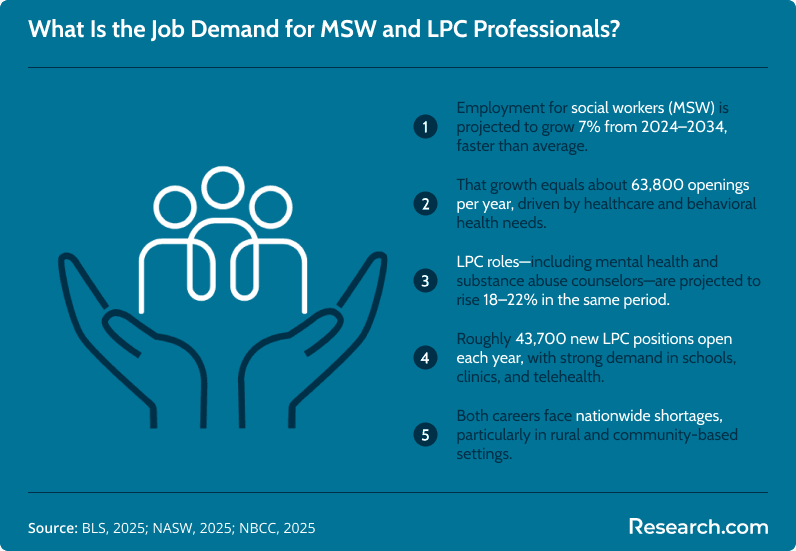
Income depends heavily on location, employer, licensure level, specialization, experience, and whether the professional works in public agencies, healthcare systems, schools, private practice, or telehealth. According to the Bureau of Labor Statistics (BLS, 2025), social workers earn a median annual wage of $61,330. Higher-paying social work-adjacent leadership roles, including healthcare and community service management positions, can exceed $75,000. LPC-related professionals, including mental health counselors, substance abuse counselors, and marriage and family therapists, commonly fall around $59,000 to $65,000 a year.
Growth projections differ. BLS projects 7% employment growth for social workers from 2024–2034. LPC-related occupations are projected to grow 18–22% over the same period, reflecting sustained demand for behavioral health, substance use, school-based, and mental health services. A higher growth rate does not guarantee a job offer or a specific salary, but it can signal where employer demand is expanding.
| Career Factor | MSW / LCSW Path | LPC Path |
| Median or typical pay noted in source material | $61,330 annually for social workers; some related leadership roles exceed $75,000 | Often around $59,000 to $65,000 a year for related counseling roles |
| Projected employment growth | 7% from 2024–2034 | 18–22% from 2024–2034 |
| Settings that may improve earning potential | Healthcare, clinical practice, program administration, government systems, and supervisory roles | Private practice, specialized behavioral health, telehealth, substance use treatment, and advanced clinical experience |
| Important caution | An MSW alone may not qualify graduates for independent clinical practice without additional licensure. | An LPC license usually requires a counseling master’s degree, supervised hours, and state-approved exams. |
Both routes can lead to stable human-service careers, but salary should not be the only deciding factor. The better question is whether you want a broader social systems career with clinical options or a counseling-centered career with a narrower therapeutic focus.
Cost, Tuition, and Time Commitment for MSW and LPC Programs
The MSW and LPC routes both require graduate education, supervised practice, exam fees, and time before independent licensure. The financial commitment is not limited to tuition. Students should also plan for books, technology, field placement travel, background checks, application fees, exam fees, unpaid or low-paid practicum hours, and continuing education after licensure.
MSW programs often take two years full time, although timelines vary by enrollment status and prior social work education. According to CollegeTuitionCompare (2025), average in-state tuition for graduate social work programs, including MSW programs, is $11,118, while out-of-state students pay about $22,741 annually. Students looking for lower-cost social work options may also compare the most affordable online social work degree pathways before deciding how to build toward graduate study.
LPC preparation generally requires a master’s degree in counseling, often lasting two to three years and including 48–60 credit hours. Tuition varies by institution and delivery format. Counseling students should also budget for NCE or NCMHCE preparation, state applications, supervision requirements, and continuing education. In both fields, the least expensive advertised tuition may not be the lowest total cost if the program has limited field placement support, poor transfer policies, or extra fees.
| Cost or Time Factor | MSW Route | LPC Route |
| Typical graduate timeline | Often two years full time | Often two to three years |
| Credit expectations noted in source material | Varies by MSW structure and prior social work preparation | Often 48–60 credit hours |
| Tuition data available | $11,118 in-state and $22,741 out-of-state annually for graduate social work programs, including MSW programs | Varies widely and may be comparable to MSW costs depending on school and format |
| Additional costs | Field placement expenses, licensure applications, ASWB exam preparation, background checks, and continuing education | Practicum and internship costs, supervision, NCE or NCMHCE fees, state applications, background checks, and continuing education |
The chart below helps frame MSW tuition expectations using the 2025 data cited above.
Challenges Students Should Expect Before Becoming an LCSW or LPC
Both paths are demanding. MSW students must balance graduate coursework with field placements and professional expectations, while LPC candidates must complete counseling coursework, clinical internships, supervised post-graduate hours, and state exams. The work can be emotionally intense because students and new professionals often serve clients dealing with trauma, addiction, poverty, mental illness, family conflict, disability, or crisis.
MSW programs often require 900 to 1,200 supervised field hours. LPC candidates may need 2,000–3,000 post-graduate supervised clinical hours for state licensure, which can take two or more years. These requirements can affect income, scheduling, family responsibilities, and geographic mobility.
Common barriers in both pathways
- Tuition and debt pressure: Graduate education can be expensive, especially at private schools or for out-of-state students.
- Licensure exam stress: ASWB pass rates range from 50%–75%, and the NCE is around 89%.
- Burnout risk: Client trauma, documentation demands, high caseloads, and limited resources can be exhausting.
- Supervision access: Rural and underserved areas may have fewer qualified supervisors.
- State-by-state complexity: Coursework, supervision, exam, and renewal rules differ across jurisdictions.
Flexible formats may help some students continue working while completing coursework. For example, students evaluating faster options can compare accelerated social work programs, but they should still confirm field placement expectations, weekly workload, and licensure alignment before enrolling.
| Common Mistake | Why It Creates Problems | Better Approach |
| Choosing a program before checking accreditation | Licensure boards may reject degrees that do not meet professional standards. | Verify CSWE accreditation for MSW programs and state board alignment for counseling programs. |
| Looking only at tuition | Fees, placement costs, travel, exam prep, and lost work hours can change the real cost. | Calculate total cost of attendance and licensure-related expenses. |
| Assuming online programs automatically qualify for licensure everywhere | State rules vary, and some programs are designed for specific jurisdictions. | Ask the program and state board whether the curriculum meets your intended state’s requirements. |
| Ignoring supervision logistics | Graduates may struggle to find approved supervisors after finishing coursework. | Ask where recent graduates completed supervision and whether the school helps with placements. |
| Relying only on rankings | A highly visible school may not be the best fit for your budget, location, licensure plan, or support needs. | Compare accreditation, placement support, outcomes, faculty access, and total cost. |
The visual below compares licensure exam pass-rate context and shows why early preparation matters.
Licensure Portability: Is an LCSW or LPC Easier to Move Across States?
Both LCSW and LPC licenses are issued by states, so neither credential is automatically portable everywhere. However, LCSW credentials are often viewed as somewhat more portable because social work licensing has broader national exam standardization through the ASWB and stronger movement toward interstate mobility frameworks. In many cases, an LCSW moving to a new state may still need to submit applications, pass background checks, verify supervision, and meet local requirements.
LPC portability can be more complicated. Counseling boards vary in required credit hours, supervision rules, qualifying exams, title definitions, and scope of practice. Some states license counselors by endorsement if they meet comparable standards, while others may require additional coursework, extra supervision, or another exam. The practical result is that an LPC planning to move should check requirements before relocating, not after.
Students considering remote education should be especially careful. Online and hybrid programs can be excellent options, but they must match the licensing expectations of the state where the student plans to practice. Those starting earlier in the social work pathway can explore online social work degree options while keeping future graduate licensure requirements in mind.
The bottom line: the LCSW path may offer somewhat stronger portability, but every candidate should verify rules directly with the target state board.
Admission Requirements and Prerequisites for MSW and LPC Programs
MSW programs typically require a bachelor’s degree, transcripts, recommendations, a personal statement, and evidence of readiness for graduate-level social work. Some applicants enter with a Bachelor of Social Work, while others come from psychology, sociology, public health, criminal justice, education, or related fields. Programs may value human-service experience, volunteer work, field exposure, or professional experience with vulnerable populations.
LPC-track counseling programs usually require a bachelor’s degree, prerequisite coursework or preparation in psychology or related subjects, recommendations, a statement of purpose, and sometimes interviews. Admissions committees may look for emotional maturity, communication skills, ethical judgment, and readiness for supervised clinical training.
Students who need flexibility can compare affordable online MSW programs, but they should ask detailed questions about accreditation, field placement support, state licensure alignment, and whether online students receive the same advising as campus students.
Questions to ask before applying
- Does the program meet licensure requirements in the state where I plan to practice?
- Who arranges field placements or counseling internships: the school, the student, or both?
- What percentage of students complete fieldwork or practicum on time?
- Are there extra fees for supervision, technology, background checks, or placement coordination?
- Can I complete the program while working, or are daytime field hours required?
- What support does the school provide for ASWB, NCE, or NCMHCE preparation?
Which Path Is Better for Therapy, Social Justice, or Community Work?
Choose the LPC route if your primary goal is to deliver counseling and psychotherapy. LPC programs are structured around mental health assessment, diagnosis, treatment planning, counseling skills, and therapeutic relationships. This path is especially aligned with careers in outpatient counseling, private practice, substance use treatment, telehealth counseling, and school or community mental health settings.
Choose the MSW route if you want clinical skills but also want the option to work in advocacy, healthcare systems, policy, community programs, case management, or public service. LCSWs can provide therapy after meeting clinical licensure requirements, but social work education also prepares graduates to address housing instability, poverty, family systems, disability services, community resources, institutional barriers, and access to care.
| Your Career Priority | Stronger Fit | Why |
| Providing therapy as your main role | LPC | Counseling programs are built around psychotherapy, diagnosis, and treatment methods. |
| Combining therapy with case management and advocacy | MSW / LCSW | Social work training connects clinical practice with social systems and client resources. |
| Working in policy, nonprofits, or community programs | MSW | The curriculum includes social welfare policy, community practice, and systems-level change. |
| Opening a counseling-focused private practice | LPC or LCSW, depending on state rules | Both may practice clinically after licensure, but training models and scope vary by state. |
| Serving clients affected by social barriers | MSW / LCSW | The MSW framework emphasizes person-in-environment and structural barriers to well-being. |
Program type also matters. Students should understand institutional differences, including how for-profit and nonprofit colleges differ, before committing to a school that will shape licensure, debt, and career outcomes.
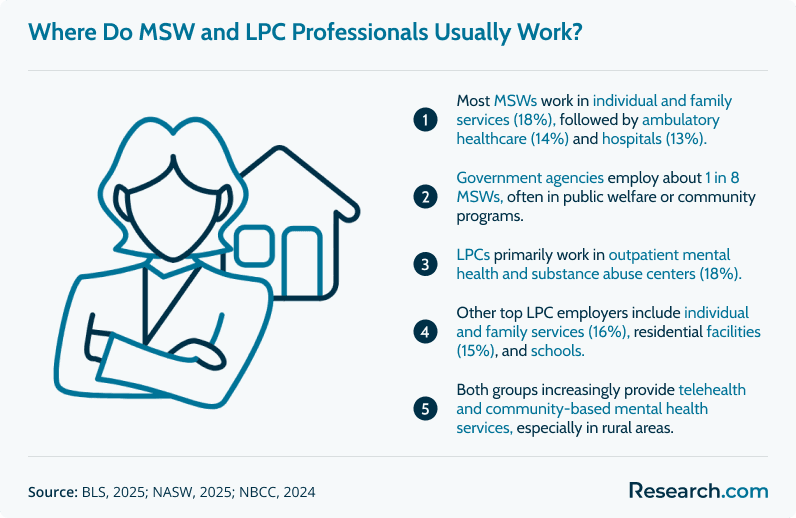
The infographic below shows where many MSW and LPC professionals work and how clinical, school, healthcare, and community settings compare.
Can You Combine, Switch, or Bridge MSW/LCSW and LPC Pathways?
It is possible to move between the MSW/LCSW and LPC worlds, but it is rarely automatic. A professional who already holds one credential may still need additional coursework, supervised clinical hours, state applications, and a separate licensure exam to qualify for the other. The overlap in ethics, client care, mental health foundations, and supervised practice helps, but licensing boards evaluate each profession according to its own standards.
Some professionals pursue both credentials because they want to combine psychotherapy with systems-level work. For example, an LCSW may add counseling-related training to deepen therapy skills, while an LPC may pursue social work education to move into healthcare coordination, nonprofit leadership, policy, or community program management. Dual preparation can be useful, but it requires careful planning and may not be worth the added cost for everyone.
Mid-career adults considering another credential should plan around workload, transfer policies, prerequisite gaps, and financing. This guide on returning to college as an adult can help with questions about credits, scheduling, and completing another degree while working.
Before switching paths, ask your state board whether prior coursework or supervision can count. Also ask employers in your target setting which credential they prefer. A hospital, school district, private practice group, community agency, or telehealth employer may value the credentials differently.
What Graduates Say About MSW and LPC Training
- Marisol: "Completing my MSW online helped me keep my job and caregiving responsibilities while finishing field education. I was able to focus on clinical social work and move into hospital practice without leaving my community. The strongest part of the program was learning to connect individual care with larger community needs."
- Darius: "My online counseling program was demanding, but the supervised labs and virtual practice sessions helped me become more comfortable with therapy delivery. I now counsel clients in a rural area where access to in-person services is limited, and the telehealth preparation still helps me every week."
- Renée: "I earned an MSW first and later completed additional training toward LPC licensure through an online bridge option. Having both perspectives expanded my work into therapy, program leadership, and advocacy. Online study required discipline, but it let me continue serving my local community while advancing professionally."
Current Trends Affecting MSW and LPC Careers
Behavioral health demand, telehealth, workforce shortages, documentation technology, and changing licensure rules are shaping both career paths. Students should choose programs that prepare them for in-person and remote care, ethical use of digital tools, trauma-informed practice, multicultural competence, and interdisciplinary collaboration.
- Telehealth is now a normal part of care delivery: LPCs and LCSWs may provide remote services, but state rules, supervision policies, client location, privacy requirements, and payer rules matter.
- Employers want licensure-ready graduates: Programs that clearly map coursework to state requirements reduce risk for students.
- AI and automation are affecting documentation: Tools may support scheduling, note drafting, and administrative workflows, but licensed professionals remain responsible for confidentiality, clinical judgment, and ethical practice.
- Integrated care is expanding: Hospitals, community clinics, schools, and behavioral health agencies increasingly value professionals who can coordinate across medical, mental health, family, and social service systems.
- Portability remains a major planning issue: Students who may move should compare state board requirements before choosing a program or supervision site.
How to Decide Between an MSW and LPC Program
- Start with the job you want. Review real job postings in your state and note whether employers request MSW, LCSW, LPC, LPCC, LMHC, or another credential.
- Check your state licensing board. Confirm degree type, accreditation expectations, coursework, practicum, supervision hours, exams, and renewal rules.
- Compare program accreditation and licensure alignment. Do not rely only on admissions representatives; verify requirements directly.
- Estimate total cost, not just tuition. Include fees, books, travel, lost work hours, supervision, exam prep, and licensing applications.
- Ask about field placement support. A strong program should explain how placements are approved, supervised, monitored, and matched to student goals.
- Evaluate schedule realism. Fieldwork and internships may require weekday daytime availability, even in online programs.
- Consider long-term flexibility. If you want leadership, policy, healthcare coordination, and therapy, MSW may be broader. If you want counseling as your core identity, LPC may be cleaner.
References
- American Counseling Association. Mental health provider shortage analysis.
- American Counseling Association. 2023 legislative agenda.
- American Counseling Association. Counseling workforce report.
- American Counseling Association. Counselor licensure requirements.
- American Counseling Association. Workforce survey executive summary.
- American Counseling Association. Year in review.
- Association of Social Work Boards. ASWB exam pass rates.
- Board of Behavioral Sciences, California. LPCC applicant information.
- CollegeTuitionCompare. 2025 social work tuition data.
- Clinical Social Work Association. ASWB exam update.
- Clinical Social Work Association. 2023 LCSW state data.
- Council on Social Work Education. State of social work education survey summary, 2022–2023.
- Virginia Department of Health Professions. Counseling examination information.
- Illinois Department of Financial and Professional Regulation. Professional counselor licensure application.
- National Board for Certified Counselors. NBCC overview.
- National Center for Biotechnology Information. Mental health services overview.
- National Counselor Examination. NCE exam information.
- National Association of Social Workers. 2025 PSLF public comment.
- National Association of Social Workers. New social workers report.
- National Association of Social Workers. Social Work Month 2024 letter.
- National Association of Social Workers. Social work salary resource.
- U.S. Bureau of Labor Statistics. Community and social service occupations.
- U.S. Bureau of Labor Statistics. Social workers occupational outlook.
- Zippia. Social worker jobs overview.
- ZipRecruiter. MSW salary resource.
- ZipRecruiter. Social worker resume skills and keywords.
- EZ Test Prep. NCE exam difficulty overview.
Key Insights
- MSW is broader; LPC is more counseling-specific. Choose MSW if you want clinical options plus advocacy, healthcare, policy, case management, or community work. Choose LPC if psychotherapy and counseling are your main career goals.
- Licensure rules matter more than program marketing. State boards control degree, coursework, supervision, exam, and renewal requirements. Always verify before enrolling.
- Both paths require supervised practice after graduate study. MSW students may complete 900 to 1,200 field hours, while LPC candidates may face 2,000–3,000 post-graduate supervised clinical hours.
- Job outlook is strong but not identical. Social worker employment is projected to grow 7% from 2024–2034, while LPC-related roles are projected to grow 18–22%.
- Cost comparisons should include the full pathway. Tuition, fees, fieldwork, supervision, exam preparation, licensing applications, and lost work time all affect ROI.
- Portability is not guaranteed. LCSW credentials may be somewhat easier to transfer across states, but both LCSW and LPC professionals must check state-specific endorsement and reciprocity rules.
- The best choice depends on your professional identity. If you see yourself primarily as a therapist, LPC may fit better. If you want to help clients while also addressing systems and social barriers, MSW may offer more flexibility.
Other Things You Should Know About MSW and LPC in Social Work
In 2027, MSWs typically require a Master of Social Work, passing the ASWB exam, and state licensure, whereas LPCs need a Master's in Counseling, the NCE or similar exam, and separate licensure. Requirements can vary by state, with different governing bodies for each profession.
In 2027, an MSW typically leads to social work roles focused on community services, case management, and clinical practice, while an LPC is primarily suited for jobs in mental health counseling, therapy, and private practice. Each involves distinct regulatory and licensure pathways.
In 2027, MSWs typically require a two-year program focusing on social work practice, policy, and client-centered advocacy. LPCs generally need a master's degree in counseling, with a focus on therapeutic techniques, clinical skills, and mental health diagnostics.


