
For-Profit vs. Nonprofit Colleges: Explaining the Difference in 2027

Co-Founder and Chief Data Scientist
Choosing between a for-profit and nonprofit college is more than just a financial decision—it is about finding the right path for your goals.
The State of Higher Education 2025 report from Gallup and Lumina Foundation reveals that six in ten currently enrolled students said expected future job opportunities were a major factor in deciding to enroll. This further emphasizes the importance of understanding the key differences in cost, accreditation, and student outcomes so you can make a confident choice that aligns with your ambitions.
Whether you prioritize career advancement or a traditional academic experience, knowing how for-profit colleges and nonprofit institutions operate is essential to shaping your educational and professional future. Use this guide to help you decide the best pathway for achieving your goals.
Key Points of For-Profit vs. Nonprofit Colleges
- For-profit colleges operate as businesses aiming to generate profit, often with flexible, career-focused programs, while nonprofit colleges reinvest revenues to prioritize educational quality and student services.
- Nonprofit colleges tend to have higher admissions standards, better graduation rates, and regional accreditation, which supports credit transfer and graduate school acceptance.
- For-profit colleges typically have higher tuition relative to public schools but may offer shorter programs and more accessible admissions; however, they often face criticism for lower student outcomes.
- Student experience at nonprofit colleges usually includes more campus resources, extracurricular activities, and academic support, whereas for-profits focus on adult learners and workforce readiness.
Affordable Quick Online Degree Programs With High Acceptance Rates
1. Nursing
Online nursing programs offer fast, flexible paths to enter or advance in healthcare. They are popular for high job demand, strong salary potential, and opportunities to make a direct impact on patient care.
2. Computer Science
This degree provides essential tech skills for in-demand careers in programming, cybersecurity, and data analysis. Its flexibility and strong job market make it a top choice for quick, career-focused online learners.
3. Healthcare Administration
Ideal for those seeking leadership roles in hospitals or clinics, this degree combines business and healthcare knowledge. It is valuable for career advancement and offers broad job opportunities in a growing industry.
4. Management
Online management programs teach leadership, communication, and problem-solving skills applicable across industries. They’re popular for professionals aiming to move into supervisory or executive positions quickly and affordably, or those who want to start their own business.
5. Management Information Systems
Combining business strategy with technology, this degree prepares students for data-driven decision-making roles. It is valued for versatility and strong job growth in IT and organizational management.
6. Economics
A flexible and analytical program, economics helps students understand market trends, finance, and policy. It is a smart choice for careers in business, government, or research with excellent return on investment.
7. Business Administration
This is one of the most popular online degrees. It offers practical knowledge in marketing, finance, and operations. Graduates gain adaptable skills ideal for management and entrepreneurship roles.
8. Accounting
Essential for every organization, this degree provides foundational financial literacy and a clear path to professional certification (like Certified Public Accountant), leading to stable, in-demand roles.
9. Special Education
Designed for those passionate about inclusive learning, this degree prepares educators to support students with diverse needs. It is rewarding, impactful, and in high demand nationwide.
10. Social Work
Online social work programs equip students with counseling and advocacy skills to help individuals and communities. The degree’s flexibility and meaningful outcomes make it a top choice for compassionate professionals.
- What are for-profit and nonprofit colleges? For-profit vs. Nonprofit
- What is the difference between for-profit and nonprofit colleges? Differences
- Are for-profit colleges more expensive than nonprofit colleges? Cost Comparison
- Do students at for-profit colleges qualify for federal financial aid and loans? Financial Aid
- Do students from for-profit colleges have higher student debt than those from nonprofit institutions? Student Debt
- Do for-profit colleges have the same accreditation as nonprofit colleges? Accreditation
- Is it easier to gain admission to for-profit or nonprofit colleges? Is it easier to gain admission to for-profit or nonprofit colleges?
- What are the employment outcomes for graduates of for-profit vs. nonprofit colleges? Employment Outcomes
- What are the pros and cons of for-profit and nonprofit colleges? Pros and Cons
- How do I decide whether a for-profit or nonprofit college is the best fit for my career goals? How do I decide whether a for-profit or nonprofit college is the best fit for my career goals?
- What are the retention and graduation rate differences between for-profit and nonprofit colleges? What are the retention and graduation rate differences between for-profit and nonprofit colleges?
What are for-profit and nonprofit colleges?
Nonprofit colleges are legally recognized as tax-exempt organizations. They must reinvest all profits into their academic programs, faculty, facilities, and student services. Their primary mission is education and public service, not financial gain.
For-profit colleges, on the other hand, are private businesses that operate to generate profit for owners or shareholders. Revenue from tuition and fees can be distributed as earnings, and these institutions are subject to corporate taxes.
In short, nonprofit colleges focus on educational impact, while for-profit colleges prioritize financial return alongside education delivery.
According to the National Center for Education Statistics (NCES), there were more than 1,700 private nonprofit institutions and more than 2,100 private for-profit institutions as of the 2024-2025 academic year (AY).
Based on the most current available data from NCES, here is the distribution of higher education institutions (HEIs) with Title IV status in the United States and other U.S. jurisdictions.
When weighing program types and timelines, some readers also compare certificate vs degree pathways within these institutions, since short, job-focused certificates may be concentrated at for-profits while nonprofits often emphasize full degree tracks and broader academic foundations.
What is the difference between for-profit and nonprofit colleges?
The key difference between nonprofit and for-profit colleges lies in their purpose, funding, priorities, and additional factors.
Nonprofit Colleges
- Governed by a Board of Trustees focused on the educational mission.
- Typically includes all public and many traditional private colleges.
- Offer a broad range of academic disciplines, including liberal arts, sciences, and professional fields.
- All surplus funds (profit) must be reinvested back into the institution. This money goes toward academic programs, student services, facility upgrades, and financial aid endowments.
- The primary funding sources are tuition, government subsidies (for public schools), endowments, and donations.
For-Profit Colleges
- Owned by a private corporation or investors focused on profit margins.
- Typically includes many private colleges, including non-degree-granting institutions, schools with multiple campuses, and online-only HEIs.
- Tend to focus on career-specific, vocational, or technical programs designed for fast entry into the workforce.
- Surplus funds can be distributed to private owners or investors. This creates an incentive to maximize enrollment while minimizing spending on educational resources.
- The primary sources of funding are tuition, investors, and federal student aid funds.
Program mix often reflects institutional priorities. For example, some schools highlight quick-entry career tracks and compare a project management degree vs certification to help applicants decide between broader academic depth and short, exam-based credentials aligned with immediate workforce needs.
Are for-profit colleges more expensive than nonprofit colleges?
Generally, for-profit colleges are more expensive than nonprofit colleges when comparing tuition. This is because for-profit institutions often rely heavily on tuition and fees for revenue, while nonprofit colleges receive funding from grants, donations, and state or federal support, allowing them to offer lower tuition and more financial aid.
However, some for-profit colleges provide shorter, accelerated programs that can reduce total costs if students complete their degrees quickly.
Additionally, for-profit colleges are typically more expensive than public, in-state colleges but less expensive than elite or traditional private nonprofit colleges.
My team and I looked into the most current data on tuition prices and the cost of attendance (COA), and here are some key findings:
- The Education Data Initiative reports that the estimated tuition for residents at public universities is $10,340 for AY 2025-2026.
- Private nonprofit colleges often have the highest sticker price for tuition, though financial aid may drastically reduce the final cost. The tuition and fees at private nonprofit institutions is priced at $41,942.
- Private for-profit schools charge $16,579 in tuition and fees.
- The University of Pennsylvania (U-Penn), which is a private non-profit Ivy League school, has tuition and fees of $71,236.
- When it comes to room and board, students can expect to spend $13,308 per year at public institutions and $15,819 per year at private schools.
- Figures from the College Board reveal that the budget for in-state students enrolled at public four-year institutions was $29,910 in 2024-2025, while for out-of-state enrollees it was $49,080.
- Full-time undergraduate in-state students at public two-year institutions had a budget of $20,570, while it was $62,990 for those at four-year private non-profit schools.
As higher education becomes a more expensive investment each year, prospective students must carefully understand the true price of attending college programs. For example, private nonprofit colleges, especially those with high tuition, often have large endowments and generous scholarship funds, which means the net price a student actually pays can be far lower than the sticker price.
I find it helpful to compare the total cost of attendance, available scholarships, and financial aid options before enrolling. You can also look into cheap admission open colleges for more affordable alternatives.
Do students at for-profit colleges qualify for federal financial aid and loans?
In most cases, students at for-profit colleges qualify for federal financial aid and loans.
For-profit institutions are eligible to participate in the major federal student aid programs under Title IV of the Higher Education Act, just like public and private nonprofit colleges, provided they meet certain requirements.
This means a student attending an eligible for-profit college can apply for:
- Federal Grants: Such as the Pell Grant, which does not have to be repaid.
- Federal Student Loans: Such as Direct Subsidized and Unsubsidized Loans.
- Federal Work-Study: A program that provides part-time jobs to students with financial need.
The College Board reports that for-profit institutions received the following percentages for each type of federal aid fund in 2022-2023:
- Pell Grants - 15%
- Federal Work-Study - 3%
- Direct Subsidized Loans - 19%
- Direct Unsubsidized Loans - 15%
- Parent PLUS Loans - 6%
- Grad PLUS Loans - 6%
Key Regulatory Condition: The 90/10 Rule
A major regulation that specifically targets for-profit colleges' eligibility for this aid is the 90/10 Rule.
- A for-profit institution must demonstrate that at least 10% of its revenue comes from sources other than federal student aid funds (Title IV funding). Up to 90% of its revenue can come from these federal sources.
- The rule is intended to be a market-based measure to ensure that for-profit colleges are providing a worthwhile education that students are willing to pay for without relying solely on taxpayer-funded grants and loans.
- The rule was amended to include federal military and veteran education benefits (like the GI Bill) in the "90%" side of the equation, closing a loophole that encouraged some for-profit schools to aggressively recruit military-affiliated students.
So, if you are considering a for-profit college, you should still fill out the Free Application for Federal Student Aid (FAFSA) to determine your eligibility, but you should also verify that the specific school is a Title IV-eligible institution.
These funding options are especially relevant for working adults mapping out how to finish your degree as an adult, since federal aid plus employer tuition benefits can make returning to school financially feasible without pausing a career.
Do students from for-profit colleges have higher student debt than those from nonprofit institutions?
On average, students from for-profit colleges tend to graduate with higher student debt than those from nonprofit institutions. This is largely because for-profit colleges often have higher tuition costs and fewer institutional grants or scholarships.
As such, many students at for-profit schools rely heavily on federal and private loans to cover expenses. Furthermore, they tend to have higher student loan default rates.
In contrast, nonprofit colleges, especially public ones, typically offer more financial aid and have lower overall borrowing rates, leading to reduced debt burdens after graduation.
Here are some data and statistics that can shed more light on this topic:
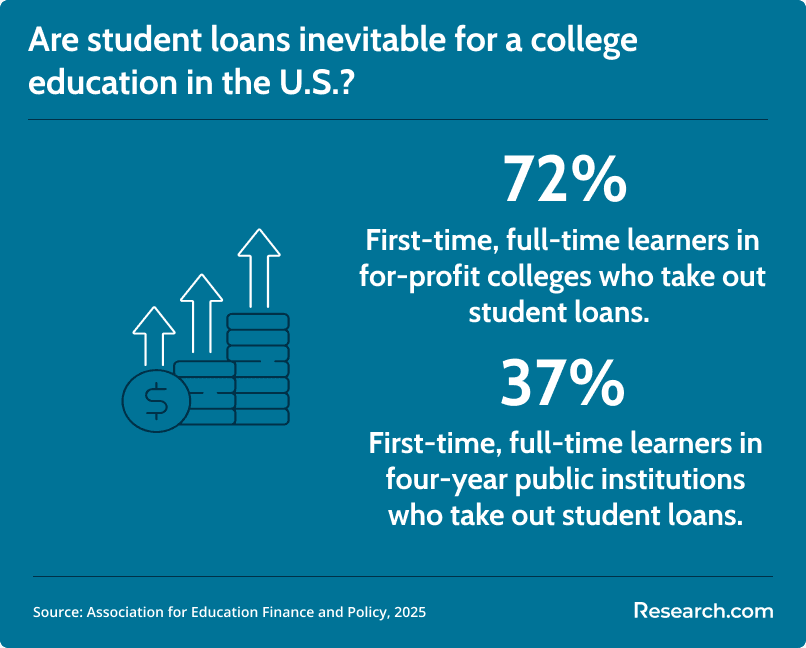
- 72% of first-time, full-time learners in for-profit colleges take out student loans.
- In comparison, that number is only 37% for enrollees in four-year public institutions and 15% for community college students.
- Those studying in for-profit schools borrow about $7,900 per year.
- Students at community colleges take out loans of about $4,700 per year, while those at four-year public institutions borrow about $7,000 per year.
- 10.3% of student borrowers default on their educational loans within three years of beginning repayment.
- 14.7% of students with loans who attended private for-profit colleges defaulted within three years of beginning repayment.
- 6.39% of student borrowers who enrolled in private nonprofit schools defaulted within three years of beginning repayment.
A recent study highlights the importance of understanding the long-term effects of student loan debt and how it affects the financial well-being of college graduates.
Additionally, it emphasizes the important role of colleges and universities in curbing the negative impacts of student loans by increasing resources for the financial education of students.
Thus, I suggest looking for schools that proactively assist individuals who require guidance as they navigate the complexities of financial aid and college costs.
If minimizing borrowing is a priority, compare in-state publics, strong-aid nonprofits, and the most affordable HBCU programs; these options often pair mission-driven support with competitive net prices that can materially reduce debt at graduation.
Do for-profit colleges have the same accreditation as nonprofit colleges?
For-profit and nonprofit colleges often have different types of institutional accreditation, and this difference can significantly impact a student. This is why when searching for the best online colleges with weekly start dates or the most affordable tuition, I recommend checking a school’s accreditation.
It should also be noted that all colleges must be accredited by an agency recognized by the U.S. Department of Education (ED) to qualify for federal financial aid.
Nonprofit colleges usually hold regional accreditation, recognized as the gold standard for academic quality. Examples of regional accrediting bodies include:
- Higher Learning Commission (HLC)
- Middle States Commission on Higher Education (MSCHE)
- Southern Association of Colleges and Schools Commission on Colleges (SACSCOC)
On the other hand, many for-profit colleges are nationally accredited, focusing on career, technical, or vocational programs. Examples of national accrediting agencies include:
- Accrediting Commission of Career Schools and Colleges (ACCSC)
- Accrediting Council for Continuing Education and Training (ACCET)
- Council on Occupational Education (COE)
Students should always verify accreditation through the U.S. Department of Education or the Council for Higher Education Accreditation (CHEA) to ensure their degree is recognized and transferable.
Is it easier to gain admission to for-profit or nonprofit colleges?
While many nonprofit schools are easy to get into, like community colleges, the for-profit sector generally has less rigorous admission standards to maximize student enrollment.
- For-profit colleges often require only a high school diploma or equivalent and a completed application.
- Many for-profit schools offer rolling or open enrollment, allowing students to start classes anytime throughout the year.
- Nonprofit colleges usually have more competitive admissions standards, standardized test scores, letters of recommendation, and application deadlines.
- Many nonprofit institutions have a minimum grade point average (GPA) requirement, which can be a hurdle for many individuals. Luckily, there are also many online colleges for low GPA students.
- Highly selective private nonprofit universities tend to have very low acceptance rates.
- Nonprofits typically have two to three admission cycles per year, compared to the continuous enrollment option at many for-profit institutions.
The good news is that more HEIs are changing their admission requirements so they can increase access for students from more diverse backgrounds. This is why it is more common to find colleges that no longer require SAT or ACT nowadays.
However, these institutions may replace that requirement with standardized tests or other screening and selection methods. Be sure to carefully review the most up-to-date admission requirements for any school to which you are applying.
When it comes to choosing a college to apply to, 54% of students at for-profit institutions said the availability of online classes was an important factor. The chart below presents additional details:
What are the employment outcomes for graduates of for-profit vs. nonprofit colleges?
Graduates of nonprofit institutions generally experience higher earnings and better employment prospects compared to for-profit college graduates.
- Research shows that for-profit college graduates tend to have significantly lower wages and employment rates than those from nonprofit institutions.
- A collaborative report from Burning Glass Institute and Strada Institute for the Future of Work reveals that the underemployment gap for for-profit and public college graduates slightly increases in the first five years.
- The underemployment rate for students from for-profit colleges was 63% after the first year of graduating and went down to 58% after five to ten years.
- For students from private nonprofit institutions, the unemployment rate was 49% after the first year since graduating and lowered to 43% after five to ten years.
- 43% of alumni of for-profit colleges expressed that their school fell short on career services and job placement assistance.
- 40% of for-profit alumni said their school fell short in providing students with valuable internships and work experience outside the classroom.
- Some for-profit associate degree graduates report slightly better job placement assistance, but overall have lower returns on investment.
- The labor market tends to value nonprofit degrees more highly, contributing to stronger career growth and earnings over time.
While recent reports and the data above do not necessarily paint a positive image of for-profit colleges, one must remember that the type of institution is just one factor that determines employment and earning outcomes.
What are the pros and cons of for-profit and nonprofit colleges?
According to the research my team and I did for this guide, these are some of the most common pros and cons of for-profit and non-profit higher education institutions:
Pros and Cons of For-Profit Colleges
- Flexible and Convenient: They often offer more flexible schedules, accelerated programs, and a wide array of online courses, making them appealing to working adults and non-traditional students.
- Career-Focused Programs: Programs are frequently highly specialized and vocational, focusing on practical skills aimed at quick entry into specific career fields.
- Open Admissions: Many have open-door or less selective admission policies, making them accessible to students who may not meet the requirements of more competitive institutions.
- Higher Cost and Debt: As previously discussed, despite their career focus, for-profit colleges generally have higher tuition and fees than public and often even private nonprofit institutions, leading to significantly higher student debt and higher student loan default rates.
- Credit Transfer Issues: Credits earned at nationally accredited for-profit schools are often difficult or impossible to transfer to regionally accredited nonprofit colleges. Additionally, many competitive master's or doctoral programs will only admit students who hold an undergraduate degree from a regionally accredited institution.
- Lower Graduation Rates: They tend to have lower degree completion rates than both public and private nonprofit schools.
- Reputation/Accreditation: Some degrees may carry a less favorable reputation with employers, and many for-profit schools hold national rather than the more widely recognized regional accreditation.
Pros and Cons of Nonprofit Colleges
- Stronger Student Outcomes: Graduates typically have better employment rates and higher average earnings, leading to a better return on investment (ROI).
- Lower Cost: Public nonprofit colleges, such as state universities and community colleges, are generally the most affordable option for in-state residents due to state subsidies.
- Reinvested Funds: Funds are spent on improving the academic experience, such as upgrading facilities, hiring top faculty, expanding libraries, and offering student support services.
- Better Credit Transfer: Credits are more likely to be regionally accredited and easily transferable to other institutions. If this is an important factor for your choice of school, learn more about the best online colleges accepting transfer credits.
- Wider Financial Aid: Nonprofit schools, especially private ones, often have larger endowments and more generous institutional financial aid and scholarships, which can significantly lower the net price of attendance.
- Less Flexibility: They tend to follow a more traditional academic calendar of fall and spring semesters that come with less flexibility in scheduling, making it challenging for full-time working students.
- Potential for Bureaucracy: Large public institutions can sometimes be less nimble in updating curricula or accommodating non-traditional student needs compared to the more business-driven for-profits.
When exploring the benefits of a college degree and which institution is worth your financial commitment, you should also consider how the field of study, gender, racial pay gaps, available career paths, and the current labor market can affect your projected outcome after graduation.
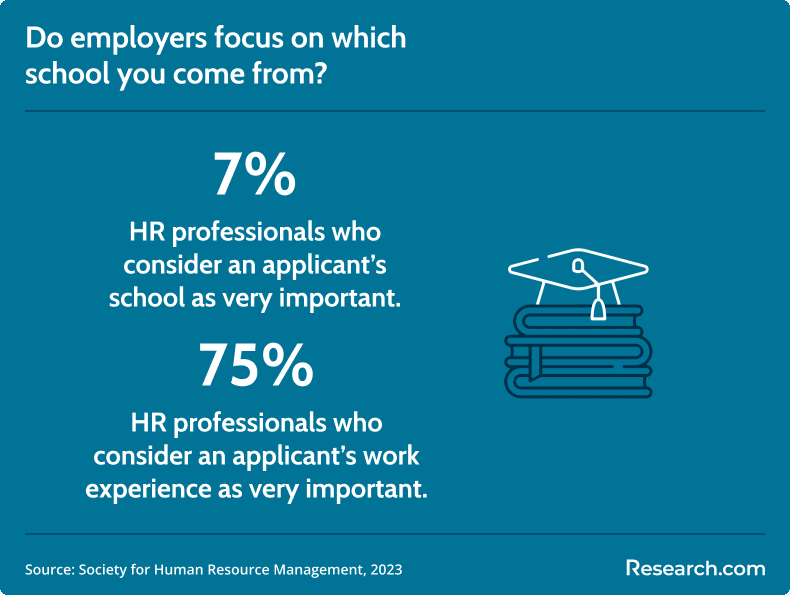
It is worth mentioning that when considering who to hire, just 7% of HR professionals say that an applicant’s school or alma mater is a very important factor. On the other hand, 79% focus more on performance in interviews, and 75% give more importance to work experience.
Thus, I find it helpful to do additional research on what prospective employers are currently looking for among new graduates and job applicants so you can determine which skills and factors to highlight in your résumé and during your interviews.
How do I decide whether a for-profit or nonprofit college is the best fit for my career goals?
To decide whether a for-profit or nonprofit institution is the best fit for your career goals, you need to prioritize what matters most to your unique circumstances and long-term professional path.
Professional Licensed Fields
- Consider nonprofit colleges since their regional accreditation and institutional reputation are essential for licensure, networking, graduate school admission, and a wider range of high-level employers.
- For-profit colleges can be an option, but make sure to choose one that is highly specialized and is accredited or recognized by your state's licensing board or target industry.
Quick Entry into a Specific Trade
- Public nonprofit community colleges are often the best, most affordable option with strong local employer ties.
- For-profit schools that specialize in accelerated, career-specific programs can also be a possible option. The fit depends entirely on the school's reputation within that niche industry.
Stable and Long-Term Career
- Generally, nonprofits have a stronger reputation and better credit transferability, making them a more viable option if you want the possibility of promotion or a graduate degree later.
- However, if you want career-specific, hands-on training in fields like healthcare, business, or technology, you can also consider for-profits. These sectors usually have more flexible and alternative pathways for career progression.
If you value academic depth and research opportunities, you should opt for a nonprofit school.
Students should also consider if the college and program offer a paid internship, include education-to-employment coaching, and provide other initiatives focused on clear employment and earning outcomes.
What are the retention and graduation rate differences between for-profit and nonprofit colleges?
Retention and graduation rates are essential metrics that reflect an institution’s ability to support student success over time. Nonprofit colleges often report higher completion rates thanks to enhanced student services, academic advising, and robust alumni networks, while for-profit institutions may experience lower rates due to differences in academic resources and student support structures. Prospective students should evaluate these indicators alongside program outcomes to determine how each institution aligns with their long-term educational and career objectives, especially when exploring opportunities like fast degrees online.
Key Findings
- Only 7% of HR professionals say that an applicant’s school or alma mater is a very important factor.
- 43% of alumni of for-profit colleges expressed that their school fell short on career services and job placement assistance.
- 54% of students at for-profit institutions said the availability of online classes was an important factor when choosing a college.
- 6.39% of student borrowers who enrolled in private nonprofit schools defaulted within three years of beginning repayment.
- 14.7% of students with loans who attended private for-profit colleges defaulted within three years of beginning repayment.
- Among private higher education institutions, 1,723 are classified as nonprofit and 2,141 are for-profit in AY 2024-2025.
References:
- Burning Glass Institute and Strada Institute for the Future of Work (2024). Talent Disrupted: Underemployment, College Graduates, and the Way Forward. https://cdn.prod.website-files.com/6777c52f82e5471a3732ea25/679a6fadfda4220bbac585d7_Talent-Disrupted-2.pdf
- Cellini, S. (March 2025). For-Profit Colleges. AEFP Live Handbook. https://livehandbook.org/higher-education/institutions-and-majors/for-profit-colleges
- Hanson, M. (July 2025). Student Loan Default Rate. Education Data Initiative. https://educationdata.org/student-loan-default-rate
- Hanson, M. (September 2025). Average Cost of College by Year. Education Data Initiative. https://educationdata.org/average-cost-of-college-by-year
- Lumina Foundation (May 2025). The State of Higher Education 2025. https://www.luminafoundation.org/wp-content/uploads/2025/07/The.State_.of_.Higher.Education.2025.pdf
- Ma, J. et al. (2024). Trends in College Pricing and Student Aid 2024. College Board. https://research.collegeboard.org/media/pdf/Trends-in-College-Pricing-and-Student-Aid-2024-ADA.pdf
- National Center for Education Statistics (2024). Table 1. Number and percentage distribution of Title IV institutions, by control of institution, level of institution, and region: United States and other U.S. jurisdictions, academic year 2024–25. https://nces.ed.gov/ipeds/search/viewtable?tableId=36525&returnUrl=%2Fsearch
- Silliman, R. and Schleifer, D. (2023). Who Profits? Students’ Experiences at For-Profit Colleges. Public Agenda. https://publicagenda.org/wp-content/uploads/Public-Agenda-For-Profit-Higher-Ed-2023.pdf
- Society for Human Resource Management (2023). Expectations and Realities: Preparing the Next Generation of Talent for the World of Work. https://cdn.sanity.io/files/mz2hls6g/production/1a2eac0785e9d95d0b1f4e66493477e543b84de0.pdf
Other Things You Need to Know About For-Profit and Nonprofit Colleges
For-profit colleges often have fewer institutional scholarships compared to nonprofit colleges, which may provide more diverse financial aid packages, including grants and scholarships. Both types of colleges participate in federal financial aid programs, but students should carefully explore each institution's specific offerings for 2027.
Yes. Many graduate schools prefer regionally accredited degrees, so credits or credentials from nationally accredited for-profit colleges may not transfer or meet admission standards. This can limit opportunities for students seeking to continue their education at traditional or research-focused institutions.
In 2027, for-profit colleges often offer career-focused programs and may prioritize profit margins, sometimes compromising educational quality. Nonprofit colleges typically emphasize a broader educational scope with rigorous accreditation standards. Accreditation, crucial for academic credibility, is generally more stringent in nonprofit institutions, ensuring consistent educational quality and standards.


