
2027 MBA in Operations Management Courses: What You'll Learn

Co-Founder and Chief Data Scientist
An MBA in operations management equips professionals with the skills to streamline business processes, optimize supply chains, and drive organizational efficiency, areas that are increasingly in demand, as employment of logisticians is projected to grow 17% from 2024 to 2034, much faster than the average for all occupations.
This guide will walk you through the key courses, skills, and career opportunities associated with the program, helping you understand what to expect and how an MBA in operations management can advance your career.
Key things you should know about MBA in operations management courses
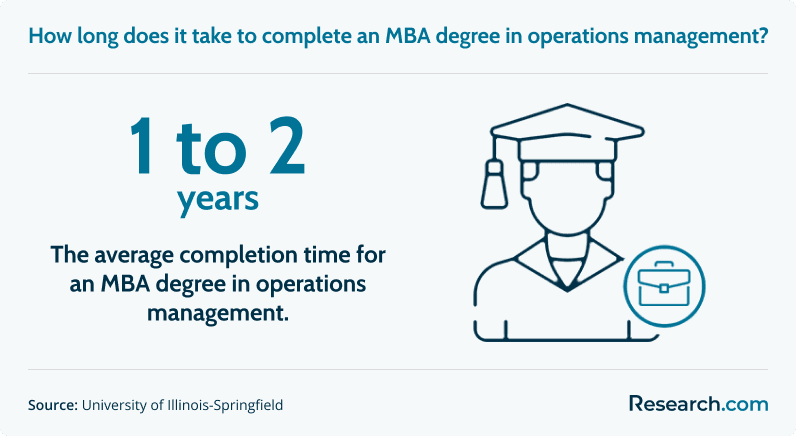
- An MBA in operations management typically takes 12 to 24 months to complete, depending on full-time or part-time enrollment.
- The program focuses on skills such as supply chain optimization, process improvement, and strategic decision-making.
- Graduates are prepared for leadership roles across industries, including manufacturing, logistics, and consulting.
- What are the core subjects taught in an MBA in operations management program? Core Subjects
- How does operations strategy differ from supply chain management in an MBA curriculum? How does operations strategy differ from supply chain management in an MBA curriculum?
- How long does it usually take to complete an MBA in operations management program? Completion Time
- What technical and analytical skills do you gain from an MBA in operations management? Essential Skills
- What are popular specializations or elective options in MBA operations management programs? Specializations
- How much can you earn with an MBA degree in operations management? Average Salary
- What are the typical admission requirements for an MBA in operations management program? What are the typical admission requirements for an MBA in operations management program?
- What job roles can you get after completing an MBA in operations management? Job Roles
- Is an MBA in Operations Management a Worthwhile Investment? Is an MBA in Operations Management a Worthwhile Investment?
- What financial aid, scholarships, or employer sponsorships are available for operations management MBA students? Financial Aid
- What is the job outlook for those with an MBA degree in operations management? Job Outlook
What are the core subjects taught in an MBA in operations management program?
An MBA in operations management is designed to equip students with both managerial and technical expertise to improve business processes, optimize supply chains, and drive organizational efficiency.
The program blends core business knowledge with specialized operations courses, preparing graduates for leadership roles across industries. Similar to an MBA in Cyber Security, it integrates strategic decision-making with technical competencies—only here, the focus is on production systems, logistics, and process optimization rather than digital protection. Core subjects typically include:
Key subjects covered in the program include:
- Operations Management: This course teaches students how to analyze and improve business processes to increase efficiency and productivity. Students also learn to manage production, workflow, and service delivery in a variety of organizational settings.
- Supply Chain Management: Students learn how to coordinate the end-to-end flow of goods and services from suppliers to customers, gaining insights that are applicable even in the shortest fashion merchandising programs online. The course emphasizes procurement, logistics, inventory management, and building strong supplier relationships.
- Project Management: This subject covers how to plan, execute, and monitor projects to ensure they are completed on time and within budget. Students develop skills in managing resources, teams, and project performance effectively.
- Quality Management: Students are introduced to frameworks such as Six Sigma and Total Quality Management to maintain high standards in products and services. They also learn to implement continuous improvement strategies across operational processes.
- Business Analytics & Decision Sciences: This course teaches students how to use data-driven approaches to make informed operational decisions. Students gain skills in statistical analysis, modeling, and forecasting to solve complex business problems.
- Finance and Accounting for Managers: Students learn the fundamentals of budgeting, cost control, and financial decision-making as they relate to operations. The course helps them interpret financial data to support strategic operational planning.
- Strategic Management: This subject focuses on aligning operational activities with long-term organizational goals. Students gain the ability to plan, execute, and evaluate strategies that enhance overall business performance.
How does operations strategy differ from supply chain management in an MBA curriculum?
In an MBA curriculum, operations strategy and supply chain management are closely related but focus on different aspects of business operations.
Operations strategy emphasizes the broader, long-term planning of how a company’s resources and processes are aligned to achieve competitive advantage. It involves decisions about production capacity, process design, technology adoption, and overall efficiency across the organization.
Understanding this distinction is also helpful when exploring what does a management accountant do, as management accountants often analyze operational efficiency, assess production costs, and provide insights that support both strategic operations and supply chain decisions.
While operations strategy sets the high-level goals and priorities for operational excellence, supply chain management deals with the practical execution of these goals, ensuring products and services move efficiently through the system.
How long does it usually take to complete an MBA in operations management program?
A full-time MBA in operations management usually takes around 12 to 24 months to complete. This format is ideal for students who can dedicate themselves fully to academics and want to finish within two years.
The program is structured with core business courses in the first year, followed by operations-focused electives and experiential projects in the second year. Many schools also include internships or capstone projects, which are factored into this timeline.
For students who need more flexibility, operations management MBA programs offered in part-time, online, or hybrid formats can extend to 2.5 to 3 years or more. These options allow professionals to continue working while completing their degree at a slower pace.
Similarly, programs like an MBA in cybersecurity often follow comparable timelines, offering accelerated, part-time, and online options that provide working professionals the flexibility to balance studies with career advancement.
Some schools even offer an accelerated online master's degree in supply chain management that can be finished in as little as 12 months if taken on a full-time basis without breaks. The exact duration depends on the credit load per semester and whether students take advantage of summer or intensive modules.
What technical and analytical skills do you gain from an MBA in operations management?
An MBA in operations management equips students with a range of technical and analytical skills that are essential for optimizing business processes and making data-driven decisions.
These skills enable graduates to evaluate complex operational problems, implement solutions efficiently, and drive organizational performance. Key skills developed through the program include:
In addition to these abilities, students in a sport management MBA program gain similar analytical and operational skills—particularly in managing logistics, budgeting, and performance metrics within athletic organizations or sports enterprises.
- Data Analysis: Students learn to interpret large datasets to uncover patterns, trends, and insights that inform operational decisions. They also gain experience using analytical tools to make data-driven recommendations.
- Process Optimization: Graduates develop the ability to assess workflows and implement improvements that enhance efficiency and reduce costs. They learn techniques for streamlining operations across different departments and functions.
- Supply Chain Analytics: Students gain proficiency in software and frameworks that support the planning, execution, and monitoring of projects, skills that are valuable even for those pursuing the shortest sports management MBA online. They learn to coordinate resources and timelines effectively to achieve project goals.
- Project Management Tools: Students gain proficiency in software and frameworks that support the planning, execution, and monitoring of projects. They learn to coordinate resources and timelines effectively to achieve project goals.
- Statistical Modeling: Graduates learn to apply methods such as regression analysis and predictive modeling to solve operational problems. These techniques help forecast demand, assess risk, and improve decision-making.
- Decision-Making under Uncertainty: Students are trained to make informed choices in complex, variable environments. They use simulations, scenario planning, and quantitative techniques to support strategic decisions.
- Performance Metrics & KPI Analysis: Graduates gain skills in designing and monitoring key performance indicators to track operational success. They learn to interpret these metrics to identify areas for improvement and support strategic planning.
What are popular specializations or elective options in MBA operations management programs?
MBA programs in operations management often offer specializations or elective courses that allow students to tailor their learning to specific career goals and industry needs. These options enable graduates to deepen their expertise in areas that are in high demand, giving them a competitive edge in the job market.
Popular specializations and electives include:
- Supply Chain Management: This specialization focuses on the end-to-end management of goods, services, and information across suppliers and customers. Students learn to optimize logistics, inventory, and procurement to improve efficiency and reduce costs.
- Lean Operations & Process Improvement: Graduates explore strategies for eliminating waste, improving workflows, and enhancing productivity. The focus is on implementing continuous improvement methodologies like Lean and Six Sigma.
- Project Management: This elective emphasizes planning, executing, and monitoring projects within operational contexts. Students gain skills to manage resources, timelines, and budgets effectively.
- Sustainability & Green Operations: Students learn how to integrate environmentally sustainable practices into operations and supply chains. The focus is on reducing environmental impact while maintaining efficiency and profitability.
- Technology & Digital Operations: This track explores the use of AI, automation, ERP systems, and other technologies to optimize operations. Graduates learn to leverage digital tools for data-driven decision-making and process innovation.
How much can you earn with an MBA degree in operations management?
Earning an MBA in operations management can significantly boost your salary potential, especially since graduates are in demand across multiple industries. Compensation varies by sector, but most roles provide strong opportunities for career advancement and long-term financial growth.
Below are average annual salaries in different industries employing MBA operations management professionals:
- Federal Government ($101,110): Operations leaders in government oversee large-scale projects and ensure smooth coordination between agencies. They also focus on compliance, efficiency, and the effective use of taxpayer resources.
- Management of Companies and Enterprises ($84,960): Professionals in this sector work on strategic planning and improving organizational performance. They often manage cross-departmental processes to ensure businesses run efficiently.
- Manufacturing ($83,720): MBA graduates in manufacturing oversee production systems and quality control to optimize output. They also implement lean practices to reduce waste and improve operational efficiency.
- Professional, Scientific, and Technical Services ($82,330): Operations managers in this field coordinate resources and streamline project execution for specialized services. They also help organizations stay competitive by improving workflows and reducing costs.
- Wholesale Trade ($73,090): Leaders in wholesale trade focus on managing supply chain networks and inventory systems. They also maintain vendor relationships and optimize distribution to ensure timely product delivery.
Pursuing an MBA in operations management not only strengthens your leadership and analytical skills but also positions you for competitive salaries across diverse industries.. Whether in government, manufacturing, or professional services, the degree opens pathways to roles that blend strategy with execution.
The chart below highlights average salaries across key sectors, giving you a clear picture of the earning potential available with this specialization.
What are the typical admission requirements for an MBA in operations management program?
Admission to an MBA in operations management program typically involves meeting a combination of academic, professional, and personal criteria, similar to what is required for the fastest online graduate certificate programs in logistics and supply chain management.
These requirements ensure that candidates are prepared for the quantitative, analytical, and leadership challenges of the program. Common admission requirements include:
- Bachelor’s Degree: Applicants are generally required to hold a bachelor’s degree from an accredited institution. While degrees in business, engineering, or related fields are preferred, many programs accept candidates from diverse academic backgrounds.
- Work Experience: Most programs look for professional experience, often ranging from 2 to 5 years. This experience helps students contribute practical insights to classroom discussions and apply learning to real-world business challenges.
- Standardized Test Scores (GMAT/GRE): Many programs require GMAT or GRE scores to assess quantitative and analytical skills. Some schools may waive this requirement for candidates with significant professional experience or prior academic achievements.
- Letters of Recommendation: Applicants are typically asked to provide 1–3 letters of recommendation from employers, professors, or professional mentors. These letters offer insight into the candidate’s leadership potential, work ethic, and suitability for graduate-level study.
- Personal Statement or Essay: Candidates are usually required to submit an essay explaining their career goals and reasons for pursuing an MBA. This helps admissions committees understand motivation, ambition, and alignment with the program.
- Interview: Some programs conduct interviews to evaluate interpersonal, communication, and leadership skills. The interview also provides an opportunity for applicants to demonstrate fit and readiness for the program.
What job roles can you get after completing an MBA in operations management?
Completing an MBA in operations management equips graduates with the skills to step into leadership positions across industries. The degree prepares you to handle complex supply chains, optimize business processes, and drive organizational efficiency. Below are some of the most common career paths available to graduates.
- Operations Manager ($107,511): Oversees day-to-day business activities, ensuring processes are efficient and cost-effective. They are responsible for managing teams, resources, and performance metrics to meet organizational goals.
- Supply Chain Manager ($103,560): Manages the end-to-end flow of goods and services, from procurement to distribution. They focus on reducing costs, improving delivery times, and strengthening supplier relationships.
- Logistics Manager ($108.574): Specializes in the transportation and storage of goods within the supply chain. They coordinate shipping, warehousing, and distribution to maintain smooth operations.
- Director of Operations ($156,277): Provides strategic oversight across multiple departments to align business activities with long-term goals. They ensure scalability, process improvements, and sustainable growth for the organization.
- Business Operations Manager ($89,070): Oversees business functions that support operational efficiency, such as budgeting, workflows, and cross-department coordination. They often act as a bridge between strategy and execution in organizations of various sizes.
- Project Manager ($94,339): Leads cross-functional projects aimed at improving efficiency, implementing new systems, or expanding capacity. They balance budgets, timelines, and team coordination to deliver successful outcomes.
An MBA in operations management opens doors to diverse roles that combine strategy, leadership, and technical expertise, offering insights similar to what students gain from the shortest online bachelor's programs in analytics. The chart below provides a snapshot of these career options and their earning potential to help you see where your degree can take you.
Is an MBA in Operations Management a Worthwhile Investment?
Evaluating the ROI of an MBA in operations management involves balancing the upfront costs of education with long-term career and financial benefits. Data-driven insights indicate that graduates secure higher salary bands and accelerated career progression, which cumulatively outweigh initial investments. Leveraging programs that offer a cost effective online MBA can also reduce expenses while accessing quality learning. A rigorous ROI assessment considers not only direct salary improvements but also enhanced leadership opportunities, improved operational decision-making, and strategic contributions that drive organizational growth.
What financial aid, scholarships, or employer sponsorships are available for operations management MBA students?
Pursuing an MBA in operations management can be a significant financial investment, but many options exist to help students manage costs. Financial aid, scholarships, and employer sponsorships can reduce tuition expenses and make the program more accessible.
Key options include:
- Federal Student Aid: U.S. students can apply for federal loans, grants, and work-study programs through the Free Application for Federal Student Aid (FAFSA). These resources help cover tuition, fees, and living expenses while enrolled in the program.
- Merit-Based Scholarships: Many business schools offer scholarships based on academic achievement, professional experience, or leadership potential. These awards typically do not require repayment and can significantly reduce overall program costs.
- Need-Based Financial Aid: Some institutions provide grants or tuition assistance based on financial need. Applicants usually submit detailed financial information to determine eligibility for support.
- Employer Sponsorships: Many companies offer tuition reimbursement or sponsorship programs for employees pursuing an MBA. This allows professionals to continue working while receiving financial support for their education.
- Professional Associations: Organizations such as the Graduate Management Admission Council (GMAC) offer scholarships and fellowships specifically for MBA students. These awards often recognize leadership, innovation, or commitment to advancing management education.
What is the job outlook for those with an MBA degree in operations management?
The job outlook for individuals with an MBA in operations management is promising, driven by increasing demand for skilled professionals who can optimize business processes, manage supply chains, and improve operational efficiency, skills also emphasized in an accelerated online bachelor's degree in supply chain management.
Organizations across industries, from manufacturing and logistics to healthcare and technology, are seeking leaders who can implement strategic improvements and navigate complex operational challenges. Graduates with this degree are often well-positioned for managerial and executive roles, making their skills highly competitive in the job market.
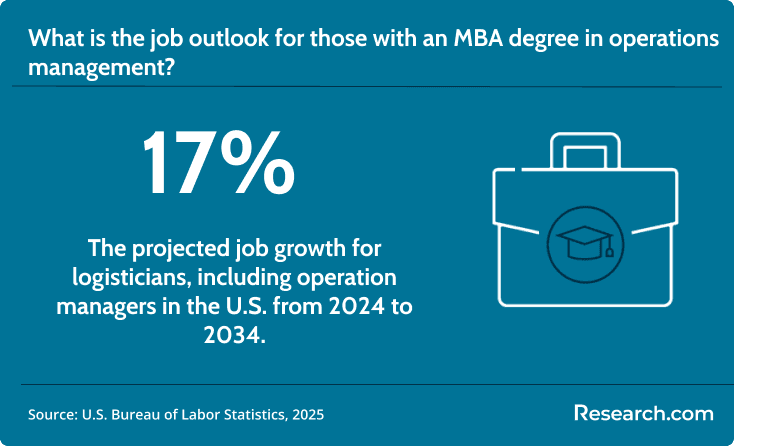
Specifically, employment opportunities for logisticians, a key role within operations management, are projected to grow 17 percent from 2024 to 2034, which is much faster than the average for all occupations.
This growth is expected to generate about 26,400 openings per year on average over the decade, highlighting strong and sustained demand for operations-focused professionals.
Such trends indicate that an MBA in operations management not only enhances earning potential but also provides long-term career stability and opportunities for advancement.
Here’s what graduates have to say about their MBA in operations management degree:
- Rachel: "Pursuing an MBA in operations management completely transformed my career trajectory. I gained the strategic thinking and leadership skills needed to manage complex operations, and within a year, I stepped into a senior management role. The flexibility of studying online made it possible to balance work and learning seamlessly. "
- Jason: "The program helped me develop advanced analytical and problem-solving skills that I now use daily in supply chain management. Learning online allowed me to access real-world case studies and collaborate with peers from around the globe, which broadened my perspective. It was both challenging and incredibly rewarding. "
- Kendall: "Studying online gave me the freedom to pursue my MBA without putting my career or personal life on hold. The hands-on projects and operations strategy exercises helped me immediately apply what I learned at work, boosting both confidence and performance. I feel more prepared than ever to take on leadership challenges. "
Key Findings
- An MBA in operations management typically takes 12 to 24 months to complete, depending on the program format.
- Employment of logisticians is projected to grow 17 percent from 2024 to 2034, much faster than the average for all occupations.
- About 26,400 openings for logisticians are expected each year over the decade, highlighting strong demand in the field.
- Graduates with this MBA can expect competitive salaries across industries, with roles like Director of Operations earning up to $150,000 per year
- Popular specializations include Supply Chain Management, Lean Operations, and Technology & Digital Operations, allowing students to tailor their skills to high-demand areas.
References:
- Glassdoor. (2025). Salary: Operations Manager in the United States 2025. Glassdoor
- Indeed. (2025). Supply chain manager salary in the United States. Indeed
- U.S. Bureau of Labor Statistics. (2025). Occupational Outlook Handbook: Logisticians. U.S. BLS
- University of Illinois at Springfield. (2025). Master of Business Administration with Operations & Supply Chain Management Certificate Online. UL Springfield
Other Things You Should Know About MBA in Operations Management Courses
In a 2027 MBA in Operations Management course, students will gain foundational skills in process optimization, project management, and strategic decision-making. Additionally, they'll learn how to analyze data effectively, manage supply chains, and implement quality control processes, all essential for driving operational excellence in various industries.
In 2027, graduates with an MBA in Operations Management can expect career growth opportunities in areas like supply chain management, production planning, and logistics. These roles often involve strategic decision-making, leveraging technology to optimize operations, and leadership positions in industries such as manufacturing, retail, and consulting.


