
2027 MBA in Sports Management: Courses, Careers & Industry Outlook

Co-Founder and Chief Data Scientist
The sports industry is experiencing unprecedented growth. In the U.S. alone, the sports sponsorship market is growing at an annual rate of 8.7%. This expansion is fueled by increased fan engagement, media rights deals, and the commercialization of women's sports.
With this potential, having an MBA in sports management in CURRENT_EYAR is a gateway to a fulfilling career in one of the world's most dynamic industries. If this is a path you want to take, this article will guide you through who should consider this degree, the career opportunities it opens, and the skills you'll gain to thrive in the global sports market.
Key Things to Know About Taking an MBA in Sports Management for 2027
- An MBA in Sports Management opens doors to various roles. This includes business development director, marketing director, finance director, and human resources director within sports organizations.
- Managerial positions in sports offer a median annual wage of $127,00.
- The sports industry is experiencing significant growth, with expanding opportunities across Europe, the United States, Asia, and beyond.
- Who should consider pursuing an MBA in sports management? Who should consider pursuing an MBA in sports management?
- What are the eligibility requirements for an MBA in sports management for 2027? Requirements
- How much does it cost to complete an MBA in sports management for 2027? Program Cost
- What core courses are included in an MBA in sports management program? Courses
- What are the most popular specializations in an MBA in sports management? Specializations
- What jobs can you get with an MBA in sports management? What jobs can you get with an MBA in sports management?
- What is the average salary of an MBA in sports management graduate for 2027? Average Salary
- What industries hire graduates with an MBA in sports management? Top Industries
- How can I evaluate and select the right MBA program in sports management? How can I evaluate and select the right MBA program in sports management?
- What are the latest trends in the global sports management industry? Trends
Who should consider pursuing an MBA in sports management?
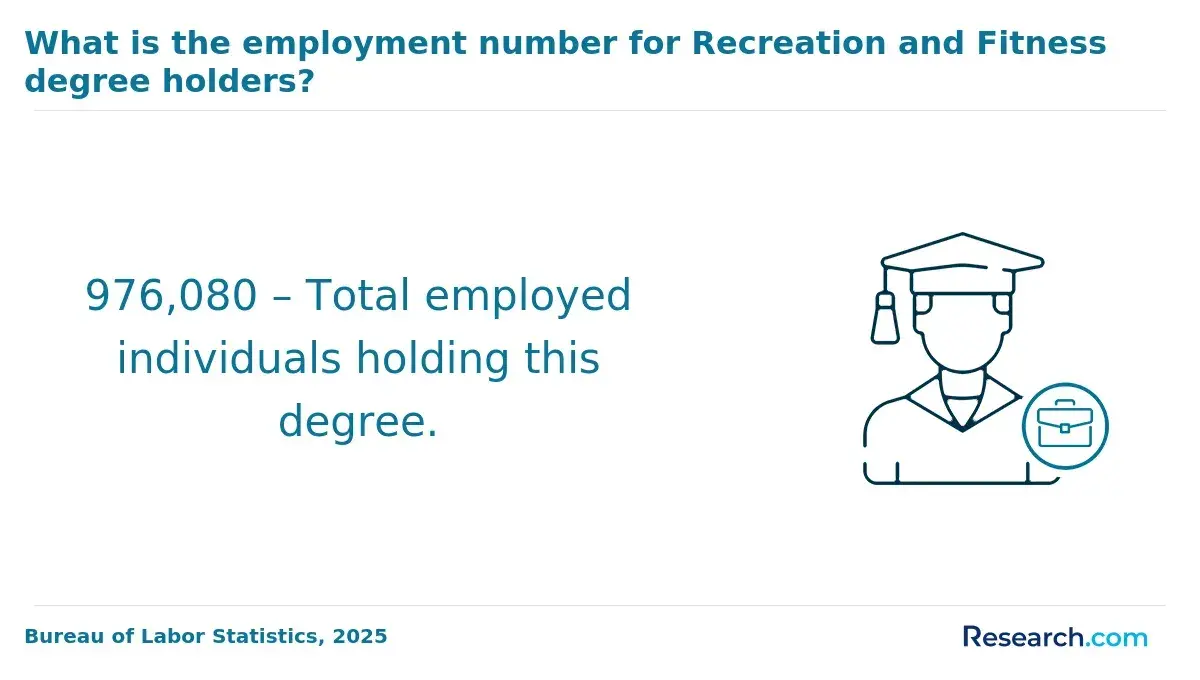
In the U.S., 976,080 recreation and fitness graduates are employed in various sectors. With so many graduates competing for roles in this growing industry, an MBA can serve as a differentiator. It equips professionals with leadership, strategic, and financial skills that go beyond an undergraduate degree.
Here are the key groups of professionals who can benefit most from pursuing the fastest online MBA programs in sports management:
- Aspiring Sports Executives and Managers: Individuals aiming for leadership roles in sports organizations, including teams, leagues, and athletic departments, can benefit from the strategic and operational insights provided by an MBA in sports management.
- Professionals Transitioning into Sports: Those with backgrounds in business, marketing, or event management who wish to pivot into the sports industry can leverage an MBA to gain industry-specific knowledge and credibility.
- Athletes Planning Post-Career Paths: Athletes like Olympic champion Jessica Fox are pursuing MBAs to prepare for careers in sports media, management, or other related fields after their athletic careers.
- Entrepreneurs and Innovators in Sports-Related Ventures: Individuals interested in launching or managing sports startups, such as fitness tech companies or esports platforms, can gain the necessary business skills through this MBA program.
- Professionals in Sports Marketing and Sponsorship: Those working in marketing, public relations, or sponsorship roles within the sports sector can enhance their strategic and leadership capabilities with this MBA.
Pursuing an MBA in sports management can open doors to leadership, entrepreneurial, and specialized roles across the sports industry. However, it’s also important to understand the current educational landscape of professionals in this field.
What are the eligibility requirements for an MBA in sports management for 2027?
MBA programs are highly selective. For example, Stanford GSB’s MBA program has had an acceptance rate of around 8.4%, and Harvard Business School's is around 13.2%. Requirements like a bachelor’s degree, work experience, and language proficiency ensure applicants are ready for advanced study.
The typical eligibility requirements for an MBA in sports management include the following:
- Bachelor’s degree from an accredited college or university
- Minimum undergraduate GPA (often around 3.0 on a 4.0 scale)
- Official transcripts from all post-secondary institutions attended
- English language proficiency for international students (e.g., TOEFL, IELTS)
- Professional experience, often 1-3 years of work experience, especially in sports, business, or administration
- Statement of purpose
- Letters of recommendation
- Resume or CV
Some MBA programs in Sports Management offer flexibility in admissions. For instance, GMAT/GRE requirements may be waived for applicants with strong GPAs, significant work experience, or prior graduate-level coursework.
Similarly, some universities allow lower GPA thresholds (2.8-2.85) if balanced by strong professional experience or other credentials.
How much does it cost to complete an MBA in sports management for 2027?
An MBA in sports management for 2027 typically costs between $32,000 and $42,000 at many U.S. universities. It can exceed $200,000 at top business schools.
For example, the Florida Atlantic University MBA in Sport Management charges about $900 per credit hour on campus, totaling $36,000–$38,700. Its online version costs around $32,000–$34,400. At Concordia University Chicago, the online MBA in sports management costs about $34,080, including tuition, fees, and books.
Similarly, operations management MBA programs in the U.S. often fall within a comparable price range, depending on program length, delivery format, and institutional prestige.
Beyond tuition, MBA in sports management students in 2026 should factor in additional costs that can greatly increase the total investment. Living expenses such as housing, food, and utilities can range from $20,000 to $30,000 per year in major U.S. cities.
For international students, visa fees, SEVIS charges, and higher insurance requirements can add several thousand dollars.
What core courses are included in an MBA in sports management program?
Core courses in an MBA in sports management combine traditional business foundations with specialized sports industry knowledge. Graduates from a fast-track online sports management bachelor's degree often find that these courses build directly on what they learned in their undergraduate studies.
Most programs include:
Sports Marketing and Sponsorship
This field focuses on the strategies for promoting teams, athletes, and events to build a powerful brand identity and engage fans. Professionals create multi-faceted campaigns across various platforms and secure profitable partnerships with corporate sponsors. Their work is essential for driving revenue, brand loyalty, and market visibility.
Sports Finance and Economics
This discipline is dedicated to the financial health of sports organizations, covering everything from daily budgeting to long-term valuation. Professionals in this area manage complex revenue streams and use economic principles to make critical financial decisions. Their expertise ensures fiscal responsibility and maximizes profitability for all stakeholders.
Sports Law and Ethics
Sports law and ethics addresses the intricate legal and moral issues that govern the world of athletics. This includes navigating contract negotiations, ensuring regulatory compliance, and protecting intellectual property rights. Professionals in this field provide legal counsel and address ethical dilemmas to maintain the integrity of the organization.
Event and Facility Management
This area of sports management involves the meticulous planning, operations, and logistics required to run sporting venues and live events. Professionals are responsible for everything from security and crowd control to vendor management and facility maintenance. Their work is crucial for guaranteeing a safe and seamless experience for all attendees.
Organizational Behavior and Leadership
This field focuses on the human element within a sports organization, exploring how individuals and groups interact to influence performance and culture. Professionals work to improve team dynamics, enhance communication, and foster a positive environment. Their leadership skills are key to motivating staff and athletes to achieve common goals.
Strategic Management in Sports
Strategic management involves the long-term planning and competitive positioning of a sports organization within the market. This includes analyzing the competitive landscape, identifying emerging trends, and developing a clear vision for future growth. Professionals in this area make critical decisions about market expansion and resource allocation to build a sustainable advantage.
Sports Media and Communications
Sports media and communications is a critical function for managing an organization's public relations, broadcasting, and digital presence. Professionals in this field create compelling narratives around teams and athletes and disseminate information through various channels. They also handle crisis management, ensuring a swift and effective response to protect the organization's brand and reputation.
Global Sports Business
Global sports business explores the complexities of the international sports market, which extends beyond domestic leagues. This discipline covers everything from the governance of international sporting bodies to the challenges of expanding a brand into new countries. Professionals in this area must understand international fan demographics and navigate cultural differences to succeed on a worldwide stage.
According to the Sports Management Degree Guide, upper-division accounting, mathematics, and statistics courses are among those most challenge-heavy for students.
This difficulty often stems from the quantitative intensity of these courses. Since most Sports Management programs come from backgrounds in communications, marketing, or athletics, adjusting to these complex concepts can be overwhelming.
What are the most popular specializations in an MBA in sports management?
The worldwide sports industry is projected to reach $680 billion by 2028, driven by sponsorships, broadcasting, and digital engagement. As the industry expands, demand for professionals with expertise in areas like marketing, analytics, and finance continues to rise. This makes specialized tracks within sports management programs highly attractive to students.
Similarly, students pursuing an MBA for construction management can also choose from specialized tracks, such as project planning, sustainable construction, and cost estimation—each designed to align business strategy with technical industry needs.
Here are some of the most popular specializations within MBA programs in Sports Management:
- Sports Marketing – trains students in sponsorship deals, fan engagement, and branding strategies specifically for sports organizations.
- Sports Analytics – focuses on using data, performance metrics, and statistical tools to inform decision-making in sports business, coaching, and operations.
- Sports Event Management – involves teaching how to plan, organise, and execute sporting events, from logistics to marketing.
- Sports Finance – deals with budgeting, revenue models, financial planning, and economic issues specific to the sports industry.
- International Sports Business – chosen by students aiming to work in cross-border sports operations, international leagues, and global marketing.
What jobs can you get with an MBA in sports management?
Organizations are increasingly seeking business-savvy professionals who can balance the passion of sports with the precision of corporate strategy. Earning an MBA in sports management equips graduates to step into leadership roles across the entire sports ecosystem.
While salaries in related fields—such as the MA in Clinical Mental Health Counseling salary—can provide a benchmark for earnings potential, sports management graduates often see competitive compensation in executive, operations, and marketing roles.
Here are some jobs you can get with an MBA in sports management:
- Sports Marketing Manager — These professionals design and execute marketing campaigns for teams, leagues, or athletes. In many cases, salaries exceed $135,000 a year in the U.S. for senior roles.
- Athletic Director — Overseeing athletic programs in schools, colleges, or universities, athletic directors manage departments, staff, budgeting, and compliance. In the U.S., median salaries are often in the $65,000– $90,000 range.
- Business Manager for Athletes — Representing athletes in contract negotiations, sponsorships, and career planning. These roles are often commission-based or performance-based and can vary widely in income.
- Facilities Manager — Managing sports venues, stadiums, or arenas, which involves maintenance, operations, and scheduling. Annual median salaries often approach $100,000 for experienced facility managers.
- Coaches and Scouts — While some of these roles don’t require MBAs, those with graduate training may take on leadership, strategy, or analytics-focused roles. Earning an advanced credential, such as an accelerated master’s in sports analytics online, can help candidates stand out in competitive hiring pools. The Bureau of Labor Statistics projects about 6% growth in jobs for coaches and scouts over the next decade.
- Sports Program Director — These roles manage events, sports programs, or the business side of sports organizations. Salaries can reach more than $80,000, depending on responsibilities.
What is the average salary of an MBA in sports management graduate in 2026?
New graduates of sports management MBA programs typically earn around $78,000 a year. Among master’s degrees with the highest salaries, an MBA in sports management ranks favorably, as graduates generally earn more than those with only a bachelor’s degree. The advanced degree equips them with the skills to pursue leadership roles in marketing, administration, and facility management.
Sports marketing managers hold the highest-paying roles for MBA graduates in sports management. They earn about $135,000 per year. Experienced sports managers in certain states can earn over $200,000 per year, particularly when working for major teams or organizations.
Advanced business training combined with the global scale of sports can translate into lucrative career opportunities.
What industries hire graduates with an MBA in sports management?
The career pathways for MBA graduates are surprisingly diverse. While many enter athletics, large portions find roles in sectors ranging from community programs to corporate business units.
Here are some industries that frequently hire graduates with an MBA in sports management:
- College Athletics: Has the largest share at 48.1% of graduates. They may take on roles in athletic administration, compliance, and operations.
- Non-sport sectors: Nearly one in four graduates (23.8%) leverage their skills in corporate or business environments outside traditional sports.
- Interscholastic sports: This industry hires 5.9% of graduates. Functions include coaching oversight, program coordination, or athletic director positions at the high school level.
- Youth and community sports: Encompassing 5.9% of the total number of workers, graduates working here contribute to grassroots sports development and recreational programming.
- Professional athletics: This industry employs only 4.8% of graduates, underscoring how competitive and limited pro-level opportunities are. A fast-track online esports business degree may offer an alternative pathway into the field.
- Other sport sectors: employ about 11.2%, spanning facility management, sporting goods, event management, and sports tech.
How can I evaluate and select the right MBA program in sports management?
To choose a program that aligns with your career objectives, consider factors such as accreditation, curriculum relevance, and faculty expertise in sports management. Review the program’s track record for internships, industry partnerships, and alumni network strength to gauge its effectiveness in preparing graduates for leadership roles. If opting for an online format, assess the instructional quality, technical support, and flexibility of the program. Additionally, compare tuition rates and financial aid options to determine a favorable return on investment, and explore available resources like cost effective online MBA programs for viable options.
What are the latest trends in the global sports management industry?
Women’s elite sports are driving much of the growth in the global sports management industry. Revenues are projected to surpass $2.35 billion for 2027, which is double that of $981 million three years ago. Basketball and soccer dominate this market, with women’s basketball expected to generate around 44% of the total revenue and women’s soccer close to 35%.
The growth is not uniform across all sports, with basketball and soccer dominating the market. Women’s basketball is on track to become the leading revenue-generating women’s sport globally, with its revenue expected to reach $1.03 billion in 2025, a significant leap from $710 million just one year prior.
Women’s soccer is also a powerhouse, projected to generate close to $820 million, driven by major international events like the FIFA Women’s World Cup and the rise of leagues like the NWSL. This growth is attracting major corporate sponsors from a variety of industries, including tech, finance, and consumer goods, who are now recognizing the immense commercial appeal and fan loyalty of women’s sports.
Although men still make up the majority in sport and fitness management (73%), the growth of women’s elite sports signals a meaningful shift and is creating a powerful new demand for female leaders.
As this market expands, the need for executives, managers, and marketers who understand both the business and the cultural significance of women’s sports increases dramatically.
This trend is opening up greater influence and leadership opportunities for women across the sports industry, from the front office to the executive suite, allowing them to shape the future of a rapidly growing and increasingly equitable field.
What is the future demand for sports management professionals?
The demand for sports management professionals is projected to remain strong. Employment of entertainment and recreation managers is projected to grow 8% through 2034, much faster than the average for all occupations. Throughout the decade, around 6,000 annual openings will be available.
These numbers suggest that organizations are expanding their investment in sports-related roles. They are also willing to pay higher salaries to attract and retain qualified talent.
Moreover, the global sports analytics market is projected to reach $5.2 billion by 2027, growing at a CAGR of nearly 30%. This will drive demand for MBA graduates who combine business expertise with analytics.
Alternatively, professionals who complete the shortest sports analytics master’s degree online can position themselves to enter this field faster.
Here’s What Professionals Have to Say About Their MBA in Sports Management
- Evan: "I came from a marketing background, and the program’s focus on data analytics in sports was eye-opening. I now lead fan engagement campaigns for a soccer league, using insights that drive attendance and merchandise sales. The mix of business rigor and sports-specific content made the program invaluable."
- Sylvia: "Studying online allowed me to keep working in athletic administration while earning my MBA. I saw my salary increase by 20% within months of graduating, and I’ve since been promoted to Director of Operations. The flexibility and direct application to my daily work made all the difference."
- Vincent: "The MBA gave me the business toolkit I was missing as a former athlete. Courses in finance and sponsorship strategy helped me land a role with a professional basketball team, where I now manage partnerships worth over $5M annually. It felt like the perfect bridge between my passion for sports and real-world management."
Key Findings
- Around 976,080 recreation and fitness graduates were employed in 2025.
- Entry-level associates in sports management roles earn around $42,487.
- Among specialized roles in sports management, sports marketing managers have one of the highest salaries, averaging $135,000 a year.
- Sports marketing managers are projected to see an employment growth of 8%.
- Males hold about 73% of undergraduate degrees in sport and fitness management.
References:
- American Sports and Fitness Association. (2025). The Best Personal Trainer Employment Outlook. https://www.americansportandfitness.com/blogs/fitness-blog/the-best-personal-trainer-employment-outlook
- Bureau of Labor Statistics. (2025). Field of degree: Recreation and fitness. https://www.bls.gov/ooh/field-of-degree/recreation-and-fitness/recreation-and-fitness-field-of-degree.htm
- ERI SalaryExpert. (2025). Sports Management Salary in the United States. https://www.salaryexpert.com/salary/job/sports-management/united-states
- PricewaterhouseCoopers. (2025). Sports industry outlook: North America. Retrieved from https://www.pwc.com/us/en/industries/tmt/library/sports-outlook-north-america.html
- Salary.com (2025). Sports Manager Salary in the United States. Retrieved from https://www.salary.com/research/salary/position/sports-manager-salary
- SMU Cox School of Business. (n.d.). Career support & outcomes: Online MBA programs. Retrieved from https://www.smu.edu/cox/business-degrees/mba-programs/online-mba/career-support-outcomes
- Sports Management Degree Guide. (n.d.). What are the most difficult classes in a sports management program? Retrieved from https://www.sports-management-degrees.com/faq/what-are-the-most-difficult-classes-in-a-sports-management-program
Other Things You Should Know About Taking an MBA in Sports Management for CURRENT_YEAR
In 2027, most MBA in Sports Management programs do not require a sports background; however, a bachelor's degree and relevant work experience are usually essential. Programs may also consider GMAT or GRE scores and personal statements in their application process.
In 2027, online MBA graduates in sports management are expected to remain competitive in the job market. The flexibility and accessibility of online programs attract professionals seeking to advance their careers, and employers increasingly recognize the value of skills gained through online education, enabling graduates to access diverse opportunities in various sports sectors.
MBA graduates in Sports Management in 2027 can expect a variety of career prospects across sports organizations, marketing firms, and event management companies. They may pursue roles in sports marketing, operations management, or team management, with an increasing demand driven by the expansion of the sports industry.


