
2027 MBA in Construction Management: Description, Program Length & Courses Required

Co-Founder and Chief Data Scientist
Over a third of global employers will hire more MBA graduates in 2025 (GMAC, 2025), boosting demand for professionals with business and construction expertise. An MBA in construction management equips students with leadership, analytical, and technology-driven decision-making skills, preparing them for roles like project manager, superintendent, or construction director to optimize projects and streamline operations.
In this article, I will talk about the MBA in construction management program structure, typical course requirements, and expected program length. I will also guide prospective students to understand how the degree supports career advancement in a competitive and evolving construction job market.
What are the benefits of an MBA in construction management?
- Earning an MBA in construction management enhances leadership skills, preparing professionals to effectively manage teams and complex construction projects.
- The degree increases career opportunities, opening pathways to senior management and specialized roles in the construction industry.
- It improves business acumen, equipping graduates with strategic decision-making and financial management expertise.
- What is an MBA in construction management? Degree Overview
- How long does it take to complete an MBA in construction management? Program Length
- What courses are required in an MBA in construction management? Required Courses
- What are the admission requirements for an MBA in construction management? Admission Requirements
- How much does an MBA in construction management cost? Program Cost
- What jobs can you get with an MBA in construction management? Job Options
- How much do MBA in construction management graduates earn? How much do MBA in construction management graduates earn?
- Are there online MBA programs in construction management? Are there online MBA programs in construction management?
- What is the difference between an MBA and a Master’s in construction management? What is the difference between an MBA and a Master’s in construction management?
- Is an MBA in construction management worth it? Is an MBA in construction management worth it?
- What funding and scholarship opportunities exist for an MBA in construction management? What funding and scholarship opportunities exist for an MBA in construction management?
What is an MBA in construction management?
An MBA in construction management is a graduate degree that integrates advanced business administration principles with the technical, legal, and operational demands of the construction industry. The program equips students with skills to lead complex projects, manage multi-disciplinary teams, and make financially sound decisions in high-stakes environments.
This degree bridges business strategy with construction expertise, preparing graduates to oversee projects that meet performance, safety, and sustainability goals while navigating regulatory and market challenges—much like COAMFTE-accredited MFT programs, which align academic training with professional standards to ensure graduates are fully prepared for industry-specific demands.
Students also develop the ability to analyze financial risks, assess investment opportunities, and adapt global business strategies to regional construction markets. The degree emphasizes practical applications, including advanced estimating, contract negotiation, and leadership in multi-million-dollar developments.
With this combination of managerial, technical, and strategic skills, graduates are positioned for leadership roles such as construction project manager, superintendent, or director, driving operational excellence and innovation within the construction industry. The degree thus prepares professionals to meet the increasing complexity and scale of modern construction projects while advancing their careers in a competitive and evolving field.
This investment often proves worthwhile. Fortune research found that MBA graduates represented nearly 40% of C-suite executives on the 2022 Fortune 1000 list, highlighting the degree’s value in positioning professionals for senior roles such as project manager, superintendent, or director in an increasingly complex and competitive industry.
How long does it take to complete an MBA in construction management?
Earning an MBA in construction management requires a commitment of time that varies according to program design, student enrollment status, and prior academic experience. Most programs can be completed in 12 to 24 months, with accelerated full-time tracks allowing completion in as little as one year.
Fast-paced programs integrate core business courses, finance, marketing, leadership, and strategic management, with construction-focused classes in project planning, cost control, risk management, legal frameworks, and sustainable building practices.
On average, graduates complete their studies in roughly the same time it takes professionals in counseling fields—such as those researching how much does an LPCC make, who typically complete their master’s degrees in two to three years before entering the workforce with strong earning potential.
More traditional two-year tracks allow students to delve deeper into both business and construction management concepts, often incorporating experiential learning opportunities such as case studies, practicums, or capstone projects. Meanwhile, flexible part-time options help students balance work, family, and academic commitments.
Students pursuing this degree should also consider additional features, such as credit transfers for prior graduate coursework or relevant professional experience, which can shorten the degree timeline. International students may require extra time for prerequisite or language courses. Ultimately, the duration of this graduate degree depends on the program format, student pace, and any supplementary academic requirements
What courses are required in an MBA in construction management?
In the modern construction industry, effective project leadership requires a blend of business knowledge, technical expertise, and technology proficiency. An MBA in construction management provides this combination by integrating core business administration courses with construction-focused subjects, preparing graduates for strategic and operational leadership roles.
In-demand technology skills, highlighted by construction managers, include Microsoft Office (17%) and Microsoft Excel (12%), which are essential for tasks such as budgeting, scheduling, and project reporting. Much like an MBA in sports management, this program emphasizes both leadership and industry-specific strategy—training students to manage large-scale projects, oversee budgets, and lead diverse teams with confidence and precision.
The program typically includes a mix of business and construction-specific courses, such as:
- Accounting for Decision Makers: Develops skills in financial analysis for construction investments.
- Managerial Finance: Emphasizes capital budgeting and cost management in large-scale projects.
- Human Resource Management: Explores leadership strategies for managing construction site teams.
- Strategic Management of Construction Organizations: Prepares students to develop long-term planning strategies for construction firms
- Advanced Construction Estimating: Strengthens abilities to forecast project costs accurately.
- Legal Aspects in Construction: Provides knowledge on contract law, liability, and regulatory compliance.
- Capstone Project: Integrates business and construction principles in a real-world applied project.
This chart from O*NET OnLine details the technology skills construction managers need most.
What are the admission requirements for an MBA in construction management?
Admission to an MBA in construction management involves demonstrating a strong combination of academic preparation, professional experience, and supporting documentation. Universities evaluate applicants holistically, considering prior education.
Most construction managers hold a bachelor’s degree (70%), while a smaller share pursue a master’s degree (7.19%), relevant work experience, and evidence of analytical and leadership abilities. Similar to applicants pursuing an MS in clinical mental health counseling salary advantage, meeting these criteria ensures candidates are well-prepared for advanced studies and better positioned for higher-paying management and executive roles in the construction industry.
With this comprehensive admissions process, candidates enter the program with the necessary academic knowledge, practical insight, and critical thinking skills to excel in both the business and construction-focused aspects of the MBA.
Below are the admission requirements for this MBA program:
- Bachelor’s Degree: Applicants must hold an accredited undergraduate degree in business, construction, engineering, or a related field. For students seeking efficiency, the fastest online construction management degree pathways can build on this academic base and help them accelerate completion while preparing for advanced roles in the industry.
- Official Transcripts: Universities require official academic records to verify completion of previous degrees and evaluate academic performance.
- Professional Experience: Some programs prefer or require work experience in construction, engineering, or management to provide a practical context for coursework.
- Resume/Curriculum Vitae: A detailed resume highlights professional achievements, leadership roles, and relevant project experience.
- Letters of Recommendation: Academic or professional references provide insight into the applicant’s leadership potential, work ethic, and suitability for graduate study.
- Statement of Purpose: A written essay demonstrates career goals, motivation for pursuing an MBA in construction management, and alignment with program objectives.
- Standardized Test Scores (Optional or Required): GMAT or GRE scores may be requested to assess quantitative, analytical, and verbal reasoning skills.
- Prerequisite Coursework: Some programs require completion of specific undergraduate courses in accounting, finance, or statistics if the applicant’s background is non-business.
- English Language Proficiency (for international students): TOEFL or IELTS scores ensure readiness to engage with an English-language academic environment.
This chart from Data USA shows the common degrees awarded to construction managers.
How much does an MBA in construction management cost?
Investing in an MBA in construction management represents a significant financial commitment, and tuition costs vary widely across universities and program types.
For example, at the University of North Florida (UNF), students pursuing the on-campus MBA with a Construction Management concentration pay approximately $24,951.96 (UNF, n.d.). Meanwhile, Ball State University charges around $20,000 for in-state students, with slightly higher fees of around $22,000 for out-of-state enrollees (BSU, n.d.).
Private institutions typically come with higher tuition, as seen at Everglades University, where the 36-credit MBA program costs $40,200, encompassing both general business administration courses and specialized construction management training (Everglades University, n.d.).
In addition to tuition, on-campus students must consider other expenses, including textbooks, technology fees, campus services, and living costs, which can substantially increase the overall investment. These costs are particularly relevant for students relocating or living independently during the program.
Overall, pursuing this on-campus MBA degree requires budgeting roughly $22,000 to $40,000, depending on the university and program specifics.
Some students reduce costs by first completing the cheapest construction management degree, which provides essential technical and managerial foundations at a lower price point, before progressing to a full MBA program. This pathway enables them to balance affordability with long-term career advancement in the construction sector.
What jobs can you get with an MBA in construction management?
Graduates with an MBA in construction management enter a dynamic job market, equipped with the business acumen and technical expertise necessary to lead complex projects across construction, real estate, and infrastructure sectors.
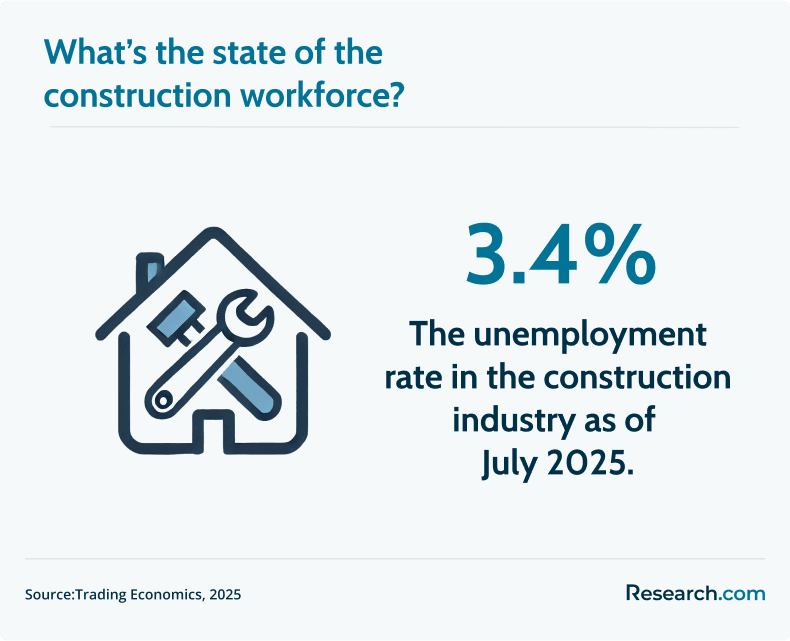
With the construction industry maintaining a low unemployment rate of 3.4% as of July 2025, professionals with this specialized MBA are well-positioned to secure competitive roles where strategic decision-making, financial oversight, and operational leadership are critical.
This MBA degree prepares candidates to navigate large-scale projects, optimize resources, and implement innovative solutions in a rapidly evolving industry. Career opportunities for graduates of the degree span both technical and executive roles. Common positions include:
- Construction Project Manager: Directs project timelines, budgets, and workforce coordination to ensure successful delivery.
- Development Manager: Oversees property investments, development planning, and market strategy.
- Operations Director: Manages operational efficiency and process improvements across construction initiatives.
- Contracts Manager: Negotiates and administers complex agreements, ensuring legal compliance and financial viability.
- Sustainability Manager: Integrates green building standards and sustainable practices into construction projects.
- Consultant: Provides strategic advice on financial, operational, and project management challenges.
- Chief Executive Officer (CEO): Leads construction or engineering firms at the executive level, shaping organizational strategy and growth.
How much do MBA in construction management graduates earn?
Graduates with an MBA in Construction Management often command competitive salaries due to their combined expertise in business strategy and construction operations. Earnings vary depending on the role, level of experience, and geographic location, but the degree generally positions professionals above peers without advanced business training.
Employers value graduates for their ability to manage complex projects, lead multidisciplinary teams, and make financially sound decisions. These traits make them attractive candidates for leadership and executive positions across construction, infrastructure, and real estate sectors.
Typical salary ranges reflect the responsibilities and strategic impact of these roles. For example, construction project managers can expect to earn approximately $97,768 annually, reflecting oversight of budgets, timelines, and workforce coordination.
At the executive level, such as construction directors or CEOs, annual salaries may reach $180,499, reflecting the high-level decision-making, organizational leadership, and strategic planning required to drive large-scale projects. These figures underscore the strong return on investment for graduates pursuing this MBA degree, highlighting both career advancement opportunities and financial rewards.
This chart from ZipRecruiter illustrates the typical salaries for MBA graduates in construction management.
Are there online MBA programs in construction management?
Online MBA programs in construction management are available for professionals seeking to advance their careers while maintaining work and personal commitments.
These programs combine core business courses, such as finance, marketing, leadership, and strategic management, with construction-focused coursework in project planning, cost control, risk management, legal compliance, and sustainable building practices. Choosing a construction management online degree ensures that students gain specialized expertise while developing advanced business acumen that directly applies to leadership roles in the industry.
Online delivery allows students to access lectures, assignments, and collaborative tools from any location, often through robust learning management systems. Many programs also incorporate interactive elements like virtual simulations, discussion forums, and project-based assignments to simulate real-world construction challenges.
These online MBA programs often accept credit transfers from previous graduate-level coursework or relevant professional experience, potentially shortening the time to completion. Online programs provide a viable pathway for developing technical, managerial, and strategic expertise in the construction industry by offering flexibility without compromising rigor.
What is the difference between an MBA and a Master’s in construction management?
While both an MBA with a construction management concentration and a master’s in construction management prepare students for leadership roles in the construction industry, they differ in focus and skill development.
An MBA emphasizes broad business competencies, combining finance, marketing, strategy, and leadership with construction-specific knowledge, whereas a Master’s in construction management concentrates on technical, operational, and project management skills.
Here are the primary distinctions between an MBA with a construction management concentration and a master’s in construction management :
- Business and Leadership Skills (MBA): Develops strategic thinking, financial acumen, and marketing expertise alongside construction knowledge, preparing graduates for executive-level roles. Some students may start with the easiest construction management programs to build foundational skills before advancing to an MBA, ensuring they gain both accessible entry-level knowledge and the advanced leadership competencies required for senior management positions.
- Technical Expertise (Master’s): Focuses on structural systems, advanced estimating, and project logistics, equipping students for technically intensive positions.
- Capstone vs. Fieldwork: MBA programs often conclude with a capstone business project integrating business and construction challenges, while Master’s programs may require fieldwork or research-based projects.
- Career Orientation: Employers may prefer MBA graduates for roles emphasizing business leadership and organizational strategy, and Master’s graduates for positions demanding hands-on project management and technical proficiency.
Is an MBA in construction management worth it?
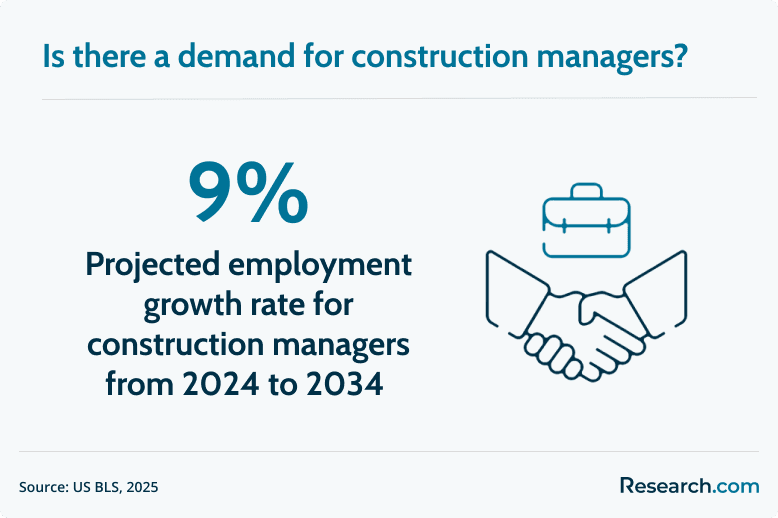
An MBA in construction management can be a worthwhile investment, particularly for professionals seeking to advance into leadership roles within a growing industry. With employment of construction managers projected to increase by 9% from 2024 to 2034, demand for individuals who combine business acumen with technical construction expertise continues to rise.
This MBA degree benefits graduates not only by expanding career opportunities but also by enhancing long-term earning potential and industry credibility. At the same time, it provides graduates with the advanced management tools needed to excel in a demanding industry, where Zippia reports construction managers experience a high 7.8 stress level. This makes strong leadership and strategic planning critical for success.
Here are some reasons this degree is worth pursuing:
- Expanding Career Opportunities: The projected growth in construction management jobs creates more pathways for graduates to secure leadership positions.
- Higher Salary Potential: MBA holders often earn more than peers with only a bachelor’s degree, reflecting advanced skills in finance, strategy, and operations. For students who begin with a construction management bachelor degree online, advancing to an MBA in construction management further elevates earning potential by blending technical knowledge with high-level business leadership expertise.
- Broader Skill Development: The degree blends business administration with construction-focused coursework, equipping graduates to oversee complex projects effectively.
- Leadership Readiness: Training in organizational strategy, negotiation, and team management positions graduates for executive roles in construction firms.
- Industry Versatility: Graduates can pursue roles not only in construction but also in real estate development, infrastructure, and consulting.
- Professional Credibility: Employers often view an MBA as a signal of readiness to handle high-stakes decisions and lead multi-disciplinary teams.
What Graduates Have to Say About Their MBA in Construction Management Degree
- Daniel: "Studying for my MBA in Construction Management gave me the tools to think strategically about budgets, contracts, and leadership. The coursework was demanding but rewarding, and I left with a new level of confidence in managing large-scale projects. "
- Sanaa : "The program was more than just lectures; it was an interactive experience filled with case studies and real-world problem-solving. I learned how to combine technical knowledge with business decision-making, which has transformed the way I approach challenges. "
- Martin: "Balancing classes on finance, project management, and technology opened my eyes to how interconnected every part of construction truly is. The study journey pushed me to grow as a leader and strengthened my ability to collaborate with diverse teams. "
Key Findings
- Jobs for construction managers are projected to grow 9% from 2024 to 2034, much faster than the average for all occupations.
- The construction industry reported a 3.4% unemployment rate in July 2025, reflecting steady demand for skilled managers.
- Construction project managers earn a mean annual salary of $97,768, showing the strong financial potential of the role.
- While 70% of construction managers hold a bachelor’s degree, 7.19% pursue a master’s, often for career advancement.
- In-demand tools for construction managers include Microsoft Office (17%) and Microsoft Excel (12%), supporting project scheduling, budgeting, and reporting.
What funding and scholarship opportunities exist for an MBA in construction management?
Prospective students can mitigate the financial burden of an MBA in construction management by exploring a variety of funding options. Many academic institutions offer targeted scholarships, grants, and merit-based awards designed for applicants with both business and industry experience. Additionally, federal aid programs, employer tuition reimbursement, and specialized financial planning services provide viable routes for managing costs. Researching institutional financial aid portals and third-party scholarship databases can further help optimize funding. For those pursuing a cost-effective education, resources like the cheapest online MBAs can offer valuable insights without compromising program quality.
References:
- Ball State University (n.d.). MBA and Graduate Certificates in Business. Retrieved from https://www.bsu.edu/academics/collegesanddepartments/mba/masters-degree/construction-management-concentration
- Data USA (n.d.). Construction Management. Retrieved from https://datausa.io/profile/cip/construction-management
- Everglades University (n.d.). Tuition and Fees. Retrieved from https://www.evergladesuniversity.edu/tuition-and-fees/
- GMAC (2025). Corporate Recruiters Survey. Retrieved from https://www.gmac.com/-/media/files/gmac/research/employment-outlook/2025-corporate-recruiters-survey/summary-report.pdf?rev=90517bad744b47959c7f593937f8f1d7
- O*NET OnLine (n.d.). In Demand Technologies 11-9021.00 - Construction Managers Retrieved from https://www.onetonline.org/link/demand/11-9021.00
- Trading Economics (2025). United States - Unemployment Rate - Construction Industry, Private Wage and Salary Workers. Retrieved from https://tradingeconomics.com/united-states/unemployment-rate-construction-industry-private-wage-and-salary-workers-fed-data.html
- University of North Florida (n.d.). 2024-2025 University Catalog. Retrieved from https://www.unf.edu/catalog/programs/gr/coggin/CCB-MBABBUSBUS2.html
- US BLS (2025). Construction Managers. Retrieved from https://www.bls.gov/ooh/management/construction-managers.htm#tab-6
- ZipRecruiter (2025). Construction Executive Salary. Retrieved from https://www.ziprecruiter.com/Salaries/Construction-Executive-Salary
- ZipRecruiter (2025). Contract Manager Salary. Retrieved from https://www.ziprecruiter.com/Salaries/Contract-Manager-Salary
- ZipRecruiter (2025). Construction Project Manager Salary. Retrieved from https://www.ziprecruiter.com/Salaries/Construction-Project-Manager-Salary
- ZipRecruiter (2025). Director Of Operations Salary. Retrieved from https://www.ziprecruiter.com/Salaries/Director-Of-Operations-Salary
- ZipRecruiter (2025). Real Estate Development Manager Salary. Retrieved from https://www.ziprecruiter.com/Salaries/Real-Estate-Development-Manager-Salary
Other Things You Should Know About MBA in Construction Management Degrees
The typical program length for an MBA in Construction Management in 2027 is between 18 months to 2 years. This time frame can vary depending on whether students choose a full-time, part-time, or accelerated track, with some flexible options offered by universities for online courses.
In 2027, an MBA in Construction Management typically requires courses such as Project Management, Construction Financial Management, Sustainable Construction Practices, and Strategic Management. These core subjects are designed to provide students with comprehensive skills to excel in the construction industry.
Admission requirements for a 2027 MBA in Construction Management usually include a bachelor's degree in a related field, a minimum GPA of 3.0, GMAT or GRE scores, and relevant work experience of at least two years in the construction industry.


