
2027 BBA vs. MBA: Explaining the Difference

Co-Founder and Chief Data Scientist
A business degree remains one of the most reliable paths to higher earnings, but not all business programs lead to the same outcomes. The Bachelor of Business Administration (BBA) and the Master of Business Administration (MBA) are often confused, yet they serve distinct purposes in career growth.
This article breaks down how these two degrees differ in curriculum, cost, experience level, salaries, and career opportunities. By the end, you’ll know which path better fits your goals—whether you’re starting your business education or aiming to move into leadership.
Key Things You Should Know About BBA and MBA
- A BBA (Bachelor of Business Administration) is an undergraduate program that builds foundational knowledge in business, finance, and management. It’s designed for students entering the workforce or planning to specialize later through graduate study.
- An MBA (Master of Business Administration) is a postgraduate program focused on leadership, strategy, and decision-making for mid-career professionals aiming for executive or management roles. It typically requires several years of work experience.
- The BBA prepares you to start your business career, while the MBA prepares you to advance it—shaping graduates for higher responsibility, salary, and organizational impact.
- What is the difference between BBA and MBA? BBA vs MBA
- Which degree is better for my career stage: BBA now or MBA later? Degree Timing
- How much work experience do I need before doing an MBA? Work Experience
- What are the costs and return on investment for BBA vs. MBA? Costs
- What salary and career gap exists between BBA and MBA holders? Salary & Career Gap
- What roles and industries hire BBAs vs. MBAs? Roles & Industries
- Can I skip a BBA and go straight to an MBA? Skipping BBA for MBA
- How competitive is MBA admission compared to BBA admission? Admission
- How has enrollment for BBA and MBA programs changed in recent years? How has enrollment for BBA and MBA programs changed in recent years?
- What factors should I consider when choosing a BBA or MBA program? What factors should I consider when choosing a BBA or MBA program?
- What are the long-term career impacts of a BBA versus an MBA? What are the long-term career impacts of a BBA versus an MBA?
What is the difference between BBA and MBA?
The main difference between a BBA (Bachelor of Business Administration) and an MBA (Master of Business Administration) lies in the level of study, experience required, and career outcomes.
- A BBA is an undergraduate program that provides students with a foundation in management, marketing, accounting, and business law—ideal for those entering the business world for the first time.
- An MBA, on the other hand, is a graduate program aimed at professionals with work experience who want to develop strategic leadership and decision-making skills to move into senior or executive roles.
In 2025, over 3,000 U.S. colleges offer BBA and related business programs, while more than 1,600 graduate schools offer MBAs (CollegeTuitionCompare, 2025). BBAs typically take four years to complete, whereas MBAs usually require two years of full-time study and several years of professional experience before admission. Those exploring other undergraduate options can read about choosing between BBA and BS degrees to understand how business paths differ early on.
| ASPECT | BBA (Bachelor of Business Administration) | MBA (Master of Business Administration) |
| Level | Undergraduate | Graduate |
| Typical Duration | 4 years | 1.5–2 years |
| Average Tuition (U.S.) | $27,077 (out-of-state, 2025) | $61,800 average cost (Zippia, 2023) |
| Work Experience Required | None | 4–6 years on average (Zippia, 2023) |
| Average Salary (U.S.) | $89,650 (ZipRecruiter, 2025) | $165,372 (ZipRecruiter, 2025) |
| Career Level | Entry to early career | Mid to senior management |
Which degree is better for my career stage: BBA now or MBA later?
If you’re at the start of your academic or professional journey, a BBA is the better choice now, while an MBA fits later once you’ve gained work experience and career clarity. A BBA builds essential business knowledge—finance, marketing, operations, and management—and is suited for high school graduates aiming for entry-level business roles. It prepares you for a wide range of early-career jobs such as analyst, coordinator, or associate.
In contrast, an MBA is designed for professionals with 4–6 years of work experience (Zippia, 2023) who are ready to move into leadership, consulting, or executive roles. The average MBA student is 28 years old, often returning to school after building real-world experience. This experience helps them apply theory to complex business decisions.
Choosing the right degree depends on timing: start with a BBA to enter the field, then consider an MBA later to deepen your strategic and leadership capabilities.
Some students also explore other business-related credentials, such as what jobs can you get with a business certificate, to gain a faster entry into the workforce before committing to a full degree program. This approach can provide practical experience that helps clarify long-term career goals before pursuing an MBA.
How much work experience do I need before doing an MBA?
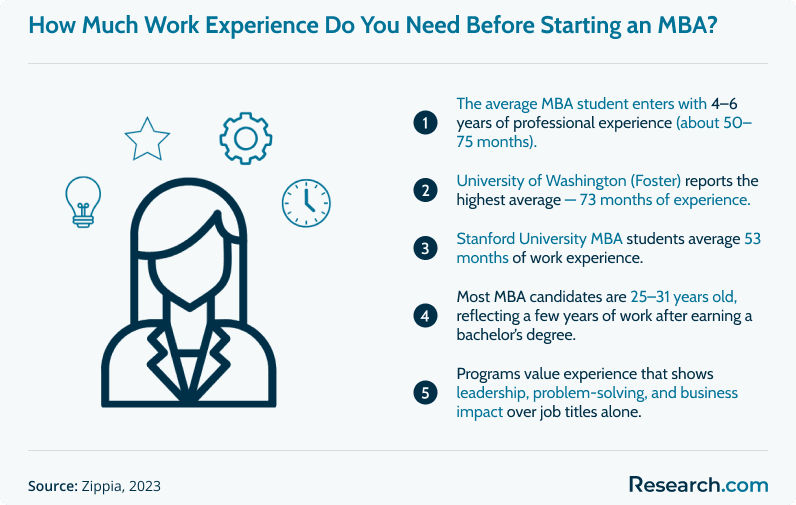
Most MBA programs expect applicants to have 4 to 6 years of full-time professional experience before applying. This requirement exists because the MBA curriculum is designed for individuals who can relate theoretical concepts to practical business challenges. Experience gives students the context to analyze decisions, manage teams, and contribute meaningfully to peer discussions.
According to Zippia (2023), the average MBA student enters with 50–75 months of work experience, and the average age is 28. For instance, students at the University of Washington (Foster) have the highest average of 73 months, while those at Stanford University average 53 months. This range shows how schools favor candidates who bring leadership, collaboration, and problem-solving experience over mere job tenure.
If you’re still early in your career, starting with an online business management degree can be a practical first step before pursuing an MBA.
The infographic below summarizes the average work experience and age profiles of MBA candidates across top programs, highlighting how professional background remains a key admission factor.
What are the costs and return on investment for BBA vs. MBA?
The cost and return on investment (ROI) between a BBA and an MBA differ greatly because of program level and career outcomes. A BBA, being an undergraduate program, costs less and serves as the entry point into the business world. In contrast, an MBA represents a larger financial and time commitment, but typically delivers stronger long-term salary growth and career advancement.
According to CollegeTuitionCompare (2025), the average BBA tuition is $9,398 per year for in-state students and $27,077 for out-of-state students. Meanwhile, MBA tuition averages $10,890 in-state and $19,134 out-of-state per year, though some elite programs can exceed $200,000 (Zippia, 2023). Despite the cost, the average MBA graduate earns about $165,372 annually, compared with $89,650 for BBA graduates (ZipRecruiter, 2025). This earnings gap often justifies the investment for those pursuing leadership or executive roles.
The chart below compares average BBA and MBA tuition rates for the 2024–2025 academic year, offering a quick reference for students weighing affordability and ROI. For lower-cost options, some cheap online business administration degree programs may offer a more accessible starting point.
What salary and career gap exists between BBA and MBA holders?
The salary and career gap between BBA and MBA graduates is significant, reflecting the difference in education level, work experience, and leadership responsibilities. A BBA prepares students for entry-level to mid-level roles, while an MBA qualifies professionals for higher management and executive positions.
According to Zippia (2023), average salaries increase with each degree level. BBA graduates—those holding a bachelor’s degree in business—earn around $115,712 annually, while MBA holders average about $120,000. Though the pay jump may seem modest at first glance, the real advantage comes from access to higher-paying industries and leadership tracks, where median pay often surpasses $160,000 annually (ZipRecruiter, 2025). MBAs also report stronger lifetime earnings, with an estimated $4.1 million total, compared with $3.3 million for bachelor’s graduates.
The chart below compares average earnings by education level, showing how salaries steadily rise with advanced degrees. Those pursuing a master degree in business salary benchmark can use this as a reference point for long-term ROI.
What roles and industries hire BBAs vs. MBAs?
Both BBA and MBA graduates are highly sought after in business, finance, and management—but the level of responsibility differs. BBA graduates typically fill entry-level or mid-tier management positions, while MBA holders are recruited for senior and strategic leadership roles across industries.
Common roles for BBA graduates:
- Sales Manager
- Marketing or Advertising Manager
- Financial Manager
- Human Resources Manager
- Training and Development Manager
Common industries hiring BBAs:
- Retail and Consumer Goods
- Financial Services and Banking
- Real Estate and Property Management
- Advertising and Marketing Agencies
- Hospitality and Tourism
Common roles for MBA graduates:
- Computer and Information Systems Manager
- Natural Sciences or Engineering Manager
- Chief Financial Officer or Financial Director
- Postsecondary Education Administrator
- School Principal or Academic Director
Common industries hiring MBAs:
- Technology and Consulting
- Healthcare and Pharmaceuticals
- Finance and Investment
- Education and Administration
- Manufacturing and Logistics
The chart below shows the highest-paying roles for both degrees, based on 2024 median pay, highlighting how earning potential and leadership scope rise with graduate-level qualifications.
If you’re pursuing a management-focused career, it’s worth comparing MBA vs DBA options for long-term planning. While the MBA prepares you for executive management, a DBA (Doctor of Business Administration) emphasizes advanced leadership research and strategic innovation for senior or academic roles.
Can I skip a BBA and go straight to an MBA?
Yes, it’s possible to pursue an MBA without a BBA, but it depends on your academic background, professional experience, and the program’s admission criteria. Most business schools don’t require a BBA specifically—they look for a bachelor’s degree in any field plus several years of relevant work experience. However, skipping the BBA means you’ll need to prove your business readiness through professional accomplishments, management experience, or prerequisite coursework.
As mentioned earlier, MBA students typically enter programs with 4–6 years of work experience, averaging an age of 28. Candidates without a business background might find the first semester more challenging, as it assumes familiarity with concepts in accounting, economics, and management. Some schools offer bridge programs or require foundation courses to help non-BBA students catch up before diving into advanced coursework.
If you’re starting fresh, consider earning an easiest business degree at the bachelor’s level first to build core knowledge, then pursue an MBA when you’re ready for strategic leadership training.
How competitive is MBA admission compared to BBA admission?
MBA admission is far more competitive than BBA admission, primarily because MBA programs evaluate both academic ability and professional experience. While BBA programs admit students directly from high school or after general education coursework, MBA applicants must typically demonstrate several years of managerial or industry experience, along with strong academic and leadership credentials.
According to Zippia (2023), the average MBA acceptance rate across U.S. schools is 18.4%, reflecting a selective admissions process that weighs test scores, prior achievements, and work history. At elite institutions like Stanford (6.2%), Harvard (12.5%), and Wharton (18.2%), the acceptance rates are even lower. In contrast, most BBA programs have open or moderate admissions, particularly in public universities, where entry often depends on GPA and standardized test results rather than professional experience.
Overall, earning a BBA is more accessible, while admission to a competitive MBA program requires strategic preparation, proven leadership, and clear post-graduation goals.
Many working professionals also compare the flexibility and affordability of modern degree formats like cost of online education vs traditional programs, since online MBAs often allow applicants to balance work experience with study—an advantage that strengthens both their résumé and graduate school applications.
How has enrollment for BBA and MBA programs changed in recent years?
Enrollment for both BBA and MBA programs has rebounded in recent years, with business education continuing to dominate college enrollment in the United States. Undergraduate business degrees remain among the most popular fields, while graduate-level MBA programs are seeing renewed demand after a brief post-pandemic slowdown.
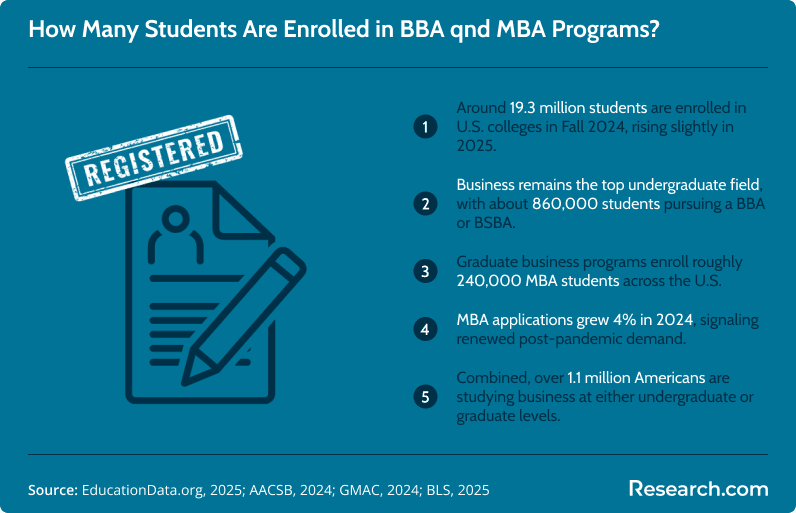
According to EducationData.org (2025), around 19.3 million students were enrolled in U.S. colleges in Fall 2024, with business majors representing a significant share. About 860,000 students are pursuing a BBA or BSBA, keeping business the leading undergraduate discipline nationwide. At the graduate level, AACSB (2024) and GMAC (2024) report that roughly 240,000 students are enrolled in MBA programs, with applications increasing by 4% in 2024—a clear sign of growing interest among mid-career professionals seeking advancement opportunities.
The infographic below visualizes current enrollment figures, showing how over 1.1 million students in the U.S. are now pursuing business degrees at both undergraduate and graduate levels.
This trend mirrors the broader resurgence of flexible graduate learning models, including online EdD programs no GRE, which reflect higher education’s move toward accessibility and convenience for working professionals—an approach also seen in online MBA and hybrid business programs.
What factors should I consider when choosing a BBA or MBA program?
When choosing between a BBA or MBA program, the most important factors are your career goals, budget, experience level, and preferred learning format. A BBA builds foundational skills for those entering the workforce, while an MBA strengthens leadership and strategic decision-making for experienced professionals.
Key factors to consider include:
- Accreditation: Ensure the program is accredited by recognized bodies like AACSB to guarantee quality and employer recognition. You can find reputable online business degree programs accredited for flexible study options.
- Program cost: Tuition varies—BBA programs average $27,077 for out-of-state students, while MBA programs can cost $61,800 or more.
- Work experience: Most MBA programs require 4–6 years of experience, while BBA programs accept students directly after high school.
- Career outcomes: MBAs often lead to management and executive roles, whereas BBAs prepare students for entry-level or supervisory positions.
- Learning format and duration: Full-time, part-time, and online programs differ in flexibility and intensity.
Here's What Graduates Have to Say About Their BBA or MBA Programs
- Maricel: "Earning my BBA online helped me balance work and family while gaining real business skills I could apply immediately. I didn’t just learn theory—I learned how companies actually run. The flexibility made it possible to graduate without debt, and that alone changed my career path. "
- Ronan: "My MBA experience taught me more about leadership than I expected. Online collaboration with classmates across industries made every case study feel real. It was challenging but rewarding—the strategic thinking I developed helped me secure a management role within months of finishing. "
- Elara: "I pursued my MBA online after five years in marketing, and it completely reshaped my career goals. The mix of analytics, finance, and management gave me confidence to start consulting independently. It wasn’t just about credentials—it was about perspective and professional growth. "
Key Findings
- The average BBA salary is $89,650, while the average MBA salary reaches $165,372.
- MBA students typically have 4–6 years of work experience and are around 28 years old.
- BBA tuition averages $27,077 out-of-state, while MBA programs cost around $61,800.
- Over 1.1 million Americans are enrolled in business programs, including 860,000 undergraduates and 240,000 MBA students.
- The average MBA acceptance rate is 18.4%, compared with far higher rates for BBA programs.
- Top-paying MBA roles include information systems and financial management, exceeding $160,000 annually.
What are the long-term career impacts of a BBA versus an MBA?
Evaluating career trajectories, MBA graduates often experience accelerated progression into senior roles, benefiting from dedicated career services and robust alumni networks that foster leadership opportunities and mentorship. These networks not only provide access to industry insights but also assist in bridging gaps between academic theory and strategic decision-making in the workplace.
In contrast, BBA holders typically build gradual expertise through hands-on roles in diverse business functions, shaping a broad skill set that leads to stability in entry‐to mid‐level positions. Nonetheless, professionals may enhance their growth with options such as low cost online MBA, which can offer a cost-effective pathway to advanced competencies and expanded networking benefits over time.
References:
- AACSB. Master’s Enrollment Trends at AACSB Schools.
- Bureau of Labor Statistics (BLS). Business and Financial Occupations.
- Bureau of Labor Statistics (BLS). Field of Degree: Business.
- Bureau of Labor Statistics (BLS). Management Occupations.
- CollegeTuitionCompare. Business Program 2025 Tuition.
- EducationData.org. College Enrollment Statistics.
- EFMD Global / GMAC. 2024 Corporate Recruiters Survey Report.
- GMAC. 2024 Application Trends Survey Report.
- ZipRecruiter. BBA Salary.
- ZipRecruiter. MBA Salary.
- Zippia. MBA Statistics.
Other Things You Should Know About BBA and MBA
A BBA usually takes four years of full-time study, covering foundational business subjects like finance, marketing, and management. An MBA, meanwhile, can take one to two years full-time or up to three years part-time or online, depending on the program’s format and course load flexibility.
In 2027, students can often work while attending BBA or MBA programs, depending on their schedule. Many schools offer part-time and online formats, catering to working students. However, balancing work and study requires good time management and the ability to prioritize responsibilities.
In 2027, BBA graduates typically qualify for entry-level roles in business sectors, while MBA graduates often pursue senior management positions. MBA holders generally have broader job prospects and may earn higher salaries due to their advanced expertise and leadership training.


