
2027 Most Affordable Online Master's Degrees in Nutrition

Co-Founder and Chief Data Scientist
Many individuals struggle to pursue further education due to time constraints or location barriers. This is unfortunate considering a master’s degree in nutrition serves as a springboard for professional advancement and competitive salaries, with graduates earning an average of $63,989 per year, according to 2024 data.
Luckily, there are now many online master's degrees in nutrition that offer flexibility and accessibility to help you advance your career in the field. Drawing upon my more than 10 years of knowledge and experience in career planning, I aim to assist you in selecting the best online master's program in nutrition.
What are the benefits of getting an affordable online master's degree in nutrition?
- A master's degree in nutrition can lead to various rewarding careers, including roles as clinical dietitians, public health nutritionists, or research scientists in food and nutrition industries.
- Professionals with a master's degree in nutrition typically enjoy competitive salaries, with the median salary starting at $61,000 per year.
- Pursuing this degree online offers unparalleled flexibility, allowing you to balance your education with other commitments.
What can I expect from an affordable online master's degree in nutrition?
- An online master's degree in nutrition typically provides a comprehensive understanding of nutritional science, including principles of human nutrition, metabolism, and dietary assessment.
- Students can expect to explore advanced topics such as macronutrient and micronutrient metabolism, nutritional epidemiology, and evidence-based nutrition interventions.
- There may be opportunities for specialization in areas like clinical nutrition, community nutrition, or sports nutrition.
- The curriculum often incorporates coursework, research projects, and practical experiences, such as internships or capstone projects, to apply theoretical knowledge in real-world settings.
- An online master's degree in nutrition may take 2 to 3 years to complete.
Where can I work with an affordable online master's degree in nutrition?
With an online master's degree in nutrition, you can find employment in healthcare settings, such as hospitals, clinics, and long-term care facilities. You can work as a clinical dietitian or nutritionist, providing personalized nutrition counseling and medical nutrition therapy to patients with chronic diseases, eating disorders, or other health conditions.
There are also employment opportunities in community health organizations, government agencies, or non-profit organizations, focusing on public health initiatives, nutrition education programs, or policy development to address community nutrition needs and promote healthy eating habits.
How much can I make with an affordable online master's degree in nutrition?
If you're wondering what is the best degree to get, consider these facts: according to 2024 data from the U.S. Bureau of Labor Statistics (BLS), the median annual wage for dietitians and nutritionists is $73,850 per year (U.S. Bureau of Labor Statistics, 2025).
Those working in hospitals earn a median salary of $70,360, while those in outpatient care centers earn $76,330. Dietitians and nutritionists in private practice or self-employed have competitive salary earnings that vary widely based on client base and geographic location.
- Most Affordable Online Master's Degrees in Nutrition for 2027 List of Programs
- How long does it take to complete an affordable online master's degree in nutrition? Program Duration
- How does an online master's degree in nutrition compare to an on-campus program? Online vs Campus
- What is the average cost of an affordable online master's degree in nutrition? Program Cost
- What are the financial aid options for students enrolling in an affordable online master's degree in nutrition? Financial Aid
- What are the prerequisites for enrolling in an affordable online master's degree in nutrition? Admission Requirements
- What courses are typically in an affordable online master's degree in nutrition? Curriculum
- What types of specializations are available in an affordable online master's degree in nutrition? Specialization
- How to choose the best affordable online master's degree in nutrition? How to choose the best affordable online master's degree in nutrition?
- How to Choose an Affordable Online Master's Degree in Nutrition How to Choose an Affordable Online Master's Degree in Nutrition
- What career paths are available for graduates of an affordable online master's degree in nutrition? What career paths are available for graduates of an affordable online master's degree in nutrition?
- What is the job market for graduates with an affordable online master's degree in nutrition? What is the job market for graduates with an affordable online master's degree in nutrition?
- Should I Consider Supplementary Courses to Enhance My Nutrition Career? Should I Consider Supplementary Courses to Enhance My Nutrition Career?
- What are the emerging trends in online nutrition education? What are the emerging trends in online nutrition education?
- What certifications or licensure do you need to pursue a career in nutrition after completing an online master's degree? What certifications or licensure do you need to pursue a career in nutrition after completing an online master's degree?
- Can an Affordable Online Master's Degree in Nutrition Prepare Me for Integrative and Alternative Nutrition Roles? Can an Affordable Online Master's Degree in Nutrition Prepare Me for Integrative and Alternative Nutrition Roles?
- How Do Employers View an Online Master's Degree in Nutrition? How Do Employers View an Online Master's Degree in Nutrition?
- Can an Online Master's Degree in Nutrition Complement Other Advanced Healthcare Degrees? Can an Online Master's Degree in Nutrition Complement Other Advanced Healthcare Degrees?
- How Can I Assess the Long-Term ROI for My Online Master's Degree in Nutrition? How Can I Assess the Long-Term ROI for My Online Master's Degree in Nutrition?
- What Support Services Can Bolster My Success in an Online Master's Program in Nutrition? What Support Services Can Bolster My Success in an Online Master's Program in Nutrition?
- What Research Opportunities Are Available in an Online Master's Program in Nutrition? What Research Opportunities Are Available in an Online Master's Program in Nutrition?
Most Affordable Online Master's Degrees in Nutrition for 2027
Choosing an affordable online master's degree in nutrition is not just a tuition decision. It affects whether you can qualify for dietetics credentials, complete supervised practice requirements, keep working while studying, and move into roles in clinical nutrition, public health, wellness, food systems, education, or research. The best program for you depends on your career goal, state credentialing rules, prior coursework, budget, and whether the degree is accredited for your intended pathway.
This guide is designed for prospective graduate students comparing online nutrition master's programs with cost, flexibility, accreditation, and career outcomes in mind. You will learn how affordable online nutrition master's degrees are ranked, how long they take, what they cost, what courses and specializations to expect, how online programs compare with campus-based options, and what to check before enrolling.
Quick Answer: Is an Affordable Online Master's in Nutrition Worth Considering?
An affordable online master's degree in nutrition can be a strong option if you need graduate-level nutrition training without relocating or leaving your job. It is most useful for students pursuing advanced nutrition knowledge, dietetics preparation, public health nutrition, nutrition education, corporate wellness, or clinical nutrition roles. However, students who want to become Registered Dietitian Nutritionists must carefully confirm that the program meets Accreditation Council for Education in Nutrition and Dietetics requirements and any supervised practice or state licensure requirements.
Online nutrition master's programs in this list range from accelerated formats that can be completed in 8-10 months to longer professional dietetics options that take 22 months. Required credits range from 30 credit hours to 54 credit hours, depending on the school, thesis option, specialization, and credentialing structure.
How we rank schools
Research.com ranks affordable online master's degrees in nutrition to help students compare programs using transparent, education-focused criteria rather than promotional claims. Our ranking process follows the Research.com methodology and draws from reputable data sources, including the IPEDS database, Peterson’s database, the College Scorecard database, and the National Center for Education Statistics.
Because nutrition programs vary widely, students should use rankings as a starting point, not the only decision tool. Accreditation, licensure fit, supervised practice access, total cost, faculty expertise, and career services should all be reviewed before applying.
Affordable Online Master's Degrees in Nutrition: Program Comparison
| Rank | School and Program | Program Length | Credits | Cost Information Listed | Accreditation Listed |
| 1 | Southeast Missouri State University Online Master of Science in Applied Nutrition | 15 months | 36 credit hours | $15,642 | Accreditation Council for Education in Nutrition and Dietetics (ACEND) |
| 2 | University of Central Arkansas Online Master of Science in Nutrition | 8-10 months thesis track or 12-15 months non-thesis track | 30 credit hours thesis track or 36 credit hours non-thesis track | not available | Accreditation Council for Education in Nutrition and Dietetics (ACEND) |
| 3 | University of Central Missouri Online Master of Science in Nutrition - Clinical Nutrition | 18 months | 54 credit hours | not available | Accreditation Council for Education for Nutrition and Dietetics (ACEND) |
| 4 | Bowling Green State University - Main Campus Online Master of Food and Nutrition | 12-18 months | 31 credit hours | $5,612.40 per semester | The Higher Learning Commission |
| 5 | Jacksonville State University Online Master of Science in Education: Physical Education - Nutrition | 15-18 months | 42 credit hours | not available | Council for the Accreditation of Educator Preparation (CAEP) |
| 6 | Ohio University Main Campus Online Master's Degree in Food and Nutrition Science | 12 months | 36 credit hours | $505 per credit hour (In-State) or $1,079 per credit hour (Out-of-state) | Accreditation Council for Education in Nutrition and Dietetics (ACEND) |
| 7 | University of Alabama Online Master of Science (MS) in Human Nutrition | 8-10 months | 30 credit hours | $1,078 per credit hour | Accreditation Council for Education in Nutrition and Dietetics (ACEND) |
| 8 | Texas Tech University Online Master of Science in Nutrition and Dietetics | 8-10 months | 33 credit hours | No information available | Accreditation Council for Education in Nutrition and Dietetics (ACEND) |
| 9 | North Dakota State University Online Master of Science in Dietetics | 15 months | 36 credit hours | not available | Accreditation Council for Education in Nutrition and Dietetics (ACEND) |
| 10 | Oregon State University M.S. in Nutrition – Professional Dietetics | 22 months | 49-50 credit hours | $560 per credit hour | Accreditation Council for Education in Nutrition and Dietetics (ACEND) |
1. Southeast Missouri State University Online Master of Science in Applied Nutrition
Southeast Missouri State University offers an online master of science in applied nutrition for students who want graduate-level training in nutrition science with practical applications across clinical, community, and sports nutrition settings.
- Program length: 15 months
- Tracks/concentrations: N/A
- Cost per credit: $15,642
- Required credits to graduate: 36 credit hours
- Accreditation: Accreditation Council for Education in Nutrition and Dietetics (ACEND)
2. University of Central Arkansas Online Master of Science in Nutrition
The University of Central Arkansas provides an online master's program in nutrition with coursework that may include areas such as macronutrient metabolism and nutritional epidemiology. The program gives students thesis and non-thesis options, which can matter for students deciding between research preparation and applied professional training.
- Program length: 8-10 months (thesis track) or 12-15 months (non-thesis track)
- Tracks/concentrations: N/A
- Cost per credit: not available
- Required credits to graduate: 30 credit hours (thesis track) or 36 credit hours (non-thesis track)
- Accreditation: Accreditation Council for Education in Nutrition and Dietetics (ACEND)
3. University of Central Missouri Online Master of Science in Nutrition - Clinical Nutrition
The University of Central Missouri's online master of science in nutrition emphasizes clinical nutrition, making it a relevant option for students interested in nutrition assessment, counseling, intervention, and healthcare-based nutrition services.
- Program length: 18 months
- Tracks/concentrations: Clinical Nutrition
- Cost per credit: not available
- Required credits to graduate: 54 credit hours
- Accreditation: Accreditation Council for Education for Nutrition and Dietetics (ACEND)
4. Bowling Green State University - Main Campus Online Master of Food and Nutrition
Bowling Green State University offers an online master of food and nutrition that covers food science, food service management, and community nutrition. It may fit students who want broader food and nutrition training rather than a narrowly clinical curriculum.
- Program length: 12-18 months
- Tracks/concentrations: N/A
- Cost per credit: $5,612.40 per semester
- Required credits to graduate: 31 credit hours
- Accreditation: The Higher Learning Commission
5. Jacksonville State University Online Master of Science in Education: Physical Education - Nutrition
Jacksonville State University's online program combines physical education and nutrition. It is best suited for professionals who want to bring nutrition education into school, coaching, fitness, wellness, or physical education environments.
- Program length: 15-18 months
- Tracks/concentrations: Nutrition
- Cost per credit: not available
- Required credits to graduate: 42 credit hours
- Accreditation: Council for the Accreditation of Educator Preparation (CAEP)
6. Ohio University Main Campus Online Master's Degree in Food and Nutrition Science
Ohio University's online master's degree in food and nutrition science uses a multidisciplinary approach that draws from food science, biochemistry, and public health. Students who want to understand nutrition's role in health, disease prevention, and food systems may find this structure useful.
- Program length: 12 months
- Tracks/concentrations: N/A
- Cost per credit: $505 per credit hour (In-State) or $1,079 per credit hour (Out-of-state)
- Required credits to graduate: 36 credit hours
- Accreditation: Accreditation Council for Education in Nutrition and Dietetics (ACEND)
7. University of Alabama Online Master of Science (MS) in Human Nutrition
The University of Alabama's online MS in human nutrition focuses on nutrient metabolism, assessment, and dietary interventions. Its track options give students more room to align the degree with generalist, community, or clinical nutrition interests.
- Program length: 8-10 months
- Tracks/concentrations: Generalist Track, Community Nutrition Track, and Clinical Nutrition Track
- Cost per credit: $1,078 per credit hour
- Required credits to graduate: 30 credit hours
- Accreditation: Accreditation Council for Education in Nutrition and Dietetics (ACEND)
8. Texas Tech University Online Master of Science in Nutrition and Dietetics
Texas Tech University's online master of science in nutrition and dietetics connects nutrition science with applied dietetics topics such as medical nutrition therapy, food service management, and community nutrition.
- Program length: 8-10 months
- Tracks/concentrations: N/A
- Cost per credit: No information available
- Required credits to graduate: 33 credit hours
- Accreditation: Accreditation Council for Education in Nutrition and Dietetics (ACEND)
9. North Dakota State University Online Master of Science in Dietetics
North Dakota State University's online master of science in dietetics is designed for students seeking advanced dietetics knowledge in nutrition assessment, intervention, evaluation, evidence-based practice, and professional development.
- Program length: 15 months
- Tracks/concentrations: N/A
- Cost per credit: not available
- Required credits to graduate: 36 credit hours
- Accreditation: Accreditation Council for Education in Nutrition and Dietetics (ACEND)
10. Oregon State University M.S. in Nutrition – Professional Dietetics
Oregon State University's M.S. in nutrition – professional dietetics combines graduate coursework with supervised practice experiences. Students considering this type of program should closely verify how the supervised practice structure supports eligibility for dietetics credentials.
- Program length: 22 months
- Tracks/concentrations: Professional Dietetics
- Cost per credit: $560 per credit hour
- Required credits to graduate: 49-50 credit hours
- Accreditation: Accreditation Council for Education in Nutrition and Dietetics (ACEND)
Student Perspectives on Online Nutrition Master's Programs
- Samantha: "Completing my nutrition master's online helped me study advanced health and wellness topics while keeping control of my schedule. The format gave me the flexibility to keep moving toward my career goals without stepping away from my responsibilities."
- Michael: "The online format worked because faculty support and digital learning resources were available when I needed them. The experience helped me build confidence in applying nutrition concepts in a field that keeps changing."
- Jessica: "Being able to work while earning my master's made the degree more realistic for me. The virtual discussions and collaboration also helped me feel connected instead of isolated during the program."
Key Findings
- Online master's programs in nutrition can be completed in as little as 8-10 months, but some professional dietetics pathways take longer because they include more credits or supervised practice components.
- ACEND accreditation is especially important for students pursuing Registered Dietitian Nutritionist pathways, while other accreditation types may be appropriate for broader food, wellness, education, or public health roles.
- Tuition is only one part of affordability. Students should also compare fees, technology costs, proctoring charges, travel for any required experiences, books, and the ability to keep working while enrolled.
- The U.S. Bureau of Labor Statistics reported that dietetics and nutrition employment is projected to grow 7% from 2023 to 2033, with about 5,600 openings expected each year over the decade.
How long does it take to complete an affordable online master's degree in nutrition?
An online master's degree in nutrition commonly takes two to three years of full-time study, which is comparable to other graduate health programs such as an MSN degree. However, the programs listed above show that some online nutrition master's degrees use accelerated formats that can be completed much faster.
Part-time study is often available for students balancing graduate school with work, family, or clinical responsibilities. Choosing part-time enrollment may extend completion to three to five years or more. Some programs also offer accelerated pacing or self-paced coursework, which can shorten the timeline for students who can manage a heavier workload.
Graduate nutrition education has become a common next step for professionals seeking advanced credentials. According to recent data, the second most common degree level in nutrition is a master's degree, comprising 14% of degree holders.
The chart below shows the most common programs for nutritionists:
How does an affordable online master's degree in nutrition compare to an on-campus program?
The main difference between online and campus-based nutrition master's programs is not academic seriousness; it is delivery, access, and how practical requirements are handled. A well-designed online program can be rigorous, but students must confirm how labs, supervised practice, internships, clinical experiences, research projects, and networking opportunities are delivered.
| Factor | Online Nutrition Master's Program | On-Campus Nutrition Master's Program | Best Fit |
| Schedule | Often allows asynchronous coursework or flexible access to lectures and materials | Usually follows fixed class meeting times | Online works better for working professionals; campus may fit students who prefer structured schedules |
| Location | Can be completed without relocating in many cases | Requires regular campus attendance and may require moving | Online is stronger for students who cannot move; campus is stronger for those seeking in-person immersion |
| Networking | Uses discussion boards, video meetings, virtual events, and online groups | Offers face-to-face contact with faculty, classmates, and local employers | Campus may offer easier informal networking; online students must be more intentional |
| Hands-on learning | May use virtual labs, simulations, local placements, or arranged supervised experiences | May provide campus labs, affiliated clinics, and local internship connections | Students pursuing credentialed practice should verify practical training requirements in either format |
| Cost | May reduce commuting, relocation, and housing expenses | May involve additional living, transportation, or campus-based costs | Online may be more affordable, but only after all fees are included |
Flexibility
Online programs generally offer more scheduling flexibility. Students may be able to review lectures, complete assignments, and participate in discussions around professional or family obligations. Campus programs usually require students to attend classes at set times and locations.
Location
Online nutrition programs can make graduate study possible for students who live far from a university or cannot relocate. Campus programs may be better for students who want daily in-person contact, access to physical labs, and local professional networks tied to the institution.
Interaction and networking
Campus programs typically make informal connection easier because students see classmates, faculty, and guest speakers in person. Online students can still build strong networks, but they need to use virtual office hours, alumni groups, professional associations, internships, and discussion forums deliberately.
Hands-on experience
Nutrition education may include applied components such as labs, assessment practice, clinical exposure, community projects, or supervised practice. Online programs may address these through virtual simulations, local placements, or scheduled experiential requirements. Before enrolling, ask the program exactly what must be completed in person and whether placements are guaranteed or student-arranged.
What is the average cost of an affordable online master's degree in nutrition?
Tuition for online graduate programs in nutrition can range from $15,000 to $40,000 or more per year. One reason students compare online options is that the cheapest online nutrition degree may reduce or eliminate expenses such as commuting, relocation, and on-campus housing.
According to a 2024 report from Education Data Initiative, online degrees come out to be $37,511 cheaper than in-person degrees, thanks to lower tuition fees and cost of attendance. Online study may also allow students to keep working, which can reduce the opportunity cost of returning to school.
Still, a low tuition number does not always mean the lowest total cost. Online nutrition master's students should ask about technology fees, proctoring fees, books, software, background checks, internship travel, lab kits, graduation fees, and any required campus visits.
Before committing, calculate the full cost from admission through graduation and compare it with your expected career pathway, credential requirements, and ability to maintain income while enrolled.
What financial aid options are available for students enrolling in affordable master's degrees in nutrition?
Online master's students in nutrition may qualify for several forms of financial support. Availability depends on the school, enrollment status, citizenship or residency status, employer policies, and whether the program participates in federal aid programs.
- Federal financial aid. Eligible online graduate students can complete the Free Application for Federal Student Aid to be considered for federal loans and other aid options. Students should confirm that the institution and program are eligible for federal aid before enrolling.
- Scholarships and grants. Universities, professional associations, private foundations, and community organizations may offer awards for graduate students in nutrition, dietetics, public health, food science, or healthcare fields.
- Graduate assistantships. Some programs may offer teaching, research, or administrative assistantships that include a stipend, tuition remission, or both. These are less common in fully online formats, so students should ask directly.
- Employer tuition assistance. Some employers support graduate education through tuition reimbursement or direct assistance. Similar to companies that pay for MBA programs and other master's degrees, healthcare organizations, school systems, wellness companies, and food-related employers may offer education benefits.
What are the prerequisites for enrolling in an affordable online master's degree in nutrition?
Admission requirements vary, but most online master's programs in nutrition expect applicants to show academic preparation in science, nutrition, or a related health field. Students changing careers may need prerequisite coursework before beginning graduate-level nutrition classes.
- Bachelor's degree. Most programs require a bachelor's degree from an accredited institution. Relevant majors may include nutrition, dietetics, food science, biology, chemistry, a public health major, or a closely related discipline.
- Minimum GPA. Many programs set a minimum GPA requirement, typically ranging from 2.5 to 3.0 on a 4.0 scale. Some schools may evaluate applicants with lower GPAs if they have strong professional experience or other strengths.
- Prerequisite courses. Applicants may need prior coursework in biology, chemistry, physiology, nutrition science, or related subjects to ensure they can succeed in advanced nutrition courses.
- Letters of recommendation. Schools may request recommendations from faculty members, supervisors, or professionals who can speak to the applicant's academic ability, work ethic, and readiness for graduate study.
- Statement of purpose. Many programs ask applicants to explain their career goals, interest in nutrition, relevant experience, and reasons for choosing that specific program.
What courses are typically in an affordable online master's degree in nutrition?
Online master's programs in nutrition usually combine advanced nutrition science, research literacy, population health, and applied counseling or assessment skills. Exact course titles vary, but students commonly encounter the following areas:
- Advanced human nutrition. Students study nutrients, metabolism, physiological processes, nutrient needs across the life span, and the biochemical foundations of human nutrition.
- Nutritional epidemiology. This course examines how researchers study relationships between dietary patterns, disease risk, public health outcomes, and population-level nutrition interventions.
- Nutrition assessment and counseling. Students learn how to evaluate dietary intake, interpret nutrition data, identify client needs, and develop counseling strategies for individuals or groups.
- Community nutrition and public health. Coursework may address nutrition education, program planning, policy, evaluation, and ways to address nutritional issues across communities.
- Research methods in nutrition. Students build skills in study design, data collection, statistical interpretation, and evidence evaluation for nutrition research or capstone projects.
What types of specializations are available in an affordable online master's degree in nutrition?
Specializations help students connect graduate coursework to a specific career direction. This is similar to how professionals compare targeted nursing certifications to match a particular role or practice setting.
| Specialization | What It Focuses On | Best For Students Interested In |
| Clinical nutrition | Nutrition therapy, assessment, counseling, care planning, and monitoring for people with medical conditions | Hospitals, outpatient clinics, long-term care, private practice, and dietetics pathways |
| Sports nutrition | Performance fueling, recovery, body composition, hydration, and nutrition for active populations | Athletics, fitness, coaching, wellness, and performance settings |
| Public health nutrition | Community interventions, program development, policy, prevention, and population health | Government agencies, nonprofits, schools, and community health organizations |
| Nutrition education and counseling | Behavior change, communication, teaching, curriculum design, and client education | Schools, wellness programs, community education, and health coaching roles |
| Food policy and sustainability | Food systems, policy, sustainability, access, and issues such as food security | Policy, advocacy, food systems, sustainability, and nonprofit work |
How should you choose the best affordable online master's degree in nutrition?
Choosing among the best online degree programs in nutrition requires more than comparing tuition. The right program should match your credential goal, state requirements, learning style, and long-term career plan.
- Start with your end goal. Decide whether you want to become an RDN, work in public health, teach nutrition, enter corporate wellness, pursue research, or specialize in clinical nutrition.
- Verify accreditation. If you want a dietetics credential, confirm whether the program is ACEND-accredited and whether it satisfies the educational and supervised practice requirements you need.
- Review the curriculum. Look for courses and specializations that match your intended role. A clinical career requires different preparation than a food policy or sports nutrition path.
- Ask about practical requirements. Confirm whether labs, internships, supervised practice, practicums, or campus visits are required and who is responsible for arranging them.
- Calculate the true cost. Include tuition, fees, books, travel, exam costs, credentialing expenses, and lost income if you plan to reduce work hours.
- Check support services. Strong advising, online tutoring, library access, technology help, career counseling, and faculty availability can make a major difference in online graduate study.
Questions to Ask Before Enrolling in an Affordable Online Master's Degree in Nutrition
Before you apply, contact admissions, the program director, and financial aid. Ask direct questions and request written answers when credentialing or cost issues are involved.
| Question | Why It Matters |
| Is the program accredited by the body required for my career goal? | Accreditation can affect dietetics eligibility, employer recognition, and financial aid access. |
| Does the program meet requirements in my state? | Licensure and nutrition practice rules vary by location. |
| Are supervised practice, internships, or practicums included? | Some career pathways require applied experience, and not every online program arranges placements. |
| What is the complete cost through graduation? | Fees, technology costs, proctoring, books, travel, and credentialing expenses can change affordability. |
| Can I transfer graduate credits? | Transfer policies can reduce time and cost, but limits vary by school. |
| What career services are available to online students? | Online students need access to job boards, resume help, interview prep, and alumni networks. |
| What financial aid resources are available? | Students comparing colleges with the best financial aid should confirm aid eligibility before committing. |
What career paths are available for graduates of an affordable online master's degree in nutrition?
Graduates of online master's programs in nutrition may pursue clinical, community, educational, corporate, consulting, or research-oriented roles. Credential requirements differ by role and state, so students should check whether the degree alone is sufficient or whether licensure, certification, supervised practice, or additional exams are required.
- Registered dietitian/nutritionist. Graduates who meet the appropriate education, supervised practice, and exam requirements may pursue RD/RDN credentials and work in hospitals, clinics, private practice, long-term care, or community health organizations.
- Public health nutritionist. Graduates may work with agencies, nonprofits, or public health organizations to design nutrition education programs, address food insecurity, support maternal and child nutrition, and contribute to chronic disease prevention efforts.
- Nutrition educator. Graduates may teach nutrition concepts in schools, universities, extension programs, wellness programs, or community organizations.
- Corporate wellness coordinator. Graduates may develop wellness initiatives, nutrition education programs, health assessments, and lifestyle programs for employees.
- Food and nutrition consultant. Graduates may advise food companies, restaurants, healthcare organizations, sports teams, or wellness businesses on menu planning, nutrition analysis, recipe development, product formulation, or food safety.
What is the job market for graduates with an affordable online master's degree in nutrition?
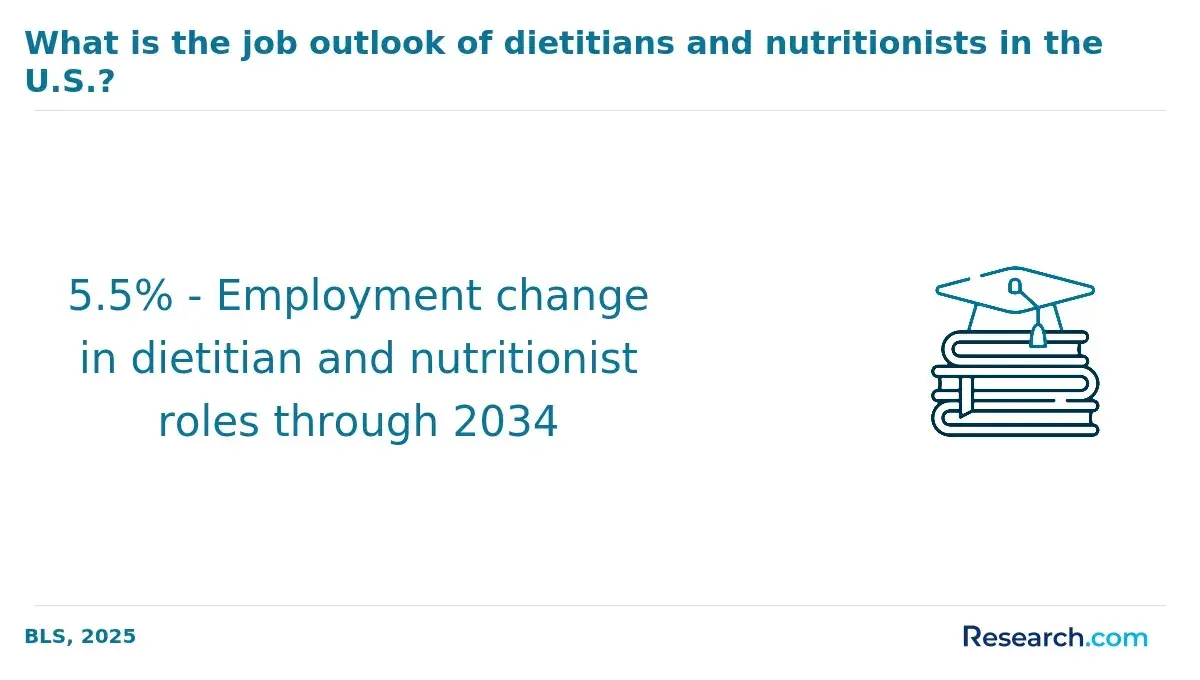
According to recent U.S. Bureau of Labor Statistics data (2024), employment for dietitians and nutritionists is expected to grow 7% from 2023 to 2033. The same source reports an average of approximately 5,600 openings for dietitians and nutritionists each year over the decade.
Demand is connected to healthcare needs, chronic disease prevention, public health initiatives, aging populations, and the role of nutrition in medical care. Registered dietitians/nutritionists often work in hospitals, outpatient clinics, long-term care facilities, community programs, and private practice, where they provide nutrition assessment, counseling, intervention, and education.
Should I consider supplementary courses to enhance my nutrition career?
Supplementary coursework can help if it fills a specific skills gap. For example, nutrition professionals working in healthcare settings may benefit from learning how patient documentation, coding, billing, insurance workflows, and electronic health records function. Students interested in these administrative skills can compare online medical billing and coding classes as a complement to nutrition training.
Supplementary courses are most useful when they support a defined career move. Avoid collecting unrelated certificates without a plan; instead, choose training that improves your ability to work in clinical teams, manage programs, analyze data, counsel clients, or lead community health initiatives.
What are the emerging trends in online nutrition education?
Online nutrition education is changing as programs use more digital tools to teach applied skills. Virtual labs, case simulations, telehealth-style counseling practice, and interactive assessments can help students practice decision-making even when they are not physically on campus.
Nutrition programs are also placing more emphasis on whole-person health, behavior change, public health, sustainable food systems, and community nutrition. Many online nutrition schools now structure coursework around broader health challenges rather than diet planning alone.
Health technology is another important trend. Wearable devices, digital food tracking tools, remote coaching platforms, and electronic health data are changing how nutrition professionals monitor behavior, communicate with clients, and evaluate progress. Students should look for programs that teach evidence-based use of these tools rather than treating technology as a substitute for clinical judgment.
What certifications or licensure do you need after completing an online master's degree in nutrition?
Certification and licensure requirements depend on your intended role and location. A master's degree can strengthen your qualifications, but it may not automatically allow you to practice as a dietitian or provide regulated nutrition services.
The Certified Nutrition Specialist credential, offered by the Board for Certification of Nutrition Specialists, is one credential commonly associated with advanced nutrition practice. Earning it typically involves a master's degree in nutrition or a closely related field and passing a comprehensive exam.
The Registered Dietitian Nutritionist credential, awarded by the Commission on Dietetic Registration, is one of the most widely recognized credentials for dietetics practice in the United States. Students interested in this path should verify ACEND accreditation, supervised practice requirements, exam eligibility, and state licensure rules before enrolling.
Some states regulate who may use nutrition-related titles or provide medical nutrition therapy. Other areas may have different rules for non-clinical wellness, education, coaching, or community roles. If your goal is to become a nutritionist, review the full pathway for how to become a nutritionist before selecting a program.
Can an affordable online master's degree in nutrition prepare me for integrative and alternative nutrition roles?
An online master's degree in nutrition can support integrative or alternative nutrition work when the curriculum is grounded in evidence-based science, counseling, behavior change, and ethical practice. Students interested in becoming a holistic nutritionist should still verify what services they can legally provide in their state and avoid programs that make unsupported health claims.
The strongest preparation for integrative roles combines nutrition science, communication skills, cultural competence, referral awareness, and a clear understanding of scope of practice.
How do employers view an online master's degree in nutrition?
Employers are most likely to value an online master's degree in nutrition when it comes from an accredited institution, has a rigorous curriculum, and is backed by relevant experience. The format matters less than whether graduates can demonstrate nutrition knowledge, communication ability, ethical judgment, applied skills, and readiness for the role.
Students can strengthen their profile by completing practicums, research projects, supervised experiences, volunteer work, or targeted nutrition courses online that build skills directly tied to their career goals.
Can an online master's degree in nutrition complement other advanced healthcare degrees?
Nutrition intersects with pharmacy, nursing, medicine, public health, behavioral health, and healthcare administration. Students with multidisciplinary interests may use nutrition graduate training to support collaborative care, prevention programs, medication-nutrition awareness, chronic disease management, or community health work.
For some healthcare professionals, nutrition training may complement advanced study in another area, such as a PharmD online program. The key is to choose an educational combination that supports a coherent career path rather than accumulating unrelated credentials.
How can I assess the long-term ROI for my online master's degree in nutrition?
To evaluate return on investment, compare the full cost of the degree with the career outcomes you can realistically pursue. Include tuition, fees, books, technology costs, travel, credentialing exams, supervision expenses, and any income you may lose if you reduce work hours.
Then compare those costs with the roles you want, the credentials required, local job availability, and projected employment trends. If you are trying to build broader clinical support skills, short-term training such as 6 weeks medical assistant programs may be relevant, but only if it supports your specific career plan.
What support services can help me succeed in an online master's program in nutrition?
Strong support services are especially important in online graduate education. Look for academic advising, responsive faculty, technology support, virtual library access, tutoring, writing assistance, career counseling, and help locating field experiences if required.
Students interested in interdisciplinary healthcare careers may also value programs that encourage collaboration across health professions. For example, learning about related paths such as the quickest online PharmD programs can help students understand how nutrition fits within broader clinical and medication-related care teams.
What research opportunities are available in an online master's program in nutrition?
Online master's programs in nutrition may include thesis projects, capstones, applied case studies, literature reviews, data analysis assignments, or faculty-guided research. Students considering doctoral study or research-focused roles should ask whether the program includes a thesis option, statistics training, research mentorship, and opportunities to present or publish work.
Some programs also support interdisciplinary research across nutrition, public health, healthcare delivery, and other health sciences. Students comparing related advanced healthcare education can review options such as top PharmD programs online to understand how nutrition research may connect with medication use, chronic disease, and patient outcomes.
How can I build a professional network through an online master's program in nutrition?
Online students need to be intentional about networking. Use virtual office hours, alumni groups, class discussion boards, professional association events, LinkedIn groups, faculty introductions, and internship contacts to build relationships before graduation.
Networking across healthcare disciplines can also be useful. Interprofessional events, webinars, and student groups may expose nutrition students to pharmacists, nurses, public health professionals, and other providers. Students comparing related credentials, including the quickest online PharmD programs, can use these conversations to better understand collaborative care opportunities.
Common Mistakes to Avoid When Choosing an Online Master's in Nutrition
| Mistake | Why It Can Hurt You | Better Approach |
| Choosing only by tuition | The cheapest listed tuition may not include fees, books, travel, or credentialing costs. | Compare total program cost through graduation. |
| Ignoring accreditation | The degree may not support your desired credential or employer expectations. | Verify institutional and programmatic accreditation before applying. |
| Assuming online means no in-person requirements | Some programs require labs, supervised practice, internships, or campus visits. | Ask for a written list of all in-person and field requirements. |
| Not checking state licensure rules | Nutrition practice rules differ by location. | Review your state's requirements before enrolling. |
| Relying only on rankings | A highly ranked program may not match your career goal, schedule, or credential pathway. | Use rankings as one input alongside accreditation, curriculum, cost, and outcomes. |
| Assuming salary outcomes are guaranteed | Career results depend on location, credentials, experience, employer type, and labor market conditions. | Review job postings in your target area and speak with program alumni when possible. |
References:
- National Association of Colleges and Employers. (2024, January 31). Starting Salaries for Class of 2024 Bachelor’s Graduates Expected to be Flat. https://www.naceweb.org/about-us/press-releases/2024/overall-starting-salaries-for-class-of-2024-bachelors-graduates-expected-to-be-flat
- Hanson, M. (2024, July 16). Cost of Online Education vs. Traditional Education. Education Data Initiative. https://educationdata.org/cost-of-online-education-vs-traditional-education
- Accreditation Council for Education in Nutrition and Dietetics. (2024). Program Enrollment Trends 2000-2024. ACEND Data. https://www.eatrightpro.org/-/media/files/eatrightpro/acend/about-acend/acend-data/program-enrollment-trends.pdf
- U.S. Bureau of Labor Statistics. (2024, May). Occupational Employment and Wage Statistics (OEWS) Profiles. Retrieved January 2026, from https://data.bls.gov/oesprofile/
- U.S. Bureau of Labor Statistics. (2025, August 28). Occupational projections and worker characteristics. Retrieved January 2026, from https://www.bls.gov/emp/tables/occupational-projections-and-characteristics.htm
- Bureau of Labor Statistics. (2024, August 29). Occupational Outlook Handbook: Dietitians and Nutritionists. U.S. Department of Labor. https://www.bls.gov/ooh/healthcare/dietitians-and-nutritionists.htm
Key Insights
- An affordable online master's in nutrition is best evaluated by total cost, accreditation, credential fit, and practical training requirements—not tuition alone.
- Students pursuing RD/RDN pathways should prioritize ACEND-related requirements and confirm supervised practice, exam eligibility, and state licensure rules before enrolling.
- Online programs can offer strong flexibility for working adults, but students must ask how labs, internships, practicums, research, and networking are handled remotely.
- Program length varies widely, from 8-10 months in accelerated options to 22 months for professional dietetics pathways with more extensive requirements.
- The best program is the one that matches your target role: clinical nutrition, public health nutrition, sports nutrition, nutrition education, food policy, corporate wellness, research, or dietetics.
- Before applying, request written details about accreditation, total cost, transfer credits, financial aid, state eligibility, placement support, and career services.
Other Things You Need to Know About Affordable Online Master's Degrees in Nutrition
In 2027, some of the most affordable and accredited online Master's in Nutrition programs include Eastern Michigan University, Texas Tech University, and Purdue University Global. These programs offer a balance of cost-efficiency and quality education, providing students with a comprehensive understanding of nutrition without the high costs typically associated with graduate education.
Applicants typically need a bachelor's degree in a related field, such as biology or health sciences. Some programs may also require coursework in subjects like biochemistry or physiology. Check specific program requirements to ensure eligibility for 2027 enrollment.


