
2027 Master's Degree Salary

Co-Founder and Chief Data Scientist
Did you know that professionals with a master’s degree can earn nearly $90,000 a year, compared to just $46,700 for those with only a high school diploma? That kind of gap makes graduate study more than just an academic milestone—it’s often a financial turning point.
This article breaks down what master’s degree holders really earn in 2025, highlighting top-paying careers, state differences, tuition costs, and long-term trends. By the end, you’ll know which degrees and industries deliver the strongest salary returns.
Key Things You Should Know About Master's Degree Salary
- A master’s degree significantly boosts earning potential, with median annual salaries around $90,000 compared to roughly $78,000 for bachelor’s holders. This pay bump reflects the advanced skills and specialized knowledge employers are willing to invest in.
- Salary outcomes vary widely depending on the field of study. Roles in healthcare, business, engineering, and technology consistently rank highest, while education and counseling—though rewarding in other ways—tend to offer lower financial returns.
- Location plays a crucial role in master’s-level salaries. For example, nurse practitioners in California average over $177,000, while their peers in Tennessee earn closer to $125,000, showing how geography can shape earning power.
- What is the average salary for someone with a master’s degree in 2027? Average Salary
- How much more does a master’s degree pay compared to a bachelor’s degree? Pay Comparison
- Which master’s degree majors have the highest salaries? Highest Paying Majors
- What industries offer the best pay for master’s degree holders? Best Paying Industries
- How much does experience affect salary for those with a master’s degree? Experience & Salary
- Do salaries for master’s degree holders vary by location or region? Salary by Location
- What are the low, median, and high salaries for master’s degree holders? Low, Median, High Pay
- Is getting a master’s degree worth the cost in terms of salary return? Is getting a master’s degree worth the cost in terms of salary return?
- Do master’s degree holders with a doctorate earn significantly more? Do master’s degree holders with a doctorate earn significantly more?
- What salary trends are expected for master’s degree holders in the next 5–10 years? What salary trends are expected for master’s degree holders in the next 5–10 years?
- Are online master’s degrees as effective as traditional programs in boosting salary outcomes? Are online master’s degrees as effective as traditional programs in boosting salary outcomes?
What is the average salary for someone with a master’s degree in 2027?
The average salary for professionals with a master’s degree in 2025 is approximately $90,324 per year, or about $1,737 per week. This figure stands well above the $77,636 median for bachelor’s degree holders, showing how graduate study continues to deliver a strong financial advantage in today’s workforce. The payoff, however, is not uniform across fields.
Graduates in business and finance, including those with a managerial accounting degree, often earn salaries that exceed the overall master’s-level median due to the high demand for professionals skilled in financial strategy and decision-making. Healthcare careers—such as nurse practitioners, physician assistants, and occupational therapists—also typically surpass the national average, with earnings from about $98,000 to over $133,000.
Meanwhile, education and counseling professionals often fall below the median despite consistent job stability. Geography further affects earnings, with master’s-trained professionals in high-cost regions like California and New York commanding higher salaries than their counterparts in other parts of the country.
For students considering graduate school, these differences matter. Knowing the national average is useful, but understanding how your chosen field and location compare ensures you can realistically weigh tuition costs against long-term financial outcomes.
How much more does a master’s degree pay compared to a bachelor’s degree?
In 2025, holding a master’s degree translates into a meaningful salary premium over a bachelor’s degree. Median annual earnings for master’s degree holders reach $90,324, while those with only a bachelor’s degree earn about $77,636. That gap of nearly $13,000 each year underscores why many professionals pursue graduate study. Over a 30-year career, the additional earnings could total almost $400,000 before accounting for raises, promotions, or inflation adjustments.
For example, specialized programs like a cyber security MBA often lead to even greater income gains. These degrees blend technical expertise with strategic management skills, preparing graduates for leadership roles in one of the fastest-growing, highest-paying sectors of the economy.
The salary gap also varies depending on the field. In business, technology, and healthcare, the earnings boost can be far greater than the national median difference. For example, physician assistants and nurse practitioners—both requiring a master’s—regularly exceed $130,000 annually. By contrast, master’s graduates in social sciences or education may see smaller financial returns. Prospective students must weigh these outcomes against tuition costs, which can range widely depending on the program. For example, some of the cheapest online Masters in Artificial Intelligence still provide access to lucrative tech roles, making them a financially strategic choice.
The chart below illustrates how salaries increase as education levels rise, placing the master’s degree in the middle of the advanced degree spectrum and highlighting its clear advantage over a bachelor’s degree.
Which master’s degree majors have the highest salaries?
Not all master’s degrees lead to the same financial outcomes, and choosing the right major can make a dramatic difference in long-term earning power. In 2025, programs tied to healthcare, technology, business, and engineering consistently deliver the strongest salaries. These fields combine high demand with specialized skills that are difficult to replace, giving graduates a clear edge in the job market.
While technical and STEM fields often dominate salary rankings, specialized business programs—such as a compliance master’s degree—are also gaining traction. These degrees prepare professionals for leadership roles in corporate governance, risk management, and regulatory affairs, where experienced graduates can earn six-figure salaries in industries like finance, healthcare, and manufacturing.
By contrast, majors in fields such as education, creative arts, or communication may offer personal fulfillment but tend to yield lower salaries unless paired with leadership roles or niche expertise. For example, while communications graduates may explore options like the shortest public relations master's degree online, healthcare-focused degrees often command higher median earnings.
Top-paying master’s majors in 2027 include the following.
Computer & Information Research Scientist
Computer and information research scientists push the boundaries of technology by developing new algorithms, creating AI systems, and solving complex computing problems. A master’s degree is critical for most positions, as it provides advanced training in machine learning, programming, and data modeling. Many also work in cutting-edge research environments where advanced credentials are a requirement. With a median annual salary of $140,910, this field is one of the highest-paying master’s-level careers, reflecting the demand for expertise in emerging technologies.
Physician Assistant (PA)
Physician assistants are licensed medical providers who conduct exams, order diagnostic tests, and prescribe treatments under a physician’s supervision. The role demands a master’s degree for licensure, ensuring PAs gain the clinical, pharmacological, and diagnostic skills necessary to deliver high-quality care. Their scope of practice continues to expand as healthcare systems rely more on mid-level providers to meet patient demand. With a median salary of $133,260, PAs represent one of the most rewarding paths for graduate-level healthcare professionals.
Nurse Practitioner (NP)
Nurse practitioners provide comprehensive patient care, from diagnosing conditions to prescribing medication, often working independently in clinics or specialty areas. The master’s degree is a required step to become an NP, equipping graduates with advanced clinical training and leadership skills. In many states, NPs have full practice authority, further increasing their professional autonomy and earning potential. The median annual salary of $132,050 demonstrates the high demand for this role, particularly as the healthcare system addresses provider shortages nationwide.
Network Architect
Network architects design and maintain large-scale computer networks, including cloud infrastructure and enterprise systems. A master’s degree in computer science, information technology, or a related field enhances technical expertise and opens doors to senior-level leadership roles. Graduate training often focuses on systems design, cybersecurity, and project management—skills vital for this profession. Employers value the advanced knowledge master’s holders bring, especially in environments that handle sensitive or large-scale data. The median salary for network architects is $129,840.
Actuary
Actuaries evaluate financial risk using advanced mathematics, probability, and statistical modeling. While entry-level positions may only require a bachelor’s degree, many actuaries pursue a master’s to strengthen their expertise and improve promotion prospects. Graduate study provides a competitive edge in consulting, insurance, and financial services. Master’s-level actuaries are often fast-tracked for leadership positions, where both analytical and managerial skills are needed. The median salary of $125,770 underscores the high value placed on professionals who can quantify uncertainty and risk.
Economist
Economists analyze data, trends, and policies to provide insights into markets, industries, and government decision-making. A master’s degree is often the minimum requirement for research-intensive positions, and it significantly boosts career prospects in academia, think tanks, and finance. The advanced training in econometrics, statistics, and policy analysis prepares graduates for specialized roles that bachelor’s holders cannot access. With a median salary of $124,520, economists demonstrate how advanced education translates into better opportunities and higher pay across diverse industries.
MBA / Finance-Related Majors
Master’s degrees in business administration and finance prepare graduates for leadership in corporate management, consulting, and investment fields. Employers expect advanced skills in strategy, decision-making, and quantitative analysis, all of which are cultivated through graduate training. While salaries vary by industry and role, MBA and finance-related degrees often command six-figure earnings, ranging from $110,000 to $150,000+. These programs remain popular because they combine versatile skills with strong salary potential, offering graduates the chance to advance quickly into executive or specialized financial positions.
Occupational Therapy (OT)
Occupational therapists work with patients recovering from injuries, illnesses, or disabilities to help them regain independence in daily life. A master’s degree is the standard entry credential for the profession, ensuring OTs gain clinical, therapeutic, and patient-focused training. Graduate education provides both the scientific foundation and practical experience necessary to address complex patient needs. With a median salary of $98,340, OTs may not reach the top income levels of other healthcare providers, but they enjoy steady demand and meaningful, hands-on careers.
The chart below highlights three healthcare-focused master’s degrees, showing how their median annual salaries compare, and reinforcing the value of selecting majors aligned with high-paying industries.
What industries offer the best pay for master’s degree holders?
While the value of a master’s degree depends heavily on the chosen field, certain industries stand out for consistently offering the highest salaries to graduate-level professionals. These sectors combine complex skill requirements with high demand, ensuring that employers are willing to pay a premium for advanced training. Healthcare, technology, and finance dominate the list, but specialized areas within business and engineering also provide strong salary opportunities.
For example, mental health professionals with counseling degrees often see competitive pay growth as experience accumulates. The average LPCC salary reflects this trend—experienced licensed professional clinical counselors can earn significantly more in healthcare or hospital settings than in community-based roles, showing how industry choice directly influences long-term earning potential.
By contrast, industries such as education, counseling, or nonprofit management—though rewarding in other respects—rarely match the pay levels of these high-paying sectors. For students weighing tuition costs against future income, targeting one of these industries can make a master’s degree a more profitable long-term investment.
Industries with the best pay for master’s degree holders include:
- Healthcare and Allied Health (e.g., NPs, PAs, OTs) – Median salaries often exceed $100,000 annually.
- Technology and Computer Science – Roles in AI, data science, and cybersecurity regularly top six figures
- Finance and Business Administration – Investment, corporate finance, and MBA-linked positions maintain strong salary levels
- Engineering and Applied Sciences – Specialized engineers and project leaders command competitive pay across sectors
How much does experience affect salary for those with a master’s degree?
Experience is one of the most powerful factors influencing salary for master’s degree holders. While the degree itself provides a higher starting point compared to a bachelor’s, wages tend to climb steadily as professionals gain years in their field. For example, entry-level nurse practitioners may start around $87,000, but those in the top 10 percent can exceed $165,000 once they accumulate advanced clinical expertise.
Similarly, physician assistants move from under $100,000 at the lower end to nearly $182,000 at the 90th percentile. These differences show that a master’s degree opens the door, but career progression and specialization determine just how far earnings can go.
Experience also interacts with industry and role. In healthcare and technology, pay raises can be substantial over time, especially for those who pursue leadership positions or niche specialties. By contrast, in education or counseling, salaries increase more slowly even at the master’s level. Programs such as the most affordable online MHA programs can be especially strategic, since they balance manageable tuition costs with opportunities for salary growth in healthcare administration.
Do salaries for master’s degree holders vary by location or region?
Yes, salaries for master’s degree holders vary considerably depending on where you live and work. States with higher costs of living or concentrated demand for skilled professionals often pay more, while others with lower costs or smaller labor markets may lag behind. For example, healthcare roles illustrate this gap clearly: nurse practitioners, physician assistants, and occupational therapists see sharp differences in earnings from one state to another.
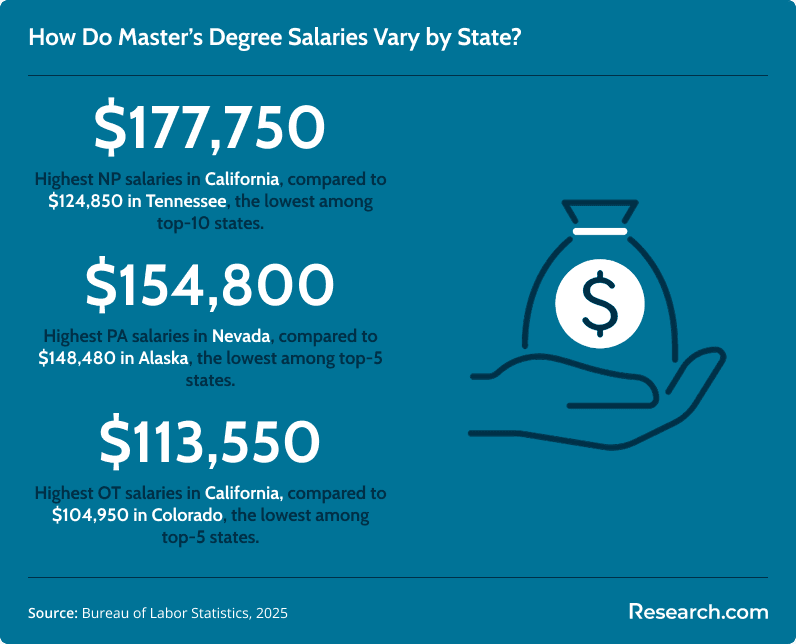
- In California, nurse practitioners average nearly $178,000, far higher than the $125,000 earned in Tennessee.
- Occupational therapists also earn a premium in California at $113,550, while those in Colorado see closer to $105,000.
- Physician assistants in Nevada average $154,800, while Alaska sits at $148,480.
These figures highlight why professionals considering a master’s degree should factor in geography alongside tuition and career path. Beyond healthcare, similar location-based disparities exist in finance, tech, and education. If you are exploring options such as what can you do with a Masters in Human Services, recognizing these regional differences will help you plan where your skills are most valued.
The infographic below highlights these state-by-state differences, making clear how much geography can influence the return on investment for a master’s degree.
What are the low, median, and high salaries for master’s degree holders?
Master’s degree salaries vary not only by field but also by experience and skill level, which is reflected in percentile wage data. At the lower end, entry-level roles or positions in less lucrative regions may offer salaries close to those of bachelor’s holders. However, median earnings demonstrate the overall financial edge of advanced degrees, while the top percentile shows the potential for significant rewards as professionals gain expertise and seniority.
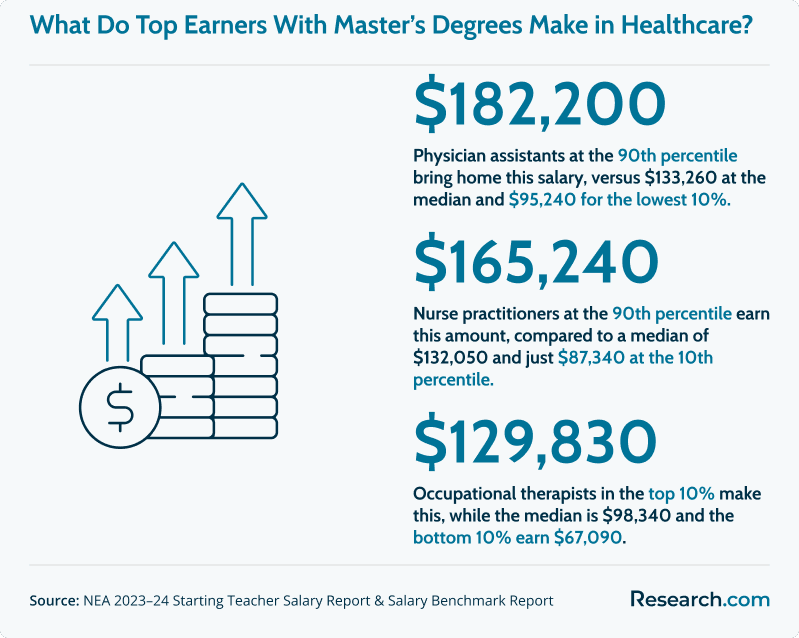
- For nurse practitioners, the spread is clear: the lowest 10 percent earn about $87,340, while the median is $132,050, and the top 10 percent bring in around $165,240.
- Occupational therapists at the 10th percentile earn roughly $67,090, compared to a median of $98,340 and a top range of $129,830.
- Physician assistants follow a similar pattern, with the lowest 10 percent making $95,240, median salaries at $133,260, and the 90th percentile reaching $182,200.
For other sectors, such as education, the gaps may be narrower, which is why exploring options like a Masters in Education online is useful to understand realistic earning ranges.
The infographic below highlights these percentile comparisons, showing how salaries rise from the lower end to the highest earners among master’s-level healthcare professionals.
Is getting a master’s degree worth the cost in terms of salary return?
Whether a master’s degree is worth the investment depends largely on tuition costs, career path, and long-term salary potential. In 2025, master’s degree holders earn about $90,324 annually, nearly $13,000 more each year than those with only a bachelor’s. That difference compounds over decades, often exceeding the total tuition cost of most programs.
Healthcare programs like nurse practitioner, physician assistant, and occupational therapy illustrate strong returns. With salaries often ranging between $98,000 and $133,000, graduates can repay their educational investment in just a few years, even when attending higher-cost schools.
Conversely, fields such as education or social sciences may require more time to offset tuition, especially at private institutions with out-of-state rates above $40,000 annually. Still, many graduates pursue these paths for job stability, professional fulfillment, or advancement opportunities, making salary only part of the equation.
The chart below compares average tuition for key master’s programs, offering context for evaluating how upfront costs align with expected salary outcomes across different career paths.
Do master’s degree holders with a doctorate earn significantly more?
Doctoral and professional degrees often signal the highest level of academic achievement, but the salary jump over a master’s degree is not always as large as expected. In 2025, master’s degree holders earn a median of $90,324 annually, compared to $109,668 for doctoral graduates and $114,712 for professional degree holders. This reflects a difference of about $19,000 between master’s and doctorate holders, and just $5,000 more for those with a professional degree compared to a doctorate.
Yet, this gap varies widely depending on the field. In academia and research, a doctorate is often required to access higher-paying tenured positions, while in healthcare, fields like nurse practitioners and physician assistants cap out at the master’s level but still command six-figure salaries. Conversely, occupational therapists with doctoral credentials do not earn significantly more than those with master’s degrees.
Ultimately, while a doctorate can increase earnings, the added years of study and higher tuition must be weighed carefully. For many professions, the master’s degree alone already delivers strong salary outcomes and faster returns on investment.
What salary trends are expected for master’s degree holders in the next 5–10 years?
Looking ahead, salaries for master’s degree holders are projected to grow steadily over the next decade, though at different rates depending on industry.
- Healthcare roles like nurse practitioners, physician assistants, and occupational therapists are expected to see the most consistent wage increases due to expanding demand from an aging population and ongoing shortages of qualified providers.
- Technology fields such as artificial intelligence, cybersecurity, and data science are also predicted to maintain strong growth, with many roles already surpassing six-figure salaries at the master’s level.
In education and social services, salary growth will likely be slower. While advanced credentials can lead to incremental increases, the return is modest compared to fields with higher labor shortages or specialized expertise. For example, teachers pursuing the easiest masters degree for teachers may see raises tied to district pay scales, but the boost will not match the jumps observed in healthcare or tech.
Overall, the next 5–10 years suggest continued strong financial returns for master’s-level graduates, especially in sectors where demand and specialization intersect. Those evaluating programs should consider not just current salaries but how earnings will grow over time.
Here's What Graduates Have To Say About Their Master's Degree Salary
- Marian: "Earning my master’s online while working full-time gave me flexibility and a clear financial payoff. My salary jumped nearly $15,000 within the first year of graduating. It felt rewarding to see my effort translate so quickly into stability for my family."
- Daria: "I worried about debt, but the online format kept costs manageable and allowed me to keep earning. Within two years, my new salary made tuition feel like a small investment compared to the opportunities it unlocked in my career."
- Elric: "What surprised me most was how employers valued the online degree equally to a traditional one. The promotion I earned came with a significant raise, and now I’m in a leadership role I never thought I’d reach this soon."
Are online master’s degrees as effective as traditional programs in boosting salary outcomes?
Research indicates that online master’s programs have evolved into credible alternatives to their traditional counterparts, offering competitive career and salary advancement opportunities. Employers increasingly recognize the rigor and flexibility of such formats, particularly when graduates demonstrate relevant hands‐on experience and industry-specific skills. Accredited online programs provide curricula that mirror conventional offerings, ensuring that graduates possess the analytical and leadership abilities needed in competitive fields. Additionally, with reduced overhead and innovative delivery methods, students may access the best online degree options that combine quality education with cost efficiency, ultimately contributing to a favorable return on investment.
Key Findings
- Master’s degree holders earn a median annual salary of $90,324, about $13,000 more than bachelor’s degree holders.
- Nurse practitioners earn a median of $132,050, physician assistants $133,260, and occupational therapists $98,340.
- Top 10% of physician assistants earn $182,200, compared to $95,240 for the bottom 10%.
- Tuition costs vary widely, from $12,268 in-state for occupational therapy to $45,010 out-of-state for nurse practitioner programs.
- California offers the highest NP salaries at $177,750, while Tennessee is lowest among top states at $124,850.
- Doctorate holders earn a median of $109,668, just $19,000 more than master’s degree holders.
References:
- Bureau of Labor Statistics. Nurse Anesthetists, Nurse Midwives, and Nurse Practitioners.
- Bureau of Labor Statistics. Occupational Therapists.
- Bureau of Labor Statistics. Physician Assistants.
- Bureau of Labor Statistics. Occupational Therapists.
- Bureau of Labor Statistics. Physician Assistants.
- Bureau of Labor Statistics. Nurse Practitioners.
- CollegeTuitionCompare. Nurse Practitioner – Adult Best Schools.
- CollegeTuitionCompare. Nurse Practitioner – Family Best Schools.
- CollegeTuitionCompare. Occupational Therapy/Therapist.
- CollegeTuitionCompare. Physician Assistant.
- EducationData.org. Educational Attainment Statistics.
- Zippia. Nurse Practitioner Education Requirements.
- Zippia. Nurse Practitioner Salaries.
- Zippia. Occupational Therapist Education Requirements.
- Zippia. Occupational Therapist Salaries.
- Zippia. Physician Assistant Education Requirements.
- Zippia. Physician Assistant Salaries.
Other Things You Should Know About Master's Degree Salary
In 2027, individuals with a master's degree typically see a salary increase of about 15-30% over those with only a bachelor's degree. This increase depends on the field of study, industry, and location, reflecting the advanced skills and expertise gained through postgraduate education.
A master's degree can increase your salary significantly. On average, individuals with a master's degree earn approximately 20% more than those with a bachelor's degree. However, the exact increase varies based on the field of study, industry, and geographic location.
Yes, healthcare and technology master’s degrees tend to hold strong salary value even during economic downturns. Roles such as nurse practitioners, physician assistants, and data scientists are tied to essential services and innovation, which maintain steady demand regardless of broader market changes, protecting salaries from major fluctuations.


