
2027 MBA in Cybersecurity: Courses, Career Paths & Job Outlook

Co-Founder and Chief Data Scientist
According to the World Economic Forum’s (WEF) 2025 report on global cybersecurity, 15% of organizations in North America lack confidence in their country’s ability to respond to major cyber incidents targeting critical infrastructure. As cyber threats become more frequent and sophisticated, the demand for business leaders with specialized cybersecurity knowledge has never been higher.
An MBA in cybersecurity is designed to meet this critical need, merging traditional business acumen with cutting-edge expertise in digital defense. Graduates emerge uniquely qualified to navigate the complex intersection of technology and enterprise risk, positioning themselves for influential roles that protect an organization's most valuable assets.
In this article, I'll walk you through the benefits of pursuing an MBA in cybersecurity and the possibilities you can look forward to as you pursue this specialization.
What are the benefits of getting an MBA in Cybersecurity?
- Professionals with cybersecurity expertise and leadership skills often see strong salary growth, with chief information security officers (CISOs) earning a median salary of over $124,910 per year in the U.S.
- Cybersecurity job opportunities are expanding rapidly, with the U.S. Bureau of Labor Statistics projecting a 29% growth rate for information security analysts and similar roles.
- An MBA in cybersecurity equips professionals to bridge the gap between technical teams and executive leadership, allowing them to influence critical decisions and protect organizations at the highest level.
- What is an MBA in Cybersecurity, and how does it differ from a Master's in Cybersecurity? MBA vs Master's
- Can you apply to MBA in Cybersecurity programs even without a background in cybersecurity? Admission Requirements
- What courses are included in an MBA in Cybersecurity program? What courses are included in an MBA in Cybersecurity program?
- What are the common specializations offered within an MBA in Cybersecurity? Specializations
- What are the most important business skills taught in MBA Cybersecurity programs? What are the most important business skills taught in MBA Cybersecurity programs?
- Do MBA Cybersecurity programs include preparation for industry certifications? Certifications
- What are the career paths for an MBA in Cybersecurity graduate? Career Paths
- What is the current job outlook for cybersecurity professionals with an MBA? Job Outlook
- What is the average salary for MBA in Cybersecurity graduates? Average Earnings
- How can I finance my MBA in Cybersecurity? How can I finance my MBA in Cybersecurity?
- What are the next big trends in cybersecurity that leaders need to be aware of? What are the next big trends in cybersecurity that leaders need to be aware of?
What is an MBA in Cybersecurity, and how does it differ from a Master's in Cybersecurity?
An MBA in Cybersecurity is a professional degree that combines core business administration principles with a specialized focus on cybersecurity. It's designed for individuals who want to take on leadership, management, and strategic roles, applying cybersecurity knowledge from a business perspective.
Unlike a traditional master’s in cybersecurity, which focuses heavily on technical skills such as network defense, ethical hacking, and digital forensics, a construction management MBA–style cybersecurity program emphasizes decision-making, policy development, and risk management at the organizational level. This blend of business strategy and technical understanding prepares graduates to oversee cybersecurity teams, manage budgets, and align security initiatives with overall business goals.
Key Differences Between an MBA in Cybersecurity and a Master's in Cybersecurity
While both degrees are graduate-level and focus on cybersecurity, their core purposes and curricula are fundamentally different.
Master's in Cybersecurity
- This is a technical and academic degree.
- It is designed for students who want to become technical experts and practitioners in the field.
- The focus is on the how—how to build secure systems, perform penetration testing, and conduct digital forensics.
- The target audience is often professionals who are already in IT or computer science and want to deepen their technical skills.
MBA in Cybersecurity
- This is a strategic and business-oriented degree.
- It is for professionals who want to lead and manage cybersecurity teams and initiatives.
- The focus is on the why and what—why security matters to the business, what the financial and operational risks of a breach are, and what policies and strategies should be implemented.
- The target audience includes a diverse range of professionals, from those with a technical background to those in finance, law, or operations who want to move into a leadership role within the security field.
In summary, the MBA in Cybersecurity equips students for strategic leadership and business integration roles, while the Master’s in Cybersecurity hones technical expertise for tactical cybersecurity roles. The choice depends largely on whether one seeks a management track or a highly technical specialization.
If you do decide to enroll in an MBA program, I suggest choosing one that is accredited by the Association to Advance Collegiate Schools of Business (AACSB).
AACSB accreditation is widely recognized as the gold standard for business schools, ensuring rigorous academic quality, a strong curriculum, experienced faculty, and a global reputation.
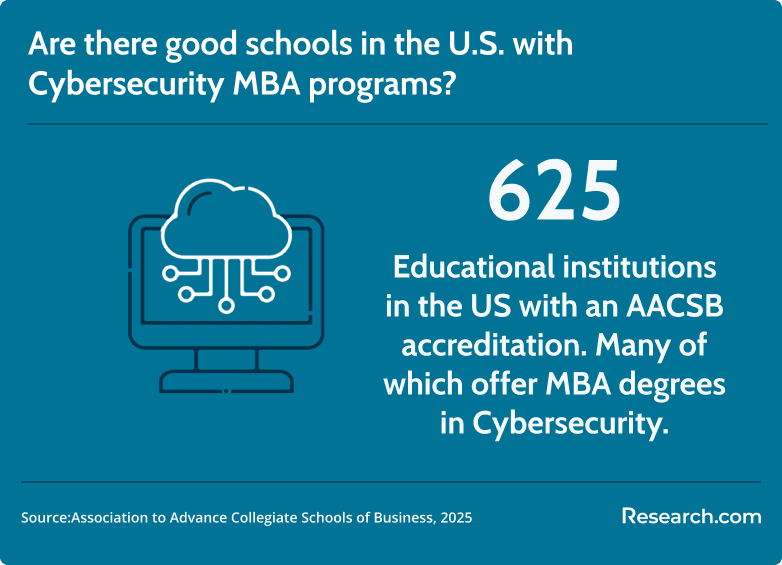
According to 2025 AACSB data, 625 educational institutions in the United States are members of the Association to Advance Collegiate Schools of Business. Many of these schools offer online MBA programs in cybersecurity, providing even more flexibility and accessibility to potential students.
Can you apply to MBA in Cybersecurity programs even without a background in cybersecurity?
Generally, students can apply to MBA in cybersecurity programs even without a prior background in cybersecurity. Most programs are designed for professionals with diverse educational and career experiences, and they emphasize business management as much as cybersecurity fundamentals.
This flexibility makes the degree accessible to candidates from business, engineering, or even social science backgrounds who want to transition into cybersecurity leadership. While having technical experience can be helpful, it’s not required—many schools offer foundational courses that bring all students up to speed.
However, applicants should still demonstrate strong analytical and problem-solving skills, since these are crucial for managing cybersecurity operations and understanding how much a licensed professional clinical counselor earns compared to leaders in this high-demand field.
- A bachelor’s degree in any field
- Two to five years of work experience, often in business, tech, or related fields
- A resume highlighting professional experience, which does not necessarily have to be cybersecurity-related
- A statement of purpose or essay, explaining career goals and fit for the program
- Some programs may require GMAT scores, but many offer waivers based on GPA, prior advanced degrees, or managerial work experience
- Some universities may also offer bridge or foundation courses to help students without technical backgrounds catch up on cybersecurity basics
If you prefer to gain prior training and education before you apply for an MBA in this specialization, look into fast track online cybersecurity bachelor's degree programs.
What courses are included in an MBA in Cybersecurity program?
An MBA in Cybersecurity program includes two main types of courses: core business courses and specialized cybersecurity courses. This blend is what makes the degree unique, as it develops both strategic management skills and a specific understanding of digital security.
Students typically study topics such as risk management, network security, data analytics, leadership, and organizational strategy. Courses like cybersecurity policy, digital forensics, and information assurance prepare graduates to manage large-scale security initiatives.
Much like COAMFTE accredited online programs ensure academic quality for counseling degrees, accredited cybersecurity MBA programs uphold rigorous standards that align business strategy with modern security challenges.
Core Business Courses
These foundational courses are standard for any Master of Business Administration program. They provide the essential knowledge needed to manage an organization effectively. They teach students how to think like a business leader, handle financial decisions, and lead teams.
- Financial and Managerial Accounting: Teaches students how to read and analyze financial statements and use accounting information for internal decision-making and budgeting.
- Corporate Finance: Focuses on financial forecasting, capital budgeting, risk evaluation, and corporate valuation.
- Organizational Behavior and Leadership: Covers topics such as human resource management, organizational structure, team dynamics, and effective leadership strategies.
- Marketing Management: Teaches principles of market analysis, competitive strategy, and the development of marketing plans.
- Strategic Management: Focuses on developing long-term business strategies, analyzing competitive landscapes, and making high-level decisions.
Specialized Cybersecurity Courses
These courses are the concentration of the degree. They apply business principles directly to the field of cybersecurity, preparing students for leadership roles where they will manage risk, policy, and strategy rather than just technical functions.
- Cybersecurity Risk Management: Explores how to identify, assess, and mitigate cyber risks from a business perspective.
- Cybersecurity Governance, Risk, and Compliance (GRC): Focuses on the policies, standards, and legal frameworks that govern cybersecurity within an organization.
- Cybersecurity Policy and Planning: Teaches students how to develop and implement comprehensive security policies, incident response plans, and disaster recovery strategies.
- Information Security Management: Covers the administration and management of an organization's security infrastructure, including technical controls and security operations.
- Secure Network Design: While not as technical as a master's program, this course covers the fundamentals of designing a secure network architecture from a management perspective.
You may also have to complete a cybersecurity strategy project or consulting practicum and participate in internships or simulations, applying both business and security knowledge.
Do you need to learn coding in MBA in cybersecurity programs?
In most MBA in Cybersecurity programs, learning coding is generally not required. These programs focus more on management, strategy, risk assessment, and leadership skills related to cybersecurity rather than deep technical programming. While some concepts like encryption protocols or data extraction might be covered, they do not typically require coding proficiency.
Many cybersecurity roles, especially managerial and executive positions that MBA grads target, do not demand coding skills but rather an understanding of cybersecurity principles and how to align them with business goals. Learn more about how much coding is involved in cyber security in our helpful guide.
What are the common specializations offered within an MBA in Cybersecurity?
Some MBA in Cybersecurity programs offer specialized concentrations to help students tailor their education to a specific area of interest within the broader field.
While the core curriculum focuses on foundational business principles and security management, these specializations allow for a deeper dive into a particular domain. Much like a compliance master’s degree emphasizes specialized knowledge in risk and regulatory frameworks, cybersecurity MBA concentrations prepare graduates for leadership in targeted sectors such as:
- Cybersecurity Executive Leadership and Governance: Focuses on developing leadership skills to manage cybersecurity teams and projects, strategic risk management, and aligning security initiatives with business goals.
- Network Security Architecture: Covers designing and managing secure enterprise networks with firewalls, intrusion detection/prevention systems, and access control.
- Project Management in IT Security: Emphasizes planning, executing, and managing cybersecurity projects, including resource allocation, risk management, and budgeting.
- Ethical Hacking and Threat Modeling: Teaches skills to identify vulnerabilities, simulate attacks, and use threat modeling to protect systems.
- Digital Forensics and Incident Response: Focuses on investigating security breaches and managing incident response.
- Cloud Security: Deals with securing cloud environments, risk management, secure cloud architecture, and regulatory compliance.
- Cybersecurity and Organizational Resilience: Combines risk management, incident response, data privacy, and business continuity to prepare students for comprehensive cybersecurity leadership roles.
The State of Cybersecurity 2025 report from the Computing Technology Industry Association (CompTIA) highlights how organizations now recognize the need for highly specialized professionals within their internal cybersecurity teams.
Moreover, 53% of these companies are willing to hire such specialists, while 56% plan to train their cybersecurity workforce to close skill gaps.
As such, this can be a good time to obtain the training and education that equips you with specialized knowledge and skills in this line of expertise, whether that is through a cybersecurity MBA or other program.
Which MBA in Cybersecurity specialization is best?
In order to answer this question, it may be best to consider which cybersecurity specialized skills are sought after among prospective employers.
Based on data from the CompTIA report, there is a significant need for these cybersecurity skills within organizations:
What are the most important business skills taught in MBA Cybersecurity programs?
The most important business skills taught in an MBA in Cybersecurity program are those that enable a professional to bridge the gap between technical security teams and the broader business strategy.
The degree is fundamentally about teaching you to speak the language of business while understanding the critical importance of cybersecurity. The key business skills taught include:
- Strategic Management and Leadership: Guiding teams, setting security priorities, and aligning cybersecurity with overall business goals.
- Financial and Risk Analysis: Understanding the cost of cyber threats, budgeting for security, and managing enterprise risk.
- Communication and Stakeholder Engagement: Explaining complex cyber issues in clear terms to executives, boards, and non-technical teams.
- Policy, Governance and Compliance: Navigating legal frameworks, industry standards, and international regulations.
- Decision-Making Under Pressure: Managing incident response, crisis communication, and business continuity.
What skills will be most valuable for cybersecurity leaders in the next decade?
In the coming decade, the most valuable skills for business graduates who are also aspiring cybersecurity leaders will be those that adapt to a rapidly evolving technological and geopolitical landscape.
1. Cybersecurity in a Cloud-First World
As more businesses migrate their operations to the cloud, leaders must become experts in managing the unique risks associated with cloud environments.
This includes understanding the shared responsibility model, securing data in multi-cloud environments, and integrating security into DevOps practices.
2. AI and Machine Learning Governance
The next wave of cyber threats will be driven by AI, and so will the defenses against them.
The 2025 WEF report on global cybersecurity reveals that 66% of organizations view AI and machine learning technologies, including generative AI, malicious use of AI, and AI-driven detection and response, as the most significant vulnerability that can affect cybersecurity in the next year.
Future cybersecurity leaders must have a strategic understanding of how to utilize AI for threat detection and anomaly analysis, as well as how to manage the new security risks and ethical considerations that AI systems themselves present.
3. Business Agility and Resilience
The ability to adapt to new and unknown threats is paramount. Future leaders must build a "resilient" organization—one that can not only defend against attacks but also recover quickly and effectively when a breach inevitably occurs.
This requires agile decision-making, crisis management skills, and a forward-looking mindset that anticipates future threats.
Such skills are in demand in today’s security-conscious world, and obtaining them can give you a competitive edge as you seek employment after graduating from your MBA in cybersecurity degree.
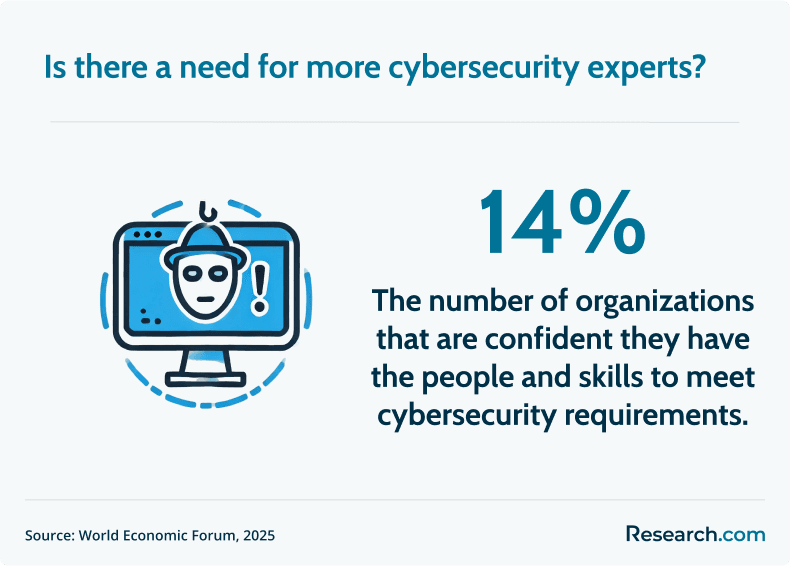
Industry reports highlight how organizations are struggling with a shortage in critical cyber talent. According to the World Economic Forum, only 14% of organizations are confident they have the people and skills they need today to meet their cybersecurity needs.
Additionally, two out of three organizations reported a moderate to critical skills gap to meet their security requirements.
Furthermore, the cyber skills gap has increased by 8% since 2024. MBA in cybersecurity graduates can be key figures in addressing these needs and shortages.
Do MBA Cybersecurity programs include preparation for industry certifications?
Many MBA in Cybersecurity programs include coursework that overlaps with the knowledge needed for major industry certifications. While not all schools directly embed certification training, the curriculum in areas like risk management, information security, and governance often prepares students to sit for exams.
Some colleges and universities often align their curricula with these certifications, include course content directly preparing students for certification exams, and sometimes offer transfer credits for earned certifications. If you are interested in the last pathway, get to know your options for the best online colleges that accept transfer credits.
What are some of the best certifications to pair with an MBA in Cybersecurity?
Pairing an MBA with the right certification creates a powerful combination of strategic leadership and verified technical knowledge. The best certifications to choose depend on your career goals, with some being more focused on management and others on technical expertise.
- Certified Information Systems Security Professional (CISSP): Recognized globally, it validates expertise in managing cybersecurity programs and policies, ideal for leadership roles.
- Certified Ethical Hacker (CEH): Focuses on ethical hacking techniques and understanding cyber threats, complementing the technical foundation.
- Certified Information Security Manager (CISM): Emphasizes managing and governing enterprise cybersecurity programs, aligning well with MBA leadership training.
- Certified Network Defender (CND): Concentrates on network security administration and defense.
- Certified Cloud Security Professional (CCSP): Specialized in securing cloud environments, relevant as many businesses shift to cloud infrastructure.
- Certified Information Security Manager (CISM): This is perfect for executives as it focuses on governance, risk, and compliance.
- CompTIA Security+: A strong foundational certification, especially for those without prior technical training.
If your chosen MBA in cybersecurity program does not offer certification tracks or the one you prefer, I would recommend online cyber security bootcamp programs as viable alternatives. Just take note that these bootcamps tend to be intensive and fast track, so make sure you are prepared to focus on your learning for the number of weeks or months required to complete the program.
To give you more information on the best certifications to pair with your MBA in cybersecurity, my team and I looked into the most sought-after credentials in the industry. Using the latest workforce data from Cyberseek, here are the number of job openings requesting cybersecurity-related certifications:
- CISSP - 82,494
- CompTIA Security+ - 70,019
- CISA - 52,337
- CISM - 44,347
- GIAC - 41,070
- CIPP - 7,590
What are the career paths for an MBA in Cybersecurity graduate?
Graduates with an MBA in Cybersecurity can pursue diverse career paths that blend technical security expertise with business leadership. Common roles include:
- Chief Information Security Officer (CISO): A C-suite executive responsible for a company's entire information security program, including the development and implementation of security strategies, policies, and budgets.
- Cybersecurity Consultant: Advises organizations on risk management, compliance, and best practices.
- IT Director or Manager: Leads IT teams while integrating strong cybersecurity protocols into operations.
- Risk and Compliance Manager: Ensures organizations meet regulatory standards and manage cyber risk effectively.
- Data Privacy Officer: Focuses on policies and frameworks that protect sensitive customer and organizational data.
- Cybersecurity Project Manager: Leads cybersecurity initiatives, deployments, and technology implementations.
- Security Operations Director: Oversees monitoring, incident response, and infrastructure defense at the organizational level.
- Security Architect: While a technical role, a security architect with an MBA is well-suited to design security systems that are not only robust but also scalable and aligned with business needs.
- Cybersecurity Entrepreneur: Start or manage businesses focused on cybersecurity products or services.
These roles capitalize on the MBA's focus on strategic leadership, risk analysis, financial management, and regulatory compliance, preparing graduates for leadership and high-impact positions in cybersecurity across sectors.
Here are the top industries that consider networks and cybersecurity as an increasingly important skill:
What is the current job outlook for cybersecurity professionals with an MBA?
The job outlook for cybersecurity professionals with an MBA is exceptionally strong and is projected to remain so for the foreseeable future.
- Data from AACSB shows that 69% of MBA graduates in 2023-2024 accepted a job by graduation, 14% did so within three months, while 6% said they got employed between three to six months after graduating, indicating a high chance of finding employment after completing their degree.
- Cyberseek reports that the national cybersecurity workforce in the United States meets only 74% of the demand as of 2025.
- Additionally, there are more than 500,000 job openings for cybersecurity-related positions.
- Data from CompTIA shows that 78% of organizations cite cybersecurity as a high priority.
- Furthermore, employment of cybersecurity analysts and engineers is projected to grow 267% over the next ten years.
- According to the World Economic Forum, 25% of employers listed networks and cybersecurity as a top core skill in 2025.
- WEF also reports that 61% of employers chose leadership and social influence as a top core skill, giving MBA degree holders who are trained as leaders an advantage when seeking employment.
- Finally, AI and big data (87%), networks and cybersecurity (70%), and technological literacy (68%) were listed as the top three fastest growing skills from 2025 to 2030.
Companies are increasingly recognizing that security is not just a technical issue but a core business function that requires high-level, strategic leadership. This could be why there are so many cybersecurity job openings, particularly those related to oversight, governance, implementation, and operation.
Graduates with an MBA in Cybersecurity will be well-positioned to fill high-level roles that require risk management, regulatory compliance, and cross-department communication skills.
To give you a better picture of the employment outlook for cybersecurity experts with MBA degrees, here are the number of job openings for different categories of the cybersecurity workforce:
What is the average salary for MBA in Cybersecurity graduates?
The average salary for a professional with an MBA in Cybersecurity can vary significantly based on their specific job title, years of experience, and location. However, due to the combination of high-demand business skills and specialized cybersecurity knowledge, these graduates generally command a very strong earning potential.
- According to the latest salary data from ZipRecruiter, the average earnings for MBA in Cybersecurity graduates is approximately $132,962 per year in the United States.
- The average hourly wage is about $63.92.
- Top earners in cybersecurity leadership roles can make upwards of $170,000 annually.
- Entry-level roles with cybersecurity specialization generally start at around $70,000 to $100,000 but grow quickly with experience and certifications.
- AACSB reports an average base salary of $118,508 for MBA graduates.
Overall, an MBA in Cybersecurity enhances earning potential by combining advanced business and cybersecurity expertise, positioning graduates well for lucrative leadership roles in the field.
You can get a better comparison on average earnings by checking out our guide that covers cyber security salary with masters degree and more.
How can I finance my MBA in Cybersecurity?
Financing an MBA in Cybersecurity requires careful consideration of tuition costs, availability of financial aid, and emerging cost-effective alternatives. Prospective students should investigate scholarship opportunities specific to cybersecurity management, explore federal and private loan options, and consider employer tuition assistance programs. Evaluating online programs may reveal innovative funding solutions and reduced living expenses. For guidance on budget-friendly alternatives, refer to the cheapest way to get MBA online.
What are the next big trends in cybersecurity that leaders need to be aware of?
In the coming years, cybersecurity leaders will face a landscape defined by an increasing pace of technological change and the evolution of threats. The next big trends will focus on both the new risks presented by cutting-edge tech and the strategic responses needed to build resilience.
- Rise of AI-Powered Threats and Defenses: Cyber attackers are increasingly using AI to launch sophisticated, targeted attacks such as realistic phishing and adaptive malware. Conversely, defenders are adopting AI-driven analytics and automated response systems to detect and neutralize threats faster than traditional methods.
- Expansion of Zero Trust Architecture: The “never trust, always verify” security model is becoming standard practice, especially in hybrid cloud and remote work environments, improving security by continuous verification of users and devices.
- Focus on Cyber Resilience Over Just Prevention: Organizations prioritize rapid recovery and business continuity planning alongside prevention, treating cyber resilience as a board-level issue.
- Critical Infrastructure and IoT Vulnerabilities: Increasing exploitation risks to connected devices in essential sectors like healthcare and manufacturing raise concerns over disruptions to critical services.
- Cloud and Multi-Cloud Security Innovation: As businesses operate across multiple cloud platforms, tools like automated cloud security posture management and runtime protection are gaining importance.
- Human-Centric Security and Awareness: Continuous security training, phishing simulations, and behavior-driven controls help mitigate the risks from human error, which remains the weakest link.
- Evolving Regulatory and Compliance Landscape: Stricter data sovereignty laws, extensive privacy legislation, and international collaboration on cybercrime enforcement will shape compliance requirements.
The CompTIA State of Cybersecurity 2025 report points out that organizations need to focus their efforts to improve their security initiatives. The data shows that these are the top methods companies plan to employ to strengthen their cybersecurity efforts:
- Executive cybersecurity visibility - 43%
- Policy creation/enforcement - 40%
- Dedicated cybersecurity roles - 40%
- Better connection to business - 39%
- Focused reporting structure - 38%
- Better metrics for cybersecurity - 35%
These trends highlight the need for cybersecurity leaders to embrace advanced technologies, holistic resilience strategies, and evolving regulatory frameworks to protect their organizations effectively.
Here’s What Graduates Have to Say About Their MBA in Cybersecurity Degree
- Jordan: "Earning my MBA in Cybersecurity gave me the confidence to move from a technical analyst role into a leadership position. The mix of business strategy and cyber risk management prepared me to make decisions that impact the entire organization."
- Melvin: "Before my MBA, I felt stuck in purely technical work. Now, I not only understand the threats but also how to present solutions in the boardroom and align security with business goals. It completely transformed my career path."
- Trent: "My MBA in Cybersecurity opened doors I never imagined—higher salary potential, international job opportunities, and the ability to lead diverse teams. The program challenged me, but it was the best investment in my future."
Key Findings
- 2025 salary data from ZipRecruiter shows that the average hourly wage for MBA in Cybersecurity graduates is about $63.92.
- Data from AACSB shows that 69% of MBA graduates in 2023-2024 accepted a job by graduation.
- Top earners in cybersecurity leadership roles can make upwards of $170,000 annually.
- Data from CompTIA shows that 78% of organizations cite cybersecurity as a high priority.
- The cyber skills gap has increased by 8% since 2024.
- According to the World Economic Forum, 25% of employers listed networks and cybersecurity as a top core skill in 2025, while 61% of employers chose leadership and social influence.
References:
- Association to Advance Collegiate Schools of Business (2025). 2025 Business School Data Guide. https://www.aacsb.edu/-/media/publications/data-reports/aacsb-data-guide-2025.pdf
- Association to Advance Collegiate Schools of Business (2025). 2025 State of Business Education Report. https://www.aacsb.edu/-/media/publications/research-reports/aacsb-2025-state-of-business-education.pdf
- Cyberseek (n.d.). Cybersecurity Supply And Demand Heat Map. https://www.cyberseek.org/heatmap.html Data Retrieved September 2025
- The Computing Technology Industry Association (March 2024). State of the Tech Workforce. https://lecbyo.files.cmp.optimizely.com/download/fa9be256b74111efa0ca8e42e80f1a8f?sfvrsn=a8aa5246_2
- The Computing Technology Industry Association (2025). State of Cybersecurity 2025. https://lecbyo.files.cmp.optimizely.com/download/877b190ab73b11efb320222b2ad96baf
- World Economic Forum (January 2025). Future of Jobs Report 2025. https://reports.weforum.org/docs/WEF_Future_of_Jobs_Report_2025.pdf
- World Economic Forum (January 2025). Global Cybersecurity Outlook 2025. https://reports.weforum.org/docs/WEF_Global_Cybersecurity_Outlook_2025.pdf
- ZipRecruiter (n.d.). Mba Cybersecurity Jobs (NOW HIRING). https://www.ziprecruiter.com/Jobs/Mba-Cybersecurity Data Retrieved September 2025
Other Things You Need to Know About MBA in Cybersecurity Degrees
A 2027 MBA in Cybersecurity typically includes core courses such as Cyber Risk Management, Information Security Strategy, Emerging Technologies in Cybersecurity, Data Privacy Laws, and Ethical Hacking. These courses aim to equip students with both technical prowess and managerial insight to lead in securing organizational infrastructures.
Admission requirements typically include a bachelor's degree in a related field, a minimum of 2-3 years of professional experience in cybersecurity, a competitive GMAT or GRE score, a statement of purpose, and letters of recommendation. Some programs may also require a personal interview.


